

Base Year Value ()
x.x %
x.x %
CAGR ()
x.x %
x.x %
Forecast Year Value ()
x.x %
x.x %
Historical Data Period
Largest Region
Forecast Period
CRM-Markt im Gesundheitswesen nach Typ (operatives CRM, analytisches CRM, kollaboratives CRM), nach Komponente (Lösung und Dienste), nach Bereitstellungsmodus (Cloud-basiert, vor Ort), nach Anwendung (Marketing, Vertrieb, Kundendienst und -support, CRM-Analyse), nach Endbenutzer (Gesundheitsdienstleister, Kostenträger im Gesundheitswesen, Biowissenschaftsbranche) und Region, globale Trends und Prognose von 2023 bis 2029
Instant access to hundreds of data points and trends
- Market estimates from 2014-2029
- Competitive analysis, industry segmentation, financial benchmarks
- Incorporates SWOT, Porter's Five Forces and risk management frameworks
- PDF report or online database with Word, Excel and PowerPoint export options
- 100% money back guarantee
CRM-Marktübersicht für das Gesundheitswesen
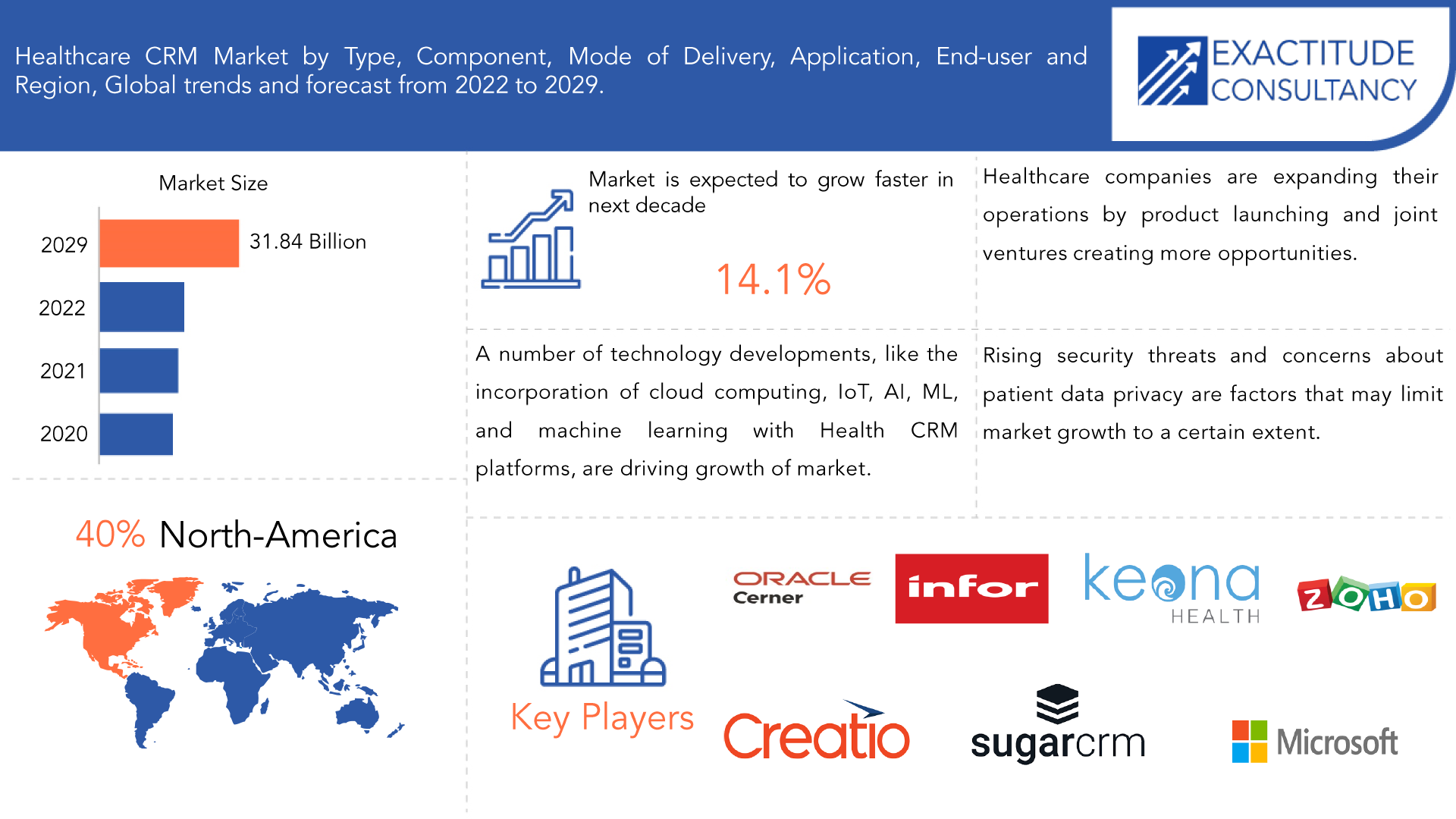
Der Markt für CRM im Gesundheitswesen wird voraussichtlich von 2022 bis 2029 um durchschnittlich 14,1 % jährlich wachsen. Es wird erwartet, dass er von 9,72 Mrd. USD im Jahr 2020 auf über 31,84 Mrd. USD im Jahr 2029 ansteigt.
Client Relationship Manager oder CRM ist eine Klasse kommerzieller Software zur Verwaltung von Kundendienstleistungen. Patienten sind die Kunden im Gesundheitssektor, während Gesundheitsdienstleister das Unternehmen sind. CRMs im Gesundheitswesen werden von Arztpraxen und Gesundheitsorganisationen verwendet, um die Patienteneinbindung zu stärken , den Patientenzugang zu verbessern und die virtuelle Behandlung zu verbessern. Dank gut konzipierter medizinischer CRMs können Anbieter Patienten einfach Online-Telemedizindienste anbieten.
Gesundheits-CRMs werden in der Regel in der Cloud oder vor Ort als operatives, analytisches und kollaboratives CRM eingesetzt. Sie umfassen ein umfassendes Patientenverwaltungssystem, ein Dashboard- und Berichtssystem, Tools zur Pflegeverwaltung und Kommunikationstools. Gesundheits-CRMs werden zur Planung und Nachverfolgung medizinischer Termine verwendet und zeichnen die Patienteninformationen wie Krankengeschichte, Besuche, Rezepte und Arztrechnungen in einem ganzheitlichen Profil auf. Es hilft dabei, eine aktuelle Patientendatenbank mit wertvollen Erkenntnissen zu pflegen und Kunden qualitativ hochwertigen Support zu bieten. Daher werden sie häufig in Krankenhäusern, Kliniken und Diagnosezentren eingesetzt.
| ATTRIBUT | DETAILS |
| Studiendauer | 2020–2029 |
| Basisjahr | 2022 |
| Geschätztes Jahr | 2022 |
| Voraussichtliches Jahr | 2022–2029 |
| Historischer Zeitraum | 2018-2020 |
| Einheit | Wert (MILLIARDEN USD) |
| Segmentierung | Nach Komponente, nach Softwaretyp, nach Funktion, nach Organisationsgröße, nach Region |
| Nach Typ |
|
| Nach Komponente |
|
| Nach Lieferart |
|
| Nach Anwendung |
|
| Nach Endbenutzer |
|
| Nach Region |
|
Um die sich ändernden Trends in den Bereichen Marketing und Kundenbeziehungen zu unterstützen, müssen die entsprechenden Tools und Technologien implementiert werden. Das CRM im Gesundheitswesen umfasst wichtige Komponenten wie integrierte Patientenakten und die Verwendung elektronischer Aufzeichnungen, um verschiedene Funktionen wie Check-in, Patientenabrechnung und Pflege zu ermöglichen, die den Anforderungen und Bedürfnissen der Patienten gerecht werden.
Es wird erwartet, dass der Markt aufgrund der wachsenden Nachfrage der Patienten nach Zugang zu Frühbehandlungen durch häusliche Pflege, virtuelle Pflege, mobile Überwachung und Krankheitsüberwachungsprogramme expandieren wird. Der Ansatz zur Kundenansprache und zu Marketingansätzen wird sich voraussichtlich weiterentwickeln, da sich die Dynamik und Strategien der Krankenhäuser auf der ganzen Welt aufgrund des intensiven Wettbewerbs ändern.
Darüber hinaus wirken eine Reihe von technologischen Entwicklungen wie die Integration von Cloud Computing, IoT, KI, ML und maschinellem Lernen in Health-CRM-Plattformen als zusätzliche wachstumsfördernde Elemente. Durch Chatbots und persönliche Gespräche bieten diese Technologien den Patienten hochwertige virtuelle Pflege, häusliche Pflege und Fernüberwachungsdienste für Krankheiten. Diese Technologien tragen auch dazu bei, den erforderlichen Arbeitsaufwand zu reduzieren, was die Kosteneffizienz verbessert, die Fehlerwahrscheinlichkeit verringert und die Kommunikation verbessert. Andere Faktoren wie steigende Gesundheitskosten für die Allgemeinheit und langwierige Forschungs- und Entwicklungsanstrengungen (F&E) werden voraussichtlich das Marktwachstum vorantreiben.
Einer der Hauptfaktoren, die das Marktwachstum bremsen dürften, sind jedoch die Komplexität und die hohen Kosten der CRM-Anwendung. Darüber hinaus sind zunehmende Sicherheitsbedrohungen und Bedenken hinsichtlich des Datenschutzes von Patienten Faktoren, die das Marktwachstum bis zu einem gewissen Grad einschränken könnten.
Verbesserungen bei Benutzerzufriedenheit, Effizienz und Qualität können durch integrierte Gesundheitsversorgung leichter erreicht werden. Die Integration eines CRM-Systems für das Gesundheitswesen ist ein Konzept, das das Management der Gesundheitsversorgung mit Gesundheitsorganisationen kombiniert, die an Behandlung, Rehabilitation, Gesundheitsförderung und Diagnose beteiligt sind. Mehrere Unternehmen tauchen auf dem CRM-Markt für das Gesundheitswesen auf und erweitern ihre Geschäftstätigkeit durch Produkteinführungen, Übernahmen, Partnerschaften und Joint Ventures.
Die COVID-19-Pandemie hatte erhebliche Auswirkungen auf Gesundheitseinrichtungen. Es bestand ein stetiger und massiver Bedarf an einem integrierten System zur Verwaltung von Arbeitsabläufen und zur Bereitstellung wirksamer Hilfe und Pflege für Patienten auf der ganzen Welt. Der Einsatz von Datentechnologien, Analyse- und Digitalisierungstechnologien hat das IT-Geschäft im Gesundheitswesen stark beeinflusst. Die COVID-19-Epidemie hat die Branchenteilnehmer gezwungen, sich auf Forschung und Entwicklung zu konzentrieren, um den CRM-Markt im Gesundheitswesen zu verbessern und zu innovieren.
[Bildunterschrift id="attachment_14619" align="aligncenter" width="1920"]
Frequently Asked Questions
• What is the total market value of global healthcare CRM market?q
The Global healthcare CRM market size was valued at 9.72 billion in 2020.
• Which market holds the maximum market share of the Global healthcare CRM market?
Based on end user, healthcare providers segment holds the maximum market share of the Global healthcare CRM market in 2020.
• What are the key trends in the global healthcare CRM market?
A rise in aging population, and population suffering from chronic diseases such as heart attack, diabetes, and others are the key trends in the Global healthcare CRM market.
• Who are the key players in the healthcare CRM market?
The Healthcare CRM Market key players include Oracle, Infor, Keona Health, Microsoft, Accenture, Salesforce, Healthgrades, SugarCRM, Influence Health, SAP SE, Creatio, Zoho Corporation and others.
• Which segment accounted for the largest healthcare CRM market share?
Cloud -based Model accounted for the largest share of the Healthcare CRM market by mode of delivery in 2021. The segment includes solutions that help manage data via third-party provider hosts on an as-needed basis with options to scale up or down. The surge in adoption of cloud technologies, rising digitalization across healthcare, and initiatives by key companies are some of the key factors propelling the segment's growth.
Healthcare CRM Market Segment Analysis
The healthcare CRM market is segmented based type, component, mode of delivery, application, end-user and region, global trends and forecast.
By type the market is divided into operational CRM, analytical CRM, and collaborative CRM; by component market is divided into solution and services; by mode of delivery market is divided into cloud-based, on-premise; by application market is divided into marketing, sales, customer service & support, and CRM analytics; by end-user market is divided into healthcare providers, healthcare payers, life sciences industry.
Based on type, the operational CRM segment captured a share of around 56.4% in 2018 and continues to lead the global industry. Operational CRM assists businesses in generating leads, converting leads into contacts, and providing the service infrastructure required to keep consumers. Analytical CRM allows businesses to better comprehend the data collected on consumers and their interactions with the company. Collaborative CRM bridges the information gap between teams and departments to deliver a seamless customer experience.
In terms of component, the software market is expected have the fastest growth with a CAGR of 14.1% during the forecast period.
Based on mode of delivery, the Cloud -based Model held the highest share of the Healthcare CRM market by mode of delivery. The section covers solutions that assist manage data on an as-needed basis through third-party provider hosts with the ability to scale up or down. Some of the primary drivers driving category development include an increase in cloud technology usage, increased digitization across healthcare, and actions by prominent corporations. In 2021, the On-premise Model category maintained a significant market share. Server hardware, software licenses, integration capabilities, and IT workers are examples of components housed in-house within an organization's premises.
With a share of more than 20% in 2021, the sales sector led the worldwide Healthcare CRM market by application. It is also predicted to increase the most rapidly. Marketing and Customer Service and Support, on the other hand, are expected to increase at a rapid pace in the future years. This is due to the existence of multiple CRM systems in the market as well as initiatives implemented by industry participants.
Healthcare providers led the market by end user segment in 2021, accounting for more than 30% of the market. In contrast, the healthcare payer segment is predicted to expand the quickest in the foreseeable future. Payers include insurance companies; providers include hospitals, clinics, and different specialty facilities such as hospice care, long-term care, and life sciences firms such as pharmaceutical, biotechnology, and CROs (CROs). CRM solutions are expected to be more adopted in the Life Sciences Industry market.
[caption id="attachment_14623" align="aligncenter" width="1920"]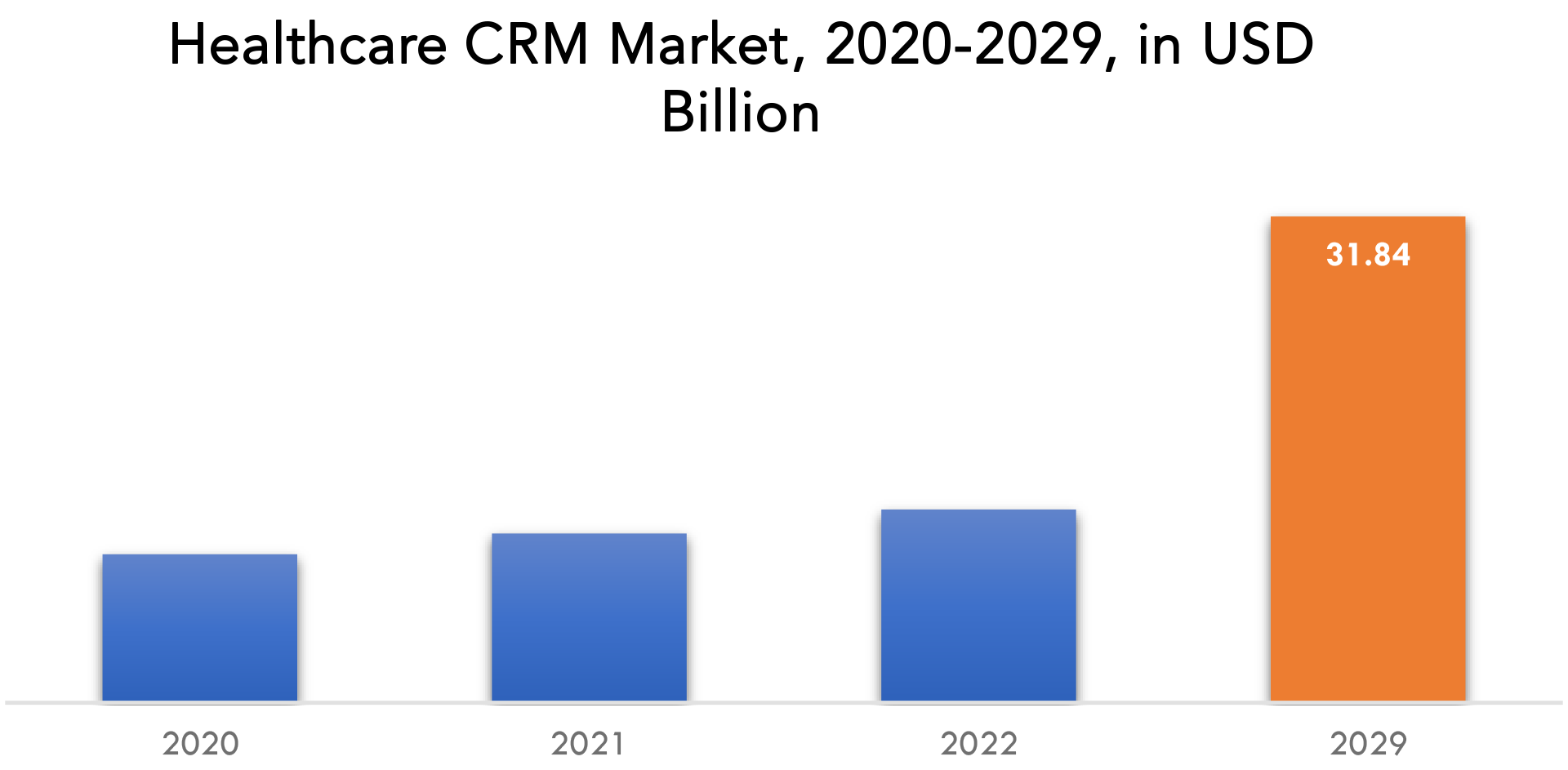
Healthcare CRM Market Key Players
The healthcare CRM market key players include Oracle, Infor, Keona Health, Microsoft, Accenture, Salesforce, Healthgrades, SugarCRM, Influence Health, SAP SE, Creatio, Zoho Corporation, and others.
Recent Developments 24 January, 2023: SugarCRM, an AI-powered CRM platform, has launched new digital self-service capabilities to assist B2B sellers in providing "always-on" brand experiences to their customers. 1 February, 2023: The province of Nova Scotia, in collaboration with the Nova Scotia Health Authority (NSHA) and IWK Health (IWK), announced the signing of a new 10-year agreement with Oracle Cerner to implement an integrated electronic care record across the province for the province's more than one million residents. 19 October 2022 Oracle Helps Healthcare Providers Improve Patient Care with Better Financial and Operational PlanningWho Should Buy? Or Key stakeholders
- Healthcare sector
- Service provider
- Research and development
- IT and telecommunication companies
- Healthcare companies.
- Hospitals, Clinics.
- Regulatory Authorities
- Others
Healthcare CRM Market Regional Analysis
The Healthcare CRM Market by region includes North America, Asia-Pacific (APAC), Europe, South America, and Middle East & Africa (MEA).
- North America: includes the US, Canada, Mexico
- Asia Pacific: includes China, Japan, South Korea, India, Australia, and Rest of APAC
- Europe: includes UK, Germany, France, Italy, Spain, and Rest of Europe
- South America: includes Brazil, Argentina, and Rest of South America
- Middle East & Africa: includes UAE, South Africa, and Rest of MEA
North America dominates the healthcare CRM market, and this trend is projected to continue during the forecast period. The established healthcare system, the rise in chronic illnesses, complex healthcare infrastructure, and the rise in demand for healthcare CRM, among other reasons, are driving the growth of this market in North America. Rising healthcare CRM product exhibits will also lead to greater acceptance of such goods and services, driving market development in North America. Furthermore, growing distribution agreements among major market participants for healthcare CRM distribution would contribute to increased adoption of healthcare CRM in healthcare organisations in the United States.
The Asia Pacific healthcare CRM solutions market will grow at the quickest rate between 2022 and 2029, owing to increased competition among businesses to retain existing clients while also reaching out to new ones. Improving healthcare infrastructure and rapid expansion in the healthcare IT industry will boost market size in Asia Pacific in the next years.
[caption id="attachment_14624" align="aligncenter" width="1920"]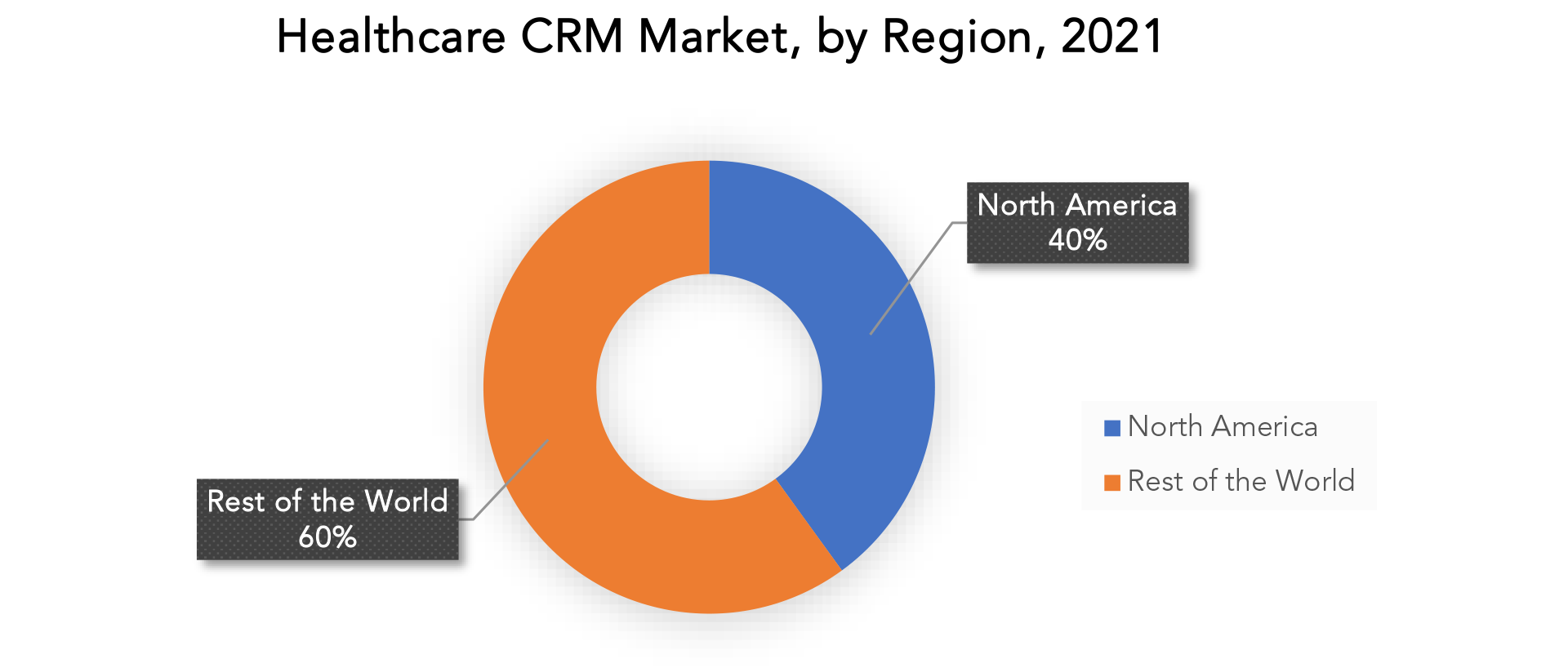
Key Market Segments: Healthcare CRM Market
Healthcare CRM Market by Type, 2020-2029, (USD Billion)- Operational CRM
- Analytical CRM
- Collaborative CRM
- Solution
- Services
- Cloud-Based
- On-Premise
- Marketing
- Sales
- Customer Service & Support
- CRM Analytics
- Healthcare Providers
- Healthcare Payers
- Life Sciences Industry
- North America
- Asia Pacific
- Europe
- South America
- Middle East and Africa
Exactitude Consultancy Services Key Objectives:
- Increasing sales and market share
- Developing new technology
- Improving profitability
- Entering new markets
- Enhancing brand reputation
Key Question Answered
- What is the expected growth rate of the healthcare CRM market over the next 5 years?
- Who are the major players in the healthcare CRM market and what is their market share?
- What are the end-user industries driving demand for market and what is their outlook?
- What are the opportunities for growth in emerging markets such as Asia-Pacific, Middle East, and Africa?
- How is the economic environment affecting the healthcare CRM market, including factors such as interest rates, inflation, and exchange rates?
- What is the expected impact of government policies and regulations on the Healthcare CRM market?
- What is the current and forecasted size and growth rate of the global Healthcare CRM market?
- What are the key drivers of growth in the healthcare CRM market?
- Who are the major players in the market and what is their market share?
- What are the distribution channels and supply chain dynamics in the healthcare CRM market?
- What are the technological advancements and innovations in the healthcare CRM market and their impact on product development and growth?
- What are the regulatory considerations and their impact on the market?
- What are the challenges faced by players in the healthcare CRM market and how are they addressing these challenges?
- What are the opportunities for growth and expansion in the healthcare CRM market?
- What are the service offerings and specifications of leading players in the market?
- EINFÜHRUNG
- MARKTDEFINITION
- MARKTSEGMENTIERUNG
- FORSCHUNGSZEITPLAN
- ASSUMPTIONS AND LIMITATIONS
- RESEARCH METHODOLOGY
- DATA MINING
- SECONDARY RESEARCH
- PRIMARY RESEARCH
- SUBJECT-MATTER EXPERTS’ ADVICE
- QUALITY CHECKS
- FINAL REVIEW
- DATA TRIANGULATION
- BOTTOM-UP APPROACH
- TOP-DOWN APPROACH
- RESEARCH FLOW
- DATA SOURCES
- DATA MINING
- EXECUTIVE SUMMARY
- MARKET OVERVIEW
- GLOBAL HEALTHCARE CRM MARKET OUTLOOK
- MARKET DRIVERS
- MARKET RESTRAINTS
- MARKET OPPORTUNITIES
- IMPACT OF COVID-19 ON HEALTHCARE CRM MARKET
- PORTER’S FIVE FORCES MODEL
- THREAT FROM NEW ENTRANTS
- THREAT FROM SUBSTITUTES
- BARGAINING POWER OF SUPPLIERS
- BARGAINING POWER OF CUSTOMERS
- DEGREE OF COMPETITION
- INDUSTRY VALUE CHAIN ANALYSIS
- GLOBAL HEALTHCARE CRM MARKET OUTLOOK
- GLOBAL HEALTHCARE CRM MARKET BY TYPE (USD BILLION), 2020-2029
- OPERATIONAL CRM
- ANALYTICAL CRM
- COLLABORATIVE CRM
- GLOBAL HEALTHCARE CRM MARKET BY COMPONENT (USD BILLION), 2020-2029
- SERVICE
- SOLUTION
- GLOBAL HEALTHCARE CRM MARKET BY MODE OF DELIVERY (USD BILLION), 2020-2029
- CLOUD-BASED
- ON-PREMISE
- GLOBAL HEALTHCARE CRM MARKET BY APPLICATION (USD BILLION), 2020-2029
- MARKETING
- SALES
- CUSTOMER SERVICE & SUPPORT
- CRM ANALYTICS
- GLOBAL HEALTHCARE CRM MARKET BY END-USER (USD BILLION), 2020-2029
- HEALTHCARE PROVIDERS
- HEALTHCARE PAYERS
- LIFE SCIENCES INDUSTRY
- GLOBAL HEALTHCARE CRM MARKET BY REGION (USD BILLION), 2020-2029
- NORTH AMERICA
- US
- CANADA
- MEXICO
- SOUTH AMERICA
- BRAZIL
- ARGENTINA
- REST OF SOUTH AMERICA
- EUROPE
- GERMANY
- UK
- FRANCE
- ITALY
- SPAIN
- REST OF EUROPE
- ASIA PACIFIC
- INDIA
- CHINA
- JAPAN
- SOUTH KOREA
- AUSTRALIA
- REST OF ASIA PACIFIC
- MIDDLE EAST AND AFRICA
- UAE
- SOUTH AFRICA
- REST OF MIDDLE EAST AND AFRICA
- NORTH AMERICA
- COMPANY PROFILES* (BUSINESS OVERVIEW, COMPANY SNAPSHOT, PRODUCTS OFFERED, RECENT DEVELOPMENTS)
- ORACLE
- INFOR
- KEONA HEALTH
- MICROSOFT
- ACCENTURE
- SALESFORCE
- HEALTHGRADES
- SUGARCRM
- INFLUENCE HEALTH
- SAP SE
- CREATIO
- ZOHO CORPORATION *THE COMPANY LIST IS INDICATIVE
LIST OF TABLES
TABLE 1 GLOBAL HEALTHCARE CRM MARKET BY TYPE (USD BILLION), 2020-2029
TABLE 2 GLOBAL HEALTHCARE CRM MARKET BY COMPONENT (USD BILLION), 2020-2029
TABLE 3 GLOBAL HEALTHCARE CRM MARKET BY MODE OF DELIVERY (USD BILLION), 2020-2029
TABLE 4 GLOBAL HEALTHCARE CRM MARKET BY APPLICATION (USD BILLION), 2020-2029
TABLE 5 GLOBAL HEALTHCARE CRM MARKET BY END-USER (USD BILLION), 2020-2029
TABLE 6 GLOBAL HEALTHCARE CRM MARKET BY REGION (USD BILLION), 2020-2029
TABLE 7 NORTH AMERICA HEALTHCARE CRM MARKET BY TYPE (USD BILLION), 2020-2029
TABLE 8 NORTH AMERICA HEALTHCARE CRM MARKET BY COMPONENT (USD BILLION), 2020-2029
TABLE 9 NORTH AMERICA HEALTHCARE CRM MARKET BY MODE OF DELIVERY (USD BILLION), 2020-2029
TABLE 10 NORTH AMERICA HEALTHCARE CRM MARKET BY APPLICATION (USD BILLION), 2020-2029
TABLE 11 NORTH AMERICA HEALTHCARE CRM MARKET BY END-USER (USD BILLION), 2020-2029
TABLE 12 NORTH AMERICA HEALTHCARE CRM MARKET BY COUNTRY (USD BILLION), 2020-2029
TABLE 13 US HEALTHCARE CRM MARKET BY TYPE (USD BILLION), 2020-2029
TABLE 14 US HEALTHCARE CRM MARKET BY COMPONENT (USD BILLION), 2020-2029
TABLE 15 US HEALTHCARE CRM MARKET BY MODE OF DELIVERY (USD BILLION), 2020-2029
TABLE 16 US HEALTHCARE CRM MARKET BY APPLICATION (USD BILLION), 2020-2029
TABLE 17 US HEALTHCARE CRM MARKET BY END-USER (USD BILLION), 2020-2029
TABLE 18 CANADA HEALTHCARE CRM MARKET BY TYPE (BILLION), 2020-2029
TABLE 19 CANADA HEALTHCARE CRM MARKET BY COMPONENT (USD BILLION), 2020-2029
TABLE 20 CANADA HEALTHCARE CRM MARKET BY MODE OF DELIVERY (USD BILLION), 2020-2029
TABLE 21 CANADA HEALTHCARE CRM MARKET BY APPLICATION (USD BILLION), 2020-2029
TABLE 22 CANADA HEALTHCARE CRM MARKET BY END-USER (USD BILLION), 2020-2029
TABLE 23 MEXICO HEALTHCARE CRM MARKET BY TYPE (USD BILLION), 2020-2029
TABLE 24 MEXICO HEALTHCARE CRM MARKET BY COMPONENT (USD BILLION), 2020-2029
TABLE 25 MEXICO HEALTHCARE CRM MARKET BY MODE OF DELIVERY (USD BILLION), 2020-2029
TABLE 26 MEXICO HEALTHCARE CRM MARKET BY APPLICATION (USD BILLION), 2020-2029
TABLE 27 MEXICO HEALTHCARE CRM MARKET BY END-USER (USD BILLION), 2020-2029
TABLE 28 SOUTH AMERICA HEALTHCARE CRM MARKET BY TYPE (USD BILLION), 2020-2029
TABLE 29 SOUTH AMERICA HEALTHCARE CRM MARKET BY COMPONENT (USD BILLION), 2020-2029
TABLE 30 SOUTH AMERICA HEALTHCARE CRM MARKET BY MODE OF DELIVERY (USD BILLION), 2020-2029
TABLE 31 SOUTH AMERICA HEALTHCARE CRM MARKET BY APPLICATION (USD BILLION), 2020-2029
TABLE 32 SOUTH AMERICA HEALTHCARE CRM MARKET BY END-USER (USD BILLION), 2020-2029
TABLE 33 SOUTH AMERICA HEALTHCARE CRM MARKET BY COUNTRY (USD BILLION), 2020-2029
TABLE 34 BRAZIL HEALTHCARE CRM MARKET BY TYPE (USD BILLION), 2020-2029
TABLE 35 BRAZIL HEALTHCARE CRM MARKET BY COMPONENT (USD BILLION), 2020-2029
TABLE 36 BRAZIL HEALTHCARE CRM MARKET BY MODE OF DELIVERY (USD BILLION), 2020-2029
TABLE 37 BRAZIL HEALTHCARE CRM MARKET BY APPLICATION (USD BILLION), 2020-2029
TABLE 38 BRAZIL HEALTHCARE CRM MARKET BY END-USER (USD BILLION), 2020-2029
TABLE 39 ARGENTINA HEALTHCARE CRM MARKET BY TYPE (USD BILLION), 2020-2029
TABLE 40 ARGENTINA HEALTHCARE CRM MARKET BY COMPONENT (USD BILLION), 2020-2029
TABLE 41 ARGENTINA HEALTHCARE CRM MARKET BY MODE OF DELIVERY (USD BILLION), 2020-2029
TABLE 42 ARGENTINA HEALTHCARE CRM MARKET BY APPLICATION (USD BILLION), 2020-2029
TABLE 43 ARGENTINA HEALTHCARE CRM MARKET BY END-USER (USD BILLION), 2020-2029
TABLE 44 REST OF SOUTH AMERICA HEALTHCARE CRM MARKET BY TYPE (USD BILLION), 2020-2029
TABLE 45 REST OF SOUTH AMERICA HEALTHCARE CRM MARKET BY COMPONENT (USD BILLION), 2020-2029
TABLE 46 REST OF SOUTH AMERICA HEALTHCARE CRM MARKET BY MODE OF DELIVERY (USD BILLION), 2020-2029
TABLE 47 REST OF SOUTH AMERICA HEALTHCARE CRM MARKET BY APPLICATION (USD BILLION), 2020-2029
TABLE 48 REST OF SOUTH AMERICA HEALTHCARE CRM MARKET BY END-USERN (USD BILLION), 2020-2029
TABLE 49 ASIA -PACIFIC HEALTHCARE CRM MARKET BY TYPE (USD BILLION), 2020-2029
TABLE 50 ASIA -PACIFIC HEALTHCARE CRM MARKET BY COMPONENT (USD BILLION), 2020-2029
TABLE 51 ASIA -PACIFIC HEALTHCARE CRM MARKET BY MODE OF DELIVERY (USD BILLION), 2020-2029
TABLE 52 ASIA -PACIFIC HEALTHCARE CRM MARKET BY APPLICATION (USD BILLION), 2020-2029
TABLE 53 ASIA -PACIFIC HEALTHCARE CRM MARKET BY END-USER (USD BILLION), 2020-2029
TABLE 54 ASIA -PACIFIC HEALTHCARE CRM MARKET BY COUNTRY (USD BILLION), 2020-2029
TABLE 55 INDIA HEALTHCARE CRM MARKET BY TYPE (USD BILLION), 2020-2029
TABLE 56 INDIA HEALTHCARE CRM MARKET BY COMPONENT (USD BILLION), 2020-2029
TABLE 57 INDIA HEALTHCARE CRM MARKET BY MODE OF DELIVERY (USD BILLION), 2020-2029
TABLE 58 INDIA HEALTHCARE CRM MARKET BY APPLICATION (USD BILLION), 2020-2029
TABLE 59 INDIA HEALTHCARE CRM MARKET BY END-USER (USD BILLION), 2020-2029
TABLE 60 CHINA HEALTHCARE CRM MARKET BY TYPE (USD BILLION), 2020-2029
TABLE 61 CHINA HEALTHCARE CRM MARKET BY COMPONENT (USD BILLION), 2020-2029
TABLE 62 CHINA HEALTHCARE CRM MARKET BY MODE OF DELIVERY (USD BILLION), 2020-2029
TABLE 63 CHINA HEALTHCARE CRM MARKET BY APPLICATION (USD BILLION), 2020-2029
TABLE 64 CHINA HEALTHCARE CRM MARKET BY END-USER (USD BILLION), 2020-2029
TABLE 65 JAPAN HEALTHCARE CRM MARKET BY TYPE (USD BILLION), 2020-2029
TABLE 66 JAPAN HEALTHCARE CRM MARKET BY COMPONENT (USD BILLION), 2020-2029
TABLE 67 JAPAN HEALTHCARE CRM MARKET BY MODE OF DELIVERY (USD BILLION), 2020-2029
TABLE 68 JAPAN HEALTHCARE CRM MARKET BY APPLICATION (USD BILLION), 2020-2029
TABLE 69 JAPAN HEALTHCARE CRM MARKET BY END-USER (USD BILLION), 2020-2029
TABLE 70 SOUTH KOREA HEALTHCARE CRM MARKET BY TYPE (USD BILLION), 2020-2029
TABLE 71 SOUTH KOREA HEALTHCARE CRM MARKET BY COMPONENT (USD BILLION), 2020-2029
TABLE 72 SOUTH KOREA HEALTHCARE CRM MARKET BY MODE OF DELIVERY (USD BILLION), 2020-2029
TABLE 73 SOUTH KOREA HEALTHCARE CRM MARKET BY APPLICATION (USD BILLION), 2020-2029
TABLE 74 SOUTH KOREA HEALTHCARE CRM MARKET BY END-USER (USD BILLION), 2020-2029
TABLE 75 AUSTRALIA HEALTHCARE CRM MARKET BY TYPE (USD BILLION), 2020-2029
TABLE 76 AUSTRALIA HYBRID MODE OF DELIVERYBY COMPONENT (USD BILLION), 2020-2029
TABLE 77 AUSTRALIA HEALTHCARE CRM MARKET BY MODE OF DELIVERY (USD BILLION), 2020-2029
TABLE 78 AUSTRALIA HEALTHCARE CRM MARKET BY APPLICATION (USD BILLION), 2020-2029
TABLE 79 AUSTRALIA HEALTHCARE CRM MARKET BY END-USER (USD BILLION), 2020-2029
TABLE 80 REST OF ASIA PACIFIC HEALTHCARE CRM MARKET BY TYPE (USD BILLION), 2020-2029
TABLE 81 REST OF ASIA PACIFIC HYBRID MODE OF DELIVERYBY COMPONENT (USD BILLION), 2020-2029
TABLE 82 REST OF ASIA PACIFIC HEALTHCARE CRM MARKET BY MODE OF DELIVERY (USD BILLION), 2020-2029
TABLE 83 REST OF ASIA PACIFIC HEALTHCARE CRM MARKET BY APPLICATION (USD BILLION), 2020-2029
TABLE 84 REST OF ASIA PACIFIC HEALTHCARE CRM MARKET BY END-USER (USD BILLION), 2020-2029
TABLE 85 EUROPE HEALTHCARE CRM MARKET BY TYPE (USD BILLION), 2020-2029
TABLE 86 EUROPE HEALTHCARE CRM MARKET BY COMPONENT (USD BILLION), 2020-2029
TABLE 87 EUROPE HEALTHCARE CRM MARKET BY MODE OF DELIVERY (USD BILLION), 2020-2029
TABLE 88 EUROPE HEALTHCARE CRM MARKET BY APPLICATION (USD BILLION), 2020-2029
TABLE 89 EUROPE HEALTHCARE CRM MARKET BY END-USER (USD BILLION), 2020-2029
TABLE 90 EUROPE HEALTHCARE CRM MARKET BY COUNTRY (USD BILLION), 2020-2029
TABLE 91 GERMANY HEALTHCARE CRM MARKET BY TYPE (USD BILLION), 2020-2029
TABLE 92 GERMANY HEALTHCARE CRM MARKET BY COMPONENT (USD BILLION), 2020-2029
TABLE 93 GERMANY HEALTHCARE CRM MARKET BY MODE OF DELIVERY (USD BILLION), 2020-2029
TABLE 94 GERMANY HEALTHCARE CRM MARKET BY APPLICATION (USD BILLION), 2020-2029
TABLE 95 GERMANY HEALTHCARE CRM MARKET BY END-USER (USD BILLION), 2020-2029
TABLE 96 UK HEALTHCARE CRM MARKET BY TYPE (USD BILLION), 2020-2029
TABLE 97 UK HEALTHCARE CRM MARKET BY COMPONENT (USD BILLION), 2020-2029
TABLE 98 UK HEALTHCARE CRM MARKET BY MODE OF DELIVERY (USD BILLION), 2020-2029
TABLE 99 UK HEALTHCARE CRM MARKET BY APPLICATION (USD BILLION), 2020-2029
TABLE 100 UK HEALTHCARE CRM MARKET BY END-USER (USD BILLION), 2020-2029
TABLE 101 FRANCE HEALTHCARE CRM MARKET BY TYPE (USD BILLION), 2020-2029
TABLE 102 FRANCE HEALTHCARE CRM MARKET BY COMPONENT (USD BILLION), 2020-2029
TABLE 103 FRANCE HEALTHCARE CRM MARKET BY MODE OF DELIVERY (USD BILLION), 2020-2029
TABLE 104 FRANCE HEALTHCARE CRM MARKET BY APPLICATION (USD BILLION), 2020-2029
TABLE 105 FRANCE HEALTHCARE CRM MARKET BY END-USER (USD BILLION), 2020-2029
TABLE 106 ITALY HEALTHCARE CRM MARKET BY TYPE (USD BILLION), 2020-2029
TABLE 107 ITALY HEALTHCARE CRM MARKET BY COMPONENT (USD BILLION), 2020-2029
TABLE 108 ITALY HEALTHCARE CRM MARKET BY MODE OF DELIVERY (USD BILLION), 2020-2029
TABLE 109 ITALY HEALTHCARE CRM MARKET BY APPLICATION (USD BILLION), 2020-2029
TABLE 110 ITALY HEALTHCARE CRM MARKET BY END-USER (USD BILLION), 2020-2029
TABLE 111 SPAIN HEALTHCARE CRM MARKET BY TYPE (USD BILLION), 2020-2029
TABLE 112 SPAIN HEALTHCARE CRM MARKET BY COMPONENT (USD BILLION), 2020-2029
TABLE 113 SPAIN HEALTHCARE CRM MARKET BY MODE OF DELIVERY (USD BILLION), 2020-2029
TABLE 114 SPAIN HEALTHCARE CRM MARKET BY APPLICATION (USD BILLION), 2020-2029
TABLE 115 SPAIN HEALTHCARE CRM MARKET BY END-USER (USD BILLION), 2020-2029
TABLE 116 REST OF EUROPE HEALTHCARE CRM MARKET BY TYPE (USD BILLION), 2020-2029
TABLE 117 REST OF EUROPE HEALTHCARE CRM MARKET BY COMPONENT (USD BILLION), 2020-2029
TABLE 118 REST OF EUROPE HEALTHCARE CRM MARKET BY MODE OF DELIVERY (USD BILLION), 2020-2029
TABLE 119 REST OF EUROPE HEALTHCARE CRM MARKET BY APPLICATION (USD BILLION), 2020-2029
TABLE 120 REST OF EUROPE HEALTHCARE CRM MARKET BY END-USERN (USD BILLION), 2020-2029
TABLE 121 MIDDLE EAST AND AFRICA HEALTHCARE CRM MARKET BY TYPE (USD BILLION), 2020-2029
TABLE 122 MIDDLE EAST AND AFRICA HEALTHCARE CRM MARKET BY COMPONENT (USD BILLION), 2020-2029
TABLE 123 MIDDLE EAST AND AFRICA HEALTHCARE CRM MARKET BY MODE OF DELIVERY (USD BILLION), 2020-2029
TABLE 124 MIDDLE EAST AND AFRICA HEALTHCARE CRM MARKET BY APPLICATION (USD BILLION), 2020-2029
TABLE 125 MIDDLE EAST AND AFRICA HEALTHCARE CRM MARKET BY END-USER (USD BILLION), 2020-2029
TABLE 126 MIDDLE EAST ABD AFRICA HEALTHCARE CRM MARKET BY COUNTRY (USD BILLION), 2020-2029
TABLE 127 UAE HEALTHCARE CRM MARKET BY TYPE (USD BILLION), 2020-2029
TABLE 128 UAE HEALTHCARE CRM MARKET BY COMPONENT (USD BILLION), 2020-2029
TABLE 129 UAE HEALTHCARE CRM MARKET BY MODE OF DELIVERY (USD BILLION), 2020-2029
TABLE 130 UAE HEALTHCARE CRM MARKET BY APPLICATION (USD BILLION), 2020-2029
TABLE 131 UAE HEALTHCARE CRM MARKET BY END-USER (USD BILLION), 2020-2029
TABLE 132 SOUTH AFRICA HEALTHCARE CRM MARKET BY TYPE (USD BILLION), 2020-2029
TABLE 133 SOUTH AFRICA HEALTHCARE CRM MARKET BY COMPONENT (USD BILLION), 2020-2029
TABLE 134 SOUTH AFRICA HEALTHCARE CRM MARKET BY MODE OF DELIVERY (USD BILLION), 2020-2029
TABLE 135 SOUTH AFRICA HEALTHCARE CRM MARKET BY APPLICATION (USD BILLION), 2020-2029
TABLE 136 SOUTH AFRICA HEALTHCARE CRM MARKET BY END-USER (USD BILLION), 2020-2029
TABLE 137 REST OF MIDDLE EAST AND AFRICA HEALTHCARE CRM MARKET BY TYPE (USD BILLION), 2020-2029
TABLE 138 REST OF MIDDLE EAST AND AFRICA HEALTHCARE CRM MARKET BY COMPONENT (USD BILLION), 2020-2029
TABLE 139 REST OF MIDDLE EAST AND AFRICA HEALTHCARE CRM MARKET BY MODE OF DELIVERY (USD BILLION), 2020-2029
TABLE 140 REST OF MIDDLE EAST AND AFRICA HEALTHCARE CRM MARKET BY APPLICATION (USD BILLION), 2020-2029
TABLE 141 REST OF MIDDLE EAST AND AFRICA HEALTHCARE CRM MARKET BY END-USER (USD BILLION), 2020-2029
LIST OF FIGURES
FIGURE 1 MARKET DYNAMICS
FIGURE 2 MARKET SEGMENTATION
FIGURE 3 REPORT TIMELINES: YEARS CONSIDERED
FIGURE 4 DATA TRIANGULATION
FIGURE 5 BOTTOM-UP APPROACH
FIGURE 6 TOP-DOWN APPROACH
FIGURE 7 RESEARCH FLOW
FIGURE 8 GLOBAL HEALTHCARE CRM BY TYPE, USD BILLION, 2020-2029
FIGURE 9 GLOBAL HEALTHCARE CRM BY COMPONENT, USD BILLION, 2020-2029
FIGURE 10 GLOBAL HEALTHCARE CRM BY MODE OF DELIVERY, USD BILLION, 2020-2029
FIGURE 11 GLOBAL HEALTHCARE CRM BY APPLICATION, USD BILLION, 2020-2029
FIGURE 12 GLOBAL HEALTHCARE CRM BY END-USER, USD BILLION, 2020-2029
FIGURE 13 GLOBAL HEALTHCARE CRM BY REGION, USD BILLION, 2020-2029
FIGURE 14 PORTER’S FIVE FORCES MODEL
FIGURE 15 HEALTHCARE CRM MARKET BY TYPE 2021
FIGURE 16 HEALTHCARE CRM MARKET BY COMPONENT 2021
FIGURE 17 HEALTHCARE CRM MARKET BY MODE OF DELIVERY 2021
FIGURE 18 HEALTHCARE CRM MARKET BY APPLICATION 2021
FIGURE 19 HEALTHCARE CRM MARKET BY END-USER 2021
FIGURE 20 HEALTHCARE CRM MARKET BY REGION 2021
FIGURE 21 MARKET SHARE ANALYSIS
FIGURE 22 ORACLE: COMPANY SNAPSHOT
FIGURE 23 INFOR: COMPANY SNAPSHOT
FIGURE 24 KEONA HEALTH: COMPANY SNAPSHOT
FIGURE 25 MICROSOFT: COMPANY SNAPSHOT
FIGURE 26 ACCENTURE: COMPANY SNAPSHOT
FIGURE 27 SALESFORCE: COMPANY SNAPSHOT
FIGURE 28 HEALTHGRADES: COMPANY SNAPSHOT
FIGURE 29 SUGARCRM: COMPANY SNAPSHOT
FIGURE 30 INFLUENCE HEALTH: COMPANY SNAPSHOT
FIGURE 31 SAP SE: COMPANY SNAPSHOT
FIGURE 32 CREATIO: COMPANY SNAPSHOT
DOWNLOAD FREE SAMPLE REPORT
License Type
SPEAK WITH OUR ANALYST
Want to know more about the report or any specific requirement?
WANT TO CUSTOMIZE THE REPORT?
Our Clients Speak
We asked them to research ‘ Equipment market’ all over the world, and their whole arrangement was helpful to us. thehealthanalytics.com insightful analysis and reports contributed to our current analysis and in creating a future strategy. Besides, the te
Yosuke Mitsui
Senior Associate Construction Equipment Sales & Marketing
We asked them to research ‘Equipment market’ all over the world, and their whole arrangement was helpful to us. thehealthanalytics.com insightful analysis and reports contributed to our current analysis and in creating a future strategy. Besides, the te