

Base Year Value ()
x.x %
x.x %
CAGR ()
x.x %
x.x %
Forecast Year Value ()
x.x %
x.x %
Historical Data Period
Largest Region
Forecast Period
Markt für Luft- und Raumfahrtrobotik nach Anwendung (Materialhandhabung, Oberflächenbehandlung, Verbundwerkstoffanwendungen, Montage), nach Robotertyp (Gelenk-, Linear-, Parallel-, SCARA-Roboter), nach Technologie (konventionell, kollaborativ), nach Lösung (Hardware, Software und Dienste) und Region, globale Trends und Prognose von 2022 bis 2029
Instant access to hundreds of data points and trends
- Market estimates from 2014-2029
- Competitive analysis, industry segmentation, financial benchmarks
- Incorporates SWOT, Porter's Five Forces and risk management frameworks
- PDF report or online database with Word, Excel and PowerPoint export options
- 100% money back guarantee
Marktübersicht für Luft- und Raumfahrtrobotik
Der globale Markt für Luft- und Raumfahrtrobotik wird voraussichtlich von 2020 bis 2029 um durchschnittlich 11,80 % jährlich wachsen. Es wird erwartet, dass er von 2,90 Milliarden USD im Jahr 2020 auf über 7,91 Milliarden USD im Jahr 2029 ansteigt.
Die Luft- und Raumfahrtindustrie verwendet eine Robotertechnologie namens Raumfahrtrobotik zum Bau von Flugzeugen. Raumfahrtroboter werden für eine Vielzahl von Aufgaben eingesetzt, beispielsweise zum Bohren von Löchern für Motoren, zur Herstellung, zum Verbinden von Metallkomponenten und zum Lackieren von Flugzeugrümpfen. Die Raumfahrtrobotiktechnologie bietet mehrere Vorteile, darunter hohe Genauigkeit, anpassbare Automatisierung, die Fähigkeit, wiederholbare Aufgaben auszuführen, und Hochgeschwindigkeitsproduktion, die alle für den Bau von Flugzeugen unerlässlich sind.
Durch das Angebot günstigerer Produkte hoffen Flugzeughersteller, sich einen Wettbewerbsvorteil gegenüber anderen Unternehmen zu verschaffen. Eines der Hauptprobleme der Luft- und Raumfahrtbranche sind die steigenden Arbeitskosten. Der Einsatz von Robotern soll Arbeitskosten einsparen und die Produktivität steigern. Roboter mögen anfangs teurer sein, aber auf lange Sicht sind sie kostengünstiger als die Einstellung einer großen Belegschaft. Andere Formen der Bezahlung wie Gehalt, Prämien, Urlaub und Zulagen sind notwendig, um menschliche Arbeitskraft zu vergüten. Für einen Roboter ist eine solche Vergütung jedoch nicht notwendig .
| ATTRIBUT | DETAILS |
| Studiendauer | 2020–2029 |
| Basisjahr | 2021 |
| Geschätztes Jahr | 2022 |
| Voraussichtliches Jahr | 2022–2029 |
| Historischer Zeitraum | 2018-2020 |
| Einheit | Wert (Milliarden USD) |
| Segmentierung | Nach Anwendung, Robotertyp, Technologie, Lösung und Region. |
| Nach Anwendung |
|
| Nach Robotertyp |
|
| Nach Technologie |
|
| Nach Lösung |
|
| Nach Region |
|
Die Roboterautomatisierung ist schwierig, insbesondere für kleine und mittlere Unternehmen (KMU). Es sind kostspielige Anfangsinvestitionen erforderlich. Darüber hinaus muss das Personal geschult werden, um die Roboter zu warten und zu programmieren. Roboter werden von KMU für eine Vielzahl von Zwecken eingesetzt, darunter Schweißen, Montage und Verpackung. Eine Änderung der Produktspezifikation kann jedoch auch Auswirkungen auf die Funktionsweise des Roboters haben. Daher ist eine Anpassung erforderlich, die den Preis des Roboters erhöht . Diese Elemente könnten somit die Expansion dieses Marktes verhindern.
Roboter ersetzen traditionelle Produktionsprozesse in der Luft- und Raumfahrtindustrie, um Aufgaben auszuführen, die Fähigkeiten und Präzision erfordern, die Menschen nicht erreichen können. Das Aufkommen kollaborativer Roboter hat die Zusammenarbeit zwischen Mensch und Roboter verstärkt, wobei Roboter Hand in Hand mit menschlichen Mitarbeitern arbeiten. Diese Integration von Robotern in die menschliche Arbeitskraft hat zu einer höheren Produktivität und Effizienz geführt. Darüber hinaus können in der Fertigung einige Aufgaben besser von Menschen ausgeführt werden, während andere besser von Robotern ausgeführt werden können. Die Einführung von Robotern in die Herstellung von Flugzeugen ist eine wichtige Wachstumschance für den Markt für Luft- und Raumfahrtrobotik, um die unterschiedlichen Stärken von Menschen und Robotern zu erkunden.
COVID-19 ist unsicher und wird voraussichtlich einige Jahre andauern. Es wird wahrscheinlich Auswirkungen auf die Luft- und Raumfahrtrobotikbranche haben. Der COVID-19-Ausbruch zwang Regierungen auf der ganzen Welt, strenge Lockdown-Maßnahmen zu ergreifen und den Import und Export von Rohstoffen für den Großteil des Jahres 2020 und einige Monate im Jahr 2021 einzuschränken. Dies führte zu einem abrupten Rückgang der Versorgung mit wichtigen Rohstoffen, die zur Herstellung von Komponenten für Luft- und Raumfahrtroboter benötigt werden. Darüber hinaus zwang die landesweite Aussperrung Fabriken, die Luft- und Raumfahrtroboter herstellen, dazu, ihre Aktivitäten einzuschränken oder sogar einzustellen. Die Auswirkungen der COVID-19-Pandemie führten zu Verzögerungen bei weltweiten Operationen und Projekten im Zusammenhang mit der Entwicklung hochentwickelter Luft- und Raumfahrtrobotikkomponenten.
[Bildunterschrift id="attachment_16248" align="aligncenter" width="1920"]
Frequently Asked Questions
• What is the worth of the global Aerospace Robotics Market?
The global Aerospace Robotics Market is expected to grow at 11.80% CAGR from 2020 to 2029. It is expected to reach above USD 7.91 Billion by 2029 from USD 2.90 Billion in 2020.
• What is the size of the Asia Pacific Aerospace Robotics Market?
Aerospace held more than 38% of the Aerospace Robotics Market revenue share in 2020 and will witness tremendous expansion during the forecast period.
• What are some of the market's driving forces?
One of the key issues facing the aerospace sector is the rising cost of labor. The deployment of robots is anticipated to save labor costs and boost productivity. Robotics may be more expensive initially, but over the long run they are more cost-effective than hiring a large staff.
• Which are the top companies to hold the market share in the Aerospace Robotics Market?
The Aerospace Robotics Market key players include ABB, AV&R, Electroimpact Inc., Fanuc Corporation, JH Robotics Inc., KUKA AG, Mitsubishi Electric Corporation, OC Robotics, Universal Robots A/S, Yaskawa Electric Corporation
• What is the leading Application of the Aerospace Robotics Market?
The aerospace the major sectors where the application of Cloud OSS BSS has seen more.
• Which is the largest regional market for Aerospace Robotics Market?
The Markets largest share is in the Asia Pacific region.
Aerospace Robotics Market Segment Analysis
The aerospace robotics industry is divided into many application categories, including material handling, surface treatment, composites applications, assembly. The demand for composites-based components in the aerospace sector, such as improved engine turbine blades and aircraft frame structures, is predicted to increase throughout the forecast period, leading to a higher market share for the composites application segment. The section for material handling comprises forging, handling, foundries, and press unloading. Similar to cleaning, laser treatment, high-pressure water jet washing, and other processes are included in the surface treatment sector. Eddy current inspection, welding, and other processes are a part of the assembly phase. Due to the widespread use of robots in drilling, welding, and painting tasks in the aircraft manufacturing industry, this sector is anticipated to have the greatest market share.
According to the kind of robot, the market is segmented into parallel robots, articulated robots, linear/Cartesian robots, selected compliance assembly robot arm (SCARA) robots, and others. The aerospace robotics market is expected to be dominated by the linear robot segment. That is because assembling, painting, machining, and packing industries heavily utilize linear robots. Due to its superior technology for performing a variety of tasks in the industrial industry efficiently, the SCARA robot segment is anticipated to have the quickest growth over the projected period.
The aircraft robotics market is divided into conventional technology and collaborative technology based on technology. It was predicted that the conventional technology sector will dominate the market. Because collaborative robots are lightweight, flexible, reliable, and capable of optimizing low-weight collaborative operational activities like putting, picking, testing, and measuring, the collaborative technology market is anticipated to have quicker growth throughout the projection period.The market is divided into three categories based on the solution: services, software, and hardware. Among them, the hardware sector had the biggest market share. because of the growing need for the controller, arm processor, sensors, and motor for the most cutting-edge robots. Due to the technical progress in planning, safety, and project engineering software, it is projected that the aerospace robotics software segment would have the quickest growth throughout the projection period. The upkeep and repair of robots are taken into consideration in the services section.
[caption id="attachment_16252" align="aligncenter" width="1920"]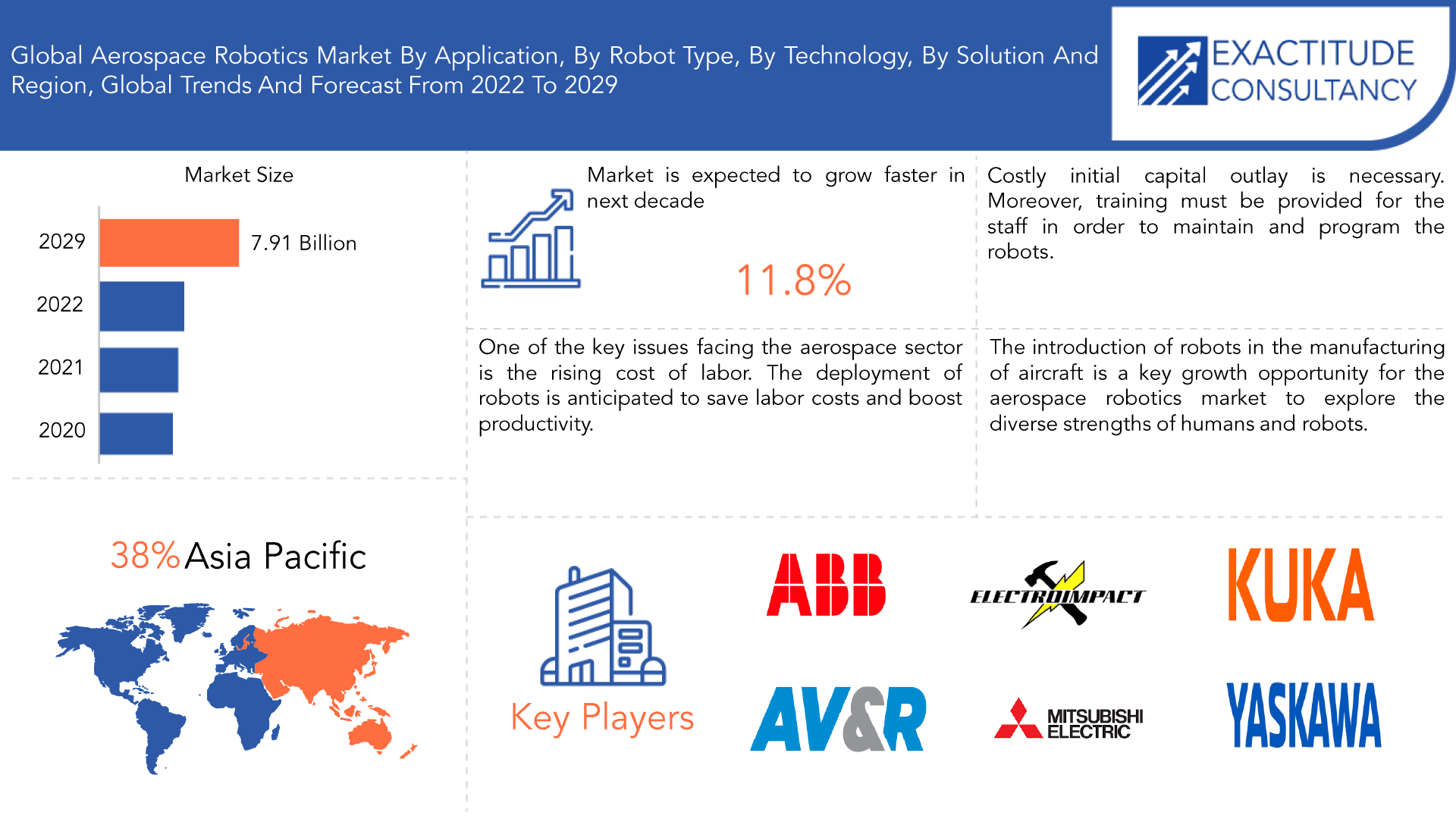
Aerospace Robotics Market Players
The Aerospace Robotics Market key players include ABB, AV&R, Electroimpact Inc., Fanuc Corporation, JH Robotics Inc., KUKA AG, Mitsubishi Electric Corporation, OC Robotics, Universal Robots A/S, Yaskawa Electric Corporation
For corporate expansion, these key leaders are implementing strategic formulations such as new product development and commercialization, commercial expansion, and distribution agreements. Moreover, these participants are substantially spending on product development, which is fueling revenue generation.
Recent Developments In July2021, Fanuc Corporation announced that it has started the production of 750,000th industrial robot, representing a record high point in the robotics industry. FANUC Corporation’s customer base covers a wide range of industries including automotive, aerospace, food and beverage, consumer goods, medical and pharmaceutical, warehousing, and many more. Nov 2022 The use of robotic MROs (Maintenance, Repair and Overhauls) on aircraft is becoming increasingly popular due to their high efficiencies and low cost. With robotic systems, inspections and maintenance are more user friendly and take less time as engines can remain on the aircraft's wings.Who Should Buy? Or Key stakeholders
- Investors
- Raw Material Manufacturer
- Aviation Companies
- Industrial robots Companies
- Industrial robots Consulting firms
- Research Organizations
- Regulatory Authorities
- Institutional & retail players
- Others
Aerospace Robotics Market Regional Analysis
The Aerospace Robotics Market by region includes North America, Asia-Pacific (APAC), Europe, South America, and Middle East & Africa (MEA).
- North America: includes the US, Canada, Mexico
- Asia Pacific: includes China, Japan, South Korea, India, Australia, ASEAN, and Rest of APAC
- Europe: includes the UK, Germany, France, Italy, Spain, Russia, and the Rest of Europe
- South America: includes Brazil, Argentina, and Rest of South America
- Middle East & Africa: includes Turkey, UAE, Saudi Arabia, South Africa, and the Rest of MEA
The biggest revenue share was attributed to the Asia Pacific region. This is because there are more businesses, like COMAC and local producers, that sell aerospace robotics systems for less money than other manufacturers. In order to meet the demand for aircraft, COMAC has hastened the renovation of its assembly and manufacturing line. India is recognized as a significant participant in the Asia Pacific region in terms of both the domestic aviation market and the global aviation sector. To encourage domestic aircraft manufacturing, the Indian government is also implementing new aviation laws. International businesses have come to India as a result of a new government policy that allowed 100% Foreign Direct Investment (FDI) in the manufacturing and aerospace sectors. Such measures will facilitate knowledge transfer from Western nations to India and increase country's production of aerospace robots.
The North American market is anticipated to develop rapidly in terms of revenue. The Internet of Things (IoT), artificial intelligence (AI), cloud computing, robots, and the integration of 3D visualization are just a few of the technological advancements that are fueling the North American market's revenue growth. These developments improve human-robot collaboration and speed up industrial turnaround times. Intense R&D (Research and Development) activities and significant developments in cyber-physical systems with automated decision-making capabilities are also anticipated to propel global revenue growth.
[caption id="attachment_16253" align="aligncenter" width="1920"]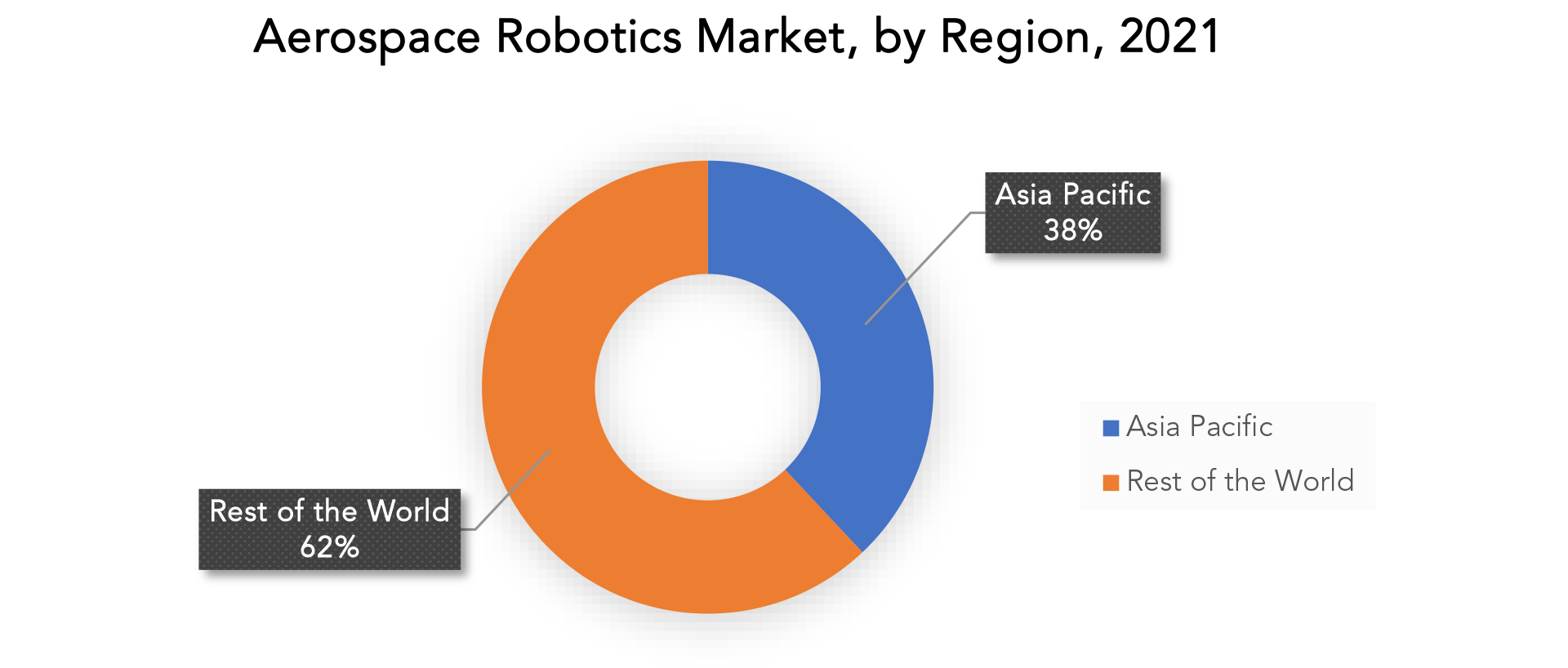
Aerospace Robotics Market | Exactitude Consultancy[/caption]
Key Market Segments: Aerospace Robotics Market
Aerospace Robotics Market by Application, 2020-2029, (USD Billion)- Material Handling
- Surface Treatment
- Composites Application
- Assembly
- Articulated
- Linear
- Parallel
- Scara
- Conventional
- Collaborative
- Hardware
- Software
- Services
- North America
- Asia Pacific
- Europe
- South America
- Middle East And Africa
Exactitude Consultancy Services Key Objectives
- Increasing sales and market share
- Developing new technology
- Improving profitability
- Entering new markets
- Enhancing brand reputation
Key Question Answered
- What is the expected growth rate of the aerospace robotics market over the next 7 years?
- Who are the major players in the aerospace robotics market and what is their market share?
- What are the end-user industries driving demand for market and what is their outlook?
- What are the opportunities for growth in emerging markets such as Asia-pacific, middle east, and Africa?
- How is the economic environment affecting the aerospace robotics market, including factors such as interest rates, inflation, and exchange rates?
- What is the expected impact of government policies and regulations on the aerospace robotics market?
- What is the current and forecasted size and growth rate of the global aerospace robotics market?
- What are the key drivers of growth in the aerospace robotics market?
- Who are the major players in the market and what is their market share?
- What are the distribution channels and supply chain dynamics in the aerospace robotics market?
- What are the technological advancements and innovations in the aerospace robotics market and their impact on product development and growth?
- What are the regulatory considerations and their impact on the market?
- What are the challenges faced by players in the aerospace robotics market and how are they addressing these challenges?
- What are the opportunities for growth and expansion in the aerospace robotics market?
- What are the services offerings and specifications of leading players in the market?
- EINFÜHRUNG
- MARKTDEFINITION
- MARKTSEGMENTIERUNG
- FORSCHUNGSZEITPLAN
- ANNAHMEN UND EINSCHRÄNKUNGEN
- FORSCHUNGSMETHODIK
- DATENMINING
- Sekundärforschung
- PRIMÄRFORSCHUNG
- RAT VON FACHEXPERTEN
- QUALITÄTSPRÜFUNGEN
- ABSCHLIESSENDE ÜBERPRÜFUNG
- DATENTRIANGULATION
- Bottom-Up-Ansatz
- TOP-DOWN-ANSATZ
- FORSCHUNGSABLAUF
- DATENQUELLEN
- DATENMINING
- ZUSAMMENFASSUNG
- MARKTÜBERSICHT
- GLOBALER MARKTAUSBLICK FÜR DIE LUFT- UND RAUMFAHRTROBOTIK
- MARKTTREIBER
- Marktbeschränkungen
- Marktchancen
- Auswirkungen von COVID-19 auf den Markt für Luft- und Raumfahrtrobotik
- PORTERS FÜNF-KRÄFTE-MODELL
- Bedrohung durch Neueinsteiger
- Bedrohung durch Ersatzprodukte
- Verhandlungsmacht der Lieferanten
- VERHANDLUNGSMACHT DER KUNDEN
- WETTBEWERBSGRAD
- ANALYSE DER BRANCHENWERTSCHÖPFUNGSKETTE
- GLOBALER MARKTAUSBLICK FÜR DIE LUFT- UND RAUMFAHRTROBOTIK
- GLOBALER MARKT FÜR LUFT- UND RAUMFAHRTROBOTIK NACH ANWENDUNG (MRD. USD), 2020-2029
- LÖSUNG
- SERVICE
- GLOBALER MARKT FÜR LUFT- UND RAUMFAHRTROBOTIK NACH ROBOTERTYP (MILLIARDEN USD), 2020-2029
- ÖFFENTLICH
- PRIVAT
- HYBRID
- GLOBALER MARKT FÜR LUFT- UND RAUMFAHRTROBOTIK NACH TECHNOLOGIE (MILLIARDEN USD), 2020-2029
- MOBILFUNKBETREIBER
- FESTBETREIBER
- GLOBALER MARKT FÜR LUFT- UND RAUMFAHRTROBOTIK NACH LÖSUNGEN (MILLIARDEN USD), 2020-2029
- GROSSUNTERNEHMEN
- KLEINE UND MITTLERE UNTERNEHMEN
- GLOBALER MARKT FÜR LUFT- UND RAUMFAHRTROBOTIK NACH REGIONEN (MRD. USD), 2020–2029
- NORDAMERIKA
- UNS
- KANADA
- MEXIKO
- SÜDAMERIKA
- BRASILIEN
- ARGENTINIEN
- KOLUMBIEN
- RESTLICHES SÜDAMERIKA
- EUROPA
- DEUTSCHLAND
- Vereinigtes Königreich
- FRANKREICH
- ITALIEN
- SPANIEN
- RUSSLAND
- RESTLICHES EUROPA
- ASIEN-PAZIFIK
- INDIEN
- CHINA
- JAPAN
- SÜDKOREA
- AUSTRALIEN
- SÜDOSTASIEN
- RESTLICHER ASIEN-PAZIFIK-RAUM
- NAHER OSTEN UND AFRIKA
- Vereinigte Arabische Emirate
- SAUDI-ARABIEN
- SÜDAFRIKA
- REST OF MIDDLE EAST AND AFRICA
- NORDAMERIKA
- COMPANY PROFILES* (BUSINESS OVERVIEW, COMPANY SNAPSHOT, PRODUCTS OFFERED, RECENT DEVELOPMENTS)
- ABB
- AV&R
- ELECTROIMPACT INC.
- FANUC CORPORATION
- JH ROBOTIC INC.
- KUKA AG
- MITSUBISHI ELECTRIC CORPORATION
- OC ROBOTICS
- UNIVERSAL ROBOTS A/S
- YASKAWA ELECTRIC CORPORATION *THE COMPANY LIST IS INDICATIVE
LIST OF TABLES
TABLE 1 GLOBAL AEROSPACE ROBOTICS MARKET BY APPLICATION (USD BILLION) 2020-2029
TABLE 2 GLOBAL AEROSPACE ROBOTICS MARKET BY ROBOT TYPE (USD BILLION) 2020-2029
TABLE 3 GLOBAL AEROSPACE ROBOTICS MARKET BY TECHNOLOGY (USD BILLION) 2020-2029
TABLE 4 GLOBAL AEROSPACE ROBOTICS MARKET BY SOLUTION (USD BILLION) 2020-2029
TABLE 5 GLOBAL AEROSPACE ROBOTICS MARKET BY REGION (USD BILLION) 2020-2029
TABLE 6 NORTH AMERICA AEROSPACE ROBOTICS MARKET BY COUNTRY (USD BILLION) 2020-2029
TABLE 7 NORTH AMERICA AEROSPACE ROBOTICS MARKET BY APPLICATION (USD BILLION) 2020-2029
TABLE 8 NORTH AMERICA AEROSPACE ROBOTICS MARKET BY ROBOT TYPE (USD BILLION) 2020-2029
TABLE 9 NORTH AMERICA AEROSPACE ROBOTICS MARKET BY TECHNOLOGY (USD BILLION) 2020-2029
TABLE 10 NORTH AMERICA AEROSPACE ROBOTICS MARKET BY SOLUTION (USD BILLION) 2020-2029
TABLE 11 US AEROSPACE ROBOTICS MARKET BY APPLICATION (USD BILLION) 2020-2029
TABLE 12 US AEROSPACE ROBOTICS MARKET BY ROBOT TYPE (USD BILLION) 2020-2029
TABLE 13 US AEROSPACE ROBOTICS MARKET BY TECHNOLOGY (USD BILLION) 2020-2029
TABLE 14 US AEROSPACE ROBOTICS MARKET BY SOLUTION (USD BILLION) 2020-2029
TABLE 15 CANADA AEROSPACE ROBOTICS MARKET BY APPLICATION (USD BILLION) 2020-2029
TABLE 16 CANADA AEROSPACE ROBOTICS MARKET BY ROBOT TYPE (USD BILLION) 2020-2029
TABLE 17 CANADA AEROSPACE ROBOTICS MARKET BY TECHNOLOGY (USD BILLION) 2020-2029
TABLE 18 CANADA AEROSPACE ROBOTICS MARKET BY SOLUTION (USD BILLION) 2020-2029
TABLE 19 MEXICO AEROSPACE ROBOTICS MARKET BY APPLICATION (USD BILLION) 2020-2029
TABLE 20 MEXICO AEROSPACE ROBOTICS MARKET BY ROBOT TYPE (USD BILLION) 2020-2029
TABLE 21 MEXICO AEROSPACE ROBOTICS MARKET BY TECHNOLOGY (USD BILLION) 2020-2029
TABLE 22 MEXICO AEROSPACE ROBOTICS MARKET BY SOLUTION (USD BILLION) 2020-2029
TABLE 23 SOUTH AMERICA AEROSPACE ROBOTICS MARKET BY COUNTRY (USD BILLION) 2020-2029
TABLE 24 SOUTH AMERICA AEROSPACE ROBOTICS MARKET BY APPLICATION (USD BILLION) 2020-2029
TABLE 25 SOUTH AMERICA AEROSPACE ROBOTICS MARKET BY ROBOT TYPE (USD BILLION) 2020-2029
TABLE 26 SOUTH AMERICA AEROSPACE ROBOTICS MARKET BY TECHNOLOGY (USD BILLION) 2020-2029
TABLE 27 SOUTH AMERICA AEROSPACE ROBOTICS MARKET BY SOLUTION (USD BILLION) 2020-2029
TABLE 28 BRAZIL AEROSPACE ROBOTICS MARKET BY APPLICATION (USD BILLION) 2020-2029
TABLE 29 BRAZIL AEROSPACE ROBOTICS MARKET BY ROBOT TYPE (USD BILLION) 2020-2029
TABLE 30 BRAZIL AEROSPACE ROBOTICS MARKET BY TECHNOLOGY (USD BILLION) 2020-2029
TABLE 31 BRAZIL AEROSPACE ROBOTICS MARKET BY SOLUTION (USD BILLION) 2020-2029
TABLE 32 ARGENTINA AEROSPACE ROBOTICS MARKET BY APPLICATION (USD BILLION) 2020-2029
TABLE 33 ARGENTINA AEROSPACE ROBOTICS MARKET BY ROBOT TYPE (USD BILLION) 2020-2029
TABLE 34 ARGENTINA AEROSPACE ROBOTICS MARKET BY TECHNOLOGY (USD BILLION) 2020-2029
TABLE 35 ARGENTINA AEROSPACE ROBOTICS MARKET BY SOLUTION (USD BILLION) 2020-2029
TABLE 36 COLOMBIA AEROSPACE ROBOTICS MARKET BY APPLICATION (USD BILLION) 2020-2029
TABLE 37 COLOMBIA AEROSPACE ROBOTICS MARKET BY ROBOT TYPE (USD BILLION) 2020-2029
TABLE 38 COLOMBIA AEROSPACE ROBOTICS MARKET BY TECHNOLOGY (USD BILLION) 2020-2029
TABLE 39 COLOMBIA AEROSPACE ROBOTICS MARKET BY SOLUTION (USD BILLION) 2020-2029
TABLE 40 REST OF SOUTH AMERICA AEROSPACE ROBOTICS MARKET BY APPLICATION (USD BILLION) 2020-2029
TABLE 41 REST OF SOUTH AMERICA AEROSPACE ROBOTICS MARKET BY ROBOT TYPE (USD BILLION) 2020-2029
TABLE 42 REST OF SOUTH AMERICA AEROSPACE ROBOTICS MARKET BY TECHNOLOGY (USD BILLION) 2020-2029
TABLE 43 REST OF SOUTH AMERICA AEROSPACE ROBOTICS MARKET BY SOLUTION (USD BILLION) 2020-2029
TABLE 44 ASIA-PACIFIC AEROSPACE ROBOTICS MARKET BY COUNTRY (USD BILLION) 2020-2029
TABLE 45 ASIA-PACIFIC AEROSPACE ROBOTICS MARKET BY APPLICATION (USD BILLION) 2020-2029
TABLE 46 ASIA-PACIFIC AEROSPACE ROBOTICS MARKET BY ROBOT TYPE (USD BILLION) 2020-2029
TABLE 47 ASIA-PACIFIC AEROSPACE ROBOTICS MARKET BY TECHNOLOGY (USD BILLION) 2020-2029
TABLE 48 ASIA-PACIFIC AEROSPACE ROBOTICS MARKET BY SOLUTION (USD BILLION) 2020-2029
TABLE 49 INDIA AEROSPACE ROBOTICS MARKET BY APPLICATION (USD BILLION) 2020-2029
TABLE 50 INDIA AEROSPACE ROBOTICS MARKET BY ROBOT TYPE (USD BILLION) 2020-2029
TABLE 51 INDIA AEROSPACE ROBOTICS MARKET BY TECHNOLOGY (USD BILLION) 2020-2029
TABLE 52 INDIA AEROSPACE ROBOTICS MARKET BY SOLUTION (USD BILLION) 2020-2029
TABLE 53 CHINA AEROSPACE ROBOTICS MARKET BY APPLICATION (USD BILLION) 2020-2029
TABLE 54 CHINA AEROSPACE ROBOTICS MARKET BY ROBOT TYPE (USD BILLION) 2020-2029
TABLE 55 CHINA AEROSPACE ROBOTICS MARKET BY TECHNOLOGY (USD BILLION) 2020-2029
TABLE 56 CHINA AEROSPACE ROBOTICS MARKET BY SOLUTION (USD BILLION) 2020-2029
TABLE 57 JAPAN AEROSPACE ROBOTICS MARKET BY APPLICATION (USD BILLION) 2020-2029
TABLE 58 JAPAN AEROSPACE ROBOTICS MARKET BY ROBOT TYPE (USD BILLION) 2020-2029
TABLE 59 JAPAN AEROSPACE ROBOTICS MARKET BY TECHNOLOGY (USD BILLION) 2020-2029
TABLE 60 JAPAN AEROSPACE ROBOTICS MARKET BY SOLUTION (USD BILLION) 2020-2029
TABLE 61 SOUTH KOREA AEROSPACE ROBOTICS MARKET BY APPLICATION (USD BILLION) 2020-2029
TABLE 62 SOUTH KOREA AEROSPACE ROBOTICS MARKET BY ROBOT TYPE (USD BILLION) 2020-2029
TABLE 63 SOUTH KOREA AEROSPACE ROBOTICS MARKET BY TECHNOLOGY (USD BILLION) 2020-2029
TABLE 64 SOUTH KOREA AEROSPACE ROBOTICS MARKET BY SOLUTION (USD BILLION) 2020-2029
TABLE 65 AUSTRALIA AEROSPACE ROBOTICS MARKET BY APPLICATION (USD BILLION) 2020-2029
TABLE 66 AUSTRALIA AEROSPACE ROBOTICS MARKET BY ROBOT TYPE (USD BILLION) 2020-2029
TABLE 67 AUSTRALIA AEROSPACE ROBOTICS MARKET BY TECHNOLOGY (USD BILLION) 2020-2029
TABLE 68 AUSTRALIA AEROSPACE ROBOTICS MARKET BY SOLUTION (USD BILLION) 2020-2029
TABLE 69 SOUTH-EAST ASIA AEROSPACE ROBOTICS MARKET BY APPLICATION (USD BILLION) 2020-2029
TABLE 70 SOUTH-EAST ASIA AEROSPACE ROBOTICS MARKET BY ROBOT TYPE (USD BILLION) 2020-2029
TABLE 71 SOUTH-EAST ASIA AEROSPACE ROBOTICS MARKET BY TECHNOLOGY (USD BILLION) 2020-2029
TABLE 72 SOUTH-EAST ASIA AEROSPACE ROBOTICS MARKET BY SOLUTION (USD BILLION) 2020-2029
TABLE 73 REST OF ASIA PACIFIC AEROSPACE ROBOTICS MARKET BY APPLICATION (USD BILLION) 2020-2029
TABLE 74 REST OF ASIA PACIFIC AEROSPACE ROBOTICS MARKET BY ROBOT TYPE (USD BILLION) 2020-2029
TABLE 75 REST OF ASIA PACIFIC AEROSPACE ROBOTICS MARKET BY TECHNOLOGY (USD BILLION) 2020-2029
TABLE 76 REST OF ASIA PACIFIC AEROSPACE ROBOTICS MARKET BY SOLUTION (USD BILLION) 2020-2029
TABLE 77 EUROPE AEROSPACE ROBOTICS MARKET BY COUNTRY (USD BILLION) 2020-2029
TABLE 78 GERMANY AEROSPACE ROBOTICS MARKET BY APPLICATION (USD BILLION) 2020-2029
TABLE 79 GERMANY AEROSPACE ROBOTICS MARKET BY ROBOT TYPE (USD BILLION) 2020-2029
TABLE 80 GERMANY AEROSPACE ROBOTICS MARKET BY TECHNOLOGY (USD BILLION) 2020-2029
TABLE 81 GERMANY AEROSPACE ROBOTICS MARKET BY SOLUTION (USD BILLION) 2020-2029
TABLE 82 UK AEROSPACE ROBOTICS MARKET BY APPLICATION (USD BILLION) 2020-2029
TABLE 83 UK AEROSPACE ROBOTICS MARKET BY ROBOT TYPE (USD BILLION) 2020-2029
TABLE 84 UK AEROSPACE ROBOTICS MARKET BY TECHNOLOGY (USD BILLION) 2020-2029
TABLE 85 UK AEROSPACE ROBOTICS MARKET BY SOLUTION (USD BILLION) 2020-2029
TABLE 86 FRANCE AEROSPACE ROBOTICS MARKET BY APPLICATION (USD BILLION) 2020-2029
TABLE 87 FRANCE AEROSPACE ROBOTICS MARKET BY ROBOT TYPE (USD BILLION) 2020-2029
TABLE 88 FRANCE AEROSPACE ROBOTICS MARKET BY TECHNOLOGY (USD BILLION) 2020-2029
TABLE 89 FRANCE AEROSPACE ROBOTICS MARKET BY SOLUTION (USD BILLION) 2020-2029
TABLE 90 ITALY AEROSPACE ROBOTICS MARKET BY APPLICATION (USD BILLION) 2020-2029
TABLE 91 ITALY AEROSPACE ROBOTICS MARKET BY ROBOT TYPE (USD BILLION) 2020-2029
TABLE 92 ITALY AEROSPACE ROBOTICS MARKET BY TECHNOLOGY (USD BILLION) 2020-2029
TABLE 93 ITALY AEROSPACE ROBOTICS MARKET BY SOLUTION (USD BILLION) 2020-2029
TABLE 94 SPAIN AEROSPACE ROBOTICS MARKET BY APPLICATION (USD BILLION) 2020-2029
TABLE 95 SPAIN AEROSPACE ROBOTICS MARKET BY ROBOT TYPE (USD BILLION) 2020-2029
TABLE 96 SPAIN AEROSPACE ROBOTICS MARKET BY TECHNOLOGY (USD BILLION) 2020-2029
TABLE 97 SPAIN AEROSPACE ROBOTICS MARKET BY SOLUTION (USD BILLION) 2020-2029
TABLE 98 RUSSIA AEROSPACE ROBOTICS MARKET BY APPLICATION (USD BILLION) 2020-2029
TABLE 99 RUSSIA AEROSPACE ROBOTICS MARKET BY ROBOT TYPE (USD BILLION) 2020-2029
TABLE 100 RUSSIA AEROSPACE ROBOTICS MARKET BY TECHNOLOGY (USD BILLION) 2020-2029
TABLE 101 RUSSIA AEROSPACE ROBOTICS MARKET BY SOLUTION (USD BILLION) 2020-2029
TABLE 102 REST OF EUROPE AEROSPACE ROBOTICS MARKET BY APPLICATION (USD BILLION) 2020-2029
TABLE 103 REST OF EUROPE AEROSPACE ROBOTICS MARKET BY ROBOT TYPE (USD BILLION) 2020-2029
TABLE 104 REST OF EUROPE AEROSPACE ROBOTICS MARKET BY TECHNOLOGY (USD BILLION) 2020-2029
TABLE 105 REST OF EUROPE AEROSPACE ROBOTICS MARKET BY SOLUTION (USD BILLION) 2020-2029
TABLE 106 MIDDLE EAST AND AFRICA AEROSPACE ROBOTICS MARKET BY COUNTRY (USD BILLION) 2020-2029
TABLE 107 MIDDLE EAST AND AFRICA AEROSPACE ROBOTICS MARKET BY APPLICATION (USD BILLION) 2020-2029
TABLE 108 MIDDLE EAST AND AFRICA AEROSPACE ROBOTICS MARKET BY ROBOT TYPE (USD BILLION) 2020-2029
TABLE 109 MIDDLE EAST AND AFRICA AEROSPACE ROBOTICS MARKET BY TECHNOLOGY (USD BILLION) 2020-2029
TABLE 110 MIDDLE EAST AND AFRICA AEROSPACE ROBOTICS MARKET BY SOLUTION (USD BILLION) 2020-2029
TABLE 111 UAE AEROSPACE ROBOTICS MARKET BY APPLICATION (USD BILLION) 2020-2029
TABLE 112 UAE AEROSPACE ROBOTICS MARKET BY ROBOT TYPE (USD BILLION) 2020-2029
TABLE 113 UAE AEROSPACE ROBOTICS MARKET BY TECHNOLOGY (USD BILLION) 2020-2029
TABLE 114 UAE AEROSPACE ROBOTICS MARKET BY SOLUTION (USD BILLION) 2020-2029
TABLE 115 SAUDI ARABIA AEROSPACE ROBOTICS MARKET BY APPLICATION (USD BILLION) 2020-2029
TABLE 116 SAUDI ARABIA AEROSPACE ROBOTICS MARKET BY ROBOT TYPE (USD BILLION) 2020-2029
TABLE 117 SAUDI ARABIA AEROSPACE ROBOTICS MARKET BY TECHNOLOGY (USD BILLION) 2020-2029
TABLE 118 SAUDI ARABIA AEROSPACE ROBOTICS MARKET BY SOLUTION (USD BILLION) 2020-2029
TABLE 119 SOUTH AFRICA AEROSPACE ROBOTICS MARKET BY APPLICATION (USD BILLION) 2020-2029
TABLE 120 SOUTH AFRICA AEROSPACE ROBOTICS MARKET BY ROBOT TYPE (USD BILLION) 2020-2029
TABLE 121 SOUTH AFRICA AEROSPACE ROBOTICS MARKET BY TECHNOLOGY (USD BILLION) 2020-2029
TABLE 122 SOUTH AFRICA AEROSPACE ROBOTICS MARKET BY SOLUTION (USD BILLION) 2020-2029
TABLE 123 REST OF MIDDLE EAST AND AFRICA AEROSPACE ROBOTICS MARKET BY APPLICATION (USD BILLION) 2020-2029
TABLE 124 REST OF MIDDLE EAST AND AFRICA AEROSPACE ROBOTICS MARKET BY ROBOT TYPE (USD BILLION) 2020-2029
TABLE 125 REST OF MIDDLE EAST AND AFRICA AEROSPACE ROBOTICS MARKET BY TECHNOLOGY (USD BILLION) 2020-2029
TABLE 126 REST OF MIDDLE EAST AND AFRICA AEROSPACE ROBOTICS MARKET BY SOLUTION (USD BILLION) 2020-2029
LIST OF FIGURES
FIGURE 1 MARKET DYNAMICS
FIGURE 2 MARKET SEGMENTATION
FIGURE 3 REPORT TIMELINES: YEARS CONSIDERED
FIGURE 4 DATA TRIANGULATION
FIGURE 5 BOTTOM-UP APPROACH
FIGURE 6 TOP-DOWN APPROACH
FIGURE 7 RESEARCH FLOW
FIGURE 8 GLOBAL AEROSPACE ROBOTICS BY APPLICATION, USD BILLON, 2020-2029
FIGURE 9 GLOBAL AEROSPACE ROBOTICS BY ROBOT TYPE, USD BILLON, 2020-2029
FIGURE 10 GLOBAL AEROSPACE ROBOTICS BY TECHNOLOGY, USD BILLON, 2020-2029
FIGURE 11 GLOBAL AEROSPACE ROBOTICS BY SOLUTION, USD BILLON, 2020-2029
FIGURE 12 GLOBAL AEROSPACE ROBOTICS BY REGION, USD BILLON, 2020-2029
FIGURE 13 PORTER’S FIVE FORCES MODEL
FIGURE 14 GLOBAL AEROSPACE ROBOTICS MARKET BY APPLICATION, USD BILLON, 2021
FIGURE 15 GLOBAL AEROSPACE ROBOTICS MARKET BY ROBOT TYPE, USD BILLON, 2021
FIGURE 16 GLOBAL AEROSPACE ROBOTICS MARKET BY TECHNOLOGY, USD BILLON, 2021
FIGURE 17 GLOBAL AEROSPACE ROBOTICS MARKET BY SOLUTION, USD BILLON, 2021
FIGURE 18 GLOBAL AEROSPACE ROBOTICS MARKET BY REGION 2021
FIGURE 19 MARKET SHARE ANALYSIS
FIGURE 20 ABB: COMPANY SNAPSHOT
FIGURE 21 AV&R: COMPANY SNAPSHOT
FIGURE 22 ELECTROIMPACT INC.: COMPANY SNAPSHOT
FIGURE 23 FANUC CORPORATION: COMPANY SNAPSHOT
FIGURE 24 JH ROBOTICS INC.: COMPANY SNAPSHOT
FIGURE 25 KUKA AG: COMPANY SNAPSHOT
FIGURE 26 MITSUBISHI ELECTRIC CORPORATION: COMPANY SNAPSHOT
FIGURE 27 OC ROBOTICS: COMPANY SNAPSHOT
FIGURE 28 UNIVERSAL ROBOTS A/S: COMPANY SNAPSHOT
FIGURE 29 YASKAWA ELECTRIC CORPORATION: COMPANY SNAPSHOT
DOWNLOAD FREE SAMPLE REPORT
License Type
SPEAK WITH OUR ANALYST
Want to know more about the report or any specific requirement?
WANT TO CUSTOMIZE THE REPORT?
Our Clients Speak
We asked them to research ‘ Equipment market’ all over the world, and their whole arrangement was helpful to us. thehealthanalytics.com insightful analysis and reports contributed to our current analysis and in creating a future strategy. Besides, the te
Yosuke Mitsui
Senior Associate Construction Equipment Sales & Marketing
We asked them to research ‘Equipment market’ all over the world, and their whole arrangement was helpful to us. thehealthanalytics.com insightful analysis and reports contributed to our current analysis and in creating a future strategy. Besides, the te