

Base Year Value ()
x.x %
x.x %
CAGR ()
x.x %
x.x %
Forecast Year Value ()
x.x %
x.x %
Historical Data Period
Largest Region
Forecast Period
n-Butanol-Markt nach Anwendung (Butylacrylat, Butylacetat, Glykolether, Direktlösungsmittel, Weichmacher, Sonstige), nach Endverbrauchsbranche (Landwirtschaft, Bauwesen, Farben und Beschichtungen, Marine, Pharmazie, Chemie, Körperpflege, Sonstige) und Region, globale Trends und Prognose von 2022 bis 2029
Instant access to hundreds of data points and trends
- Market estimates from 2014-2029
- Competitive analysis, industry segmentation, financial benchmarks
- Incorporates SWOT, Porter's Five Forces and risk management frameworks
- PDF report or online database with Word, Excel and PowerPoint export options
- 100% money back guarantee
n-Butanol Marktübersicht
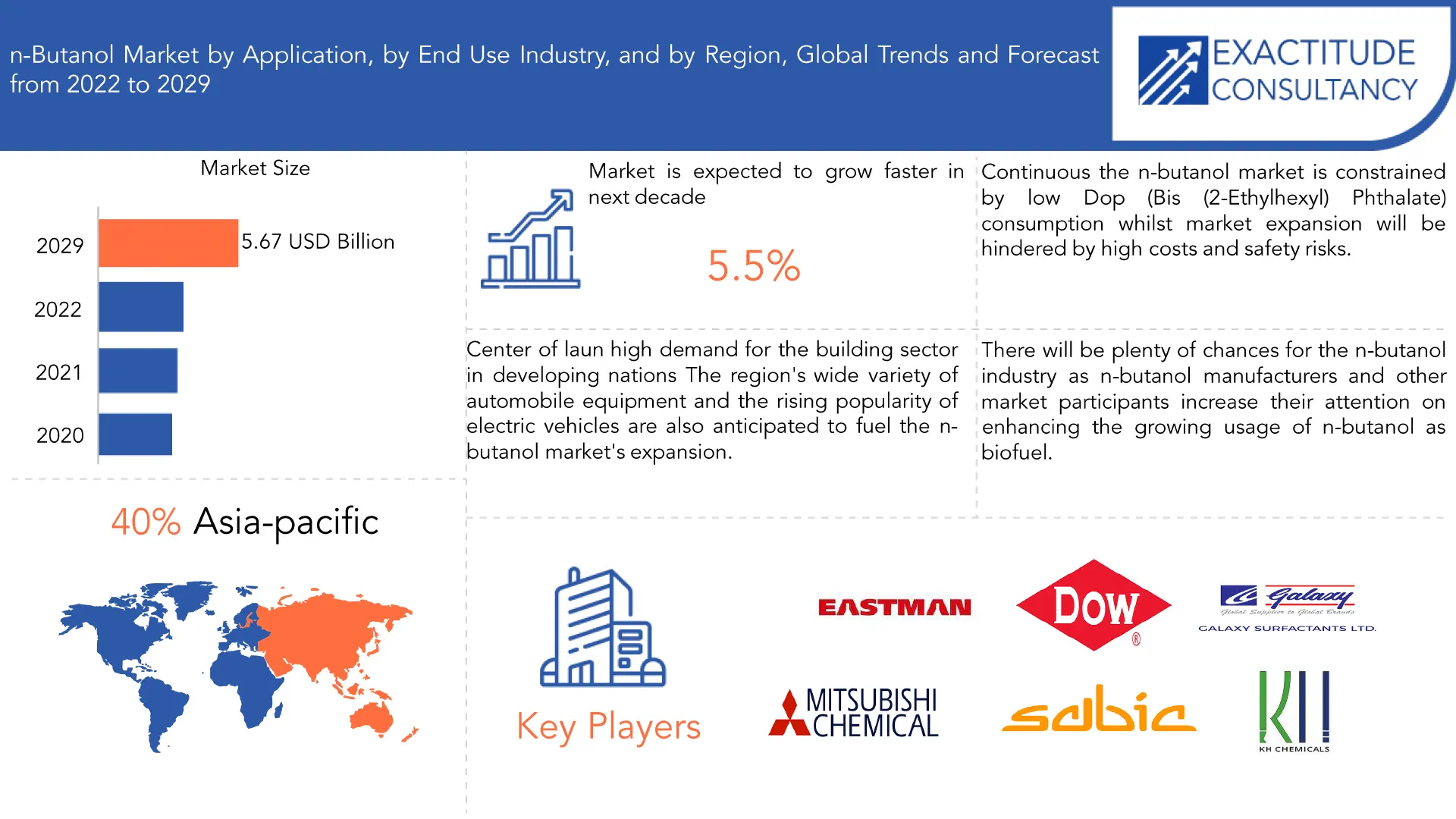
Der n-Butanol-Markt wird voraussichtlich von 2022 bis 2029 um durchschnittlich 5,5 % jährlich wachsen. Es wird erwartet, dass er von 3,5 Milliarden USD im Jahr 2020 auf über 5,67 Milliarden USD im Jahr 2029 ansteigt.
Der wichtigste Alkohol mit einer farblosen Flüssigkeit mittlerer Flüchtigkeit ist n-Butanol. Es wird häufig als chemisches Zwischenprodukt zur Herstellung anderer Chemikalien wie Ester und Aminoharze verwendet. Bei Konsumgütern ist es mittlerweile weit verbreitet und wird als Lösungsmittel für Farben, Beschichtungen , Lacke, Fette, Öle, Wachse , Gummi und Weichmacher verwendet. N-Butanol ist eine Substanz, die bei der Herstellung von synthetischem Gummi, Kunststoffen, Polymeren , Schmiermitteln und Bremsflüssigkeiten verwendet wird. Es dient auch als Brennstoffquelle. Die Verwendung von N-Butanol als synthetisches Lebensmittelaroma im Lebensmittel- und Getränkesektor hat im Laufe der Zeit zugenommen. Im Prognosezeitraum wird N-Butanol in einigen Endverbrauchsanwendungen zunehmend verwendet, was den globalen N-Butanol-Markt ankurbelt. Latexfarben, Textilanwendungen und Schlagzähmodifikatoren für steifes Polyvinylchlorid sind die Hauptverwendungszwecke für n-Butylacrylat und -methacrylat . Diese Substanzen sind die am weitesten verbreiteten kommerziellen Derivate von N-Butanol. Darüber hinaus kommen bei Lösemittelanwendungen überwiegend die größten Derivate des N-Butyls, die Butylglykolether zum Einsatz.
[Bildunterschrift id="attachment_25490" align="aligncenter" width="1920"]
Aufgrund der Markttrends sind derzeit grüne, nachhaltige und umweltfreundliche Kraftstoffe gefragt. Es hat sich herausgestellt, dass Biobutanolkraftstoff aus Biomasserohstoffen, die durch ABE-Fermentation erzeugt werden, ein überraschend nachhaltiger und sauberer Kraftstoff mit einer hohen Energiedichte ist, die mit der von Benzin mithalten kann. Angesichts der Tatsache, dass Bioethanol eine geringere Energiedichte aufweist und für bereits auf dem Markt erhältliche benzinbetriebene Verbrennungsmotoren schädlich sein könnte, ist es ein wichtiger Ersatz für Bioethanolkraftstoff. Durch CRISPR und Bioengineering, technologische Verbesserungen und Forschung wird die großtechnische, auf Fermentation basierende Biobutanolverarbeitung voraussichtlich bald möglich sein. Darüber hinaus wird die genetische Modifikation bestimmter Bakterienarten mithilfe von N-Butanol zu einer höheren Produktion beitragen und enormes Potenzial für die Energie- und Kraftstoffbranche bieten.
Additionally, N-butanol and butyl acetate work together synergistically as a potential solvent system for nitrocellulose lacquers and thinners to create a system that is more efficient than each solvent working alone. Additionally, the formulation of medications, waxes, and resins heavily utilizes the solvent from N-butyl alcohol. Plasticizer esters, butylated melamine-formaldehyde resins, mono-, di-, and tributylamine are some more commercial uses for N-butanol. During the projected period, the worldwide N-butanol market will be driven by the expanding use of N-butanol in several applications.
The travel restrictions, reduced manufacturing, and worldwide lockdowns significantly disrupted supply networks across industries. The n-butanol market was not exempt from these disturbances, which resulted in a delay in the availability of raw materials, difficulties with transportation, and reduced production capabilities. During the pandemic, demand for n-butanol decreased in several end-use industries, including paints and coatings, adhesives, textiles, and automotive. There was less demand for goods and services based on n-butanol as a result of the slowdown in manufacturing, building, and consumer expenditure. Consumer behavior was altered as a result of the epidemic, including a move towards remote work and less travel. The demand for commercial and industrial applications fell as a result of these developments, which had an impact on the consumption of n-butanol in sectors like paints and coatings.
| ATTRIBUTE | DETAILS |
| Study period | 2020-2029 |
| Base year | 2021 |
| Estimated year | 2022 |
| Forecasted year | 2022-2029 |
| Historical period | 2018-2020 |
| Unit | Value (USD Billion) (Kilotons) |
| Segmentation | By Application, By End Use Industry, By Region |
| By Application |
|
| By End Use Industry |
|
| By Region |
|
Frequently Asked Questions
• What is the worth of the n-butanol market?
The n-butanol market is expected to grow at 5.5% CAGR from 2022 to 2029. It is expected to reach above USD 5.67 billion by 2029 from USD 3.5 billion in 2020.
• What is the size of the Asia Pacific in the n-butanol market?
Asia Pacific held more than 40% of the n-butanol market revenue share in 2021 and will witness expansion in the forecast period.
• What are some of the n-butanol market's driving forces?
The global market is driven by the rising building and infrastructure industries. The increased coating demand from end-use industries is also expected to cause a rise in global N-Butanol production. The demand for N-Butanol is hampered by fluctuating raw material prices, expected scarcity, and potential health and environmental issues related to solvent-based systems. Spending on construction and infrastructure is rising globally. Recent increasing industrialization and urbanization in significant nations like China and India have increased demand for N-Butanol.
• Which are the top companies to hold the market share in the n-butanol market?
The market research report covers the analysis of market players. Key companies profiled in the report include Eastman Chemical Company, Mitsubishi Chemical Corporation, Dow, SABIC, GALAXY CHEMICALS, KH Chemicals, Solvents, KH Neochem Co., Ltd., OQ Chemicals GmbH, and PetroChina.
• Which is the largest regional market for the n-butanol market?
Due to an increase in building construction, which will enhance regional n-Butanol consumption, the Asia-Pacific area is predicted to have the highest growth rate. Several significant producers and manufacturers of n-butanol are based in the Asia-Pacific region. To meet local demand and export to other areas, these businesses have created production facilities and distribution networks. Their presence enhances the Asia-Pacific region's market supremacy.
n-Butanol Market Segment Analysis
n-butanol market is segmented based on application, end-use industry, and region.
Based on application, a significant portion of the market was made up of butyl acetate. There are numerous uses for butyl acetate in various fields. Its great solubility and quick evaporation rate make it a preferred solvent in the paint and coatings industry. It is also used as a solvent in cleaning products, inks, adhesives, and the food and beverage industries. Butyl acetate's strong demand and market domination are attributed to its adaptability and a wide variety of applications. Butyl acetate is widely used in the paint and coatings industry. It serves as a solvent in a variety of coatings, including industrial, architectural, and wood coatings. The need for butyl acetate is driven by the rising demand for paints and coatings, which is fueled by infrastructure development, automobile manufacturing, and building activities.
[caption id="attachment_25491" align="aligncenter" width="1920"]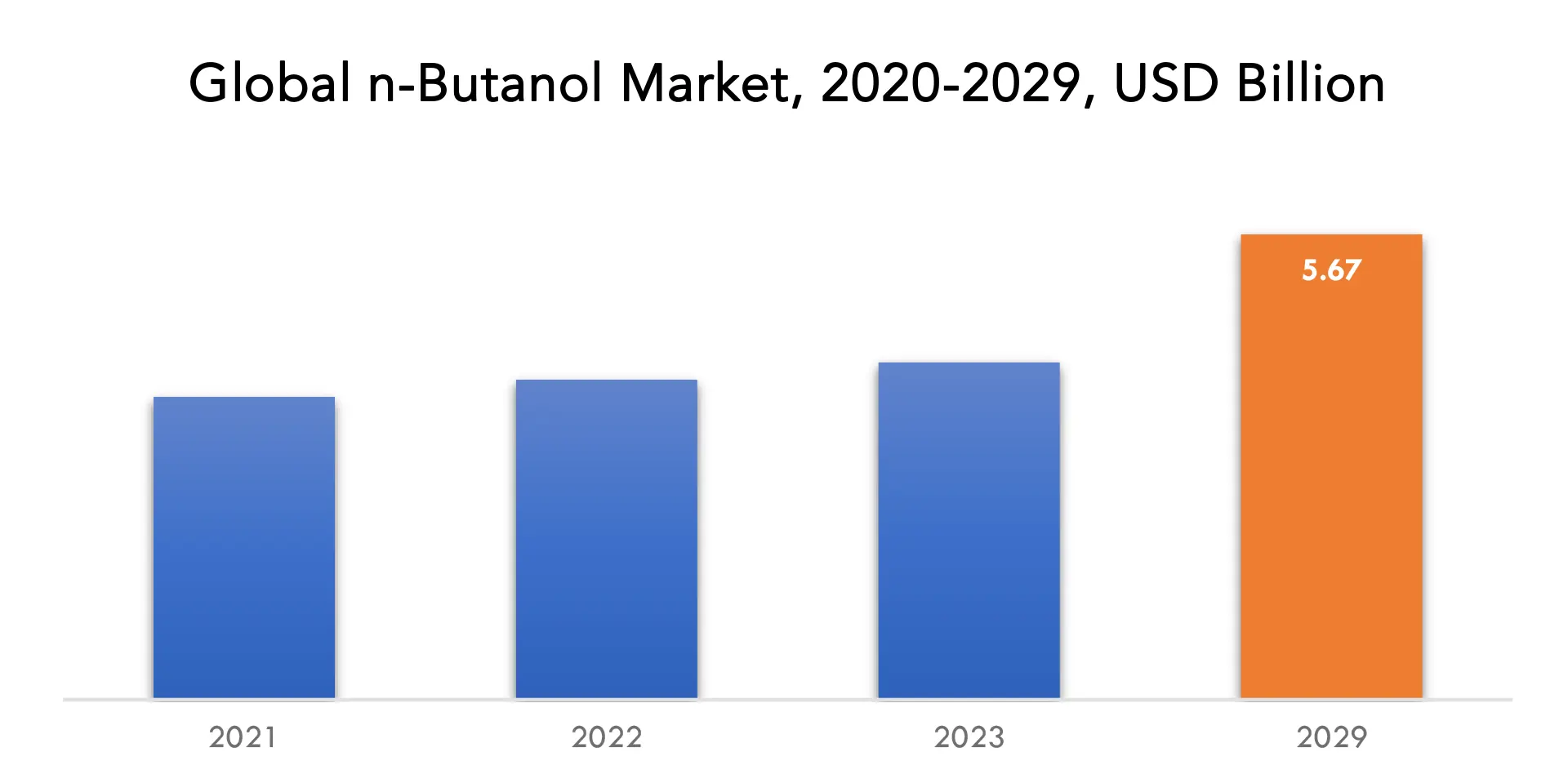
Based on the end-use industry, a significant portion of the market was made up of paints & coatings. The greatest user of n-butanol is the paints and coatings sector. In both industrial and architectural coatings, it serves as a solvent. Due to its qualities, including its compatibility with different resin systems, evaporation rate, and solvency power, n-butanol is a crucial component of paint and coating formulas. The industry's ongoing need for n-butanol helps to explain its market dominance. The building and infrastructure development sectors are strongly related to the paints and coatings sector. The need for paints and coatings increases along with urbanization and construction projects. Numerous coating applications, such as ornamental paints, protective coatings, and automotive coatings, all support the market leadership of n-butanol. A large user of paints and coatings is the automotive industry. The need for n-butanol in automobile coatings rises as the automotive industry develops.
n-Butanol Market Key Players
The market research report covers the analysis of market players. Key companies profiled in the report include Eastman Chemical Company, Mitsubishi Chemical Corporation, Dow, SABIC, GALAXY CHEMICALS, KH Chemicals, Solvents, KH Neochem Co., Ltd., OQ Chemicals Gmbh, and Petrochina. Recent News:- On May 2023, Dopper made the first reusable bottle collection to achieve the gold level set by the Cradle-to-Cradle Products Innovation Institute, verifying the company’s commitment to eliminating single-use plastic waste. The new Dopper Original collection features a classic bottle design with components that are separated to form a unique drinking cup. The BPA-free cup is made with Eastman Tritan™ Renew, which contains 50% certified recycled content. *
- On April 2023, Mitsubishi Corporation (MC), together with South Pole, a global climate project developer, and solutions provider, established NextGen CDR Facility (NextGen) to scale up carbon removal technologies and catalyzed the market for high-quality carbon removals. NextGen is the first global facility specialized for innovative carbon removal technologies (tech-based CDR*).
Who Should Buy? Or Key stakeholders
- n-Butanol manufacturers and other stakeholders
- Organizations, forums, and alliances related to n-Butanol distribution
- Government bodies such as regulating authorities and policymakers
- Market research organizations and consulting companies
- Nationalized Laboratory
n-Butanol Market Regional Analysis
The n-butanol market by region includes North America, Asia-Pacific (APAC), Europe, South America, And Middle East & Africa (MEA).
- North America: includes the US, Canada, Mexico
- Asia Pacific: includes China, Japan, South Korea, India, Australia, ASEAN, and the Rest of APAC
- Europe: includes the UK, Germany, France, Italy, Spain, Russia, and the Rest of Europe
- South America: includes Brazil, Argentina, and Rest of South America
- Middle East & Africa: includes Turkey, UAE, Saudi Arabia, South Africa, and the Rest of MEA
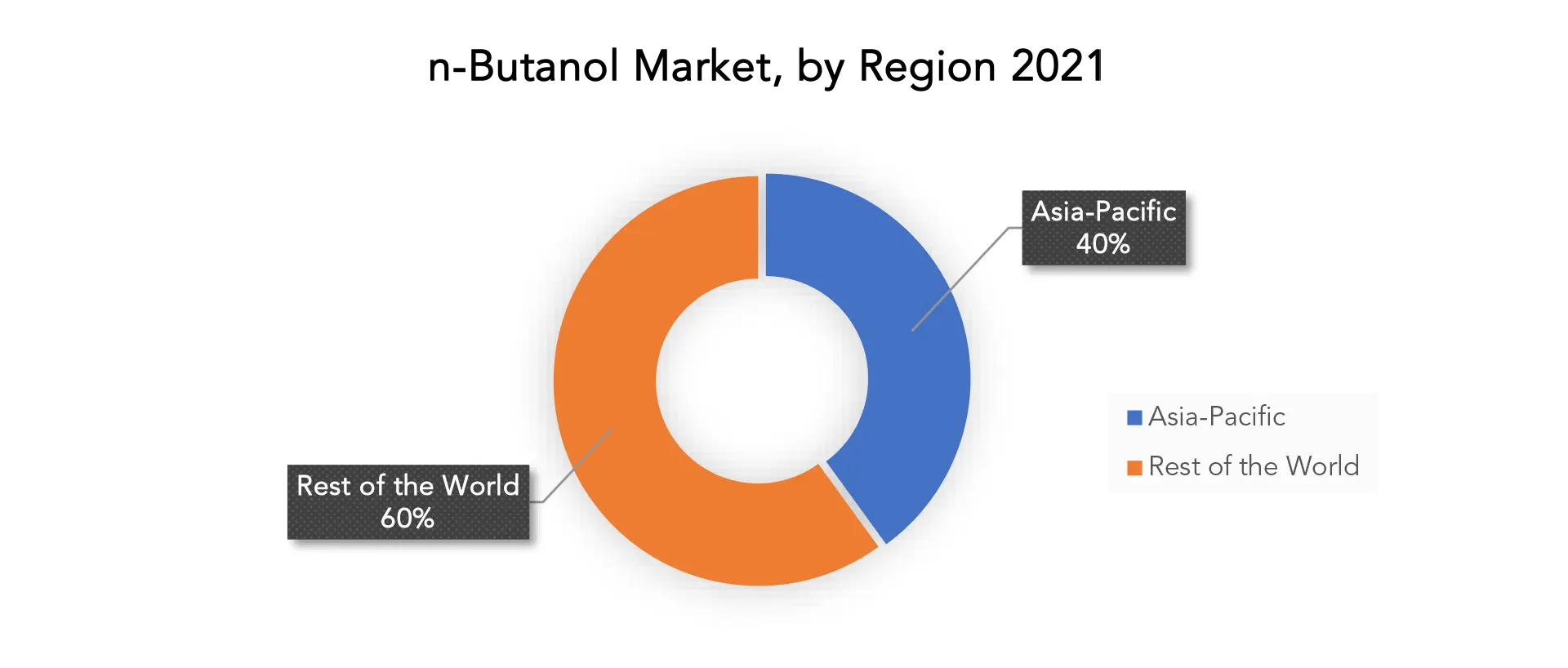
The greatest revenue share in 2021 over 40% was accounted for by Asia Pacific. China uses a lot of n-butanol. Due to of the increasing demand for butyl acrylate in water-based coatings and automotive paints, China is predicted to experience rapid growth. A crucial factor in the industry's growth throughout the projected period will also be the rise of a few end-use sectors, including the pharmaceutical, paints & coatings, textile, food & beverage, and automotive industries in China, India, and Indonesia. Furthermore, over the next seven years, the n-butanol industry will be driven by strong demand in the personal care sector due to its use as a perfume ingredient and a solvent for the extraction of essential oils.
North America is anticipated to experience the highest CAGR growth during the forecast period. The industry is growing as a result of higher production in dependable transportation sectors such the vehicle, airplanes, ships, and locomotives.
Key Market Segments: n-Butanol Market
n-Butanol Market by Application, 2020-2029, (USD Billion), (Kilotons)- Butyl Acrylate
- Butyl Acetate
- Glycol Ethers
- Direct Solvent
- Plasticizers
- Others
- Agriculture
- Building & Construction
- Paints & Coatings
- Marine
- Pharmaceutical
- Chemical
- Personal Care
- Others
- North America
- Asia Pacific
- Europe
- South America
- Middle East and Africa
Exactitude Consultancy Services Key Objectives:
- Increasing sales and Market share
- Developing new Application
- Improving profitability
- Entering new markets
- Enhancing brand reputation
Key Question Answered
- What is the expected growth rate of the n-butanol market over the next 7 years?
- Who are the major players in the n-butanol market and what is their market share?
- What are the end-user industries driving the market demand and what is their outlook?
- What are the opportunities for growth in emerging markets such as Asia-Pacific, Middle East, And Africa?
- How is the economic environment affecting the n-butanol market, including factors such as interest rates, inflation, and exchange rates?
- What is the expected impact of government policies and regulations on the n-butanol market?
- What is the current and forecasted size and growth rate of the global n-butanol market?
- What are the key drivers of growth in the n-butanol market?
- Who are the major players in the market and what is their market share?
- What are the distribution channels and supply chain dynamics in the n-butanol market?
- What are the technological advancements and innovations in the n-butanol market and their impact on product development and growth?
- What are the regulatory considerations and their impact on the market?
- What are the challenges faced by players in the n-butanol market and how are they addressing these challenges?
- What are the opportunities for growth and expansion in the n-butanol market?
- What are the products offerings and specifications of leading players in the market?
- INTRODUCTION
- MARKET DEFINITION
- MARKET SEGMENTATION
- RESEARCH TIMELINES
- ASSUMPTIONS AND LIMITATIONS
- RESEARCH METHODOLOGY
- DATA MINING
- SECONDARY RESEARCH
- PRIMARY RESEARCH
- SUBJECT-MATTER EXPERTS’ ADVICE
- QUALITY CHECKS
- FINAL REVIEW
- DATA TRIANGULATION
- BOTTOM-UP APPROACH
- TOP-DOWN APPROACH
- RESEARCH FLOW
- DATA SOURCES
- DATA MINING
- EXECUTIVE SUMMARY
- MARKET OVERVIEW
- GLOBAL N-BUTANOL MARKET OUTLOOK
- MARKET DRIVERS
- MARKET RESTRAINTS
- MARKET OPPORTUNITIES
- IMPACT OF COVID-19 ON N-BUTANOL MARKET
- PORTER’S FIVE FORCES MODEL
- THREAT FROM NEW ENTRANTS
- THREAT FROM SUBSTITUTES
- BARGAINING POWER OF SUPPLIERS
- BARGAINING POWER OF CUSTOMERS
- DEGREE OF COMPETITION
- INDUSTRY VALUE CHAIN ANALYSIS
- GLOBAL N-BUTANOL MARKET OUTLOOK
- GLOBAL N-BUTANOL MARKET BY APPLICATION, 2020-2029, (USD BILLION), (KILOTONS)
- BUTYL ACRYLATE
- BUTYL ACETATE
- GLYCOL ETHERS
- DIRECT SOLVENT
- PLASTICIZERS
- OTHERS
- GLOBAL N-BUTANOL MARKET BY END-USE INDUSTRY, 2020-2029, (USD BILLION), (KILOTONS)
- AGRICULTURE
- BUILDING & CONSTRUCTION
- PAINTS & COATINGS
- MARINE
- PHARMACEUTICAL
- CHEMICAL
- PERSONAL CARE
- OTHERS
- GLOBAL N-BUTANOL MARKET BY REGION, 2020-2029, (USD BILLION), (KILOTONS)
- NORTH AMERICA
- US
- CANADA
- MEXICO
- SOUTH AMERICA
- BRAZIL
- ARGENTINA
- COLOMBIA
- REST OF SOUTH AMERICA
- EUROPE
- GERMANY
- UK
- FRANCE
- ITALY
- SPAIN
- RUSSIA
- REST OF EUROPE
- ASIA PACIFIC
- INDIA
- CHINA
- JAPAN
- SOUTH KOREA
- AUSTRALIA
- SOUTH-EAST ASIA
- REST OF ASIA PACIFIC
- MIDDLE EAST AND AFRICA
- UAE
- SAUDI ARABIA
- SOUTH AFRICA
- REST OF MIDDLE EAST AND AFRICA
- NORTH AMERICA
- COMPANY PROFILES* (BUSINESS OVERVIEW, COMPANY SNAPSHOT, PRODUCTS OFFERED, RECENT DEVELOPMENTS)
- EASTMAN CHEMICAL COMPANY
- MITSUBISHI CHEMICAL CORPORATION
- DOW
- SABIC
- GALAXY CHEMICALS
- KH CHEMICALS
- SOLVENTIS
- KH NEOCHEM CO., LTD.
- OQ CHEMICALS GMBH
- PETROCHINA *THE COMPANY LIST IS INDICATIVE
LIST OF TABLES
TABLE 1 GLOBAL N-BUTANOL MARKET BY APPLICATION (USD BILLION), 2020-2029
TABLE 2 GLOBAL N-BUTANOL MARKET BY APPLICATION (KILOTONS), 2020-2029
TABLE 3 GLOBAL N-BUTANOL MARKET BY END USE INDUSTRY (USD BILLION), 2020-2029
TABLE 4 GLOBAL N-BUTANOL MARKET BY END USE INDUSTRY (KILOTONS), 2020-2029
TABLE 5 GLOBAL N-BUTANOL MARKET BY REGION (USD BILLION), 2020-2029
TABLE 6 GLOBAL N-BUTANOL MARKET BY REGION (KILOTONS), 2020-2029
TABLE 7 NORTH AMERICA N-BUTANOL MARKET BY APPLICATION (USD BILLION), 2020-2029
TABLE 8 NORTH AMERICA N-BUTANOL MARKET BY APPLICATION (KILOTONS), 2020-2029
TABLE 9 NORTH AMERICA N-BUTANOL MARKET BY END USE INDUSTRY (USD BILLION), 2020-2029
TABLE 10 NORTH AMERICA N-BUTANOL MARKET BY END USE INDUSTRY (KILOTONS), 2020-2029
TABLE 11 NORTH AMERICA N-BUTANOL MARKET BY COUNTRY (USD BILLION), 2020-2029
TABLE 12 NORTH AMERICA N-BUTANOL MARKET BY COUNTRY (KILOTONS), 2020-2029
TABLE 13 US N-BUTANOL MARKET BY APPLICATION (USD BILLION), 2020-2029
TABLE 14 US N-BUTANOL MARKET BY APPLICATION (KILOTONS), 2020-2029
TABLE 15 US N-BUTANOL MARKET BY END USE INDUSTRY (USD BILLION), 2020-2029
TABLE 16 US N-BUTANOL MARKET BY END USE INDUSTRY (KILOTONS), 2020-2029
TABLE 17 CANADA N-BUTANOL MARKET BY APPLICATION (USD BILLION), 2020-2029
TABLE 18 CANADA N-BUTANOL MARKET BY APPLICATION (KILOTONS), 2020-2029
TABLE 19 CANADA N-BUTANOL MARKET BY END USE INDUSTRY (USD BILLION), 2020-2029
TABLE 20 CANADA N-BUTANOL MARKET BY END USE INDUSTRY (KILOTONS), 2020-2029
TABLE 21 MEXICO N-BUTANOL MARKET BY APPLICATION (USD BILLION), 2020-2029
TABLE 22 MEXICO N-BUTANOL MARKET BY APPLICATION (KILOTONS), 2020-2029
TABLE 23 MEXICO N-BUTANOL MARKET BY END USE INDUSTRY (USD BILLION), 2020-2029
TABLE 24 MEXICO N-BUTANOL MARKET BY END USE INDUSTRY (KILOTONS), 2020-2029
TABLE 25 SOUTH AMERICA N-BUTANOL MARKET BY APPLICATION (USD BILLION), 2020-2029
TABLE 26 SOUTH AMERICA N-BUTANOL MARKET BY APPLICATION (KILOTONS), 2020-2029
TABLE 27 SOUTH AMERICA N-BUTANOL MARKET BY END USE INDUSTRY (USD BILLION), 2020-2029
TABLE 28 SOUTH AMERICA N-BUTANOL MARKET BY END USE INDUSTRY (KILOTONS), 2020-2029
TABLE 29 SOUTH AMERICA N-BUTANOL MARKET BY COUNTRY (USD BILLION), 2020-2029
TABLE 30 SOUTH AMERICA N-BUTANOL MARKET BY COUNTRY (KILOTONS), 2020-2029
TABLE 31 BRAZIL N-BUTANOL MARKET BY APPLICATION (USD BILLION), 2020-2029
TABLE 32 BRAZIL N-BUTANOL MARKET BY APPLICATION (KILOTONS), 2020-2029
TABLE 33 BRAZIL N-BUTANOL MARKET BY END USE INDUSTRY (USD BILLION), 2020-2029
TABLE 34 BRAZIL N-BUTANOL MARKET BY END USE INDUSTRY (KILOTONS), 2020-2029
TABLE 35 ARGENTINA N-BUTANOL MARKET BY APPLICATION (USD BILLION), 2020-2029
TABLE 36 ARGENTINA N-BUTANOL MARKET BY APPLICATION (KILOTONS), 2020-2029
TABLE 37 ARGENTINA N-BUTANOL MARKET BY END USE INDUSTRY (USD BILLION), 2020-2029
TABLE 38 ARGENTINA N-BUTANOL MARKET BY END USE INDUSTRY (KILOTONS), 2020-2029
TABLE 39 COLOMBIA N-BUTANOL MARKET BY APPLICATION (USD BILLION), 2020-2029
TABLE 40 COLOMBIA N-BUTANOL MARKET BY APPLICATION (KILOTONS), 2020-2029
TABLE 41 COLOMBIA N-BUTANOL MARKET BY END USE INDUSTRY (USD BILLION), 2020-2029
TABLE 42 COLOMBIA N-BUTANOL MARKET BY END USE INDUSTRY (KILOTONS), 2020-2029
TABLE 43 REST OF SOUTH AMERICA N-BUTANOL MARKET BY APPLICATION (USD BILLION), 2020-2029
TABLE 44 REST OF SOUTH AMERICA N-BUTANOL MARKET BY APPLICATION (KILOTONS), 2020-2029
TABLE 45 REST OF SOUTH AMERICA N-BUTANOL MARKET BY END USE INDUSTRY (USD BILLION), 2020-2029
TABLE 46 REST OF SOUTH AMERICA N-BUTANOL MARKET BY END USE INDUSTRY (KILOTONS), 2020-2029
TABLE 47 ASIA-PACIFIC N-BUTANOL MARKET BY APPLICATION (USD BILLION), 2020-2029
TABLE 48 ASIA-PACIFIC N-BUTANOL MARKET BY APPLICATION (KILOTONS), 2020-2029
TABLE 49 ASIA-PACIFIC N-BUTANOL MARKET BY END USE INDUSTRY (USD BILLION), 2020-2029
TABLE 50 ASIA-PACIFIC N-BUTANOL MARKET BY END USE INDUSTRY (KILOTONS), 2020-2029
TABLE 51 ASIA-PACIFIC N-BUTANOL MARKET BY COUNTRY (USD BILLION), 2020-2029
TABLE 52 ASIA-PACIFIC N-BUTANOL MARKET BY COUNTRY (KILOTONS), 2020-2029
TABLE 53 INDIA N-BUTANOL MARKET BY APPLICATION (USD BILLION), 2020-2029
TABLE 54 INDIA N-BUTANOL MARKET BY APPLICATION (KILOTONS), 2020-2029
TABLE 55 INDIA N-BUTANOL MARKET BY END USE INDUSTRY (USD BILLION), 2020-2029
TABLE 56 INDIA N-BUTANOL MARKET BY END USE INDUSTRY (KILOTONS), 2020-2029
TABLE 57 CHINA N-BUTANOL MARKET BY APPLICATION (USD BILLION), 2020-2029
TABLE 58 CHINA N-BUTANOL MARKET BY APPLICATION (KILOTONS), 2020-2029
TABLE 59 CHINA N-BUTANOL MARKET BY END USE INDUSTRY (USD BILLION), 2020-2029
TABLE 60 CHINA N-BUTANOL MARKET BY END USE INDUSTRY (KILOTONS), 2020-2029
TABLE 61 JAPAN N-BUTANOL MARKET BY APPLICATION (USD BILLION), 2020-2029
TABLE 62 JAPAN N-BUTANOL MARKET BY APPLICATION (KILOTONS), 2020-2029
TABLE 63 JAPAN N-BUTANOL MARKET BY END USE INDUSTRY (USD BILLION), 2020-2029
TABLE 64 JAPAN N-BUTANOL MARKET BY END USE INDUSTRY (KILOTONS), 2020-2029
TABLE 65 SOUTH KOREA N-BUTANOL MARKET BY APPLICATION (USD BILLION), 2020-2029
TABLE 66 SOUTH KOREA N-BUTANOL MARKET BY APPLICATION (KILOTONS), 2020-2029
TABLE 67 SOUTH KOREA N-BUTANOL MARKET BY END USE INDUSTRY (USD BILLION), 2020-2029
TABLE 68 SOUTH KOREA N-BUTANOL MARKET BY END USE INDUSTRY (KILOTONS), 2020-2029
TABLE 69 AUSTRALIA N-BUTANOL MARKET BY APPLICATION (USD BILLION), 2020-2029
TABLE 70 AUSTRALIA N-BUTANOL MARKET BY APPLICATION (KILOTONS), 2020-2029
TABLE 71 AUSTRALIA N-BUTANOL MARKET BY END USE INDUSTRY (USD BILLION), 2020-2029
TABLE 72 AUSTRALIA N-BUTANOL MARKET BY END USE INDUSTRY (KILOTONS), 2020-2029
TABLE 73 SOUTH EAST ASIA N-BUTANOL MARKET BY APPLICATION (USD BILLION), 2020-2029
TABLE 74 SOUTH EAST ASIA N-BUTANOL MARKET BY APPLICATION (KILOTONS), 2020-2029
TABLE 75 SOUTH EAST ASIA N-BUTANOL MARKET BY END USE INDUSTRY (USD BILLION), 2020-2029
TABLE 76 SOUTH EAST ASIA N-BUTANOL MARKET BY END USE INDUSTRY (KILOTONS), 2020-2029
TABLE 77 REST OF ASIA PACIFIC N-BUTANOL MARKET BY APPLICATION (USD BILLION), 2020-2029
TABLE 78 REST OF ASIA PACIFIC N-BUTANOL MARKET BY APPLICATION (KILOTONS), 2020-2029
TABLE 79 REST OF ASIA PACIFIC N-BUTANOL MARKET BY END USE INDUSTRY (USD BILLION), 2020-2029
TABLE 80 REST OF ASIA PACIFIC N-BUTANOL MARKET BY END USE INDUSTRY (KILOTONS), 2020-2029
TABLE 81 EUROPE N-BUTANOL MARKET BY APPLICATION (USD BILLION), 2020-2029
TABLE 82 EUROPE N-BUTANOL MARKET BY APPLICATION (KILOTONS), 2020-2029
TABLE 83 EUROPE N-BUTANOL MARKET BY END USE INDUSTRY (USD BILLION), 2020-2029
TABLE 84 EUROPE N-BUTANOL MARKET BY END USE INDUSTRY (KILOTONS), 2020-2029
TABLE 85 EUROPE N-BUTANOL MARKET BY COUNTRY (USD BILLION), 2020-2029
TABLE 86 EUROPE N-BUTANOL MARKET BY COUNTRY (KILOTONS), 2020-2029
TABLE 87 GERMANY N-BUTANOL MARKET BY APPLICATION (USD BILLION), 2020-2029
TABLE 88 GERMANY N-BUTANOL MARKET BY APPLICATION (KILOTONS), 2020-2029
TABLE 89 GERMANY N-BUTANOL MARKET BY END USE INDUSTRY (USD BILLION), 2020-2029
TABLE 90 GERMANY N-BUTANOL MARKET BY END USE INDUSTRY (KILOTONS), 2020-2029
TABLE 91 UK N-BUTANOL MARKET BY APPLICATION (USD BILLION), 2020-2029
TABLE 92 UK N-BUTANOL MARKET BY APPLICATION (KILOTONS), 2020-2029
TABLE 93 UK N-BUTANOL MARKET BY END USE INDUSTRY (USD BILLION), 2020-2029
TABLE 94 UK N-BUTANOL MARKET BY END USE INDUSTRY (KILOTONS), 2020-2029
TABLE 95 FRANCE N-BUTANOL MARKET BY APPLICATION (USD BILLION), 2020-2029
TABLE 96 FRANCE N-BUTANOL MARKET BY APPLICATION (KILOTONS), 2020-2029
TABLE 97 FRANCE N-BUTANOL MARKET BY END USE INDUSTRY (USD BILLION), 2020-2029
TABLE 98 FRANCE N-BUTANOL MARKET BY END USE INDUSTRY (KILOTONS), 2020-2029
TABLE 99 ITALY N-BUTANOL MARKET BY APPLICATION (USD BILLION), 2020-2029
TABLE 100 ITALY N-BUTANOL MARKET BY APPLICATION (KILOTONS), 2020-2029
TABLE 101 ITALY N-BUTANOL MARKET BY END USE INDUSTRY (USD BILLION), 2020-2029
TABLE 102 ITALY N-BUTANOL MARKET BY END USE INDUSTRY (KILOTONS), 2020-2029
TABLE 103 SPAIN N-BUTANOL MARKET BY APPLICATION (USD BILLION), 2020-2029
TABLE 104 SPAIN N-BUTANOL MARKET BY APPLICATION (KILOTONS), 2020-2029
TABLE 105 SPAIN N-BUTANOL MARKET BY END USE INDUSTRY (USD BILLION), 2020-2029
TABLE 106 SPAIN N-BUTANOL MARKET BY END USE INDUSTRY (KILOTONS), 2020-2029
TABLE 107 RUSSIA N-BUTANOL MARKET BY APPLICATION (USD BILLION), 2020-2029
TABLE 108 RUSSIA N-BUTANOL MARKET BY APPLICATION (KILOTONS), 2020-2029
TABLE 109 RUSSIA N-BUTANOL MARKET BY END USE INDUSTRY (USD BILLION), 2020-2029
TABLE 110 RUSSIA N-BUTANOL MARKET BY END USE INDUSTRY (KILOTONS), 2020-2029
TABLE 111 REST OF EUROPE N-BUTANOL MARKET BY APPLICATION (USD BILLION), 2020-2029
TABLE 112 REST OF EUROPE N-BUTANOL MARKET BY APPLICATION (KILOTONS), 2020-2029
TABLE 113 REST OF EUROPE N-BUTANOL MARKET BY END USE INDUSTRY (USD BILLION), 2020-2029
TABLE 114 REST OF EUROPE N-BUTANOL MARKET BY END USE INDUSTRY (KILOTONS), 2020-2029
TABLE 115 MIDDLE EAST AND AFRICA N-BUTANOL MARKET BY APPLICATION (USD BILLION), 2020-2029
TABLE 116 MIDDLE EAST AND AFRICA N-BUTANOL MARKET BY APPLICATION (KILOTONS), 2020-2029
TABLE 117 MIDDLE EAST AND AFRICA N-BUTANOL MARKET BY END USE INDUSTRY (USD BILLION), 2020-2029
TABLE 118 MIDDLE EAST AND AFRICA N-BUTANOL MARKET BY END USE INDUSTRY (KILOTONS), 2020-2029
TABLE 119 MIDDLE EAST AND AFRICA N-BUTANOL MARKET BY COUNTRY (USD BILLION), 2020-2029
TABLE 120 MIDDLE EAST AND AFRICA N-BUTANOL MARKET BY COUNTRY (KILOTONS), 2020-2029
TABLE 121 UAE N-BUTANOL MARKET BY APPLICATION (USD BILLION), 2020-2029
TABLE 122 UAE N-BUTANOL MARKET BY APPLICATION (KILOTONS), 2020-2029
TABLE 123 UAE N-BUTANOL MARKET BY END USE INDUSTRY (USD BILLION), 2020-2029
TABLE 124 UAE N-BUTANOL MARKET BY END USE INDUSTRY (KILOTONS), 2020-2029
TABLE 125 SAUDI ARABIA N-BUTANOL MARKET BY APPLICATION (USD BILLION), 2020-2029
TABLE 126 SAUDI ARABIA N-BUTANOL MARKET BY APPLICATION (KILOTONS), 2020-2029
TABLE 127 SAUDI ARABIA N-BUTANOL MARKET BY END USE INDUSTRY (USD BILLION), 2020-2029
TABLE 128 SAUDI ARABIA N-BUTANOL MARKET BY END USE INDUSTRY (KILOTONS), 2020-2029
TABLE 129 SOUTH AFRICA N-BUTANOL MARKET BY APPLICATION (USD BILLION), 2020-2029
TABLE 130 SOUTH AFRICA N-BUTANOL MARKET BY APPLICATION (KILOTONS), 2020-2029
TABLE 131 SOUTH AFRICA N-BUTANOL MARKET BY END USE INDUSTRY (USD BILLION), 2020-2029
TABLE 132 SOUTH AFRICA N-BUTANOL MARKET BY END USE INDUSTRY (KILOTONS), 2020-2029
TABLE 133 REST OF MIDDLE EAST AND AFRICA N-BUTANOL MARKET BY APPLICATION (USD BILLION), 2020-2029
TABLE 134 REST OF MIDDLE EAST AND AFRICA N-BUTANOL MARKET BY APPLICATION (KILOTONS), 2020-2029
TABLE 135 REST OF MIDDLE EAST AND AFRICA N-BUTANOL MARKET BY END USE INDUSTRY (USD BILLION), 2020-2029
TABLE 136 REST OF MIDDLE EAST AND AFRICA N-BUTANOL MARKET BY END USE INDUSTRY (KILOTONS), 2020-2029
LIST OF FIGURES
FIGURE 1 MARKET DYNAMICS
FIGURE 2 MARKET SEGMENTATION
FIGURE 3 REPORT TIMELINES: YEARS CONSIDERED
FIGURE 4 DATA TRIANGULATION
FIGURE 5 BOTTOM-UP APPROACH
FIGURE 6 TOP-DOWN APPROACH
FIGURE 7 RESEARCH FLOW
FIGURE 8 GLOBAL N-BUTANOL MARKET BY APPLICATION, USD BILLION, 2020-2029
FIGURE 9 GLOBAL N-BUTANOL MARKET BY END-USE INDUSTRY, USD BILLION, 2020-2029
FIGURE 10 GLOBAL N-BUTANOL MARKET BY REGION, USD BILLION, 2020-2029
FIGURE 11 PORTER’S FIVE FORCES MODEL
FIGURE 12 GLOBAL N-BUTANOL MARKET BY APPLICATION, USD BILLION, 2021
FIGURE 13 GLOBAL N-BUTANOL MARKET BY END-USE INDUSTRY, USD BILLION, 2021
FIGURE 14 GLOBAL N-BUTANOL MARKET BY REGION, USD BILLION, 2021
FIGURE 15 MARKET SHARE ANALYSIS
FIGURE 16 EASTMAN CHEMICAL COMPANY: COMPANY SNAPSHOT
FIGURE 16 MITSUBISHI CHEMICAL CORPORATION: COMPANY SNAPSHOT
FIGURE 17 DOW: COMPANY SNAPSHOT
FIGURE 18 SABIC: COMPANY SNAPSHOT
FIGURE 19 GALAXY CHEMICALS: COMPANY SNAPSHOT
FIGURE 20 KH CHEMICALS: COMPANY SNAPSHOT
FIGURE 21 SOLVENTIS: COMPANY SNAPSHOT
FIGURE 22 KH NEOCHEM CO., LTD.: COMPANY SNAPSHOT
FIGURE 23 OQ CHEMICALS GMBH: COMPANY SNAPSHOT
FIGURE 24 PETROCHINA: COMPANY SNAPSHOT
DOWNLOAD FREE SAMPLE REPORT
License Type
SPEAK WITH OUR ANALYST
Want to know more about the report or any specific requirement?
WANT TO CUSTOMIZE THE REPORT?
Our Clients Speak
We asked them to research ‘ Equipment market’ all over the world, and their whole arrangement was helpful to us. thehealthanalytics.com insightful analysis and reports contributed to our current analysis and in creating a future strategy. Besides, the te
Yosuke Mitsui
Senior Associate Construction Equipment Sales & Marketing
We asked them to research ‘Equipment market’ all over the world, and their whole arrangement was helpful to us. thehealthanalytics.com insightful analysis and reports contributed to our current analysis and in creating a future strategy. Besides, the te