

Base Year Value ()
x.x %
x.x %
CAGR ()
x.x %
x.x %
Forecast Year Value ()
x.x %
x.x %
Historical Data Period
Largest Region
Forecast Period
Polyamidmarkt nach Produkt (Polyamid 6, Polyamid 66, biobasiertes Polyamid, Spezialpolyamid), Anwendung (technische Kunststoffe, Fasern), Endverbraucher (Automobil, Elektrik und Elektronik, Textil, Bauwesen, Verpackung, Konsumgüter, Sonstiges) und nach Region – Globale Trends und Prognose von 2022 bis 2029
Instant access to hundreds of data points and trends
- Market estimates from 2014-2029
- Competitive analysis, industry segmentation, financial benchmarks
- Incorporates SWOT, Porter's Five Forces and risk management frameworks
- PDF report or online database with Word, Excel and PowerPoint export options
- 100% money back guarantee
Polyamid Marktübersicht
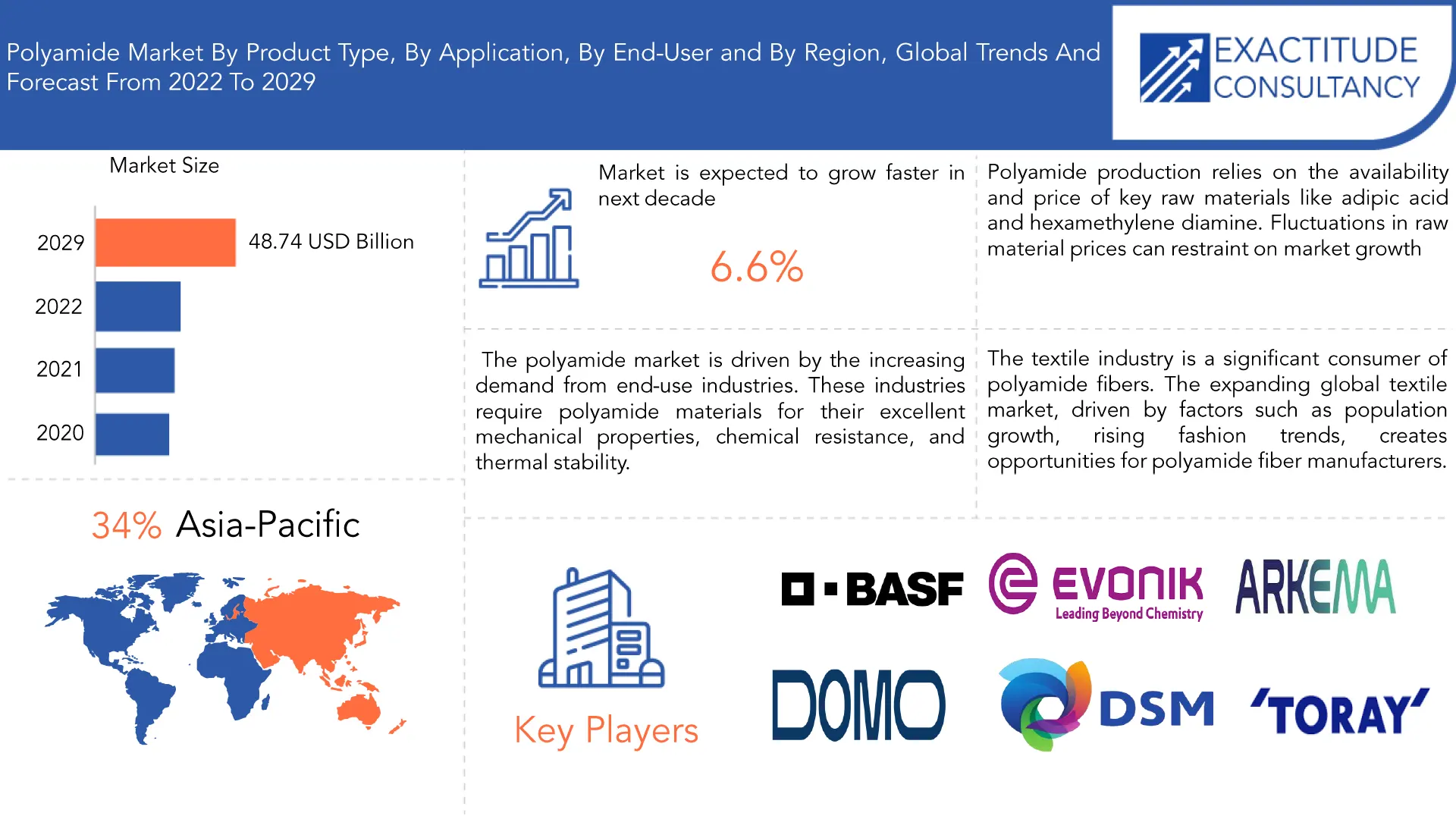
Der globale Polyamidmarkt soll von 30,36 Milliarden US-Dollar im Jahr 2020 auf 48,74 Milliarden US-Dollar im Jahr 2029 anwachsen und zwischen 2022 und 2029 eine durchschnittliche jährliche Wachstumsrate (CAGR) von 6,6 % aufweisen.
Polyamid ist ein flexibles Polymer , das in der Natur in Form von Wolle und Seide vorkommt. Das Produkt wird künstlich hergestellt und in zahlreichen Branchen eingesetzt, darunter Automobil-, Textil-, Verpackungs- , Elektronikteile-, Maschinen- und Beschichtungsindustrie . Polyamid ist für seine Wasserbeständigkeit bekannt. Polyamide kommen in der Natur in Wolle und Seide vor und werden unter anderem als Nylon, Polyamid 6 und Aramid synthetisiert. Verschleißfestigkeit, hohe mechanische Festigkeit, geringe Gasdurchlässigkeit und chemische Stabilität sind allesamt Merkmale synthetischer Polyamide. Biobasierte Polyamide werden aufgrund ihrer Umweltverträglichkeit immer beliebter.
[Bildunterschrift id="attachment_25780" align="aligncenter" width="1920"]
Viele Branchen verwenden wasserdichte Polyamidtextilien für eine Reihe von Produkten. Aufgrund seiner wasserdichten Eigenschaften wird es vor allem bei der Herstellung von Sport- und Outdoor-Kleidung eingesetzt. Auch die Textilindustrie profitiert erheblich von Polyamid. Seine außergewöhnliche Festigkeit und Haltbarkeit machen es zu einer ausgezeichneten Wahl für die Herstellung von Fasern für Kleidung, Teppiche und Polster. Polyamidgewebe bieten eine hervorragende Abriebfestigkeit und feuchtigkeitsableitende Eigenschaften und sorgen so für Langlebigkeit und Komfort in verschiedenen Anwendungen.
Polyamide weisen außerdem eine gute thermische Stabilität auf, d. h. sie können ihre strukturelle Integrität auch bei erhöhten Temperaturen beibehalten. Dank dieser Eigenschaft können sie Hitze standhalten, ohne sich zu verformen oder ihre mechanischen Eigenschaften zu verlieren. Daher werden Polyamide in Umgebungen mit hohen Temperaturen eingesetzt, beispielsweise in Motorkomponenten von Kraftfahrzeugen, elektrischen Steckverbindern und Industriemaschinen.
Die zunehmende Beliebtheit von Polyamid als technischer Kunststoff in verschiedenen Endverbrauchssektoren wie Automobil und Industrie/Maschinenbau wird voraussichtlich das weltweite Marktwachstum ankurbeln. Darüber hinaus wird die steigende Nachfrage nach Polyamid in den Bereichen Elektrik und Elektronik sowie Verpackung in den kommenden Jahren voraussichtlich das globale Marktwachstum ankurbeln. Darüber hinaus wird die erhebliche Expansion in der Konsumgüter- und Haushaltsgeräteindustrie in den kommenden Jahren voraussichtlich das potenzielle Marktwachstum ankurbeln. Die steigende Nachfrage nach diesen Artikeln sowohl in Schwellen- als auch in Industrieländern ist ein weiterer Faktor, der das weltweite Marktwachstum ankurbeln dürfte.
Die Volatilität der Rohstoffpreise ist eine der größten Hemmnisse auf dem Polyamidmarkt. Polyamide werden aus petrochemischen Rohstoffen hergestellt, und Preisschwankungen bei Rohöl und anderen Rohstoffen können einen direkten Einfluss auf die Herstellungskosten von Polyamidmaterialien haben. Diese Volatilität stellt für die Hersteller ein Problem dar, da sie zu unvorhersehbaren Gewinnspannen führen und Preisstrategien verändern kann.
Umweltbedenken und Nachhaltigkeitsprobleme stellen ebenfalls Einschränkungen für den Polyamidmarkt dar. Polyamide werden in der Regel aus nicht erneuerbaren Ressourcen gewonnen und sind nicht leicht biologisch abbaubar. Dies gibt Anlass zu Bedenken hinsichtlich ihrer langfristigen Umweltauswirkungen, insbesondere im Hinblick auf Abfallmanagement und Entsorgung am Ende der Lebensdauer. Da Nachhaltigkeit für Verbraucher und Aufsichtsbehörden zu einem immer wichtigeren Faktor wird, erforscht und entwickelt die Polyamidindustrie aktiv nachhaltigere Alternativen, wie z. B. biobasierte Polyamide und Recyclingtechnologien.
Angesichts der steigenden Nachfrage nach Leichtbaumaterialien in der Automobilindustrie bieten Polyamide eine überzeugende Lösung zur Gewichtsreduzierung und Verbesserung der Kraftstoffeffizienz . Der Drang nach Nachhaltigkeit schafft Möglichkeiten für biobasierte Polyamide aus erneuerbaren Ressourcen. Der Elektro- und Elektroniksektor sucht nach Polyamiden mit hervorragenden elektrischen Isoliereigenschaften.
| ATTRIBUT | DETAILS |
| Studiendauer | 2022–2029 |
| Basisjahr | 2022 |
| Geschätztes Jahr | 2023 |
| Voraussichtliches Jahr | 2023–2029 |
| Historischer Zeitraum | 2018-2022 |
| Einheit | Wert (Mrd. USD) Volumen (Kilotonnen) |
| Segmentierung | Nach Produkt, nach Anwendung, nach Endbenutzer, nach Region |
| Nach Produkt |
|
| Nach Anwendung |
|
| Nach Endbenutzer |
|
| Nach Region |
|
Frequently Asked Questions
• What is the worth of the polyamide market?
The global polyamide market is projected to reach USD 48.74 billion by 2029 from USD 30.36 billion in 2020, at a CAGR of 6.6 % from 2022 to 2029.
• What is the share of the Asia Pacific polyamide industry?
Asia Pacific dominates the polyamide market, with a market share of over 34%.
• Which are the top companies to hold the market share in the polyamide market?
BASF SE, DowDuPont Inc., Lanxess AG, Solvay S.A., Avient, Evonik Industries AG, Asahi Kasei Corporation, Arkema SA, Domo Chemical, Honeywell, Royal DSM, Toray Industries Inc., KOLON PLASTIC INC, AdvanSix are among the leading players in the global polyamide market.
• What is the CAGR of polyamide market?
The global polyamide market registered a CAGR of 6.6 % from 2022 to 2029.
• What are the key factors driving the market?
Increasing demand from the automotive sector, expansion in electrical and electronics applications, investments and R&D in bio-based and specialized polyamides, and an increase in disposable income are all projected to fuel polyamide adoption.
Polyamide Market Segment Analysis
The global polyamide market is segmented by product, application, end-user and region.
Based on product, the polyamide market is segmented into Polyamide 6, Polyamide 66, Bio-based Polyamide, Specialty Polyamide. Polyamide 6 segmental growth will account for the majority of market share. Its unique qualities make it a suitable product substitution for steel, bronze, brass, gunmetal, aluminium, and plastics, among others. Electrical protection device producers will also be able to expand into new markets. Furthermore, the incorporation of PA 6 from the luxury carpet sector, fishing nets, and travel accessories would boost polyamide 6 demand throughout the projection period.
[caption id="attachment_25781" align="aligncenter" width="1920"]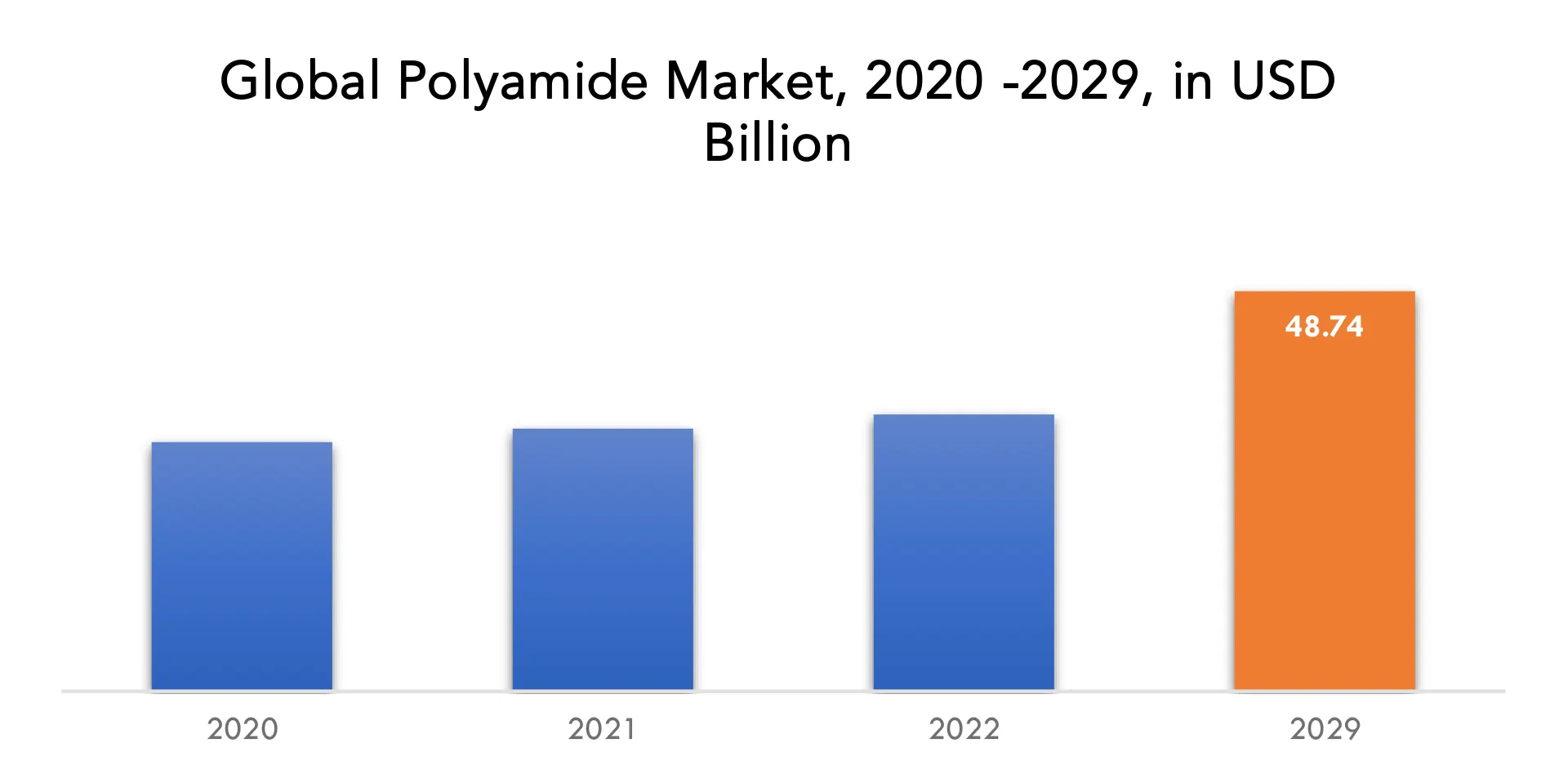
Based on application, the polyamide market is segmented into Engineering Plastics, Fibers. The engineering plastics can be further distributed across automotive, electronics and electrical, consumer goods and appliances, packaging, and others, while the fibers segment can be broken down into textile, carpet, and others. Engineering plastics will account for the largest segmental growth. Engineering plastics are a versatile group of materials known for their exceptional mechanical, thermal, and chemical properties. Polyamides, commonly referred to as nylons, are widely used in engineering plastics due to their high strength, toughness, and resistance to wear and abrasion.
Polyamide fibers, commonly known as nylon fibers, are widely used in the textile industry due to their exceptional strength, durability, and abrasion resistance. These fibers find applications in various textile products, including apparel, active wear, hosiery, industrial fabrics, and carpets.Based on end-user, the polyamide market is segmented into automotive, electrical & electronics, textile, construction, packaging, consumer goods, others. Automotive will account for the largest segmental growth. Polyamide integration in hydraulic clutch lines, headlamp bezels, automotive cooling systems, air intake manifolds, and airbag containers will increase the market value of the global polyamide market share. Furthermore, factors such as high mechanical qualities, wear resistance, and the growing need for lightweight automobiles will boost the market forward.
The electrical and electronics industry utilizes polyamides in engineering plastics and fibers. In engineering plastics, polyamides are used for electrical connectors, circuit boards, and other components due to their excellent electrical insulation and heat resistance properties. In the form of fibers, polyamides find applications in wire and cable insulation, protective coatings, and electronic device components.
Polyamide Market Key Players
The global polyamide market key players include BASF SE, DowDuPont Inc., Lanxess AG, Solvay S.A., Avient, Evonik Industries AG, Asahi Kasei Corporation, Arkema SA, Domo Chemical, Honeywell, Royal DSM, Toray Industries Inc., KOLON PLASTIC INC., AdvanSix. Recent News: April 27, 2023: Asahi Kasei and Microwave Chemical launched a joint demonstration project in April 2023 with the objective of commercializing a chemical recycling process for polyamide 661 (PA66, also called nylon 66) using microwave technology. December 12, 2022 – Avient Corporation announced an expansion to its range of polyketone (PK) based materials with new Comple PKE long fiber reinforced engineered thermoplastics. The new formulations broaden options for customers looking for strong mechanical performance to support demanding applications, even in cold environments.Polyamide Market Regional Analysis
The polyamide market by region includes North America, Asia-Pacific (APAC), Europe, South America, and Middle East & Africa (MEA).
- North America: includes the US, Canada, Mexico
- Asia Pacific: includes China, Japan, South Korea, India, Australia, ASEAN and Rest of APAC
- Europe: includes UK, Germany, France, Italy, Spain, Russia, and Rest of Europe
- South America: includes Brazil, Argentina and Rest of South America
- Middle East & Africa: includes Turkey, UAE, Saudi Arabia, South Africa, and Rest of MEA
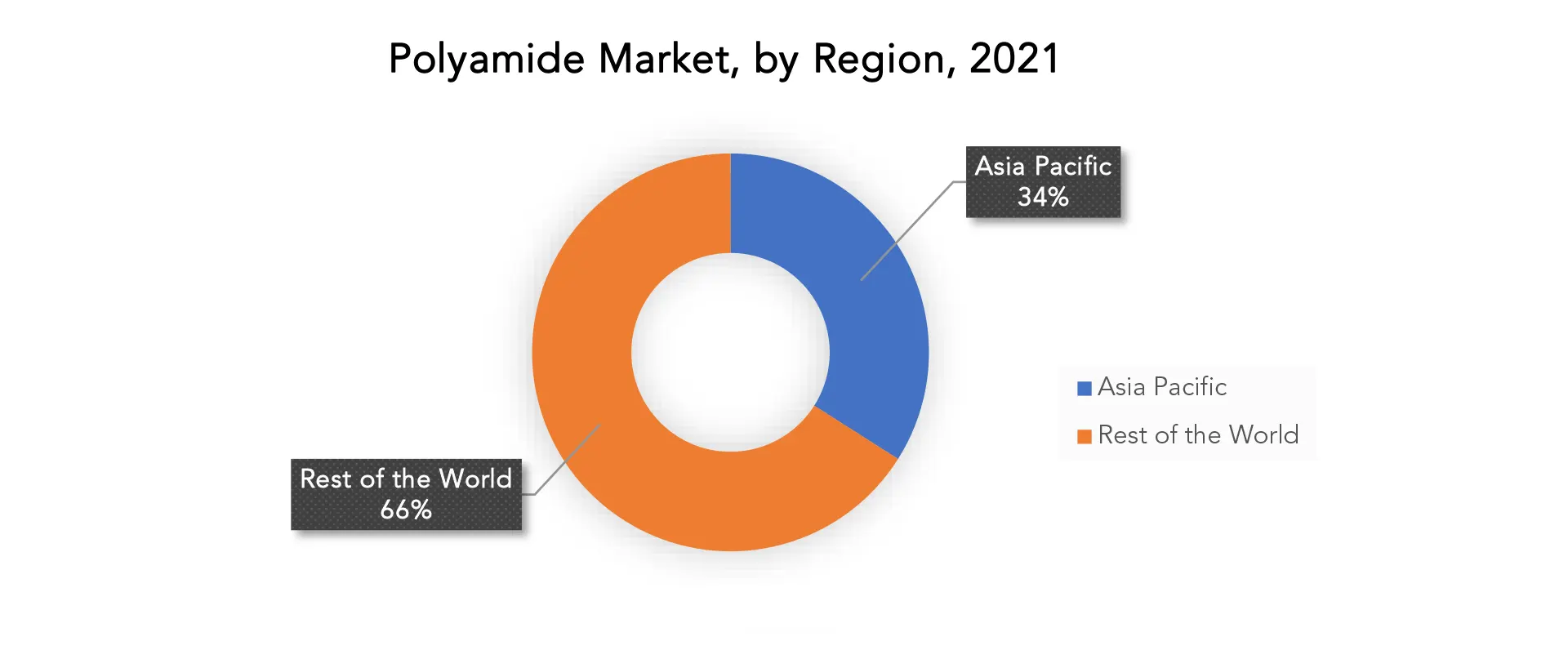
The Asia-Pacific region has seen the most development in the polyamide market, with rising usage in industries like as automotive, consumer products, and electrical and electronics. The region has seen a growth in demand for luxury automobiles as customers' spending power has improved, resulting in higher polyamide consumption in this area. China, as the major consumer, has considerably contributed to the rise of polyamides in the Asia-Pacific area.
Polyamide demand is increasing in the North and South American regions due to its use in the vehicle and electronics markets. North America is one of the world's most technologically sophisticated areas, particularly in terms of consumer electronics and other electronic items. Recent advancements have contributed in the expansion of the polyamide market in the electrical and electronics segment in North America.
Europe, the Middle East, and Africa are likely to expand faster in the next years as a result of increasing automotive sales; the government has intensified infrastructure construction operations. In Europe, the increased need for high-quality, long-lasting consumer electronics is driving up demand for polyamides. The electronics industry dominates the European polyamide market, followed by consumer products and appliances.
Key Market Segments: Polyamide Market
Polyamide Market by Product 2022-2029, (USD Billion) (Kilotons)- Polyamide 6
- Polyamide 66
- Bio-based Polyamide
- Specialty Polyamide
- Engineering Plastics
- Automotive
- Electronic and Electrical
- Consumer Goods and Appliances
- Packaging
- Others
- Fibers
- Textile
- Carpet
- Others
- Automotive
- Electrical & Electronics
- Textile
- Construction
- Packaging
- Consumer Goods
- Others
- North America
- Europe
- Asia Pacific
- South America
- MEA
Who Should Buy? Or Key stakeholders
- Polyamide Manufacturers
- Polyamide Traders, Suppliers, and Distributors
- Government and Research Organizations
- Material R&D Companies
- Associations and Industrial Bodies
- Feedstock Suppliers and Distributors
- Industry Associations
Key Question Answered
- What is the expected growth rate of the polyamide market over the next 7 years?
- Who are the major players in the polyamide market and what is their market share?
- What are the end-user industries driving demand for market and what is their outlook?
- What are the opportunities for growth in emerging markets such as Asia-Pacific, Middle East, and Africa?
- How is the economic environment affecting the polyamide market, including factors such as interest rates, inflation, and exchange rates?
- What is the expected impact of government policies and regulations on the polyamide market?
- What is the current and forecasted size and growth rate of the global polyamide market?
- What are the key drivers of growth in the polyamide market?
- What are the distribution channels and supply chain dynamics in the polyamide market?
- What are the technological advancements and innovations in the polyamide market and their impact on product development and growth?
- What are the regulatory considerations and their impact on the market?
- What are the challenges faced by players in the polyamide market and how are they addressing these challenges?
- What are the opportunities for growth and expansion in the polyamide market?
- What are the product offerings and specifications of leading players in the market?
- What is the pricing trend of polyamide in the market and what is the impact of raw material prices on the price trend?
Exactitude Consultancy Services Key Objectives:
- Increasing sales and market share
- Developing new technology
- Improving profitability
- Entering new markets
- Enhancing brand reputation
- EINFÜHRUNG
- MARKTDEFINITION
- MARKTSEGMENTIERUNG
- FORSCHUNGSZEITPLAN
- ANNAHMEN UND EINSCHRÄNKUNGEN
- FORSCHUNGSMETHODIK
- DATENMINING
- Sekundärforschung
- PRIMÄRFORSCHUNG
- RAT VON FACHEXPERTEN
- QUALITÄTSPRÜFUNGEN
- ABSCHLIESSENDE ÜBERPRÜFUNG
- DATENTRIANGULATION
- Bottom-Up-Ansatz
- TOP-DOWN-ANSATZ
- FORSCHUNGSABLAUF
- DATENQUELLEN
- DATENMINING
- ZUSAMMENFASSUNG
- MARKTÜBERSICHT
- GLOBAL POLYAMIDE MARKET OUTLOOK
- MARKET DRIVERS
- MARKET RESTRAINTS
- MARKET OPPORTUNITIES
- IMPACT OF COVID-19 ON POLYAMIDE MARKET
- PORTER’S FIVE FORCES MODEL
- THREAT FROM NEW ENTRANTS
- THREAT FROM SUBSTITUTES
- BARGAINING POWER OF SUPPLIERS
- BARGAINING POWER OF CUSTOMERS
- DEGREE OF COMPETITION
- INDUSTRY VALUE CHAIN ANALYSIS
- GLOBAL POLYAMIDE MARKET OUTLOOK
- GLOBAL POLYAMIDE MARKET BY PRODUCT TYPE, 2020-2029, (USD BILLION) (KILOTONS)
- POLYAMIDE 6
- POLYAMIDE 66
- BIO-BASED POLYAMIDE
- SPECIALTY POLYAMIDE
- GLOBAL POLYAMIDE MARKET BY APPLICATION, 2020-2029, (USD BILLION) (KILOTONS)
- ENGINEERING PLASTICS
- AUTOMOTIVE
- ELECTRONIC AND ELECTRICAL
- CONSUMER GOODS AND APPLIANCES
- PACKAGING
- OTHERS
- FIBERS
- TEXTILE
- CARPET
- OTHERS
- ENGINEERING PLASTICS
- GLOBAL POLYAMIDE MARKET BY END-USER, 2020-2029, (USD BILLION) (KILOTONS)
- AUTOMOTIVE
- ELECTRICAL & ELECTRONICS
- TEXTILE
- CONSTRUCTION
- PACKAGING
- CONSUMER GOODS
- OTHERS
- GLOBAL POLYAMIDE MARKET BY REGION, 2020-2029, (USD BILLION) (KILOTONS)
- NORTH AMERICA
- US
- CANADA
- MEXICO
- SOUTH AMERICA
- BRAZIL
- ARGENTINA
- COLOMBIA
- REST OF SOUTH AMERICA
- EUROPE
- GERMANY
- UK
- FRANCE
- ITALY
- SPAIN
- RUSSIA
- REST OF EUROPE
- ASIA PACIFIC
- INDIA
- CHINA
- JAPAN
- SOUTH KOREA
- AUSTRALIA
- SOUTH-EAST ASIA
- REST OF ASIA PACIFIC
- MIDDLE EAST AND AFRICA
- UAE
- SAUDI ARABIA
- SOUTH AFRICA
- REST OF MIDDLE EAST AND AFRICA
- NORTH AMERICA
- COMPANY PROFILES* (BUSINESS OVERVIEW, COMPANY SNAPSHOT, PRODUCT OFFERED, RECENT DEVELOPMENTS)
- BASF SE
- SOLVAY SA
- DOWDUPONT INC.
- EVONIK INDUSTRIES
- LANXESS AG
- AVIENT
- ASAHI KASEI CORPORATION
- ARKEMA SA
- DOMO CHEMICAL
- HONEYWELL
- ROYAL DSM
- TORAY INDUSTRIES INC.
- KOLON PLASTIC INC *THE COMPANY LIST IS INDICATIVE
LIST OF TABLES
TABLE 1 GLOBAL POLYAMIDE MARKET BY PRODUCT TYPE (USD BILLION) 2020-2029
TABLE 2 GLOBAL POLYAMIDE MARKET BY PRODUCT TYPE (KILOTONS) 2020-2029
TABLE 3 GLOBAL POLYAMIDE MARKET BY APPLICATION (USD BILLION) 2020-2029
TABLE 4 GLOBAL POLYAMIDE MARKET BY APPLICATION (KILOTONS) 2020-2029
TABLE 5 GLOBAL POLYAMIDE MARKET BY END-USER (USD BILLION) 2020-2029
TABLE 6 GLOBAL POLYAMIDE MARKET BY END-USER (KILOTONS) 2020-2029
TABLE 7 GLOBAL POLYAMIDE MARKET BY REGION (USD BILLION) 2020-2029
TABLE 8 GLOBAL POLYAMIDE MARKET BY REGION (KILOTONS) 2020-2029
TABLE 9 NORTH AMERICA POLYAMIDE MARKET BY COUNTRY (USD BILLION) 2020-2029
TABLE 10 NORTH AMERICA POLYAMIDE MARKET BY COUNTRY (KILOTONS) 2020-2029
TABLE 11 NORTH AMERICA POLYAMIDE MARKET BY PRODUCT TYPE (USD BILLION) 2020-2029
TABLE 12 NORTH AMERICA POLYAMIDE MARKET BY PRODUCT TYPE (KILOTONS) 2020-2029
TABLE 13 NORTH AMERICA POLYAMIDE MARKET BY APPLICATION (USD BILLION) 2020-2029
TABLE 14 NORTH AMERICA POLYAMIDE MARKET BY APPLICATION (KILOTONS) 2020-2029
TABLE 15 NORTH AMERICA POLYAMIDE MARKET BY END-USER (USD BILLION) 2020-2029
TABLE 16 NORTH AMERICA POLYAMIDE MARKET BY END-USER (KILOTONS) 2020-2029
TABLE 17 US POLYAMIDE MARKET BY PRODUCT TYPE (USD BILLION) 2020-2029
TABLE 18 US POLYAMIDE MARKET BY PRODUCT TYPE (KILOTONS) 2020-2029
TABLE 19 US POLYAMIDE MARKET BY APPLICATION (USD BILLION) 2020-2029
TABLE 20 US POLYAMIDE MARKET BY APPLICATION (KILOTONS) 2020-2029
TABLE 21 US POLYAMIDE MARKET BY END-USER (USD BILLION) 2020-2029
TABLE 22 US POLYAMIDE MARKET BY END-USER (KILOTONS) 2020-2029
TABLE 23 CANADA POLYAMIDE MARKET BY PRODUCT TYPE (USD BILLION) 2020-2029
TABLE 24 CANADA POLYAMIDE MARKET BY PRODUCT TYPE (KILOTONS) 2020-2029
TABLE 25 CANADA POLYAMIDE MARKET BY APPLICATION (USD BILLION) 2020-2029
TABLE 26 CANADA POLYAMIDE MARKET BY APPLICATION (KILOTONS) 2020-2029
TABLE 27 CANADA POLYAMIDE MARKET BY END-USER (USD BILLION) 2020-2029
TABLE 28 CANADA POLYAMIDE MARKET BY END-USER (KILOTONS) 2020-2029
TABLE 29 MEXICO POLYAMIDE MARKET BY PRODUCT TYPE (USD BILLION) 2020-2029
TABLE 30 MEXICO POLYAMIDE MARKET BY PRODUCT TYPE (KILOTONS) 2020-2029
TABLE 31 MEXICO POLYAMIDE MARKET BY APPLICATION (USD BILLION) 2020-2029
TABLE 32 MEXICO POLYAMIDE MARKET BY APPLICATION (KILOTONS) 2020-2029
TABLE 33 MEXICO POLYAMIDE MARKET BY END-USER (USD BILLION) 2020-2029
TABLE 34 MEXICO POLYAMIDE MARKET BY END-USER (KILOTONS) 2020-2029
TABLE 35 SOUTH AMERICA POLYAMIDE MARKET BY COUNTRY (USD BILLION) 2020-2029
TABLE 36 SOUTH AMERICA POLYAMIDE MARKET BY COUNTRY (KILOTONS) 2020-2029
TABLE 37 SOUTH AMERICA POLYAMIDE MARKET BY PRODUCT TYPE (USD BILLION) 2020-2029
TABLE 38 SOUTH AMERICA POLYAMIDE MARKET BY PRODUCT TYPE (KILOTONS) 2020-2029
TABLE 39 SOUTH AMERICA POLYAMIDE MARKET BY APPLICATION (USD BILLION) 2020-2029
TABLE 40 SOUTH AMERICA POLYAMIDE MARKET BY APPLICATION (KILOTONS) 2020-2029
TABLE 41 SOUTH AMERICA POLYAMIDE MARKET BY END-USER (USD BILLION) 2020-2029
TABLE 42 SOUTH AMERICA POLYAMIDE MARKET BY END-USER (KILOTONS) 2020-2029
TABLE 43 BRAZIL POLYAMIDE MARKET BY PRODUCT TYPE (USD BILLION) 2020-2029
TABLE 44 BRAZIL POLYAMIDE MARKET BY PRODUCT TYPE (KILOTONS) 2020-2029
TABLE 45 BRAZIL POLYAMIDE MARKET BY APPLICATION (USD BILLION) 2020-2029
TABLE 46 BRAZIL POLYAMIDE MARKET BY APPLICATION (KILOTONS) 2020-2029
TABLE 47 BRAZIL POLYAMIDE MARKET BY END-USER (USD BILLION) 2020-2029
TABLE 48 BRAZIL POLYAMIDE MARKET BY END-USER (KILOTONS) 2020-2029
TABLE 49 ARGENTINA POLYAMIDE MARKET BY PRODUCT TYPE (USD BILLION) 2020-2029
TABLE 50 ARGENTINA POLYAMIDE MARKET BY PRODUCT TYPE (KILOTONS) 2020-2029
TABLE 51 ARGENTINA POLYAMIDE MARKET BY APPLICATION (USD BILLION) 2020-2029
TABLE 52 ARGENTINA POLYAMIDE MARKET BY APPLICATION (KILOTONS) 2020-2029
TABLE 53 ARGENTINA POLYAMIDE MARKET BY END-USER (USD BILLION) 2020-2029
TABLE 54 ARGENTINA POLYAMIDE MARKET BY END-USER (KILOTONS) 2020-2029
TABLE 55 COLOMBIA POLYAMIDE MARKET BY PRODUCT TYPE (USD BILLION) 2020-2029
TABLE 56 COLOMBIA POLYAMIDE MARKET BY PRODUCT TYPE (KILOTONS) 2020-2029
TABLE 57 COLOMBIA POLYAMIDE MARKET BY APPLICATION (USD BILLION) 2020-2029
TABLE 58 COLOMBIA POLYAMIDE MARKET BY APPLICATION (KILOTONS) 2020-2029
TABLE 59 COLOMBIA POLYAMIDE MARKET BY END-USER (USD BILLION) 2020-2029
TABLE 60 COLOMBIA POLYAMIDE MARKET BY END-USER (KILOTONS) 2020-2029
TABLE 61 REST OF SOUTH AMERICA POLYAMIDE MARKET BY PRODUCT TYPE (USD BILLION) 2020-2029
TABLE 62 REST OF SOUTH AMERICA POLYAMIDE MARKET BY PRODUCT TYPE (KILOTONS) 2020-2029
TABLE 63 REST OF SOUTH AMERICA POLYAMIDE MARKET BY APPLICATION (USD BILLION) 2020-2029
TABLE 64 REST OF SOUTH AMERICA POLYAMIDE MARKET BY APPLICATION (KILOTONS) 2020-2029
TABLE 65 REST OF SOUTH AMERICA POLYAMIDE MARKET BY END-USER (USD BILLION) 2020-2029
TABLE 66 REST OF SOUTH AMERICA POLYAMIDE MARKET BY END-USER (KILOTONS) 2020-2029
TABLE 67 ASIA-PACIFIC POLYAMIDE MARKET BY COUNTRY (USD BILLION) 2020-2029
TABLE 68 ASIA-PACIFIC POLYAMIDE MARKET BY COUNTRY (KILOTONS) 2020-2029
TABLE 69 ASIA-PACIFIC POLYAMIDE MARKET BY PRODUCT TYPE (USD BILLION) 2020-2029
TABLE 70 ASIA-PACIFIC POLYAMIDE MARKET BY PRODUCT TYPE (KILOTONS) 2020-2029
TABLE 71 ASIA-PACIFIC POLYAMIDE MARKET BY APPLICATION (USD BILLION) 2020-2029
TABLE 72 ASIA-PACIFIC POLYAMIDE MARKET BY APPLICATION (KILOTONS) 2020-2029
TABLE 73 ASIA-PACIFIC POLYAMIDE MARKET BY END-USER (USD BILLION) 2020-2029
TABLE 74 ASIA-PACIFIC POLYAMIDE MARKET BY END-USER (KILOTONS) 2020-2029
TABLE 75 INDIA POLYAMIDE MARKET BY PRODUCT TYPE (USD BILLION) 2020-2029
TABLE 76 INDIA POLYAMIDE MARKET BY PRODUCT TYPE (KILOTONS) 2020-2029
TABLE 77 INDIA POLYAMIDE MARKET BY APPLICATION (USD BILLION) 2020-2029
TABLE 78 INDIA POLYAMIDE MARKET BY APPLICATION (KILOTONS) 2020-2029
TABLE 79 INDIA POLYAMIDE MARKET BY END-USER (USD BILLION) 2020-2029
TABLE 80 INDIA POLYAMIDE MARKET BY END-USER (KILOTONS) 2020-2029
TABLE 81 CHINA POLYAMIDE MARKET BY PRODUCT TYPE (USD BILLION) 2020-2029
TABLE 82 CHINA POLYAMIDE MARKET BY PRODUCT TYPE (KILOTONS) 2020-2029
TABLE 83 CHINA POLYAMIDE MARKET BY APPLICATION (USD BILLION) 2020-2029
TABLE 84 CHINA POLYAMIDE MARKET BY APPLICATION (KILOTONS) 2020-2029
TABLE 85 CHINA POLYAMIDE MARKET BY END-USER (USD BILLION) 2020-2029
TABLE 86 CHINA POLYAMIDE MARKET BY END-USER (KILOTONS) 2020-2029
TABLE 87 JAPAN POLYAMIDE MARKET BY PRODUCT TYPE (USD BILLION) 2020-2029
TABLE 88 JAPAN POLYAMIDE MARKET BY PRODUCT TYPE (KILOTONS) 2020-2029
TABLE 89 JAPAN POLYAMIDE MARKET BY APPLICATION (USD BILLION) 2020-2029
TABLE 90 JAPAN POLYAMIDE MARKET BY APPLICATION (KILOTONS) 2020-2029
TABLE 91 JAPAN POLYAMIDE MARKET BY END-USER (USD BILLION) 2020-2029
TABLE 92 JAPAN POLYAMIDE MARKET BY END-USER (KILOTONS) 2020-2029
TABLE 93 SOUTH KOREA POLYAMIDE MARKET BY PRODUCT TYPE (USD BILLION) 2020-2029
TABLE 94 SOUTH KOREA POLYAMIDE MARKET BY PRODUCT TYPE (KILOTONS) 2020-2029
TABLE 95 SOUTH KOREA POLYAMIDE MARKET BY APPLICATION (USD BILLION) 2020-2029
TABLE 96 SOUTH KOREA POLYAMIDE MARKET BY APPLICATION (KILOTONS) 2020-2029
TABLE 97 SOUTH KOREA POLYAMIDE MARKET BY END-USER (USD BILLION) 2020-2029
TABLE 98 SOUTH KOREA POLYAMIDE MARKET BY END-USER (KILOTONS) 2020-2029
TABLE 99 AUSTRALIA POLYAMIDE MARKET BY PRODUCT TYPE (USD BILLION) 2020-2029
TABLE 100 AUSTRALIA POLYAMIDE MARKET BY PRODUCT TYPE (KILOTONS) 2020-2029
TABLE 101 AUSTRALIA POLYAMIDE MARKET BY APPLICATION (USD BILLION) 2020-2029
TABLE 102 AUSTRALIA POLYAMIDE MARKET BY APPLICATION (KILOTONS) 2020-2029
TABLE 103 AUSTRALIA POLYAMIDE MARKET BY END-USER (USD BILLION) 2020-2029
TABLE 104 AUSTRALIA POLYAMIDE MARKET BY END-USER (KILOTONS) 2020-2029
TABLE 105 SOUTH-EAST ASIA POLYAMIDE MARKET BY PRODUCT TYPE (USD BILLION) 2020-2029
TABLE 106 SOUTH-EAST ASIA POLYAMIDE MARKET BY PRODUCT TYPE (KILOTONS) 2020-2029
TABLE 107 SOUTH-EAST ASIA POLYAMIDE MARKET BY APPLICATION (USD BILLION) 2020-2029
TABLE 108 SOUTH-EAST ASIA POLYAMIDE MARKET BY APPLICATION (KILOTONS) 2020-2029
TABLE 109 SOUTH-EAST ASIA POLYAMIDE MARKET BY END-USER (USD BILLION) 2020-2029
TABLE 110 SOUTH-EAST ASIA POLYAMIDE MARKET BY END-USER (KILOTONS) 2020-2029
TABLE 111 REST OF ASIA PACIFIC POLYAMIDE MARKET BY PRODUCT TYPE (USD BILLION) 2020-2029
TABLE 112 REST OF ASIA PACIFIC POLYAMIDE MARKET BY PRODUCT TYPE (KILOTONS) 2020-2029
TABLE 113 REST OF ASIA PACIFIC POLYAMIDE MARKET BY APPLICATION (USD BILLION) 2020-2029
TABLE 114 REST OF ASIA PACIFIC POLYAMIDE MARKET BY APPLICATION (KILOTONS) 2020-2029
TABLE 115 REST OF ASIA PACIFIC POLYAMIDE MARKET BY END-USER (USD BILLION) 2020-2029
TABLE 116 REST OF ASIA PACIFIC POLYAMIDE MARKET BY END-USER (KILOTONS) 2020-2029
TABLE 117 EUROPE POLYAMIDE MARKET BY COUNTRY (USD BILLION) 2020-2029
TABLE 118 EUROPE POLYAMIDE MARKET BY COUNTRY (KILOTONS) 2020-2029
TABLE 119 EUROPE POLYAMIDE MARKET BY PRODUCT TYPE (USD BILLION) 2020-2029
TABLE 120 EUROPE POLYAMIDE MARKET BY PRODUCT TYPE (KILOTONS) 2020-2029
TABLE 121 EUROPE POLYAMIDE MARKET BY APPLICATION (USD BILLION) 2020-2029
TABLE 122 EUROPE POLYAMIDE MARKET BY APPLICATION (KILOTONS) 2020-2029
TABLE 123 EUROPE POLYAMIDE MARKET BY END-USER (USD BILLION) 2020-2029
TABLE 124 EUROPE POLYAMIDE MARKET BY END-USER (KILOTONS) 2020-2029
TABLE 125 GERMANY POLYAMIDE MARKET BY PRODUCT TYPE (USD BILLION) 2020-2029
TABLE 126 GERMANY POLYAMIDE MARKET BY PRODUCT TYPE (KILOTONS) 2020-2029
TABLE 127 GERMANY POLYAMIDE MARKET BY APPLICATION (USD BILLION) 2020-2029
TABLE 128 GERMANY POLYAMIDE MARKET BY APPLICATION (KILOTONS) 2020-2029
TABLE 129 GERMANY POLYAMIDE MARKET BY END-USER (USD BILLION) 2020-2029
TABLE 130 GERMANY POLYAMIDE MARKET BY END-USER (KILOTONS) 2020-2029
TABLE 131 UK POLYAMIDE MARKET BY PRODUCT TYPE (USD BILLION) 2020-2029
TABLE 132 UK POLYAMIDE MARKET BY PRODUCT TYPE (KILOTONS) 2020-2029
TABLE 133 UK POLYAMIDE MARKET BY APPLICATION (USD BILLION) 2020-2029
TABLE 134 UK POLYAMIDE MARKET BY APPLICATION (KILOTONS) 2020-2029
TABLE 135 UK POLYAMIDE MARKET BY END-USER (USD BILLION) 2020-2029
TABLE 136 UK POLYAMIDE MARKET BY END-USER (KILOTONS) 2020-2029
TABLE 137 FRANCE POLYAMIDE MARKET BY PRODUCT TYPE (USD BILLION) 2020-2029
TABLE 138 FRANCE POLYAMIDE MARKET BY PRODUCT TYPE (KILOTONS) 2020-2029
TABLE 139 FRANCE POLYAMIDE MARKET BY APPLICATION (USD BILLION) 2020-2029
TABLE 140 FRANCE POLYAMIDE MARKET BY APPLICATION (KILOTONS) 2020-2029
TABLE 141 FRANCE POLYAMIDE MARKET BY END-USER (USD BILLION) 2020-2029
TABLE 142 FRANCE POLYAMIDE MARKET BY END-USER (KILOTONS) 2020-2029
TABLE 143 ITALY POLYAMIDE MARKET BY PRODUCT TYPE (USD BILLION) 2020-2029
TABLE 144 ITALY POLYAMIDE MARKET BY PRODUCT TYPE (KILOTONS) 2020-2029
TABLE 145 ITALY POLYAMIDE MARKET BY APPLICATION (USD BILLION) 2020-2029
TABLE 146 ITALY POLYAMIDE MARKET BY APPLICATION (KILOTONS) 2020-2029
TABLE 147 ITALY POLYAMIDE MARKET BY END-USER (USD BILLION) 2020-2029
TABLE 148 ITALY POLYAMIDE MARKET BY END-USER (KILOTONS) 2020-2029
TABLE 149 SPAIN POLYAMIDE MARKET BY PRODUCT TYPE (USD BILLION) 2020-2029
TABLE 150 SPAIN POLYAMIDE MARKET BY PRODUCT TYPE (KILOTONS) 2020-2029
TABLE 151 SPAIN POLYAMIDE MARKET BY APPLICATION (USD BILLION) 2020-2029
TABLE 152 SPAIN POLYAMIDE MARKET BY APPLICATION (KILOTONS) 2020-2029
TABLE 153 SPAIN POLYAMIDE MARKET BY END-USER (USD BILLION) 2020-2029
TABLE 154 SPAIN POLYAMIDE MARKET BY END-USER (KILOTONS) 2020-2029
TABLE 155 RUSSIA POLYAMIDE MARKET BY PRODUCT TYPE (USD BILLION) 2020-2029
TABLE 156 RUSSIA POLYAMIDE MARKET BY PRODUCT TYPE (KILOTONS) 2020-2029
TABLE 157 RUSSIA POLYAMIDE MARKET BY APPLICATION (USD BILLION) 2020-2029
TABLE 158 RUSSIA POLYAMIDE MARKET BY APPLICATION (KILOTONS) 2020-2029
TABLE 159 RUSSIA POLYAMIDE MARKET BY END-USER (USD BILLION) 2020-2029
TABLE 160 RUSSIA POLYAMIDE MARKET BY END-USER (KILOTONS) 2020-2029
TABLE 161 REST OF EUROPE POLYAMIDE MARKET BY PRODUCT TYPE (USD BILLION) 2020-2029
TABLE 162 REST OF EUROPE POLYAMIDE MARKET BY PRODUCT TYPE (KILOTONS) 2020-2029
TABLE 163 REST OF EUROPE POLYAMIDE MARKET BY APPLICATION (USD BILLION) 2020-2029
TABLE 164 REST OF EUROPE POLYAMIDE MARKET BY APPLICATION (KILOTONS) 2020-2029
TABLE 165 REST OF EUROPE POLYAMIDE MARKET BY END-USER (USD BILLION) 2020-2029
TABLE 166 REST OF EUROPE POLYAMIDE MARKET BY END-USER (KILOTONS) 2020-2029
TABLE 167 MIDDLE EAST AND AFRICA POLYAMIDE MARKET BY COUNTRY (USD BILLION) 2020-2029
TABLE 168 MIDDLE EAST AND AFRICA POLYAMIDE MARKET BY COUNTRY (KILOTONS) 2020-2029
TABLE 169 MIDDLE EAST AND AFRICA POLYAMIDE MARKET BY PRODUCT TYPE (USD BILLION) 2020-2029
TABLE 170 MIDDLE EAST AND AFRICA POLYAMIDE MARKET BY PRODUCT TYPE (KILOTONS) 2020-2029
TABLE 171 MIDDLE EAST AND AFRICA POLYAMIDE MARKET BY APPLICATION (USD BILLION) 2020-2029
TABLE 172 MIDDLE EAST AND AFRICA POLYAMIDE MARKET BY APPLICATION (KILOTONS) 2020-2029
TABLE 173 MIDDLE EAST AND AFRICA POLYAMIDE MARKET BY END-USER (USD BILLION) 2020-2029
TABLE 174 MIDDLE EAST AND AFRICA POLYAMIDE MARKET BY END-USER (KILOTONS) 2020-2029
TABLE 175 UAE POLYAMIDE MARKET BY PRODUCT TYPE (USD BILLION) 2020-2029
TABLE 176 UAE POLYAMIDE MARKET BY PRODUCT TYPE (KILOTONS) 2020-2029
TABLE 177 UAE POLYAMIDE MARKET BY APPLICATION (USD BILLION) 2020-2029
TABLE 178 UAE POLYAMIDE MARKET BY APPLICATION (KILOTONS) 2020-2029
TABLE 179 UAE POLYAMIDE MARKET BY END-USER (USD BILLION) 2020-2029
TABLE 180 UAE POLYAMIDE MARKET BY END-USER (KILOTONS) 2020-2029
TABLE 181 SAUDI ARABIA POLYAMIDE MARKET BY PRODUCT TYPE (USD BILLION) 2020-2029
TABLE 182 SAUDI ARABIA POLYAMIDE MARKET BY PRODUCT TYPE (KILOTONS) 2020-2029
TABLE 183 SAUDI ARABIA POLYAMIDE MARKET BY APPLICATION (USD BILLION) 2020-2029
TABLE 184 SAUDI ARABIA POLYAMIDE MARKET BY APPLICATION (KILOTONS) 2020-2029
TABLE 185 SAUDI ARABIA POLYAMIDE MARKET BY END-USER (USD BILLION) 2020-2029
TABLE 186 SAUDI ARABIA POLYAMIDE MARKET BY END-USER (KILOTONS) 2020-2029
TABLE 187 SOUTH AFRICA POLYAMIDE MARKET BY PRODUCT TYPE (USD BILLION) 2020-2029
TABLE 188 SOUTH AFRICA POLYAMIDE MARKET BY PRODUCT TYPE (KILOTONS) 2020-2029
TABLE 189 SOUTH AFRICA POLYAMIDE MARKET BY APPLICATION (USD BILLION) 2020-2029
TABLE 190 SOUTH AFRICA POLYAMIDE MARKET BY APPLICATION (KILOTONS) 2020-2029
TABLE 191 SOUTH AFRICA POLYAMIDE MARKET BY END-USER (USD BILLION) 2020-2029
TABLE 192 SOUTH AFRICA POLYAMIDE MARKET BY END-USER (KILOTONS) 2020-2029
TABLE 193 REST OF MIDDLE EAST AND AFRICA POLYAMIDE MARKET BY PRODUCT TYPE (USD BILLION) 2020-2029
TABLE 194 REST OF MIDDLE EAST AND AFRICA POLYAMIDE MARKET BY PRODUCT TYPE (KILOTONS) 2020-2029
TABLE 195 REST OF MIDDLE EAST AND AFRICA POLYAMIDE MARKET BY APPLICATION (USD BILLION) 2020-2029
TABLE 196 REST OF MIDDLE EAST AND AFRICA POLYAMIDE MARKET BY APPLICATION (KILOTONS) 2020-2029
TABLE 197 REST OF MIDDLE EAST AND AFRICA POLYAMIDE MARKET BY END-USER (USD BILLION) 2020-2029
TABLE 198 REST OF MIDDLE EAST AND AFRICA POLYAMIDE MARKET BY END-USER (KILOTONS) 2020-2029
LIST OF FIGURES
FIGURE 1 MARKET DYNAMICS
FIGURE 2 MARKET SEGMENTATION
FIGURE 3 REPORT TIMELINES: YEARS CONSIDERED
FIGURE 4 DATA TRIANGULATION
FIGURE 5 BOTTOM-UP APPROACH
FIGURE 6 TOP-DOWN APPROACH
FIGURE 7 RESEARCH FLOW
FIGURE 8 GLOBAL POLYAMIDE MARKET BY PRODUCT TYPE (USD BILLION) 2020-2029
FIGURE 9 GLOBAL POLYAMIDE MARKET BY APPLICATION (USD BILLION) 2020-2029
FIGURE 10 GLOBAL POLYAMIDE MARKET BY END-USER (USD BILLION) 2020-2029
FIGURE 11 GLOBAL POLYAMIDE MARKET BY REGION (USD BILLION) 2020-2029
FIGURE 12 PORTER’S FIVE FORCES MODEL
FIGURE 13 GLOBAL POLYAMIDE MARKET BY PRODUCT TYPE (USD BILLION) 2021
FIGURE 14 GLOBAL POLYAMIDE MARKET BY APPLICATION (USD BILLION) 2021
FIGURE 15 GLOBAL POLYAMIDE MARKET BY END-USER (USD BILLION) 2021
FIGURE 16 GLOBAL POLYAMIDE MARKET BY REGION (USD BILLION) 2021
FIGURE 17 MARKET SHARE ANALYSIS
FIGURE 18 BASF SE: COMPANY SNAPSHOT
FIGURE 19 DOWDUPONT INC.: COMPANY SNAPSHOT
FIGURE 20 LANXESS AG: COMPANY SNAPSHOT
FIGURE 21 SOLVAY S.A.: COMPANY SNAPSHOT
FIGURE 22 AVIENT: COMPANY SNAPSHOT
FIGURE 23 EVONIK INDUSTRIES AG: COMPANY SNAPSHOT
FIGURE 24 ASAHI KASEI CORPORATION: COMPANY SNAPSHOT
FIGURE 25 ARKEMA SA: COMPANY SNAPSHOT
FIGURE 26 DOMO CHEMICAL: COMPANY SNAPSHOT
FIGURE 27 HONEYWELL: COMPANY SNAPSHOT
FIGURE 28 ROYAL DSM: COMPANY SNAPSHOT
FIGURE 29 TORAY INDUSTRIES INC.: COMPANY SNAPSHOT
FIGURE 30 KOLON PLASTIC INC: COMPANY SNAPSHOT
DOWNLOAD FREE SAMPLE REPORT
License Type
SPEAK WITH OUR ANALYST
Want to know more about the report or any specific requirement?
WANT TO CUSTOMIZE THE REPORT?
Our Clients Speak
We asked them to research ‘ Equipment market’ all over the world, and their whole arrangement was helpful to us. thehealthanalytics.com insightful analysis and reports contributed to our current analysis and in creating a future strategy. Besides, the te
Yosuke Mitsui
Senior Associate Construction Equipment Sales & Marketing
We asked them to research ‘Equipment market’ all over the world, and their whole arrangement was helpful to us. thehealthanalytics.com insightful analysis and reports contributed to our current analysis and in creating a future strategy. Besides, the te