

Base Year Value ()
x.x %
x.x %
CAGR ()
x.x %
x.x %
Forecast Year Value ()
x.x %
x.x %
Historical Data Period
Largest Region
Forecast Period
Markt für Biotenside nach Typ (Glykolipide, Lipopeptide und Lipoproteine, Phospholipide, Polymere, Sonstige), Anwendung (Körperpflege, Industriereiniger und -waschmittel, Lebensmittelverarbeitung, Ölfeldindustrie, Agrarchemikalien, Sonstige) und nach Region – Globale Trends und Prognose von 2022 bis 2029
Instant access to hundreds of data points and trends
- Market estimates from 2014-2029
- Competitive analysis, industry segmentation, financial benchmarks
- Incorporates SWOT, Porter's Five Forces and risk management frameworks
- PDF report or online database with Word, Excel and PowerPoint export options
- 100% money back guarantee
Marktübersicht für Biotenside
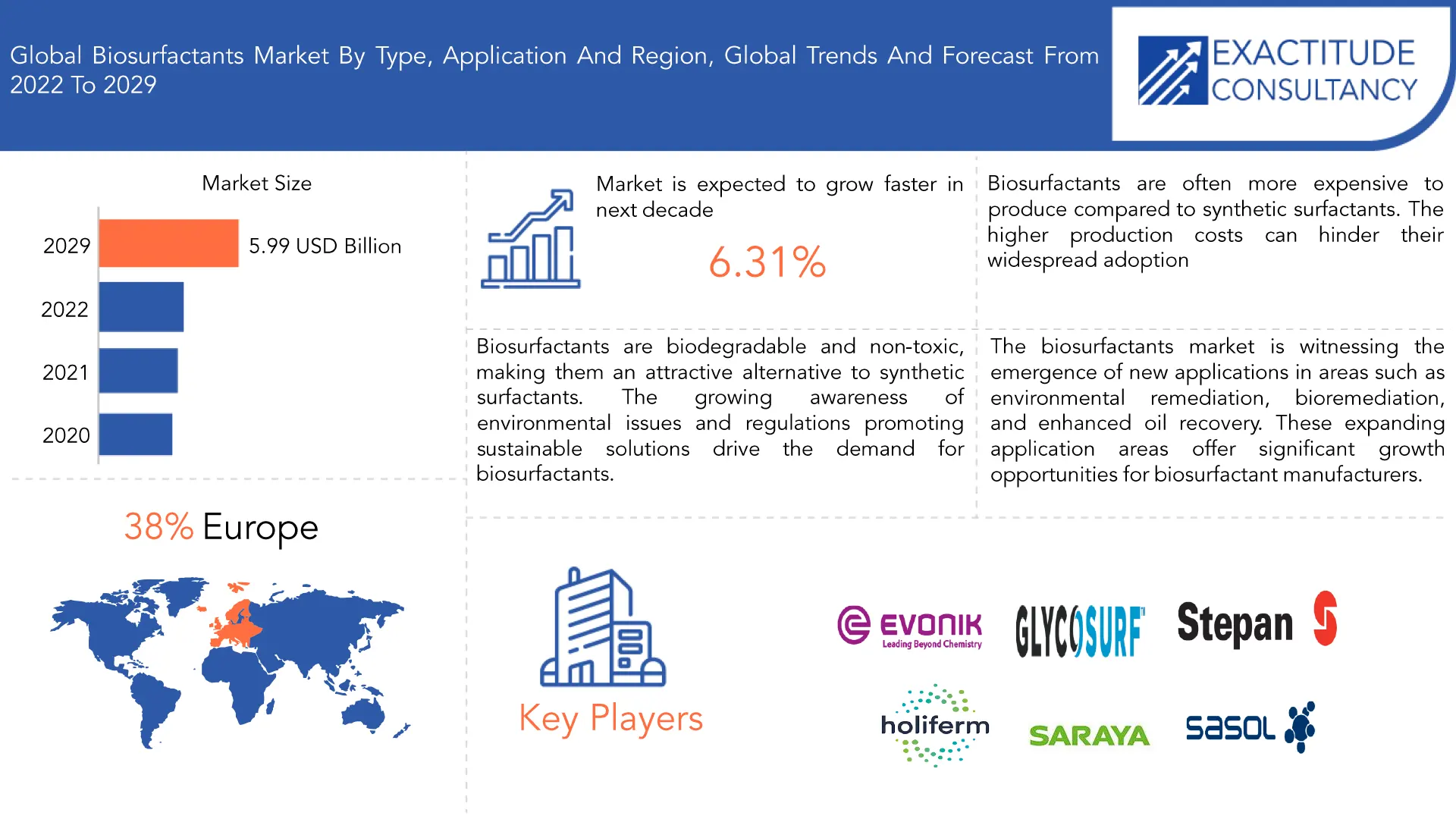
Der globale Markt für Biotenside soll von 3,73 Milliarden US-Dollar im Jahr 2020 auf 5,99 Milliarden US-Dollar im Jahr 2029 anwachsen und zwischen 2022 und 2029 eine durchschnittliche jährliche Wachstumsrate (CAGR) von 6,31 % aufweisen.
Biotenside werden auch als mikrobielle Tenside bezeichnet. Biotenside sind amphiphile Chemikalien. Dabei handelt es sich um oberflächenaktive Biomoleküle, die von Mikroben mit einzigartigen Umwelteigenschaften erzeugt werden. Reinigungsmittel, Netzmittel, Schaummittel und Emulgatoren sind weitere Beispiele für Biotenside. Biotenside können praktisch jedes synthetische Tensid ersetzen und bieten dabei neue physikochemischen Eigenschaften. Kunden werden von Biotensiden aufgrund ihrer besonderen Eigenschaften angezogen, wie z. B. geringe Toxizität, Präzision, hohe biologische Abbaubarkeit , antibakterielle, antimykotische und antivirale Eigenschaften. Biotenside vergrößern die Oberfläche hydrophober, wasserunlöslicher Substrate, die von Organismen zum Wachstum verwendet werden, und sind bei biologischem Abbau, Biosanierung und Biokontrollprozessen nützlich.
Biotenside werden aufgrund der verschiedenen Gesundheitsrisiken, die mit der Verwendung synthetischer Chemikalien verbunden sind, schrittweise abgeschafft . Biotenside werden aufgrund ihrer Eigenschaften wie Emulgierung, Schaumbildung, Dispersion, Benetzung, Penetration, Verdickung, mikrobielle Wachstumsstimulanzien und antimikrobielle Wirkung in einer Vielzahl landwirtschaftlicher Anwendungen eingesetzt. Biotenside sind umweltfreundliche Tenside, die häufig von Bakterien, Hefen und Pilzen erzeugt werden. Sie werden in landwirtschaftlichen Anwendungen eingesetzt, da sie weniger schädlich und besser für die Umwelt sind. Bei der Bodensanierung werden Biotenside eingesetzt, um die Bodenqualität zu verbessern. Sie fungieren als Mobilisierungsmittel und erhöhen die Löslichkeit chemischer Substanzen, die ein biologisches Risiko darstellen.
Die steigende Nachfrage nach Biotensiden in einer Vielzahl von Anwendungen wie Seifen und Reinigungsmitteln, Körperpflegemitteln und Industriereinigungen wird voraussichtlich die Aussichten der Branche verbessern. Das Bewusstsein der Verbraucher für umweltfreundliche Optionen bei Körperpflege- und Kosmetikprodukten wird die Marktnachfrage im Prognosezeitraum ankurbeln. Aufgrund seiner umweltfreundlichen, ungiftigen und biologisch abbaubaren Eigenschaften floriert der Sektor. Der globale Markt für Biotenside wächst aufgrund einer Reihe mikro- und makroökonomischer Variablen. Die wachsende Nachfrage aus dem Textilsektor ist einer der Haupttreiber der Marktexpansion.
[Bildunterschrift id="attachment_26084" align="aligncenter" width="1920"]
Die Fähigkeit von Biotensiden, Textilien zu durchdringen, ist der Grund für die gestiegene Nachfrage nach ihnen in der Textilindustrie. Biotenside haben die Fähigkeit, Mizellen zu bilden, die dann mit Wasser und Öl reagieren können. Diese Interaktion hilft bei der Entfernung hartnäckiger und tiefer Flecken aus Textilien, die durch Schokolade, Tee, Wachse, Öle und andere Substanzen verursacht werden. Darüber hinaus wird der weltweite Markt für Biotenside durch eine steigende Nachfrage nach Haushaltsseifen und Reinigungsmitteln unterstützt, da sich die Menschen für einen besseren Lebensstil entscheiden. Da diese Emulsionen ätherische Öle und natürliche Antioxidantien enthalten, eignen sie sich besser für Biokosmetik.
Die hohen Herstellungskosten der Biotensid-Hersteller sind einer der Hauptfaktoren, die das Wachstum des Biotensid-Marktes einschränken. Aufgrund der hohen Anschaffungskosten wurde bisher keine großtechnische Produktion von Biotensiden durchgeführt. Die Umweltbedingungen spielen bei der Herstellung und den Eigenschaften von Biotensiden eine entscheidende Rolle. Rohstoffknappheit und überhöhte Preise dürften die Marktexpansion behindern. Die hohen Herstellungskosten traditioneller chemischer Tenside und biobasierter Tenside sind ein wichtiger Faktor, der das Wachstum des globalen Biotensid-Marktes einschränkt.
Biotenside sind oberflächenaktive Verbindungen, die von Mikroorganismen produziert werden und eine nachhaltige und umweltfreundliche Alternative zu herkömmlichen Tensiden aus petrochemischen Quellen darstellen. Dieser aufstrebende Markt wird von verschiedenen Faktoren angetrieben, darunter der wachsenden Nachfrage nach umweltfreundlichen und biologisch abbaubaren Lösungen in Branchen wie Kosmetik, Pharmazie, Landwirtschaft sowie Öl und Gas. Biotenside weisen bemerkenswerte Eigenschaften auf, darunter geringe Toxizität, hohe biologische Abbaubarkeit und hervorragende Leistung in verschiedenen Anwendungen wie Emulgierung, Reinigung, Schaumbildung und Benetzung. Darüber hinaus besitzen sie einzigartige Eigenschaften wie antimikrobielle und antiadhäsive Eigenschaften, was sie ideal für Anwendungen in Gesundheits- und Körperpflegeprodukten macht.
| ATTRIBUT | DETAILS |
| Studiendauer | 2022–2029 |
| Basisjahr | 2022 |
| Geschätztes Jahr | 2023 |
| Voraussichtliches Jahr | 2023–2029 |
| Historischer Zeitraum | 2018-2022 |
| Einheit | Wert (Mrd. USD) Volumen (Kilotonnen) |
| Segmentierung | Nach Typ, nach Anwendung, nach Region |
| Nach Produkt |
|
| Nach Anwendung |
|
| Nach Region |
|
Frequently Asked Questions
• What is the worth of the biosurfactants market?
The global biosurfactants market is projected to reach USD 5.99 billion by 2029 from USD 3.73 billion in 2020, at a CAGR of 6.31 % from 2022 to 2029.
• What is the share of the Europe biosurfactants industry?
Europe dominates the biosurfactants market, with a market share of over 38%.
• Which are the top companies to hold the market share in the biosurfactants market?
Jeneil, Evonik Industries, AGAE Technologies, Glycosurf, Tensiogreen, Stepan Company, Holiferm, Saraya Co., Soliance, Sasol Chemicals, Solvay are among the leading players in the global biosurfactants market.
• What is the CAGR of biosurfactants market?
The global biosurfactants market registered a CAGR of 6.31 % from 2022 to 2029.
• What are the key factors driving the market?
Growing consumer awareness of environmentally friendly and sustainable product alternatives, emerging trends and novel strategies related to biosurfactant manufacturing or industrial production processes, and increased demand from end-use industries are key factors driving the global biosurfactants market's growth.
Biosurfactants Market Segment Analysis
The global biosurfactants market is segmented by type, application and region.
Based on type, the biosurfactants market is segmented into glycolipids, lipopeptides & lipoproteins, phospholipids, polymeric, others. The glycolipid surfactant category accounted for a sizable sales share in 2021. Glycolipids are the most extensively researched low-molecular-weight biosurfactants derived from hydrocarbons and industrial waste. Due to their capacity to diminish surface and interfacial tension and their substantial participation in disrupting biological membranes via the formation of ion channels and holes, glycolipids have been discovered to be particularly efficient against bacteria, viruses, mycoplasma, and fungus. Glycolipids regulate enzyme activity by activating or inhibiting enzymes in a variety of biotechnological processes. They're also used in cosmetics due to their ability to moisturize and anti-adhesive characteristics, which keep microbes from adhering to them.
Rhamnolipids (RLs) are surface-active chemicals that are a kind of glycolipid biosurfactant produced largely by Pseudomonas aeruginosa. Due to their non-toxicity, excellent biodegradability, low surface tension, and low inhibitory concentration values, they have uses in the food, healthcare, pharmaceutical, and petrochemical sectors. Rhamnolipids are effective therapeutic ingredients due to their ecologically friendly biological properties.
Based on application, the biosurfactants market is classified into personal care, industrial cleaners & detergents, food processing, oilfield industry, agriculture chemicals, others. The personal care category had the highest revenue share in 2021. Increasing demand from the skincare and cosmetics sectors is a major element driving this segment's growth. Biosurfactants have showed significant promise in terms of low toxicity, biocompatibility, skin protection, and surface moisturizing, all of which are crucial components of an effective skincare regimen. Furthermore, biosurfactants offer important physiochemical properties that are essential for skin health care.
The industrial cleansers and detergents industry is predicted to have substantial growth in revenue during the forecasted period. They reduce the surface tension of two normally unmixable liquids, allowing them to blend. Microorganisms in bio-enzymatic cleaner may degrade oil molecules when two solutions are mixed together, assisting in stain elimination. Furthermore, biosurfactants in bio-enzymatic cleansers, such as conventional cleaners without bacteria, can break up stains and lift them off a surface in the same way as synthetic surfactants do, making stain removal simpler.
[caption id="attachment_26088" align="aligncenter" width="1920"]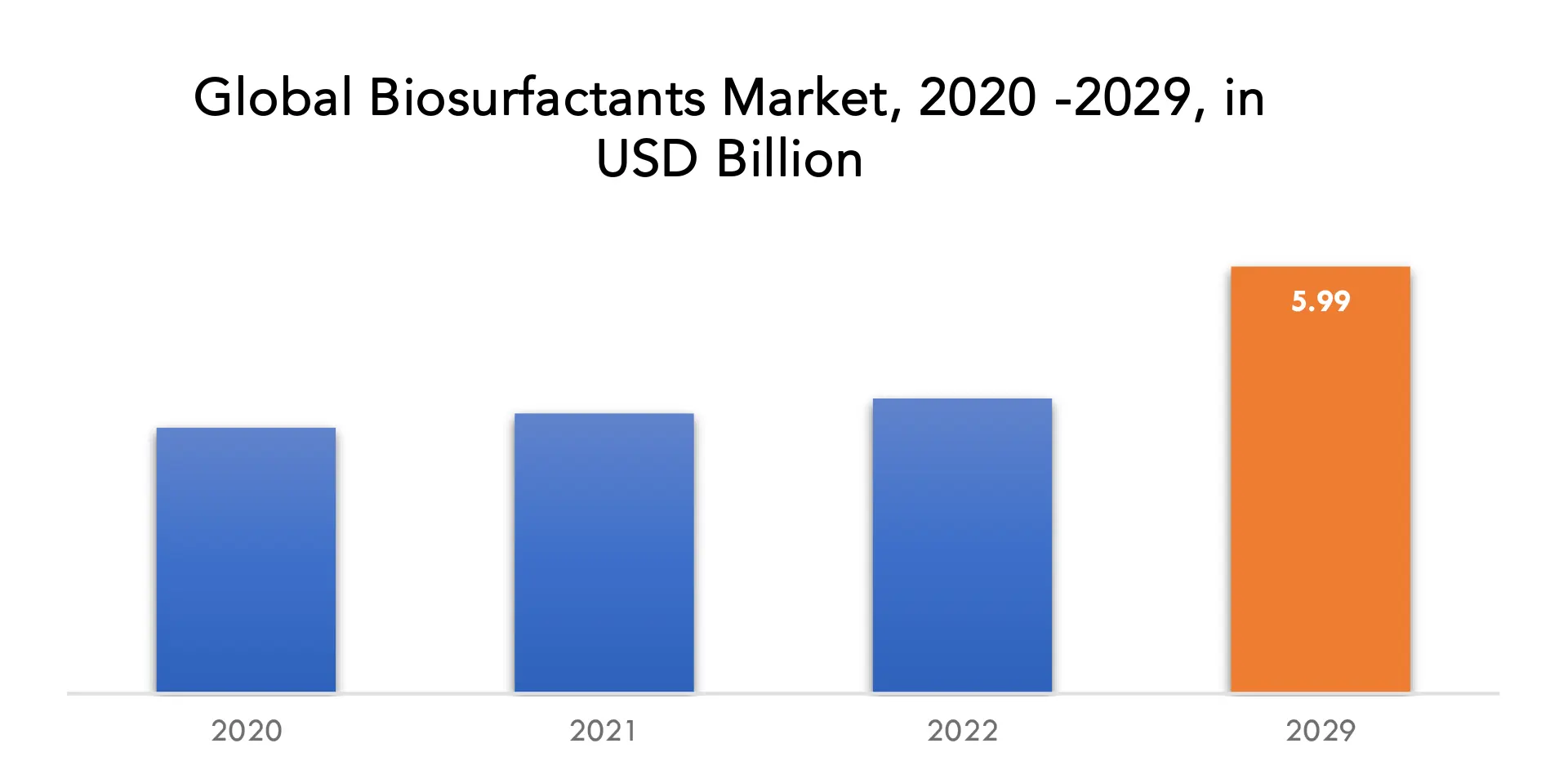
Biosurfactants Market Players
The global biosurfactants market key players include Jeneil, Evonik Industries, AGAE Technologies, Glycosurf, Tensiogreen, Stepan Company, Holiferm, Saraya Co., Soliance, Sasol Chemicals, Solvay.
25 January, 2023: Holiferm Limited and Sasol Chemicals, a business unit of Sasol Ltd. (JSE: SOL; NYSE: SSL), announced a collaboration to produce and market rhamnolipids and mannosylerythritol lipids (MELs). Jun 14, 2022: Solvay, a leading supplier of cosmetic ingredients, introduced Mirasoft® SL L60 and Mirasoft® SL A60 - two new high-performance biosurfactants that enable the development of sustainable beauty care products.Who Should Buy? Or Key stakeholders
- Manufacturers and suppliers of biosurfactants
- Industries and sectors using surfactants
- Research institutions and academia
- Regulatory agencies and policymakers
- Environmental and sustainability organizations
- Investors and financial institutions
- End-users and consumers
- Trade associations and industry groups
- Consultants and market research firms
Biosurfactants Market Regional Analysis
The biosurfactants market by region includes North America, Asia-Pacific (APAC), Europe, South America, and Middle East & Africa (MEA).- North America: includes the US, Canada, Mexico
- Asia Pacific: includes China, Japan, South Korea, India, Australia, ASEAN and Rest of APAC
- Europe: includes UK, Germany, France, Italy, Spain, Russia, and Rest of Europe
- South America: includes Brazil, Argentina and Rest of South America
- Middle East & Africa: includes Turkey, UAE, Saudi Arabia, South Africa, and Rest of MEA
Europe will have the highest revenue share in 2021. The main factors driving market expansion in this area is an increase in R&D efforts and government-funded research programmers in the field of green surfactants. Furthermore, increased manufacturer knowledge of the usage of green surfactant alternatives to minimize carbon output is likely to fuel market expansion. Waste2Func, a BBI-JU-funded European project, has been awarded EURO 6.7 million to develop a technology platform that will collect waste from farmers, food production, supermarkets, auctions, and restaurants and ferment and purify it into lactic acid and biosurfactants for use in cosmetics, personal care, and household care products. Furthermore, as regulatory requirements tighten, biosurfactants are becoming more commonly regarded as a viable alternative to synthetic surfactants, which is expected to boost market expansion.
The Asia Pacific market will account for the second greatest revenue share in 2021.Given its lower surface area and interfacial tension of immiscible fluids, which enhances solubility and sorption of hydrophobic pesticide contaminants, the biosurfactant market is growing in this region, particularly in India, Japan, and China. Furthermore, the pesticide industry commonly uses them as an emulsifiable concentrate in pesticide formulations. In 2021, the North American market accounted for the third-largest revenue share. The growing presence of significant industry participants and others is driving market expansion in this area.
[caption id="attachment_26089" align="aligncenter" width="1920"]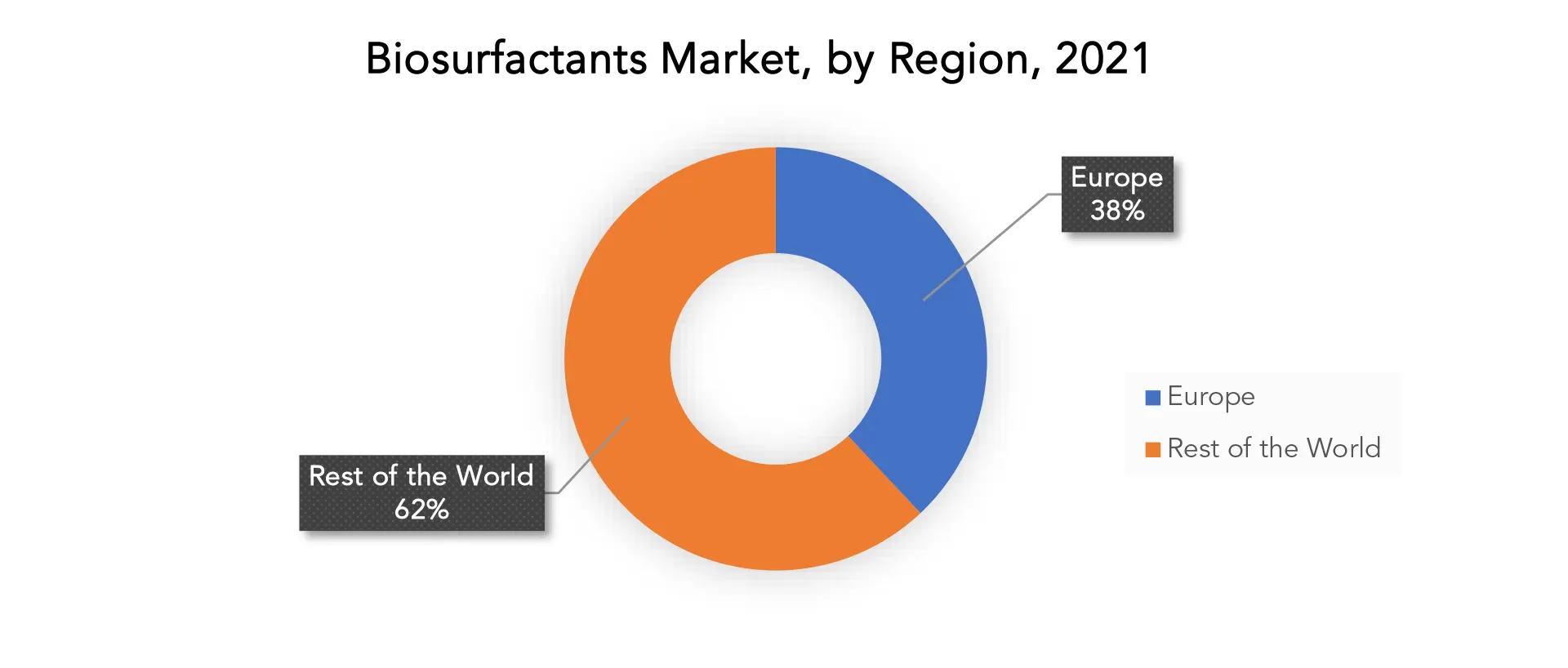
Key Market Segments: Biosurfactants Market
Biosurfactants Market by Type 2022-2029, (USD Billion) (Kilotons)- Glycolipids
- Lipopeptides & Lipoproteins
- Phospholipids
- Polymeric
- Others
- Personal Care
- Industrial Cleaners & Detergents
- Food Processing
- Oilfield Industry
- Agriculture Chemicals
- Others
- North America
- Europe
- Asia Pacific
- South America
- Middle East and Africa
Exactitude Consultancy Services Key Objectives:
- Increasing sales and market share
- Developing new technology
- Improving profitability
- Entering new markets
- Enhancing brand reputation
Key Question Answered
- What is the expected growth rate of the biosurfactants market over the next 7 years?
- Who are the major players in the biosurfactants market and what is their market share?
- What are the end-user industries driving demand for market and what is their outlook?
- What are the opportunities for growth in emerging markets such as Asia-Pacific, Middle East, and Africa?
- How is the economic environment affecting the biosurfactants market, including factors such as interest rates, inflation, and exchange rates?
- What is the expected impact of government policies and regulations on the biosurfactants market?
- What is the current and forecasted size and growth rate of the global biosurfactants market?
- What are the key drivers of growth in the biosurfactants market?
- What are the distribution channels and supply chain dynamics in the biosurfactants market?
- What are the technological advancements and innovations in the biosurfactants market and their impact on product development and growth?
- What are the regulatory considerations and their impact on the market?
- What are the challenges faced by players in the biosurfactants market and how are they addressing these challenges?
- What are the opportunities for growth and expansion in the biosurfactants market?
- What are the product offerings and specifications of leading players in the market?
- What is the pricing trend of biosurfactants in the market and what is the impact of raw material prices on the price trend?
- EINFÜHRUNG
- MARKTDEFINITION
- MARKTSEGMENTIERUNG
- FORSCHUNGSZEITPLAN
- ANNAHMEN UND EINSCHRÄNKUNGEN
- FORSCHUNGSMETHODIK
- DATENMINING
- Sekundärforschung
- PRIMÄRFORSCHUNG
- RAT VON FACHEXPERTEN
- QUALITÄTSPRÜFUNGEN
- ABSCHLIESSENDE ÜBERPRÜFUNG
- DATENTRIANGULATION
- Bottom-Up-Ansatz
- TOP-DOWN-ANSATZ
- FORSCHUNGSABLAUF
- DATENQUELLEN
- DATENMINING
- ZUSAMMENFASSUNG
- MARKTÜBERSICHT
- GLOBALER MARKTAUSBLICK FÜR BIOSTENSIDE
- MARKTTREIBER
- Marktbeschränkungen
- Marktchancen
- IMPACT OF COVID-19 ON BIOSURFACTANTS MARKET
- PORTER’S FIVE FORCES MODEL
- THREAT FROM NEW ENTRANTS
- THREAT FROM SUBSTITUTES
- BARGAINING POWER OF SUPPLIERS
- BARGAINING POWER OF CUSTOMERS
- DEGREE OF COMPETITION
- INDUSTRY VALUE CHAIN ANALYSIS
- GLOBALER MARKTAUSBLICK FÜR BIOSTENSIDE
- GLOBAL BIOSURFACTANTS MARKET BY TYPE, 2020-2029, (USD BILLION) (KILOTONS)
- GLYCOLIPIDS
- LIPOPEPTIDES & LIPOPROTEINS
- PHOSPHOLIPIDS
- POLYMERIC
- OTHERS
- GLOBAL BIOSURFACTANTS MARKET BY APPLICATION, 2020-2029, (USD BILLION) (KILOTONS)
- PERSONAL CARE
- INDUSTRIAL CLEANERS & DETERGENTS
- FOOD PROCESSING
- OILFIELD INDUSTRY
- AGRICULTURE CHEMICALS
- OTHERS
- GLOBAL BIOSURFACTANTS MARKET BY REGION, 2020-2029, (USD BILLION) (KILOTONS)
- NORTH AMERICA
- US
- CANADA
- MEXICO
- SOUTH AMERICA
- BRAZIL
- ARGENTINA
- COLOMBIA
- REST OF SOUTH AMERICA
- EUROPE
- GERMANY
- UK
- FRANCE
- ITALY
- SPAIN
- RUSSIA
- REST OF EUROPE
- ASIA PACIFIC
- INDIA
- CHINA
- JAPAN
- SOUTH KOREA
- AUSTRALIA
- SOUTH-EAST ASIA
- REST OF ASIA PACIFIC
- MIDDLE EAST AND AFRICA
- UAE
- SAUDI ARABIA
- SOUTH AFRICA
- REST OF MIDDLE EAST AND AFRICA
- NORTH AMERICA
- COMPANY PROFILES*(BUSINESS OVERVIEW, COMPANY SNAPSHOT, PRODUCT OFFERED, RECENT DEVELOPMENTS)
- JENEIL
- EVONIK INDUSTRIES
- AGAE TECHNOLOGIES
- GLYCOSURF
- TENSIOGREEN
- STEPAN COMPANY
- HOLIFERM
- SARAYA CO.
- SOLIANCE
- SASOL CHEMICALS
- SOLVAY*THE COMPANY LIST IS INDICATIVE
LIST OF TABLES
TABLE 1 GLOBAL BIOSURFACTANTS MARKET BY TYPE (USD BILLION) 2020-2029
TABLE 2 GLOBAL BIOSURFACTANTS MARKET BY TYPE (KILOTONS) 2020-2029
TABLE 3 GLOBAL BIOSURFACTANTS MARKET BY APPLICATION (USD BILLION) 2020-2029
TABLE 4 GLOBAL BIOSURFACTANTS MARKET BY APPLICATION (KILOTONS) 2020-2029
TABLE 5 GLOBAL BIOSURFACTANTS MARKET BY REGION (USD BILLION) 2020-2029
TABLE 6 GLOBAL BIOSURFACTANTS MARKET BY REGION (KILOTONS) 2020-2029
TABLE 7 NORTH AMERICA BIOSURFACTANTS MARKET BY COUNTRY (USD BILLION) 2020-2029
TABLE 8 NORTH AMERICA BIOSURFACTANTS MARKET BY COUNTRY (KILOTONS) 2020-2029
TABLE 9 NORTH AMERICA BIOSURFACTANTS MARKET BY TYPE (USD BILLION) 2020-2029
TABLE 10 NORTH AMERICA BIOSURFACTANTS MARKET BY TYPE (KILOTONS) 2020-2029
TABLE 11 NORTH AMERICA BIOSURFACTANTS MARKET BY APPLICATION (USD BILLION) 2020-2029
TABLE 12 NORTH AMERICA BIOSURFACTANTS MARKET BY APPLICATION (KILOTONS) 2020-2029
TABLE 13 US BIOSURFACTANTS MARKET BY TYPE (USD BILLION) 2020-2029
TABLE 14 US BIOSURFACTANTS MARKET BY TYPE (KILOTONS) 2020-2029
TABLE 15 US BIOSURFACTANTS MARKET BY APPLICATION (USD BILLION) 2020-2029
TABLE 16 US BIOSURFACTANTS MARKET BY APPLICATION (KILOTONS) 2020-2029
TABLE 17 CANADA BIOSURFACTANTS MARKET BY TYPE (USD BILLION) 2020-2029
TABLE 18 CANADA BIOSURFACTANTS MARKET BY TYPE (KILOTONS) 2020-2029
TABLE 19 CANADA BIOSURFACTANTS MARKET BY APPLICATION (USD BILLION) 2020-2029
TABLE 20 CANADA BIOSURFACTANTS MARKET BY APPLICATION (KILOTONS) 2020-2029
TABLE 21 MEXICO BIOSURFACTANTS MARKET BY TYPE (USD BILLION) 2020-2029
TABLE 22 MEXICO BIOSURFACTANTS MARKET BY TYPE (KILOTONS) 2020-2029
TABLE 23 MEXICO BIOSURFACTANTS MARKET BY APPLICATION (USD BILLION) 2020-2029
TABLE 24 MEXICO BIOSURFACTANTS MARKET BY APPLICATION (KILOTONS) 2020-2029
TABLE 25 SOUTH AMERICA BIOSURFACTANTS MARKET BY COUNTRY (USD BILLION) 2020-2029
TABLE 26 SOUTH AMERICA BIOSURFACTANTS MARKET BY COUNTRY (KILOTONS) 2020-2029
TABLE 27 SOUTH AMERICA BIOSURFACTANTS MARKET BY TYPE (USD BILLION) 2020-2029
TABLE 28 SOUTH AMERICA BIOSURFACTANTS MARKET BY TYPE (KILOTONS) 2020-2029
TABLE 29 SOUTH AMERICA BIOSURFACTANTS MARKET BY APPLICATION (USD BILLION) 2020-2029
TABLE 30 SOUTH AMERICA BIOSURFACTANTS MARKET BY APPLICATION (KILOTONS) 2020-2029
TABLE 31 BRAZIL BIOSURFACTANTS MARKET BY TYPE (USD BILLION) 2020-2029
TABLE 32 BRAZIL BIOSURFACTANTS MARKET BY TYPE (KILOTONS) 2020-2029
TABLE 33 BRAZIL BIOSURFACTANTS MARKET BY APPLICATION (USD BILLION) 2020-2029
TABLE 34 BRAZIL BIOSURFACTANTS MARKET BY APPLICATION (KILOTONS) 2020-2029
TABLE 35 ARGENTINA BIOSURFACTANTS MARKET BY TYPE (USD BILLION) 2020-2029
TABLE 36 ARGENTINA BIOSURFACTANTS MARKET BY TYPE (KILOTONS) 2020-2029
TABLE 37 ARGENTINA BIOSURFACTANTS MARKET BY APPLICATION (USD BILLION) 2020-2029
TABLE 38 ARGENTINA BIOSURFACTANTS MARKET BY APPLICATION (KILOTONS) 2020-2029
TABLE 39 COLOMBIA BIOSURFACTANTS MARKET BY TYPE (USD BILLION) 2020-2029
TABLE 40 COLOMBIA BIOSURFACTANTS MARKET BY TYPE (KILOTONS) 2020-2029
TABLE 41 COLOMBIA BIOSURFACTANTS MARKET BY APPLICATION (USD BILLION) 2020-2029
TABLE 42 COLOMBIA BIOSURFACTANTS MARKET BY APPLICATION (KILOTONS) 2020-2029
TABLE 43 REST OF SOUTH AMERICA BIOSURFACTANTS MARKET BY TYPE (USD BILLION) 2020-2029
TABLE 44 REST OF SOUTH AMERICA BIOSURFACTANTS MARKET BY TYPE (KILOTONS) 2020-2029
TABLE 45 REST OF SOUTH AMERICA BIOSURFACTANTS MARKET BY APPLICATION (USD BILLION) 2020-2029
TABLE 46 REST OF SOUTH AMERICA BIOSURFACTANTS MARKET BY APPLICATION (KILOTONS) 2020-2029
TABLE 47 ASIA-PACIFIC BIOSURFACTANTS MARKET BY COUNTRY (USD BILLION) 2020-2029
TABLE 48 ASIA-PACIFIC BIOSURFACTANTS MARKET BY COUNTRY (KILOTONS) 2020-2029
TABLE 49 ASIA-PACIFIC BIOSURFACTANTS MARKET BY TYPE (USD BILLION) 2020-2029
TABLE 50 ASIA-PACIFIC BIOSURFACTANTS MARKET BY TYPE (KILOTONS) 2020-2029
TABLE 51 ASIA-PACIFIC BIOSURFACTANTS MARKET BY APPLICATION (USD BILLION) 2020-2029
TABLE 52 ASIA-PACIFIC BIOSURFACTANTS MARKET BY APPLICATION (KILOTONS) 2020-2029
TABLE 53 INDIA BIOSURFACTANTS MARKET BY TYPE (USD BILLION) 2020-2029
TABLE 54 INDIA BIOSURFACTANTS MARKET BY TYPE (KILOTONS) 2020-2029
TABLE 55 INDIA BIOSURFACTANTS MARKET BY APPLICATION (USD BILLION) 2020-2029
TABLE 56 INDIA BIOSURFACTANTS MARKET BY APPLICATION (KILOTONS) 2020-2029
TABLE 57 CHINA BIOSURFACTANTS MARKET BY TYPE (USD BILLION) 2020-2029
TABLE 58 CHINA BIOSURFACTANTS MARKET BY TYPE (KILOTONS) 2020-2029
TABLE 59 CHINA BIOSURFACTANTS MARKET BY APPLICATION (USD BILLION) 2020-2029
TABLE 60 CHINA BIOSURFACTANTS MARKET BY APPLICATION (KILOTONS) 2020-2029
TABLE 61 JAPAN BIOSURFACTANTS MARKET BY TYPE (USD BILLION) 2020-2029
TABLE 62 JAPAN BIOSURFACTANTS MARKET BY TYPE (KILOTONS) 2020-2029
TABLE 63 JAPAN BIOSURFACTANTS MARKET BY APPLICATION (USD BILLION) 2020-2029
TABLE 64 JAPAN BIOSURFACTANTS MARKET BY APPLICATION (KILOTONS) 2020-2029
TABLE 65 SOUTH KOREA BIOSURFACTANTS MARKET BY TYPE (USD BILLION) 2020-2029
TABLE 66 SOUTH KOREA BIOSURFACTANTS MARKET BY TYPE (KILOTONS) 2020-2029
TABLE 67 SOUTH KOREA BIOSURFACTANTS MARKET BY APPLICATION (USD BILLION) 2020-2029
TABLE 68 SOUTH KOREA BIOSURFACTANTS MARKET BY APPLICATION (KILOTONS) 2020-2029
TABLE 69 AUSTRALIA BIOSURFACTANTS MARKET BY TYPE (USD BILLION) 2020-2029
TABLE 70 AUSTRALIA BIOSURFACTANTS MARKET BY TYPE (KILOTONS) 2020-2029
TABLE 71 AUSTRALIA BIOSURFACTANTS MARKET BY APPLICATION (USD BILLION) 2020-2029
TABLE 72 AUSTRALIA BIOSURFACTANTS MARKET BY APPLICATION (KILOTONS) 2020-2029
TABLE 73 SOUTH-EAST ASIA BIOSURFACTANTS MARKET BY TYPE (USD BILLION) 2020-2029
TABLE 74 SOUTH-EAST ASIA BIOSURFACTANTS MARKET BY TYPE (KILOTONS) 2020-2029
TABLE 75 SOUTH-EAST ASIA BIOSURFACTANTS MARKET BY APPLICATION (USD BILLION) 2020-2029
TABLE 76 SOUTH-EAST ASIA BIOSURFACTANTS MARKET BY APPLICATION (KILOTONS) 2020-2029
TABLE 77 REST OF ASIA PACIFIC BIOSURFACTANTS MARKET BY TYPE (USD BILLION) 2020-2029
TABLE 78 REST OF ASIA PACIFIC BIOSURFACTANTS MARKET BY TYPE (KILOTONS) 2020-2029
TABLE 79 REST OF ASIA PACIFIC BIOSURFACTANTS MARKET BY APPLICATION (USD BILLION) 2020-2029
TABLE 80 REST OF ASIA PACIFIC BIOSURFACTANTS MARKET BY APPLICATION (KILOTONS) 2020-2029
TABLE 81 EUROPE BIOSURFACTANTS MARKET BY COUNTRY (USD BILLION) 2020-2029
TABLE 82 EUROPE BIOSURFACTANTS MARKET BY COUNTRY (KILOTONS) 2020-2029
TABLE 83 EUROPE BIOSURFACTANTS MARKET BY TYPE (USD BILLION) 2020-2029
TABLE 84 EUROPE BIOSURFACTANTS MARKET BY TYPE (KILOTONS) 2020-2029
TABLE 85 EUROPE BIOSURFACTANTS MARKET BY APPLICATION (USD BILLION) 2020-2029
TABLE 86 EUROPE BIOSURFACTANTS MARKET BY APPLICATION (KILOTONS) 2020-2029
TABLE 87 GERMANY BIOSURFACTANTS MARKET BY TYPE (USD BILLION) 2020-2029
TABLE 88 GERMANY BIOSURFACTANTS MARKET BY TYPE (KILOTONS) 2020-2029
TABLE 89 GERMANY BIOSURFACTANTS MARKET BY APPLICATION (USD BILLION) 2020-2029
TABLE 90 GERMANY BIOSURFACTANTS MARKET BY APPLICATION (KILOTONS) 2020-2029
TABLE 91 UK BIOSURFACTANTS MARKET BY TYPE (USD BILLION) 2020-2029
TABLE 92 UK BIOSURFACTANTS MARKET BY TYPE (KILOTONS) 2020-2029
TABLE 93 UK BIOSURFACTANTS MARKET BY APPLICATION (USD BILLION) 2020-2029
TABLE 94 UK BIOSURFACTANTS MARKET BY APPLICATION (KILOTONS) 2020-2029
TABLE 95 FRANCE BIOSURFACTANTS MARKET BY TYPE (USD BILLION) 2020-2029
TABLE 96 FRANCE BIOSURFACTANTS MARKET BY TYPE (KILOTONS) 2020-2029
TABLE 97 FRANCE BIOSURFACTANTS MARKET BY APPLICATION (USD BILLION) 2020-2029
TABLE 98 FRANCE BIOSURFACTANTS MARKET BY APPLICATION (KILOTONS) 2020-2029
TABLE 99 ITALY BIOSURFACTANTS MARKET BY TYPE (USD BILLION) 2020-2029
TABLE 100 ITALY BIOSURFACTANTS MARKET BY TYPE (KILOTONS) 2020-2029
TABLE 101 ITALY BIOSURFACTANTS MARKET BY APPLICATION (USD BILLION) 2020-2029
TABLE 102 ITALY BIOSURFACTANTS MARKET BY APPLICATION (KILOTONS) 2020-2029
TABLE 103 SPAIN BIOSURFACTANTS MARKET BY TYPE (USD BILLION) 2020-2029
TABLE 104 SPAIN BIOSURFACTANTS MARKET BY TYPE (KILOTONS) 2020-2029
TABLE 105 SPAIN BIOSURFACTANTS MARKET BY APPLICATION (USD BILLION) 2020-2029
TABLE 106 SPAIN BIOSURFACTANTS MARKET BY APPLICATION (KILOTONS) 2020-2029
TABLE 107 RUSSIA BIOSURFACTANTS MARKET BY TYPE (USD BILLION) 2020-2029
TABLE 108 RUSSIA BIOSURFACTANTS MARKET BY TYPE (KILOTONS) 2020-2029
TABLE 109 RUSSIA BIOSURFACTANTS MARKET BY APPLICATION (USD BILLION) 2020-2029
TABLE 110 RUSSIA BIOSURFACTANTS MARKET BY APPLICATION (KILOTONS) 2020-2029
TABLE 111 REST OF EUROPE BIOSURFACTANTS MARKET BY TYPE (USD BILLION) 2020-2029
TABLE 112 REST OF EUROPE BIOSURFACTANTS MARKET BY TYPE (KILOTONS) 2020-2029
TABLE 113 REST OF EUROPE BIOSURFACTANTS MARKET BY APPLICATION (USD BILLION) 2020-2029
TABLE 114 REST OF EUROPE BIOSURFACTANTS MARKET BY APPLICATION (KILOTONS) 2020-2029
TABLE 115 MIDDLE EAST AND AFRICA BIOSURFACTANTS MARKET BY COUNTRY (USD BILLION) 2020-2029
TABLE 116 MIDDLE EAST AND AFRICA BIOSURFACTANTS MARKET BY COUNTRY (KILOTONS) 2020-2029
TABLE 117 MIDDLE EAST AND AFRICA BIOSURFACTANTS MARKET BY TYPE (USD BILLION) 2020-2029
TABLE 118 MIDDLE EAST AND AFRICA BIOSURFACTANTS MARKET BY TYPE (KILOTONS) 2020-2029
TABLE 119 MIDDLE EAST AND AFRICA BIOSURFACTANTS MARKET BY APPLICATION (USD BILLION) 2020-2029
TABLE 120 MIDDLE EAST AND AFRICA BIOSURFACTANTS MARKET BY APPLICATION (KILOTONS) 2020-2029
TABLE 121 UAE BIOSURFACTANTS MARKET BY TYPE (USD BILLION) 2020-2029
TABLE 122 UAE BIOSURFACTANTS MARKET BY TYPE (KILOTONS) 2020-2029
TABLE 123 UAE BIOSURFACTANTS MARKET BY APPLICATION (USD BILLION) 2020-2029
TABLE 124 UAE BIOSURFACTANTS MARKET BY APPLICATION (KILOTONS) 2020-2029
TABLE 125 SAUDI ARABIA BIOSURFACTANTS MARKET BY TYPE (USD BILLION) 2020-2029
TABLE 126 SAUDI ARABIA BIOSURFACTANTS MARKET BY TYPE (KILOTONS) 2020-2029
TABLE 127 SAUDI ARABIA BIOSURFACTANTS MARKET BY APPLICATION (USD BILLION) 2020-2029
TABLE 128 SAUDI ARABIA BIOSURFACTANTS MARKET BY APPLICATION (KILOTONS) 2020-2029
TABLE 129 SOUTH AFRICA BIOSURFACTANTS MARKET BY TYPE (USD BILLION) 2020-2029
TABLE 130 SOUTH AFRICA BIOSURFACTANTS MARKET BY TYPE (KILOTONS) 2020-2029
TABLE 131 SOUTH AFRICA BIOSURFACTANTS MARKET BY APPLICATION (USD BILLION) 2020-2029
TABLE 132 SOUTH AFRICA BIOSURFACTANTS MARKET BY APPLICATION (KILOTONS) 2020-2029
TABLE 133 REST OF MIDDLE EAST AND AFRICA BIOSURFACTANTS MARKET BY TYPE (USD BILLION) 2020-2029
TABLE 134 REST OF MIDDLE EAST AND AFRICA BIOSURFACTANTS MARKET BY TYPE (KILOTONS) 2020-2029
TABLE 135 REST OF MIDDLE EAST AND AFRICA BIOSURFACTANTS MARKET BY APPLICATION (USD BILLION) 2020-2029
TABLE 136 REST OF MIDDLE EAST AND AFRICA BIOSURFACTANTS MARKET BY APPLICATION (KILOTONS) 2020-2029
LIST OF FIGURES
FIGURE 1 MARKET DYNAMICS
FIGURE 2 MARKET SEGMENTATION
FIGURE 3 REPORT TIMELINES: YEARS CONSIDERED
FIGURE 4 DATA TRIANGULATION
FIGURE 5 BOTTOM-UP APPROACH
FIGURE 6 TOP-DOWN APPROACH
FIGURE 7 RESEARCH FLOW
FIGURE 8 GLOBAL BIOSURFACTANTS MARKET BY TYPE (USD BILLION) 2020-2029
FIGURE 9 GLOBAL BIOSURFACTANTS MARKET BY APPLICATION (USD BILLION) 2020-2029
FIGURE 11 GLOBAL BIOSURFACTANTS MARKET BY REGION (USD BILLION) 2020-2029
FIGURE 12 PORTER’S FIVE FORCES MODEL
FIGURE 13 GLOBAL BIOSURFACTANTS MARKET BY TYPE (USD BILLION) 2021
FIGURE 14 GLOBAL BIOSURFACTANTS MARKET BY APPLICATION (USD BILLION) 2021
FIGURE 16 GLOBAL BIOSURFACTANTS MARKET BY REGION (USD BILLION) 2021
FIGURE 17 MARKET SHARE ANALYSIS
FIGURE 18 JENEIL: COMPANY SNAPSHOT
FIGURE 19 EVONIK INDUSTRIES: COMPANY SNAPSHOT
FIGURE 20 AGAE TECHNOLOGIES: COMPANY SNAPSHOT
FIGURE 21 GLYCOSURF: COMPANY SNAPSHOT
FIGURE 22 TENSIOGREEN: COMPANY SNAPSHOT
FIGURE 23 STEPAN COMPANY: COMPANY SNAPSHOT
FIGURE 24 HOLIFERM: COMPANY SNAPSHOT
FIGURE 25 SARAYA CO.: COMPANY SNAPSHOT
FIGURE 26 SOLIANCE: COMPANY SNAPSHOT
FIGURE 27 SASOL CHEMICALS: COMPANY SNAPSHOT
FIGURE 28 SOLVAY: COMPANY SNAPSHOT
DOWNLOAD FREE SAMPLE REPORT
License Type
SPEAK WITH OUR ANALYST
Want to know more about the report or any specific requirement?
WANT TO CUSTOMIZE THE REPORT?
Our Clients Speak
We asked them to research ‘ Equipment market’ all over the world, and their whole arrangement was helpful to us. thehealthanalytics.com insightful analysis and reports contributed to our current analysis and in creating a future strategy. Besides, the te
Yosuke Mitsui
Senior Associate Construction Equipment Sales & Marketing
We asked them to research ‘Equipment market’ all over the world, and their whole arrangement was helpful to us. thehealthanalytics.com insightful analysis and reports contributed to our current analysis and in creating a future strategy. Besides, the te