

Base Year Value ()
x.x %
x.x %
CAGR ()
x.x %
x.x %
Forecast Year Value ()
x.x %
x.x %
Historical Data Period
Largest Region
Forecast Period
Markt für biologisch abbaubare Folien nach Typ (PLA, Stärkemischungen, biologisch abbaubare Polyester und PHA), Anwendung (Lebensmittelverpackung, Landwirtschaft und Gartenbau, Verpackung von Kosmetik- und Körperpflegeprodukten sowie Industrieverpackung) und nach Region (Nordamerika, Lateinamerika, Europa, Asien-Pazifik und Naher Osten und Afrika), globale Trends und Prognose von 2022 bis 2029
Instant access to hundreds of data points and trends
- Market estimates from 2014-2029
- Competitive analysis, industry segmentation, financial benchmarks
- Incorporates SWOT, Porter's Five Forces and risk management frameworks
- PDF report or online database with Word, Excel and PowerPoint export options
- 100% money back guarantee
Marktübersicht für biologisch abbaubare Folien
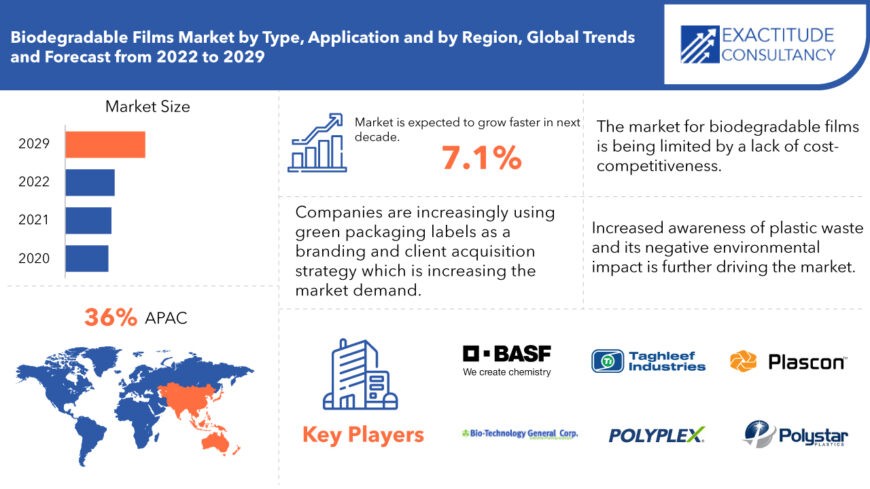
Der Markt für biologisch abbaubare Folien hatte im Jahr 2020 einen Wert von 1,1 Milliarden US-Dollar und soll bis 2029 einen Wert von 2,03 Milliarden US-Dollar erreichen, was einem durchschnittlichen jährlichen Wachstumstempo von 7,1 % zwischen 2022 und 2029 entspricht.
Der Markt für biologisch abbaubare Folien umfasst eine breite Palette von Folien aus erneuerbaren Ressourcen, die im Laufe der Zeit auf natürliche Weise abgebaut werden können und somit eine nachhaltige Alternative zu herkömmlichen Kunststofffolien darstellen. Diese Folien finden Anwendung in verschiedenen Branchen, darunter Verpackung , Landwirtschaft und Medizin, wo Umweltbedenken und regulatorischer Druck die Nachfrage nach umweltfreundlichen Lösungen vorantreiben. Biologisch abbaubare Folien sind so konzipiert, dass sie durch natürliche Prozesse wie mikrobielle Wirkung, Kompostierung oder Abbau im Boden oder im Meer in harmlose Nebenprodukte wie Wasser und Kohlendioxid zerfallen.
Mehrere Trends prägen den Markt für biologisch abbaubare Folien. Das Umweltbewusstsein der Verbraucher treibt die Nachfrage nach nachhaltigen Verpackungslösungen an , was zu einer zunehmenden Nutzung biologisch abbaubarer Folien durch Lebensmittel- und Getränkeunternehmen sowie Einzelhändler führt. Technologische Fortschritte in der Materialwissenschaft ermöglichen die Entwicklung biologisch abbaubarer Folien mit verbesserten mechanischen Eigenschaften, Barriereeigenschaften und Haltbarkeitsstabilität, wodurch sie für ein breiteres Anwendungsspektrum geeignet sind.
| ATTRIBUT | DETAILS |
| Studiendauer | 2020–2029 |
| Basisjahr | 2021 |
| Geschätztes Jahr | 2022 |
| Voraussichtliches Jahr | 2022–2029 |
| Historischer Zeitraum | 2018-2020 |
| Einheit | Wert (Mrd. USD) Volumen (Kilotonnen) |
| Segmentierung | Nach Typ, nach Anwendung, nach Region |
| Nach Typ |
|
| Nach Anwendung |
|
| Nach Region |
|
Der globale Regulierungsrahmen für biologisch abbaubare Folien variiert je nach Region und entwickelt sich weiter, um Umweltbedenken Rechnung zu tragen und nachhaltige Praktiken zu fördern. Regulierungsbehörden wie die Europäische Chemikalienagentur (ECHA) der Europäischen Union, die US-amerikanische Food and Drug Administration (FDA) und die Internationale Organisation für Normung (ISO) legen Standards und Richtlinien für biologisch abbaubare Materialien, einschließlich Folien, fest. Diese Vorschriften decken Aspekte wie Testmethoden für die biologische Abbaubarkeit, Kennzeichnungsanforderungen und zulässige Zusatzstoffe ab. Die Einhaltung dieser Vorschriften ist für Hersteller unerlässlich, um die Sicherheit, Qualität und Umweltverträglichkeit biologisch abbaubarer Folien zu gewährleisten und Marktakzeptanz zu erlangen. Da das Umweltbewusstsein wächst und die Vorschriften strenger werden, wird der Markt für biologisch abbaubare Folien voraussichtlich weiter wachsen, angetrieben von der steigenden Nachfrage nach nachhaltigen Verpackungslösungen weltweit.
[Bildunterschrift id="attachment_6654" align="aligncenter" width="870"]
Frequently Asked Questions
• What is the worth of global biodegradable films market?
Biodegradable films market size was valued at USD 1.1 billion in 2020 and is projected to reach USD 2.03 billion by 2029, growing at a CAGR of 7.1% from 2022 to 2029 driven by the increased awareness of plastic waste and its negative environmental impact.
• What is the size of the Asia pacific biodegradable films industry?
Asia Pacific held more than 36% of the biodegradable films market revenue share in 2021 and will witness market expansion owing to the factors such as the implementation of various environmental regulations, as well as increased government rules surrounding the prohibition on traditional plastic bags.
• What are the upcoming trends of biodegradable films market, globally?
Rising demand from the food packaging industry and strong demand from the agriculture and horticulture sectors will assist the market growth in future.
• Which are the top companies to hold the market share in biodegradable films market?
BASF SE, Biogeneral, Plascon Group, TAGHLEEF INDUSTRIES GROUP, Shreejistretchfilm, Polyplex, STOROPACK HANS REICHENECKER GMBH, Grafix Plastics are among the major companies dominating the market.
Biodegradable Films Market Segment Analysis
The market is broadly segmented into type, application, and region. On the basis of type, PLA is expected to be the largest segment of the biodegradable films market, by type. Because it has no detrimental impact on food pricing or supply, it is widely employed in the packaging sector. It's frequently used with starch to improve biodegradability and cut costs. Thermoformed goods, such as drink cups, takeaway food trays, containers, and planter boxes, are among PLA's most common uses. It has a high stiffness and can be used to replace polystyrene and PET in certain applications. PLA is quickly gaining popularity since it is more cost-effective to produce than other biodegradable plastics. On the basis of application, food packaging is the fastest-growing application of biodegradable films, according to estimates. Biodegradable films are commonly used in the food packaging industry for egg trays, edible coatings, paper boards, wrapping films, and food containers. The most extensively used biodegradable films in the food packaging business include PLA, starch blends, PBS, PHA, and cellulose. Biodegradable films are becoming more popular in food packaging due to the demand for more sustainable packaging materials for fast food and ready-to-eat foods. Biodegradable films are commonly used in the packaging of fresh and frozen foods, as well as dried snacks and candy, and bakery goods.
[caption id="attachment_6655" align="aligncenter" width="553"]
Biodegradable Films Market Market Players
The major players covered in the report are BASF SE, Biogeneral, Plascon Group, TAGHLEEF INDUSTRIES GROUP, Shreejistretchfilm, Polyplex, STOROPACK HANS REICHENECKER GMBH, Grafix Plastics, Profol GmbH, Walki Group Oy, BioBag Americas, Inc., AVERY DENNISON CORPORATION, Polystar Plastics Ltd, TIPA LTD, Cortec Corporation, BI-AX International Inc, Futamura Group, Trioplast Industrier AB, Poysha Packaging Private Limited, Layfield Group. Ltd., Accredo Packaging, Inc., Paco Label, Brentwood Plastics, Inc., Novamont S.p.A., PLASTIKA KRITIS S.A. among other domestic players.
Recent Development:
-
BASF SE (BASF) is a chemical company. It carries out production, marketing and sales of chemicals, plastics, crop protection products, and performance products. Its product line comprises solvents, adhesives, surfactant, fuel additives, electronic chemicals, pigments, paints, food additives, fungicides, and herbicides.
-
Biogeneral manufactures tubing in a wide range of I.D., O.D. and materials: Gas permeable tubing, bioabsorbable, flow chemistry structures, fluoropolymers, engineering polymers, thermoplastic elastomers.
-
Taghleef Industries (TI) is one of the largest global manufacturers of biaxially oriented polypropylene films (BoPP), cast polypropylene films (CPP), biaxially oriented polylactic acid and biodegradable films (BoPLA) offering a standard and speciality film.
Who Should Buy? Or Key Stakeholders
- Plastic Industry
- Chemical Industry
- Packaging Industry
- Scientific Research and Development
- Investors
- Manufacturing companies
- End user companies
- Others
Key Takeaways:
- Biodegradable films market size is projected to be growing at a CAGR of 7.1%.
- On the basis of type, PLA is expected to be the largest segment of the biodegradable films market.
- On the basis of application, food packaging is the fastest-growing application of biodegradable films.
- Asia Pacific is expected to be the fastest-growing market for biodegradable films.
- The major trend in the biodegradable films market is the growing demand for sustainable packaging solutions driven by environmental concerns.
Biodegradable Films Market Regional Analysis
The global biodegradable films market by region includes North America, Asia-Pacific (APAC), Europe, South America, and Middle East & Africa (MEA).
- North America: includes the US, Canada, Mexico
- Asia Pacific: includes China, Japan, South Korea, India, Australia, ASEAN and Rest of APAC
- Europe: includes UK, Germany, France, Italy, Spain, Russia, and Rest of Europe
- South America: includes Brazil, Argentina and Rest of South America
- Middle East & Africa: includes Turkey, UAE, Saudi Arabia, South Africa, and Rest of MEA
Asia Pacific is expected to be the fastest-growing market for biodegradable films. In Asia Pacific, factors such as the implementation of various environmental regulations, as well as increased government rules surrounding the prohibition on traditional plastic bags and global warming measures, are projected to fuel demand for biodegradable films for packaging applications.
[caption id="attachment_6659" align="aligncenter" width="579"]
Key Market Segments: Biodegradable Films Market
Biodegradable Films Market by Type, 2020-2029, (USD Million) (Kilotons)- PLA
- Starch Blends
- Biodegradable Polyesters
- PHA
- Food Packaging
- Agriculture & Horticulture
- Cosmetic & Personal Care Products Packaging
- Industrial Packaging
- North America
- Europe
- Asia Pacific
- South America
- Middle East And Africa
Key Question Answered
- What are the growth opportunities related to the adoption of biodegradable films across major regions in the future?
- What are the new trends and advancements in the biodegradable films market?
- Which product categories are expected to have highest growth rate in the biodegradable films market?
- Which are the key factors driving the biodegradable films market?
- What will the market growth rate, growth momentum or acceleration the market carries during the forecast period?
- Einführung
- Marktdefinition
- Marktsegmentierung
- Forschungszeitpläne
- Annahmen und Einschränkungen
- Forschungsmethodik
- Datengewinnung
- Sekundärforschung
- Primärforschung
- Ratschläge von Fachexperten
- Qualitätskontrollen
- Abschließende Überprüfung
- Datentriangulation
- Bottom-Up-Ansatz
- Top-Down-Ansatz
- Forschungsablauf
- Datenquellen
- Datengewinnung
- Zusammenfassung
- Marktübersicht
- Globaler Marktausblick für biologisch abbaubare Folien
- Markttreiber
- Marktbeschränkungen
- Marktchancen
- Auswirkungen von Covid-19 auf den Markt für biologisch abbaubare Folien
- Porters Fünf-Kräfte-Modell
- Bedrohung durch neue Marktteilnehmer
- Bedrohung durch Ersatzstoffe
- Verhandlungsmacht der Lieferanten
- Verhandlungsmacht der Kunden
- Grad des Wettbewerbs
- Analyse der industriellen Wertschöpfungskette
- Globaler Marktausblick für biologisch abbaubare Folien
- Globaler Markt für biologisch abbaubare Folien nach Typ (in Mio. USD) (Kilotonnen)
- PLA
- Stärkemischungen
- Biologisch abbaubare Polyester
- PHA
- Globaler Markt für biologisch abbaubare Folien nach Anwendung (in Mio. USD) (Kilotonnen)
- Lebensmittelverpackungen
- Landwirtschaft & Gartenbau
- Verpackungen für Kosmetik- und Körperpflegeprodukte
- Industrielle Verpackungen
- Globaler Markt für biologisch abbaubare Folien nach Regionen (in Mio. USD) (Kilotonnen)
- Nordamerika
- UNS
- Kanada
- Mexiko
- Südamerika
- Brasilien
- Argentinien
- Kolumbien
- Restliches Südamerika
- Europa
- Deutschland
- Vereinigtes Königreich
- Frankreich
- Italien
- Spanien
- Russland
- Restliches Europa
- Asien-Pazifik
- Indien
- China
- Japan
- Südkorea
- Australien
- Südostasien
- Restlicher Asien-Pazifik-Raum
- Naher Osten und Afrika
- Vereinigte Arabische Emirate
- Saudi-Arabien
- Südafrika
- Restlicher Naher Osten und Afrika
- Nordamerika
- Firmenprofile* (Geschäftsübersicht, Firmenporträt, angebotene Produkte, aktuelle Entwicklungen)
- BASF SE
- Bioallgemein
- Plascon-Gruppe
- TAGHLEEF INDUSTRIES GRUPPE
- Shreejistretchfilm
- Polyplex
- STOROPACK HANS REICHENECKER GMBH
- Grafix Kunststoffe
- Profol GmbH
- Walki Group Oy
- BioBag Americas, Inc.
- Andere *Die Firmenliste ist indikativ
TABELLENLISTE
TABLE 1 GLOBAL BIODEGRADABLE FILMS MARKET BY TYPE (USD MILLIONS) 2020-2029
TABLE 2 GLOBAL BIODEGRADABLE FILMS MARKET BY TYPE (KILOTONS) 2020-2029
TABLE 3 GLOBAL BIODEGRADABLE FILMS MARKET BY APPLICATION (USD MILLIONS) 2020-2029
TABLE 4 GLOBAL BIODEGRADABLE FILMS MARKET BY APPLICATION (KILOTONS) 2020-2029
TABLE 5 GLOBAL BIODEGRADABLE FILMS MARKET BY REGION (USD MILLIONS) 2020-2029
TABLE 6 GLOBAL BIODEGRADABLE FILMS MARKET BY REGION (KILOTONS) 2020-2029
TABLE 7 US BIODEGRADABLE FILMS MARKET BY TYPE (USD MILLIONS) 2020-2029
TABLE 8 US BIODEGRADABLE FILMS MARKET BY TYPE (KILOTONS) 2020-2029
TABLE 9 US BIODEGRADABLE FILMS MARKET BY APPLICATION (USD MILLIONS) 2020-2029
TABLE 10 US BIODEGRADABLE FILMS MARKET BY APPLICATION (KILOTONS) 2020-2029
TABLE 11 CANADA BIODEGRADABLE FILMS MARKET BY TYPE (USD MILLIONS) 2020-2029
TABLE 12 CANADA BIODEGRADABLE FILMS MARKET BY TYPE (KILOTONS) 2020-2029
TABLE 13 CANADA BIODEGRADABLE FILMS MARKET BY APPLICATION (USD MILLIONS) 2020-2029
TABLE 14 CANADA BIODEGRADABLE FILMS MARKET BY APPLICATION (KILOTONS) 2020-2029
TABLE 15 MEXICO BIODEGRADABLE FILMS MARKET BY TYPE (USD MILLIONS) 2020-2029
TABLE 16 MEXICO BIODEGRADABLE FILMS MARKET BY TYPE (KILOTONS) 2020-2029
TABLE 17 MEXICO BIODEGRADABLE FILMS MARKET BY APPLICATION (USD MILLIONS) 2020-2029
TABLE 18 MEXICO BIODEGRADABLE FILMS MARKET BY APPLICATION (KILOTONS) 2020-2029
TABLE 19 BRAZIL BIODEGRADABLE FILMS MARKET BY TYPE (USD MILLIONS) 2020-2029
TABLE 20 BRAZIL BIODEGRADABLE FILMS MARKET BY TYPE (KILOTONS) 2020-2029
TABLE 21 BRAZIL BIODEGRADABLE FILMS MARKET BY APPLICATION (USD MILLIONS) 2020-2029
TABLE 22 BRAZIL BIODEGRADABLE FILMS MARKET BY APPLICATION (KILOTONS) 2020-2029
TABLE 23 ARGENTINA BIODEGRADABLE FILMS MARKET BY TYPE (USD MILLIONS) 2020-2029
TABLE 24 ARGENTINA BIODEGRADABLE FILMS MARKET BY TYPE (KILOTONS) 2020-2029
TABLE 25 ARGENTINA BIODEGRADABLE FILMS MARKET BY APPLICATION (USD MILLIONS) 2020-2029
TABLE 26 ARGENTINA BIODEGRADABLE FILMS MARKET BY APPLICATION (KILOTONS) 2020-2029
TABLE 27 COLOMBIA BIODEGRADABLE FILMS MARKET BY TYPE (USD MILLIONS) 2020-2029
TABLE 28 COLOMBIA BIODEGRADABLE FILMS MARKET BY TYPE (KILOTONS) 2020-2029
TABLE 29 COLOMBIA BIODEGRADABLE FILMS MARKET BY APPLICATION (USD MILLIONS) 2020-2029
TABLE 30 COLOMBIA BIODEGRADABLE FILMS MARKET BY APPLICATION (KILOTONS) 2020-2029
TABLE 31 REST OF SOUTH AMERICA BIODEGRADABLE FILMS MARKET BY TYPE (USD MILLIONS) 2020-2029
TABLE 32 REST OF SOUTH AMERICA BIODEGRADABLE FILMS MARKET BY TYPE (KILOTONS) 2020-2029
TABLE 33 REST OF SOUTH AMERICA BIODEGRADABLE FILMS MARKET BY APPLICATION (USD MILLIONS) 2020-2029
TABLE 34 REST OF SOUTH AMERICA BIODEGRADABLE FILMS MARKET BY APPLICATION (KILOTONS) 2020-2029
TABLE 35 INDIA BIODEGRADABLE FILMS MARKET BY TYPE (USD MILLIONS) 2020-2029
TABLE 36 INDIA BIODEGRADABLE FILMS MARKET BY TYPE (KILOTONS) 2020-2029
TABLE 37 INDIA BIODEGRADABLE FILMS MARKET BY APPLICATION (USD MILLIONS) 2020-2029
TABLE 38 INDIA BIODEGRADABLE FILMS MARKET BY APPLICATION (KILOTONS) 2020-2029
TABLE 39 CHINA BIODEGRADABLE FILMS MARKET BY TYPE (USD MILLIONS) 2020-2029
TABLE 40 CHINA BIODEGRADABLE FILMS MARKET BY TYPE (KILOTONS) 2020-2029
TABLE 41 CHINA BIODEGRADABLE FILMS MARKET BY APPLICATION (USD MILLIONS) 2020-2029
TABLE 42 CHINA BIODEGRADABLE FILMS MARKET BY APPLICATION (KILOTONS) 2020-2029
TABLE 43 JAPAN BIODEGRADABLE FILMS MARKET BY TYPE (USD MILLIONS) 2020-2029
TABLE 44 JAPAN BIODEGRADABLE FILMS MARKET BY TYPE (KILOTONS) 2020-2029
TABLE 45 JAPAN BIODEGRADABLE FILMS MARKET BY APPLICATION (USD MILLIONS) 2020-2029
TABLE 46 JAPAN BIODEGRADABLE FILMS MARKET BY APPLICATION (KILOTONS) 2020-2029
TABLE 47 SOUTH KOREA BIODEGRADABLE FILMS MARKET BY TYPE (USD MILLIONS) 2020-2029
TABLE 48 SOUTH KOREA BIODEGRADABLE FILMS MARKET BY TYPE (KILOTONS) 2020-2029
TABLE 49 SOUTH KOREA BIODEGRADABLE FILMS MARKET BY APPLICATION (USD MILLIONS) 2020-2029
TABLE 50 SOUTH KOREA BIODEGRADABLE FILMS MARKET BY APPLICATION (KILOTONS) 2020-2029
TABLE 51 AUSTRALIA BIODEGRADABLE FILMS MARKET BY TYPE (USD MILLIONS) 2020-2029
TABLE 52 AUSTRALIA BIODEGRADABLE FILMS MARKET BY TYPE (KILOTONS) 2020-2029
TABLE 53 AUSTRALIA BIODEGRADABLE FILMS MARKET BY APPLICATION (USD MILLIONS) 2020-2029
TABLE 54 AUSTRALIA BIODEGRADABLE FILMS MARKET BY APPLICATION (KILOTONS) 2020-2029
TABLE 55 SOUTH-EAST ASIA BIODEGRADABLE FILMS MARKET BY TYPE (USD MILLIONS) 2020-2029
TABLE 56 SOUTH-EAST ASIA BIODEGRADABLE FILMS MARKET BY TYPE (KILOTONS) 2020-2029
TABLE 57 SOUTH-EAST ASIA BIODEGRADABLE FILMS MARKET BY APPLICATION (USD MILLIONS) 2020-2029
TABLE 58 SOUTH-EAST ASIA BIODEGRADABLE FILMS MARKET BY APPLICATION (KILOTONS) 2020-2029
TABLE 59 REST OF ASIA PACIFIC BIODEGRADABLE FILMS MARKET BY TYPE (USD MILLIONS) 2020-2029
TABLE 60 REST OF ASIA PACIFIC BIODEGRADABLE FILMS MARKET BY TYPE (KILOTONS) 2020-2029
TABLE 61 REST OF ASIA PACIFIC BIODEGRADABLE FILMS MARKET BY APPLICATION (USD MILLIONS) 2020-2029
TABLE 62 REST OF ASIA PACIFIC BIODEGRADABLE FILMS MARKET BY APPLICATION (KILOTONS) 2020-2029
TABLE 63 GERMANY BIODEGRADABLE FILMS MARKET BY TYPE (USD MILLIONS) 2020-2029
TABLE 64 GERMANY BIODEGRADABLE FILMS MARKET BY TYPE (KILOTONS) 2020-2029
TABLE 65 GERMANY BIODEGRADABLE FILMS MARKET BY APPLICATION (USD MILLIONS) 2020-2029
TABLE 66 GERMANY BIODEGRADABLE FILMS MARKET BY APPLICATION (KILOTONS) 2020-2029
TABLE 67 UK BIODEGRADABLE FILMS MARKET BY TYPE (USD MILLIONS) 2020-2029
TABLE 68 UK BIODEGRADABLE FILMS MARKET BY TYPE (KILOTONS) 2020-2029
TABLE 69 UK BIODEGRADABLE FILMS MARKET BY APPLICATION (USD MILLIONS) 2020-2029
TABLE 70 UK BIODEGRADABLE FILMS MARKET BY APPLICATION (KILOTONS) 2020-2029
TABLE 71 FRANCE BIODEGRADABLE FILMS MARKET BY TYPE (USD MILLIONS) 2020-2029
TABLE 72 FRANCE BIODEGRADABLE FILMS MARKET BY TYPE (KILOTONS) 2020-2029
TABLE 73 FRANCE BIODEGRADABLE FILMS MARKET BY APPLICATION (USD MILLIONS) 2020-2029
TABLE 74 FRANCE BIODEGRADABLE FILMS MARKET BY APPLICATION (KILOTONS) 2020-2029
TABLE 75 ITALY BIODEGRADABLE FILMS MARKET BY TYPE (USD MILLIONS) 2020-2029
TABLE 76 ITALY BIODEGRADABLE FILMS MARKET BY TYPE (KILOTONS) 2020-2029
TABLE 77 ITALY BIODEGRADABLE FILMS MARKET BY APPLICATION (USD MILLIONS) 2020-2029
TABLE 78 ITALY BIODEGRADABLE FILMS MARKET BY APPLICATION (KILOTONS) 2020-2029
TABLE 79 SPAIN BIODEGRADABLE FILMS MARKET BY TYPE (USD MILLIONS) 2020-2029
TABLE 80 SPAIN BIODEGRADABLE FILMS MARKET BY TYPE (KILOTONS) 2020-2029
TABLE 81 SPAIN BIODEGRADABLE FILMS MARKET BY APPLICATION (USD MILLIONS) 2020-2029
TABLE 82 SPAIN BIODEGRADABLE FILMS MARKET BY APPLICATION (KILOTONS) 2020-2029
TABLE 83 RUSSIA BIODEGRADABLE FILMS MARKET BY TYPE (USD MILLIONS) 2020-2029
TABLE 84 RUSSIA BIODEGRADABLE FILMS MARKET BY TYPE (KILOTONS) 2020-2029
TABLE 85 RUSSIA BIODEGRADABLE FILMS MARKET BY APPLICATION (USD MILLIONS) 2020-2029
TABLE 86 RUSSIA BIODEGRADABLE FILMS MARKET BY APPLICATION (KILOTONS) 2020-2029
TABLE 87 REST OF EUROPE BIODEGRADABLE FILMS MARKET BY TYPE (USD MILLIONS) 2020-2029
TABLE 88 REST OF EUROPE BIODEGRADABLE FILMS MARKET BY TYPE (KILOTONS) 2020-2029
TABLE 89 REST OF EUROPE BIODEGRADABLE FILMS MARKET BY APPLICATION (USD MILLIONS) 2020-2029
TABLE 90 REST OF EUROPE BIODEGRADABLE FILMS MARKET BY APPLICATION (KILOTONS) 2020-2029
TABLE 91 UAE BIODEGRADABLE FILMS MARKET BY TYPE (USD MILLIONS) 2020-2029
TABLE 92 UAE BIODEGRADABLE FILMS MARKET BY TYPE (KILOTONS) 2020-2029
TABLE 93 UAE BIODEGRADABLE FILMS MARKET BY APPLICATION (USD MILLIONS) 2020-2029
TABLE 94 UAE BIODEGRADABLE FILMS MARKET BY APPLICATION (KILOTONS) 2020-2029
TABLE 95 SAUDI ARABIA BIODEGRADABLE FILMS MARKET BY TYPE (USD MILLIONS) 2020-2029
TABLE 96 SAUDI ARABIA BIODEGRADABLE FILMS MARKET BY TYPE (KILOTONS) 2020-2029
TABLE 97 SAUDI ARABIA BIODEGRADABLE FILMS MARKET BY APPLICATION (USD MILLIONS) 2020-2029
TABLE 98 SAUDI ARABIA BIODEGRADABLE FILMS MARKET BY APPLICATION (KILOTONS) 2020-2029
TABLE 99 SOUTH AFRICA BIODEGRADABLE FILMS MARKET BY TYPE (USD MILLIONS) 2020-2029
TABLE 100 SOUTH AFRICA BIODEGRADABLE FILMS MARKET BY TYPE (KILOTONS) 2020-2029
TABLE 101 SOUTH AFRICA BIODEGRADABLE FILMS MARKET BY APPLICATION (USD MILLIONS) 2020-2029
TABLE 102 SOUTH AFRICA BIODEGRADABLE FILMS MARKET BY APPLICATION (KILOTONS) 2020-2029
TABLE 103 REST OF MIDDLE EAST AND AFRICA BIODEGRADABLE FILMS MARKET BY TYPE (USD MILLIONS) 2020-2029
TABLE 104 REST OF MIDDLE EAST AND AFRICA BIODEGRADABLE FILMS MARKET BY TYPE (KILOTONS) 2020-2029
TABLE 105 REST OF MIDDLE EAST AND AFRICA BIODEGRADABLE FILMS MARKET BY APPLICATION (USD MILLIONS) 2020-2029
TABLE 106 REST OF MIDDLE EAST AND AFRICA BIODEGRADABLE FILMS MARKET BY APPLICATION (KILOTONS) 2020-2029
LIST OF FIGURES
FIGURE 1 MARKET DYNAMICS
FIGURE 2 MARKET SEGMENTATION
FIGURE 3 REPORT TIMELINES: YEARS CONSIDERED
FIGURE 4 DATA TRIANGULATION
FIGURE 5 BOTTOM-UP APPROACH
FIGURE 6 TOP-DOWN APPROACH
FIGURE 7 RESEARCH FLOW
FIGURE 8 GLOBAL BIODEGRADABLE FILMS MARKET BY TYPE, USD MILLION, 2020-2029
FIGURE 9 GLOBAL BIODEGRADABLE FILMS MARKET BY APPLICATION, USD MILLION, 2020-2029
FIGURE 10 GLOBAL BIODEGRADABLE FILMS MARKET BY APPLICATION, USD MILLION, 2020-2029
FIGURE 11 GLOBAL BIODEGRADABLE FILMS MARKET BY REGION, USD MILLION, 2020-2029
FIGURE 12 PORTER’S FIVE FORCES MODEL
FIGURE 13 NORTH AMERICA BIODEGRADABLE FILMS MARKET SNAPSHOT
FIGURE 14 EUROPE BIODEGRADABLE FILMS MARKET SNAPSHOT
FIGURE 15 ASIA PACIFIC BIODEGRADABLE FILMS MARKET SNAPSHOT
FIGURE 16 SOUTH AMERICA BIODEGRADABLE FILMS MARKET SNAPSHOT
FIGURE 17 MIDDLE EAST & AFRICA BIODEGRADABLE FILMS MARKET SNAPSHOT
FIGURE 18 BASF SE: COMPANY SNAPSHOT
FIGURE 19 BIOGENERAL: COMPANY SNAPSHOT
FIGURE 20 PLASCON GROUP: COMPANY SNAPSHOT
FIGURE 21 TAGHLEEF INDUSTRIES GROUP: COMPANY SNAPSHOT
FIGURE 22 SHREEJISTRETCHFILM: COMPANY SNAPSHOT
FIGURE 23 POLYPLEX: COMPANY SNAPSHOT
FIGURE 24 STOROPACK HANS REICHENECKER GMBH: COMPANY SNAPSHOT
FIGURE 25 GRAFIX PLASTICS: COMPANY SNAPSHOT
FIGURE 26 PROFOL GMBH: COMPANY SNAPSHOT
FIGURE 27 WALKI GROUP OY: COMPANY SNAPSHOT
FIGURE 28 BIOBAG AMERICAS, INC.: COMPANY SNAPSHOT
DOWNLOAD FREE SAMPLE REPORT
License Type
SPEAK WITH OUR ANALYST
Want to know more about the report or any specific requirement?
WANT TO CUSTOMIZE THE REPORT?
Our Clients Speak
We asked them to research ‘ Equipment market’ all over the world, and their whole arrangement was helpful to us. thehealthanalytics.com insightful analysis and reports contributed to our current analysis and in creating a future strategy. Besides, the te
Yosuke Mitsui
Senior Associate Construction Equipment Sales & Marketing
We asked them to research ‘Equipment market’ all over the world, and their whole arrangement was helpful to us. thehealthanalytics.com insightful analysis and reports contributed to our current analysis and in creating a future strategy. Besides, the te