

Base Year Value ()
x.x %
x.x %
CAGR ()
x.x %
x.x %
Forecast Year Value ()
x.x %
x.x %
Historical Data Period
Largest Region
Forecast Period
Mercado de fluidos de transferencia de calor por producto (aceites minerales, fluidos sintéticos, fluidos a base de glicol), por uso final (químico y petroquímico, petróleo y gas, automotriz, energía renovable, farmacéutico) y por región, tendencias globales y pronóstico de 2022 a 2029
Instant access to hundreds of data points and trends
- Market estimates from 2014-2029
- Competitive analysis, industry segmentation, financial benchmarks
- Incorporates SWOT, Porter's Five Forces and risk management frameworks
- PDF report or online database with Word, Excel and PowerPoint export options
- 100% money back guarantee
Descripción general del mercado de fluidos de transferencia de calor
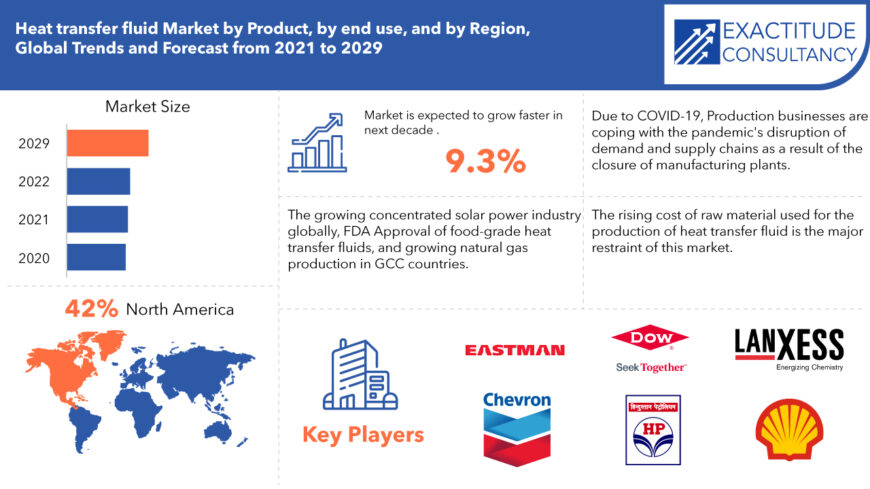
Se estima que el mercado global de fluidos de transferencia de calor será de USD 3.38 mil millones en 2022 y se espera que crezca a USD 6.88 mil millones a una CAGR del 9.3% para 2029.
Los fluidos de transferencia de calor son gases o líquidos producidos específicamente con el propósito de transferir calor de un sistema a otro en un circuito cerrado como un ciclo continuo. Los fluidos de transferencia de calor se utilizan en innumerables aplicaciones y procesos industriales que requieren calefacción o refrigeración , normalmente en un circuito cerrado y en ciclos continuos. El creciente número de plantas de energía solar concentrada con la creciente demanda de energía limpia impulsa el crecimiento del mercado de HTF. Además, HTF encuentra aplicaciones en varias industrias de uso final como la química, la automotriz, el petróleo y el gas, la energía renovable, la alimentación y las bebidas, la HVAC y las industrias farmacéuticas. Los fluidos de transferencia de calor son productos industriales derivados de fuentes de petróleo que se utilizan para evitar el sobrecalentamiento y para el almacenamiento de energía térmica. Las materias primas básicas involucradas en la producción son el petróleo crudo, la sílice y los aceites base. Las características importantes que definen un fluido de transferencia de calor son baja viscosidad, naturaleza no corrosiva, alta conductividad térmica y difusividad y temperaturas de transición de fase extremas. Los fluidos de transferencia de calor (HTF) son gases o líquidos fabricados específicamente con el propósito de transmitir calor de un sistema a otro. Estos fluidos se fabrican a partir de petróleo altamente refinado, hidrocarburos formulados sintéticamente o siloxanos ( silicona ). Proporcionan altas temperaturas a presiones de sistema muy bajas y también ofrecen seguridad, bajo mantenimiento y una vida útil prolongada como principales beneficios. Se estima que esto afectará posteriormente al mercado de los fluidos para transferencia de calor.
| ATRIBUTO | DETALLES |
| Periodo de estudio | 2021-2029 |
| Año base | 2021 |
| Año pronosticado | 2021-2029 |
| Unidad | Valor (miles de millones de USD), (kilotones) |
| Segmentación | Por producto, Por uso final, Por región |
| Por producto |
|
| Por uso final |
|
| Por región |
|
En la industria del petróleo y el gas, los fluidos de transferencia de calor se utilizan en plataformas marinas y refinerías para calentar instalaciones y regenerar glicoles para eliminar el agua del gas natural producido y para calentar recalentadores y columnas para la destilación de petróleo y productos derivados del petróleo. En 2022, debido a la pandemia, la producción de petróleo crudo y gas natural ha sido lenta, debido a la caída del consumo de petróleo y gas y productos relacionados. Por lo tanto, atribuido a este factor, la demanda de fluidos de transferencia de calor en la industria del petróleo y el procesamiento ha disminuido, lo que se espera que afecte el crecimiento del mercado en un futuro próximo.
Al igual que en otros sectores, el mercado mundial de fluidos de transferencia de calor también ha experimentado cambios debido a la pandemia provocada durante la COVID-19. En el sector químico, el mercado de HTF estuvo estancado en 2022, cuando el impacto provocó una importante caída en las industrias de fabricación de productos químicos. El mercado de EE. UU. y Europa también experimentó una disminución en la capacidad de fabricación de productos químicos , ya que las plantas cerraron o funcionaron con una fuerza laboral limitada.
Para recuperarse de las pérdidas causadas por la pandemia, la mayoría de los fabricantes limitaron su presupuesto en el departamento de I+D para reestructurarlos y mantener su función fundamental en las diversas industrias de uso final.
[título id="attachment_11772" align="aligncenter" width="870"]
Frequently Asked Questions
• What is the growth rate of Heat Transfer Fluid market?
Chicory market is estimated grow at a rate of 9.3% CAGR till 2029 with an estimated value of USD 6.88 billion.
• What are the factors influencing Heat transfer fluids market?
The growth of this market can be attributed to growth of chemical & petrochemical processing, oil & gas and automotive industries.
• List the major players in this market?
The following is the list of the major market player of Heat transfer fluid market who fulfill the need of the industry with their proper segmentation and strategies; Eastman Chemical Company (US), The Dow Chemical Company (US), ExxonMobil (US), Chevron (US), Lanxess (Germany), Shell plc (Netherlands), Hindustan Petroleum Corporation Limited (India), Phillips 66 Company (US), Preterm (US), and Arkema (France).
• Which region witnesses to have lucrative market?
Amongst all the region which contain the Heat transfer fluid market the largest stake is held by North American region.
• Does the report provide details about Covid 19 impact?
HTF are used in various end use industries including of chemical & petrochemical processing, oil & gas and automotive industries. Due to the ongoing pandemic, these industries have been severely affected throughout the world. Manpower shortage, logistical restrictions, material unavailability, and other restrictions have slowed the growth of the industry in a considerable manner.
Heat Transfer Fluids Market Segment Analysis:
The HTF market is segmented by product, by end use industry and by region. The mineral oil segmented for the major share of HTF market in 2019. Mineral oil is considered to be inexpensive in comparison to other synthetic liquids as its initial cost is greater than the initial cost of mineral oil. There is seen to be loss in thermal fluid during the maintenance of thermal heater and it is expensive to replace the fluid back in the system. The regions of Asia Pacific and Middle east and Africa are the highest end user region but the usage is mainly on low-cost products.
The mineral oil segment accounted for the major share in 2019. Mineral oil is inexpensive in comparison to synthetic liquids as its initial cost is two to three times greater than the initial cost of mineral oil. There is loss of thermal fluid during the maintenance of a thermal heater, and it is expensive to replace the fluid back into the system. Even if the cost of replacing the fluid is higher, the cost of replacing mineral oil is much less than the cost associated with replacing a synthetic fluid. Furthermore, it is widely used in APAC and MEA regions where the focus is on the usage of low-cost products.
The End Use industry generally includes Chemical & Petrochemical, Oil & Gas, Automotive, Renewable Energy, Pharmaceutical and other, amongst these user, Chemical segment has accounted for the major heat transfer fluid market share. The increase in demand for chemical from automotive, energy and resource, construction, consumer goods and other has increased the production of chemicals. This factor has resulted in increase of demand for heat transfer fluids from chemical manufacturer for indirect heating of process liquids and polymers, pipeline tracing, energy recovering, dying and heating of bulk materials and gas processing and others.
Asia Pacific is a highly attractive market for HTFs. The rapid industrialization witnessed by the emerging economies in the region, especially in China and India, is creating a high demand for HTFs. Leading HTF manufacturers such as Dow, Indian Oil Corporation, Hindustan Petroleum Corporation Limited, and Dalian Rich Fortune Chemical Company are adopting marketing strategies such as product launches and developments to increase their share in the Asia Pacific HTF market. The renewable energy sector in India is likely to be one of the fast-growing segments in the HTF market in Asia Pacific.
The regional segment is dominated by Asia Pacific region.
[caption id="attachment_11773" align="alignleft" width="680"]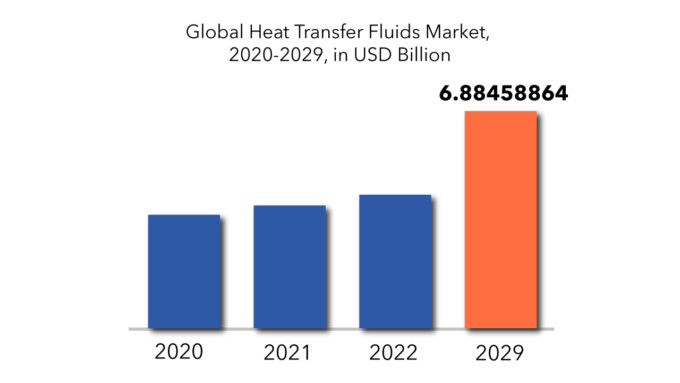
Heat Transfer Fluids Market Players:
Eastman Chemical Company (US), The Dow Chemical Company (US), ExxonMobil (US), Chevron (US), Lanxess (Germany), Shell plc (Netherlands), Hindustan Petroleum Corporation Limited (India), Phillips 66 Company (US), Preterm (US), and Arkema (France).
For corporate expansion, these key leaders are implementing strategic formulations such as new product development and commercialization, commercial expansion, and distribution agreements. Moreover, these participants are substantially spending in product development, which is fueling revenue generation.
Recent Developments July 18, 2022 -Eastman announced a planned increase of its Eastman Therminol® 66 heat transfer fluid manufacturing capacity in Anniston, Alabama. The plant expansion is expected to be complete in 2024 and will increase U.S.-based capacity by 50%.Who should buy? Or Key Stakeholders
- Investors
- Research Organizations
- Power Generation
- LPG blending
- Industrial
- Regulatory Authorities
- Others
Heat Transfer Fluids Market Regional Analysis:
- North America includes USA, Canada and Mexico
- South America includes Brazil
- Europe includes Germany, UK and Russia
- Middle East and Africa includes Saudi Arabia, South Africa and UAE
- Asia Pacific includes India, China, Japan, Australia, Thailand, Malaysia and South Korea
On the basis of geographies, the global market has been divided into North America, Asia Pacific, Europe, South America, and Middle East & Africa. The North America region accounted for the largest volume-based share of 42%. It is the dominant market with key macroeconomic indicators, such as high per capita income & manufacturing output, supporting the region’s growth.
Rapid industrialization coupled with the growing export of chemicals to NAFTA countries is expected to drive the demand for HTFs. The country also has a strong presence in the plastic manufacturing industry.
[caption id="attachment_11774" align="alignleft" width="680"]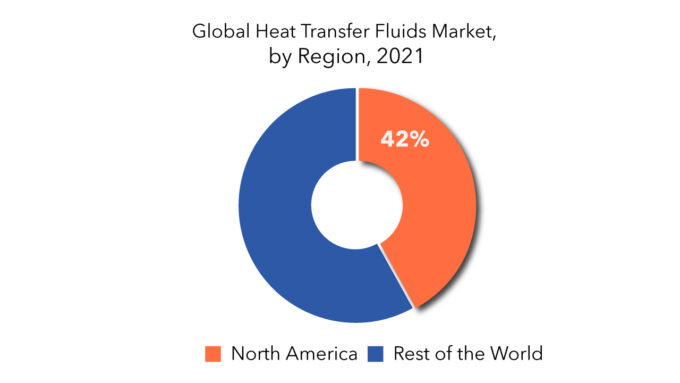
Key Market Segments: Heat Transfer Fluid Market Segment:
Heat Transfer Fluid Market by Product, 2023-2029 (USD Billions) (Kilotons)- Mineral Oils
- Synthetic Fluids
- Glycol-Based Fluids
- Other
- Chemical & Petrochemical
- Oil & Gas
- Automotive
- Renewable Energy
- Pharmaceutical
- Asia Pacific
- North America
- South America
- Europe
- Middle East and Africa
[video width="1920" height="1080" mp4="https://gwsdigital.com/exactitudeconsultancy/wp-content/uploads/2022/11/Heat-Transfer-Fluids-Market.mp4" poster="https://gwsdigital.com/exactitudeconsultancy/wp-content/uploads/2022/02/exactitude-1-3.jpg"][/video]
Key Questions Answered:
- What is the current size of Heat Transfer Fluid Market?
- What are the Key factors influencing the Growth of Heat Transfer Fluid Market?
- Who are Major Competitors in the Heat Transfer Fluid Market?
- What are the major applications of the Heat Transfer Fluid Products?
- Which Region is holding the largest share in the Heat Transfer Fluid Market?
- Introducción
- Definición de mercado
- Segmentación del mercado
- Cronología de la investigación
- Supuestos y limitaciones
- Metodología de la investigación
- Minería de datos
- Investigación secundaria
- Investigación primaria
- Asesoramiento de expertos en la materia
- Controles de calidad
- Revisión final
- Triangulación de datos
- Enfoque de abajo hacia arriba
- Enfoque de arriba hacia abajo
- Flujo de investigación
- Fuentes de datos
- Minería de datos
- Resumen ejecutivo
- Descripción general del mercado
- Perspectivas del mercado de fluidos de transferencia de calor
- Factores impulsores del mercado
- Restricciones del mercado
- Oportunidades de mercado
- Impacto de Covid-19 en el mercado de fluidos de transferencia de calor
- Análisis de la cadena de valor de la industria
- Perspectivas del mercado de fluidos de transferencia de calor
- Mercado de fluidos de transferencia de calor por producto, 2021-2029 (miles de millones de USD) (kilotones)
- Aceites minerales
- Fluidos sintéticos
- Fluidos a base de glicol
- Otro
- Mercado de fluidos de transferencia de calor por uso final, 2021-2029 (miles de millones de USD) (kilotones)
- Química y petroquímica
- Petróleo y gas
- Automotor
- Energía renovable
- Farmacéutico
- Mercado de fluidos de transferencia de calor por región, 2021-2029 (miles de millones de USD)
- Asia Pacífico
- India
- Porcelana
- Japón
- Malasia
- Tailandia
- Australia y
- Corea del Sur
- América del norte
- EE.UU
- Canadá y
- México
- Sudamerica
- Brasil
- Europa
- Alemania
- Reino Unido
- Rusia
- Oriente Medio y África
- Arabia Saudita
- Sudáfrica y
- Emiratos Árabes Unidos
- Asia Pacífico
- Perfiles de empresas* (descripción general de la empresa, descripción general de la empresa, productos ofrecidos, desarrollos recientes)
- Compañía química Eastman (Estados Unidos)
- La compañía química Dow (Estados Unidos)
- ExxonMobil (Estados Unidos)
- Chevron (Estados Unidos)
- Lanxess (Alemania),
- Shell plc (Países Bajos)
- Corporación petrolera Hindustan Limited (India)
- Compañía Phillips 66 (Estados Unidos)
- Prematuro (EE. UU.)
- Arkema (RUSIA)
LISTA DE TABLAS:
TABLE 1 GLOBAL HEAT TRANSFER FLUIDS MARKET BY PRODUCT (USD MILLIONS) 2020-2029
TABLE 2 GLOBAL HEAT TRANSFER FLUIDS MARKET BY PRODUCT (KILOTONS) 2020-2029
TABLE 3 GLOBAL HEAT TRANSFER FLUIDS MARKET BY END USER (USD MILLIONS) 2020-2029
TABLE 4 GLOBAL HEAT TRANSFER FLUIDS MARKET BY END USER (KILOTONS) 2020-2029
TABLE 5 GLOBAL HEAT TRANSFER FLUIDS MARKET BY REGION (USD MILLIONS) 2020-2029
TABLE 6 GLOBAL HEAT TRANSFER FLUIDS MARKET BY REGION (KILOTONS) 2020-2029
TABLE 7 US HEAT TRANSFER FLUIDS MARKET BY PRODUCT (USD MILLIONS) 2020-2029
TABLE 8 US HEAT TRANSFER FLUIDS MARKET BY PRODUCT (KILOTONS) 2020-2029
TABLE 9 US HEAT TRANSFER FLUIDS MARKET BY END USER (USD MILLIONS) 2020-2029
TABLE 10 US HEAT TRANSFER FLUIDS MARKET BY END USER (KILOTONS) 2020-2029
TABLE 11 CANADA HEAT TRANSFER FLUIDS MARKET BY PRODUCT (USD MILLIONS) 2020-2029
TABLE 12 CANADA HEAT TRANSFER FLUIDS MARKET BY PRODUCT (KILOTONS) 2020-2029
TABLE 13 CANADA HEAT TRANSFER FLUIDS MARKET BY END USER (USD MILLIONS) 2020-2029
TABLE 14 CANADA HEAT TRANSFER FLUIDS MARKET BY END USER (KILOTONS) 2020-2029
TABLE 15 MEXICO HEAT TRANSFER FLUIDS MARKET BY PRODUCT (USD MILLIONS) 2020-2029
TABLE 16 MEXICO HEAT TRANSFER FLUIDS MARKET BY PRODUCT (KILOTONS) 2020-2029
TABLE 17 MEXICO HEAT TRANSFER FLUIDS MARKET BY END USER (USD MILLIONS) 2020-2029
TABLE 18 MEXICO HEAT TRANSFER FLUIDS MARKET BY END USER (KILOTONS) 2020-2029
TABLE 19 BRAZIL HEAT TRANSFER FLUIDS MARKET BY PRODUCT (USD MILLIONS) 2020-2029
TABLE 20 BRAZIL HEAT TRANSFER FLUIDS MARKET BY PRODUCT (KILOTONS) 2020-2029
TABLE 21 BRAZIL HEAT TRANSFER FLUIDS MARKET BY END USER (USD MILLIONS) 2020-2029
TABLE 22 BRAZIL HEAT TRANSFER FLUIDS MARKET BY END USER (KILOTONS) 2020-2029
TABLE 23 ARGENTINA HEAT TRANSFER FLUIDS MARKET BY PRODUCT (USD MILLIONS) 2020-2029
TABLE 24 ARGENTINA HEAT TRANSFER FLUIDS MARKET BY PRODUCT (KILOTONS) 2020-2029
TABLE 25 ARGENTINA HEAT TRANSFER FLUIDS MARKET BY END USER (USD MILLIONS) 2020-2029
TABLE 26 ARGENTINA HEAT TRANSFER FLUIDS MARKET BY END USER (KILOTONS) 2020-2029
TABLE 27 COLOMBIA HEAT TRANSFER FLUIDS MARKET BY PRODUCT (USD MILLIONS) 2020-2029
TABLE 28 COLOMBIA HEAT TRANSFER FLUIDS MARKET BY PRODUCT (KILOTONS) 2020-2029
TABLE 29 COLOMBIA HEAT TRANSFER FLUIDS MARKET BY END USER (USD MILLIONS) 2020-2029
TABLE 30 COLOMBIA HEAT TRANSFER FLUIDS MARKET BY END USER (KILOTONS) 2020-2029
TABLE 31 REST OF SOUTH AMERICA HEAT TRANSFER FLUIDS MARKET BY PRODUCT (USD MILLIONS) 2020-2029
TABLE 32 REST OF SOUTH AMERICA HEAT TRANSFER FLUIDS MARKET BY PRODUCT (KILOTONS) 2020-2029
TABLE 33 REST OF SOUTH AMERICA HEAT TRANSFER FLUIDS MARKET BY END USER (USD MILLIONS) 2020-2029
TABLE 34 REST OF SOUTH AMERICA HEAT TRANSFER FLUIDS MARKET BY END USER (KILOTONS) 2020-2029
TABLE 35 INDIA HEAT TRANSFER FLUIDS MARKET BY PRODUCT (USD MILLIONS) 2020-2029
TABLE 36 INDIA HEAT TRANSFER FLUIDS MARKET BY PRODUCT (KILOTONS) 2020-2029
TABLE 37 INDIA HEAT TRANSFER FLUIDS MARKET BY END USER (USD MILLIONS) 2020-2029
TABLE 38 INDIA HEAT TRANSFER FLUIDS MARKET BY END USER (KILOTONS) 2020-2029
TABLE 39 CHINA HEAT TRANSFER FLUIDS MARKET BY PRODUCT (USD MILLIONS) 2020-2029
TABLE 40 CHINA HEAT TRANSFER FLUIDS MARKET BY PRODUCT (KILOTONS) 2020-2029
TABLE 41 CHINA HEAT TRANSFER FLUIDS MARKET BY END USER (USD MILLIONS) 2020-2029
TABLE 42 CHINA HEAT TRANSFER FLUIDS MARKET BY END USER (KILOTONS) 2020-2029
TABLE 43 JAPAN HEAT TRANSFER FLUIDS MARKET BY PRODUCT (USD MILLIONS) 2020-2029
TABLE 44 JAPAN HEAT TRANSFER FLUIDS MARKET BY PRODUCT (KILOTONS) 2020-2029
TABLE 45 JAPAN HEAT TRANSFER FLUIDS MARKET BY END USER (USD MILLIONS) 2020-2029
TABLE 46 JAPAN HEAT TRANSFER FLUIDS MARKET BY END USER (KILOTONS) 2020-2029
TABLE 47 SOUTH KOREA HEAT TRANSFER FLUIDS MARKET BY PRODUCT (USD MILLIONS) 2020-2029
TABLE 48 SOUTH KOREA HEAT TRANSFER FLUIDS MARKET BY PRODUCT (KILOTONS) 2020-2029
TABLE 49 SOUTH KOREA HEAT TRANSFER FLUIDS MARKET BY END USER (USD MILLIONS) 2020-2029
TABLE 50 SOUTH KOREA HEAT TRANSFER FLUIDS MARKET BY END USER (KILOTONS) 2020-2029
TABLE 51 AUSTRALIA HEAT TRANSFER FLUIDS MARKET BY PRODUCT (USD MILLIONS) 2020-2029
TABLE 52 AUSTRALIA HEAT TRANSFER FLUIDS MARKET BY PRODUCT (KILOTONS) 2020-2029
TABLE 53 AUSTRALIA HEAT TRANSFER FLUIDS MARKET BY END USER (USD MILLIONS) 2020-2029
TABLE 54 AUSTRALIA HEAT TRANSFER FLUIDS MARKET BY END USER (KILOTONS) 2020-2029
TABLE 55 SOUTH-EAST ASIA HEAT TRANSFER FLUIDS MARKET BY PRODUCT (USD MILLIONS) 2020-2029
TABLE 56 SOUTH-EAST ASIA HEAT TRANSFER FLUIDS MARKET BY PRODUCT (KILOTONS) 2020-2029
TABLE 57 SOUTH-EAST ASIA HEAT TRANSFER FLUIDS MARKET BY END USER (USD MILLIONS) 2020-2029
TABLE 58 SOUTH-EAST ASIA HEAT TRANSFER FLUIDS MARKET BY END USER (KILOTONS) 2020-2029
TABLE 59 REST OF ASIA PACIFIC HEAT TRANSFER FLUIDS MARKET BY PRODUCT (USD MILLIONS) 2020-2029
TABLE 60 REST OF ASIA PACIFIC HEAT TRANSFER FLUIDS MARKET BY PRODUCT (KILOTONS) 2020-2029
TABLE 61 REST OF ASIA PACIFIC HEAT TRANSFER FLUIDS MARKET BY END USER (USD MILLIONS) 2020-2029
TABLE 62 REST OF ASIA PACIFIC HEAT TRANSFER FLUIDS MARKET BY END USER (KILOTONS) 2020-2029
TABLE 63 GERMANY HEAT TRANSFER FLUIDS MARKET BY PRODUCT (USD MILLIONS) 2020-2029
TABLE 64 GERMANY HEAT TRANSFER FLUIDS MARKET BY PRODUCT (KILOTONS) 2020-2029
TABLE 65 GERMANY HEAT TRANSFER FLUIDS MARKET BY END USER (USD MILLIONS) 2020-2029
TABLE 66 GERMANY HEAT TRANSFER FLUIDS MARKET BY END USER (KILOTONS) 2020-2029
TABLE 67 UK HEAT TRANSFER FLUIDS MARKET BY PRODUCT (USD MILLIONS) 2020-2029
TABLE 68 UK HEAT TRANSFER FLUIDS MARKET BY PRODUCT (KILOTONS) 2020-2029
TABLE 69 UK HEAT TRANSFER FLUIDS MARKET BY END USER (USD MILLIONS) 2020-2029
TABLE 70 UK HEAT TRANSFER FLUIDS MARKET BY END USER (KILOTONS) 2020-2029
TABLE 71 FRANCE HEAT TRANSFER FLUIDS MARKET BY PRODUCT (USD MILLIONS) 2020-2029
TABLE 72 FRANCE HEAT TRANSFER FLUIDS MARKET BY PRODUCT (KILOTONS) 2020-2029
TABLE 73 FRANCE HEAT TRANSFER FLUIDS MARKET BY END USER (USD MILLIONS) 2020-2029
TABLE 74 FRANCE HEAT TRANSFER FLUIDS MARKET BY END USER (KILOTONS) 2020-2029
TABLE 75 ITALY HEAT TRANSFER FLUIDS MARKET BY PRODUCT (USD MILLIONS) 2020-2029
TABLE 76 ITALY HEAT TRANSFER FLUIDS MARKET BY PRODUCT (KILOTONS) 2020-2029
TABLE 77 ITALY HEAT TRANSFER FLUIDS MARKET BY END USER (USD MILLIONS) 2020-2029
TABLE 78 ITALY HEAT TRANSFER FLUIDS MARKET BY END USER (KILOTONS) 2020-2029
TABLE 79 SPAIN HEAT TRANSFER FLUIDS MARKET BY PRODUCT (USD MILLIONS) 2020-2029
TABLE 80 SPAIN HEAT TRANSFER FLUIDS MARKET BY PRODUCT (KILOTONS) 2020-2029
TABLE 81 SPAIN HEAT TRANSFER FLUIDS MARKET BY END USER (USD MILLIONS) 2020-2029
TABLE 82 SPAIN HEAT TRANSFER FLUIDS MARKET BY END USER (KILOTONS) 2020-2029
TABLE 83 RUSSIA HEAT TRANSFER FLUIDS MARKET BY PRODUCT (USD MILLIONS) 2020-2029
TABLE 84 RUSSIA HEAT TRANSFER FLUIDS MARKET BY PRODUCT (KILOTONS) 2020-2029
TABLE 85 RUSSIA HEAT TRANSFER FLUIDS MARKET BY END USER (USD MILLIONS) 2020-2029
TABLE 86 RUSSIA HEAT TRANSFER FLUIDS MARKET BY END USER (KILOTONS) 2020-2029
TABLE 87 REST OF EUROPE HEAT TRANSFER FLUIDS MARKET BY PRODUCT (USD MILLIONS) 2020-2029
TABLE 88 REST OF EUROPE HEAT TRANSFER FLUIDS MARKET BY PRODUCT (KILOTONS) 2020-2029
TABLE 89 REST OF EUROPE HEAT TRANSFER FLUIDS MARKET BY END USER (USD MILLIONS) 2020-2029
TABLE 90 REST OF EUROPE HEAT TRANSFER FLUIDS MARKET BY END USER (KILOTONS) 2020-2029
TABLE 91 UAE HEAT TRANSFER FLUIDS MARKET BY PRODUCT (USD MILLIONS) 2020-2029
TABLE 92 UAE HEAT TRANSFER FLUIDS MARKET BY PRODUCT (KILOTONS) 2020-2029
TABLE 93 UAE HEAT TRANSFER FLUIDS MARKET BY END USER (USD MILLIONS) 2020-2029
TABLE 94 UAE HEAT TRANSFER FLUIDS MARKET BY END USER (KILOTONS) 2020-2029
TABLE 95 SAUDI ARABIA HEAT TRANSFER FLUIDS MARKET BY PRODUCT (USD MILLIONS) 2020-2029
TABLE 96 SAUDI ARABIA HEAT TRANSFER FLUIDS MARKET BY PRODUCT (KILOTONS) 2020-2029
TABLE 97 SAUDI ARABIA HEAT TRANSFER FLUIDS MARKET BY END USER (USD MILLIONS) 2020-2029
TABLE 98 SAUDI ARABIA HEAT TRANSFER FLUIDS MARKET BY END USER (KILOTONS) 2020-2029
TABLE 99 SOUTH AFRICA HEAT TRANSFER FLUIDS MARKET BY PRODUCT (USD MILLIONS) 2020-2029
TABLE 100 SOUTH AFRICA HEAT TRANSFER FLUIDS MARKET BY PRODUCT (KILOTONS) 2020-2029
TABLE 101 SOUTH AFRICA HEAT TRANSFER FLUIDS MARKET BY END USER (USD MILLIONS) 2020-2029
TABLE 102 SOUTH AFRICA HEAT TRANSFER FLUIDS MARKET BY END USER (KILOTONS) 2020-2029
TABLE 103 REST OF MIDDLE EAST AND AFRICA HEAT TRANSFER FLUIDS MARKET BY PRODUCT (USD MILLIONS) 2020-2029
TABLE 104 REST OF MIDDLE EAST AND AFRICA HEAT TRANSFER FLUIDS MARKET BY PRODUCT (KILOTONS) 2020-2029
TABLE 105 REST OF MIDDLE EAST AND AFRICA HEAT TRANSFER FLUIDS MARKET BY END USER (USD MILLIONS) 2020-2029
TABLE 106 REST OF MIDDLE EAST AND AFRICA HEAT TRANSFER FLUIDS MARKET BY END USER (KILOTONS) 2020-2029
LIST OF FIGURES
FIGURE 1 MARKET DYNAMICS
FIGURE 2 MARKET SEGMENTATION
FIGURE 3 REPORT TIMELINES: YEARS CONSIDERED
FIGURE 4 DATA TRIANGULATION
FIGURE 5 BOTTOM-UP APPROACH
FIGURE 6 TOP-DOWN APPROACH
FIGURE 7 RESEARCH FLOW
FIGURE 8 GLOBAL HEAT TRANSFER FLUID MARKET BY PRODUCT, USD MILLION, 2021-
2029
FIGURE 9 GLOBAL HEAT TRANSFER FLUID MARKET BY END USE, USD MILLION, 2021-
2029
FIGURE 10 GLOBAL HEAT TRANSFER FLUID MARKET BY REGION, USD MILLION, 2021-2029
FIGURE 11 PORTER’S FIVE FORCES MODEL
FIGURE 12 NORTH AMERICA HEAT TRANSFER FLUID MARKET SNAPSHOT
FIGURE 13 EUROPE HEAT TRANSFER FLUID MARKET SNAPSHOT
FIGURE 14 SOUTH AMERICA HEAT TRANSFER FLUID MARKET SNAPSHOT
FIGURE 15 ASIA PACIFIC HEAT TRANSFER FLUID MARKET SNAPSHOT
FIGURE 16 MIDDLE EAST ASIA AND AFRICA HEAT TRANSFER FLUID MARKET SNAPSHOT
FIGURE 17 MARKET SHARE ANALYSIS
FIGURE 18 EASTMAN CHEMICAL COMPANY.: COMPANY SNAPSHOT
FIGURE 19 THE DOW CHEMICAL COMPANY: COMPANY SNAPSHOT
FIGURE 20 EXXON MOBIL: COMPANY SNAPSHOT
FIGURE 21 CHEVRON.: COMPANY SNAPSHOT
FIGURE 22 LANXESS COMPANY SNAPSHOT
FIGURE 23 SHELL PLC.: COMPANY SNAPSHOT
FIGURE 24 HINDUSTAN PETROLEUM CORPORATION LIMITED: COMPANY SNAPSHOT
FIGURE 25 PHILLIPS 66 COMPANY: COMPANY SNAPSHOT
FIGURE 26 PRETERM: COMPANY SNAPSHOT
FIGURE 27 ARKEMA: COMPANY SNAPSHOT
DOWNLOAD FREE SAMPLE REPORT
License Type
SPEAK WITH OUR ANALYST
Want to know more about the report or any specific requirement?
WANT TO CUSTOMIZE THE REPORT?
Our Clients Speak
We asked them to research ‘ Equipment market’ all over the world, and their whole arrangement was helpful to us. thehealthanalytics.com insightful analysis and reports contributed to our current analysis and in creating a future strategy. Besides, the te
Yosuke Mitsui
Senior Associate Construction Equipment Sales & Marketing
We asked them to research ‘Equipment market’ all over the world, and their whole arrangement was helpful to us. thehealthanalytics.com insightful analysis and reports contributed to our current analysis and in creating a future strategy. Besides, the te