

Base Year Value ()
x.x %
x.x %
CAGR ()
x.x %
x.x %
Forecast Year Value ()
x.x %
x.x %
Historical Data Period
Largest Region
Forecast Period
Mercado de biosimulación por producto (software, simulación molecular, servicios internos, servicios por contrato), aplicación (ensayos clínicos, PKPD, ADME), entrega (suscripción, propiedad), usuario final (biotecnología, compañías farmacéuticas, CRO, normativas) y por región (América del Norte, América Latina, Europa, Asia Pacífico y Oriente Medio y África), tendencias globales y pronóstico de 2022 a 2029
Instant access to hundreds of data points and trends
- Market estimates from 2014-2029
- Competitive analysis, industry segmentation, financial benchmarks
- Incorporates SWOT, Porter's Five Forces and risk management frameworks
- PDF report or online database with Word, Excel and PowerPoint export options
- 100% money back guarantee
Panorama del mercado de la biosimulación
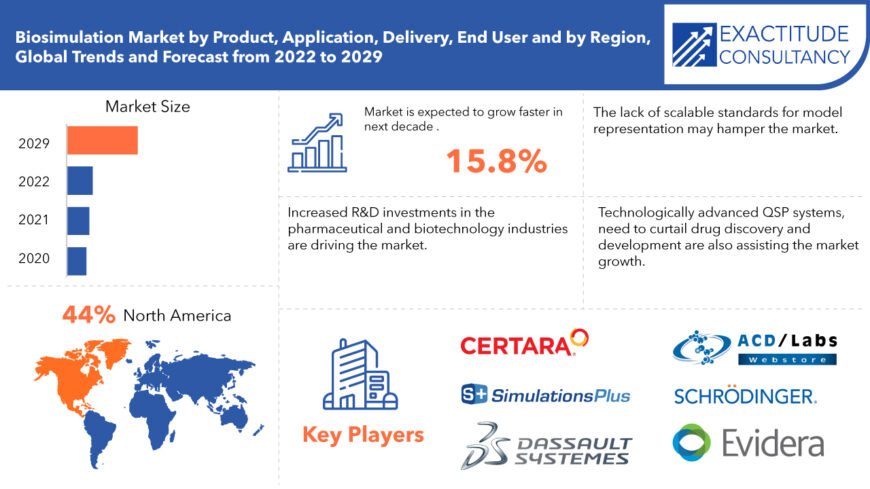
El tamaño del mercado de biosimulación se valoró en USD 2.21 mil millones en 2020 y se proyecta que alcance los USD 8.27 mil millones para 2029, creciendo a una CAGR del 15,8% entre 2022 y 2029.
En el campo de la investigación de fármacos , la biosimulación es cada vez más importante. La biosimulación puede utilizarse para predecir si un posible fármaco fracasará en el proceso de desarrollo, como los ensayos clínicos , debido a efectos secundarios indeseables, una farmacocinética deficiente o incluso toxicidad, dado que solo el 11% de todos los fármacos candidatos son aprobados. La predicción temprana de si un medicamento fracasará en animales o en personas sería fundamental para reducir los gastos de desarrollo de fármacos, así como el número de pruebas con animales y ensayos clínicos necesarios. La biosimulación se centra en proporcionar predicciones basadas en modelos del comportamiento y la dinámica de los sistemas biológicos . El enorme aumento del gasto en I+D de las empresas farmacéuticas y biotecnológicas puede atribuirse a la expansión del mercado mundial de la biosimulación. Además, el elevado coste de volver a realizar los ensayos clínicos como resultado de la alta tasa de fracasos en los ensayos clínicos de fase III fomenta el uso de la biosimulación en el descubrimiento y desarrollo de fármacos, lo que promueve el crecimiento del mercado.
Durante las últimas décadas, se han producido grandes avances en varios sectores de la industria médica como resultado de los avances tecnológicos y las actividades de investigación. En los últimos años, el desarrollo de tratamientos innovadores para diversas enfermedades y trastornos médicos ha cambiado de rumbo, lo que ha dado lugar a una demanda sin precedentes de biosimulación, un factor que se prevé que impulse el crecimiento del mercado de la biosimulación durante el período de evaluación. La biosimulación se utiliza en el descubrimiento y desarrollo de fármacos para diversos fines, entre los que se incluyen la identificación y validación de objetivos, la optimización de los fármacos y las pruebas preclínicas de nuevos fármacos.
| ATRIBUTO | DETALLES |
| Periodo de estudio | 2020-2029 |
| Año base | 2021 |
| Año estimado | 2022 |
| Año pronosticado | 2022-2029 |
| Periodo histórico | 2018-2020 |
| Unidad | Valor (miles de millones de USD) |
| Segmentación | Por producto, por aplicación, por entrega, por usuario final y por región |
| Por producto |
|
| Por aplicación |
|
| Por entrega |
|
| Por el usuario final |
|
| By Region |
|
The recording, annotation, storage, analysis, and retrieval of nucleic acid sequence, protein sequence, and structural information are all covered by biosimulation. It has a variety of uses in health and biology, including molecular medications, preventive medicine, gene therapy, drug development, biotechnology, and microbial forensic investigation. It's also employed in genetics and genomic research. The global biosimulation market is predicted to develop significantly in the near future, owing to an increase in demand for integrated data, a rise in demand for nucleic acid and protein sequencing due to lower sequencing costs, and an increase in proteomics and genomics applications. Moreover, drug research and development, as well as government and private-sector activities, are likely to drive market expansion over the projection period. The demand for integrated biosimulation systems in proteomics and genomics is also driving the biosimulation market forward.
A new drug's development requires a significant quantity of research and resources. Every stage of the medication development process, from clinical trials through approval, has a significant risk of failure. Biosimulation can considerably lower these odds. Biosimulation not only aids in the prediction of medication failure throughout the development phase, but it also lowers the expense of any other potential failures by reducing the number of clinical trials required. Pharmaceutical companies (such as Pfizer, Merck, Novartis, and Johnson Pharmaceutical Research & Development) and research firms (such as Johnson Pharmaceutical Research & Development) have been using biosimulation software and service providers to reduce the length of trials and the high costs associated with failures.
Furthermore, the market's growth is expected to be fueled by the clinical urgency to produce high-potency and sophisticated medications. Biosimulation is being more widely used in disease simulation modelling, such as diabetes mellitus. Models for advanced therapies are developed using it in conjunction with proteomic and genomic technology. As a result of ongoing technology developments and software upgrades, researchers' interest in biosimulation is projected to expand. This is expected to provide the market a significant lift. Technical advancements include microarrays and prediction models, to name a few. Semantic systems that enable a restricted number of biosimulation elements have also been developed, decreasing the time, cost, and complexity of the entire process.
La biosimulación captura y procesa diversos aspectos de los procesos biológicos utilizando una variedad de modelos, herramientas y lenguajes. Los métodos de modelado actuales no logran capturar la semántica fundamental de los modelos de biosimulación, lo que dificulta la construcción, reutilización, composición y fusión de modelos de biosimulación diversos y complicados. El uso de tecnología in silico o de biosimulación en el proceso de investigación o desarrollo de medicamentos aún no ha sido estandarizado por las agencias reguladoras. La capacidad de cómputo de los investigadores biomédicos para construir y operar sistemas de biosimulación sofisticados ha aumentado como resultado de los recientes desarrollos tecnológicos. Por otro lado, los investigadores encuentran más difícil comunicar, administrar y cambiar sus modelos a medida que sus modelos y simulaciones se vuelven más complicados. La falta de estándares escalables para la representación y reutilización de modelos exacerba el desafío de compartir modelos biomédicos sofisticados. Como resultado, muchos desarrolladores de modelos no pueden intercambiar y construir nuevos modelos basados en modelos existentes. Esta debilidad de la biosimulación solo se puede abordar mediante el desarrollo de un modelo de representación sistemático basado en estándares que pueda expresar de manera inequívoca los datos de biosimulación en formatos legibles tanto para humanos como para máquinas. Como resultado, la comunidad de biosimulación necesita desesperadamente herramientas que les ayuden a construir, gestionar y reutilizar sus modelos de forma más eficiente.
[título id="attachment_11860" align="alignleft" width="870"]
Frequently Asked Questions
• What is the worth of Biosimulation market?
Biosimulation market size was valued at USD 2.21 billion in 2020 and is projected to reach USD 8.27 billion by 2029, growing at a CAGR of 15.8% from 2022 to 2029.
• What is the size of the North America Biosimulation market industry?
North America held more than 44% of the Biosimulation market revenue share in 2021 and will witness expansion in the forecast period.
• What are some of the market's driving forces?
In recent years, the development of breakthrough treatments for a number of medical diseases and disorders has shifted gears, resulting in unprecedented demand for biosimulation– a factor that is projected to boost the biosimulation market's growth during the assessment period. Biosimulation is utilised in drug discovery and development for a variety of purposes, including target identification and validation, lead optimization, and pre-clinical testing of new drugs.
• Which are the top companies to hold the market share in Biosimulation market?
Certara, Simulations Plus Inc, Dassault Systèmes, Schrödinger, ACD/Labs, Chemical Computing Group, Physiomics, Evidera, InSilico Biosciences, INOSIM Software, Insilico Biotechnology, LeadInvent Technologies, Rosa, Nuventra Pharma, and Genedata are some of the major players in the market that are dominating the market
• What is the leading application of Biosimulation market?
The leading application of Biosimulation market in 2020 was pharmaceutical market segment. It has the biggest market share.
• Which is the largest regional market for Biosimulation market?
North America held the largest market share of Biosimulation market.
Biosimulation Market Segment Analysis
The market is broadly segmented into product, application, delivery, end user and region. Based on product & service, the biosimulation market is segmented into software and services. The biosimulation software segment is expected to account for the largest market share. The increasing usage of biosimulation software by pharmaceutical and research firms, as well as increased R&D investment for pharmaceutical research, are driving this segment's rapid rise.
Based on end user, research institutes, pharmaceutical and biotechnology businesses, contract research organisations (CROs), regulatory authorities, and other end users make up the biosimulation market (consulting firms, defence research and development organizations, nutraceutical companies, and food and agricultural companies). Pharmaceutical and biotechnology firms are likely to account for the greatest share, with the highest CAGR throughout the forecast period. Increased pharmaceutical and biotechnology R&D spending, as well as increased adoption of inorganic development strategies by various biosimulation service providers, are expected to drive biosimulation solutions adoption in the pharmaceutical and biotechnology industries.
[caption id="attachment_11861" align="alignleft" width="680"]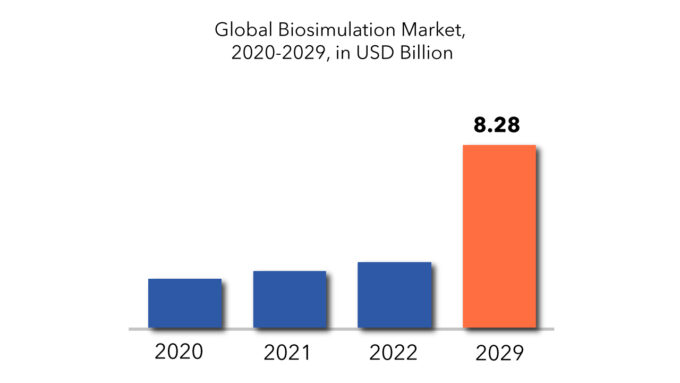
Biosimulation Market Players
Certara, Simulations Plus Inc, Dassault Systèmes, Schrödinger, ACD/Labs, Chemical Computing Group, Physiomics, Evidera, InSilico Biosciences, INOSIM Software, Insilico Biotechnology, LeadInvent Technologies, Rosa, Nuventra Pharma, and Genedata are some of the major players in the market that are dominating the market.- Certara accelerates medicines using proprietary biosimulation software, technology and services to transform traditional drug discovery and development. Its clients include 2,000 biopharmaceutical companies, academic institutions, and regulatory agencies across 62 countries.
- Simulations Plus, Inc. develops absorption, distribution, metabolism, excretion, and toxicity modelling and simulation software for the pharmaceutical and biotechnology, industrial chemicals, cosmetics, food ingredients, and herbicide industries.
- Dassault Systèmes SE is a French software corporation, which develops software for 3D product design, simulation, manufacturing and other 3D related products.
Who Should Buy? Or Key Stakeholders
- Software Industry
- Pharmaceutical Industry
- Healthcare Industry
- Biotechnology Companies
- Hospitals and Clinics
- Scientific Research and Development
- Investors
- Manufacturing companies
- End user companies
Biosimulation Market Regional Analysis
The global biosimulation market by region includes North America, Asia-Pacific (APAC), Europe, South America, and Middle East & Africa (MEA).
- North America: includes the US, Canada, Mexico
- Asia Pacific: includes China, Japan, South Korea, India, Australia, ASEAN and Rest of APAC
- Europe: includes UK, Germany, France, Italy, Spain, Russia, and Rest of Europe
- South America: includes Brazil, Argentina and Rest of South America
- Middle East & Africa: includes Turkey, UAE, Saudi Arabia, South Africa, and Rest of MEA
With a market share of 44 percent in 2021, North America dominated the biosimulation market. Growth in the biotechnology and pharmaceutical industries, a significant number of active drug development processes, growing usage of personalised medicine, and higher R&D expenditure by pharmaceutical and biotechnology businesses are all contributing to the North American market's dominance.
[caption id="attachment_11862" align="alignleft" width="680"]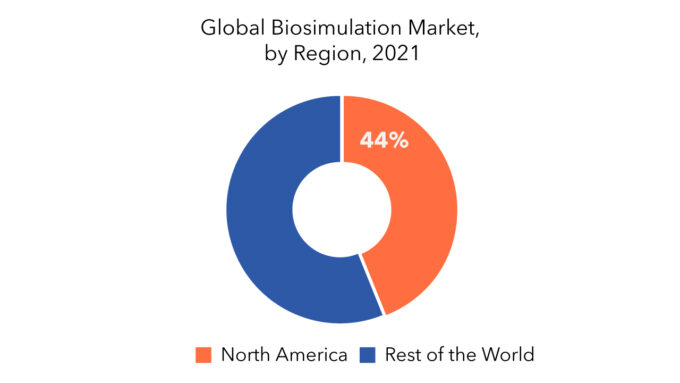
Key Market Segments: Biosimulation Market
Biosimulation Market by Product, 2020-2029, (USD Million)- Software
- Molecular Simulation
- In House
- Contract Services
- Clinical Trials
- PKPD
- ADME
- Subscription
- Ownership
- BIOTECH
- PHARMA COMPANIES
- CROS
- REGULATORY
- North America
- Europe
- Asia Pacific
- South America
- Middle East And Africa
[video width="1920" height="1080" mp4="https://gwsdigital.com/exactitudeconsultancy/wp-content/uploads/2022/11/Biosimulation-Market-.mp4" poster="https://gwsdigital.com/exactitudeconsultancy/wp-content/uploads/2022/02/exactitude-1-3.jpg"][/video]
- INTRODUCCIÓN
- DEFINICIÓN DE MERCADO
- SEGMENTACIÓN DEL MERCADO
- CRONOGRAMAS DE INVESTIGACIÓN
- SUPUESTOS Y LIMITACIONES
- METODOLOGÍA DE LA INVESTIGACIÓN
- MINERÍA DE DATOS
- INVESTIGACIÓN SECUNDARIA
- INVESTIGACIÓN PRIMARIA
- ASESORAMIENTO DE EXPERTOS EN LA MATERIA
- CONTROLES DE CALIDAD
- REVISIÓN FINAL
- TRIANGULACIÓN DE DATOS
- ENFOQUE DE ABAJO HACIA ARRIBA
- ENFOQUE DE ARRIBA HACIA ABAJO
- FLUJO DE INVESTIGACIÓN
- FUENTES DE DATOS
- MINERÍA DE DATOS
- RESUMEN EJECUTIVO
- PANORAMA DEL MERCADO
- PERSPECTIVAS DEL MERCADO GLOBAL DE BIOSIMULACIÓN
- IMPULSORES DEL MERCADO
- RESTRICCIONES DEL MERCADO
- OPORTUNIDADES DE MERCADO
- IMPACTO DEL COVID-19 EN EL MERCADO GLOBAL DE BIOSIMULACIÓN
- PERSPECTIVAS DEL MERCADO GLOBAL DE BIOSIMULACIÓN
- MERCADO GLOBAL DE BIOSIMULACIÓN POR PRODUCTO (MILLONES DE USD)
- SOFTWARE
- SIMULACIÓN MOLECULAR
- EN CASA
- SERVICIOS CONTRACTUALES
- MERCADO GLOBAL DE BIOSIMULACIÓN POR ENTREGA (MILLONES DE USD)
- SUSCRIPCIÓN
- PROPIEDAD
- MERCADO GLOBAL DE BIOSIMULACIÓN POR APLICACIÓN (MILLONES DE USD)
- ENSAYOS CLÍNICOS
- Policía de KPK
- AdmE
- MERCADO GLOBAL DE BIOSIMULACIÓN POR USUARIO FINAL (MILLONES DE USD)
- BIOTECNOLOGÍA
- EMPRESAS FARMACÉUTICAS
- Cruz
- REGULADOR
- MERCADO GLOBAL DE BIOSIMULACIÓN POR REGIÓN (MILLONES DE USD)
- INTRODUCCIÓN
- ASIA-PACÍFICO
- PORCELANA
- INDIA
- JAPÓN
- COREA DEL SUR
- AUSTRALIA
- ASIA SUDESTE
- RESTO DE ASIA-PACÍFICO
- AMÉRICA DEL NORTE
- ESTADOS UNIDOS
- CANADÁ
- MÉXICO
- EUROPA
- ALEMANIA
- REINO UNIDO
- FRANCIA
- ITALIA
- ESPAÑA
- RUSIA
- RESTO DE EUROPA
- SUDAMERICA
- BRASIL
- ARGENTINA
- COLOMBIA
- RESTO DE SUDAMÉRICA
- ORIENTE MEDIO Y ÁFRICA
- Emiratos Árabes Unidos
- ARABIA SAUDITA
- SUDÁFRICA
- RESTO DE ORIENTE MEDIO Y ÁFRICA
- PERFILES DE EMPRESAS* (DESCRIPCIÓN GENERAL DEL NEGOCIO, RESEÑA DE LA EMPRESA, PRODUCTOS OFRECIDOS, DESARROLLOS RECIENTES)
- CERTARA
- SIMULACIONES PLUS INC
- SISTEMAS DASSAULT
- Schrödinger
- ACD/LABORATORIOS
- GRUPO DE COMPUTACION QUIMICA
- FISIOMIA
- EVIDERA
- INSILICO BIOSCIENCES
- INOSIM SOFTWARE
- INSILICO BIOTECHNOLOGY
- OTHERS *THE COMPANY LIST IS INDICATIVE
LIST OF TABLES
TABLE 1 GLOBAL BIOSIMULATION MARKET BY PRODUCT (USD MILLIONS)2020-2029
TABLE 2 GLOBAL BIOSIMULATION MARKET BY APPLICATION (USD MILLIONS) 2020-2029
TABLE 3 GLOBAL BIOSIMULATION MARKET BY END USER (USD MILLIONS) 2020-2029
TABLE 4 GLOBAL BIOSIMULATION MARKET BY DELIVERY (USD MILLIONS) 2020-2029
TABLE 5 GLOBAL BIOSIMULATION MARKET BY REGION (USD MILLIONS) 2020-2029
TABLE 6 US BIOSIMULATION MARKET BY PRODUCT (USD MILLIONS) 2020-2029
TABLE 7 US BIOSIMULATION MARKET BY APPLICATION (USD MILLIONS) 2020-2029
TABLE 8 US BIOSIMULATION MARKET BY END USER (USD MILLIONS) 2020-2029
TABLE 9 US BIOSIMULATION MARKET BY DELIVERY (USD MILLIONS) 2020-2029
TABLE 10 CANADA BIOSIMULATION MARKET BY PRODUCT (USD MILLIONS) 2020-2029
TABLE 11 CANADA BIOSIMULATION MARKET BY APPLICATION (USD MILLIONS) 2020-2029
TABLE 12 CANADA BIOSIMULATION MARKET BY END USER (USD MILLIONS) 2020-2029
TABLE 13 CANADA BIOSIMULATION MARKET BY DELIVERY (USD MILLIONS) 2020-2029
TABLE 14 MEXICO BIOSIMULATION MARKET BY PRODUCT (USD MILLIONS) 2020-2029
TABLE 15 MEXICO BIOSIMULATION MARKET BY APPLICATION (USD MILLIONS) 2020-2029
TABLE 16 MEXICO BIOSIMULATION MARKET BY END USER (USD MILLIONS) 2020-2029
TABLE 17 MEXICO BIOSIMULATION MARKET BY DELIVERY (USD MILLIONS) 2020-2029
TABLE 18 BRAZIL BIOSIMULATION MARKET BY PRODUCT (USD MILLIONS) 2020-2029
TABLE 19 BRAZIL BIOSIMULATION MARKET BY APPLICATION (USD MILLIONS) 2020-2029
TABLE 20 BRAZIL BIOSIMULATION MARKET BY END USER (USD MILLIONS) 2020-2029
TABLE 21 BRAZIL BIOSIMULATION MARKET BY DELIVERY (USD MILLIONS) 2020-2029
TABLE 22 ARGENTINA BIOSIMULATION MARKET BY PRODUCT (USD MILLIONS) 2020-2029
TABLE 23 ARGENTINA BIOSIMULATION MARKET BY APPLICATION (USD MILLIONS) 2020-2029
TABLE 24 ARGENTINA BIOSIMULATION MARKET BY END USER (USD MILLIONS) 2020-2029
TABLE 25 ARGENTINA BIOSIMULATION MARKET BY DELIVERY (USD MILLIONS) 2020-2029
TABLE 26 COLOMBIA BIOSIMULATION MARKET BY PRODUCT (USD MILLIONS) 2020-2029
TABLE 27 COLOMBIA BIOSIMULATION MARKET BY APPLICATION (USD MILLIONS) 2020-2029
TABLE 28 COLOMBIA BIOSIMULATION MARKET BY END USER (USD MILLIONS) 2020-2029
TABLE 29 COLOMBIA BIOSIMULATION MARKET BY DELIVERY (USD MILLIONS) 2020-2029
TABLE 30 REST OF SOUTH AMERICA BIOSIMULATION MARKET BY PRODUCT (USD MILLIONS) 2020-2029
TABLE 31 REST OF SOUTH AMERICA BIOSIMULATION MARKET BY APPLICATION (USD MILLIONS) 2020-2029
TABLE 32 REST OF SOUTH AMERICA BIOSIMULATION MARKET BY END USER (USD MILLIONS) 2020-2029
TABLE 33 REST OF SOUTH AMERICA BIOSIMULATION MARKET BY DELIVERY (USD MILLIONS) 2020-2029
TABLE 34 INDIA BIOSIMULATION MARKET BY PRODUCT (USD MILLIONS) 2020-2029
TABLE 35 INDIA BIOSIMULATION MARKET BY APPLICATION (USD MILLIONS) 2020-2029
TABLE 36 INDIA BIOSIMULATION MARKET BY END USER (USD MILLIONS) 2020-2029
TABLE 37 INDIA BIOSIMULATION MARKET BY DELIVERY (USD MILLIONS) 2020-2029
TABLE 38 CHINA BIOSIMULATION MARKET BY PRODUCT (USD MILLIONS) 2020-2029
TABLE 39 CHINA BIOSIMULATION MARKET BY APPLICATION (USD MILLIONS) 2020-2029
TABLE 40 CHINA BIOSIMULATION MARKET BY END USER (USD MILLIONS) 2020-2029
TABLE 41 CHINA BIOSIMULATION MARKET BY DELIVERY (USD MILLIONS) 2020-2029
TABLE 42 JAPAN BIOSIMULATION MARKET BY PRODUCT (USD MILLIONS) 2020-2029
TABLE 43 JAPAN BIOSIMULATION MARKET BY APPLICATION (USD MILLIONS) 2020-2029
TABLE 44 JAPAN BIOSIMULATION MARKET BY END USER (USD MILLIONS) 2020-2029
TABLE 45 JAPAN BIOSIMULATION MARKET BY DELIVERY (USD MILLIONS) 2020-2029
TABLE 46 SOUTH KOREA BIOSIMULATION MARKET BY PRODUCT (USD MILLIONS) 2020-2029
TABLE 47 SOUTH KOREA BIOSIMULATION MARKET BY APPLICATION (USD MILLIONS) 2020-2029
TABLE 48 SOUTH KOREA BIOSIMULATION MARKET BY END USER (USD MILLIONS) 2020-2029
TABLE 49 SOUTH KOREA BIOSIMULATION MARKET BY DELIVERY (USD MILLIONS) 2020-2029
TABLE 50 AUSTRALIA BIOSIMULATION MARKET BY PRODUCT (USD MILLIONS) 2020-2029
TABLE 51 AUSTRALIA BIOSIMULATION MARKET BY APPLICATION (USD MILLIONS) 2020-2029
TABLE 52 AUSTRALIA BIOSIMULATION MARKET BY END USER (USD MILLIONS) 2020-2029
TABLE 53 AUSTRALIA BIOSIMULATION MARKET BY DELIVERY (USD MILLIONS) 2020-2029
TABLE 54 SOUTH-EAST ASIA BIOSIMULATION MARKET BY PRODUCT (USD MILLIONS) 2020-2029
TABLE 55 SOUTH-EAST ASIA BIOSIMULATION MARKET BY APPLICATION (USD MILLIONS) 2020-2029
TABLE 56 SOUTH-EAST ASIA BIOSIMULATION MARKET BY END USER (USD MILLIONS) 2020-2029
TABLE 57 SOUTH-EAST ASIA BIOSIMULATION MARKET BY DELIVERY (USD MILLIONS) 2020-2029
TABLE 58 REST OF ASIA PACIFIC BIOSIMULATION MARKET BY PRODUCT (USD MILLIONS) 2020-2029
TABLE 59 REST OF ASIA PACIFIC BIOSIMULATION MARKET BY APPLICATION (USD MILLIONS) 2020-2029
TABLE 60 REST OF ASIA PACIFIC BIOSIMULATION MARKET BY END USER (USD MILLIONS) 2020-2029
TABLE 61 REST OF ASIA PACIFIC BIOSIMULATION MARKET BY DELIVERY (USD MILLIONS) 2020-2029
TABLE 62 GERMANY BIOSIMULATION MARKET BY PRODUCT (USD MILLIONS) 2020-2029
TABLE 63 GERMANY BIOSIMULATION MARKET BY APPLICATION (USD MILLIONS) 2020-2029
TABLE 64 GERMANY BIOSIMULATION MARKET BY END USER (USD MILLIONS) 2020-2029
TABLE 65 GERMANY BIOSIMULATION MARKET BY DELIVERY (USD MILLIONS) 2020-2029
TABLE 66 UK BIOSIMULATION MARKET BY PRODUCT (USD MILLIONS) 2020-2029
TABLE 67 UK BIOSIMULATION MARKET BY APPLICATION (USD MILLIONS) 2020-2029
TABLE 68 UK BIOSIMULATION MARKET BY END USER (USD MILLIONS) 2020-2029
TABLE 69 UK BIOSIMULATION MARKET BY DELIVERY (USD MILLIONS) 2020-2029
TABLE 70 FRANCE BIOSIMULATION MARKET BY PRODUCT (USD MILLIONS) 2020-2029
TABLE 71 FRANCE BIOSIMULATION MARKET BY APPLICATION (USD MILLIONS) 2020-2029
TABLE 72 FRANCE BIOSIMULATION MARKET BY END USER (USD MILLIONS) 2020-2029
TABLE 73 FRANCE BIOSIMULATION MARKET BY DELIVERY (USD MILLIONS) 2020-2029
TABLE 74 ITALY BIOSIMULATION MARKET BY PRODUCT (USD MILLIONS) 2020-2029
TABLE 75 ITALY BIOSIMULATION MARKET BY APPLICATION (USD MILLIONS) 2020-2029
TABLE 76 ITALY BIOSIMULATION MARKET BY END USER (USD MILLIONS) 2020-2029
TABLE 77 ITALY BIOSIMULATION MARKET BY DELIVERY (USD MILLIONS) 2020-2029
TABLE 78 SPAIN BIOSIMULATION MARKET BY PRODUCT (USD MILLIONS) 2020-2029
TABLE 79 SPAIN BIOSIMULATION MARKET BY APPLICATION (USD MILLIONS) 2020-2029
TABLE 80 SPAIN BIOSIMULATION MARKET BY END USER (USD MILLIONS) 2020-2029
TABLE 81 SPAIN BIOSIMULATION MARKET BY DELIVERY (USD MILLIONS) 2020-2029
TABLE 82 RUSSIA BIOSIMULATION MARKET BY PRODUCT (USD MILLIONS) 2020-2029
TABLE 83 RUSSIA BIOSIMULATION MARKET BY APPLICATION (USD MILLIONS) 2020-2029
TABLE 84 RUSSIA BIOSIMULATION MARKET BY END USER (USD MILLIONS) 2020-2029
TABLE 85 RUSSIA BIOSIMULATION MARKET BY DELIVERY (USD MILLIONS) 2020-2029
TABLE 86 REST OF EUROPE BIOSIMULATION MARKET BY PRODUCT (USD MILLIONS) 2020-2029
TABLE 87 REST OF EUROPE BIOSIMULATION MARKET BY APPLICATION (USD MILLIONS) 2020-2029
TABLE 88 REST OF EUROPE BIOSIMULATION MARKET BY END USER (USD MILLIONS) 2020-2029
TABLE 89 REST OF EUROPE BIOSIMULATION MARKET BY DELIVERY (USD MILLIONS) 2020-2029
TABLE 90 UAE BIOSIMULATION MARKET BY PRODUCT (USD MILLIONS) 2020-2029
TABLE 91 UAE BIOSIMULATION MARKET BY APPLICATION (USD MILLIONS) 2020-2029
TABLE 92 UAE BIOSIMULATION MARKET BY END USER (USD MILLIONS) 2020-2029
TABLE 93 UAE BIOSIMULATION MARKET BY DELIVERY (USD MILLIONS) 2020-2029
TABLE 94 SAUDI ARABIA BIOSIMULATION MARKET BY PRODUCT (USD MILLIONS) 2020-2029
TABLE 95 SAUDI ARABIA BIOSIMULATION MARKET BY APPLICATION (USD MILLIONS) 2020-2029
TABLE 96 SAUDI ARABIA BIOSIMULATION MARKET BY END USER (USD MILLIONS) 2020-2029
TABLE 97 SAUDI ARABIA BIOSIMULATION MARKET BY DELIVERY (USD MILLIONS) 2020-2029
TABLE 98 SOUTH AFRICA BIOSIMULATION MARKET BY PRODUCT (USD MILLIONS) 2020-2029
TABLE 99 SOUTH AFRICA BIOSIMULATION MARKET BY APPLICATION (USD MILLIONS) 2020-2029
TABLE 100 SOUTH AFRICA BIOSIMULATION MARKET BY END USER (USD MILLIONS) 2020-2029
TABLE 101 SOUTH AFRICA BIOSIMULATION MARKET BY DELIVERY (USD MILLIONS) 2020-2029
TABLE 102 REST OF MIDDLE EAST AND AFRICA BIOSIMULATION MARKET BY PRODUCT (USD MILLIONS) 2020-2029
TABLE 103 REST OF MIDDLE EAST AND AFRICA BIOSIMULATION MARKET BY APPLICATION (USD MILLIONS) 2020-2029
TABLE 104 REST OF MIDDLE EAST AND AFRICA BIOSIMULATION MARKET BY END USER (USD MILLIONS) 2020-2029
TABLE 105 REST OF MIDDLE EAST AND AFRICA BIOSIMULATION MARKET BY DELIVERY (USD MILLIONS) 2020-2029
LIST OF FIGURES
FIGURE 1 MARKET DYNAMICS
FIGURE 2 MARKET SEGMENTATION
FIGURE 3 REPORT TIMELINES: YEARS CONSIDERED
FIGURE 4 DATA TRIANGULATION
FIGURE 5 BOTTOM-UP APPROACH
FIGURE 6 TOP-DOWN APPROACH
FIGURE 7 RESEARCH FLOW
FIGURE 8 GLOBAL BIOSIMULATION MARKET BY PRODUCT, USD MILLION, 2020-2029
FIGURE 10 GLOBAL BIOSIMULATION MARKET BY DELIVERY, USD MILLION, 2020-2029
FIGURE 11 GLOBAL BIOSIMULATION MARKET BY APPLICATION, USD MILLION, 2020-2029
FIGURE 12 GLOBAL BIOSIMULATION MARKET BY END USER, USD MILLION, 2020-2029
FIGURE 13 GLOBAL BIOSIMULATION MARKETBY REGION, USD MILLION, 2020-2029
FIGURE 14 PORTER’S FIVE FORCES MODEL
FIGURE 15 GLOBAL BIOSIMULATION MARKETBY PRODUCT, 2020
FIGURE 16 GLOBAL BIOSIMULATION MARKETBY DELIVERY 2020
FIGURE 17 GLOBAL BIOSIMULATION MARKETBY APPLICATION 2020
FIGURE 18 GLOBAL BIOSIMULATION MARKET BY END USER 2020
FIGURE 19 BIOSIMULATION MARKETBY REGION 2020
FIGURE 20 MARKET SHARE ANALYSIS
FIGURE 21 CERTARA: COMPANY SNAPSHOT
FIGURE 22 SIMULATIONS PLUS INC: COMPANY SNAPSHOT
FIGURE 23 DASSAULT SYSTÈMES: COMPANY SNAPSHOT
FIGURE 24 SCHRÖDINGER: COMPANY SNAPSHOT
FIGURE 25 ACD/LABS: COMPANY SNAPSHOT
FIGURE 26 CHEMICAL COMPUTING GROUP: COMPANY SNAPSHOT
FIGURE 27 PHYSIOMICS: COMPANY SNAPSHOT
FIGURE 28 EVIDERA: COMPANY SNAPSHOT
FIGURE 29 INSILICO BIOSCIENCES: COMPANY SNAPSHOT
FIGURE 30 INOSIM SOFTWARE: COMPANY SNAPSHOT
DOWNLOAD FREE SAMPLE REPORT
License Type
SPEAK WITH OUR ANALYST
Want to know more about the report or any specific requirement?
WANT TO CUSTOMIZE THE REPORT?
Our Clients Speak
We asked them to research ‘ Equipment market’ all over the world, and their whole arrangement was helpful to us. thehealthanalytics.com insightful analysis and reports contributed to our current analysis and in creating a future strategy. Besides, the te
Yosuke Mitsui
Senior Associate Construction Equipment Sales & Marketing
We asked them to research ‘Equipment market’ all over the world, and their whole arrangement was helpful to us. thehealthanalytics.com insightful analysis and reports contributed to our current analysis and in creating a future strategy. Besides, the te