

Base Year Value ()
x.x %
x.x %
CAGR ()
x.x %
x.x %
Forecast Year Value ()
x.x %
x.x %
Historical Data Period
Largest Region
Forecast Period
Mercado de manipuladores de pruebas por tipo (manipuladores de pruebas de obleas y manipuladores de pruebas de dispositivos empaquetados), por aplicación (electrónica automotriz, electrónica de consumo, comunicaciones, informática, industrial/médica y militar/aviación) y región, tendencias globales y pronóstico de 2023 a 2029
Instant access to hundreds of data points and trends
- Market estimates from 2014-2029
- Competitive analysis, industry segmentation, financial benchmarks
- Incorporates SWOT, Porter's Five Forces and risk management frameworks
- PDF report or online database with Word, Excel and PowerPoint export options
- 100% money back guarantee
Descripción general del mercado de controladores de pruebas
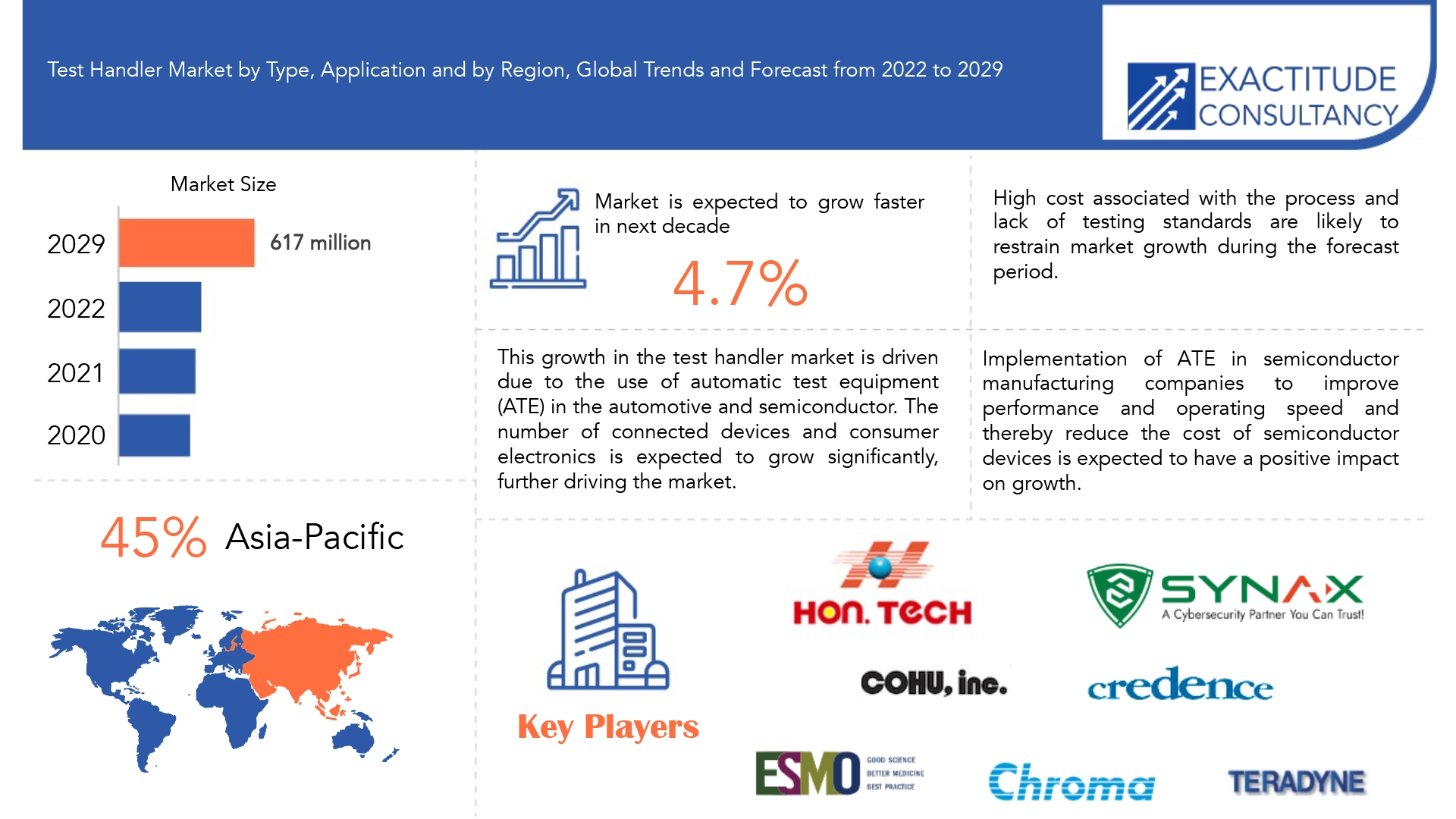
Se espera que el mercado de controladores de pruebas crezca a una tasa compuesta anual del 4,7 % entre 2023 y 2029. Se espera que alcance más de 617 millones de USD en 2029 desde 538 millones de USD en 2022.
Se espera que el mercado mundial de manipuladores de pruebas de semiconductores aumente a un ritmo considerable durante el período de pronóstico. En 2021, el mercado está creciendo de manera constante y se espera que supere el horizonte proyectado a medida que los actores clave adopten cada vez más la estrategia.
Los manipuladores de pruebas mueven las piezas bajo prueba, lo que realiza la clasificación de las piezas de prueba y actúa como un medio de transporte para ponerlas a disposición en la terminal ATE donde se realizan las mediciones de prueba. resultados de la prueba. manipulador de pruebas. El manipulador de CI automatizado con control remoto y control de temperatura se utiliza para mejorar la productividad en los laboratorios de semiconductores. El mercado de la electrónica móvil actual consume muchos CI, lo que da como resultado un alto consumo de energía durante las etapas de caracterización y preproducción del dispositivo. Un gigante mundial de fabricación de semiconductores instaló un manipulador de pruebas de semiconductores MT2168 XT de Xcerra. Este manipulador satisface el creciente volumen de demanda de pruebas de tres temperaturas confiables y rentables de paquetes y módulos de múltiples chips en los mercados automotriz y de consumo. Actualmente, los procesadores de prueba unitaria disponibles son soluciones especializadas con bajo rendimiento y capacidades de prueba de temperatura limitadas. El MT2168 XT aborda la necesidad del mercado de soluciones de prueba de producción de módulos de alto volumen . El conocimiento de tres temperaturas de los especialistas de Xcerra Handler Group se utiliza para brindar las capacidades técnicas avanzadas de nuestra última generación de manipuladores de selección y colocación. El MT2168 XT se puede utilizar para manipular dispositivos empaquetados y módulos. Debido a las dimensiones físicas y la arquitectura heterogénea del módulo, su manipulación y prueba pueden resultar difíciles. Los controles independientes de temperatura y fuerza del pistón le permiten gestionar módulos y controlar con precisión el consumo de energía para obtener altos rendimientos de prueba.
| ATRIBUTO | DETALLES |
| Periodo de estudio | 2022-2029 |
| Año base | 2022 |
| Año estimado | 2022 |
| Año pronosticado | 2023-2029 |
| Periodo histórico | 2018-2022 |
| Unidad | Valor (USD MILLONES), (MILES UNIDADES) |
| Segmentación | Por tipo, por aplicación, por región |
| Por tipo de vehículo |
|
| Por aplicación |
|
| Por región |
|
La integración de soluciones de contacto del grupo de productos de interfaz de XCerra puede proporcionar beneficios adicionales para las pruebas unitarias. El crecimiento del mercado de manipuladores de pruebas se debe al uso de equipos de prueba automáticos (ATE) en las industrias automotriz y de semiconductores. Además de las soluciones de prueba de extremo a extremo y el creciente interés de las empresas por mejorar la calidad, se espera que la cantidad de dispositivos conectados y productos electrónicos de consumo crezca significativamente, lo que impulsará aún más el mercado. Se espera que la implementación de su ATE en las empresas de fabricación de semiconductores para mejorar el rendimiento y la velocidad operativa y, por lo tanto, reducir el costo de los dispositivos semiconductores tenga un impacto positivo en el crecimiento.
Una de las principales limitaciones en el mercado de manipuladores de pruebas es la relación coste-eficacia y el uso inadecuado de la tecnología moderna en los países subdesarrollados, y estos son dos factores que se prevé que limiten el crecimiento del mercado de manipuladores de pruebas durante el período de pronóstico. Factores como la pérdida de inversiones, la escasez de profesionales cualificados y la incertidumbre económica mundial general están afectando gravemente al sector industrial. Los altos costes de los componentes asociados y la falta de profesionales cualificados en la producción industrial de los países subdesarrollados se han visto gravemente afectados en todo el mundo. El mercado de manipuladores de pruebas se ha visto afectado negativamente desde el brote de COVID-19 en diciembre de 2019. Durante la pandemia, muchos países impusieron confinamientos y cerraron empresas, excepto los servicios esenciales (permitidos con una dotación mínima de personal). Sin embargo, muchos países comenzaron a levantar gradualmente los confinamientos. Se espera que la demanda de EVW se recupere en los próximos meses. Los gobiernos de varios países han permitido reanudar las actividades comerciales teniendo en cuenta las directrices de seguridad. Los equipos de prueba automatizados (ATE) identifican defectos en el dispositivo bajo prueba (DUT) para garantizar la calidad del dispositivo. Para la introducción de ATE, estos equipos desempeñan un papel clave en la reducción de los costos de fabricación y la prevención de que los dispositivos defectuosos ingresen al mercado. Los ATE se utilizan ampliamente para probar circuitos integrados, obleas de semiconductores, placas de circuitos impresos, chips y otros componentes electrónicos en busca de defectos. Se utilizan ampliamente en la industria de semiconductores para probar sistemas electrónicos y componentes electrónicos de semiconductores en busca de defectos durante todo el proceso de fabricación para garantizar productos de calidad. [caption id="attachment_13599" align="aligncenter" width="1920"]
Frequently Asked Questions
• What is the worth of test handler market?
The Test handler market is worth USD 589 million and is forecasted to reach above USD 617 million by 2029.
• What is the size of the Asia-Pacific test handler industry?
Asia-Pacific Test handler market was sized 538 million in 2022 and is expected to grow at a CAGR of 4.7% to USD 242.1 million by 2029.
• What are some of the market's driving forces?
This growth in the test handler market is driven because of the use of automatic test equipment (ATE) in the automotive and semiconductor industries. In addition to end-to-end testing solutions, increasing interest by companies to improve quality, the number of connected devices and consumer electronics is expected to grow significantly, further driving the market.
• Which are the top companies to hold the market share in test handler market?
The Test handler market key players include Hontech, Synax, Esmo, Chroma, Cohu, Teradyne, Advantest, LTX-Credence and SPEA, etc.
• What is the leading application of test handler market?
Test handlers are mainly used to handle packaged devices as well as modules. Due to the physical dimensions and heterogeneous architecture of the module, handling and testing the module can be difficult. Independent piston force and temperature controls enables the management of modules and precise control power consumption for high test yields.
• Which is the largest regional market for test handler market?
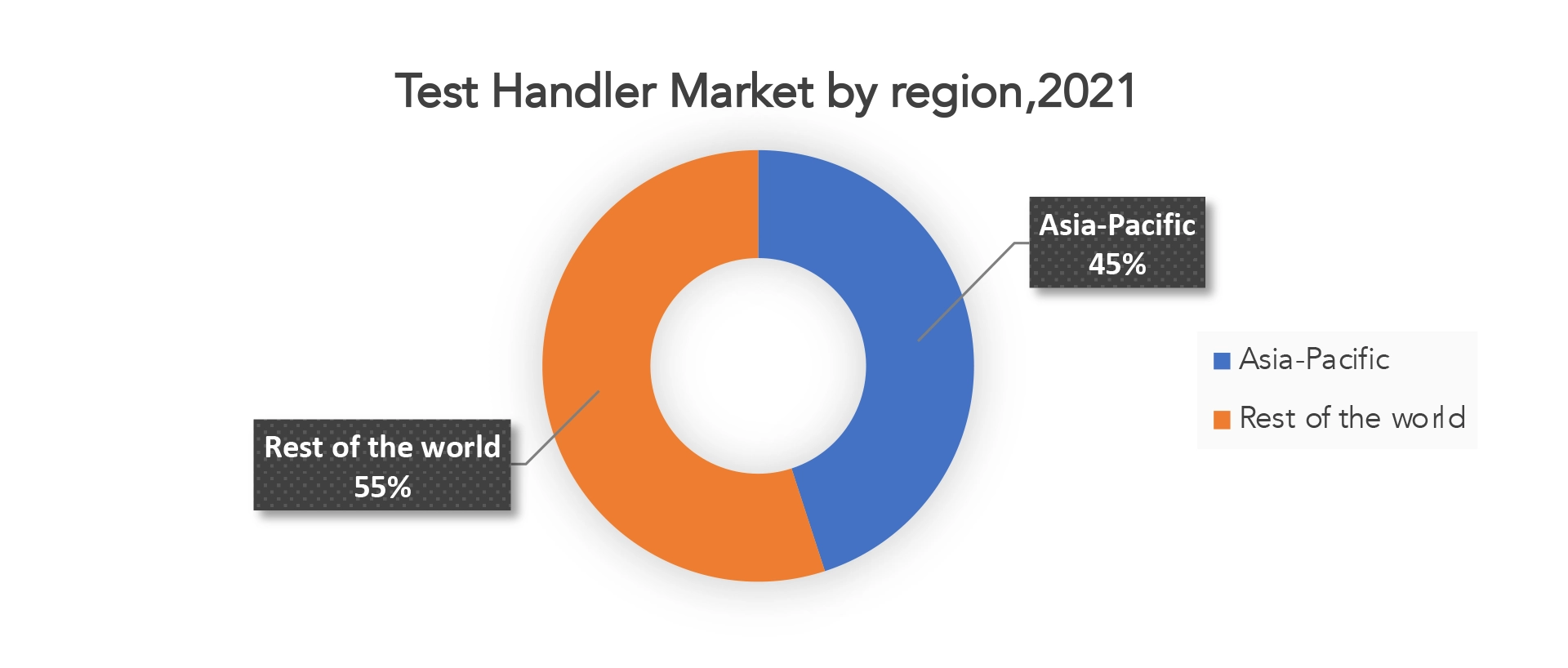
Asia-Pacific region is forecasted to account for the maximum share and continue the trend during the forecast period. Asia-Pacific Test handler market was sized 538 million in 2022 and is expected to grow at a CAGR of 4.7% to USD 242.1 million by 2029. The Asia-Pacific test handler market is experiencing rapid growth due to factors such as increased use of automatic test equipment (ATE) in the automotive and semiconductor industries
Test Handler Market Segment Analysis
The Test handler market is segmented based on type, application and region, global trends and forecast. By type, the market is bifurcated into wafer test handler and packaged device test handler. In terms of type wafer test handler dominates the market and is expected to do so in the forecast period. In terms of application the market is divided into Automotive Electronics, Consumer Electronics, Communications, Computer, Industrial/Medical, and Military/Aviation. [caption id="attachment_13609" align="aligncenter" width="1920"]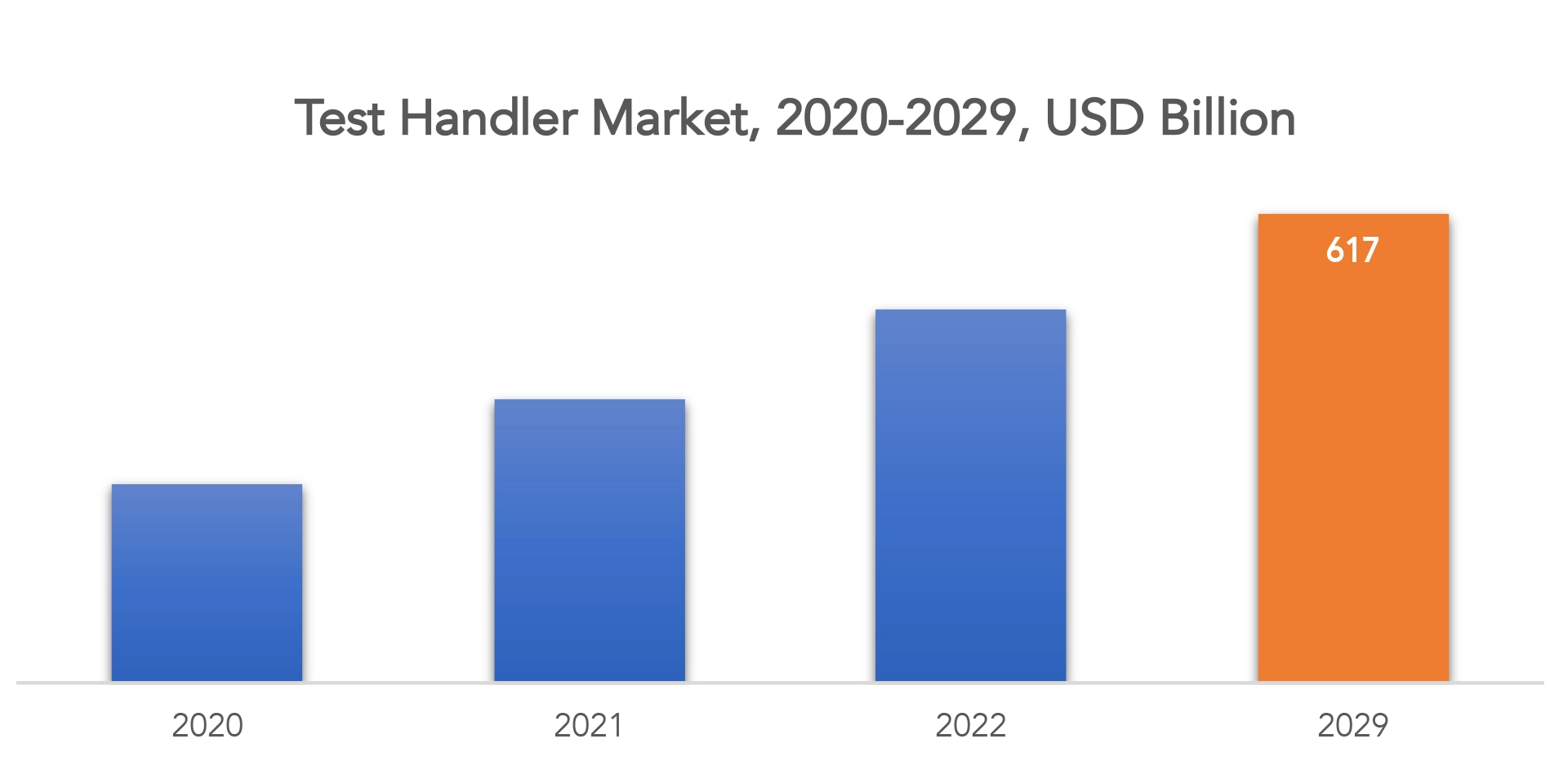
Test Handler Market Players
The Test Handler Market key players include Hontech, Synax, Esmo, Chroma, Cohu, Teradyne, Advantest, LTX-Credence and SPEA. Recent Developments In March 2022, National Instruments announced its Test Workflow subscription bundle for automated test systems. This offering expands engineers’ access to the software needed to design and automate a test or measurement system through a single software license. In December 2021, Advantest Corporation introduced and has begun shipping the fourth generation of its high-speed image-processing engine that applies heterogeneous computing technology to detect defects in the data output from today's most advanced CMOS image sensors (CIS). When integrated into the proven T2000 ISS platform, the new T2000 IP Engine 4 (Image Processing Engine 4) system provides the optimal means of evaluating the latest high-resolution, high-speed CIS devices used in advanced smartphone cameras. In April 2021, Astronics Corporation announced its next-generation circuit card diagnostic and test system, the PinPoint 3-PXIe (P3-PXIe). The P3-PXIe helps to identify failures down to the component level and can test a variety of mixed-signal products with the flexibility of PXIe. In January 2021, Teradyne announced that the company’s UltraFLEX test platform has enabled AI chip company Syntiant Corp. to successfully ship millions of its microwatt-power, deep learning Neural Decision Processors to customers worldwide. Using its UltraFLEX test platform, Teradyne is currently supporting the qualification and production ramp of the Syntiant NDP120 and Syntiant NDP121 Neural Decision Processors, Syntiant Corp’s second-generation hardware platforms, to run multiple audio applications simultaneously at under 1mW power consumption.Who Should Buy? Or Key stakeholders
- Investors
- Manufacturing companies
- Automotive Industry
- Government Institution
- Research Organizations
- Environment, Health, and Safety Professionals
- Regulatory Authorities
- Others
Test Handler Market Regional Analysis
The Test handler market by region includes North America, Asia-Pacific (APAC), Europe, South America, and Middle East & Africa (MEA).- North America: includes the US, Canada, Mexico
- Asia Pacific: includes China, Japan, South Korea, India, Australia, ASEAN and Rest of APAC
- Europe: includes UK, Germany, France, Italy, Spain, Russia, and Rest of Europe
- South America: includes Brazil, Argentina, and Rest of South America
- Middle East & Africa: includes Turkey, UAE, Saudi Arabia, South Africa, and Rest of MEA
Key Market Segments: Test Handler Market
Test Handler Market By Type, 2022-2029, (Usd Million), (Thousand Units)- Wafer Test Handler
- Packaged Device Test Handler
- Automotive Electronics
- Consumer Electronics
- Communications
- Computer
- Industrial/Medical
- Military/Aviation
Key Question Answered
- What is the current size of the Test handler market?
- What are the key factors influencing the growth of Connected Truck?
- What are the major applications for Connected Truck?
- Who are the major key players in the Test handler market?
- Which region will provide more business opportunities Test handler in future?
- Which segment holds the maximum share of the Test handler market?
DOWNLOAD FREE SAMPLE REPORT
License Type
SPEAK WITH OUR ANALYST
Want to know more about the report or any specific requirement?
WANT TO CUSTOMIZE THE REPORT?
Our Clients Speak
We asked them to research ‘ Equipment market’ all over the world, and their whole arrangement was helpful to us. thehealthanalytics.com insightful analysis and reports contributed to our current analysis and in creating a future strategy. Besides, the te
Yosuke Mitsui
Senior Associate Construction Equipment Sales & Marketing
We asked them to research ‘Equipment market’ all over the world, and their whole arrangement was helpful to us. thehealthanalytics.com insightful analysis and reports contributed to our current analysis and in creating a future strategy. Besides, the te