

Base Year Value ()
x.x %
x.x %
CAGR ()
x.x %
x.x %
Forecast Year Value ()
x.x %
x.x %
Historical Data Period
Largest Region
Forecast Period
Mercado de bioconservación por producto (equipos, medios, sistema de gestión de información de laboratorio (LIMS)), por bioespecímenes (tejidos humanos, células madre, órganos), por aplicación (medicina regenerativa, biobancos, descubrimiento de fármacos) y región, tendencias globales y pronóstico de 2022 a 2029
Instant access to hundreds of data points and trends
- Market estimates from 2014-2029
- Competitive analysis, industry segmentation, financial benchmarks
- Incorporates SWOT, Porter's Five Forces and risk management frameworks
- PDF report or online database with Word, Excel and PowerPoint export options
- 100% money back guarantee
Panorama del mercado de la bioconservación
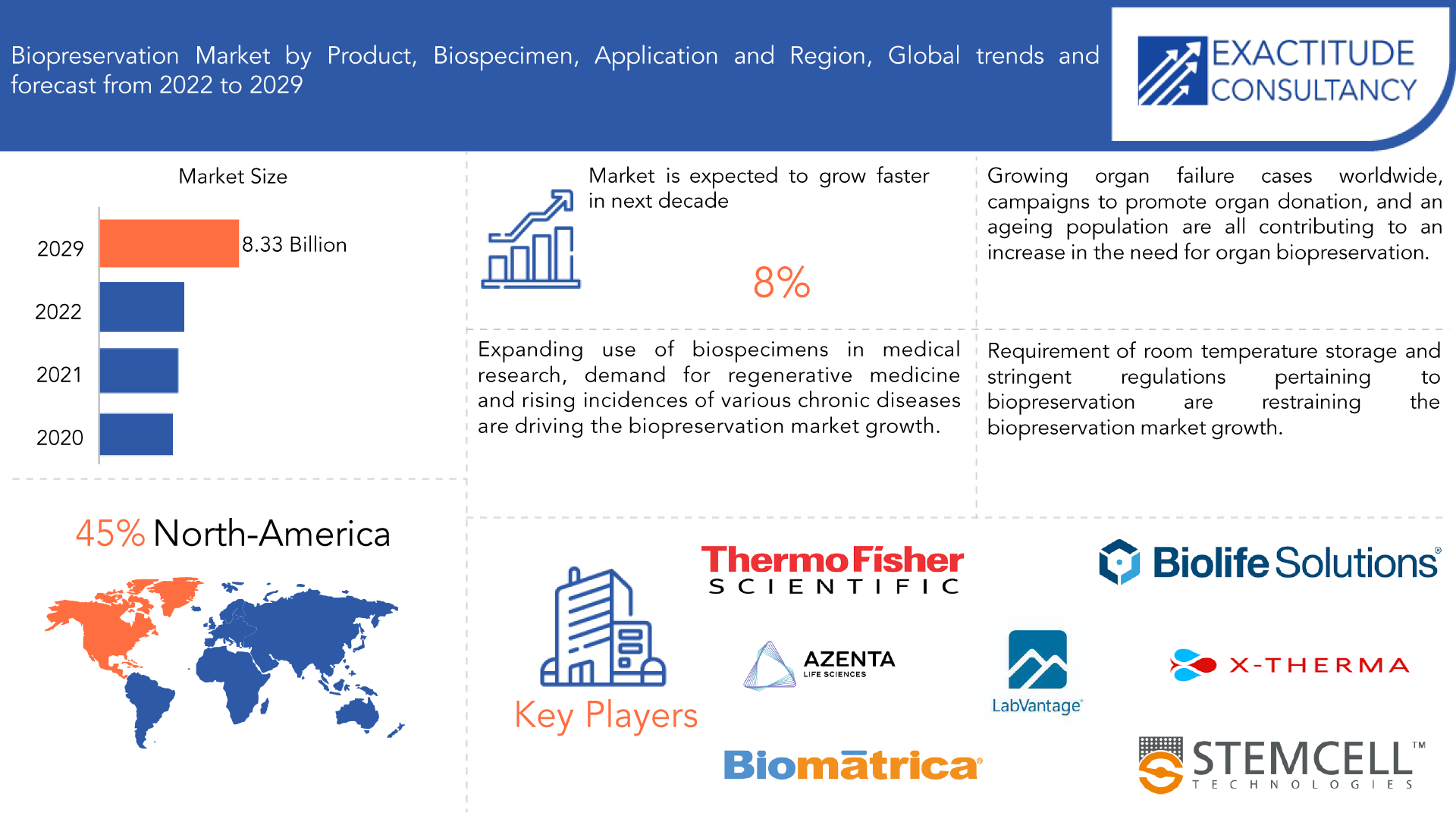
Se espera que el mercado de biopreservación crezca a una tasa compuesta anual del 8 % entre 2022 y 2029. Se espera que alcance más de USD 8,33 mil millones para 2029 desde USD 3,9 mil millones en 2020.
La biopreservación es el proceso de conservación y almacenamiento de diferentes bioespecímenes, como células, plasma, saliva, tejidos y órganos, fuera de sus entornos naturales. Las herramientas, que incluyen congeladores, refrigeradores y bancos de nitrógeno líquido, garantizan la estabilidad y pureza de los componentes biológicos, extendiendo su vida útil. La biopreservación se utiliza ampliamente en los centros de atención médica para una variedad de aplicaciones clínicas, incluido el almacenamiento de materiales de ensayos clínicos , investigación genómica , trasplante de órganos, estudios basados en células y medicina personalizada. Esto se debe a que exhibe una amplia actividad bactericida, no tóxica, no inmunogénica y propiedades de termorresistencia. Además, debido a que aprovecha las propiedades antimicrobianas de los patógenos en los productos alimenticios, también se utiliza en la industria alimentaria para aumentar la vida útil del producto terminado.
| ATRIBUTO | DETALLES |
| Periodo de estudio | 2020-2029 |
| Año base | 2021 |
| Año estimado | 2022 |
| Año pronosticado | 2022-2029 |
| Periodo histórico | 2018-2020 |
| Unidad | Valor (USD MIL MILLONES) |
| Segmentación | Por producto, por bioespecímen, por función, por región |
| Por producto |
|
| Por Bioespecimen |
|
| Por aplicación |
|
| Por región |
|
Las tecnologías basadas en células se pueden desarrollar utilizando una amplia gama de usos terapéuticos y comerciales que ofrece la biopreservación. Para preservar el funcionamiento y la integridad de los materiales de ensayos clínicos, como óvulos, espermatozoides, embriones y otros recursos biológicos, se utiliza en muchos centros sanitarios. La biopreservación aumenta la vida útil de las muestras biológicas al tiempo que mantiene su sostenibilidad y pureza.
La práctica de preservar las células madre de la sangre del cordón umbilical de los recién nacidos, los avances en biobancos, una mayor financiación para la investigación en medicina regenerativa y el creciente deseo de una atención individualizada son solo algunos de los factores que impulsan el crecimiento de la industria de la biopreservación.
El mercado de la biopreservación está impulsado principalmente por el uso cada vez mayor de bioespecímenes en la investigación médica para crear nuevos tratamientos y medicamentos. En consecuencia, la demanda de medicina regenerativa, en la que los componentes celulares de la biopreservación se utilizan para restablecer el funcionamiento normal de los tejidos dañados, se ve facilitada aún más por la creciente incidencia de diversas enfermedades crónicas, como el cáncer y la diabetes, así como las enfermedades degenerativas y los trastornos neurológicos. Otro factor importante que promueve el crecimiento es la creciente popularidad de los biobancos. Además, el aumento de los costos de la atención médica, especialmente en los países en desarrollo, junto con los rápidos avances en las técnicas y herramientas de biopreservación están impulsando la expansión del mercado. Además, para apoyar las terapias con células madre y mejorar los estándares de biobancos y preservación, los gobiernos de todo el mundo están implementando una legislación favorable e invirtiendo continuamente en esfuerzos de I+D. A su vez, esto está dando como resultado un pronóstico de mercado prometedor.
Además de alentar a las compañías farmacéuticas, las compañías de biotecnología y los hospitales a adoptar sistemas internos para las muestras, el desarrollo de técnicas de criopreservación de próxima generación, la mejora de la formulación de almacenamiento hipotérmico y la integración y el diseño de tecnologías a nanoescala han incrementado el valor de mercado.
La falta de especialistas cualificados y la escasa seguridad cibernética están relacionadas con la expansión de la industria de la biopreservación, ya que el software estandarizado y la formación del personal tienen un coste considerable, lo que puede afectar a la expansión del mercado en su conjunto.
Los confinamientos implementados por el gobierno para detener la propagación de la COVID-19 han provocado temporalmente una ligera caída en el negocio mundial de la biopreservación. La epidemia interrumpió la cadena de suministro global, lo que tuvo un efecto en el mercado. Sin embargo, ha habido una creciente necesidad de conservación de plasmas, fluidos corporales, tejidos y órganos en medio de la epidemia. Esto llevó a un aumento en la demanda de servicios de biopreservación. El mercado seguirá teniendo una tendencia al alza en el próximo año. Por ejemplo, el Biobanco COVID-19 fue establecido por el Colegio de Médicos y Cirujanos Vagelos de la Universidad de Columbia, EE. UU., y el Hospital Presbiteriano de Nueva York en marzo de 2020 como un repositorio central para la recopilación, almacenamiento y difusión de muestras biológicas y datos clínicos para investigadores de la Universidad de Columbia y otros lugares.
[título id="attachment_16537" align="aligncenter" width="1920"]
Frequently Asked Questions
• What is the expected CAGR in terms of revenue for the global Biopreservation Market over the forecast period (2020–2029)?
The global Biopreservation Market revenue is projected to expand at a CAGR of 7.6% during the forecast period.
• What was the global Biopreservation Market valued at in 2020?
The global Biopreservation Market was valued at USD 4.28 Billion in 2020.
• Who are the key players in the Biopreservation Market?
Some key players operating in the Biopreservation Market include Agilent Technologies Inc., Becton Dickinson and Company, bioMérieux SA, Bio-Rad Laboratories Inc., Danaher Corporation, DiaSorin S.p.A., Miltenyi Biotec Inc., Sartorius AG, Sysmex Corporation, Thermo Fisher Scientific Inc.
• What are the factors driving the Biopreservation Market?
Key factors driving the Biopreservation Market growth include the rising R&D investments in the biotechnology sector and technological advancements in the field of flow cytometry for introducing new and improved analytical tools, such as microfluidic flow cytometry, for point-of-care testing.
• Which region will lead the global Biopreservation Market?
North America region will lead the global Biopreservation Market during the forecast period 2022 to 2029.
Biopreservation Market Segment Analysis
The Biopreservation Market is segmented based on Product, Biospecimen, Application, and Region, Global trends and forecast.
By Product the market is bifurcated into Equipment, Media and Laboratory Information Management System (LIMS); by biospecimen the market is bifurcated into Human Tissue, Stem Cells and Organs; by Application the market is bifurcated into Regenerative Medicine, Bio-banking, Drug Discovery, and Region.
Due to the growing demand for bio-banking to preserve stem cells, DNA, plasma, and tissue culture, the equipment segment held the greatest revenue share of over 75.0% in 2021. Due to preservation's widespread acceptance and application, there is now enough storage space and little maintenance required, which is predicted to spur market expansion. The media industry is anticipated to grow at a gratifying CAGR of 30.6%. Given that it is an essential step in the biopreservation process, the market has room to develop. The ability to investigate, diagnose, monitor, and treat health disorders—which are expected to drive the market in the forecast period—is improved by media apps' increased features and details that enable researchers to access and exchange research data and analysis.
Human tissue samples, organs, stem cells, and other biospecimens are among the biospecimens that can be preserved using the biopreservation process. Growing organ failure cases worldwide, campaigns to promote organ donation, and an ageing population are all contributing to an increase in the need for organ biopreservation. The stem cells segment accounted for a sizeable portion of sales and is anticipated to expand profitably over the next years. The increasing use of mesenchymal stem cells in various scientific projects and therapeutic trials is responsible for the segmental expansion. Additionally, the potential of stem cells to differentiate into various cell types, such as cartilage, bone, muscle, and adipocytes, would increase their uptake, leading to segmental expansion.
In 2021, the biobanking market category held a commanding revenue share of over 70.0%. Growing acceptance of sperm and egg banking, rising awareness of stem cell preservation, and the use of animal assisted reproduction technology are all driving the segment's expansion. For the preservation of tissue, pharmaceutical corporations work with hospitals and reserve biobanks. In the forecast future, the regenerative medicine segment is anticipated to grow at the highest CAGR of 30.3% due to rising demand for technologically enhanced bio-storage methods. In the upcoming years, the introduction of certain preservation procedures is anticipated to fuel the segment's expansion. [caption id="attachment_16542" align="aligncenter" width="1920"]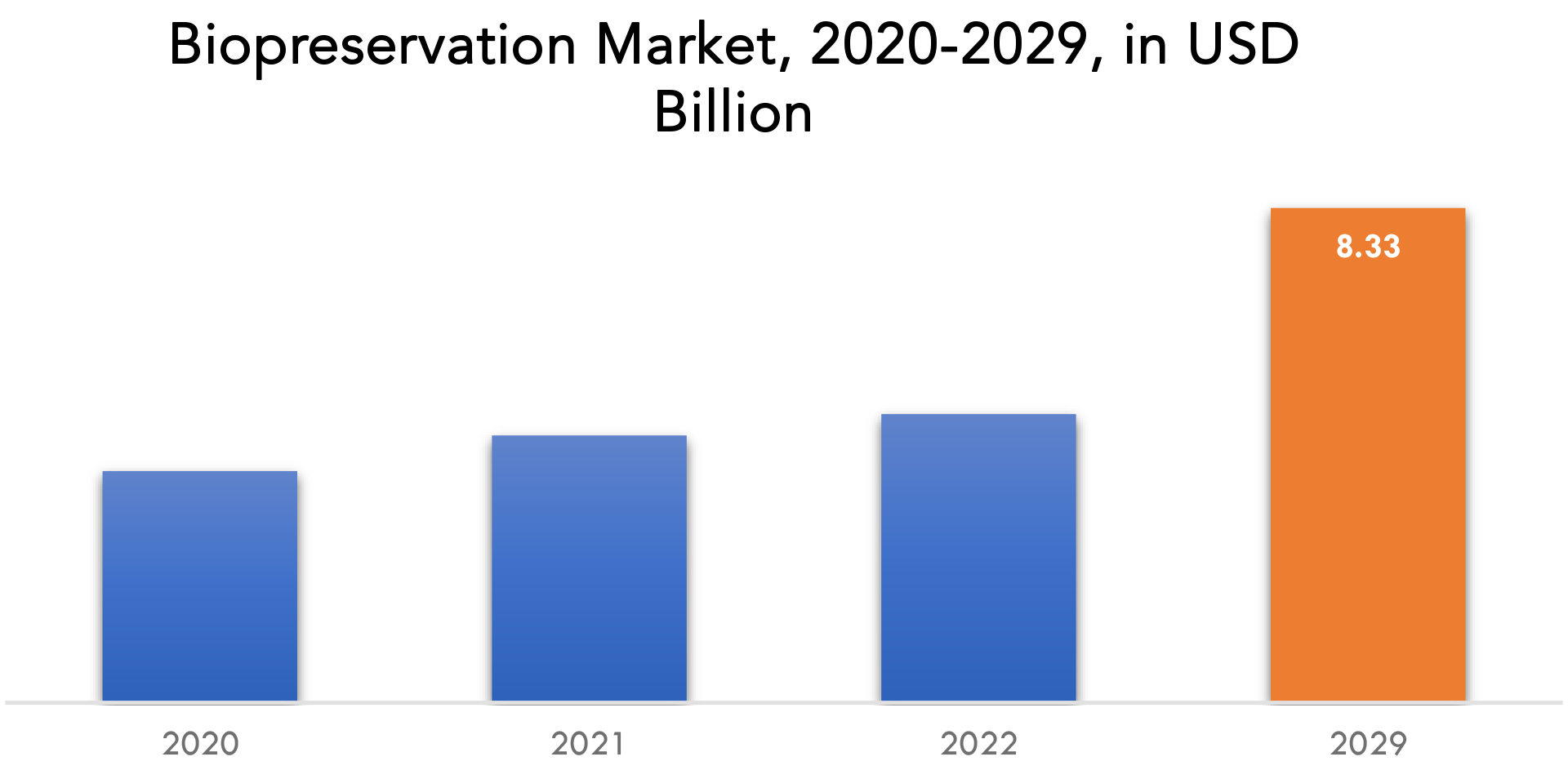
Biopreservation Market Key Players
The Biopreservation Market key players include Azenta Inc., Biomatrica Inc., BioLife Solutions, MVE Biological Solutions, LabVantage Solutions Inc., Taylor-Wharton, Thermo Fisher Scientific Inc., Panasonic Corporation, X-Therma Inc., PrincetonCryo, Stirling Ultracold, Biocision LLC, Stemcell Technologies Inc., and others.
Recent Developments 03 February, 2023: Azenta, Inc. announced the acquisition of Ziath, Ltd. and its subsidiaries. Ziath, headquartered in Cambridge, UK, is a leading provider of 2D barcode readers for life sciences applications. 08 November, 2022: Azenta Inc. and the Government of Luxembourg today announced the signing of a Memorandum of Understanding ("MoU") to facilitate continued healthcare technology development in Luxembourg.Who Should Buy? Or Key Stakeholders
- Medical Technology Companies
- Scientific Research & Development
- Medical Devices Manufacturers
- End-users
- Regulatory Authorities
- Others
Biopreservation Market Regional Analysis
The Biopreservation Market by region includes North America, Asia-Pacific (APAC), Europe, South America, and Middle East & Africa (MEA).
- North America: includes the US, Canada, Mexico
- Asia Pacific: includes China, Japan, South Korea, India, Australia, and Rest of APAC
- Europe: includes UK, Germany, France, Italy, Spain, Russia, and Rest of Europe
- South America: includes Brazil, Argentina, and Rest of South America
- Middle East & Africa: includes UAE, South Africa, Saudi Arabia and Rest of MEA
In 2021, North America had the highest revenue share over 45.0%. This is due to the development of cutting-edge therapies and the advancement of biomedical research. Additionally, the region's market position is strengthened by the increased occurrence of chronic diseases that require therapies. This in turn produces a demand for biopreservation. Such operations are anticipated to support growth by expanding the range of biopreservation products accessible on the market. The penetration of biopreservation techniques is expected to increase significantly in the U.S. during the projection period as a result of government organizations and other biobanking institutions.
Due to factors such the high prevalence of chronic diseases and rising healthcare costs, the Asia Pacific region is predicted to develop at the quickest rate over the forecast period.
Because of the increasing funding support for biobanking techniques and services, as well as the growing partnerships and collaborations brought about by bio-preservation technologies, Germany is predicted to have the fastest growth in Europe throughout the projected timeframe. High growth in the biopreservation business is caused by increased government support for international partnerships and the networking of biobanks like the UK Biobank.
[caption id="attachment_16544" align="aligncenter" width="1920"]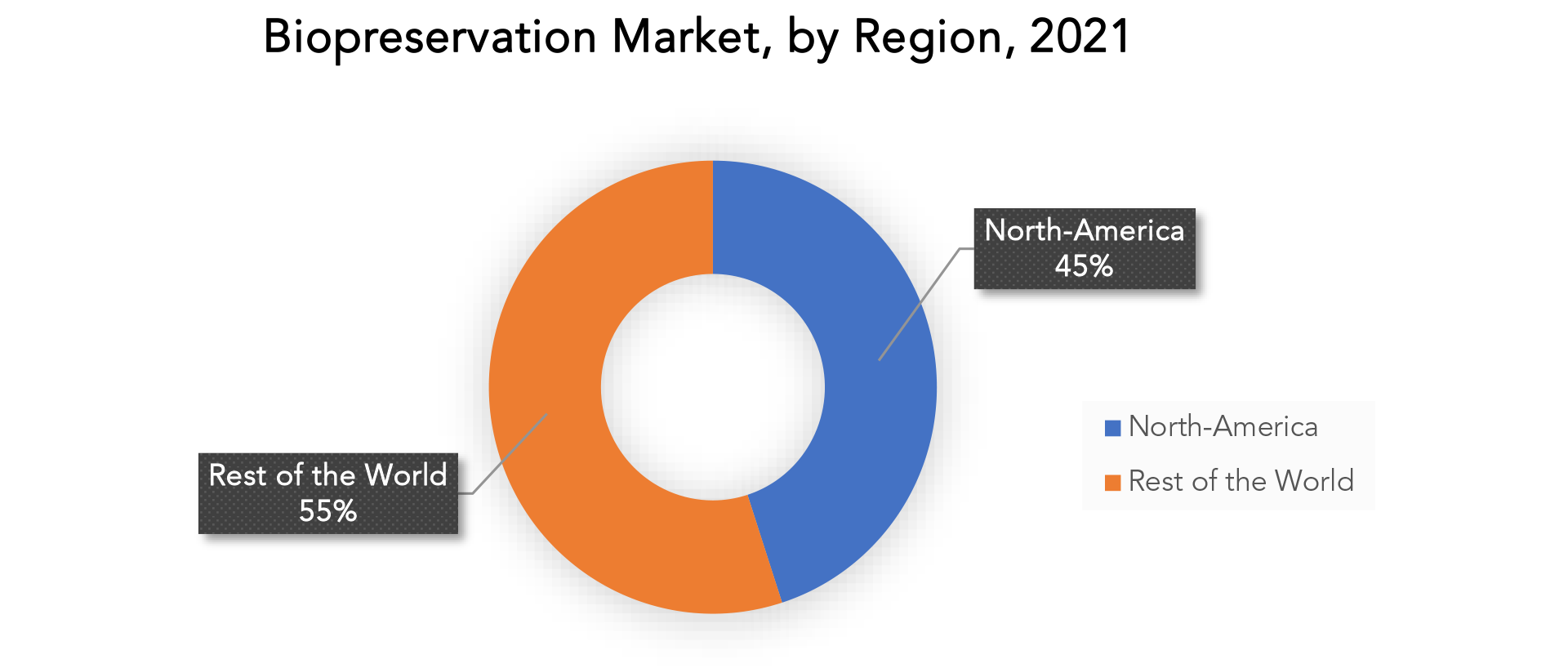
Key Market Segments: Biopreservation Market
Biopreservation Market by Product, 2020-2029, (USD Billion)- Equipment
- Media
- Laboratory Information Management System (Lims)
- Human Tissue
- Stem Cells
- Organs
- Regenerative Medicine
- Bio-Banking
- Drug Discovery
- North America
- Asia Pacific
- Europe
- South America
- Middle East And Africa
Exactitude Consultancy Services Key Objectives
- Increasing sales and market share
- Developing new technology
- Improving profitability
- Entering new markets
- Enhancing brand reputation
Key Question Answered
- What is the expected growth rate of the Biopreservation Market over the next 7 years?
- Who are the major players in the Biopreservation Market and what is their market share?
- What are the end-user industries driving demand for market and what is their outlook?
- What are the opportunities for growth in emerging markets such as Asia-Pacific, Middle East, and Africa?
- How is the economic environment affecting the Biopreservation Market, including factors such as interest rates, inflation, and exchange rates?
- What is the expected impact of government policies and regulations on the Biopreservation Market?
- What is the current and forecasted size and growth rate of the global Biopreservation Market?
- What are the key drivers of growth in the Biopreservation Market?
- Who are the major players in the market and what is their market share?
- What are the distribution channels and supply chain dynamics in the Biopreservation Market?
- What are the technological advancements and innovations in the Biopreservation Market and their impact on product development and growth?
- What are the regulatory considerations and their impact on the market?
- What are the challenges faced by players in the Biopreservation Market and how are they addressing these challenges?
- What are the opportunities for growth and expansion in the Biopreservation Market?
- What are the service offerings and specifications of leading players in the market?
- INTRODUCCIÓN
- DEFINICIÓN DE MERCADO
- SEGMENTACIÓN DEL MERCADO
- CRONOGRAMAS DE INVESTIGACIÓN
- SUPUESTOS Y LIMITACIONES
- METODOLOGÍA DE LA INVESTIGACIÓN
- MINERÍA DE DATOS
- INVESTIGACIÓN SECUNDARIA
- INVESTIGACIÓN PRIMARIA
- ASESORAMIENTO DE EXPERTOS EN LA MATERIA
- CONTROLES DE CALIDAD
- REVISIÓN FINAL
- TRIANGULACIÓN DE DATOS
- ENFOQUE DE ABAJO HACIA ARRIBA
- ENFOQUE DE ARRIBA HACIA ABAJO
- FLUJO DE INVESTIGACIÓN
- FUENTES DE DATOS
- MINERÍA DE DATOS
- RESUMEN EJECUTIVO
- PANORAMA DEL MERCADO
- PERSPECTIVAS DEL MERCADO MUNDIAL DE BIOPRESERVACIÓN
- IMPULSORES DEL MERCADO
- MARKET RESTRAINTS
- MARKET OPPORTUNITIES
- IMPACT OF COVID-19 ON BIOPRESERVATION MARKET
- PORTER’S FIVE FORCES MODEL
- THREAT FROM NEW ENTRANTS
- THREAT FROM SUBSTITUTES
- BARGAINING POWER OF SUPPLIERS
- BARGAINING POWER OF CUSTOMERS
- DEGREE OF COMPETITION
- INDUSTRY VALUE CHAIN ANALYSIS
- PERSPECTIVAS DEL MERCADO MUNDIAL DE BIOPRESERVACIÓN
- GLOBAL BIOPRESERVATION MARKET BY PRODUCT (USD BILLION), 2020-2029
- EQUIPMENT
- MEDIA
- LABORATORY INFORMATION MANAGEMENT SYSTEM (LIMS)
- GLOBAL BIOPRESERVATION MARKET BY BIOSPECIMEN (USD BILLION), 2020-2029
- HUMAN TISSUE
- STEM CELLS
- ORGANS
- GLOBAL BIOPRESERVATION MARKET BY APPLICATION (USD BILLION), 2020-2029
- REGENERATIVE MEDICINE
- BIO-BANKING
- DRUG DISCOVERY
- GLOBAL BIOPRESERVATION MARKET BY REGION (USD BILLION), 2020-2029
- NORTH AMERICA
- US
- CANADA
- MEXICO
- SOUTH AMERICA
- BRAZIL
- ARGENTINA
- COLOMBIA
- REST OF SOUTH AMERICA
- EUROPE
- GERMANY
- UK
- FRANCE
- ITALY
- SPAIN
- RUSSIA
- REST OF EUROPE
- ASIA PACIFIC
- INDIA
- CHINA
- JAPAN
- SOUTH KOREA
- AUSTRALIA
- REST OF ASIA PACIFIC
- MIDDLE EAST AND AFRICA
- UAE
- SAUDI ARABIA
- SOUTH AFRICA
- REST OF MIDDLE EAST AND AFRICA
- NORTH AMERICA
- COMPANY PROFILES* (BUSINESS OVERVIEW, COMPANY SNAPSHOT, PRODUCTS OFFERED, RECENT DEVELOPMENTS)
- AZENTA INC.
- BIOMATRICA INC.
- BIOLIFE SOLUTIONS
- MVE BIOLOGICAL SOLUTIONS
- LABVANTAGE SOLUTIONS INC.
- TAYLOR-WHARTON
- THERMO FISHER SCIENTIFIC INC.
- PANASONIC CORPORATION
- X-THERMA INC.
- PRINCETONCRYO
- STIRLING ULTRACOLD
- BIOCISION LLC
- STEMCELL TECHNOLOGIES INC *THE COMPANY LIST IS INDICATIVE
LIST OF TABLES
TABLE 1 GLOBAL BIOPRESERVATION MARKET BY PRODUCT (USD BILLION), 2020-2029
TABLE 2 GLOBAL BIOPRESERVATION MARKET BY BIOSPECIMEN (USD BILLION), 2020-2029
TABLE 3 GLOBAL BIOPRESERVATION MARKET BY APPLICATION (USD BILLION), 2020-2029
TABLE 4 GLOBAL BIOPRESERVATION MARKET BY REGION (USD BILLION), 2020-2029
TABLE 5 NORTH AMERICA BIOPRESERVATION MARKET BY PRODUCT (USD BILLION), 2020-2029
TABLE 6 NORTH AMERICA BIOPRESERVATION MARKET BY BIOSPECIMEN (USD BILLION), 2020-2029
TABLE 7 NORTH AMERICA BIOPRESERVATION MARKET BY APPLICATION (USD BILLION), 2020-2029
TABLE 8 NORTH AMERICA BIOPRESERVATION MARKET BY COUNTRY (USD BILLION), 2020-2029
TABLE 9 US BIOPRESERVATION MARKET BY PRODUCT (USD BILLION), 2020-2029
TABLE 10 US BIOPRESERVATION MARKET BY BIOSPECIMEN (USD BILLION), 2020-2029
TABLE 11 US BIOPRESERVATION MARKET BY APPLICATION (USD BILLION), 2020-2029
TABLE 12 CANADA BIOPRESERVATION MARKET BY PRODUCT (BILLION), 2020-2029
TABLE 13 CANADA BIOPRESERVATION MARKET BY BIOSPECIMEN (USD BILLION), 2020-2029
TABLE 14 CANADA BIOPRESERVATION MARKET BY APPLICATION (USD BILLION), 2020-2029
TABLE 15 MEXICO BIOPRESERVATION MARKET BY PRODUCT (USD BILLION), 2020-2029
TABLE 16 MEXICO BIOPRESERVATION MARKET BY BIOSPECIMEN (USD BILLION), 2020-2029
TABLE 17 MEXICO BIOPRESERVATION MARKET BY APPLICATION (USD BILLION), 2020-2029
TABLE 18 REST OF NORTH AMERICA BIOPRESERVATION MARKET BY PRODUCT (USD BILLION), 2020-2029
TABLE 19 REST OF NORTH AMERICA BIOPRESERVATION MARKET BY BIOSPECIMEN (USD BILLION), 2020-2029
TABLE 20 REST OF NORTH AMERICA BIOPRESERVATION MARKET BY APPLICATION (USD BILLION), 2020-2029
TABLE 21 SOUTH AMERICA BIOPRESERVATION MARKET BY PRODUCT (USD BILLION), 2020-2029
TABLE 22 SOUTH AMERICA BIOPRESERVATION MARKET BY BIOSPECIMEN (USD BILLION), 2020-2029
TABLE 23 SOUTH AMERICA BIOPRESERVATION MARKET BY APPLICATION (USD BILLION), 2020-2029
TABLE 24 SOUTH AMERICA BIOPRESERVATION MARKET BY COUNTRY (USD BILLION), 2020-2029
TABLE 25 BRAZIL BIOPRESERVATION MARKET BY PRODUCT (USD BILLION), 2020-2029
TABLE 26 BRAZIL BIOPRESERVATION MARKET BY BIOSPECIMEN (USD BILLION), 2020-2029
TABLE 27 BRAZIL BIOPRESERVATION MARKET BY APPLICATION (USD BILLION), 2020-2029
TABLE 28 ARGENTINA BIOPRESERVATION MARKET BY PRODUCT (USD BILLION), 2020-2029
TABLE 29 ARGENTINA BIOPRESERVATION MARKET BY BIOSPECIMEN (USD BILLION), 2020-2029
TABLE 30 ARGENTINA BIOPRESERVATION MARKET BY APPLICATION (USD BILLION), 2020-2029
TABLE 31 COLOMBIA BIOPRESERVATION MARKET BY PRODUCT (USD BILLION), 2020-2029
TABLE 32 COLOMBIA BIOPRESERVATION MARKET BY BIOSPECIMEN (USD BILLION), 2020-2029
TABLE 33 COLOMBIA BIOPRESERVATION MARKET BY APPLICATION (USD BILLION), 2020-2029
TABLE 34 REST OF SOUTH AMERICA BIOPRESERVATION MARKET BY PRODUCT (USD BILLION), 2020-2029
TABLE 35 REST OF SOUTH AMERICA BIOPRESERVATION MARKET BY BIOSPECIMEN (USD BILLION), 2020-2029
TABLE 36 REST OF SOUTH AMERICA BIOPRESERVATION MARKET BY APPLICATION (USD BILLION), 2020-2029
TABLE 37 ASIA-PACIFIC BIOPRESERVATION MARKET BY PRODUCT (USD BILLION), 2020-2029
TABLE 38 ASIA-PACIFIC BIOPRESERVATION MARKET BY BIOSPECIMEN (USD BILLION), 2020-2029
TABLE 39 ASIA-PACIFIC BIOPRESERVATION MARKET BY APPLICATION (USD BILLION), 2020-2029
TABLE 40 ASIA-PACIFIC BIOPRESERVATION MARKET BY COUNTRY (USD BILLION), 2020-2029
TABLE 41 INDIA BIOPRESERVATION MARKET BY PRODUCT (USD BILLION), 2020-2029
TABLE 42 INDIA BIOPRESERVATION MARKET BY BIOSPECIMEN (USD BILLION), 2020-2029
TABLE 43 INDIA BIOPRESERVATION MARKET BY APPLICATION (USD BILLION), 2020-2029
TABLE 44 CHINA BIOPRESERVATION MARKET BY PRODUCT (USD BILLION), 2020-2029
TABLE 45 CHINA BIOPRESERVATION MARKET BY BIOSPECIMEN (USD BILLION), 2020-2029
TABLE 46 CHINA BIOPRESERVATION MARKET BY APPLICATION (USD BILLION), 2020-2029
TABLE 47 JAPAN BIOPRESERVATION MARKET BY PRODUCT (USD BILLION), 2020-2029
TABLE 48 JAPAN BIOPRESERVATION MARKET BY BIOSPECIMEN (USD BILLION), 2020-2029
TABLE 49 JAPAN BIOPRESERVATION MARKET BY APPLICATION (USD BILLION), 2020-2029
TABLE 50 SOUTH KOREA BIOPRESERVATION MARKET BY PRODUCT (USD BILLION), 2020-2029
TABLE 51 SOUTH KOREA BIOPRESERVATION MARKET BY BIOSPECIMEN (USD BILLION), 2020-2029
TABLE 52 SOUTH KOREA BIOPRESERVATION MARKET BY APPLICATION (USD BILLION), 2020-2029
TABLE 53 AUSTRALIA BIOPRESERVATION MARKET BY PRODUCT (USD BILLION), 2020-2029
TABLE 54 AUSTRALIA BIOPRESERVATION MARKET BY BIOSPECIMEN (USD BILLION), 2020-2029
TABLE 55 AUSTRALIA BIOPRESERVATION MARKET BY APPLICATION (USD BILLION), 2020-2029
TABLE 56 REST OF ASIA PACIFIC BIOPRESERVATION MARKET BY PRODUCT (USD BILLION), 2020-2029
TABLE 57 REST OF ASIA PACIFIC BIOPRESERVATION MARKET BY BIOSPECIMEN (USD BILLION), 2020-2029
TABLE 58 REST OF ASIA PACIFIC BIOPRESERVATION MARKET BY APPLICATION (USD BILLION), 2020-2029
TABLE 59 EUROPE BIOPRESERVATION MARKET BY PRODUCT (USD BILLION), 2020-2029
TABLE 60 EUROPE BIOPRESERVATION MARKET BY BIOSPECIMEN (USD BILLION), 2020-2029
TABLE 61 EUROPE BIOPRESERVATION MARKET BY APPLICATION (USD BILLION), 2020-2029
TABLE 62 EUROPE BIOPRESERVATION MARKET BY COUNTRY (USD BILLION), 2020-2029
TABLE 63 GERMANY BIOPRESERVATION MARKET BY PRODUCT (USD BILLION), 2020-2029
TABLE 64 GERMANY BIOPRESERVATION MARKET BY BIOSPECIMEN (USD BILLION), 2020-2029
TABLE 65 GERMANY BIOPRESERVATION MARKET BY APPLICATION (USD BILLION), 2020-2029
TABLE 66 UK BIOPRESERVATION MARKET BY PRODUCT (USD BILLION), 2020-2029
TABLE 67 UK BIOPRESERVATION MARKET BY BIOSPECIMEN (USD BILLION), 2020-2029
TABLE 68 UK BIOPRESERVATION MARKET BY APPLICATION (USD BILLION), 2020-2029
TABLE 69 FRANCE BIOPRESERVATION MARKET BY PRODUCT (USD BILLION), 2020-2029
TABLE 70 FRANCE BIOPRESERVATION MARKET BY BIOSPECIMEN (USD BILLION), 2020-2029
TABLE 71 FRANCE BIOPRESERVATION MARKET BY APPLICATION (USD BILLION), 2020-2029
TABLE 72 ITALY BIOPRESERVATION MARKET BY PRODUCT (USD BILLION), 2020-2029
TABLE 73 ITALY BIOPRESERVATION MARKET BY BIOSPECIMEN (USD BILLION), 2020-2029
TABLE 74 ITALY BIOPRESERVATION MARKET BY APPLICATION (USD BILLION), 2020-2029
TABLE 75 SPAIN BIOPRESERVATION MARKET BY PRODUCT (USD BILLION), 2020-2029
TABLE 76 SPAIN BIOPRESERVATION MARKET BY BIOSPECIMEN (USD BILLION), 2020-2029
TABLE 77 SPAIN BIOPRESERVATION MARKET BY APPLICATION (USD BILLION), 2020-2029
TABLE 78 RUSSIA BIOPRESERVATION MARKET BY PRODUCT (USD BILLION), 2020-2029
TABLE 79 RUSSIA BIOPRESERVATION MARKET BY BIOSPECIMEN (USD BILLION), 2020-2029
TABLE 80 RUSSIA BIOPRESERVATION MARKET BY APPLICATION (USD BILLION), 2020-2029
TABLE 81 REST OF EUROPE BIOPRESERVATION MARKET BY PRODUCT (USD BILLION), 2020-2029
TABLE 82 REST OF EUROPE BIOPRESERVATION MARKET BY BIOSPECIMEN (USD BILLION), 2020-2029
TABLE 83 REST OF EUROPE BIOPRESERVATION MARKET BY APPLICATION (USD BILLION), 2020-2029
TABLE 84 MIDDLE EAST AND AFRICA BIOPRESERVATION MARKET BY PRODUCT (USD BILLION), 2020-2029
TABLE 85 MIDDLE EAST AND AFRICA BIOPRESERVATION MARKET BY BIOSPECIMEN (USD BILLION), 2020-2029
TABLE 86 MIDDLE EAST AND AFRICA BIOPRESERVATION MARKET BY APPLICATION (USD BILLION), 2020-2029
TABLE 87 MIDDLE EAST AND AFRICA BIOPRESERVATION MARKET BY COUNTRY (USD BILLION), 2020-2029
TABLE 88 UAE BIOPRESERVATION MARKET BY PRODUCT (USD BILLION), 2020-2029
TABLE 89 UAE BIOPRESERVATION MARKET BY BIOSPECIMEN (USD BILLION), 2020-2029
TABLE 90 UAE BIOPRESERVATION MARKET BY APPLICATION (USD BILLION), 2020-2029
TABLE 91 SAUDI ARABIA BIOPRESERVATION MARKET BY PRODUCT (USD BILLION), 2020-2029
TABLE 92 SAUDI ARABIA BIOPRESERVATION MARKET BY BIOSPECIMEN (USD BILLION), 2020-2029
TABLE 93 SAUDI ARABIA BIOPRESERVATION MARKET BY APPLICATION (USD BILLION), 2020-2029
TABLE 94 SOUTH AFRICA BIOPRESERVATION MARKET BY PRODUCT (USD BILLION), 2020-2029
TABLE 95 SOUTH AFRICA BIOPRESERVATION MARKET BY BIOSPECIMEN (USD BILLION), 2020-2029
TABLE 96 SOUTH AFRICA BIOPRESERVATION MARKET BY APPLICATION (USD BILLION), 2020-2029
TABLE 97 REST OF MIDDLE EAST AND AFRICA BIOPRESERVATION MARKET BY PRODUCT (USD BILLION), 2020-2029
TABLE 98 REST OF MIDDLE EAST AND AFRICA BIOPRESERVATION MARKET BY BIOSPECIMEN (USD BILLION), 2020-2029
TABLE 99 REST OF MIDDLE EAST AND AFRICA BIOPRESERVATION MARKET BY APPLICATION (USD BILLION), 2020-2029
LIST OF FIGURES
FIGURE 1 MARKET DYNAMICS
FIGURE 2 MARKET SEGMENTATION
FIGURE 3 REPORT TIMELINES: YEARS CONSIDERED
FIGURE 4 DATA TRIANGULATION
FIGURE 5 BOTTOM-UP APPROACH
FIGURE 6 TOP-DOWN APPROACH
FIGURE 7 RESEARCH FLOW
FIGURE 8 GLOBAL BIOPRESERVATION MARKET BY PRODUCT, USD BILLION, 2020-2029
FIGURE 9 GLOBAL BIOPRESERVATION MARKET BY BIOSPECIMEN, USD BILLION, 2020-2029
FIGURE 10 GLOBAL BIOPRESERVATION MARKET BY APPLICATION, USD BILLION, 2020-2029
FIGURE 11 GLOBAL BIOPRESERVATION MARKET BY REGION, USD BILLION, 2020-2029
FIGURE 12 PORTER’S FIVE FORCES MODEL
FIGURE 13 BIOPRESERVATION MARKET BY REGION 2021
FIGURE 14 BIOPRESERVATION MARKET BY PRODUCT 2021
FIGURE 15 BIOPRESERVATION MARKET BY BIOSPECIMEN 2021
FIGURE 16 BIOPRESERVATION MARKET BY APPLICATION 2021
FIGURE 17 MARKET SHARE ANALYSIS
FIGURE 18 AZENTA INC.: COMPANY SNAPSHOT
FIGURE 19 BIOMATRICA INC.: COMPANY SNAPSHOT
FIGURE 20 BIOLIFE SOLUTIONS: COMPANY SNAPSHOT
FIGURE 21 MVE BIOLOGICAL SOLUTIONS: COMPANY SNAPSHOT
FIGURE 22 LABVANTAGE SOLUTIONS INC.: COMPANY SNAPSHOT
FIGURE 23 TAYLOR-WHARTON: COMPANY SNAPSHOT
FIGURE 24 THERMO FISHER SCIENTIFIC INC.: COMPANY SNAPSHOT
FIGURE 25 PANASONIC CORPORATION: COMPANY SNAPSHOT
FIGURE 26 X-THERMA INC.: COMPANY SNAPSHOT
FIGURE 27 PRINCETONCRYO: COMPANY SNAPSHOT
FIGURE 28 STIRLING ULTRACOLD: COMPANY SNAPSHOT
FIGURE 29 BIOCISION LLC: COMPANY SNAPSHOT
FIGURE 30 STEMCELL TECHNOLOGIES INC: COMPANY SNAPSHOT
DOWNLOAD FREE SAMPLE REPORT
License Type
SPEAK WITH OUR ANALYST
Want to know more about the report or any specific requirement?
WANT TO CUSTOMIZE THE REPORT?
Our Clients Speak
We asked them to research ‘ Equipment market’ all over the world, and their whole arrangement was helpful to us. thehealthanalytics.com insightful analysis and reports contributed to our current analysis and in creating a future strategy. Besides, the te
Yosuke Mitsui
Senior Associate Construction Equipment Sales & Marketing
We asked them to research ‘Equipment market’ all over the world, and their whole arrangement was helpful to us. thehealthanalytics.com insightful analysis and reports contributed to our current analysis and in creating a future strategy. Besides, the te