

Base Year Value ()
x.x %
x.x %
CAGR ()
x.x %
x.x %
Forecast Year Value ()
x.x %
x.x %
Historical Data Period
Largest Region
Forecast Period
Mercado de pruebas inalámbricas por aplicación (electrónica de consumo, TI y telecomunicaciones, automoción, energía y electricidad, atención médica), por tecnología (pruebas de redes inalámbricas, pruebas de dispositivos inalámbricos), por oferta (equipos y servicios) y región, tendencias globales y pronóstico de 2022 a 2029
Instant access to hundreds of data points and trends
- Market estimates from 2014-2029
- Competitive analysis, industry segmentation, financial benchmarks
- Incorporates SWOT, Porter's Five Forces and risk management frameworks
- PDF report or online database with Word, Excel and PowerPoint export options
- 100% money back guarantee
Descripción general del mercado de pruebas inalámbricas
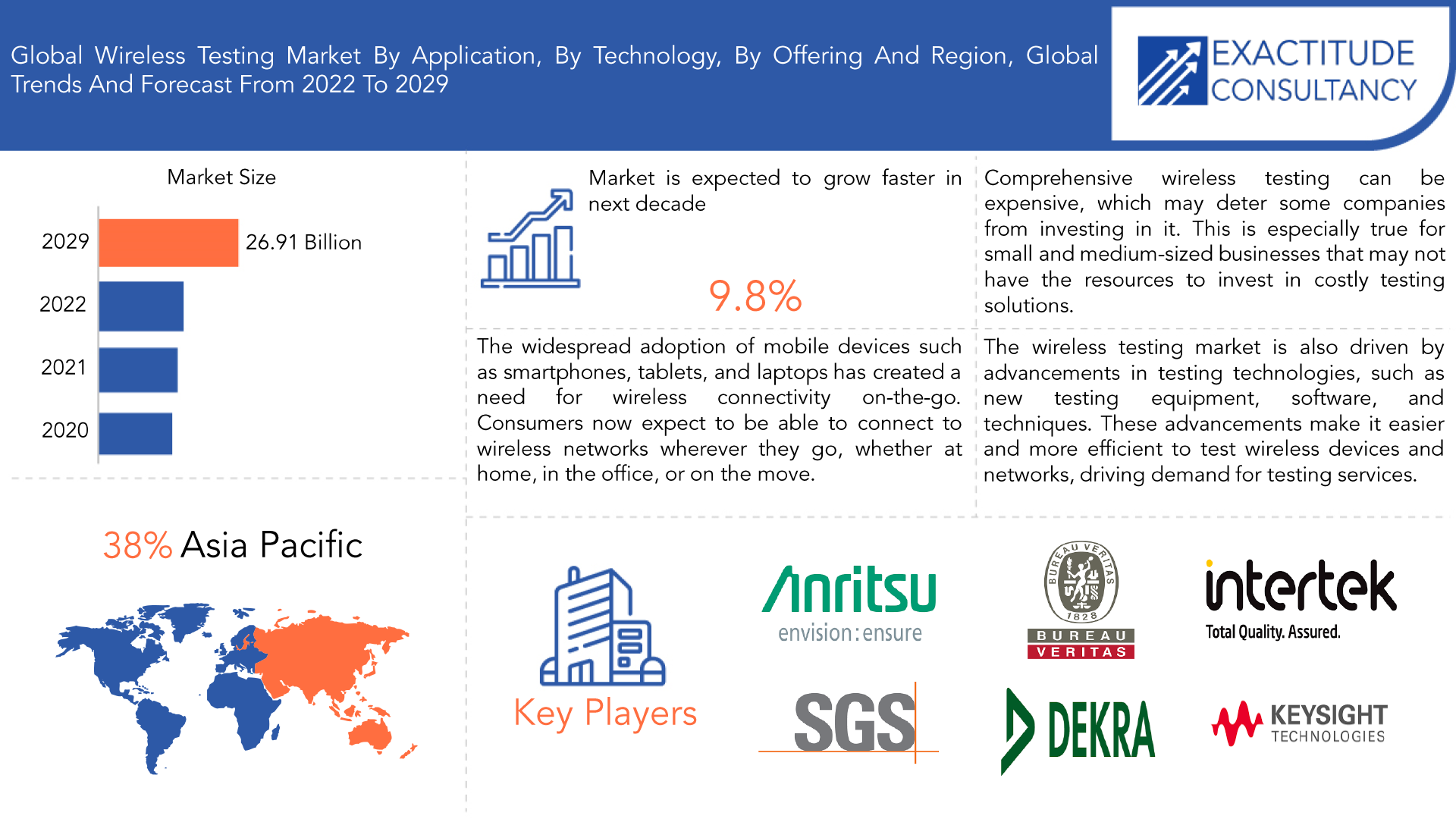
Se espera que el mercado global de pruebas inalámbricas crezca a una tasa compuesta anual del 9,80 % entre 2020 y 2029. Se espera que alcance más de USD 26,91 mil millones para 2029 desde USD 11,60 mil millones en 2020.
Las pruebas inalámbricas son el proceso de evaluación y verificación de la funcionalidad, el rendimiento y la confiabilidad de los dispositivos y redes inalámbricas. Esto implica realizar varias pruebas y mediciones para garantizar que los dispositivos inalámbricos, como teléfonos móviles, computadoras portátiles y dispositivos IoT , puedan comunicarse de manera eficaz y eficiente entre sí y con redes inalámbricas, como Wi-Fi, Bluetooth y redes celulares. Las pruebas inalámbricas también implican probar la calidad de las señales inalámbricas, incluidos factores como la intensidad de la señal, la relación señal-ruido y las velocidades de transferencia de datos. Esto se hace para garantizar que los dispositivos y redes inalámbricas puedan funcionar de manera eficaz en escenarios del mundo real, como en entornos concurridos o en largas distancias.
La creciente complejidad de las redes y dispositivos inalámbricos está impulsando la industria de las pruebas inalámbricas. Las redes y dispositivos inalámbricos se están volviendo más sofisticados a medida que las tecnologías inalámbricas continúan mejorando y se producen nuevas tecnologías. Debido a esta complejidad, se requieren servicios de prueba y validación para verificar que los dispositivos y redes inalámbricos funcionen de manera correcta y eficaz. Mayores velocidades de datos, más dispositivos, más bandas de frecuencia, protocolos más sofisticados y preocupaciones de seguridad son todos factores que contribuyen a la creciente complejidad de las redes y dispositivos inalámbricos. La complejidad se suma a los problemas de prueba y validación, lo que requiere servicios de prueba más avanzados para verificar que estos sistemas funcionen de manera correcta y eficaz.
Los dispositivos inteligentes construyen redes inteligentes, se conectan y comparten datos entre sí, lo que hace necesario el establecimiento de protocolos de comunicación comunes para ellos. El intercambio rápido de datos e información entre diferentes dispositivos conectados es fundamental para el crecimiento de la industria de las conexiones inalámbricas. Debido a que las infraestructuras de conexión actuales carecen de estándares de comunicación universales, no pueden abordar los desafíos de interoperabilidad. Las organizaciones y las empresas están trabajando para crear un estándar común que incluya una variedad de dispositivos, aplicaciones de IoT, software y plataformas. La falta de un estándar o plataforma de comunicación estandarizada afecta las pruebas inalámbricas, ya que los proveedores de servicios deben responder a las necesidades de muchos dispositivos inalámbricos personalizados que emplean diferentes protocolos.
| ATRIBUTO | DETALLES |
| Periodo de estudio | 2020-2029 |
| Año base | 2022 |
| Año estimado | 2022 |
| Año pronosticado | 2022-2029 |
| Periodo histórico | 2018-2020 |
| Unidad | Valor (miles de millones de USD) |
| Segmentación | Por aplicación, tecnología, oferta y región. |
| Por aplicación |
|
| Por tecnología |
|
| Al ofrecer |
|
| Por región |
|
El uso cada vez mayor de dispositivos móviles es un factor importante en el mercado de pruebas inalámbricas. Los dispositivos móviles, como los teléfonos inteligentes y las tabletas, se están volviendo cada vez más omnipresentes y esenciales en nuestra vida diaria. La comodidad, la multifuncionalidad, la asequibilidad y la innovación constante de los dispositivos móviles están impulsando el uso cada vez mayor de estos dispositivos. La pandemia de COVID-19 también ha acelerado la tendencia de trabajar desde casa, lo que ha aumentado el uso de dispositivos móviles para tareas relacionadas con el trabajo. El uso cada vez mayor de dispositivos móviles está impulsando la necesidad de servicios de pruebas inalámbricas más sofisticados para garantizar que las redes y los dispositivos inalámbricos puedan funcionar de manera correcta y eficiente en escenarios del mundo real.
Aunque el negocio se ha expandido rápidamente en los últimos años, la COVID-19 ha impactado positivamente el crecimiento del mercado. La pandemia en el mercado de pruebas inalámbricas ha aumentado la demanda de conectividad inalámbrica y la necesidad de servicios de pruebas inalámbricas más sofisticados. Con más personas trabajando desde casa y asistiendo a reuniones virtuales, ha habido un aumento en la demanda de conectividad inalámbrica confiable y rápida. Esto ha creado nuevas oportunidades para que las empresas de pruebas desarrollen y brinden soluciones de prueba innovadoras que satisfagan las demandas de este nuevo mercado. La pandemia también ha acelerado la adopción de nuevas tecnologías inalámbricas, como 5G y Wi-Fi 6, ya que las empresas y las personas buscan mejorar su conectividad inalámbrica. Esto ha creado oportunidades para que las empresas de pruebas ofrezcan servicios de prueba especializados para estas nuevas tecnologías.
[título id="attachment_19427" align="aligncenter" width="1920"]
Frequently Asked Questions
• What is the worth of the global Wireless Testing Market?
The global Wireless Testing Market is expected to grow at 9.80% CAGR from 2020 to 2029. It is expected to reach above USD 26.91 Billion by 2029 from USD 11.60 Billion in 2020.
• What is the size of the Asia Pacific Wireless Testing Market?
Asia Pacific held more than 38% of the Wireless Testing Market revenue share in 2020 and will witness tremendous expansion during the forecast period.
• What are some of the market's driving forces?
As demand for faster data rates increases, wireless networks and devices must become more complex to support these rates. This can include the use of multiple antennas, carrier aggregation, and more sophisticated modulation schemes.
• Which are the top companies to hold the market share in the Wireless Testing Market?
The Wireless Testing Market key players include Anritsu, SGS Group, Bureau Veritas, Intertek, DEKRA SE, Keysight, Rohde & Schwarz, Viavi Solutions, Bluflux, TUV Rheinland.
• What is the leading Application of the Wireless Testing Market?
The consumer electronics are major sector where the application of Wireless Testing has seen more.
• Which is the largest regional market for Wireless Testing Market?
The Markets largest share is in the Asia Pacific region.
Wireless Testing Market Segment Analysis
The services category has the biggest market share. When educational institutions and business offices got online, the need for wireless testing services increased since it evaluates network maintenance and installation. Furthermore, increased internet penetration and use of digital services have resulted in an exponential increase in the number of sensitive data created. Along with that, there is a demand for better infrastructure solutions, which is propelling the wireless network testing market forward. It is projected that government initiatives for free Wi-Fi services in a number of countries, including India, would offer considerable market opportunities. Wi-Fi technology has emerged as the most common cellular offload option since it is unlicensed, inexpensive, and widely available. Hence, testing wireless equipment helps service providers to deliver dependable Wi-Fi.
Wireless device testing technology have the biggest market share. Bluetooth, WLAN, GPS, GNSS, 2G/3G/5G, and Wi-Fi are various wireless device testing technologies. The major goal of Wi-Fi testing is to assess the transmitting power or sensitivity of receivers. With 2G, you may transport both data and voice. 3G provides faster data transfer rates and voice carrying capacity. 5G is the fifth generation of wireless technology, introducing three new features: wider channels (speed), lower latency (responsiveness), and greater bandwidth (the ability to connect a lot more devices at once). Therefore, these are the key aspects driving the growth of wireless device testing technology in the worldwide wireless testing market.
In the wireless testing market, the consumer electronics sector had the highest revenue share. This is mostly due to the increased demand for wearables and smart electronic devices. In the consumer electronics business, where goods are evaluated for safety, functionality, and performance, wireless testing is critical. GSM, UMTS, and LTE are three of the most widely utilized technologies in consumer devices, such as smartphones and tablets. Many firms are currently testing various wireless technologies used in consumer devices, such as Bluetooth, cellular, near-field communication (NFC), and Wi-Fi.
[caption id="attachment_19435" align="aligncenter" width="1920"]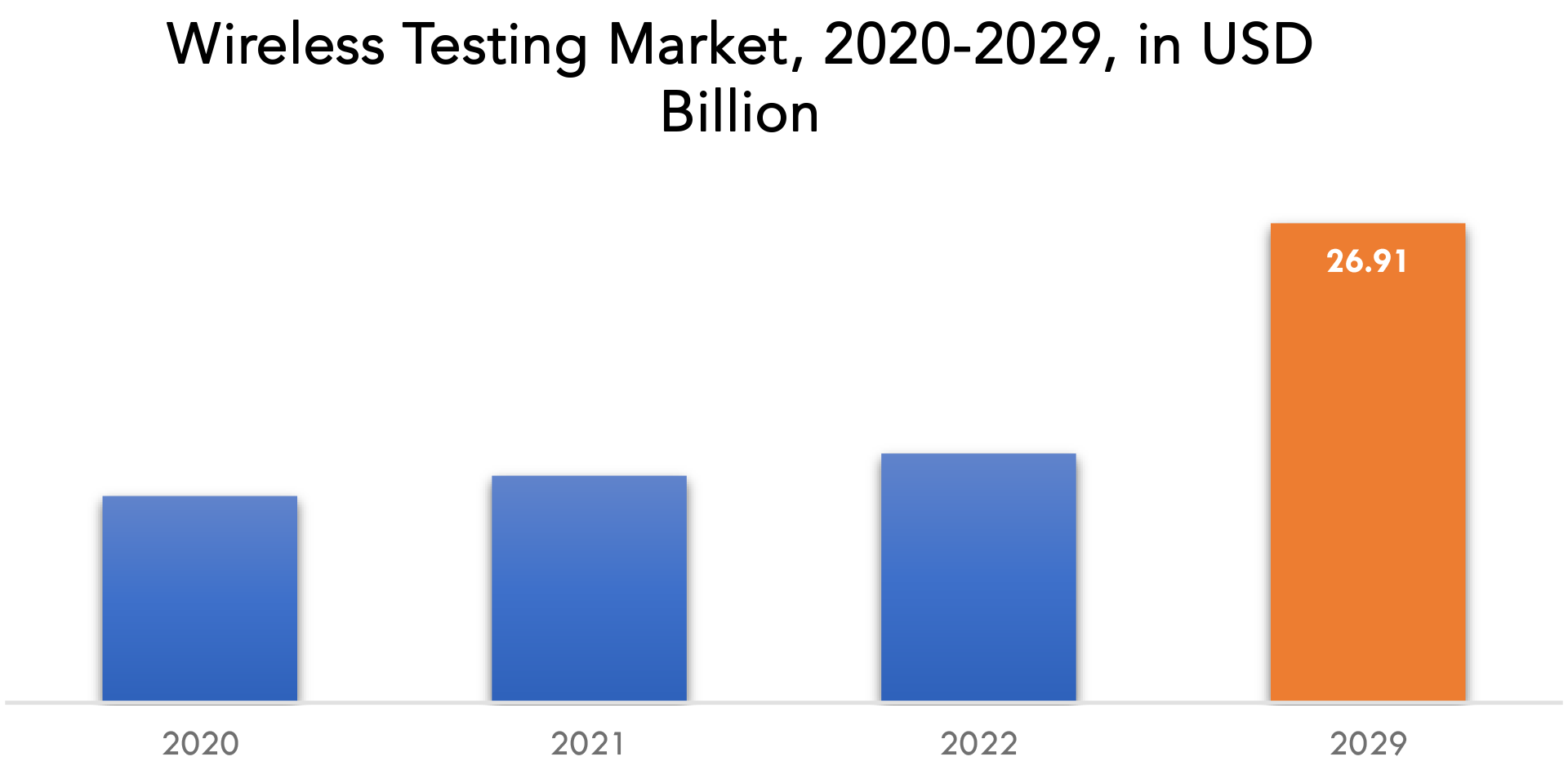
Wireless Testing Market Players
The Wireless Testing Market key players include Anritsu, SGS Group, Bureau Veritas, Intertek, DEKRA SE, Keysight, Rohde & Schwarz, Viavi Solutions, Bluflux, TUV Rheinland. Recent Developments: Jan 2022 - Anritsu Corporation announces that the Conformance Agreement Group (CAG) operated by Global Certification Forum (GCF) has approved the industry-first Release 16 Protocol Conformance tests for 5G New Radio (NR) at the CAG#68 meetings held in October 2021. This industry-first achievement was verified on the Anritsu 5G NR Mobile Device Test Platform ME7834NR. April 2022 - Viavi Solutions Inc. (VIAVI) (NASDAQ: VIAV) today announced the launch of the ALT-9000 universal radio altimeter (RADALT) flight line test set. As manufacturers release RADALTs with more sophisticated waveforms to address safety and security issues in the aviation industry, the ALT-9000 adds fiber optic delay to traditional radio frequency (RF) testing, enabling it to test all types of RADALTS on the market today.Who Should Buy? Or Key stakeholders
- Investors
- Telecommunication Companies
- Insurance Sector
- Banking Industry
- IT Companies
- Research Organizations
- Regulatory Authorities
- Institutional & retail players
- Others
Wireless Testing Market Regional Analysis
The Wireless Testing Market by region includes North America, Asia-Pacific (APAC), Europe, South America, and Middle East & Africa (MEA).
- North America: includes the US, Canada, Mexico
- Asia Pacific: includes China, Japan, South Korea, India, Australia, ASEAN, and Rest of APAC
- Europe: includes the UK, Germany, France, Italy, Spain, Russia, and the Rest of Europe
- South America: includes Brazil, Argentina, and Rest of South America
- Middle East & Africa: includes Turkey, UAE, Saudi Arabia, South Africa, and the Rest of MEA
The Asia Pacific wireless testing market is the largest market for wireless testing globally. The growing demand for smartphones is driving growth in the Asia Pacific area. The Asia Pacific area is experiencing significant development in terms of the adoption of new technology across numerous industries. The Internet of Things (IoT) and machine-to-machine (M2M) are projected to profit greatly from 5G technology. China, Japan, and India are emerging as high-growth nations in the wireless testing business due to increasing investment by mobile carriers and a rapidly rising mobile user base. Hence, these are the primary drivers driving growth in the Asia Pacific area of the worldwide wireless testing market.
North America is also an important market for the development of new wireless technologies, such as 5G and Wi-Fi 6. This has created opportunities for testing companies to offer specialized testing services for these new technologies, and to work closely with technology companies and network operators to develop new testing solutions.
Key Market Segments: Wireless Testing Market
Wireless Testing Market By Application, 2020-2029, (USD Billion)- Consumer Electronics
- It & Telecommunication
- Automotive
- Energy & Power
- Healthcare
- Wireless Network Testing
- Wireless Device Testing
- Equipment
- Services
- North America
- Asia Pacific
- Europe
- South America
- Middle East And Africa
Exactitude Consultancy Services Key Objectives:
- Increasing sales and market share
- Developing new technology
- Improving profitability
- Entering new markets
- Enhancing brand reputation
Key Question Answered
- What is the expected growth rate of the wireless testing market over the next 7 years?
- Who are the major players in the wireless testing market and what is their market share?
- What are the end-user industries driving demand for market and what is their outlook?
- What are the opportunities for growth in emerging markets such as Asia-pacific, middle east, and Africa?
- How is the economic environment affecting the Wireless Testing market, including factors such as interest rates, inflation, and exchange rates?
- What is the expected impact of government policies and regulations on the wireless testing market?
- What is the current and forecasted size and growth rate of the global wireless testing market?
- What are the key drivers of growth in the wireless testing market?
- Who are the major players in the market and what is their market share?
- What are the distribution channels and supply chain dynamics in the wireless testing market?
- What are the technological advancements and innovations in the wireless testing market and their impact on product development and growth?
- What are the regulatory considerations and their impact on the market?
- What are the challenges faced by players in the wireless testing market and how are they addressing these challenges?
- What are the opportunities for growth and expansion in the wireless testing market?
- What are the services offerings and specifications of leading players in the market?
- INTRODUCCIÓN
- MARKET DEFINITION
- MARKET SEGMENTATION
- RESEARCH TIMELINES
- ASSUMPTIONS AND LIMITATIONS
- RESEARCH METHODOLOGY
- DATA MINING
- SECONDARY RESEARCH
- PRIMARY RESEARCH
- SUBJECT-MATTER EXPERTS’ ADVICE
- QUALITY CHECKS
- FINAL REVIEW
- DATA TRIANGULATION
- BOTTOM-UP APPROACH
- TOP-DOWN APPROACH
- RESEARCH FLOW
- DATA SOURCES
- DATA MINING
- EXECUTIVE SUMMARY
- MARKET OVERVIEW
- GLOBAL WIRELESS TESTING MARKET OUTLOOK
- MARKET DRIVERS
- MARKET RESTRAINTS
- MARKET OPPORTUNITIES
- IMPACT OF COVID-19 ON THE WIRELESS TESTING MARKET
- PORTER’S FIVE FORCES MODEL
- THREAT FROM NEW ENTRANTS
- THREAT FROM SUBSTITUTES
- BARGAINING POWER OF SUPPLIERS
- BARGAINING POWER OF CUSTOMERS
- DEGREE OF COMPETITION
- INDUSTRY VALUE CHAIN ANALYSIS
- GLOBAL WIRELESS TESTING MARKET OUTLOOK
- GLOBAL WIRELESS TESTING MARKET BY APPLICATION (USD BILLION), 2020-2029
- CONSUMER ELECTRONICS
- IT & TELECOMMUNICATION
- AUTOMOTIVE
- ENERGY & POWER
- HEALTHCARE
- GLOBAL WIRELESS TESTING MARKET BY TECHNOLOGY (USD BILLION),2020-2029
- WIRELESS NETWORK TESTING
- WIRELESS DEVICE TESTING
- GLOBAL WIRELESS TESTING MARKET BY OFFERING (USD BILLION),2020-2029
- EQUIPMENT
- SERVICES
- GLOBAL WIRELESS TESTING MARKET BY REGION (USD BILLION),2020-2029
- NORTH AMERICA
- US
- CANADA
- MEXICO
- SOUTH AMERICA
- BRAZIL
- ARGENTINA
- COLOMBIA
- REST OF SOUTH AMERICA
- EUROPE
- GERMANY
- UK
- FRANCE
- ITALY
- SPAIN
- RUSSIA
- REST OF EUROPE
- ASIA PACIFIC
- INDIA
- CHINA
- JAPAN
- SOUTH KOREA
- AUSTRALIA
- SOUTH-EAST ASIA
- REST OF ASIA PACIFIC
- MIDDLE EAST AND AFRICA
- UAE
- SAUDI ARABIA
- SOUTH AFRICA
- REST OF MIDDLE EAST AND AFRICA
- NORTH AMERICA
- COMPANY PROFILES* (BUSINESS OVERVIEW, COMPANY SNAPSHOT, PRODUCTS OFFERED, RECENT DEVELOPMENTS)
- ANRITSU
- SGS GROUP
- BUREAU VERITAS
- INTERTEK
- DEKRA SE
- KEYSIGHT
- ROHDE & SCHWARZ
- VIAVI SOLUTIONS
- BLUFLUX
- TUV RHINELAND. *THE COMPANY LIST IS INDICATIVE
LIST OF TABLES
TABLE 1 GLOBAL WIRELESS TESTING MARKET BY TYPE (USD BILLION) 2020-2029
TABLE 2 GLOBAL WIRELESS TESTING MARKET BY APPLICATION (USD BILLION) 2020-2029
TABLE 3 GLOBAL WIRELESS TESTING MARKET BY TECHNOLOGY (USD BILLION) 2020-2029
TABLE 4 GLOBAL WIRELESS TESTING MARKET BY OFFERING (USD BILLION) 2020-2029
TABLE 5 GLOBAL WIRELESS TESTING MARKET BY REGION (USD BILLION) 2020-2029
TABLE 6 NORTH AMERICA WIRELESS TESTING MARKET BY COUNTRY (USD BILLION) 2020-2029
TABLE 7 NORTH AMERICA WIRELESS TESTING MARKET BY APPLICATION (USD BILLION) 2020-2029
TABLE 8 NORTH AMERICA WIRELESS TESTING MARKET BY TECHNOLOGY (USD BILLION) 2020-2029
TABLE 9 NORTH AMERICA WIRELESS TESTING MARKET BY OFFERING (USD BILLION) 2020-2029
TABLE 10 US WIRELESS TESTING MARKET BY APPLICATION (USD BILLION) 2020-2029
TABLE 11 US WIRELESS TESTING MARKET BY TECHNOLOGY (USD BILLION) 2020-2029
TABLE 12 US WIRELESS TESTING MARKET BY OFFERING (USD BILLION) 2020-2029
TABLE 13 CANADA WIRELESS TESTING MARKET BY APPLICATION (USD BILLION) 2020-2029
TABLE 14 CANADA WIRELESS TESTING MARKET BY TECHNOLOGY (USD BILLION) 2020-2029
TABLE 15 CANADA WIRELESS TESTING MARKET BY OFFERING (USD BILLION) 2020-2029
TABLE 16 MEXICO WIRELESS TESTING MARKET BY APPLICATION (USD BILLION) 2020-2029
TABLE 17 MEXICO WIRELESS TESTING MARKET BY TECHNOLOGY (USD BILLION) 2020-2029
TABLE 18 MEXICO WIRELESS TESTING MARKET BY OFFERING (USD BILLION) 2020-2029
TABLE 19 SOUTH AMERICA WIRELESS TESTING MARKET BY COUNTRY (USD BILLION) 2020-2029
TABLE 20 SOUTH AMERICA WIRELESS TESTING MARKET BY APPLICATION (USD BILLION) 2020-2029
TABLE 21 SOUTH AMERICA WIRELESS TESTING MARKET BY TECHNOLOGY (USD BILLION) 2020-2029
TABLE 22 SOUTH AMERICA WIRELESS TESTING MARKET BY OFFERING (USD BILLION) 2020-2029
TABLE 23 BRAZIL WIRELESS TESTING MARKET BY APPLICATION (USD BILLION) 2020-2029
TABLE 24 BRAZIL WIRELESS TESTING MARKET BY TECHNOLOGY (USD BILLION) 2020-2029
TABLE 25 BRAZIL WIRELESS TESTING MARKET BY OFFERING (USD BILLION) 2020-2029
TABLE 26 ARGENTINA WIRELESS TESTING MARKET BY APPLICATION (USD BILLION) 2020-2029
TABLE 27 ARGENTINA WIRELESS TESTING MARKET BY TECHNOLOGY (USD BILLION) 2020-2029
TABLE 28 ARGENTINA WIRELESS TESTING MARKET BY OFFERING (USD BILLION) 2020-2029
TABLE 29 COLOMBIA WIRELESS TESTING MARKET BY APPLICATION (USD BILLION) 2020-2029
TABLE 30 COLOMBIA WIRELESS TESTING MARKET BY TECHNOLOGY (USD BILLION) 2020-2029
TABLE 31 COLOMBIA WIRELESS TESTING MARKET BY OFFERING (USD BILLION) 2020-2029
TABLE 32 REST OF SOUTH AMERICA WIRELESS TESTING MARKET BY APPLICATION (USD BILLION) 2020-2029
TABLE 33 REST OF SOUTH AMERICA WIRELESS TESTING MARKET BY TECHNOLOGY (USD BILLION) 2020-2029
TABLE 34 REST OF THE SOUTH AMERICA WIRELESS TESTING MARKET BY OFFERING (USD BILLION) 2020-2029
TABLE 35 ASIA-PACIFIC WIRELESS TESTING MARKET BY COUNTRY (USD BILLION) 2020-2029
TABLE 36 ASIA-PACIFIC WIRELESS TESTING MARKET BY APPLICATION (USD BILLION) 2020-2029
TABLE 37 ASIA-PACIFIC WIRELESS TESTING MARKET BY TECHNOLOGY (USD BILLION) 2020-2029
TABLE 38 ASIA-PACIFIC WIRELESS TESTING MARKET BY OFFERING (USD BILLION) 2020-2029
TABLE 39 INDIA WIRELESS TESTING MARKET BY APPLICATION (USD BILLION) 2020-2029
TABLE 40 INDIA WIRELESS TESTING MARKET BY TECHNOLOGY (USD BILLION) 2020-2029
TABLE 41 INDIA WIRELESS TESTING MARKET BY OFFERING (USD BILLION) 2020-2029
TABLE 42 CHINA WIRELESS TESTING MARKET BY APPLICATION (USD BILLION) 2020-2029
TABLE 43 CHINA WIRELESS TESTING MARKET BY TECHNOLOGY (USD BILLION) 2020-2029
TABLE 44 CHINA WIRELESS TESTING MARKET BY OFFERING (USD BILLION) 2020-2029
TABLE 45 JAPAN WIRELESS TESTING MARKET BY APPLICATION (USD BILLION) 2020-2029
TABLE 46 JAPAN WIRELESS TESTING MARKET BY TECHNOLOGY (USD BILLION) 2020-2029
TABLE 47 JAPAN WIRELESS TESTING MARKET BY OFFERING (USD BILLION) 2020-2029
TABLE 48 SOUTH KOREA WIRELESS TESTING MARKET BY APPLICATION (USD BILLION) 2020-2029
TABLE 49 SOUTH KOREA WIRELESS TESTING MARKET BY TECHNOLOGY (USD BILLION) 2020-2029
TABLE 50 SOUTH KOREA WIRELESS TESTING MARKET BY OFFERING (USD BILLION) 2020-2029
TABLE 51 AUSTRALIA WIRELESS TESTING MARKET BY APPLICATION (USD BILLION) 2020-2029
TABLE 52 AUSTRALIA WIRELESS TESTING MARKET BY TECHNOLOGY (USD BILLION) 2020-2029
TABLE 53 AUSTRALIA WIRELESS TESTING MARKET BY OFFERING (USD BILLION) 2020-2029
TABLE 54 SOUTH-EAST ASIA WIRELESS TESTING MARKET BY APPLICATION (USD BILLION) 2020-2029
TABLE 55 SOUTH-EAST ASIA WIRELESS TESTING MARKET BY TECHNOLOGY (USD BILLION) 2020-2029
TABLE 56 SOUTH-EAST ASIA WIRELESS TESTING MARKET BY OFFERING (USD BILLION) 2020-2029
TABLE 57 REST OF ASIA PACIFIC WIRELESS TESTING MARKET BY APPLICATION (USD BILLION) 2020-2029
TABLE 58 REST OF ASIA PACIFIC WIRELESS TESTING MARKET BY TECHNOLOGY (USD BILLION) 2020-2029
TABLE 59 REST OF THE ASIA PACIFIC WIRELESS TESTING MARKET BY OFFERING (USD BILLION) 2020-2029
TABLE 60 EUROPE WIRELESS TESTING MARKET BY COUNTRY (USD BILLION) 2020-2029
TABLE 61 ASIA-PACIFIC WIRELESS TESTING MARKET BY APPLICATION (USD BILLION) 2020-2029
TABLE 62 ASIA-PACIFIC WIRELESS TESTING MARKET BY TECHNOLOGY (USD BILLION) 2020-2029
TABLE 63 ASIA-PACIFIC WIRELESS TESTING MARKET BY OFFERING (USD BILLION) 2020-2029
TABLE 64 GERMANY WIRELESS TESTING MARKET BY APPLICATION (USD BILLION) 2020-2029
TABLE 65 GERMANY WIRELESS TESTING MARKET BY TECHNOLOGY (USD BILLION) 2020-2029
TABLE 66 GERMANY WIRELESS TESTING MARKET BY OFFERING (USD BILLION) 2020-2029
TABLE 67 UK WIRELESS TESTING MARKET BY APPLICATION (USD BILLION) 2020-2029
TABLE 68 UK WIRELESS TESTING MARKET BY TECHNOLOGY (USD BILLION) 2020-2029
TABLE 69 UK WIRELESS TESTING MARKET BY OFFERING (USD BILLION) 2020-2029
TABLE 70 FRANCE WIRELESS TESTING MARKET BY APPLICATION (USD BILLION) 2020-2029
TABLE 71 FRANCE WIRELESS TESTING MARKET BY TECHNOLOGY (USD BILLION) 2020-2029
TABLE 72 FRANCE WIRELESS TESTING MARKET BY OFFERING (USD BILLION) 2020-2029
TABLE 73 ITALY WIRELESS TESTING MARKET BY APPLICATION (USD BILLION) 2020-2029
TABLE 74 ITALY WIRELESS TESTING MARKET BY TECHNOLOGY (USD BILLION) 2020-2029
TABLE 75 ITALY WIRELESS TESTING MARKET BY OFFERING (USD BILLION) 2020-2029
TABLE 76 SPAIN WIRELESS TESTING MARKET BY APPLICATION (USD BILLION) 2020-2029
TABLE 77 SPAIN WIRELESS TESTING MARKET BY TECHNOLOGY (USD BILLION) 2020-2029
TABLE 78 SPAIN WIRELESS TESTING MARKET BY OFFERING (USD BILLION) 2020-2029
TABLE 79 RUSSIA WIRELESS TESTING MARKET BY APPLICATION (USD BILLION) 2020-2029
TABLE 80 RUSSIA WIRELESS TESTING MARKET BY TECHNOLOGY (USD BILLION) 2020-2029
TABLE 81 RUSSIA WIRELESS TESTING MARKET BY OFFERING (USD BILLION) 2020-2029
TABLE 82 REST OF EUROPE WIRELESS TESTING MARKET BY APPLICATION (USD BILLION) 2020-2029
TABLE 83 REST OF EUROPE WIRELESS TESTING MARKET BY TECHNOLOGY (USD BILLION) 2020-2029
TABLE 84 REST OF EUROPE WIRELESS TESTING MARKET BY OFFERING (USD BILLION) 2020-2029
TABLE 85 MIDDLE EAST AND AFRICA WIRELESS TESTING MARKET BY COUNTRY (USD BILLION) 2020-2029
TABLE 86 MIDDLE EAST AND AFRICA WIRELESS TESTING MARKET BY APPLICATION (USD BILLION) 2020-2029
TABLE 87 MIDDLE EAST AND AFRICA WIRELESS TESTING MARKET BY TECHNOLOGY (USD BILLION) 2020-2029
TABLE 88 MIDDLE EAST AND AFRICA WIRELESS TESTING MARKET BY OFFERING (USD BILLION) 2020-2029
TABLE 89 UAE WIRELESS TESTING MARKET BY APPLICATION (USD BILLION) 2020-2029
TABLE 90 UAE WIRELESS TESTING MARKET BY TECHNOLOGY (USD BILLION) 2020-2029
TABLE 91 UAE WIRELESS TESTING MARKET BY OFFERING (USD BILLION) 2020-2029
TABLE 92 SAUDI ARABIA WIRELESS TESTING MARKET BY APPLICATION (USD BILLION) 2020-2029
TABLE 93 SAUDI ARABIA WIRELESS TESTING MARKET BY TECHNOLOGY (USD BILLION) 2020-2029
TABLE 94 SAUDI ARABIA WIRELESS TESTING MARKET BY OFFERING (USD BILLION) 2020-2029
TABLE 95 SOUTH AFRICA WIRELESS TESTING MARKET BY APPLICATION (USD BILLION) 2020-2029
TABLE 96 SOUTH AFRICA WIRELESS TESTING MARKET BY TECHNOLOGY (USD BILLION) 2020-2029
TABLE 97 SOUTH AFRICA WIRELESS TESTING MARKET BY OFFERING (USD BILLION) 2020-2029
TABLE 98 REST OF THE MIDDLE EAST AND AFRICA WIRELESS TESTING MARKET BY APPLICATION (USD BILLION) 2020-2029
TABLE 99 REST OF THE MIDDLE EAST AND AFRICA WIRELESS TESTING MARKET BY TECHNOLOGY (USD BILLION) 2020-2029
TABLE 100 REST OF THE MIDDLE EAST AND AFRICA WIRELESS TESTING MARKET BY OFFERING (USD BILLION) 2020-2029
LIST OF FIGURES
FIGURE 1 MARKET DYNAMICS
FIGURE 2 MARKET SEGMENTATION
FIGURE 3 REPORT TIMELINES: YEARS CONSIDERED
FIGURE 4 DATA TRIANGULATION
FIGURE 5 BOTTOM-UP APPROACH
FIGURE 6 TOP-DOWN APPROACH
FIGURE 7 RESEARCH FLOW
FIGURE 8 GLOBAL WIRELESS TESTING MARKET BY OFFERING, USD BILLION, 2020-2029
FIGURE 9 GLOBAL WIRELESS TESTING MARKET BY APPLICATION, USD BILLION, 2020-2029
FIGURE 10 GLOBAL WIRELESS TESTING MARKET BY TECHNOLOGY, USD BILLION, 2020-2029
FIGURE 11 GLOBAL WIRELESS TESTING MARKET BY REGION, USD BILLION, 2020-2029
FIGURE 12 PORTER’S FIVE FORCES MODEL
FIGURE 13 GLOBAL WIRELESS TESTING MARKET BY OFFERING, USD BILLION, 2021
FIGURE 14 GLOBAL WIRELESS TESTING MARKET BY APPLICATION, USD BILLION, 2021
FIGURE 15 GLOBAL WIRELESS TESTING MARKET BY TECHNOLOGY, USD BILLION, 2021
FIGURE 16 GLOBAL WIRELESS TESTING MARKET BY REGION 2021
FIGURE 17 MARKET SHARE ANALYSIS
FIGURE 18 ANRITSU: COMPANY SNAPSHOT
FIGURE 19 SGS GROUP: COMPANY SNAPSHOT
FIGURE 20 BUREAU VERITAS: COMPANY SNAPSHOT
FIGURE 21 INTERTEK: COMPANY SNAPSHOT
FIGURE 22 DEKRA SE: COMPANY SNAPSHOT
FIGURE 23 KEY SIGHT: COMPANY SNAPSHOT
FIGURE 24 ROHDE & SCHWARZ: COMPANY SNAPSHOT
FIGURE 25 VIAVI SOLUTIONS: COMPANY SNAPSHOT
FIGURE 26 BLUFLUX: COMPANY SNAPSHOT
FIGURE 27 TUV RHEINLAND: COMPANY SNAPSHOT
DOWNLOAD FREE SAMPLE REPORT
License Type
SPEAK WITH OUR ANALYST
Want to know more about the report or any specific requirement?
WANT TO CUSTOMIZE THE REPORT?
Our Clients Speak
We asked them to research ‘ Equipment market’ all over the world, and their whole arrangement was helpful to us. thehealthanalytics.com insightful analysis and reports contributed to our current analysis and in creating a future strategy. Besides, the te
Yosuke Mitsui
Senior Associate Construction Equipment Sales & Marketing
We asked them to research ‘Equipment market’ all over the world, and their whole arrangement was helpful to us. thehealthanalytics.com insightful analysis and reports contributed to our current analysis and in creating a future strategy. Besides, the te