

Base Year Value ()
x.x %
x.x %
CAGR ()
x.x %
x.x %
Forecast Year Value ()
x.x %
x.x %
Historical Data Period
Largest Region
Forecast Period
Mercado de comunicaciones industriales por oferta (componentes, software, servicios), forma (amorfa, semicristalina), protocolo de comunicación (bus de campo, Ethernet industrial, inalámbrica), industria de uso final (automotriz y transporte, eléctrica y electrónica, aeroespacial y defensa, gestión de agua y aguas residuales, alimentos y bebidas, productos farmacéuticos y dispositivos médicos, energía y electricidad, metales y minería, productos químicos y fertilizantes, ingeniería/fabricación, otros) y por región Tendencias globales y pronóstico de 2022 a 2029
Instant access to hundreds of data points and trends
- Market estimates from 2014-2029
- Competitive analysis, industry segmentation, financial benchmarks
- Incorporates SWOT, Porter's Five Forces and risk management frameworks
- PDF report or online database with Word, Excel and PowerPoint export options
- 100% money back guarantee
Panorama del mercado de las comunicaciones industriales
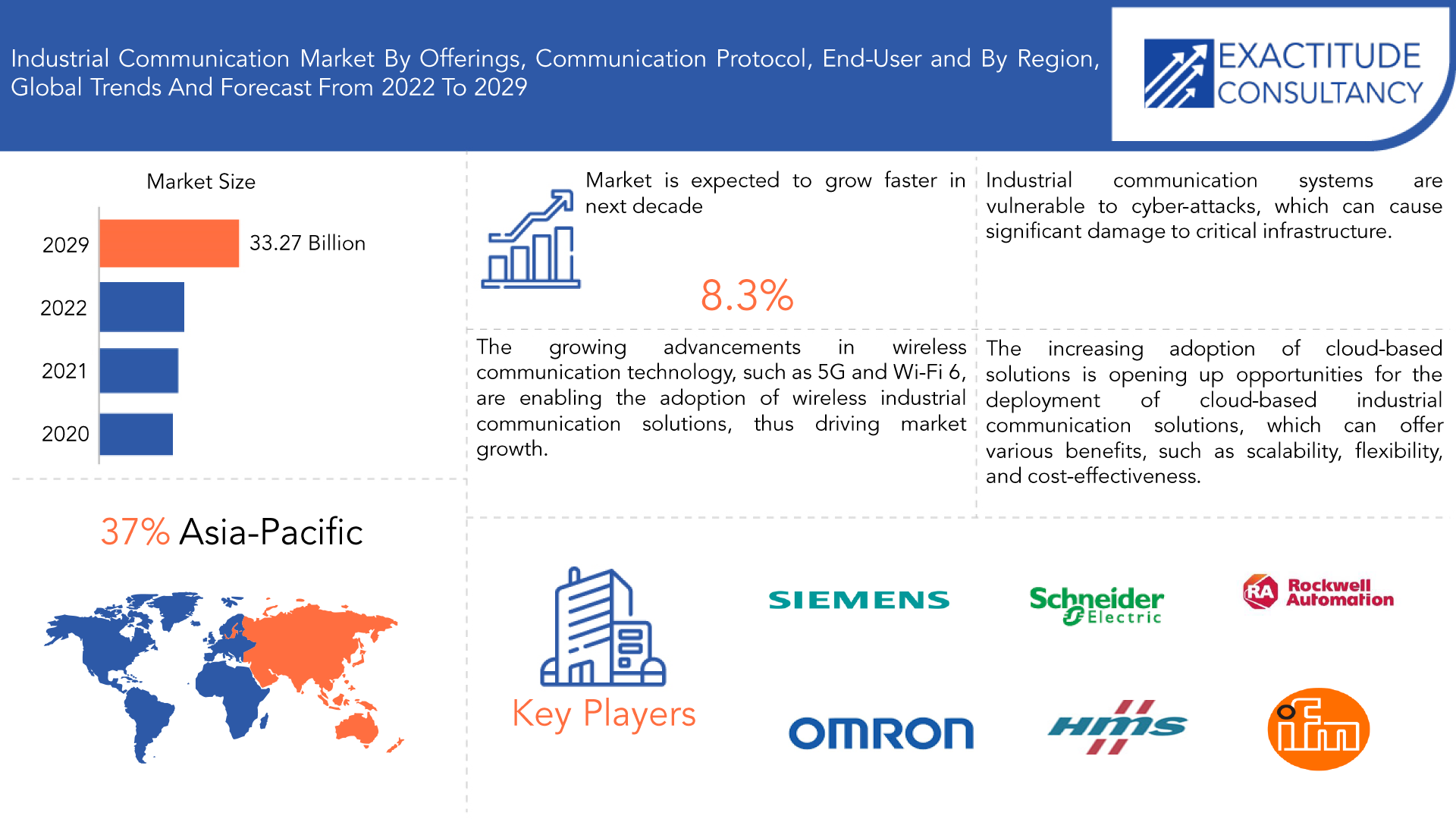
Se proyecta que el mercado mundial de comunicaciones industriales alcance los 33.270 millones de dólares en 2029, desde los 17.500 millones de dólares en 2020, con una CAGR del 8,3 % entre 2022 y 2029.
La comunicación industrial es un término que se utiliza para describir el proceso de intercambio de información y datos dentro de los sistemas y procesos industriales. En un entorno industrial, la comunicación se produce entre varios dispositivos, como sensores , actuadores, controladores y otros equipos. La comunicación industrial es un aspecto esencial de la automatización industrial, ya que permite que las máquinas y los sistemas se comuniquen entre sí y con los operadores humanos.
El uso de tecnología y protocolos de comunicación industrial permite la monitorización y el control en tiempo real de los procesos industriales, lo que ayuda a mejorar la eficiencia y la seguridad. Por ejemplo, los sistemas de comunicación industrial pueden proporcionar a los operadores datos en tiempo real sobre el rendimiento de las máquinas y los sistemas, lo que les permite identificar y resolver rápidamente cualquier problema que pueda surgir.
| ATRIBUTO | DETALLES |
| Periodo de estudio | 2020-2029 |
| Año base | 2021 |
| Año estimado | 2022 |
| Año pronosticado | 2022-2029 |
| Periodo histórico | 2018-2020 |
| Unidad | Valor (miles de millones de USD) |
| Segmentación | Por ofertas, por protocolo de comunicación, por usuario final, por región. |
| Al ofrecer |
|
| Por protocolo de comunicación |
|
| Por el usuario final |
|
| Por región |
|
La creciente necesidad de automatización en diversos sectores es uno de los principales factores que impulsan la industria de las comunicaciones industriales. La automatización ayuda a que los procesos industriales sean más eficientes, gasten menos mano de obra y cometan menos errores. Por ello, cada vez son más demandadas las soluciones de comunicación industrial que proporcionan conexión y control en tiempo real entre varios dispositivos y sistemas. El Internet industrial de las cosas (IIoT) es otro importante impulsor del mercado de las comunicaciones industriales. El IIoT se refiere al uso de dispositivos y sensores conectados para recopilar y analizar datos en tiempo real, lo que permite a las empresas tomar decisiones más informadas y optimizar sus operaciones.
La complejidad y los problemas de compatibilidad de los distintos protocolos y tecnologías de comunicación son una de las principales limitaciones en el sector de las comunicaciones industriales. Los sistemas de comunicación industrial suelen estar compuestos por varios componentes de hardware y software de distintos proveedores, y pueden surgir problemas de compatibilidad cuando estos componentes utilizan distintos protocolos de comunicación. Debido a esto, puede resultar complicado combinar muchos dispositivos y sistemas en una red unificada, lo que puede afectar a la eficiencia y eficacia con la que funcionan los sistemas de comunicación industrial.
Se espera que la adopción de la tecnología 5G impulse un crecimiento significativo en el mercado de las comunicaciones industriales. La tecnología 5G ofrece capacidades de comunicación más rápidas y confiables que las generaciones anteriores de redes móviles, lo que la hace ideal para aplicaciones industriales. Las empresas que pueden desarrollar e implementar sistemas de comunicación industrial habilitados para 5G, así como los proveedores que pueden proporcionar hardware y software compatibles con 5G, están bien posicionados para aprovechar esta oportunidad.
[título id="attachment_21578" align="aligncenter" width="1920"]
Frequently Asked Questions
What is the worth of global Industrial Communication market?
The global industrial communication market is projected to reach USD 33.27 billion by 2029 from USD 17.50 billion in 2020, at a CAGR of 8.3 % from 2022 to 2029.
What are the key drivers in the Industrial Communication market, globally?
The technological advancement in industrial sector, growing need for faster, scalable, reliable, and interoperable communication protocols in industry sector, rising industrial revolution 4.0, increasing machine-to-machine communication, and rapid government initiatives to support industrial automation especially in developed and some developing economies are key drivers of the global industrial communication market.
What is the CAGR of Industrial Communication market?
The global Industrial Communication market registered a CAGR of 8.3 % from 2022 to 2029.
Which are the top companies to hold the market share in Industrial Communication market?
Key players profiled in the report include Siemens AG, ABB Ltd., Schneider Electric SE, Rockwell Automation, Inc., Honeywell International, Inc., Belden, Inc., Cisco Systems, Inc., General Electric Company, Moxa Inc., Omron Corporation, Emerson Electric Co., Eaton Corporation, Yokogawa Electric Corporation, Pepperl+Fuchs AG, Advantech Co., Ltd., HMS Industrial Networks, Mitsubishi Electric, IFM Electronic, Huawei Technologies and others.
Which is the largest regional market for Industrial Communication market?
Asia Pacific is expected to constitute a key share of the market during the forecast period, owing to growing industrialization in the region.
Industrial Communication Market Segment Analysis
The global industrial communication market is segmented by offering, communication protocol, end-user and region.Based on offering, the industrial communication market is segmented into components, software, services. The components segment is expected to dominate the Industrial Communication market in terms of revenue over the forecast period. This is due to hardware components are the backbone of industrial communication networks, and businesses require a variety of hardware components to establish and maintain these networks. Industrial equipment like IP phones and PCs are connected to the Internet to enable speedy communication. Machine-to-machine (M2M) communication supports efficient plant operations in an industrial context.
However, the software and services segments are also expected to experience significant growth in the coming years. As industrial communication networks become more complex, businesses are increasingly looking for software solutions to manage and optimize these networks.
Based on communication protocol, the industrial communication market is bifurcated into fieldbus, industrial Ethernet, wireless. The Industrial Ethernet protocol is expected to dominate the Industrial Communication market in terms of revenue over the forecast period. Industrial Ethernet is a network protocol that uses Ethernet technology to connect devices in industrial settings. It is a high-speed protocol that provides reliable and secure communication, making it ideal for applications that require large amounts of data transfer. Industrial Ethernet protocols include EtherCAT, PROFINET, Ethernet/IP, and others.However, Fieldbus and wireless communication protocols are also expected to experience growth in the coming years. Fieldbus remains a popular choice for many industrial applications due to its simplicity and cost-effectiveness. Wireless communication protocols are increasingly being used in environments where wired communication is not feasible or cost-effective.
Based on End-User, the industrial communication market is segregated into automotive & transportation, electrical & electronics, aerospace & defense, water & wastewater management, food & beverages, pharmaceuticals & medical devices, energy & power, metals & mining, chemicals & fertilizers, engineering/fabrication, others. Automotive and transportation, which will account for 23.9% of all industrial communication usage in 2021, is the largest industry to do so. the use of cutting-edge technology to design manufacturing processes that are effective in terms of operational efficiency, flexibility, and output cost. In many end-user industries, high performance industrial communication protocols are required.
[caption id="attachment_21610" align="aligncenter" width="1920"]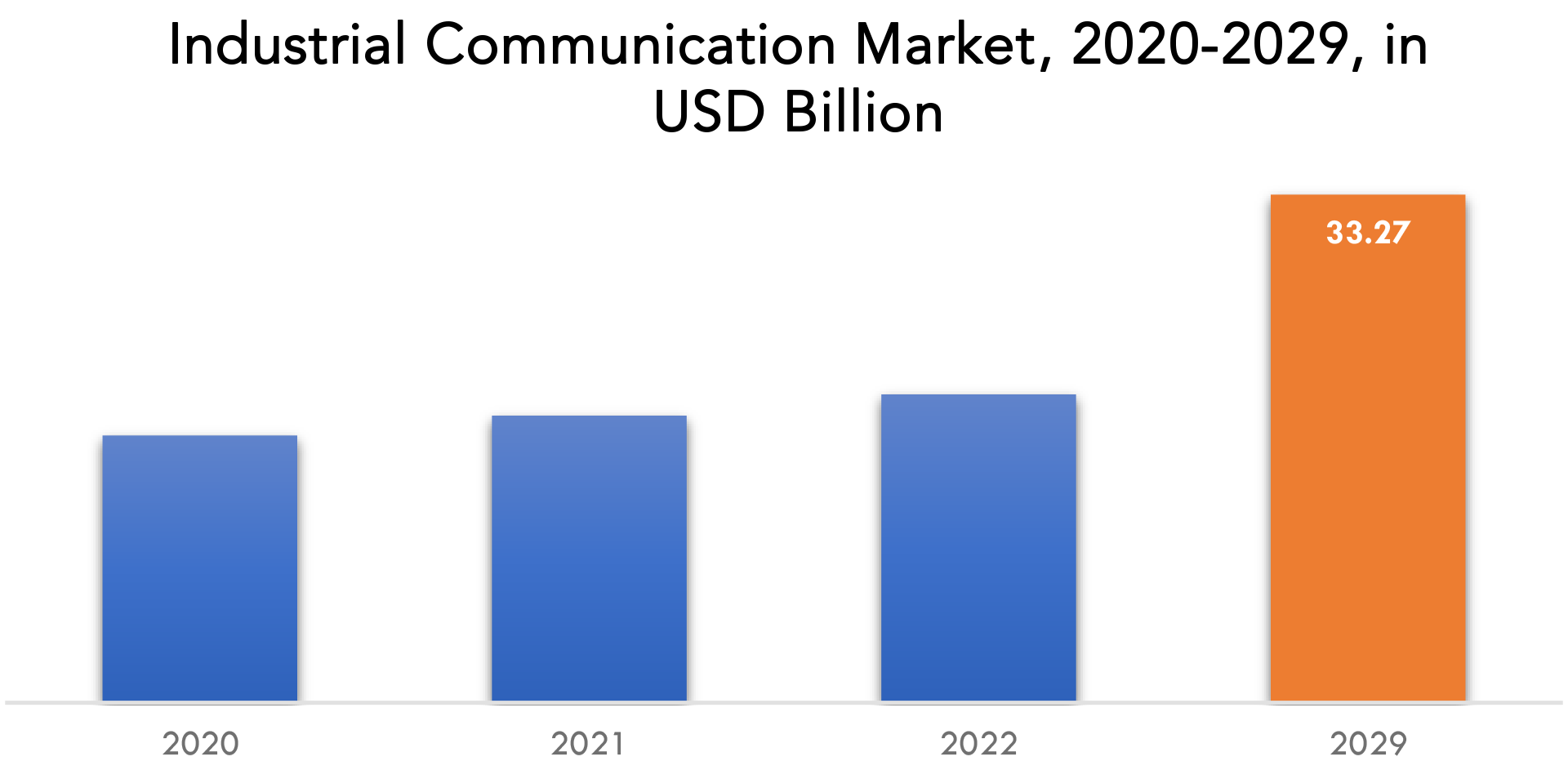
Industrial Communication Market Players
The global industrial communication market key players include Siemens AG, ABB Ltd., Schneider Electric SE, Rockwell Automation, Inc., Honeywell International, Inc., Belden, Inc., Cisco Systems, Inc., General Electric Company, Moxa Inc., Omron Corporation, Emerson Electric Co., Eaton Corporation, Yokogawa Electric Corporation, Pepperl+Fuchs AG, Advantech Co., Ltd., HMS Industrial Networks, Mitsubishi Electric, IFM Electronic, Huawei Technologies and others. Industrial Development: 13 April 2023: Siemens introduced Sinamics DriveSim Advanced, an expanded simulation programme for drive constellations that can be used for both engineering and commissioning using a digital twin. Sinamics DriveSim Advanced thereby increases Siemens' simulation range for motion control drives, which was launched in 2021 with Sinamics DriveSim Basic. April 10, 2023: Huawei, Ugandan telecom provider MTN, and HIMA Cement Company collaborated to build the country's first 5G industrial use case in a HIMA cement facility. 5G will enable real-time data transfer in the production area by providing high bandwidth, low latency, and the ability to connect with a large concentration of devices. 5G will dramatically enhance industry production efficiency by leveraging edge computing.Who Should Buy? Or Key stakeholders
- Industrial communication raw material and component providers
- Industrial communication providers
- Industrial communication -related service providers
- Industrial communication related associations, organizations, and alliances
- Government bodies, such as regulating authorities and policy makers
- Venture capitalists, private equity firms, and start-up companies
- Industrial communication distributors, sales firms, and third party distributors
- Target end users of industrial communication
- Research Institutes for industrial communication and automation
Industrial Communication Market Regional Analysis
The industrial communication market by region includes North America, Asia-Pacific (APAC), Europe, South America, and Middle East & Africa (MEA).- North America: includes the US, Canada, Mexico
- Asia Pacific: includes China, Japan, South Korea, India, Australia, ASEAN and Rest of APAC
- Europe: includes UK, Germany, France, Italy, Spain, Russia, and Rest of Europe
- South America: includes Brazil, Argentina and Rest of South America
- Middle East & Africa: includes Turkey, UAE, Saudi Arabia, South Africa, and Rest of MEA
The Asia-Pacific region is expected to witness significant growth in the Industrial Communication market due to the growing demand for automation technology in emerging economies such as China and India. The increasing adoption of Industry 4.0 technology and the government's initiatives to promote industrial automation are also driving the market growth in the region. China, Japan, and South Korea are the major contributors to the growth of the market in this region. the Asia-Pacific Industrial Communication market is expected to reach USD 26.8 billion by 2023, growing at a CAGR of 11.1%.
North America is also one of the largest markets for Industrial Communication and is expected to dominate the market over the forecast period. The region has a strong presence of major market players, coupled with the high adoption of industrial automation technology in various industries, such as automotive, aerospace, and energy & power. The United States is the largest market in this region, driven by the high adoption of automation technology in various industries, such as automotive, aerospace, and energy & power. Canada is also a significant market due to the increasing demand for industrial communication solutions in various end-use industries.
[caption id="attachment_21625" align="aligncenter" width="1920"]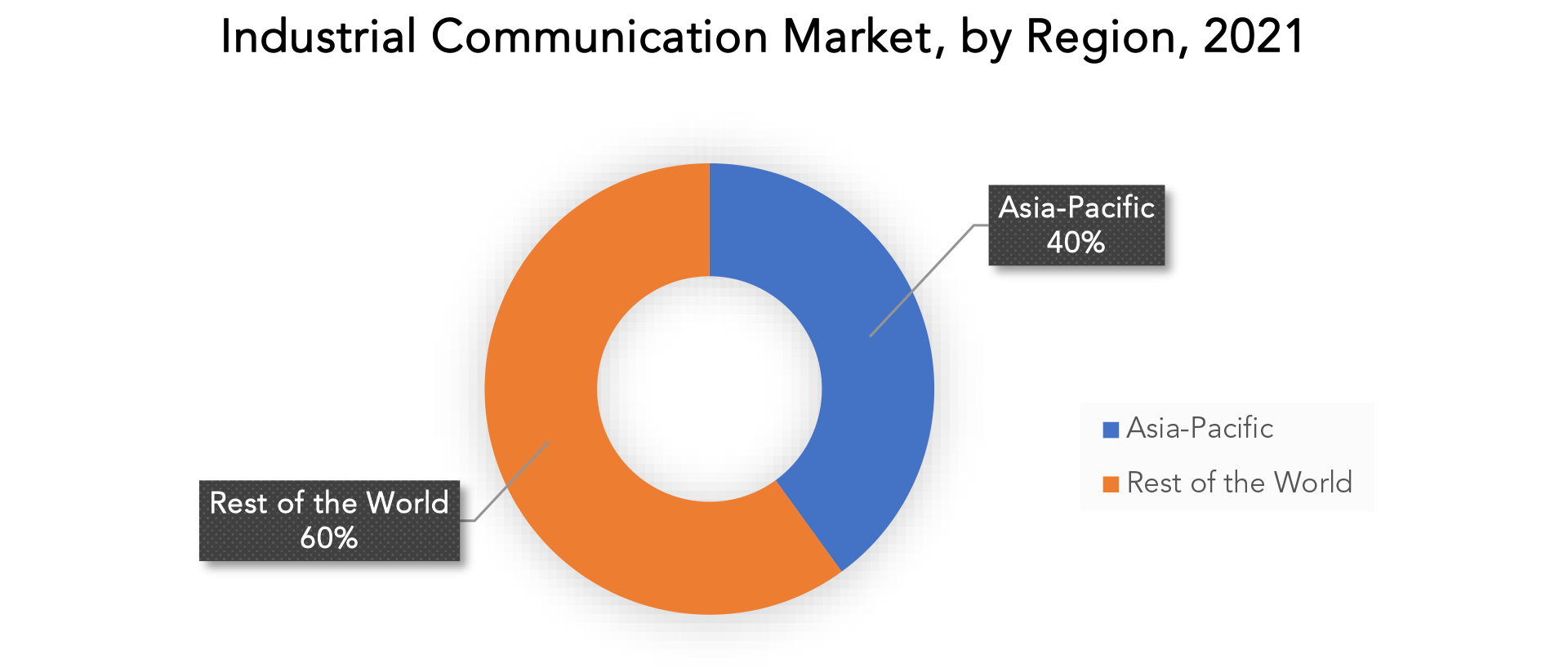
Key Market Segments: Industrial Communication Market
Industrial Communication Market by Offering, 2020-2029, (USD Billion)- Components
- Software
- Services
- Fieldbus
- Industrial Ethernet
- Wireless
- Automotive & Transportation
- Electrical & Electronics
- Aerospace & Defense
- Water & Wastewater Management
- Food & Beverages
- Pharmaceuticals & Medical Devices
- Energy & Power
- Metals & Mining
- Chemicals & Fertilizers
- Engineering/Fabrication
- Others
- North America
- Europe
- Asia Pacific
- South America
- Middle East And Africa
Exactitude Consultancy Services Key Objectives:
- Increasing sales and market share
- Developing new technology
- Improving profitability
- Entering new markets
- Enhancing brand reputation
Key Question Answered
- What is the expected growth rate of the industrial communication market over the next 7 years?
- Who are the major players in the industrial communication market and what is their market share?
- What are the end-user industries driving demand for market and what is their outlook?
- What are the opportunities for growth in emerging markets such as Asia-Pacific, Middle East, and Africa?
- How is the economic environment affecting the industrial communication market, including factors such as interest rates, inflation, and exchange rates?
- What is the expected impact of government policies and regulations on the industrial communication market?
- What is the current and forecasted size and growth rate of the global industrial communication market?
- What are the key drivers of growth in the industrial communication market?
- What are the distribution channels and supply chain dynamics in the industrial communication market?
- What are the technological advancements and innovations in the industrial communication market and their impact on product development and growth?
- What are the regulatory considerations and their impact on the market?
- What are the challenges faced by players in the industrial communication market and how are they addressing these challenges?
- What are the opportunities for growth and expansion in the industrial communication market?
- What are the service offerings and specifications of leading players in the market?
- INTRODUCCIÓN
- DEFINICIÓN DE MERCADO
- SEGMENTACIÓN DEL MERCADO
- CRONOGRAMAS DE INVESTIGACIÓN
- SUPUESTOS Y LIMITACIONES
- METODOLOGÍA DE LA INVESTIGACIÓN
- MINERÍA DE DATOS
- INVESTIGACIÓN SECUNDARIA
- INVESTIGACIÓN PRIMARIA
- ASESORAMIENTO DE EXPERTOS EN LA MATERIA
- CONTROLES DE CALIDAD
- REVISIÓN FINAL
- TRIANGULACIÓN DE DATOS
- ENFOQUE DE ABAJO HACIA ARRIBA
- ENFOQUE DE ARRIBA HACIA ABAJO
- FLUJO DE INVESTIGACIÓN
- FUENTES DE DATOS
- MINERÍA DE DATOS
- RESUMEN EJECUTIVO
- PANORAMA DEL MERCADO
- PERSPECTIVAS DEL MERCADO MUNDIAL DE LA COMUNICACIÓN INDUSTRIAL
- IMPULSORES DEL MERCADO
- RESTRICCIONES DEL MERCADO
- OPORTUNIDADES DE MERCADO
- IMPACTO DEL COVID-19 EN EL MERCADO DE LA COMUNICACIÓN INDUSTRIAL
- MODELO DE LAS CINCO FUERZAS DE PORTER
- AMENAZA DE NUEVOS INGRESANTES
- AMENAZA DE SUSTITUTOS
- PODER DE NEGOCIACIÓN DE LOS PROVEEDORES
- PODER DE NEGOCIACIÓN DE LOS CLIENTES
- GRADO DE COMPETENCIA
- ANÁLISIS DE LA CADENA DE VALOR DE LA INDUSTRIA
- PERSPECTIVAS DEL MERCADO MUNDIAL DE LA COMUNICACIÓN INDUSTRIAL
- MERCADO GLOBAL DE COMUNICACIONES INDUSTRIALES POR TIPO, 2020-2029 (MIL MILLONES DE USD)
- COMPONENTES
- SOFTWARE
- SERVICIOS
- MERCADO GLOBAL DE COMUNICACIONES INDUSTRIALES POR PROTOCOLO DE COMUNICACIÓN, 2020-2029 (MILES DE MILLONES DE USD)
- BUS DE CAMPO
- Ethernet industrial
- INALÁMBRICO
- MERCADO GLOBAL DE COMUNICACIONES INDUSTRIALES POR USUARIO FINAL, 2020-2029 (MILES DE MILLONES DE USD)
- AUTOMOCIÓN Y TRANSPORTE
- ELECTRICAL & ELECTRONICS
- AEROSPACE & DEFENSE
- WATER & WASTEWATER MANAGEMENT
- FOOD & BEVERAGES
- PHARMACEUTICALS & MEDICAL DEVICES
- ENERGY & POWER
- METALS & MINING
- CHEMICALS & FERTILIZERS
7.10. ENGINEERING/FABRICATION
7.11. OTHERS
- GLOBAL INDUSTRIAL COMMUNICATION MARKET BY REGION, 2020-2029, (USD BILLION)
- NORTH AMERICA
- US
- CANADA
- MEXICO
- SOUTH AMERICA
- BRAZIL
- ARGENTINA
- COLOMBIA
- REST OF SOUTH AMERICA
- EUROPE
- GERMANY
- UK
- FRANCE
- ITALY
- SPAIN
- RUSSIA
- REST OF EUROPE
- ASIA PACIFIC
- INDIA
- CHINA
- JAPAN
- SOUTH KOREA
- AUSTRALIA
- SOUTH-EAST ASIA
- REST OF ASIA PACIFIC
- MIDDLE EAST AND AFRICA
- UAE
- SAUDI ARABIA
- SOUTH AFRICA
- REST OF MIDDLE EAST AND AFRICA
- NORTH AMERICA
- COMPANY PROFILES* (BUSINESS OVERVIEW, COMPANY SNAPSHOT, PRODUCT OFFERED, RECENT DEVELOPMENTS)
9.1. SIEMENS AG
9.2. ABB LTD.
9.3. SCHNEIDER ELECTRIC SE
9.4. ROCKWELL AUTOMATION INC.
9.5. HONEYWELL INTERNATIONAL INC.
9.6. BELDEN INC.
9.7. CISCO SYSTEMS INC.
9.8. GENERAL ELECTRIC COMPANY
9.9. MOXA INC.
9.10. OMRON CORPORATION
9.11. EMERSON ELECTRIC CO.
9.12. EATON CORPORATION
9.13. YOKOGAWA ELECTRIC CORPORATION
9.14. PEPPERL+FUCHS AG
9.15. ADVANTECH CO. LTD.
9.16. HMS INDUSTRIAL NETWORKS
9.17. MITSUBISHI ELECTRIC
9.18. IFM ELECTRONIC
9.19. HUAWEI TECHNOLOGIES *THE COMPANY LIST IS INDICATIVE
LIST OF TABLES
TABLE 1 GLOBAL INDUSTRIAL COMMUNICATION MARKET BY OFFERING (USD BILLION) 2020-2029
TABLE 2 GLOBAL INDUSTRIAL COMMUNICATION MARKET BY COMMUNICATION PROTOCOL (USD BILLION) 2020-2029
TABLE 3 GLOBAL INDUSTRIAL COMMUNICATION MARKET BY END-USER (USD BILLION) 2020-2029
TABLE 4 GLOBAL INDUSTRIAL COMMUNICATION MARKET BY REGION (USD BILLION) 2020-2029
TABLE 5 NORTH AMERICA INDUSTRIAL COMMUNICATION MARKET BY OFFERING (USD BILLION) 2020-2029
TABLE 6 NORTH AMERICA INDUSTRIAL COMMUNICATION MARKET BY COMMUNICATION PROTOCOL (USD BILLION) 2020-2029
TABLE 7 NORTH AMERICA INDUSTRIAL COMMUNICATION MARKET BY END-USER (USD BILLION) 2020-2029
TABLE 8 NORTH AMERICA INDUSTRIAL COMMUNICATION MARKET BY COUNTRY (USD BILLION) 2020-2029
TABLE 9 US INDUSTRIAL COMMUNICATION MARKET BY OFFERING (USD BILLION) 2020-2029
TABLE 10 US INDUSTRIAL COMMUNICATION MARKET BY COMMUNICATION PROTOCOL (USD BILLION) 2020-2029
TABLE 11 US INDUSTRIAL COMMUNICATION MARKET BY END-USER (USD BILLION) 2020-2029
TABLE 12 US INDUSTRIAL COMMUNICATION MARKET BY REGION (USD BILLION) 2020-2029
TABLE 13 CANADA INDUSTRIAL COMMUNICATION MARKET BY OFFERING (USD BILLION) 2020-2029
TABLE 14 CANADA INDUSTRIAL COMMUNICATION MARKET BY COMMUNICATION PROTOCOL (USD BILLION) 2020-2029
TABLE 15 CANADA INDUSTRIAL COMMUNICATION MARKET BY END-USER (USD BILLION) 2020-2029
TABLE 16 CANADA INDUSTRIAL COMMUNICATION MARKET BY REGION (USD BILLION) 2020-2029
TABLE 17 MEXICO INDUSTRIAL COMMUNICATION MARKET BY OFFERING (USD BILLION) 2020-2029
TABLE 18 MEXICO INDUSTRIAL COMMUNICATION MARKET BY COMMUNICATION PROTOCOL (USD BILLION) 2020-2029
TABLE 19 MEXICO INDUSTRIAL COMMUNICATION MARKET BY END-USER (USD BILLION) 2020-2029
TABLE 20 MEXICO INDUSTRIAL COMMUNICATION MARKET BY REGION (USD BILLION) 2020-2029
TABLE 21 SOUTH AMERICA INDUSTRIAL COMMUNICATION MARKET BY OFFERING (USD BILLION) 2020-2029
TABLE 22 SOUTH AMERICA INDUSTRIAL COMMUNICATION MARKET BY COMMUNICATION PROTOCOL (USD BILLION) 2020-2029
TABLE 23 SOUTH AMERICA INDUSTRIAL COMMUNICATION MARKET BY END-USER (USD BILLION) 2020-2029
TABLE 24 SOUTH AMERICA INDUSTRIAL COMMUNICATION MARKET BY COUNTRY (USD BILLION) 2020-2029
TABLE 25 BRAZIL INDUSTRIAL COMMUNICATION MARKET BY OFFERING (USD BILLION) 2020-2029
TABLE 26 BRAZIL INDUSTRIAL COMMUNICATION MARKET BY COMMUNICATION PROTOCOL (USD BILLION) 2020-2029
TABLE 27 BRAZIL INDUSTRIAL COMMUNICATION MARKET BY END-USER (USD BILLION) 2020-2029
TABLE 28 BRAZIL INDUSTRIAL COMMUNICATION MARKET BY REGION (USD BILLION) 2020-2029
TABLE 29 ARGENTINA INDUSTRIAL COMMUNICATION MARKET BY OFFERING (USD BILLION) 2020-2029
TABLE 30 ARGENTINA INDUSTRIAL COMMUNICATION MARKET BY COMMUNICATION PROTOCOL (USD BILLION) 2020-2029
TABLE 31 ARGENTINA INDUSTRIAL COMMUNICATION MARKET BY END-USER (USD BILLION) 2020-2029
TABLE 32 ARGENTINA INDUSTRIAL COMMUNICATION MARKET BY REGION (USD BILLION) 2020-2029
TABLE 33 COLOMBIA INDUSTRIAL COMMUNICATION MARKET BY OFFERING (USD BILLION) 2020-2029
TABLE 34 COLOMBIA INDUSTRIAL COMMUNICATION MARKET BY COMMUNICATION PROTOCOL (USD BILLION) 2020-2029
TABLE 35 COLOMBIA INDUSTRIAL COMMUNICATION MARKET BY END-USER (USD BILLION) 2020-2029
TABLE 36 COLOMBIA INDUSTRIAL COMMUNICATION MARKET BY REGION (USD BILLION) 2020-2029
TABLE 37 REST OF SOUTH AMERICA INDUSTRIAL COMMUNICATION MARKET BY OFFERING (USD BILLION) 2020-2029
TABLE 38 REST OF SOUTH AMERICA INDUSTRIAL COMMUNICATION MARKET BY COMMUNICATION PROTOCOL (USD BILLION) 2020-2029
TABLE 39 REST OF SOUTH AMERICA INDUSTRIAL COMMUNICATION MARKET BY END-USER (USD BILLION) 2020-2029
TABLE 40 REST OF SOUTH AMERICA INDUSTRIAL COMMUNICATION MARKET BY REGION (USD BILLION) 2020-2029
TABLE 41 ASIA-PACIFIC INDUSTRIAL COMMUNICATION MARKET BY OFFERING (USD BILLION) 2020-2029
TABLE 42 ASIA-PACIFIC INDUSTRIAL COMMUNICATION MARKET BY COMMUNICATION PROTOCOL (USD BILLION) 2020-2029
TABLE 43 ASIA-PACIFIC INDUSTRIAL COMMUNICATION MARKET BY END-USER (USD BILLION) 2020-2029
TABLE 44 ASIA-PACIFIC INDUSTRIAL COMMUNICATION MARKET BY COUNTRY (USD BILLION) 2020-2029
TABLE 45 INDIA INDUSTRIAL COMMUNICATION MARKET BY OFFERING (USD BILLION) 2020-2029
TABLE 46 INDIA INDUSTRIAL COMMUNICATION MARKET BY COMMUNICATION PROTOCOL (USD BILLION) 2020-2029
TABLE 47 INDIA INDUSTRIAL COMMUNICATION MARKET BY END-USER (USD BILLION) 2020-2029
TABLE 48 INDIA INDUSTRIAL COMMUNICATION MARKET BY REGION (USD BILLION) 2020-2029
TABLE 49 CHINA INDUSTRIAL COMMUNICATION MARKET BY OFFERING (USD BILLION) 2020-2029
TABLE 50 CHINA INDUSTRIAL COMMUNICATION MARKET BY COMMUNICATION PROTOCOL (USD BILLION) 2020-2029
TABLE 51 CHINA INDUSTRIAL COMMUNICATION MARKET BY END-USER (USD BILLION) 2020-2029
TABLE 52 CHINA INDUSTRIAL COMMUNICATION MARKET BY REGION (USD BILLION) 2020-2029
TABLE 53 JAPAN INDUSTRIAL COMMUNICATION MARKET BY OFFERING (USD BILLION) 2020-2029
TABLE 54 JAPAN INDUSTRIAL COMMUNICATION MARKET BY COMMUNICATION PROTOCOL (USD BILLION) 2020-2029
TABLE 55 JAPAN INDUSTRIAL COMMUNICATION MARKET BY END-USER (USD BILLION) 2020-2029
TABLE 56 JAPAN INDUSTRIAL COMMUNICATION MARKET BY REGION (USD BILLION) 2020-2029
TABLE 57 SOUTH KOREA INDUSTRIAL COMMUNICATION MARKET BY OFFERING (USD BILLION) 2020-2029
TABLE 58 SOUTH KOREA INDUSTRIAL COMMUNICATION MARKET BY COMMUNICATION PROTOCOL (USD BILLION) 2020-2029
TABLE 59 SOUTH KOREA INDUSTRIAL COMMUNICATION MARKET BY END-USER (USD BILLION) 2020-2029
TABLE 60 SOUTH KOREA INDUSTRIAL COMMUNICATION MARKET BY REGION (USD BILLION) 2020-2029
TABLE 61 AUSTRALIA INDUSTRIAL COMMUNICATION MARKET BY OFFERING (USD BILLION) 2020-2029
TABLE 62 AUSTRALIA INDUSTRIAL COMMUNICATION MARKET BY COMMUNICATION PROTOCOL (USD BILLION) 2020-2029
TABLE 63 AUSTRALIA INDUSTRIAL COMMUNICATION MARKET BY END-USER (USD BILLION) 2020-2029
TABLE 64 AUSTRALIA INDUSTRIAL COMMUNICATION MARKET BY REGION (USD BILLION) 2020-2029
TABLE 65 SOUTH-EAST ASIA INDUSTRIAL COMMUNICATION MARKET BY OFFERING (USD BILLION) 2020-2029
TABLE 66 SOUTH-EAST ASIA INDUSTRIAL COMMUNICATION MARKET BY COMMUNICATION PROTOCOL (USD BILLION) 2020-2029
TABLE 67 SOUTH-EAST ASIA INDUSTRIAL COMMUNICATION MARKET BY END-USER (USD BILLION) 2020-2029
TABLE 68 SOUTH-EAST ASIA INDUSTRIAL COMMUNICATION MARKET BY REGION (USD BILLION) 2020-2029
TABLE 69 REST OF ASIA PACIFIC INDUSTRIAL COMMUNICATION MARKET BY OFFERING (USD BILLION) 2020-2029
TABLE 70 REST OF ASIA PACIFIC INDUSTRIAL COMMUNICATION MARKET BY COMMUNICATION PROTOCOL (USD BILLION) 2020-2029
TABLE 71 REST OF ASIA PACIFIC INDUSTRIAL COMMUNICATION MARKET BY END-USER (USD BILLION) 2020-2029
TABLE 72 REST OF ASIA PACIFIC INDUSTRIAL COMMUNICATION MARKET BY REGION (USD BILLION) 2020-2029
TABLE 73 EUROPE INDUSTRIAL COMMUNICATION MARKET BY OFFERING (USD BILLION) 2020-2029
TABLE 74 EUROPE INDUSTRIAL COMMUNICATION MARKET BY COMMUNICATION PROTOCOL (USD BILLION) 2020-2029
TABLE 75 EUROPE INDUSTRIAL COMMUNICATION MARKET BY END-USER (USD BILLION) 2020-2029
TABLE 76 EUROPE INDUSTRIAL COMMUNICATION MARKET BY COUNTRY (USD BILLION) 2020-2029
TABLE 77 GERMANY INDUSTRIAL COMMUNICATION MARKET BY OFFERING (USD BILLION) 2020-2029
TABLE 78 GERMANY INDUSTRIAL COMMUNICATION MARKET BY COMMUNICATION PROTOCOL (USD BILLION) 2020-2029
TABLE 79 GERMANY INDUSTRIAL COMMUNICATION MARKET BY END-USER (USD BILLION) 2020-2029
TABLE 80 GERMANY INDUSTRIAL COMMUNICATION MARKET BY REGION (USD BILLION) 2020-2029
TABLE 81 UK INDUSTRIAL COMMUNICATION MARKET BY OFFERING (USD BILLION) 2020-2029
TABLE 82 UK INDUSTRIAL COMMUNICATION MARKET BY COMMUNICATION PROTOCOL (USD BILLION) 2020-2029
TABLE 83 UK INDUSTRIAL COMMUNICATION MARKET BY END-USER (USD BILLION) 2020-2029
TABLE 84 UK INDUSTRIAL COMMUNICATION MARKET BY REGION (USD BILLION) 2020-2029
TABLE 85 FRANCE INDUSTRIAL COMMUNICATION MARKET BY OFFERING (USD BILLION) 2020-2029
TABLE 86 FRANCE INDUSTRIAL COMMUNICATION MARKET BY COMMUNICATION PROTOCOL (USD BILLION) 2020-2029
TABLE 87 FRANCE INDUSTRIAL COMMUNICATION MARKET BY END-USER (USD BILLION) 2020-2029
TABLE 88 FRANCE INDUSTRIAL COMMUNICATION MARKET BY REGION (USD BILLION) 2020-2029
TABLE 89 ITALY INDUSTRIAL COMMUNICATION MARKET BY OFFERING (USD BILLION) 2020-2029
TABLE 90 ITALY INDUSTRIAL COMMUNICATION MARKET BY COMMUNICATION PROTOCOL (USD BILLION) 2020-2029
TABLE 91 ITALY INDUSTRIAL COMMUNICATION MARKET BY END-USER (USD BILLION) 2020-2029
TABLE 92 ITALY INDUSTRIAL COMMUNICATION MARKET BY REGION (USD BILLION) 2020-2029
TABLE 93 SPAIN INDUSTRIAL COMMUNICATION MARKET BY OFFERING (USD BILLION) 2020-2029
TABLE 94 SPAIN INDUSTRIAL COMMUNICATION MARKET BY COMMUNICATION PROTOCOL (USD BILLION) 2020-2029
TABLE 95 SPAIN INDUSTRIAL COMMUNICATION MARKET BY END-USER (USD BILLION) 2020-2029
TABLE 96 SPAIN INDUSTRIAL COMMUNICATION MARKET BY REGION (USD BILLION) 2020-2029
TABLE 97 RUSSIA INDUSTRIAL COMMUNICATION MARKET BY OFFERING (USD BILLION) 2020-2029
TABLE 98 RUSSIA INDUSTRIAL COMMUNICATION MARKET BY COMMUNICATION PROTOCOL (USD BILLION) 2020-2029
TABLE 99 RUSSIA INDUSTRIAL COMMUNICATION MARKET BY END-USER (USD BILLION) 2020-2029
TABLE 100 RUSSIA INDUSTRIAL COMMUNICATION MARKET BY REGION (USD BILLION) 2020-2029
TABLE 101 REST OF EUROPE INDUSTRIAL COMMUNICATION MARKET BY OFFERING (USD BILLION) 2020-2029
TABLE 102 REST OF EUROPE INDUSTRIAL COMMUNICATION MARKET BY COMMUNICATION PROTOCOL (USD BILLION) 2020-2029
TABLE 103 REST OF EUROPE INDUSTRIAL COMMUNICATION MARKET BY END-USER (USD BILLION) 2020-2029
TABLE 104 REST OF EUROPE INDUSTRIAL COMMUNICATION MARKET BY REGION (USD BILLION) 2020-2029
TABLE 105 MIDDLE EAST AND AFRICA INDUSTRIAL COMMUNICATION MARKET BY OFFERING (USD BILLION) 2020-2029
TABLE 106 MIDDLE EAST AND AFRICA INDUSTRIAL COMMUNICATION MARKET BY COMMUNICATION PROTOCOL (USD BILLION) 2020-2029
TABLE 107 MIDDLE EAST AND AFRICA INDUSTRIAL COMMUNICATION MARKET BY END-USER (USD BILLION) 2020-2029
TABLE 108 MIDDLE EAST AND AFRICA INDUSTRIAL COMMUNICATION MARKET BY COUNTRY (USD BILLION) 2020-2029
TABLE 109 UAE INDUSTRIAL COMMUNICATION MARKET BY OFFERING (USD BILLION) 2020-2029
TABLE 110 UAE INDUSTRIAL COMMUNICATION MARKET BY COMMUNICATION PROTOCOL (USD BILLION) 2020-2029
TABLE 111 UAE INDUSTRIAL COMMUNICATION MARKET BY END-USER (USD BILLION) 2020-2029
TABLE 112 UAE INDUSTRIAL COMMUNICATION MARKET BY REGION (USD BILLION) 2020-2029
TABLE 113 SAUDI ARABIA INDUSTRIAL COMMUNICATION MARKET BY OFFERING (USD BILLION) 2020-2029
TABLE 114 SAUDI ARABIA INDUSTRIAL COMMUNICATION MARKET BY COMMUNICATION PROTOCOL (USD BILLION) 2020-2029
TABLE 115 SAUDI ARABIA INDUSTRIAL COMMUNICATION MARKET BY END-USER (USD BILLION) 2020-2029
TABLE 116 SAUDI ARABIA INDUSTRIAL COMMUNICATION MARKET BY REGION (USD BILLION) 2020-2029
TABLE 117 SOUTH AFRICA INDUSTRIAL COMMUNICATION MARKET BY OFFERING (USD BILLION) 2020-2029
TABLE 118 SOUTH AFRICA INDUSTRIAL COMMUNICATION MARKET BY COMMUNICATION PROTOCOL (USD BILLION) 2020-2029
TABLE 119 SOUTH AFRICA INDUSTRIAL COMMUNICATION MARKET BY END-USER (USD BILLION) 2020-2029
TABLE 120 SOUTH AFRICA INDUSTRIAL COMMUNICATION MARKET BY REGION (USD BILLION) 2020-2029
TABLE 121 REST OF MIDDLE EAST AND AFRICA INDUSTRIAL COMMUNICATION MARKET BY OFFERING (USD BILLION) 2020-2029
TABLE 122 REST OF MIDDLE EAST AND AFRICA INDUSTRIAL COMMUNICATION MARKET BY COMMUNICATION PROTOCOL (USD BILLION) 2020-2029
TABLE 123 REST OF MIDDLE EAST AND AFRICA INDUSTRIAL COMMUNICATION MARKET BY END-USER (USD BILLION) 2020-2029
TABLE 124 REST OF MIDDLE EAST AND AFRICA INDUSTRIAL COMMUNICATION MARKET BY REGION (USD BILLION) 2020-2029
LIST OF FIGURES
FIGURE 1 MARKET DYNAMICS
FIGURE 2 MARKET SEGMENTATION
FIGURE 3 REPORT TIMELINES: YEARS CONSIDERED
FIGURE 4 DATA TRIANGULATION
FIGURE 5 BOTTOM-UP APPROACH
FIGURE 6 TOP-DOWN APPROACH
FIGURE 7 RESEARCH FLOW
FIGURE 8 GLOBAL INDUSTRIAL COMMUNICATION MARKET BY OFFERING (USD BILLION) 2020-2029
FIGURE 9 GLOBAL INDUSTRIAL COMMUNICATION MARKET BY COMMUNICATION PROTOCOL (USD BILLION) 2020-2029
FIGURE 10 GLOBAL INDUSTRIAL COMMUNICATION MARKET BY END-USER (USD BILLION) 2020-2029
FIGURE 11 GLOBAL INDUSTRIAL COMMUNICATION MARKET BY REGION (USD BILLION) 2020-2029
FIGURE 12 PORTER’S FIVE FORCES MODEL
FIGURE 13 GLOBAL INDUSTRIAL COMMUNICATION MARKET BY OFFERING (USD BILLION) 2021
FIGURE 14 GLOBAL INDUSTRIAL COMMUNICATION MARKET BY COMMUNICATION PROTOCOL (USD BILLION) 2021
FIGURE 15 GLOBAL INDUSTRIAL COMMUNICATION MARKET BY END-USER (USD BILLION) 2021
FIGURE 16 GLOBAL INDUSTRIAL COMMUNICATION MARKET BY REGION (USD BILLION) 2021
FIGURE 17 NORTH AMERICA INDUSTRIAL COMMUNICATION MARKET SNAPSHOT
FIGURE 18 EUROPE INDUSTRIAL COMMUNICATION MARKET SNAPSHOT
FIGURE 19 SOUTH AMERICA INDUSTRIAL COMMUNICATION MARKET SNAPSHOT
FIGURE 20 ASIA PACIFIC INDUSTRIAL COMMUNICATION MARKET SNAPSHOT
FIGURE 21 MIDDLE EAST ASIA AND AFRICA INDUSTRIAL COMMUNICATION MARKET SNAPSHOT
FIGURE 22 MARKET SHARE ANALYSIS
FIGURE 23 SIEMENS AG: COMPANY SNAPSHOT
FIGURE 24 ABB LTD.: COMPANY SNAPSHOT
FIGURE 25 SCHNEIDER ELECTRIC SE: COMPANY SNAPSHOT
FIGURE 26 ROCKWELL AUTOMATION INC.: COMPANY SNAPSHOT
FIGURE 27 HONEYWELL INTERNATIONAL INC.: COMPANY SNAPSHOT
FIGURE 28 BELDEN INC.: COMPANY SNAPSHOT
FIGURE 29 CISCO SYSTEMS INC.: COMPANY SNAPSHOT
FIGURE 30 GENERAL ELECTRIC COMPANY: COMPANY SNAPSHOT
FIGURE 31 MOXA INC.: COMPANY SNAPSHOT
FIGURE 32 OMRON CORPORATION: COMPANY SNAPSHOT
FIGURE 33 EMERSON ELECTRIC CO.: COMPANY SNAPSHOT
FIGURE 34 EATON CORPORATION: COMPANY SNAPSHOT
FIGURE 35 YOKOGAWA ELECTRIC CORPORATION: COMPANY SNAPSHOT
FIGURE 36 PEPPERL+FUCHS AG: COMPANY SNAPSHOT
FIGURE 37 ADVANTECH CO. LTD.: COMPANY SNAPSHOT
FIGURE 38 HMS INDUSTRIAL NETWORKS: COMPANY SNAPSHOT
FIGURE 39 MITSUBISHI ELECTRIC: COMPANY SNAPSHOT
FIGURE 40 IFM ELECTRONIC: COMPANY SNAPSHOT
FIGURE 41 HUAWEI TECHNOLOGIES: COMPANY SNAPSHOT
DOWNLOAD FREE SAMPLE REPORT
License Type
SPEAK WITH OUR ANALYST
Want to know more about the report or any specific requirement?
WANT TO CUSTOMIZE THE REPORT?
Our Clients Speak
We asked them to research ‘ Equipment market’ all over the world, and their whole arrangement was helpful to us. thehealthanalytics.com insightful analysis and reports contributed to our current analysis and in creating a future strategy. Besides, the te
Yosuke Mitsui
Senior Associate Construction Equipment Sales & Marketing
We asked them to research ‘Equipment market’ all over the world, and their whole arrangement was helpful to us. thehealthanalytics.com insightful analysis and reports contributed to our current analysis and in creating a future strategy. Besides, the te