

Base Year Value ()
x.x %
x.x %
CAGR ()
x.x %
x.x %
Forecast Year Value ()
x.x %
x.x %
Historical Data Period
Largest Region
Forecast Period
Mercado de tratamiento de la hiperplasia prostática benigna por tratamiento (clase de fármaco, cirugías mínimamente invasivas, terapia láser y otros), usuario final (hospitales, centros quirúrgicos ambulatorios, clínicas especializadas y otros) y por región (América del Norte, América Latina, Europa, Asia Pacífico y Oriente Medio y África), tendencias globales y pronóstico de 2022 a 2029
Instant access to hundreds of data points and trends
- Market estimates from 2014-2029
- Competitive analysis, industry segmentation, financial benchmarks
- Incorporates SWOT, Porter's Five Forces and risk management frameworks
- PDF report or online database with Word, Excel and PowerPoint export options
- 100% money back guarantee
Descripción general del mercado de tratamiento de la hiperplasia prostática benigna
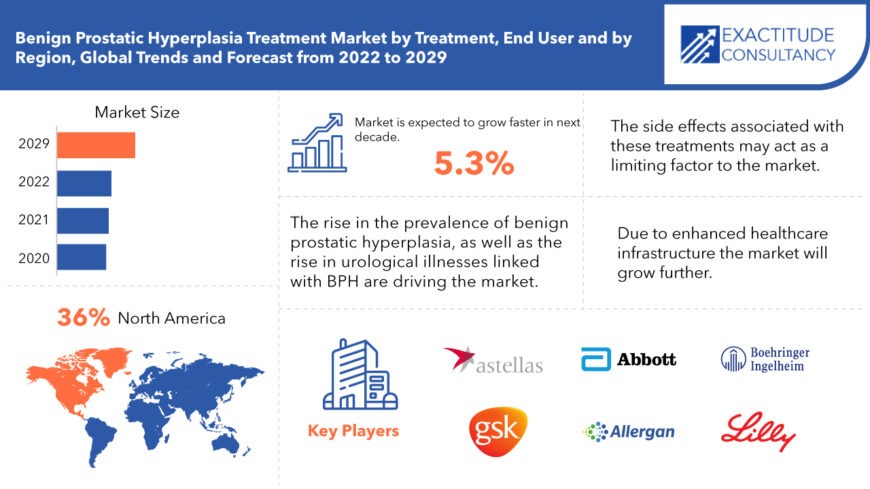
El tamaño del mercado de tratamiento de la hiperplasia prostática benigna se valoró en USD 5.87 mil millones en 2020 y se proyecta que alcance los USD 9.71 mil millones para 2029, creciendo a una CAGR del 19,4% entre 2022 y 2029.
El mercado de tratamiento de la hiperplasia prostática benigna (HPB) abarca los productos farmacéuticos, dispositivos médicos e intervenciones terapéuticas destinadas a controlar los síntomas y complicaciones asociados con la hiperplasia prostática benigna, una afección común caracterizada por el agrandamiento no canceroso de la glándula prostática en hombres mayores. Este mercado incluye una amplia gama de medicamentos, procedimientos quirúrgicos, terapias mínimamente invasivas e intervenciones de estilo de vida diseñadas para aliviar los síntomas urinarios , mejorar la calidad de vida y reducir el riesgo de complicaciones como la retención urinaria y las infecciones del tracto urinario.
El mercado del tratamiento de la HBP se está expandiendo debido a una serie de razones. En primer lugar, un factor importante es la creciente incidencia de la HBP en todo el mundo. Existe un mayor grupo de pacientes que buscan tratamiento como resultado de la creciente incidencia de la HBP provocada por el envejecimiento de la población. La demanda de opciones de tratamiento creativas y mínimamente invasivas ha aumentado como resultado de esta tendencia demográfica. La embolización de la arteria prostática (PAE), la terapia láser y la resección transuretral de la próstata (RTUP) son ejemplos de procedimientos mínimamente invasivos que han ganado popularidad porque son menos invasivos que los métodos quirúrgicos tradicionales y requieren períodos de recuperación más cortos y menos complicaciones. Estos avances no solo han mejorado los resultados de los pacientes, sino que también han aumentado la participación en el mercado al atraer a más pacientes que buscan tratamientos menos invasivos y más efectivos.
La hiperplasia prostática benigna (HPB) se reconoce cada vez más como un problema de salud importante entre los hombres de edad avanzada. Según los datos de 2022 de World Population Review, Mónaco ostenta la edad media masculina más alta, alcanzando los 52 años en 2022. Esta tendencia demográfica indica un aumento notable de la población masculina de edad avanzada en los próximos años. En consecuencia, se espera que la prevalencia de la HPB aumente significativamente a medida que la población de hombres mayores siga aumentando.
| ATRIBUTO | DETALLES |
| Periodo de estudio | 2020-2029 |
| Año base | 2021 |
| Año estimado | 2022 |
| Año pronosticado | 2022-2029 |
| Periodo histórico | 2018-2020 |
| Unidad | Valor (miles de millones de USD) |
| Segmentación | Por tratamiento, por usuario final, por región |
| Por tratamiento |
|
| Por el usuario final |
|
| Por región |
|
El mercado de tratamiento de la hiperplasia prostática benigna presenta perspectivas de crecimiento sustanciales para los fabricantes de genéricos. Con la expiración de las patentes de muchos medicamentos utilizados para el tratamiento de la HBP, como Avodart, Cialis y Jalyn, el mercado se ha abierto a alternativas genéricas. Además, existe una creciente demanda de opciones de tratamiento más eficaces, lo que fomenta una sólida cartera de productos dentro del sector del tratamiento de la hiperplasia prostática benigna.
Las investigaciones indican que el costo de los medicamentos alfabloqueantes genéricos puede ser tan bajo como USD 8 o menos para un suministro de un mes, un marcado contraste con el gasto mensual de casi USD 100 para los productos de marca. Si bien este precio más bajo puede afectar inicialmente la generación general de ingresos, también se traduce en una accesibilidad significativamente mejorada, lo que potencialmente aumenta los volúmenes de ventas a largo plazo.
[título id="attachment_9368" align="aligncenter" width="870"]
Frequently Asked Questions
• What is the worth of global benign prostatic hyperplasia treatment market?
The benign prostatic hyperplasia treatment market size had crossed USD 5.87 Billion in 2020 and will observe a CAGR of more than 19.4% up to USD 9.71 billion in 2029 driven by high demand for mental health services amidst provider shortages, expanding usage of behavioral health software, and rising problems of stress, anxiety, and depression.
• What is the size of the North America benign prostatic hyperplasia treatment industry?
North America held more than 36% of the benign prostatic hyperplasia treatment market revenue share in 2021 and will witness market expansion owing to the expanding elderly and obese population, as well as the availability of research funding.
• What are the upcoming trends of benign prostatic hyperplasia treatment market, globally?
The upcoming trends in benign prostatic hyperplasia treatment market are enhanced healthcare infrastructure, an increase in unmet healthcare demands, and an increase in R&D activities.
• Which are the top companies to hold the market share in benign prostatic hyperplasia treatment market?
Key players include Abbott Laboratories, AbbVie (Allergan Plc), Astellas Pharma Inc., Boehringer Ingelheim Pharma GmbH & Co. KG, Eli Lilly and Company, GlaxoSmithKline plc., Merck & Co., Inc.
Benign Prostatic Hyperplasia Treatment Device Treatment Type Insights:
On the basis of treatment type, the global BPH treatment market is segmented into combination drug therapy and mono-drug therapy. Dominance of combination drug therapy segmentIn the global market for BPH treatment, the combination drug therapy segment held the largest revenue share in 2022. This treatment reduced side effects, increased effectiveness, enhanced compliance, and lowered costs. When treating patients with mild to moderate lower urinary system symptoms, combination medication therapy is the first line of treatment (LUT). Apart from mitigating symptoms, these therapies also have the potential to stop the disease's progression and avoid complications such as Acute Urine Retention (AUR) or surgeries related to BPH.
Over the course of the forecast period, the global market for BPH treatment is anticipated to witness a consistently rapid revenue growth rate in the mono drug therapy segment. Clinical trials have shown that in men receiving alpha-blocker monotherapy but still experiencing bothersome storage LUTS, adding an OAB medication significantly reduces storage symptoms and improves quality of life. When alpha-blocker monotherapy is ineffective in relieving storage symptoms, clinical guidelines recommend incorporating a beta-3 agonist or antimuscarinic medication into the treatment regimen. Tamsulosin monotherapy was the most often prescribed treatment for sub-cohort patients (58.3%), followed by doxazosin.
Benign Prostatic Hyperplasia Treatment Device Therapy Type Insights: On the basis of therapy type, the global BPH treatment market is segmented into drug type and minimally invasive surgeries, laser therapy, and others. Dominance of drug type segmentOver the course of the forecast period, the drug type segment is anticipated to hold a sizable revenue share in the global BPH treatment market. This is due to the fact that certain alpha blockers, such as terazosin (Hytrin), doxazosin (Cardura), alfuzosin (Uroxatral), and tamsulosin (Flomax), can relax the muscles in the prostate and the neck of the bladder. However, 5-alpha reductase inhibitors (5-ARIs) effectively reduce blood and prostate DHT levels, which results in the involution of prostate tissue.
Right now, there are two 5-ARIs used to treat BPH: finasteride and dutasteride. Both have been demonstrated to improve LUTS, decrease prostate volume, and raise urine flow rates, all of which reduce the chance that surgery related to BPH and AUR will be required. Aside from that, BPH and hypertension are common in aging men. As the world's population ages, these two diseases are developing into significant global public health concerns. Thirty percent of men undergoing BPH treatment also suffer from hypertension. In addition, e-beta-adrenergic blockers (Prazosin, Terazosin, and Doxazosin) are effective BPH medications and well-known treatments for hypertension.
[caption id="attachment_9369" align="alignleft" width="680"]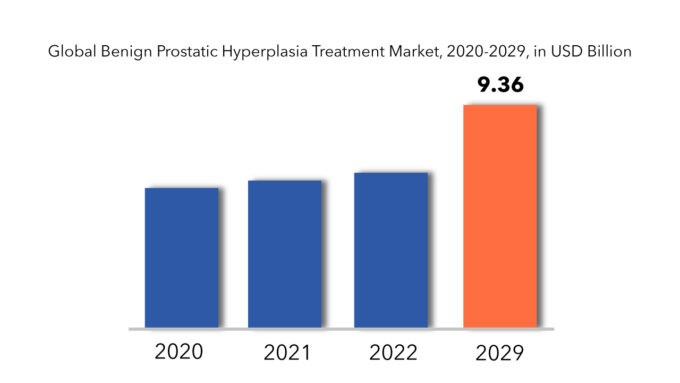
Benign Prostatic Hyperplasia Treatment Market Players
The key players operating in the global benign prostatic hyperplasia therapeutics market are Abbott Laboratories, AbbVie (Allergan Plc), Astellas Pharma Inc., Boehringer Ingelheim Pharma GmbH & Co. KG, Eli Lilly and Company, GlaxoSmithKline plc., Merck & Co., Inc. (Merck Sharp & Dohme Corp), Pfizer Inc., Sanofi and Teva Pharmaceutical Industries Limited.
Recent Development:
- Abbott Laboratories is an American multinational medical devices and health care company with headquarters in Abbott Park, Illinois, United States. The company was founded by Chicago physician Wallace Calvin Abbott in 1888 to formulate known drugs; today, it sells medical devices, diagnostics, branded generic medicines and nutritional products.
- AbbVie focuses on discovering and delivering transformational medicines and products in several key therapeutic areas: immunology, oncology, neuroscience, eye care, virology, and women's health, as well as through their Allergan Aesthetics portfolio.
- Astellas Pharma Inc. is a Japanese multinational pharmaceutical company, formed on 1 April 2005 from the merger of Yamanouchi Pharmaceutical Co., Ltd. and Fujisawa Pharmaceutical Co., Ltd.
Who Should Buy? Or Key Stakeholders
- Plastic Industry
- Chemical Industry
- Construction Industry
- Scientific Research and Development
- Investors
- Manufacturing companies
- End user companies
- Others
Key Takeaways:
- Benign prostatic hyperplasia treatment market is projected to be growing at a CAGR of 19.4%
- Based on treatment, the largest and fastest-growing segment of this industry is drug treatment.
- Based on end-user, home healthcare accounted for the greatest share of this market.
- The market for benign prostatic hyperplasia treatment was dominated by North America.
- Combination therapies emerging as a prominent trend in the benign prostatic hyperplasia treatment market.
Benign Prostatic Hyperplasia Treatment Market Regional Analysis
The global benign prostatic hyperplasia market by region includes North America, Asia-Pacific (APAC), Europe, South America, and Middle East & Africa (MEA).
- North America: includes the US, Canada, Mexico
- Asia Pacific: includes China, Japan, South Korea, India, Australia, ASEAN and Rest of APAC
- Europe: includes UK, Germany, France, Italy, Spain, Russia, and Rest of Europe
- South America: includes Brazil, Argentina and Rest of South America
- Middle East & Africa: includes Turkey, UAE, Saudi Arabia, South Africa, and Rest of MEA
The market for benign prostatic hyperplasia treatment was dominated by North America. The expanding elderly and obese population, as well as the availability of research funding, are the primary factors driving market expansion. Key players' initiatives are also expected to have an impact on the industry.
[caption id="attachment_9370" align="alignleft" width="680"]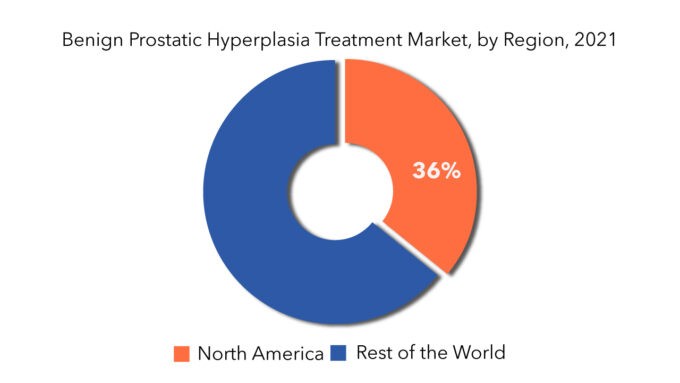
Key Market Segments: Benign Prostatic Hyperplasia Treatment Market
Benign Prostatic Hyperplasia Treatment Market by Treatment, 2020-2029, (USD Million)- Drug Class
- Minimally Invasive Surgeries
- Laser Therapy
- Hospitals
- Ambulatory Surgical Centres
- Specialty Clinics
- North America
- Europe
- Asia Pacific
- South America
- Middle East And Africa
Key Question Answered
- What are the growth opportunities related to the adoption of benign prostatic hyperplasia treatment across major regions in the future?
- What are the new trends and advancements in the benign prostatic hyperplasia treatment market?
- Which product categories are expected to have highest growth rate in the benign prostatic hyperplasia treatment market?
- Which are the key factors driving the benign prostatic hyperplasia treatment market?
- What will the market growth rate, growth momentum or acceleration the market carries during the forecast period?
- Introducción
- Definición de mercado
- Segmentación del mercado
- Cronología de la investigación
- Supuestos y limitaciones
- Metodología de la investigación
- Minería de datos
- Investigación secundaria
- Investigación primaria
- Asesoramiento de expertos en la materia
- Controles de calidad
- Revisión final
- Triangulación de datos
- Enfoque de abajo hacia arriba
- Enfoque de arriba hacia abajo
- Flujo de investigación
- Fuentes de datos
- Minería de datos
- Resumen ejecutivo
- Descripción general del mercado
- Perspectivas del mercado mundial de tratamiento de la hiperplasia prostática benigna
- Factores impulsores del mercado
- Restricciones del mercado
- Oportunidades de mercado
- Impacto de Covid-19 en el mercado de tratamiento de la hiperplasia prostática benigna
- Modelo de las cinco fuerzas de Porter
- Amenaza de nuevos participantes
- Amenaza de sustitutos
- Poder de negociación de los proveedores
- Poder de negociación de los clientes
- Grado de competencia
- Análisis de la cadena de valor de la industria
- Perspectivas del mercado mundial de tratamiento de la hiperplasia prostática benigna
- Mercado mundial de tratamiento de la hiperplasia prostática benigna por tratamiento (millones de USD)
- Clase de droga
- Cirugías mínimamente invasivas
- Terapia con láser
- Mercado mundial de tratamiento de la hiperplasia prostática benigna por usuario final (millones de USD)
- Hospitales
- Centros de cirugía ambulatoria
- Clínicas de especialidades
- Mercado mundial de tratamiento de la hiperplasia prostática benigna por región (millones de USD)
- América del norte
- A NOSOTROS
- Canadá
- México
- Sudamerica
- Brasil
- Argentina
- Colombia
- Resto de Sudamérica
- Europa
- Alemania
- Reino Unido
- Francia
- Italia
- España
- Rusia
- Resto de Europa
- Asia Pacífico
- India
- Porcelana
- Japón
- Corea del Sur
- Australia
- Sudeste asiático
- Resto de Asia Pacífico
- Oriente Medio y África
- Emiratos Árabes Unidos
- Arabia Saudita
- Sudáfrica
- Resto de Oriente Medio y África
- América del norte
- Perfiles de empresas* (descripción general de la empresa, descripción general de la empresa, productos ofrecidos, desarrollos recientes)
- Laboratorios Abbott
- AbbVie (Allergan Plc)
- Compañía farmacéutica Astellas Inc.
- Boehringer Ingelheim Pharma GmbH & Co. KG
- Eli Lilly y compañía
- Compañía: GlaxoSmithKline plc.
- Merck & Co., Inc. (Merck Sharp & Dohme Corp)
- Pfizer Inc.
- Sanofi
- Industrias farmacéuticas Teva limitada
*The Company List Is Indicative
LIST OF TABLES
TABLE 1 GLOBAL BENIGN PROSTATIC HYPERPLASIA TREATMENT MARKET BY TREATMENT (USD MILLIONS) 2020-2029
TABLE 2 GLOBAL BENIGN PROSTATIC HYPERPLASIA TREATMENT MARKET BY END USER (USD MILLIONS) 2020-2029
TABLE 3 GLOBAL BENIGN PROSTATIC HYPERPLASIA TREATMENT MARKET BY REGION (USD MILLIONS) 2020-2029
TABLE 4 US BENIGN PROSTATIC HYPERPLASIA TREATMENT MARKET BY TREATMENT (USD MILLIONS) 2020-2029
TABLE 5 US BENIGN PROSTATIC HYPERPLASIA TREATMENT MARKET BY END USER (USD MILLIONS) 2020-2029
TABLE 6 CANADA BENIGN PROSTATIC HYPERPLASIA TREATMENT MARKET BY TREATMENT (USD MILLIONS) 2020-2029
TABLE 7 CANADA BENIGN PROSTATIC HYPERPLASIA TREATMENT MARKET BY END USER (USD MILLIONS) 2020-2029
TABLE 8 MEXICO BENIGN PROSTATIC HYPERPLASIA TREATMENT MARKET BY TREATMENT (USD MILLIONS) 2020-2029
TABLE 9 MEXICO BENIGN PROSTATIC HYPERPLASIA TREATMENT MARKET BY END USER (USD MILLIONS) 2020-2029
TABLE 10 BRAZIL BENIGN PROSTATIC HYPERPLASIA TREATMENT MARKET BY TREATMENT (USD MILLIONS) 2020-2029
TABLE 11 BRAZIL BENIGN PROSTATIC HYPERPLASIA TREATMENT MARKET BY END USER (USD MILLIONS) 2020-2029
TABLE 12 ARGENTINA BENIGN PROSTATIC HYPERPLASIA TREATMENT MARKET BY TREATMENT (USD MILLIONS) 2020-2029
TABLE 13 ARGENTINA BENIGN PROSTATIC HYPERPLASIA TREATMENT MARKET BY END USER (USD MILLIONS) 2020-2029
TABLE 14 COLOMBIA BENIGN PROSTATIC HYPERPLASIA TREATMENT MARKET BY TREATMENT (USD MILLIONS) 2020-2029
TABLE 15 COLOMBIA BENIGN PROSTATIC HYPERPLASIA TREATMENT MARKET BY END USER (USD MILLIONS) 2020-2029
TABLE 16 REST OF SOUTH AMERICA BENIGN PROSTATIC HYPERPLASIA TREATMENT MARKET BY TREATMENT (USD MILLIONS) 2020-2029
TABLE 17 REST OF SOUTH AMERICA BENIGN PROSTATIC HYPERPLASIA TREATMENT MARKET BY END USER (USD MILLIONS) 2020-2029
TABLE 18 INDIA BENIGN PROSTATIC HYPERPLASIA TREATMENT MARKET BY TREATMENT (USD MILLIONS) 2020-2029
TABLE 19 INDIA BENIGN PROSTATIC HYPERPLASIA TREATMENT MARKET BY END USER (USD MILLIONS) 2020-2029
TABLE 20 CHINA BENIGN PROSTATIC HYPERPLASIA TREATMENT MARKET BY TREATMENT (USD MILLIONS) 2020-2029
TABLE 21 CHINA BENIGN PROSTATIC HYPERPLASIA TREATMENT MARKET BY END USER (USD MILLIONS) 2020-2029
TABLE 22 JAPAN BENIGN PROSTATIC HYPERPLASIA TREATMENT MARKET BY TREATMENT (USD MILLIONS) 2020-2029
TABLE 23 JAPAN BENIGN PROSTATIC HYPERPLASIA TREATMENT MARKET BY END USER (USD MILLIONS) 2020-2029
TABLE 24 SOUTH KOREA BENIGN PROSTATIC HYPERPLASIA TREATMENT MARKET BY TREATMENT (USD MILLIONS) 2020-2029
TABLE 25 SOUTH KOREA BENIGN PROSTATIC HYPERPLASIA TREATMENT MARKET BY END USER (USD MILLIONS) 2020-2029
TABLE 26 AUSTRALIA BENIGN PROSTATIC HYPERPLASIA TREATMENT MARKET BY TREATMENT (USD MILLIONS) 2020-2029
TABLE 27 AUSTRALIA BENIGN PROSTATIC HYPERPLASIA TREATMENT MARKET BY END USER (USD MILLIONS) 2020-2029
TABLE 28 SOUTH-EAST ASIA BENIGN PROSTATIC HYPERPLASIA TREATMENT MARKET BY TREATMENT (USD MILLIONS) 2020-2029
TABLE 29 SOUTH-EAST ASIA BENIGN PROSTATIC HYPERPLASIA TREATMENT MARKET BY END USER (USD MILLIONS) 2020-2029
TABLE 30 REST OF ASIA PACIFIC BENIGN PROSTATIC HYPERPLASIA TREATMENT MARKET BY TREATMENT (USD MILLIONS) 2020-2029
TABLE 31 REST OF ASIA PACIFIC BENIGN PROSTATIC HYPERPLASIA TREATMENT MARKET BY END USER (USD MILLIONS) 2020-2029
TABLE 32 GERMANY BENIGN PROSTATIC HYPERPLASIA TREATMENT MARKET BY TREATMENT (USD MILLIONS) 2020-2029
TABLE 33 GERMANY BENIGN PROSTATIC HYPERPLASIA TREATMENT MARKET BY END USER (USD MILLIONS) 2020-2029
TABLE 34 UK BENIGN PROSTATIC HYPERPLASIA TREATMENT MARKET BY TREATMENT (USD MILLIONS) 2020-2029
TABLE 35 UK BENIGN PROSTATIC HYPERPLASIA TREATMENT MARKET BY END USER (USD MILLIONS) 2020-2029
TABLE 36 FRANCE BENIGN PROSTATIC HYPERPLASIA TREATMENT MARKET BY TREATMENT (USD MILLIONS) 2020-2029
TABLE 37 FRANCE BENIGN PROSTATIC HYPERPLASIA TREATMENT MARKET BY END USER (USD MILLIONS) 2020-2029
TABLE 38 ITALY BENIGN PROSTATIC HYPERPLASIA TREATMENT MARKET BY TREATMENT (USD MILLIONS) 2020-2029
TABLE 39 ITALY BENIGN PROSTATIC HYPERPLASIA TREATMENT MARKET BY END USER (USD MILLIONS) 2020-2029
TABLE 40 SPAIN BENIGN PROSTATIC HYPERPLASIA TREATMENT MARKET BY TREATMENT (USD MILLIONS) 2020-2029
TABLE 41 SPAIN BENIGN PROSTATIC HYPERPLASIA TREATMENT MARKET BY END USER (USD MILLIONS) 2020-2029
TABLE 42 RUSSIA BENIGN PROSTATIC HYPERPLASIA TREATMENT MARKET BY TREATMENT (USD MILLIONS) 2020-2029
TABLE 43 RUSSIA BENIGN PROSTATIC HYPERPLASIA TREATMENT MARKET BY END USER (USD MILLIONS) 2020-2029
TABLE 44 REST OF EUROPE BENIGN PROSTATIC HYPERPLASIA TREATMENT MARKET BY TREATMENT (USD MILLIONS) 2020-2029
TABLE 45 REST OF EUROPE BENIGN PROSTATIC HYPERPLASIA TREATMENT MARKET BY END USER (USD MILLIONS) 2020-2029
TABLE 46 UAE BENIGN PROSTATIC HYPERPLASIA TREATMENT MARKET BY TREATMENT (USD MILLIONS) 2020-2029
TABLE 47 UAE BENIGN PROSTATIC HYPERPLASIA TREATMENT MARKET BY END USER (USD MILLIONS) 2020-2029
TABLE 48 SAUDI ARABIA BENIGN PROSTATIC HYPERPLASIA TREATMENT MARKET BY TREATMENT (USD MILLIONS) 2020-2029
TABLE 49 SAUDI ARABIA BENIGN PROSTATIC HYPERPLASIA TREATMENT MARKET BY END USER (USD MILLIONS) 2020-2029
TABLE 50 SOUTH AFRICA BENIGN PROSTATIC HYPERPLASIA TREATMENT MARKET BY TREATMENT (USD MILLIONS) 2020-2029
TABLE 51 SOUTH AFRICA BENIGN PROSTATIC HYPERPLASIA TREATMENT MARKET BY END USER (USD MILLIONS) 2020-2029
TABLE 52 REST OF MIDDLE EAST AND AFRICA BENIGN PROSTATIC HYPERPLASIA TREATMENT MARKET BY TREATMENT (USD MILLIONS) 2020-2029
TABLE 53 REST OF MIDDLE EAST AND AFRICA BENIGN PROSTATIC HYPERPLASIA TREATMENT MARKET BY END USER (USD MILLIONS) 2020-2029
LIST OF FIGURES
FIGURE 1 MARKET DYNAMICS
FIGURE 2 MARKET SEGMENTATION
FIGURE 3 REPORT TIMELINES: YEARS CONSIDERED
FIGURE 4 DATA TRIANGULATION
FIGURE 5 BOTTOM-UP APPROACH
FIGURE 6 TOP-DOWN APPROACH
FIGURE 7 RESEARCH FLOW
FIGURE 8 GLOBAL BENIGN PROSTATIC HYPERPLASIA TREATMENT MARKET BY TREATMENT, USD MILLION, 2020-2029
FIGURE 9 GLOBAL BENIGN PROSTATIC HYPERPLASIA TREATMENT MARKET BY END USER, USD MILLION, 2020-2029
FIGURE 10 GLOBAL BENIGN PROSTATIC HYPERPLASIA TREATMENT MARKET BY END USER, USD MILLION, 2020-2029
FIGURE 11 GLOBAL BENIGN PROSTATIC HYPERPLASIA TREATMENT MARKET BY REGION, USD MILLION, 2020-2029
FIGURE 12 PORTER’S FIVE FORCES MODEL
FIGURE 13 NORTH AMERICA BENIGN PROSTATIC HYPERPLASIA TREATMENT MARKET SNAPSHOT
FIGURE 14 EUROPE BENIGN PROSTATIC HYPERPLASIA TREATMENT MARKET SNAPSHOT
FIGURE 15 ASIA PACIFIC BENIGN PROSTATIC HYPERPLASIA TREATMENT MARKET SNAPSHOT
FIGURE 16 SOUTH AMERICA BENIGN PROSTATIC HYPERPLASIA TREATMENT MARKET SNAPSHOT
FIGURE 17 MIDDLE EAST & AFRICA BENIGN PROSTATIC HYPERPLASIA TREATMENT MARKET SNAPSHOT
FIGURE 18 ABBOTT LABORATORIES: COMPANY SNAPSHOT
FIGURE 19 ABBVIE (ALLERGAN PLC): COMPANY SNAPSHOT
FIGURE 20 ASTELLAS PHARMA INC.: COMPANY SNAPSHOT
FIGURE 21 BOEHRINGER INGELHEIM PHARMA GMBH & CO. KG: COMPANY SNAPSHOT
FIGURE 22 ELI LILLY AND COMPANY: COMPANY SNAPSHOT
FIGURE 23 GLAXOSMITHKLINE PLC.: COMPANY SNAPSHOT
FIGURE 24 MERCK & CO., INC. (MERCK SHARP & DOHME CORP): COMPANY SNAPSHOT
FIGURE 25 PFIZER INC.: COMPANY SNAPSHOT
FIGURE 26 SANOFI: COMPANY SNAPSHOT
FIGURE 27 TEVA PHARMACEUTICAL INDUSTRIES LIMITED: COMPANY SNAPSHOT
DOWNLOAD FREE SAMPLE REPORT
License Type
SPEAK WITH OUR ANALYST
Want to know more about the report or any specific requirement?
WANT TO CUSTOMIZE THE REPORT?
Our Clients Speak
We asked them to research ‘ Equipment market’ all over the world, and their whole arrangement was helpful to us. thehealthanalytics.com insightful analysis and reports contributed to our current analysis and in creating a future strategy. Besides, the te
Yosuke Mitsui
Senior Associate Construction Equipment Sales & Marketing
We asked them to research ‘Equipment market’ all over the world, and their whole arrangement was helpful to us. thehealthanalytics.com insightful analysis and reports contributed to our current analysis and in creating a future strategy. Besides, the te