

Base Year Value ()
x.x %
x.x %
CAGR ()
x.x %
x.x %
Forecast Year Value ()
x.x %
x.x %
Historical Data Period
Largest Region
Forecast Period
Mercado de películas biodegradables por tipo (PLA, mezclas de almidón, poliésteres biodegradables y PHA), aplicación (envasado de alimentos, agricultura y horticultura, envasado de productos cosméticos y de cuidado personal y envasado industrial) y por región (América del Norte, América Latina, Europa, Asia Pacífico y Oriente Medio y África), tendencias globales y pronóstico de 2022 a 2029
Instant access to hundreds of data points and trends
- Market estimates from 2014-2029
- Competitive analysis, industry segmentation, financial benchmarks
- Incorporates SWOT, Porter's Five Forces and risk management frameworks
- PDF report or online database with Word, Excel and PowerPoint export options
- 100% money back guarantee
Descripción general del mercado de películas biodegradables
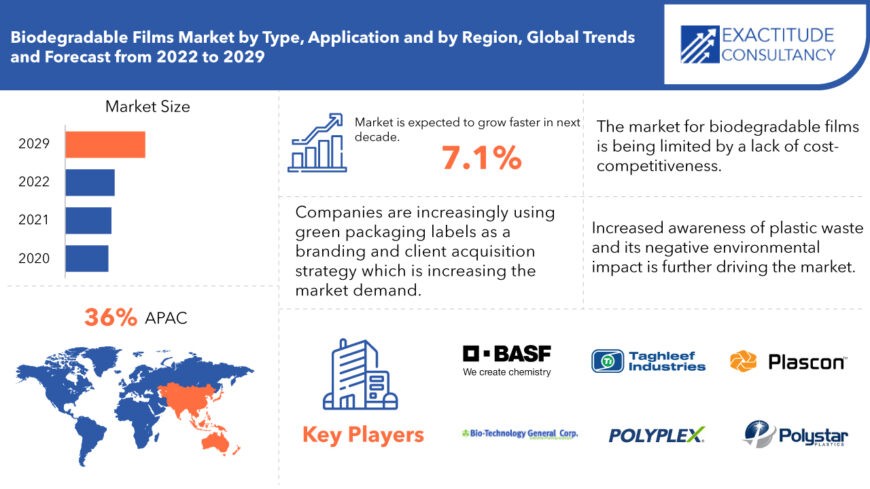
El tamaño del mercado de películas biodegradables se valoró en USD 1.100 millones en 2020 y se proyecta que alcance los USD 2.030 millones en 2029, creciendo a una CAGR del 7,1 % entre 2022 y 2029.
El mercado de películas biodegradables abarca una amplia gama de películas fabricadas a partir de recursos renovables que pueden degradarse de forma natural con el tiempo, lo que ofrece una alternativa sostenible a las películas de plástico tradicionales. Estas películas se utilizan en diversas industrias, como el sector del embalaje , la agricultura y la medicina, donde las preocupaciones medioambientales y las presiones normativas están impulsando la demanda de soluciones ecológicas. Las películas biodegradables están diseñadas para descomponerse en subproductos inofensivos, como agua y dióxido de carbono, a través de procesos naturales como la acción microbiana, el compostaje o la degradación en el suelo o en entornos marinos.
Varias tendencias están dando forma al mercado de películas biodegradables. La conciencia de los consumidores sobre los problemas ambientales está impulsando la demanda de soluciones de envasado sostenibles , lo que lleva a una mayor adopción de películas biodegradables por parte de las empresas de alimentos y bebidas y los minoristas. Los avances tecnológicos en la ciencia de los materiales están permitiendo el desarrollo de películas biodegradables con mejores propiedades mecánicas, propiedades de barrera y estabilidad de la vida útil, lo que las hace adecuadas para una gama más amplia de aplicaciones.
| ATRIBUTO | DETALLES |
| Periodo de estudio | 2020-2029 |
| Año base | 2021 |
| Año estimado | 2022 |
| Año pronosticado | 2022-2029 |
| Periodo histórico | 2018-2020 |
| Unidad | Valor (miles de millones de USD) Volumen (kilotones) |
| Segmentación | Por tipo, por aplicación, por región |
| Por tipo |
|
| Por aplicación |
|
| Por región |
|
El marco regulatorio global para películas biodegradables varía según la región y está evolucionando para abordar las preocupaciones ambientales y promover prácticas sostenibles. Los organismos reguladores como la Agencia Europea de Sustancias Químicas (ECHA) de la Unión Europea, la Administración de Alimentos y Medicamentos de los Estados Unidos (FDA) y la Organización Internacional de Normalización (ISO) establecen estándares y pautas para materiales biodegradables, incluidas las películas. Estas regulaciones cubren aspectos como los métodos de prueba de biodegradabilidad, los requisitos de etiquetado y los aditivos permitidos. El cumplimiento de estas regulaciones es esencial para que los fabricantes garanticen la seguridad, la calidad y la sostenibilidad ambiental de las películas biodegradables y ganen aceptación en el mercado. A medida que aumenta la conciencia ambiental y las regulaciones se vuelven más estrictas, se espera que el mercado de películas biodegradables continúe expandiéndose, impulsado por la creciente demanda de soluciones de envasado sostenibles en todo el mundo.
[título id="attachment_6654" align="aligncenter" width="870"]
Frequently Asked Questions
• What is the worth of global biodegradable films market?
Biodegradable films market size was valued at USD 1.1 billion in 2020 and is projected to reach USD 2.03 billion by 2029, growing at a CAGR of 7.1% from 2022 to 2029 driven by the increased awareness of plastic waste and its negative environmental impact.
• What is the size of the Asia pacific biodegradable films industry?
Asia Pacific held more than 36% of the biodegradable films market revenue share in 2021 and will witness market expansion owing to the factors such as the implementation of various environmental regulations, as well as increased government rules surrounding the prohibition on traditional plastic bags.
• What are the upcoming trends of biodegradable films market, globally?
Rising demand from the food packaging industry and strong demand from the agriculture and horticulture sectors will assist the market growth in future.
• Which are the top companies to hold the market share in biodegradable films market?
BASF SE, Biogeneral, Plascon Group, TAGHLEEF INDUSTRIES GROUP, Shreejistretchfilm, Polyplex, STOROPACK HANS REICHENECKER GMBH, Grafix Plastics are among the major companies dominating the market.
Biodegradable Films Market Segment Analysis
The market is broadly segmented into type, application, and region. On the basis of type, PLA is expected to be the largest segment of the biodegradable films market, by type. Because it has no detrimental impact on food pricing or supply, it is widely employed in the packaging sector. It's frequently used with starch to improve biodegradability and cut costs. Thermoformed goods, such as drink cups, takeaway food trays, containers, and planter boxes, are among PLA's most common uses. It has a high stiffness and can be used to replace polystyrene and PET in certain applications. PLA is quickly gaining popularity since it is more cost-effective to produce than other biodegradable plastics. On the basis of application, food packaging is the fastest-growing application of biodegradable films, according to estimates. Biodegradable films are commonly used in the food packaging industry for egg trays, edible coatings, paper boards, wrapping films, and food containers. The most extensively used biodegradable films in the food packaging business include PLA, starch blends, PBS, PHA, and cellulose. Biodegradable films are becoming more popular in food packaging due to the demand for more sustainable packaging materials for fast food and ready-to-eat foods. Biodegradable films are commonly used in the packaging of fresh and frozen foods, as well as dried snacks and candy, and bakery goods.
[caption id="attachment_6655" align="aligncenter" width="553"]
Biodegradable Films Market Market Players
The major players covered in the report are BASF SE, Biogeneral, Plascon Group, TAGHLEEF INDUSTRIES GROUP, Shreejistretchfilm, Polyplex, STOROPACK HANS REICHENECKER GMBH, Grafix Plastics, Profol GmbH, Walki Group Oy, BioBag Americas, Inc., AVERY DENNISON CORPORATION, Polystar Plastics Ltd, TIPA LTD, Cortec Corporation, BI-AX International Inc, Futamura Group, Trioplast Industrier AB, Poysha Packaging Private Limited, Layfield Group. Ltd., Accredo Packaging, Inc., Paco Label, Brentwood Plastics, Inc., Novamont S.p.A., PLASTIKA KRITIS S.A. among other domestic players.
Recent Development:
-
BASF SE (BASF) is a chemical company. It carries out production, marketing and sales of chemicals, plastics, crop protection products, and performance products. Its product line comprises solvents, adhesives, surfactant, fuel additives, electronic chemicals, pigments, paints, food additives, fungicides, and herbicides.
-
Biogeneral manufactures tubing in a wide range of I.D., O.D. and materials: Gas permeable tubing, bioabsorbable, flow chemistry structures, fluoropolymers, engineering polymers, thermoplastic elastomers.
-
Taghleef Industries (TI) is one of the largest global manufacturers of biaxially oriented polypropylene films (BoPP), cast polypropylene films (CPP), biaxially oriented polylactic acid and biodegradable films (BoPLA) offering a standard and speciality film.
Who Should Buy? Or Key Stakeholders
- Plastic Industry
- Chemical Industry
- Packaging Industry
- Scientific Research and Development
- Investors
- Manufacturing companies
- End user companies
- Others
Key Takeaways:
- Biodegradable films market size is projected to be growing at a CAGR of 7.1%.
- On the basis of type, PLA is expected to be the largest segment of the biodegradable films market.
- On the basis of application, food packaging is the fastest-growing application of biodegradable films.
- Asia Pacific is expected to be the fastest-growing market for biodegradable films.
- The major trend in the biodegradable films market is the growing demand for sustainable packaging solutions driven by environmental concerns.
Biodegradable Films Market Regional Analysis
The global biodegradable films market by region includes North America, Asia-Pacific (APAC), Europe, South America, and Middle East & Africa (MEA).
- North America: includes the US, Canada, Mexico
- Asia Pacific: includes China, Japan, South Korea, India, Australia, ASEAN and Rest of APAC
- Europe: includes UK, Germany, France, Italy, Spain, Russia, and Rest of Europe
- South America: includes Brazil, Argentina and Rest of South America
- Middle East & Africa: includes Turkey, UAE, Saudi Arabia, South Africa, and Rest of MEA
Asia Pacific is expected to be the fastest-growing market for biodegradable films. In Asia Pacific, factors such as the implementation of various environmental regulations, as well as increased government rules surrounding the prohibition on traditional plastic bags and global warming measures, are projected to fuel demand for biodegradable films for packaging applications.
[caption id="attachment_6659" align="aligncenter" width="579"]
Key Market Segments: Biodegradable Films Market
Biodegradable Films Market by Type, 2020-2029, (USD Million) (Kilotons)- PLA
- Starch Blends
- Biodegradable Polyesters
- PHA
- Food Packaging
- Agriculture & Horticulture
- Cosmetic & Personal Care Products Packaging
- Industrial Packaging
- North America
- Europe
- Asia Pacific
- South America
- Middle East And Africa
Key Question Answered
- What are the growth opportunities related to the adoption of biodegradable films across major regions in the future?
- What are the new trends and advancements in the biodegradable films market?
- Which product categories are expected to have highest growth rate in the biodegradable films market?
- Which are the key factors driving the biodegradable films market?
- What will the market growth rate, growth momentum or acceleration the market carries during the forecast period?
- Introducción
- Definición de mercado
- Segmentación del mercado
- Cronología de la investigación
- Supuestos y limitaciones
- Metodología de la investigación
- Minería de datos
- Investigación secundaria
- Investigación primaria
- Asesoramiento de expertos en la materia
- Controles de calidad
- Revisión final
- Triangulación de datos
- Enfoque de abajo hacia arriba
- Enfoque de arriba hacia abajo
- Flujo de investigación
- Fuentes de datos
- Minería de datos
- Resumen ejecutivo
- Descripción general del mercado
- Perspectivas del mercado mundial de películas biodegradables
- Factores impulsores del mercado
- Restricciones del mercado
- Oportunidades de mercado
- Impacto de la COVID-19 en el mercado de películas biodegradables
- Modelo de las cinco fuerzas de Porter
- Amenaza de nuevos participantes
- Amenaza de sustitutos
- Poder de negociación de los proveedores
- Poder de negociación de los clientes
- Grado de competencia
- Análisis de la cadena de valor de la industria
- Perspectivas del mercado mundial de películas biodegradables
- Mercado mundial de películas biodegradables por tipo (millones de USD) (kilotones)
- EPL
- Mezclas de almidones
- Poliésteres biodegradables
- PHA
- Mercado mundial de películas biodegradables por aplicación (millones de USD) (kilotones)
- Envasado de alimentos
- Agricultura y horticultura
- Embalaje de productos cosméticos y de cuidado personal
- Embalaje industrial
- Mercado mundial de películas biodegradables por región (millones de USD) (kilotones)
- América del norte
- A NOSOTROS
- Canadá
- México
- Sudamerica
- Brasil
- Argentina
- Colombia
- Resto de Sudamérica
- Europa
- Alemania
- Reino Unido
- Francia
- Italia
- España
- Rusia
- Resto de Europa
- Asia Pacífico
- India
- Porcelana
- Japón
- Corea del Sur
- Australia
- Sudeste asiático
- Resto de Asia Pacífico
- Oriente Medio y África
- Emiratos Árabes Unidos
- Arabia Saudita
- Sudáfrica
- Resto de Oriente Medio y África
- América del norte
- Perfiles de empresas* (descripción general de la empresa, descripción general de la empresa, productos ofrecidos, desarrollos recientes)
- BASF SE
- Biogeneral
- Grupo Plascon
- GRUPO DE INDUSTRIAS TAGHLEEF
- Película estirable Shreeji
- Poliplexo
- STOROPACK HANS REICHENECKER GMBH
- Plásticos Grafix
- Profol GmbH
- Grupo Walki Oy
- BioBag Américas, Inc.
- Otros *El listado de empresas es orientativo
LISTA DE TABLAS
TABLE 1 GLOBAL BIODEGRADABLE FILMS MARKET BY TYPE (USD MILLIONS) 2020-2029
TABLE 2 GLOBAL BIODEGRADABLE FILMS MARKET BY TYPE (KILOTONS) 2020-2029
TABLE 3 GLOBAL BIODEGRADABLE FILMS MARKET BY APPLICATION (USD MILLIONS) 2020-2029
TABLE 4 GLOBAL BIODEGRADABLE FILMS MARKET BY APPLICATION (KILOTONS) 2020-2029
TABLE 5 GLOBAL BIODEGRADABLE FILMS MARKET BY REGION (USD MILLIONS) 2020-2029
TABLE 6 GLOBAL BIODEGRADABLE FILMS MARKET BY REGION (KILOTONS) 2020-2029
TABLE 7 US BIODEGRADABLE FILMS MARKET BY TYPE (USD MILLIONS) 2020-2029
TABLE 8 US BIODEGRADABLE FILMS MARKET BY TYPE (KILOTONS) 2020-2029
TABLE 9 US BIODEGRADABLE FILMS MARKET BY APPLICATION (USD MILLIONS) 2020-2029
TABLE 10 US BIODEGRADABLE FILMS MARKET BY APPLICATION (KILOTONS) 2020-2029
TABLE 11 CANADA BIODEGRADABLE FILMS MARKET BY TYPE (USD MILLIONS) 2020-2029
TABLE 12 CANADA BIODEGRADABLE FILMS MARKET BY TYPE (KILOTONS) 2020-2029
TABLE 13 CANADA BIODEGRADABLE FILMS MARKET BY APPLICATION (USD MILLIONS) 2020-2029
TABLE 14 CANADA BIODEGRADABLE FILMS MARKET BY APPLICATION (KILOTONS) 2020-2029
TABLE 15 MEXICO BIODEGRADABLE FILMS MARKET BY TYPE (USD MILLIONS) 2020-2029
TABLE 16 MEXICO BIODEGRADABLE FILMS MARKET BY TYPE (KILOTONS) 2020-2029
TABLE 17 MEXICO BIODEGRADABLE FILMS MARKET BY APPLICATION (USD MILLIONS) 2020-2029
TABLE 18 MEXICO BIODEGRADABLE FILMS MARKET BY APPLICATION (KILOTONS) 2020-2029
TABLE 19 BRAZIL BIODEGRADABLE FILMS MARKET BY TYPE (USD MILLIONS) 2020-2029
TABLE 20 BRAZIL BIODEGRADABLE FILMS MARKET BY TYPE (KILOTONS) 2020-2029
TABLE 21 BRAZIL BIODEGRADABLE FILMS MARKET BY APPLICATION (USD MILLIONS) 2020-2029
TABLE 22 BRAZIL BIODEGRADABLE FILMS MARKET BY APPLICATION (KILOTONS) 2020-2029
TABLE 23 ARGENTINA BIODEGRADABLE FILMS MARKET BY TYPE (USD MILLIONS) 2020-2029
TABLE 24 ARGENTINA BIODEGRADABLE FILMS MARKET BY TYPE (KILOTONS) 2020-2029
TABLE 25 ARGENTINA BIODEGRADABLE FILMS MARKET BY APPLICATION (USD MILLIONS) 2020-2029
TABLE 26 ARGENTINA BIODEGRADABLE FILMS MARKET BY APPLICATION (KILOTONS) 2020-2029
TABLE 27 COLOMBIA BIODEGRADABLE FILMS MARKET BY TYPE (USD MILLIONS) 2020-2029
TABLE 28 COLOMBIA BIODEGRADABLE FILMS MARKET BY TYPE (KILOTONS) 2020-2029
TABLE 29 COLOMBIA BIODEGRADABLE FILMS MARKET BY APPLICATION (USD MILLIONS) 2020-2029
TABLE 30 COLOMBIA BIODEGRADABLE FILMS MARKET BY APPLICATION (KILOTONS) 2020-2029
TABLE 31 REST OF SOUTH AMERICA BIODEGRADABLE FILMS MARKET BY TYPE (USD MILLIONS) 2020-2029
TABLE 32 REST OF SOUTH AMERICA BIODEGRADABLE FILMS MARKET BY TYPE (KILOTONS) 2020-2029
TABLE 33 REST OF SOUTH AMERICA BIODEGRADABLE FILMS MARKET BY APPLICATION (USD MILLIONS) 2020-2029
TABLE 34 REST OF SOUTH AMERICA BIODEGRADABLE FILMS MARKET BY APPLICATION (KILOTONS) 2020-2029
TABLE 35 INDIA BIODEGRADABLE FILMS MARKET BY TYPE (USD MILLIONS) 2020-2029
TABLE 36 INDIA BIODEGRADABLE FILMS MARKET BY TYPE (KILOTONS) 2020-2029
TABLE 37 INDIA BIODEGRADABLE FILMS MARKET BY APPLICATION (USD MILLIONS) 2020-2029
TABLE 38 INDIA BIODEGRADABLE FILMS MARKET BY APPLICATION (KILOTONS) 2020-2029
TABLE 39 CHINA BIODEGRADABLE FILMS MARKET BY TYPE (USD MILLIONS) 2020-2029
TABLE 40 CHINA BIODEGRADABLE FILMS MARKET BY TYPE (KILOTONS) 2020-2029
TABLE 41 CHINA BIODEGRADABLE FILMS MARKET BY APPLICATION (USD MILLIONS) 2020-2029
TABLE 42 CHINA BIODEGRADABLE FILMS MARKET BY APPLICATION (KILOTONS) 2020-2029
TABLE 43 JAPAN BIODEGRADABLE FILMS MARKET BY TYPE (USD MILLIONS) 2020-2029
TABLE 44 JAPAN BIODEGRADABLE FILMS MARKET BY TYPE (KILOTONS) 2020-2029
TABLE 45 JAPAN BIODEGRADABLE FILMS MARKET BY APPLICATION (USD MILLIONS) 2020-2029
TABLE 46 JAPAN BIODEGRADABLE FILMS MARKET BY APPLICATION (KILOTONS) 2020-2029
TABLE 47 SOUTH KOREA BIODEGRADABLE FILMS MARKET BY TYPE (USD MILLIONS) 2020-2029
TABLE 48 SOUTH KOREA BIODEGRADABLE FILMS MARKET BY TYPE (KILOTONS) 2020-2029
TABLE 49 SOUTH KOREA BIODEGRADABLE FILMS MARKET BY APPLICATION (USD MILLIONS) 2020-2029
TABLE 50 SOUTH KOREA BIODEGRADABLE FILMS MARKET BY APPLICATION (KILOTONS) 2020-2029
TABLE 51 AUSTRALIA BIODEGRADABLE FILMS MARKET BY TYPE (USD MILLIONS) 2020-2029
TABLE 52 AUSTRALIA BIODEGRADABLE FILMS MARKET BY TYPE (KILOTONS) 2020-2029
TABLE 53 AUSTRALIA BIODEGRADABLE FILMS MARKET BY APPLICATION (USD MILLIONS) 2020-2029
TABLE 54 AUSTRALIA BIODEGRADABLE FILMS MARKET BY APPLICATION (KILOTONS) 2020-2029
TABLE 55 SOUTH-EAST ASIA BIODEGRADABLE FILMS MARKET BY TYPE (USD MILLIONS) 2020-2029
TABLE 56 SOUTH-EAST ASIA BIODEGRADABLE FILMS MARKET BY TYPE (KILOTONS) 2020-2029
TABLE 57 SOUTH-EAST ASIA BIODEGRADABLE FILMS MARKET BY APPLICATION (USD MILLIONS) 2020-2029
TABLE 58 SOUTH-EAST ASIA BIODEGRADABLE FILMS MARKET BY APPLICATION (KILOTONS) 2020-2029
TABLE 59 REST OF ASIA PACIFIC BIODEGRADABLE FILMS MARKET BY TYPE (USD MILLIONS) 2020-2029
TABLE 60 REST OF ASIA PACIFIC BIODEGRADABLE FILMS MARKET BY TYPE (KILOTONS) 2020-2029
TABLE 61 REST OF ASIA PACIFIC BIODEGRADABLE FILMS MARKET BY APPLICATION (USD MILLIONS) 2020-2029
TABLE 62 REST OF ASIA PACIFIC BIODEGRADABLE FILMS MARKET BY APPLICATION (KILOTONS) 2020-2029
TABLE 63 GERMANY BIODEGRADABLE FILMS MARKET BY TYPE (USD MILLIONS) 2020-2029
TABLE 64 GERMANY BIODEGRADABLE FILMS MARKET BY TYPE (KILOTONS) 2020-2029
TABLE 65 GERMANY BIODEGRADABLE FILMS MARKET BY APPLICATION (USD MILLIONS) 2020-2029
TABLE 66 GERMANY BIODEGRADABLE FILMS MARKET BY APPLICATION (KILOTONS) 2020-2029
TABLE 67 UK BIODEGRADABLE FILMS MARKET BY TYPE (USD MILLIONS) 2020-2029
TABLE 68 UK BIODEGRADABLE FILMS MARKET BY TYPE (KILOTONS) 2020-2029
TABLE 69 UK BIODEGRADABLE FILMS MARKET BY APPLICATION (USD MILLIONS) 2020-2029
TABLE 70 UK BIODEGRADABLE FILMS MARKET BY APPLICATION (KILOTONS) 2020-2029
TABLE 71 FRANCE BIODEGRADABLE FILMS MARKET BY TYPE (USD MILLIONS) 2020-2029
TABLE 72 FRANCE BIODEGRADABLE FILMS MARKET BY TYPE (KILOTONS) 2020-2029
TABLE 73 FRANCE BIODEGRADABLE FILMS MARKET BY APPLICATION (USD MILLIONS) 2020-2029
TABLE 74 FRANCE BIODEGRADABLE FILMS MARKET BY APPLICATION (KILOTONS) 2020-2029
TABLE 75 ITALY BIODEGRADABLE FILMS MARKET BY TYPE (USD MILLIONS) 2020-2029
TABLE 76 ITALY BIODEGRADABLE FILMS MARKET BY TYPE (KILOTONS) 2020-2029
TABLE 77 ITALY BIODEGRADABLE FILMS MARKET BY APPLICATION (USD MILLIONS) 2020-2029
TABLE 78 ITALY BIODEGRADABLE FILMS MARKET BY APPLICATION (KILOTONS) 2020-2029
TABLE 79 SPAIN BIODEGRADABLE FILMS MARKET BY TYPE (USD MILLIONS) 2020-2029
TABLE 80 SPAIN BIODEGRADABLE FILMS MARKET BY TYPE (KILOTONS) 2020-2029
TABLE 81 SPAIN BIODEGRADABLE FILMS MARKET BY APPLICATION (USD MILLIONS) 2020-2029
TABLE 82 SPAIN BIODEGRADABLE FILMS MARKET BY APPLICATION (KILOTONS) 2020-2029
TABLE 83 RUSSIA BIODEGRADABLE FILMS MARKET BY TYPE (USD MILLIONS) 2020-2029
TABLE 84 RUSSIA BIODEGRADABLE FILMS MARKET BY TYPE (KILOTONS) 2020-2029
TABLE 85 RUSSIA BIODEGRADABLE FILMS MARKET BY APPLICATION (USD MILLIONS) 2020-2029
TABLE 86 RUSSIA BIODEGRADABLE FILMS MARKET BY APPLICATION (KILOTONS) 2020-2029
TABLE 87 REST OF EUROPE BIODEGRADABLE FILMS MARKET BY TYPE (USD MILLIONS) 2020-2029
TABLE 88 REST OF EUROPE BIODEGRADABLE FILMS MARKET BY TYPE (KILOTONS) 2020-2029
TABLE 89 REST OF EUROPE BIODEGRADABLE FILMS MARKET BY APPLICATION (USD MILLIONS) 2020-2029
TABLE 90 REST OF EUROPE BIODEGRADABLE FILMS MARKET BY APPLICATION (KILOTONS) 2020-2029
TABLE 91 UAE BIODEGRADABLE FILMS MARKET BY TYPE (USD MILLIONS) 2020-2029
TABLE 92 UAE BIODEGRADABLE FILMS MARKET BY TYPE (KILOTONS) 2020-2029
TABLE 93 UAE BIODEGRADABLE FILMS MARKET BY APPLICATION (USD MILLIONS) 2020-2029
TABLE 94 UAE BIODEGRADABLE FILMS MARKET BY APPLICATION (KILOTONS) 2020-2029
TABLE 95 SAUDI ARABIA BIODEGRADABLE FILMS MARKET BY TYPE (USD MILLIONS) 2020-2029
TABLE 96 SAUDI ARABIA BIODEGRADABLE FILMS MARKET BY TYPE (KILOTONS) 2020-2029
TABLE 97 SAUDI ARABIA BIODEGRADABLE FILMS MARKET BY APPLICATION (USD MILLIONS) 2020-2029
TABLE 98 SAUDI ARABIA BIODEGRADABLE FILMS MARKET BY APPLICATION (KILOTONS) 2020-2029
TABLE 99 SOUTH AFRICA BIODEGRADABLE FILMS MARKET BY TYPE (USD MILLIONS) 2020-2029
TABLE 100 SOUTH AFRICA BIODEGRADABLE FILMS MARKET BY TYPE (KILOTONS) 2020-2029
TABLE 101 SOUTH AFRICA BIODEGRADABLE FILMS MARKET BY APPLICATION (USD MILLIONS) 2020-2029
TABLE 102 SOUTH AFRICA BIODEGRADABLE FILMS MARKET BY APPLICATION (KILOTONS) 2020-2029
TABLE 103 REST OF MIDDLE EAST AND AFRICA BIODEGRADABLE FILMS MARKET BY TYPE (USD MILLIONS) 2020-2029
TABLE 104 REST OF MIDDLE EAST AND AFRICA BIODEGRADABLE FILMS MARKET BY TYPE (KILOTONS) 2020-2029
TABLE 105 REST OF MIDDLE EAST AND AFRICA BIODEGRADABLE FILMS MARKET BY APPLICATION (USD MILLIONS) 2020-2029
TABLE 106 REST OF MIDDLE EAST AND AFRICA BIODEGRADABLE FILMS MARKET BY APPLICATION (KILOTONS) 2020-2029
LIST OF FIGURES
FIGURE 1 MARKET DYNAMICS
FIGURE 2 MARKET SEGMENTATION
FIGURE 3 REPORT TIMELINES: YEARS CONSIDERED
FIGURE 4 DATA TRIANGULATION
FIGURE 5 BOTTOM-UP APPROACH
FIGURE 6 TOP-DOWN APPROACH
FIGURE 7 RESEARCH FLOW
FIGURE 8 GLOBAL BIODEGRADABLE FILMS MARKET BY TYPE, USD MILLION, 2020-2029
FIGURE 9 GLOBAL BIODEGRADABLE FILMS MARKET BY APPLICATION, USD MILLION, 2020-2029
FIGURE 10 GLOBAL BIODEGRADABLE FILMS MARKET BY APPLICATION, USD MILLION, 2020-2029
FIGURE 11 GLOBAL BIODEGRADABLE FILMS MARKET BY REGION, USD MILLION, 2020-2029
FIGURE 12 PORTER’S FIVE FORCES MODEL
FIGURE 13 NORTH AMERICA BIODEGRADABLE FILMS MARKET SNAPSHOT
FIGURE 14 EUROPE BIODEGRADABLE FILMS MARKET SNAPSHOT
FIGURE 15 ASIA PACIFIC BIODEGRADABLE FILMS MARKET SNAPSHOT
FIGURE 16 SOUTH AMERICA BIODEGRADABLE FILMS MARKET SNAPSHOT
FIGURE 17 MIDDLE EAST & AFRICA BIODEGRADABLE FILMS MARKET SNAPSHOT
FIGURE 18 BASF SE: COMPANY SNAPSHOT
FIGURE 19 BIOGENERAL: COMPANY SNAPSHOT
FIGURE 20 PLASCON GROUP: COMPANY SNAPSHOT
FIGURE 21 TAGHLEEF INDUSTRIES GROUP: COMPANY SNAPSHOT
FIGURE 22 SHREEJISTRETCHFILM: COMPANY SNAPSHOT
FIGURE 23 POLYPLEX: COMPANY SNAPSHOT
FIGURE 24 STOROPACK HANS REICHENECKER GMBH: COMPANY SNAPSHOT
FIGURE 25 GRAFIX PLASTICS: COMPANY SNAPSHOT
FIGURE 26 PROFOL GMBH: COMPANY SNAPSHOT
FIGURE 27 WALKI GROUP OY: COMPANY SNAPSHOT
FIGURE 28 BIOBAG AMERICAS, INC.: COMPANY SNAPSHOT
DOWNLOAD FREE SAMPLE REPORT
License Type
SPEAK WITH OUR ANALYST
Want to know more about the report or any specific requirement?
WANT TO CUSTOMIZE THE REPORT?
Our Clients Speak
We asked them to research ‘ Equipment market’ all over the world, and their whole arrangement was helpful to us. thehealthanalytics.com insightful analysis and reports contributed to our current analysis and in creating a future strategy. Besides, the te
Yosuke Mitsui
Senior Associate Construction Equipment Sales & Marketing
We asked them to research ‘Equipment market’ all over the world, and their whole arrangement was helpful to us. thehealthanalytics.com insightful analysis and reports contributed to our current analysis and in creating a future strategy. Besides, the te