

Base Year Value ()
x.x %
x.x %
CAGR ()
x.x %
x.x %
Forecast Year Value ()
x.x %
x.x %
Historical Data Period
Largest Region
Forecast Period
Marché des fluides de transfert de chaleur par produit (huiles minérales, fluides synthétiques, fluides à base de glycol), par utilisation finale (chimie et pétrochimie, pétrole et gaz, automobile, énergie renouvelable, pharmaceutique) et par région, tendances mondiales et prévisions de 2022 à 2029
Instant access to hundreds of data points and trends
- Market estimates from 2014-2029
- Competitive analysis, industry segmentation, financial benchmarks
- Incorporates SWOT, Porter's Five Forces and risk management frameworks
- PDF report or online database with Word, Excel and PowerPoint export options
- 100% money back guarantee
Aperçu du marché des fluides de transfert de chaleur
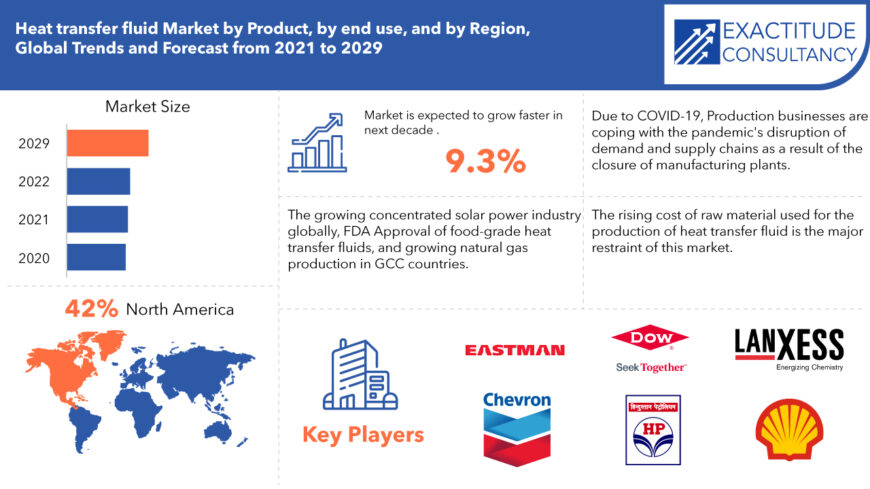
Le marché mondial des fluides de transfert de chaleur est estimé à 3,38 milliards USD en 2022 et devrait atteindre 6,88 milliards USD à un TCAC de 9,3 % d'ici 2029.
Les fluides caloporteurs sont des gaz ou des liquides produits spécifiquement dans le but de transférer la chaleur d'un système à un autre dans un circuit fermé en cycle continu. Les fluides caloporteurs sont utilisés dans d'innombrables applications et processus industriels nécessitant du chauffage ou du refroidissement , généralement dans un circuit fermé et dans des cycles continus. Le nombre croissant de centrales solaires à concentration et la demande croissante d'énergie propre stimulent la croissance du marché des fluides caloporteurs. En outre, les fluides caloporteurs trouvent des applications dans diverses industries d'utilisation finale comme la chimie, l'automobile, le pétrole et le gaz, les énergies renouvelables, l'alimentation et les boissons, le CVC et les industries pharmaceutiques. Les fluides caloporteurs sont des produits industriels dérivés de sources pétrolières qui sont utilisés pour éviter la surchauffe et pour le stockage de l'énergie thermique. Les matières premières de base impliquées dans la production sont le pétrole brut, la silice et les huiles de base. Les caractéristiques importantes qui définissent un fluide caloporteur sont une faible viscosité, une nature non corrosive, une conductivité thermique et une diffusivité élevées et des températures de transition de phase extrêmes. Les fluides caloporteurs (HTF) sont des gaz ou des liquides spécifiquement fabriqués dans le but de transmettre la chaleur d'un système à un autre. Ces fluides sont fabriqués à partir de pétrole hautement raffiné, d'hydrocarbures synthétiques ou de siloxanes ( silicone ). Ils permettent d'atteindre des températures élevées à des pressions système très basses et offrent également des avantages majeurs en termes de sécurité, de faible maintenance et de durée de vie prolongée. On estime que cela aura un impact ultérieur sur le marché des HTF.
| ATTRIBUT | DÉTAILS |
| Période d'étude | 2021-2029 |
| Année de base | 2021 |
| Année prévue | 2021-2029 |
| Unité | Valeur (milliards USD), (kilotonnes) |
| Segmentation | Par produit, par utilisation finale, par région |
| Par produit |
|
| Par utilisation finale |
|
| Par région |
|
Dans l'industrie pétrolière et gazière, les fluides caloporteurs sont utilisés dans les plates-formes offshore et les raffineries pour chauffer les installations et régénérer les glycols afin d'éliminer l'eau du gaz naturel produit et de chauffer les rebouilleurs et les colonnes pour la distillation du pétrole et des produits à base de pétrole. En 2022, en raison de la pandémie, la production de pétrole brut et de gaz naturel a été lente, en raison de la baisse de la consommation de pétrole, de gaz et de produits connexes. Par conséquent, en raison de ce facteur, la demande de fluides caloporteurs dans l'industrie pétrolière et de transformation a diminué, ce qui devrait affecter la croissance du marché dans un avenir proche.
À l’instar d’autres secteurs, le marché mondial des fluides de transfert de chaleur a également subi des changements en raison de la pandémie provoquée par le Covid-19. Dans le secteur chimique, le marché des fluides de transfert de chaleur a été morose en 2022 lorsque l’impact a provoqué un déclin majeur dans les industries de fabrication de produits chimiques. Le marché aux États-Unis et en Europe a également connu une baisse de la capacité de fabrication de produits chimiques , les usines ayant été fermées ou fonctionnant avec une main-d’œuvre limitée.
Pour récupérer les pertes causées par la pandémie, la plupart des fabricants ont limité leur budget dans le département R&D pour les restructurer afin de maintenir leur fonction fondamentale dans les différentes industries d'utilisation finale.
[caption id="attachment_11772" align="aligncenter" width="870"]
Frequently Asked Questions
• What is the growth rate of Heat Transfer Fluid market?
Chicory market is estimated grow at a rate of 9.3% CAGR till 2029 with an estimated value of USD 6.88 billion.
• What are the factors influencing Heat transfer fluids market?
The growth of this market can be attributed to growth of chemical & petrochemical processing, oil & gas and automotive industries.
• List the major players in this market?
The following is the list of the major market player of Heat transfer fluid market who fulfill the need of the industry with their proper segmentation and strategies; Eastman Chemical Company (US), The Dow Chemical Company (US), ExxonMobil (US), Chevron (US), Lanxess (Germany), Shell plc (Netherlands), Hindustan Petroleum Corporation Limited (India), Phillips 66 Company (US), Preterm (US), and Arkema (France).
• Which region witnesses to have lucrative market?
Amongst all the region which contain the Heat transfer fluid market the largest stake is held by North American region.
• Does the report provide details about Covid 19 impact?
HTF are used in various end use industries including of chemical & petrochemical processing, oil & gas and automotive industries. Due to the ongoing pandemic, these industries have been severely affected throughout the world. Manpower shortage, logistical restrictions, material unavailability, and other restrictions have slowed the growth of the industry in a considerable manner.
Heat Transfer Fluids Market Segment Analysis:
The HTF market is segmented by product, by end use industry and by region. The mineral oil segmented for the major share of HTF market in 2019. Mineral oil is considered to be inexpensive in comparison to other synthetic liquids as its initial cost is greater than the initial cost of mineral oil. There is seen to be loss in thermal fluid during the maintenance of thermal heater and it is expensive to replace the fluid back in the system. The regions of Asia Pacific and Middle east and Africa are the highest end user region but the usage is mainly on low-cost products.
The mineral oil segment accounted for the major share in 2019. Mineral oil is inexpensive in comparison to synthetic liquids as its initial cost is two to three times greater than the initial cost of mineral oil. There is loss of thermal fluid during the maintenance of a thermal heater, and it is expensive to replace the fluid back into the system. Even if the cost of replacing the fluid is higher, the cost of replacing mineral oil is much less than the cost associated with replacing a synthetic fluid. Furthermore, it is widely used in APAC and MEA regions where the focus is on the usage of low-cost products.
The End Use industry generally includes Chemical & Petrochemical, Oil & Gas, Automotive, Renewable Energy, Pharmaceutical and other, amongst these user, Chemical segment has accounted for the major heat transfer fluid market share. The increase in demand for chemical from automotive, energy and resource, construction, consumer goods and other has increased the production of chemicals. This factor has resulted in increase of demand for heat transfer fluids from chemical manufacturer for indirect heating of process liquids and polymers, pipeline tracing, energy recovering, dying and heating of bulk materials and gas processing and others.
Asia Pacific is a highly attractive market for HTFs. The rapid industrialization witnessed by the emerging economies in the region, especially in China and India, is creating a high demand for HTFs. Leading HTF manufacturers such as Dow, Indian Oil Corporation, Hindustan Petroleum Corporation Limited, and Dalian Rich Fortune Chemical Company are adopting marketing strategies such as product launches and developments to increase their share in the Asia Pacific HTF market. The renewable energy sector in India is likely to be one of the fast-growing segments in the HTF market in Asia Pacific.
The regional segment is dominated by Asia Pacific region.
[caption id="attachment_11773" align="alignleft" width="680"]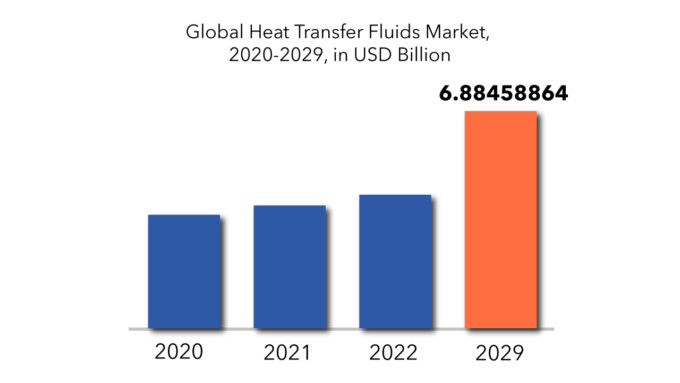
Heat Transfer Fluids Market Players:
Eastman Chemical Company (US), The Dow Chemical Company (US), ExxonMobil (US), Chevron (US), Lanxess (Germany), Shell plc (Netherlands), Hindustan Petroleum Corporation Limited (India), Phillips 66 Company (US), Preterm (US), and Arkema (France).
For corporate expansion, these key leaders are implementing strategic formulations such as new product development and commercialization, commercial expansion, and distribution agreements. Moreover, these participants are substantially spending in product development, which is fueling revenue generation.
Recent Developments July 18, 2022 -Eastman announced a planned increase of its Eastman Therminol® 66 heat transfer fluid manufacturing capacity in Anniston, Alabama. The plant expansion is expected to be complete in 2024 and will increase U.S.-based capacity by 50%.Who should buy? Or Key Stakeholders
- Investors
- Research Organizations
- Power Generation
- LPG blending
- Industrial
- Regulatory Authorities
- Others
Heat Transfer Fluids Market Regional Analysis:
- North America includes USA, Canada and Mexico
- South America includes Brazil
- Europe includes Germany, UK and Russia
- Middle East and Africa includes Saudi Arabia, South Africa and UAE
- Asia Pacific includes India, China, Japan, Australia, Thailand, Malaysia and South Korea
On the basis of geographies, the global market has been divided into North America, Asia Pacific, Europe, South America, and Middle East & Africa. The North America region accounted for the largest volume-based share of 42%. It is the dominant market with key macroeconomic indicators, such as high per capita income & manufacturing output, supporting the region’s growth.
Rapid industrialization coupled with the growing export of chemicals to NAFTA countries is expected to drive the demand for HTFs. The country also has a strong presence in the plastic manufacturing industry.
[caption id="attachment_11774" align="alignleft" width="680"]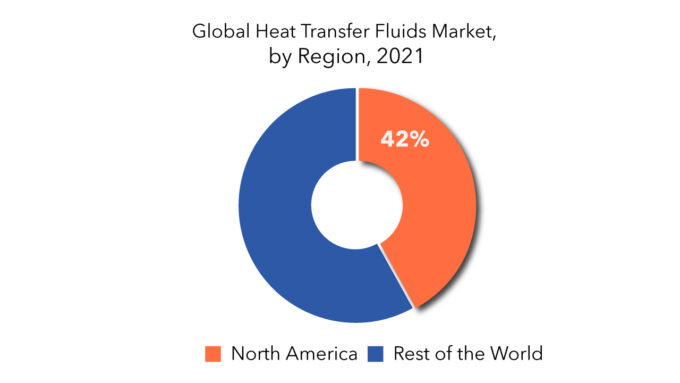
Key Market Segments: Heat Transfer Fluid Market Segment:
Heat Transfer Fluid Market by Product, 2023-2029 (USD Billions) (Kilotons)- Mineral Oils
- Synthetic Fluids
- Glycol-Based Fluids
- Other
- Chemical & Petrochemical
- Oil & Gas
- Automotive
- Renewable Energy
- Pharmaceutical
- Asia Pacific
- North America
- South America
- Europe
- Middle East and Africa
[video width="1920" height="1080" mp4="https://gwsdigital.com/exactitudeconsultancy/wp-content/uploads/2022/11/Heat-Transfer-Fluids-Market.mp4" poster="https://gwsdigital.com/exactitudeconsultancy/wp-content/uploads/2022/02/exactitude-1-3.jpg"][/video]
Key Questions Answered:
- What is the current size of Heat Transfer Fluid Market?
- What are the Key factors influencing the Growth of Heat Transfer Fluid Market?
- Who are Major Competitors in the Heat Transfer Fluid Market?
- What are the major applications of the Heat Transfer Fluid Products?
- Which Region is holding the largest share in the Heat Transfer Fluid Market?
- Introduction
- Définition du marché
- Segmentation du marché
- Chronologies de la recherche
- Hypothèses et limites
- Méthodologie de recherche
- Exploration de données
- Recherche secondaire
- Recherche primaire
- Conseils d'experts en la matière
- Contrôles de qualité
- Examen final
- Triangulation des données
- Approche ascendante
- Approche descendante
- Flux de recherche
- Sources de données
- Exploration de données
- Résumé exécutif
- Aperçu du marché
- Perspectives du marché des fluides caloporteurs
- Facteurs moteurs du marché
- Restrictions du marché
- Opportunités de marché
- Impact du Covid-19 sur le marché des fluides caloporteurs
- Analyse de la chaîne de valeur de l'industrie
- Perspectives du marché des fluides caloporteurs
- Marché des fluides de transfert de chaleur par produit, 2021-2029 (milliards USD) (kilotonnes)
- Huiles minérales
- Fluides synthétiques
- Fluides à base de glycol
- Autre
- Marché des fluides de transfert de chaleur par utilisation finale, 2021-2029 (milliards USD) (kilotonnes)
- Chimie et pétrochimie
- Pétrole et gaz
- Automobile
- Energie renouvelable
- Pharmaceutique
- Marché des fluides de transfert de chaleur par région, 2021-2029 (milliards USD)
- Asie-Pacifique
- Inde
- Chine
- Japon
- Malaisie
- Thaïlande
- Australie et
- Corée du Sud
- Amérique du Nord
- USA
- Canada et
- Mexique
- Amérique du Sud
- Brésil
- Europe
- Allemagne
- ROYAUME-UNI
- Russie
- Moyen-Orient et Afrique
- Arabie Saoudite
- Afrique du Sud et
- Émirats arabes unis
- Asie-Pacifique
- Profils d'entreprise* (présentation de l'entreprise, aperçu de l'entreprise, produits offerts, développements récents)
- Eastman Chemical Company (États-Unis)
- La société Dow Chemical (États-Unis)
- ExxonMobil (États-Unis)
- Chevron (États-Unis)
- Lanxess (Allemagne),
- Shell plc (Pays-Bas)
- Hindustan Petroleum Corporation Limited (Inde)
- Société Phillips 66 (États-Unis)
- Prématuré (États-Unis)
- Arkema (RUSSIE)
LISTE DES TABLEAUX :
TABLE 1 GLOBAL HEAT TRANSFER FLUIDS MARKET BY PRODUCT (USD MILLIONS) 2020-2029
TABLE 2 GLOBAL HEAT TRANSFER FLUIDS MARKET BY PRODUCT (KILOTONS) 2020-2029
TABLE 3 GLOBAL HEAT TRANSFER FLUIDS MARKET BY END USER (USD MILLIONS) 2020-2029
TABLE 4 GLOBAL HEAT TRANSFER FLUIDS MARKET BY END USER (KILOTONS) 2020-2029
TABLE 5 GLOBAL HEAT TRANSFER FLUIDS MARKET BY REGION (USD MILLIONS) 2020-2029
TABLE 6 GLOBAL HEAT TRANSFER FLUIDS MARKET BY REGION (KILOTONS) 2020-2029
TABLE 7 US HEAT TRANSFER FLUIDS MARKET BY PRODUCT (USD MILLIONS) 2020-2029
TABLE 8 US HEAT TRANSFER FLUIDS MARKET BY PRODUCT (KILOTONS) 2020-2029
TABLE 9 US HEAT TRANSFER FLUIDS MARKET BY END USER (USD MILLIONS) 2020-2029
TABLE 10 US HEAT TRANSFER FLUIDS MARKET BY END USER (KILOTONS) 2020-2029
TABLE 11 CANADA HEAT TRANSFER FLUIDS MARKET BY PRODUCT (USD MILLIONS) 2020-2029
TABLE 12 CANADA HEAT TRANSFER FLUIDS MARKET BY PRODUCT (KILOTONS) 2020-2029
TABLE 13 CANADA HEAT TRANSFER FLUIDS MARKET BY END USER (USD MILLIONS) 2020-2029
TABLE 14 CANADA HEAT TRANSFER FLUIDS MARKET BY END USER (KILOTONS) 2020-2029
TABLE 15 MEXICO HEAT TRANSFER FLUIDS MARKET BY PRODUCT (USD MILLIONS) 2020-2029
TABLE 16 MEXICO HEAT TRANSFER FLUIDS MARKET BY PRODUCT (KILOTONS) 2020-2029
TABLE 17 MEXICO HEAT TRANSFER FLUIDS MARKET BY END USER (USD MILLIONS) 2020-2029
TABLE 18 MEXICO HEAT TRANSFER FLUIDS MARKET BY END USER (KILOTONS) 2020-2029
TABLE 19 BRAZIL HEAT TRANSFER FLUIDS MARKET BY PRODUCT (USD MILLIONS) 2020-2029
TABLE 20 BRAZIL HEAT TRANSFER FLUIDS MARKET BY PRODUCT (KILOTONS) 2020-2029
TABLE 21 BRAZIL HEAT TRANSFER FLUIDS MARKET BY END USER (USD MILLIONS) 2020-2029
TABLE 22 BRAZIL HEAT TRANSFER FLUIDS MARKET BY END USER (KILOTONS) 2020-2029
TABLE 23 ARGENTINA HEAT TRANSFER FLUIDS MARKET BY PRODUCT (USD MILLIONS) 2020-2029
TABLE 24 ARGENTINA HEAT TRANSFER FLUIDS MARKET BY PRODUCT (KILOTONS) 2020-2029
TABLE 25 ARGENTINA HEAT TRANSFER FLUIDS MARKET BY END USER (USD MILLIONS) 2020-2029
TABLE 26 ARGENTINA HEAT TRANSFER FLUIDS MARKET BY END USER (KILOTONS) 2020-2029
TABLE 27 COLOMBIA HEAT TRANSFER FLUIDS MARKET BY PRODUCT (USD MILLIONS) 2020-2029
TABLE 28 COLOMBIA HEAT TRANSFER FLUIDS MARKET BY PRODUCT (KILOTONS) 2020-2029
TABLE 29 COLOMBIA HEAT TRANSFER FLUIDS MARKET BY END USER (USD MILLIONS) 2020-2029
TABLE 30 COLOMBIA HEAT TRANSFER FLUIDS MARKET BY END USER (KILOTONS) 2020-2029
TABLE 31 REST OF SOUTH AMERICA HEAT TRANSFER FLUIDS MARKET BY PRODUCT (USD MILLIONS) 2020-2029
TABLE 32 REST OF SOUTH AMERICA HEAT TRANSFER FLUIDS MARKET BY PRODUCT (KILOTONS) 2020-2029
TABLE 33 REST OF SOUTH AMERICA HEAT TRANSFER FLUIDS MARKET BY END USER (USD MILLIONS) 2020-2029
TABLE 34 REST OF SOUTH AMERICA HEAT TRANSFER FLUIDS MARKET BY END USER (KILOTONS) 2020-2029
TABLE 35 INDIA HEAT TRANSFER FLUIDS MARKET BY PRODUCT (USD MILLIONS) 2020-2029
TABLE 36 INDIA HEAT TRANSFER FLUIDS MARKET BY PRODUCT (KILOTONS) 2020-2029
TABLE 37 INDIA HEAT TRANSFER FLUIDS MARKET BY END USER (USD MILLIONS) 2020-2029
TABLE 38 INDIA HEAT TRANSFER FLUIDS MARKET BY END USER (KILOTONS) 2020-2029
TABLE 39 CHINA HEAT TRANSFER FLUIDS MARKET BY PRODUCT (USD MILLIONS) 2020-2029
TABLE 40 CHINA HEAT TRANSFER FLUIDS MARKET BY PRODUCT (KILOTONS) 2020-2029
TABLE 41 CHINA HEAT TRANSFER FLUIDS MARKET BY END USER (USD MILLIONS) 2020-2029
TABLE 42 CHINA HEAT TRANSFER FLUIDS MARKET BY END USER (KILOTONS) 2020-2029
TABLE 43 JAPAN HEAT TRANSFER FLUIDS MARKET BY PRODUCT (USD MILLIONS) 2020-2029
TABLE 44 JAPAN HEAT TRANSFER FLUIDS MARKET BY PRODUCT (KILOTONS) 2020-2029
TABLE 45 JAPAN HEAT TRANSFER FLUIDS MARKET BY END USER (USD MILLIONS) 2020-2029
TABLE 46 JAPAN HEAT TRANSFER FLUIDS MARKET BY END USER (KILOTONS) 2020-2029
TABLE 47 SOUTH KOREA HEAT TRANSFER FLUIDS MARKET BY PRODUCT (USD MILLIONS) 2020-2029
TABLE 48 SOUTH KOREA HEAT TRANSFER FLUIDS MARKET BY PRODUCT (KILOTONS) 2020-2029
TABLE 49 SOUTH KOREA HEAT TRANSFER FLUIDS MARKET BY END USER (USD MILLIONS) 2020-2029
TABLE 50 SOUTH KOREA HEAT TRANSFER FLUIDS MARKET BY END USER (KILOTONS) 2020-2029
TABLE 51 AUSTRALIA HEAT TRANSFER FLUIDS MARKET BY PRODUCT (USD MILLIONS) 2020-2029
TABLE 52 AUSTRALIA HEAT TRANSFER FLUIDS MARKET BY PRODUCT (KILOTONS) 2020-2029
TABLE 53 AUSTRALIA HEAT TRANSFER FLUIDS MARKET BY END USER (USD MILLIONS) 2020-2029
TABLE 54 AUSTRALIA HEAT TRANSFER FLUIDS MARKET BY END USER (KILOTONS) 2020-2029
TABLE 55 SOUTH-EAST ASIA HEAT TRANSFER FLUIDS MARKET BY PRODUCT (USD MILLIONS) 2020-2029
TABLE 56 SOUTH-EAST ASIA HEAT TRANSFER FLUIDS MARKET BY PRODUCT (KILOTONS) 2020-2029
TABLE 57 SOUTH-EAST ASIA HEAT TRANSFER FLUIDS MARKET BY END USER (USD MILLIONS) 2020-2029
TABLE 58 SOUTH-EAST ASIA HEAT TRANSFER FLUIDS MARKET BY END USER (KILOTONS) 2020-2029
TABLE 59 REST OF ASIA PACIFIC HEAT TRANSFER FLUIDS MARKET BY PRODUCT (USD MILLIONS) 2020-2029
TABLE 60 REST OF ASIA PACIFIC HEAT TRANSFER FLUIDS MARKET BY PRODUCT (KILOTONS) 2020-2029
TABLE 61 REST OF ASIA PACIFIC HEAT TRANSFER FLUIDS MARKET BY END USER (USD MILLIONS) 2020-2029
TABLE 62 REST OF ASIA PACIFIC HEAT TRANSFER FLUIDS MARKET BY END USER (KILOTONS) 2020-2029
TABLE 63 GERMANY HEAT TRANSFER FLUIDS MARKET BY PRODUCT (USD MILLIONS) 2020-2029
TABLE 64 GERMANY HEAT TRANSFER FLUIDS MARKET BY PRODUCT (KILOTONS) 2020-2029
TABLE 65 GERMANY HEAT TRANSFER FLUIDS MARKET BY END USER (USD MILLIONS) 2020-2029
TABLE 66 GERMANY HEAT TRANSFER FLUIDS MARKET BY END USER (KILOTONS) 2020-2029
TABLE 67 UK HEAT TRANSFER FLUIDS MARKET BY PRODUCT (USD MILLIONS) 2020-2029
TABLE 68 UK HEAT TRANSFER FLUIDS MARKET BY PRODUCT (KILOTONS) 2020-2029
TABLE 69 UK HEAT TRANSFER FLUIDS MARKET BY END USER (USD MILLIONS) 2020-2029
TABLE 70 UK HEAT TRANSFER FLUIDS MARKET BY END USER (KILOTONS) 2020-2029
TABLE 71 FRANCE HEAT TRANSFER FLUIDS MARKET BY PRODUCT (USD MILLIONS) 2020-2029
TABLE 72 FRANCE HEAT TRANSFER FLUIDS MARKET BY PRODUCT (KILOTONS) 2020-2029
TABLE 73 FRANCE HEAT TRANSFER FLUIDS MARKET BY END USER (USD MILLIONS) 2020-2029
TABLE 74 FRANCE HEAT TRANSFER FLUIDS MARKET BY END USER (KILOTONS) 2020-2029
TABLE 75 ITALY HEAT TRANSFER FLUIDS MARKET BY PRODUCT (USD MILLIONS) 2020-2029
TABLE 76 ITALY HEAT TRANSFER FLUIDS MARKET BY PRODUCT (KILOTONS) 2020-2029
TABLE 77 ITALY HEAT TRANSFER FLUIDS MARKET BY END USER (USD MILLIONS) 2020-2029
TABLE 78 ITALY HEAT TRANSFER FLUIDS MARKET BY END USER (KILOTONS) 2020-2029
TABLE 79 SPAIN HEAT TRANSFER FLUIDS MARKET BY PRODUCT (USD MILLIONS) 2020-2029
TABLE 80 SPAIN HEAT TRANSFER FLUIDS MARKET BY PRODUCT (KILOTONS) 2020-2029
TABLE 81 SPAIN HEAT TRANSFER FLUIDS MARKET BY END USER (USD MILLIONS) 2020-2029
TABLE 82 SPAIN HEAT TRANSFER FLUIDS MARKET BY END USER (KILOTONS) 2020-2029
TABLE 83 RUSSIA HEAT TRANSFER FLUIDS MARKET BY PRODUCT (USD MILLIONS) 2020-2029
TABLE 84 RUSSIA HEAT TRANSFER FLUIDS MARKET BY PRODUCT (KILOTONS) 2020-2029
TABLE 85 RUSSIA HEAT TRANSFER FLUIDS MARKET BY END USER (USD MILLIONS) 2020-2029
TABLE 86 RUSSIA HEAT TRANSFER FLUIDS MARKET BY END USER (KILOTONS) 2020-2029
TABLE 87 REST OF EUROPE HEAT TRANSFER FLUIDS MARKET BY PRODUCT (USD MILLIONS) 2020-2029
TABLE 88 REST OF EUROPE HEAT TRANSFER FLUIDS MARKET BY PRODUCT (KILOTONS) 2020-2029
TABLE 89 REST OF EUROPE HEAT TRANSFER FLUIDS MARKET BY END USER (USD MILLIONS) 2020-2029
TABLE 90 REST OF EUROPE HEAT TRANSFER FLUIDS MARKET BY END USER (KILOTONS) 2020-2029
TABLE 91 UAE HEAT TRANSFER FLUIDS MARKET BY PRODUCT (USD MILLIONS) 2020-2029
TABLE 92 UAE HEAT TRANSFER FLUIDS MARKET BY PRODUCT (KILOTONS) 2020-2029
TABLE 93 UAE HEAT TRANSFER FLUIDS MARKET BY END USER (USD MILLIONS) 2020-2029
TABLE 94 UAE HEAT TRANSFER FLUIDS MARKET BY END USER (KILOTONS) 2020-2029
TABLE 95 SAUDI ARABIA HEAT TRANSFER FLUIDS MARKET BY PRODUCT (USD MILLIONS) 2020-2029
TABLE 96 SAUDI ARABIA HEAT TRANSFER FLUIDS MARKET BY PRODUCT (KILOTONS) 2020-2029
TABLE 97 SAUDI ARABIA HEAT TRANSFER FLUIDS MARKET BY END USER (USD MILLIONS) 2020-2029
TABLE 98 SAUDI ARABIA HEAT TRANSFER FLUIDS MARKET BY END USER (KILOTONS) 2020-2029
TABLE 99 SOUTH AFRICA HEAT TRANSFER FLUIDS MARKET BY PRODUCT (USD MILLIONS) 2020-2029
TABLE 100 SOUTH AFRICA HEAT TRANSFER FLUIDS MARKET BY PRODUCT (KILOTONS) 2020-2029
TABLE 101 SOUTH AFRICA HEAT TRANSFER FLUIDS MARKET BY END USER (USD MILLIONS) 2020-2029
TABLE 102 SOUTH AFRICA HEAT TRANSFER FLUIDS MARKET BY END USER (KILOTONS) 2020-2029
TABLE 103 REST OF MIDDLE EAST AND AFRICA HEAT TRANSFER FLUIDS MARKET BY PRODUCT (USD MILLIONS) 2020-2029
TABLE 104 REST OF MIDDLE EAST AND AFRICA HEAT TRANSFER FLUIDS MARKET BY PRODUCT (KILOTONS) 2020-2029
TABLE 105 REST OF MIDDLE EAST AND AFRICA HEAT TRANSFER FLUIDS MARKET BY END USER (USD MILLIONS) 2020-2029
TABLE 106 REST OF MIDDLE EAST AND AFRICA HEAT TRANSFER FLUIDS MARKET BY END USER (KILOTONS) 2020-2029
LIST OF FIGURES
FIGURE 1 MARKET DYNAMICS
FIGURE 2 MARKET SEGMENTATION
FIGURE 3 REPORT TIMELINES: YEARS CONSIDERED
FIGURE 4 DATA TRIANGULATION
FIGURE 5 BOTTOM-UP APPROACH
FIGURE 6 TOP-DOWN APPROACH
FIGURE 7 RESEARCH FLOW
FIGURE 8 GLOBAL HEAT TRANSFER FLUID MARKET BY PRODUCT, USD MILLION, 2021-
2029
FIGURE 9 GLOBAL HEAT TRANSFER FLUID MARKET BY END USE, USD MILLION, 2021-
2029
FIGURE 10 GLOBAL HEAT TRANSFER FLUID MARKET BY REGION, USD MILLION, 2021-2029
FIGURE 11 PORTER’S FIVE FORCES MODEL
FIGURE 12 NORTH AMERICA HEAT TRANSFER FLUID MARKET SNAPSHOT
FIGURE 13 EUROPE HEAT TRANSFER FLUID MARKET SNAPSHOT
FIGURE 14 SOUTH AMERICA HEAT TRANSFER FLUID MARKET SNAPSHOT
FIGURE 15 ASIA PACIFIC HEAT TRANSFER FLUID MARKET SNAPSHOT
FIGURE 16 MIDDLE EAST ASIA AND AFRICA HEAT TRANSFER FLUID MARKET SNAPSHOT
FIGURE 17 MARKET SHARE ANALYSIS
FIGURE 18 EASTMAN CHEMICAL COMPANY.: COMPANY SNAPSHOT
FIGURE 19 THE DOW CHEMICAL COMPANY: COMPANY SNAPSHOT
FIGURE 20 EXXON MOBIL: COMPANY SNAPSHOT
FIGURE 21 CHEVRON.: COMPANY SNAPSHOT
FIGURE 22 LANXESS COMPANY SNAPSHOT
FIGURE 23 SHELL PLC.: COMPANY SNAPSHOT
FIGURE 24 HINDUSTAN PETROLEUM CORPORATION LIMITED: COMPANY SNAPSHOT
FIGURE 25 PHILLIPS 66 COMPANY: COMPANY SNAPSHOT
FIGURE 26 PRETERM: COMPANY SNAPSHOT
FIGURE 27 ARKEMA: COMPANY SNAPSHOT
DOWNLOAD FREE SAMPLE REPORT
License Type
SPEAK WITH OUR ANALYST
Want to know more about the report or any specific requirement?
WANT TO CUSTOMIZE THE REPORT?
Our Clients Speak
We asked them to research ‘ Equipment market’ all over the world, and their whole arrangement was helpful to us. thehealthanalytics.com insightful analysis and reports contributed to our current analysis and in creating a future strategy. Besides, the te
Yosuke Mitsui
Senior Associate Construction Equipment Sales & Marketing
We asked them to research ‘Equipment market’ all over the world, and their whole arrangement was helpful to us. thehealthanalytics.com insightful analysis and reports contributed to our current analysis and in creating a future strategy. Besides, the te