

Base Year Value ()
x.x %
x.x %
CAGR ()
x.x %
x.x %
Forecast Year Value ()
x.x %
x.x %
Historical Data Period
Largest Region
Forecast Period
Marché du cuir synthétique (cuir artificiel) par type (PU, PVC, biosourcé), par application (ameublement, automobile, chaussures, portefeuilles, sacs et sacs à main, vêtements, autres) et par région, tendances mondiales et prévisions de 2022 à 2029
Instant access to hundreds of data points and trends
- Market estimates from 2014-2029
- Competitive analysis, industry segmentation, financial benchmarks
- Incorporates SWOT, Porter's Five Forces and risk management frameworks
- PDF report or online database with Word, Excel and PowerPoint export options
- 100% money back guarantee
Aperçu du marché du cuir synthétique (cuir artificiel)
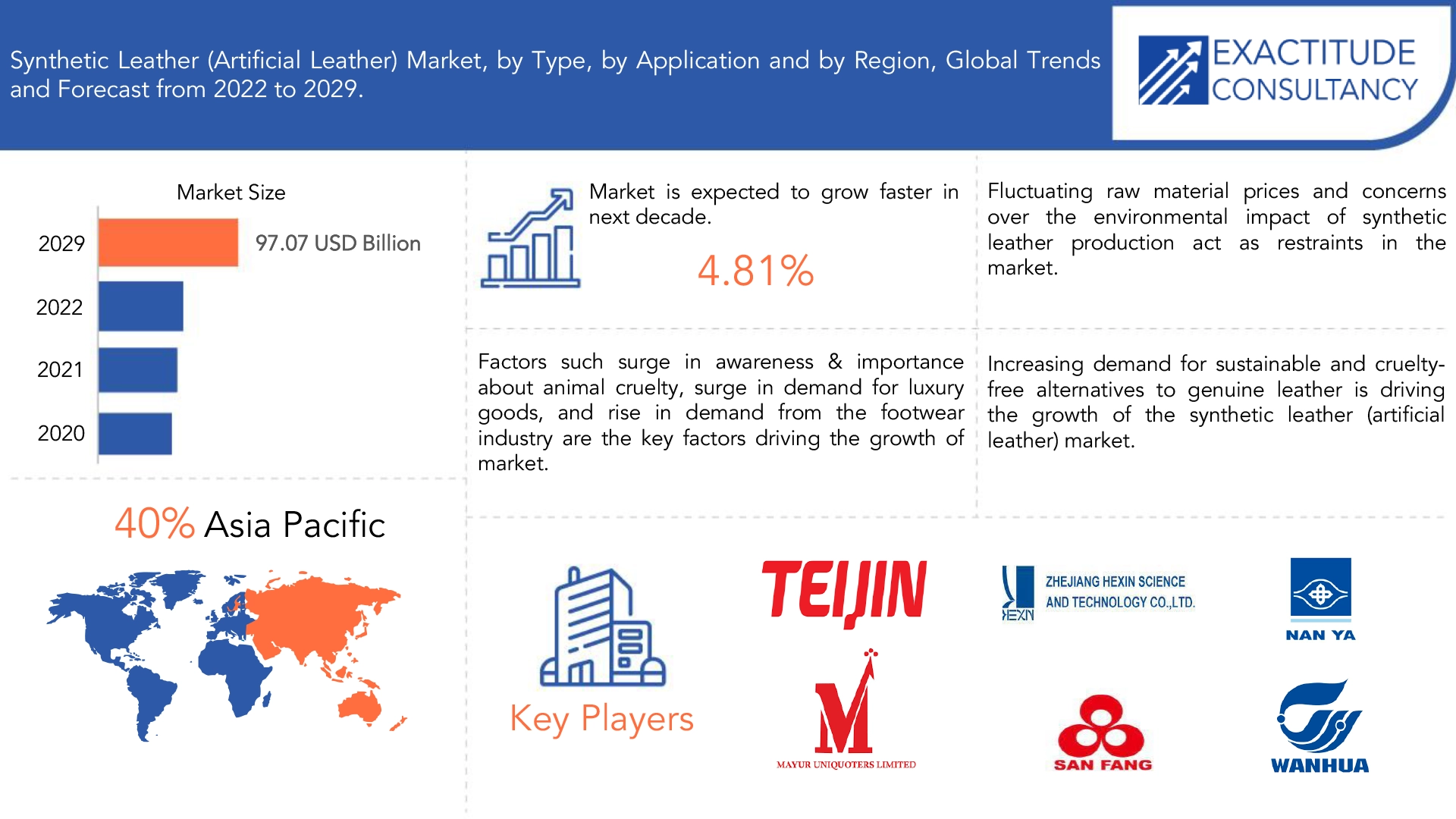
Le marché du cuir synthétique (cuir artificiel) devrait croître à un TCAC de 4,81 % entre 2022 et 2029. Il devrait atteindre plus de 97,07 milliards USD d'ici 2029, contre 63,6 milliards USD en 2020.
Le cuir synthétique, communément appelé similicuir, présente des qualités de pointe, notamment un entretien facile, une résistance aux UV, une grande solidité, une plus grande ductilité et une finition très brillante. Le prix des produits créés à partir de cuir synthétique est comparable à celui du cuir naturel. En raison de la teinture et des traitements supplémentaires, le cuir synthétique ressemble au cuir naturel. Le polyuréthane ou le chlorure de polyvinyle sont utilisés dans sa fabrication.
La croissance du marché mondial du cuir synthétique est principalement due à des facteurs tels que la sensibilisation accrue et l'importance accordée à la cruauté envers les animaux, le développement du secteur du commerce électronique , l'augmentation du revenu disponible, l'augmentation de la demande de produits de luxe, la sensibilisation accrue aux avantages du cuir synthétique par rapport au cuir naturel et l'augmentation de la demande de l'industrie de la chaussure. L'expansion du marché est entravée par les droits d'importation et les taxes élevés ainsi que par les conséquences négatives du PVC. D'autre part, il est prévu que les acteurs du marché bénéficieront de l'accent accru mis sur le développement du cuir biosourcé.
Le cuir naturel provient d'animaux tués, ce qui implique de la cruauté envers les animaux. Pour défendre les droits des animaux, de nombreux gouvernements ont adopté de nombreuses lois et réglementations. Les restrictions légales sur les droits des animaux constituent désormais un obstacle majeur pour ceux qui fabriquent du cuir naturel. La demande de substituts du cuir a augmenté en raison de la sensibilisation croissante du public à la souffrance animale, qui a été alimentée par des initiatives soutenues par des groupes comme PETA. En raison d'une inadéquation croissante entre l'offre et la demande sur le marché du cuir véritable, les fabricants se tournent de plus en plus vers le cuir synthétique.
[caption id="attachment_27741" align="aligncenter" width="1920"]
The cheaper cost of production for synthetic leather is a crucial factor driving its uptake. Compared to natural leather, synthetic leather is less expensive and easier to manufacture. As a result, investments in synthetic leather have increased, helping the product gain traction in the market. Activities used in the production of natural leather, notably tanning, harm the environment. Cost is another important element influencing the shift in demand for synthetic leather. Government rules and environmental legislation have contributed to the rise in popularity of synthetic leather.
Among other basic materials for synthetic leather, polyvinyl chloride and polyurethane are harmful to the environment, animal health, and human health. Real asthma attacks can be brought on by polyurethane isocyanate irritation of the lungs. Breathing becomes more difficult since it affects the epidermis. In polyurethane production plants, workers frequently breathe in polyurethane fumes, which can make them queasy, sick, and dizzy.
The production procedure for bio-based imitation leather doesn't have any negative effects on the environment. The primary focus of producers should be synthetic leather made from natural fibers like flax or cotton combined with corn, palm or soybean, among others. In reality, the production of "Pinatex," a revolutionary synthetic leather product, uses pineapple fruit leaves. The elastic and sturdy fiber in these pineapple leaves makes them ideal for use in the manufacturing process.
A surge in shipment and demand for products amid the current COVID-19 epidemic is expected to enhance synthetic leather import and export. Since the reopening of nation borders is assisting in resolving logistical and transportation challenges due to strict standards being followed during the transit of raw materials, manufacturers in the synthetic leather market are taking advantage of this opportunity. Manufacturers are utilizing sales channels through eCommerce and online shopping applications to improve product adoption due to customers' purchasing power has declined as a result of the global economic recession. They are doing contingency planning in order to prevent disruptions in client demand, material supply, and the availability of logistics services.
| ATTRIBUTE | DETAILS |
| Study period | 2020-2029 |
| Base year | 2021 |
| Estimated year | 2022 |
| Forecasted year | 2022-2029 |
| Historical period | 2018-2020 |
| Unit | Value (USD Billion), (Million Meter). |
| Segmentation | By Type, By Application, By Region. |
| By Type |
|
| By Application |
|
| By Region |
|
Frequently Asked Questions
• What is the worth of synthetic leather (artificial leather) market?
The synthetic leather (artificial leather) market is expected to grow at 4.81 % CAGR from 2022 to 2029. It is expected to reach above USD 97.07 billion by 2029 from USD 63.6 billion in 2020.
• What is the size of the Asia Pacific synthetic leather (artificial leather) industry?
Asia Pacific held more than 40% of the synthetic leather (artificial leather) market revenue share in 2021 and will witness expansion in the forecast period.
• What are some of the market's driving forces?
The growth of the global synthetic leather market is primarily being driven by factors including an increase in awareness of and importance placed on animal cruelty, the development of the e-commerce industry, an increase in disposable income, an increase in demand for luxury goods, an increase in awareness of the advantages of synthetic leather over natural leather, and an increase in demand from the footwear industry.
• Which are the top companies to hold the market share in synthetic leather (artificial leather) market?
The synthetic leather (artificial leather) market key players includes Kuraray Co. Ltd, R. Polycoats Pvt. Ltd, Alfatex Italia SRL, Filwel Co. Ltd, Yantai Wanhua Synthetic Leather Group Co. Ltd, San Fang Chemical Industry Co. Ltd, Mayur Uniquoters Limited, Nan Ya Plastics Corporation, Zhejiang Hexin Industry Group Co. Ltd, Teijin Limited.
• What is the leading application of synthetic leather (artificial leather) market?
More than 30.0% of global revenue in 2021 came from the market's largest category, footwear. Its use is edging closer towards that of genuine leather, which is replacing its use in handbags, briefcases, car interiors, and clothes. The demand for footwear has increased as a result of rising income levels and economic expansion, particularly in emerging economies.
• Which is the largest regional market for synthetic leather (artificial leather) market?
Asia Pacific is the largest regional market for synthetic leather (artificial leather) market.
Synthetic Leather (Artificial Leather) Market Segment Analysis
The synthetic leather (artificial leather) market is segmented based on type and application.In 2021, the PU synthetic leather category dominated the market and accounted for more than 55.0% of total sales. In terms of product quality, diversity, and yield, it has been experiencing encouraging growth. In comparison to real skins, polyurethane is more easily damaged and dry cleaned while also being waterproof, softer, and lighter. Additionally, sunshine has no impact on it.
More than 30.0% of global revenue in 2021 came from the market's largest category, footwear. Its use is edging closer towards that of genuine leather, which is replacing its use in handbags, briefcases, car interiors, and clothes. The demand for footwear has increased as a result of rising income levels and economic expansion, particularly in emerging economies.
[caption id="attachment_27769" align="aligncenter" width="1920"]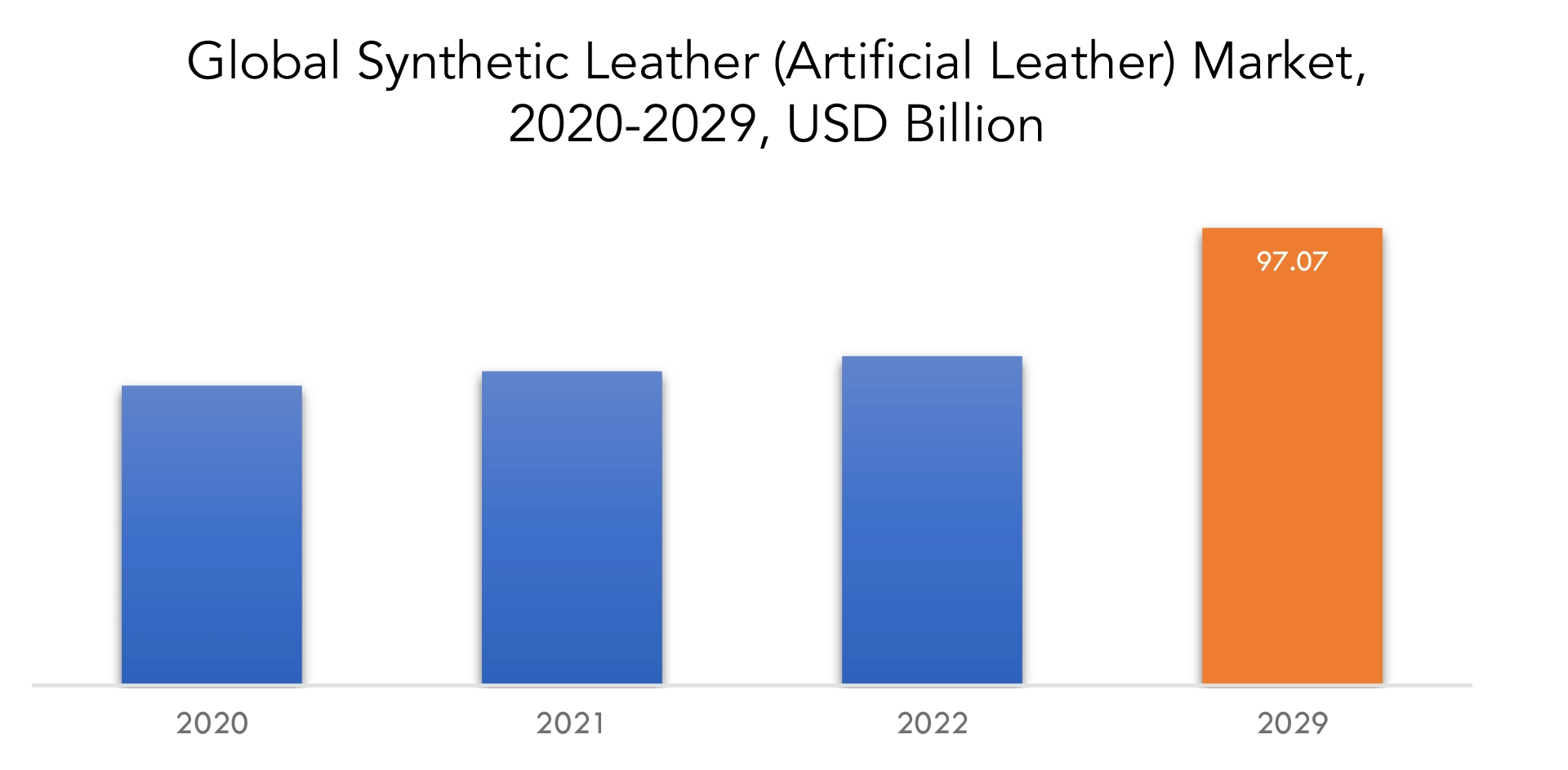
Synthetic Leather (Artificial Leather) Market Player
The synthetic leather (artificial leather) market key players includes Kuraray Co. Ltd, R. Polycoats Pvt. Ltd, Alfatex Italia SRL, Filwel Co. Ltd, Yantai Wanhua Synthetic Leather Group Co. Ltd, San Fang Chemical Industry Co. Ltd, Mayur Uniquoters Limited, Nan Ya Plastics Corporation, Zhejiang Hexin Industry Group Co. Ltd, Teijin Limited. Recent developments: 08 June 2023: Teijin Frontier Co., Ltd., the Teijin Group’s fibers and products converting company, announced the development of SOLOTEX® LIBERTE, a new functional fabric for sportswear and casual wear. SOLOTEX® LIBERTE fabric features a unique span-like texture and exceptional stretchability, as well as excellent colorability, luster and natural swelling. This innovative fabric combines comfort with sustainability, thanks to its incorporation of plant-derived raw materials. 26 April 2023: teijin automotive technologies supplied key exterior components on new lotus Emira.Who Should Buy? Or Key Stakeholders
- Manufacturers
- End-Use Industries
- Suppliers of Raw Materials
- Retailers
- Consumers
- Fashion Designers and Stylists
- Regulatory Authorities
- Industry Associations and Trade Organizations
- Environmental and Sustainability Advocates
- Waste Management and Recycling Companies
- Others
Synthetic Leather (Artificial Leather) Market Regional Analysis
The synthetic leather (artificial leather) market by region includes North America, Asia-Pacific (APAC), Europe, South America, and Middle East & Africa (MEA).
- North America: includes the US, Canada, Mexico
- Asia Pacific: includes China, Japan, South Korea, India, Australia, ASEAN and Rest of APAC
- Europe: includes UK, Germany, France, Italy, Spain, Russia, and Rest of Europe
- South America: includes Brazil, Argentina and Rest of South America
- Middle East & Africa: includes Turkey, UAE, Saudi Arabia, South Africa, and Rest of MEA
In 2021, the Asia Pacific region dominated the market and generated more than 40.0% of global revenue. The three main economies in APAC likely to drive growth are China, India, and South Korea. The market will have plenty of chances as a result of rising disposable income and population growth. When it comes to sales and production, China is one of the major markets for leather. The country's manufacturing production, however, has been negatively impacted by the coronavirus outbreak. To stop the virus from spreading, several manufacturers have either shut down or reduced their production.
Due to the saturation of more well-known domestic fashion companies, the market in North America is anticipated to expand slowly. There have been growth restrictions in the leather sector as a result of growing concerns from animal rights organisations like PETA, WWF, and a few others. As a result, there has been an increase in demand for synthetic leather products in the area. Due to the thriving automobile and consumer appliance industries throughout the continent, the European market experienced significant growth. Governments in the area are concentrating on bio-based, affordable, and durable products in the midst of the global economic crisis.
[caption id="attachment_27771" align="aligncenter" width="1920"]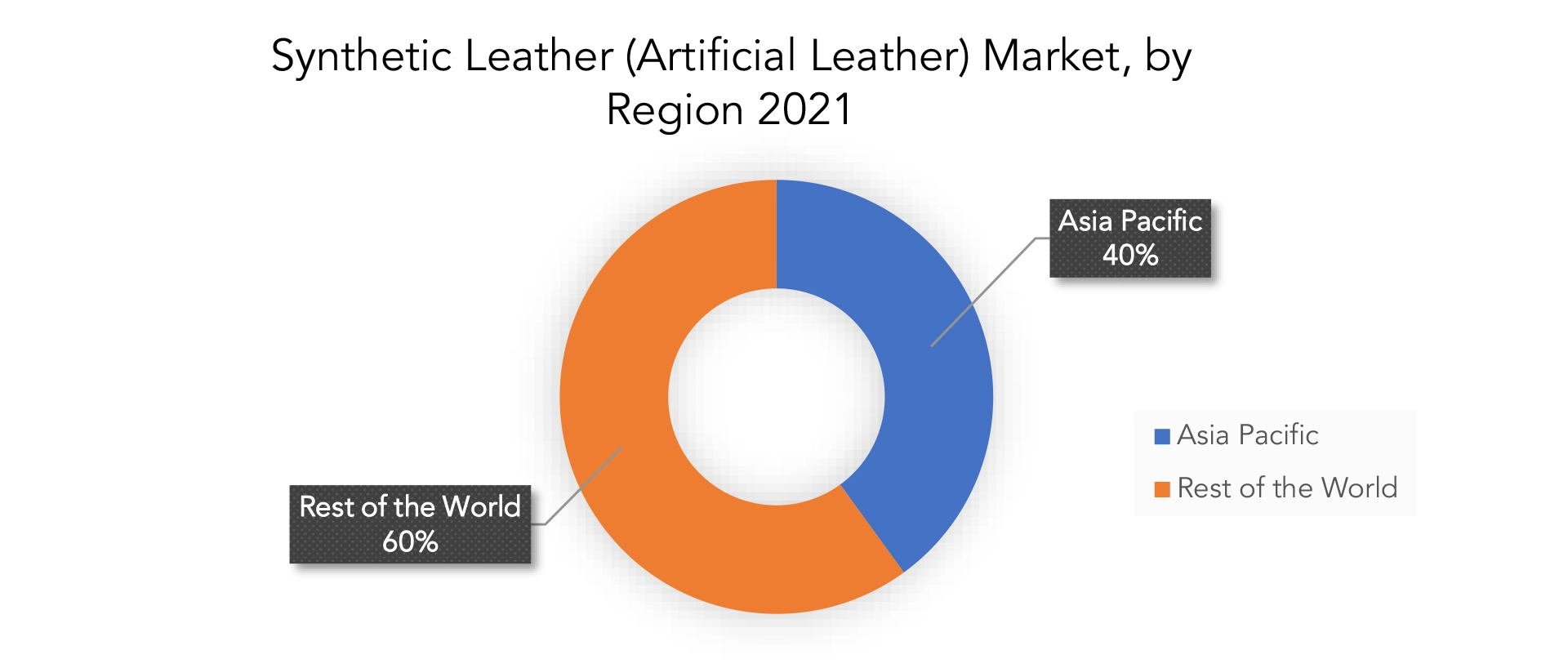
Key Market Segments: Synthetic Leather (Artificial Leather) Market
Synthetic Leather (Artificial Leather) Market by Type, 2020-2029, (USD Billion), (Million Meter).- PU
- PVC
- Bio Based
- Furnishing
- Automotive
- Footwear
- Wallets Bags & Purses
- Clothing
- Others
- North America
- Asia Pacific
- Europe
- South America
- Middle East and Africa
Exactitude Consultancy Services Key Objectives
- Increasing sales and market share
- Developing new technology
- Improving profitability
- Entering new markets
- Enhancing brand reputation
Key Question Answered
- What is the expected growth rate of the synthetic leather (artificial leather) market over the next 7 years?
- Who are the major players in the synthetic leather (artificial leather) market and what is their market share?
- What are the end-user industries driving demand for market and what is their outlook?
- What are the opportunities for growth in emerging markets such as Asia-Pacific, Middle East, and Africa?
- How is the economic environment affecting the synthetic leather (artificial leather) market, including factors such as interest rates, inflation, and exchange rates?
- What is the expected impact of government policies and regulations on the synthetic leather (artificial leather) market?
- What is the current and forecasted size and growth rate of the global synthetic leather (artificial leather) market?
- What are the key drivers of growth in the synthetic leather (artificial leather) market?
- What are the distribution channels and supply chain dynamics in the synthetic leather (artificial leather) market?
- What are the technological advancements and innovations in the synthetic leather (artificial leather) market and their impact on material development and growth?
- What are the regulatory considerations and their impact on the market?
- What are the challenges faced by players in the synthetic leather (artificial leather) market and how are they addressing these challenges?
- What are the opportunities for growth and expansion in the synthetic leather (artificial leather) market?
- What are the products offerings and specifications of leading players in the market?
- What is the pricing trend of synthetic leather (artificial leather) in the market and what is the impact of raw application prices on the price trend?
- INTRODUCTION
- MARKET DEFINITION
- MARKET SEGMENTATION
- RESEARCH TIMELINES
- ASSUMPTIONS AND LIMITATIONS
- RESEARCH METHODOLOGY
- DATA MINING
- SECONDARY RESEARCH
- PRIMARY RESEARCH
- SUBJECT-MATTER EXPERTS’ ADVICE
- QUALITY CHECKS
- FINAL REVIEW
- DATA TRIANGULATION
- BOTTOM-UP APPROACH
- TOP-DOWN APPROACH
- RESEARCH FLOW
- DATA SOURCES
- DATA MINING
- EXECUTIVE SUMMARY
- MARKET OVERVIEW
- GLOBAL SYNTHETIC LEATHER (ARTIFICIAL LEATHER) MARKET OUTLOOK
- MARKET DRIVERS
- MARKET RESTRAINTS
- MARKET OPPORTUNITIES
- IMPACT OF COVID-19 ON SYNTHETIC LEATHER (ARTIFICIAL LEATHER) MARKET
- PORTER’S FIVE FORCES MODEL
- THREAT FROM NEW ENTRANTS
- THREAT FROM SUBSTITUTES
- BARGAINING POWER OF SUPPLIERS
- BARGAINING POWER OF CUSTOMERS
- DEGREE OF COMPETITION
- INDUSTRY VALUE CHAIN ANALYSIS
- GLOBAL SYNTHETIC LEATHER (ARTIFICIAL LEATHER) MARKET OUTLOOK
- GLOBAL SYNTHETIC LEATHER (ARTIFICIAL LEATHER) MARKET BY TYPE, 2020-2029, (USD BILLION), (MILLION METERS)
- PU
- PVC
- BIO BASED
- GLOBAL SYNTHETIC LEATHER (ARTIFICIAL LEATHER) MARKET BY APPLICATION, 2020-2029, (USD BILLION), (MILLION METERS)
- FURNISHING
- AUTOMOTIVE
- FOOTWEAR
- WALLETS BAGS & PURSES
- CLOTHING
- OTHERS
- GLOBAL SYNTHETIC LEATHER (ARTIFICIAL LEATHER) MARKET BY REGION, 2020-2029, (USD BILLION), (MILLION METERS)
- NORTH AMERICA
- US
- CANADA
- MEXICO
- SOUTH AMERICA
- BRAZIL
- ARGENTINA
- COLOMBIA
- REST OF SOUTH AMERICA
- EUROPE
- GERMANY
- UK
- FRANCE
- ITALY
- SPAIN
- RUSSIA
- REST OF EUROPE
- ASIA PACIFIC
- INDIA
- CHINA
- JAPAN
- SOUTH KOREA
- AUSTRALIA
- SOUTH-EAST ASIA
- REST OF ASIA PACIFIC
- MIDDLE EAST AND AFRICA
- UAE
- SAUDI ARABIA
- SOUTH AFRICA
- REST OF MIDDLE EAST AND AFRICA
- NORTH AMERICA
- COMPANY PROFILES* (BUSINESS OVERVIEW, COMPANY SNAPSHOT, PRODUCTS OFFERED, RECENT DEVELOPMENTS)
- KURARAY CO. LTD
- POLYCOATS PVT. LTD
- ALFATEX ITALIA SRL
- FILWEL CO. LTD
- YANTAI WANHUA SYNTHETIC LEATHER GROUP CO. LTD
- SAN FANG CHEMICAL INDUSTRY CO. LTD
- MAYUR UNIQUOTERS LIMITED
- NAN YA PLASTICS CORPORATION
- ZHEJIANG HEXIN INDUSTRY GROUP CO. LTD
- TEIJIN LIMITED *THE COMPANY LIST IS INDICATIVE
LIST OF TABLES
TABLE 1 GLOBAL SYNTHETIC LEATHER (ARTIFICIAL LEATHER) MARKET BY TYPE (USD BILLION), 2020-2029
TABLE 2 GLOBAL SYNTHETIC LEATHER (ARTIFICIAL LEATHER) MARKET BY TYPE (MILLION METERS), 2020-2029
TABLE 3 GLOBAL SYNTHETIC LEATHER (ARTIFICIAL LEATHER) MARKET BY APPLICATION (USD BILLION), 2020-2029
TABLE 4 GLOBAL SYNTHETIC LEATHER (ARTIFICIAL LEATHER) MARKET BY APPLICATION (MILLION METERS), 2020-2029
TABLE 5 GLOBAL SYNTHETIC LEATHER (ARTIFICIAL LEATHER) MARKET BY REGION (USD BILLION), 2020-2029
TABLE 6 GLOBAL SYNTHETIC LEATHER (ARTIFICIAL LEATHER) MARKET BY REGION (MILLION METERS), 2020-2029
TABLE 7 NORTH AMERICA SYNTHETIC LEATHER (ARTIFICIAL LEATHER) MARKET BY TYPE (USD BILLION), 2020-2029
TABLE 8 NORTH AMERICA SYNTHETIC LEATHER (ARTIFICIAL LEATHER) MARKET BY TYPE (MILLION METERS), 2020-2029
TABLE 9 NORTH AMERICA SYNTHETIC LEATHER (ARTIFICIAL LEATHER) MARKET BY APPLICATION (USD BILLION), 2020-2029
TABLE 10 NORTH AMERICA SYNTHETIC LEATHER (ARTIFICIAL LEATHER) MARKET BY APPLICATION (MILLION METERS), 2020-2029
TABLE 11 NORTH AMERICA SYNTHETIC LEATHER (ARTIFICIAL LEATHER) MARKET BY COUNTRY (USD BILLION), 2020-2029
TABLE 12 NORTH AMERICA SYNTHETIC LEATHER (ARTIFICIAL LEATHER) MARKET BY COUNTRY (MILLION METERS), 2020-2029
TABLE 13 US SYNTHETIC LEATHER (ARTIFICIAL LEATHER) MARKET BY TYPE (USD BILLION), 2020-2029
TABLE 14 US SYNTHETIC LEATHER (ARTIFICIAL LEATHER) MARKET BY TYPE (MILLION METERS), 2020-2029
TABLE 15 US SYNTHETIC LEATHER (ARTIFICIAL LEATHER) MARKET BY APPLICATION (USD BILLION), 2020-2029
TABLE 16 US SYNTHETIC LEATHER (ARTIFICIAL LEATHER) MARKET BY APPLICATION (MILLION METERS), 2020-2029
TABLE 17 CANADA SYNTHETIC LEATHER (ARTIFICIAL LEATHER) MARKET BY TYPE (USD BILLION), 2020-2029
TABLE 18 CANADA SYNTHETIC LEATHER (ARTIFICIAL LEATHER) MARKET BY TYPE (MILLION METERS), 2020-2029
TABLE 19 CANADA SYNTHETIC LEATHER (ARTIFICIAL LEATHER) MARKET BY APPLICATION (USD BILLION), 2020-2029
TABLE 20 CANADA SYNTHETIC LEATHER (ARTIFICIAL LEATHER) MARKET BY APPLICATION (MILLION METERS), 2020-2029
TABLE 21 MEXICO SYNTHETIC LEATHER (ARTIFICIAL LEATHER) MARKET BY TYPE (USD BILLION), 2020-2029
TABLE 22 MEXICO SYNTHETIC LEATHER (ARTIFICIAL LEATHER) MARKET BY TYPE (MILLION METERS), 2020-2029
TABLE 23 MEXICO SYNTHETIC LEATHER (ARTIFICIAL LEATHER) MARKET BY APPLICATION (USD BILLION), 2020-2029
TABLE 24 MEXICO SYNTHETIC LEATHER (ARTIFICIAL LEATHER) MARKET BY APPLICATION (MILLION METERS), 2020-2029
TABLE 25 SOUTH AMERICA SYNTHETIC LEATHER (ARTIFICIAL LEATHER) MARKET BY TYPE (USD BILLION), 2020-2029
TABLE 26 SOUTH AMERICA SYNTHETIC LEATHER (ARTIFICIAL LEATHER) MARKET BY TYPE (MILLION METERS), 2020-2029
TABLE 27 SOUTH AMERICA SYNTHETIC LEATHER (ARTIFICIAL LEATHER) MARKET BY COUNTRY (USD BILLION), 2020-2029
TABLE 28 SOUTH AMERICA SYNTHETIC LEATHER (ARTIFICIAL LEATHER) MARKET BY COUNTRY (MILLION METERS), 2020-2029
TABLE 29 SOUTH AMERICA SYNTHETIC LEATHER (ARTIFICIAL LEATHER) MARKET BY APPLICATION (USD BILLION), 2020-2029
TABLE 30 SOUTH AMERICA SYNTHETIC LEATHER (ARTIFICIAL LEATHER) MARKET BY APPLICATION (MILLION METERS), 2020-2029
TABLE 31 BRAZIL SYNTHETIC LEATHER (ARTIFICIAL LEATHER) MARKET BY TYPE (USD BILLION), 2020-2029
TABLE 32 BRAZIL SYNTHETIC LEATHER (ARTIFICIAL LEATHER) MARKET BY TYPE (MILLION METERS), 2020-2029
TABLE 33 BRAZIL SYNTHETIC LEATHER (ARTIFICIAL LEATHER) MARKET BY APPLICATION (USD BILLION), 2020-2029
TABLE 34 BRAZIL SYNTHETIC LEATHER (ARTIFICIAL LEATHER) MARKET BY APPLICATION (MILLION METERS), 2020-2029
TABLE 35 ARGENTINA SYNTHETIC LEATHER (ARTIFICIAL LEATHER) MARKET BY TYPE (USD BILLION), 2020-2029
TABLE 36 ARGENTINA SYNTHETIC LEATHER (ARTIFICIAL LEATHER) MARKET BY TYPE (MILLION METERS), 2020-2029
TABLE 37 ARGENTINA SYNTHETIC LEATHER (ARTIFICIAL LEATHER) MARKET BY APPLICATION (USD BILLION), 2020-2029
TABLE 38 ARGENTINA SYNTHETIC LEATHER (ARTIFICIAL LEATHER) MARKET BY APPLICATION (MILLION METERS), 2020-2029
TABLE 39 COLOMBIA SYNTHETIC LEATHER (ARTIFICIAL LEATHER) MARKET BY TYPE (USD BILLION), 2020-2029
TABLE 40 COLOMBIA SYNTHETIC LEATHER (ARTIFICIAL LEATHER) MARKET BY TYPE (MILLION METERS), 2020-2029
TABLE 41 COLOMBIA SYNTHETIC LEATHER (ARTIFICIAL LEATHER) MARKET BY APPLICATION (USD BILLION), 2020-2029
TABLE 42 COLOMBIA SYNTHETIC LEATHER (ARTIFICIAL LEATHER) MARKET BY APPLICATION (MILLION METERS), 2020-2029
TABLE 43 REST OF SOUTH AMERICA SYNTHETIC LEATHER (ARTIFICIAL LEATHER) MARKET BY TYPE (USD BILLION), 2020-2029
TABLE 44 REST OF SOUTH AMERICA SYNTHETIC LEATHER (ARTIFICIAL LEATHER) MARKET BY TYPE (MILLION METERS), 2020-2029
TABLE 45 REST OF SOUTH AMERICA SYNTHETIC LEATHER (ARTIFICIAL LEATHER) MARKET BY APPLICATION (USD BILLION), 2020-2029
TABLE 46 REST OF SOUTH AMERICA SYNTHETIC LEATHER (ARTIFICIAL LEATHER) MARKET BY APPLICATION (MILLION METERS), 2020-2029
TABLE 47 ASIA-PACIFIC SYNTHETIC LEATHER (ARTIFICIAL LEATHER) MARKET BY TYPE (USD BILLION), 2020-2029
TABLE 48 ASIA-PACIFIC SYNTHETIC LEATHER (ARTIFICIAL LEATHER) MARKET BY TYPE (MILLION METERS), 2020-2029
TABLE 49 ASIA-PACIFIC SYNTHETIC LEATHER (ARTIFICIAL LEATHER) MARKET BY APPLICATION (USD BILLION), 2020-2029
TABLE 50 ASIA-PACIFIC SYNTHETIC LEATHER (ARTIFICIAL LEATHER) MARKET BY APPLICATION (MILLION METERS), 2020-2029
TABLE 51 ASIA-PACIFIC SYNTHETIC LEATHER (ARTIFICIAL LEATHER) MARKET BY COUNTRY (USD BILLION), 2020-2029
TABLE 52 ASIA-PACIFIC SYNTHETIC LEATHER (ARTIFICIAL LEATHER) MARKET BY COUNTRY (MILLION METERS), 2020-2029
TABLE 53 INDIA SYNTHETIC LEATHER (ARTIFICIAL LEATHER) MARKET BY TYPE (USD BILLION), 2020-2029
TABLE 54 INDIA SYNTHETIC LEATHER (ARTIFICIAL LEATHER) MARKET BY TYPE (MILLION METERS), 2020-2029
TABLE 55 INDIA SYNTHETIC LEATHER (ARTIFICIAL LEATHER) MARKET BY APPLICATION (USD BILLION), 2020-2029
TABLE 56 INDIA SYNTHETIC LEATHER (ARTIFICIAL LEATHER) MARKET BY APPLICATION (MILLION METERS), 2020-2029
TABLE 57 CHINA SYNTHETIC LEATHER (ARTIFICIAL LEATHER) MARKET BY TYPE (USD BILLION), 2020-2029
TABLE 58 CHINA SYNTHETIC LEATHER (ARTIFICIAL LEATHER) MARKET BY TYPE (MILLION METERS), 2020-2029
TABLE 59 CHINA SYNTHETIC LEATHER (ARTIFICIAL LEATHER) MARKET BY APPLICATION (USD BILLION), 2020-2029
TABLE 60 CHINA SYNTHETIC LEATHER (ARTIFICIAL LEATHER) MARKET BY APPLICATION (MILLION METERS), 2020-2029
TABLE 61 JAPAN SYNTHETIC LEATHER (ARTIFICIAL LEATHER) MARKET BY TYPE (USD BILLION), 2020-2029
TABLE 62 JAPAN SYNTHETIC LEATHER (ARTIFICIAL LEATHER) MARKET BY TYPE (MILLION METERS), 2020-2029
TABLE 63 JAPAN SYNTHETIC LEATHER (ARTIFICIAL LEATHER) MARKET BY APPLICATION (USD BILLION), 2020-2029
TABLE 64 JAPAN SYNTHETIC LEATHER (ARTIFICIAL LEATHER) MARKET BY APPLICATION (MILLION METERS), 2020-2029
TABLE 65 SOUTH KOREA SYNTHETIC LEATHER (ARTIFICIAL LEATHER) MARKET BY TYPE (USD BILLION), 2020-2029
TABLE 66 SOUTH KOREA SYNTHETIC LEATHER (ARTIFICIAL LEATHER) MARKET BY TYPE (MILLION METERS), 2020-2029
TABLE 67 SOUTH KOREA SYNTHETIC LEATHER (ARTIFICIAL LEATHER) MARKET BY APPLICATION (USD BILLION), 2020-2029
TABLE 68 SOUTH KOREA SYNTHETIC LEATHER (ARTIFICIAL LEATHER) MARKET BY APPLICATION (MILLION METERS), 2020-2029
TABLE 69 AUSTRALIA SYNTHETIC LEATHER (ARTIFICIAL LEATHER) MARKET BY TYPE (USD BILLION), 2020-2029
TABLE 70 AUSTRALIA SYNTHETIC LEATHER (ARTIFICIAL LEATHER) MARKET BY TYPE (MILLION METERS), 2020-2029
TABLE 71 AUSTRALIA SYNTHETIC LEATHER (ARTIFICIAL LEATHER) MARKET BY APPLICATION (USD BILLION), 2020-2029
TABLE 72 AUSTRALIA SYNTHETIC LEATHER (ARTIFICIAL LEATHER) MARKET BY APPLICATION (MILLION METERS), 2020-2029
TABLE 73 SOUTH EAST ASIA SYNTHETIC LEATHER (ARTIFICIAL LEATHER) MARKET BY TYPE (USD BILLION), 2020-2029
TABLE 74 SOUTH EAST ASIA SYNTHETIC LEATHER (ARTIFICIAL LEATHER) MARKET BY TYPE (MILLION METERS), 2020-2029
TABLE 75 SOUTH EAST ASIA SYNTHETIC LEATHER (ARTIFICIAL LEATHER) MARKET BY APPLICATION (USD BILLION), 2020-2029
TABLE 76 SOUTH EAST ASIA SYNTHETIC LEATHER (ARTIFICIAL LEATHER) MARKET BY APPLICATION (MILLION METERS), 2020-2029
TABLE 77 REST OF ASIA PACIFIC SYNTHETIC LEATHER (ARTIFICIAL LEATHER) MARKET BY TYPE (USD BILLION), 2020-2029
TABLE 78 REST OF ASIA PACIFIC SYNTHETIC LEATHER (ARTIFICIAL LEATHER) MARKET BY TYPE (MILLION METERS), 2020-2029
TABLE 79 REST OF ASIA PACIFIC SYNTHETIC LEATHER (ARTIFICIAL LEATHER) MARKET BY APPLICATION (USD BILLION), 2020-2029
TABLE 80 REST OF ASIA PACIFIC SYNTHETIC LEATHER (ARTIFICIAL LEATHER) MARKET BY APPLICATION (MILLION METERS), 2020-2029
TABLE 81 EUROPE SYNTHETIC LEATHER (ARTIFICIAL LEATHER) MARKET BY TYPE (USD BILLION), 2020-2029
TABLE 82 EUROPE SYNTHETIC LEATHER (ARTIFICIAL LEATHER) MARKET BY TYPE (MILLION METERS), 2020-2029
TABLE 83 EUROPE SYNTHETIC LEATHER (ARTIFICIAL LEATHER) MARKET BY APPLICATION (USD BILLION), 2020-2029
TABLE 84 EUROPE SYNTHETIC LEATHER (ARTIFICIAL LEATHER) MARKET BY APPLICATION (MILLION METERS), 2020-2029
TABLE 85 EUROPE SYNTHETIC LEATHER (ARTIFICIAL LEATHER) MARKET BY COUNTRY (USD BILLION), 2020-2029
TABLE 86 EUROPE SYNTHETIC LEATHER (ARTIFICIAL LEATHER) MARKET BY COUNTRY (MILLION METERS), 2020-2029
TABLE 87 GERMANY SYNTHETIC LEATHER (ARTIFICIAL LEATHER) MARKET BY TYPE (USD BILLION), 2020-2029
TABLE 88 GERMANY SYNTHETIC LEATHER (ARTIFICIAL LEATHER) MARKET BY TYPE (MILLION METERS), 2020-2029
TABLE 89 GERMANY SYNTHETIC LEATHER (ARTIFICIAL LEATHER) MARKET BY APPLICATION (USD BILLION), 2020-2029
TABLE 90 GERMANY SYNTHETIC LEATHER (ARTIFICIAL LEATHER) MARKET BY APPLICATION (MILLION METERS), 2020-2029
TABLE 91 UK SYNTHETIC LEATHER (ARTIFICIAL LEATHER) MARKET BY TYPE (USD BILLION), 2020-2029
TABLE 92 UK SYNTHETIC LEATHER (ARTIFICIAL LEATHER) MARKET BY TYPE (MILLION METERS), 2020-2029
TABLE 93 UK SYNTHETIC LEATHER (ARTIFICIAL LEATHER) MARKET BY APPLICATION (USD BILLION), 2020-2029
TABLE 94 UK SYNTHETIC LEATHER (ARTIFICIAL LEATHER) MARKET BY APPLICATION (MILLION METERS), 2020-2029
TABLE 95 FRANCE SYNTHETIC LEATHER (ARTIFICIAL LEATHER) MARKET BY TYPE (USD BILLION), 2020-2029
TABLE 96 FRANCE SYNTHETIC LEATHER (ARTIFICIAL LEATHER) MARKET BY TYPE (MILLION METERS), 2020-2029
TABLE 97 FRANCE SYNTHETIC LEATHER (ARTIFICIAL LEATHER) MARKET BY APPLICATION (USD BILLION), 2020-2029
TABLE 98 FRANCE SYNTHETIC LEATHER (ARTIFICIAL LEATHER) MARKET BY APPLICATION (MILLION METERS), 2020-2029
TABLE 99 ITALY SYNTHETIC LEATHER (ARTIFICIAL LEATHER) MARKET BY TYPE (USD BILLION), 2020-2029
TABLE 100 ITALY SYNTHETIC LEATHER (ARTIFICIAL LEATHER) MARKET BY TYPE (MILLION METERS), 2020-2029
TABLE 101 ITALY SYNTHETIC LEATHER (ARTIFICIAL LEATHER) MARKET BY APPLICATION (USD BILLION), 2020-2029
TABLE 102 ITALY SYNTHETIC LEATHER (ARTIFICIAL LEATHER) MARKET BY APPLICATION (MILLION METERS), 2020-2029
TABLE 103 SPAIN SYNTHETIC LEATHER (ARTIFICIAL LEATHER) MARKET BY TYPE (USD BILLION), 2020-2029
TABLE 104 SPAIN SYNTHETIC LEATHER (ARTIFICIAL LEATHER) MARKET BY TYPE (MILLION METERS), 2020-2029
TABLE 105 SPAIN SYNTHETIC LEATHER (ARTIFICIAL LEATHER) MARKET BY APPLICATION (USD BILLION), 2020-2029
TABLE 106 SPAIN SYNTHETIC LEATHER (ARTIFICIAL LEATHER) MARKET BY APPLICATION (MILLION METERS), 2020-2029
TABLE 107 RUSSIA SYNTHETIC LEATHER (ARTIFICIAL LEATHER) MARKET BY TYPE (USD BILLION), 2020-2029
TABLE 108 RUSSIA SYNTHETIC LEATHER (ARTIFICIAL LEATHER) MARKET BY TYPE (MILLION METERS), 2020-2029
TABLE 109 RUSSIA SYNTHETIC LEATHER (ARTIFICIAL LEATHER) MARKET BY APPLICATION (USD BILLION), 2020-2029
TABLE 110 RUSSIA SYNTHETIC LEATHER (ARTIFICIAL LEATHER) MARKET BY APPLICATION (MILLION METERS), 2020-2029
TABLE 111 REST OF EUROPE SYNTHETIC LEATHER (ARTIFICIAL LEATHER) MARKET BY TYPE (USD BILLION), 2020-2029
TABLE 112 REST OF EUROPE SYNTHETIC LEATHER (ARTIFICIAL LEATHER) MARKET BY TYPE (MILLION METERS), 2020-2029
TABLE 113 REST OF EUROPE SYNTHETIC LEATHER (ARTIFICIAL LEATHER) MARKET BY APPLICATION (USD BILLION), 2020-2029
TABLE 114 REST OF EUROPE SYNTHETIC LEATHER (ARTIFICIAL LEATHER) MARKET BY APPLICATION (MILLION METERS), 2020-2029
TABLE 115 MIDDLE EAST AND AFRICA SYNTHETIC LEATHER (ARTIFICIAL LEATHER) MARKET BY TYPE (USD BILLION), 2020-2029
TABLE 116 MIDDLE EAST AND AFRICA SYNTHETIC LEATHER (ARTIFICIAL LEATHER) MARKET BY TYPE (MILLION METERS), 2020-2029
TABLE 117 MIDDLE EAST AND AFRICA SYNTHETIC LEATHER (ARTIFICIAL LEATHER) MARKET BY APPLICATION (USD BILLION), 2020-2029
TABLE 118 MIDDLE EAST AND AFRICA SYNTHETIC LEATHER (ARTIFICIAL LEATHER) MARKET BY APPLICATION (MILLION METERS), 2020-2029
TABLE 119 MIDDLE EAST AND AFRICA SYNTHETIC LEATHER (ARTIFICIAL LEATHER) MARKET BY COUNTRY (USD BILLION), 2020-2029
TABLE 120 MIDDLE EAST AND AFRICA SYNTHETIC LEATHER (ARTIFICIAL LEATHER) MARKET BY COUNTRY (MILLION METERS), 2020-2029
TABLE 121 UAE SYNTHETIC LEATHER (ARTIFICIAL LEATHER) MARKET BY TYPE (USD BILLION), 2020-2029
TABLE 122 UAE SYNTHETIC LEATHER (ARTIFICIAL LEATHER) MARKET BY TYPE (MILLION METERS), 2020-2029
TABLE 123 UAE SYNTHETIC LEATHER (ARTIFICIAL LEATHER) MARKET BY APPLICATION (USD BILLION), 2020-2029
TABLE 124 UAE SYNTHETIC LEATHER (ARTIFICIAL LEATHER) MARKET BY APPLICATION (MILLION METERS), 2020-2029
TABLE 125 SAUDI ARABIA SYNTHETIC LEATHER (ARTIFICIAL LEATHER) MARKET BY TYPE (USD BILLION), 2020-2029
TABLE 126 SAUDI ARABIA SYNTHETIC LEATHER (ARTIFICIAL LEATHER) MARKET BY TYPE (MILLION METERS), 2020-2029
TABLE 127 SAUDI ARABIA SYNTHETIC LEATHER (ARTIFICIAL LEATHER) MARKET BY APPLICATION (USD BILLION), 2020-2029
TABLE 128 SAUDI ARABIA SYNTHETIC LEATHER (ARTIFICIAL LEATHER) MARKET BY APPLICATION (MILLION METERS), 2020-2029
TABLE 129 SOUTH AFRICA SYNTHETIC LEATHER (ARTIFICIAL LEATHER) MARKET BY TYPE (USD BILLION), 2020-2029
TABLE 130 SOUTH AFRICA SYNTHETIC LEATHER (ARTIFICIAL LEATHER) MARKET BY TYPE (MILLION METERS), 2020-2029
TABLE 131 SOUTH AFRICA SYNTHETIC LEATHER (ARTIFICIAL LEATHER) MARKET BY APPLICATION (USD BILLION), 2020-2029
TABLE 132 SOUTH AFRICA SYNTHETIC LEATHER (ARTIFICIAL LEATHER) MARKET BY APPLICATION (MILLION METERS), 2020-2029
TABLE 133 REST OF MIDDLE EAST AND AFRICA SYNTHETIC LEATHER (ARTIFICIAL LEATHER) MARKET BY TYPE (USD BILLION), 2020-2029
TABLE 134 REST OF MIDDLE EAST AND AFRICA SYNTHETIC LEATHER (ARTIFICIAL LEATHER) MARKET BY TYPE (MILLION METERS), 2020-2029
TABLE 135 REST OF MIDDLE EAST AND AFRICA SYNTHETIC LEATHER (ARTIFICIAL LEATHER) MARKET BY APPLICATION (USD BILLION), 2020-2029
TABLE 136 REST OF MIDDLE EAST AND AFRICA SYNTHETIC LEATHER (ARTIFICIAL LEATHER) MARKET BY APPLICATION (MILLION METERS), 2020-2029
LIST OF FIGURES
FIGURE 1 MARKET DYNAMICS
FIGURE 2 MARKET SEGMENTATION
FIGURE 3 REPORT TIMELINES: YEARS CONSIDERED
FIGURE 4 DATA TRIANGULATION
FIGURE 5 BOTTOM-UP APPROACH
FIGURE 6 TOP-DOWN APPROACH
FIGURE 7 RESEARCH FLOW
FIGURE 8 GLOBAL SYNTHETIC LEATHER (ARTIFICIAL LEATHER) BY TYPE, USD BILLION, 2020-2029
FIGURE 9 GLOBAL SYNTHETIC LEATHER (ARTIFICIAL LEATHER) BY APPLICATION, USD BILLION, 2020-2029
FIGURE 10 GLOBAL SYNTHETIC LEATHER (ARTIFICIAL LEATHER) BY REGION, USD BILLION, 2020-2029
FIGURE 11 PORTER’S FIVE FORCES MODEL
FIGURE 12 GLOBAL SYNTHETIC LEATHER (ARTIFICIAL LEATHER) BY TYPE, USD BILLION, 2021
FIGURE 13 GLOBAL SYNTHETIC LEATHER (ARTIFICIAL LEATHER) BY APPLICATION, USD BILLION, 2021
FIGURE 14 GLOBAL SYNTHETIC LEATHER (ARTIFICIAL LEATHER) BY REGION, USD BILLION, 2021
FIGURE 15 MARKET SHARE ANALYSIS
FIGURE 16 KURARAY CO. LTD: COMPANY SNAPSHOT
FIGURE 17 R. POLYCOATS PVT. LTD: COMPANY SNAPSHOT
FIGURE 18 ALFATEX ITALIA SRL: COMPANY SNAPSHOT
FIGURE 19 FILWEL CO. LTD: COMPANY SNAPSHOT
FIGURE 20 YANTAI WANHUA SYNTHETIC LEATHER GROUP CO. LTD: COMPANY SNAPSHOT
FIGURE 21 SAN FANG CHEMICAL INDUSTRY CO. LTD: COMPANY SNAPSHOT
FIGURE 22 MAYUR UNIQUOTERS LIMITED: COMPANY SNAPSHOT
FIGURE 23 NAN YA PLASTICS CORPORATION: COMPANY SNAPSHOT
FIGURE 24 ZHEJIANG HEXIN INDUSTRY GROUP CO. LTD: COMPANY SNAPSHOT
FIGURE 25 TEIJIN LIMITED: COMPANY SNAPSHOT
DOWNLOAD FREE SAMPLE REPORT
License Type
SPEAK WITH OUR ANALYST
Want to know more about the report or any specific requirement?
WANT TO CUSTOMIZE THE REPORT?
Our Clients Speak
We asked them to research ‘ Equipment market’ all over the world, and their whole arrangement was helpful to us. thehealthanalytics.com insightful analysis and reports contributed to our current analysis and in creating a future strategy. Besides, the te
Yosuke Mitsui
Senior Associate Construction Equipment Sales & Marketing
We asked them to research ‘Equipment market’ all over the world, and their whole arrangement was helpful to us. thehealthanalytics.com insightful analysis and reports contributed to our current analysis and in creating a future strategy. Besides, the te