

Base Year Value ()
x.x %
x.x %
CAGR ()
x.x %
x.x %
Forecast Year Value ()
x.x %
x.x %
Historical Data Period
Largest Region
Forecast Period
Mercato dell'acido polilattico per settore di utilizzo finale (imballaggio, tessile, agricolo, elettronico, biomedico e altri) e regione (Nord America, Europa, Asia Pacifico, Sud America, Medio Oriente e Africa), tendenze globali e previsioni dal 2022 al 2029
Instant access to hundreds of data points and trends
- Market estimates from 2014-2029
- Competitive analysis, industry segmentation, financial benchmarks
- Incorporates SWOT, Porter's Five Forces and risk management frameworks
- PDF report or online database with Word, Excel and PowerPoint export options
- 100% money back guarantee
Panoramica del mercato dell'acido polilattico
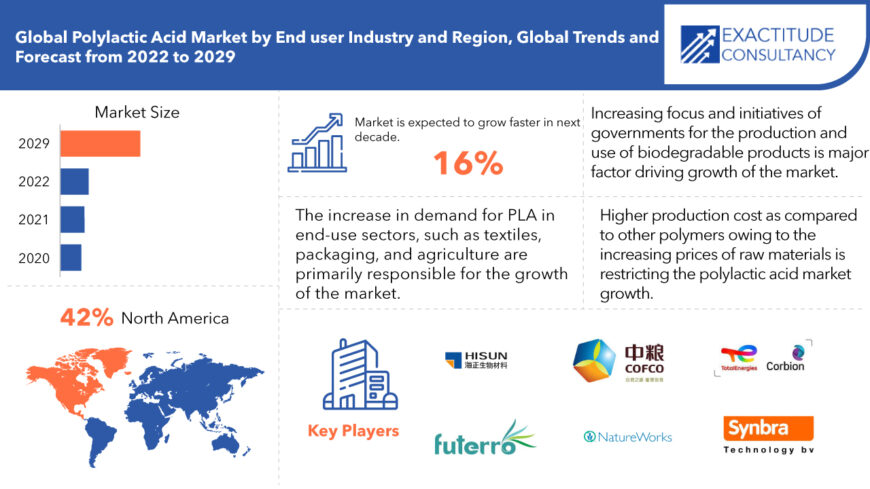
Si prevede che il mercato globale dell'acido polilattico crescerà al 16% di CAGR dal 2022 al 2029. Si prevede che raggiungerà oltre 1,98 miliardi di USD entro il 2029 da 0,52 miliardi di USD nel 2020.
Il materiale in acido polilattico (PLA) è diverso dalla forma comunemente disponibile di materiali polimerici termoplastici. È derivato principalmente da risorse rinnovabili come amido di mais o canna da zucchero. Il PLA è relativamente economico con diverse proprietà meccaniche vantaggiose rispetto ad altri polimeri biodegradabili , il che lo ha reso un materiale popolare. A partire dal 2019, la capacità produttiva di PLA era di circa 290 mila tonnellate. Il PLA è relativamente economico con diverse proprietà meccaniche vantaggiose rispetto ad altri polimeri biodegradabili, il che lo ha reso un materiale popolare. A partire dal 2019, la capacità produttiva di PLA era di circa 290 mila tonnellate. La produzione di PLA si basa in gran parte su materie prime vegetali come manioca, patate, mais e canna da zucchero. Altri tipi di materie prime come sottoprodotti agricoli, materiali cellulosici o gas serra (ad esempio, anidride carbonica e metano) sono stati studiati ed esplorati. Tuttavia, la tecnica è ancora in fase di sviluppo e sembra probabile che i prodotti agricoli rimangano nel prossimo futuro come materia prima primaria per miscele di amido e PLA.
L'aumento della domanda di PLA nei settori di utilizzo finale, come tessile, imballaggio e agricoltura, è il principale responsabile della crescita del mercato dell'acido polilattico. Inoltre, le minori emissioni di carbonio prodotte dall'acido polilattico rispetto ai polimeri convenzionali guidano la domanda a livello globale. Inoltre, l'aumento della domanda di prodotti di imballaggio flessibili spinge la crescita del mercato dell'acido polilattico. Il settore dell'imballaggio è in forte espansione, a causa della crescente domanda di alimenti confezionati, snack, pasti pronti (RTE) e altri articoli. Di conseguenza, si prevede che la domanda di PLA aumenterà nel periodo di previsione a causa del rapido sviluppo dell'industria dell'imballaggio.
| ATTRIBUTO | DETTAGLI |
| Periodo di studio | 2020-2029 |
| Anno base | 2021 |
| Anno stimato | 2022 |
| Anno previsto | 2022-2029 |
| Periodo storico | 2018-2020 |
| Unità | Valore (miliardi di USD) Volume (chilotoni) |
| Segmentazione | Per utenti finali, per regione |
| Da parte degli utenti finali |
|
| Per regione |
|
Tuttavia, i costi di produzione più elevati rispetto ad altri polimeri dovuti all'aumento dei prezzi delle materie prime stanno limitando la crescita del mercato dell'acido polilattico. L'acido polilattico è un polimero biodegradabile e compostabile industrialmente e uno dei primi polimeri rinnovabili a competere con i polimeri attuali combinando qualità funzionali, come trasparenza, lucentezza e rigidità. Imballaggi alimentari, stoviglie monouso, tessuti , petrolio e gas, elettronica, automotive e stampa 3D sono solo alcuni dei settori che impiegano l'acido polilattico. Si prevede che il mercato dell'acido polilattico vedrà notevoli opportunità di crescita durante il periodo di previsione, grazie agli usi vari e adattabili dell'acido polilattico in tutti i settori, nonché alle multifunzionalità degli acidi polilattici.
Il progresso tecnologico, il trasferimento tecnologico dai paesi sviluppati e l'elevata domanda dei consumatori nei paesi in via di sviluppo sono responsabili delle prossime nuove configurazioni nei settori dell'imballaggio, dei tessili e dell'elettronica. La domanda di acido polilattico da parte di questi settori è il principale motore di crescita del mercato nei paesi in via di sviluppo.
L'attenzione crescente e le iniziative dei governi in tutto il mondo per la produzione e l'uso di prodotti biodegradabili sono i principali fattori che guidano la crescita del mercato globale dell'acido polilattico. Inoltre, i governi delle economie sviluppate ed emergenti stanno fornendo sussidi per la produzione di acido polilattico che si prevede alimenterà la crescita del settore target nel prossimo futuro. Inoltre, le crescenti preferenze per la bioplastica rispetto alla plastica convenzionale da parte degli stakeholder a causa della sicurezza ambientale e del controllo dell'inquinamento sono tra i principali fattori che promuovono la crescita del mercato globale nel periodo di previsione. Inoltre, la crescente domanda di acido polilattico da parte dell'industria cosmetica per la produzione di prodotti per la cura della persona come shampoo, creme e altri dovrebbe supportare la crescita del mercato target nei prossimi anni.
[caption id="allegato_10379" align="aligncenter" width="870"]
Frequently Asked Questions
• What is the worth of global polylactic acid market?
The polylactic acid market size had crossed USD 0.52 billion in 2020 and will observe a CAGR of more than 16% up to 2029 driven by the increase in demand for PLA in end-use sectors, such as textiles, packaging, and agriculture.
• What is the size of the North America polylactic acid industry?
North America held more than 42% of the polylactic acid market revenue share in 2020 due to the high demand for bioplastics, which is one of the largest markets for PLA. Moreover, several initiatives promoting environmentally-friendly products by the regional government are supporting market growth.
• What are the upcoming trends of polylactic acid market, globally?
The upcoming trends in polylactic acid market are the technological advancement, technological transfer from developed countries and high consumer demand in developing countries.
• What is the CAGR of polylactic acid market?
The global polylactic acid market registered a CAGR of 16% from 2022 to 2029. The packaging segment was the highest revenue contributor to the market, with 0.20 billion in 2020, and is estimated to reach 0.70 billion by 2029, with a CAGR of 15%.
• Which are the top companies to hold the market share in polylactic acid market?
Key players profiled in the report include Total Corbion PLA, Nature Works LLC, COFCO, Futerro, Jiangxi Keyuan Bio-Material Co., Ltd., Zhejiang Hisun Biomaterials Co., Ltd., Shanghai Tong-Jie-Liang Biomaterials Co., Ltd., Corbion Purac, Hisun Biomaterials, Synbra Technology bv.
• What is the leading application of polylactic acid market?
Leading application of polylactic acid market are hospitals. Hospitals hold a significant share of the polylactic acid market due to increasing accessibility and affordability in health care system.
• Which is the largest regional market for polylactic acid market?
North America is expected to hold the largest market share in terms of revenue, during the forecast period. The growth is attributed to high demand for bioplastics, which is one of the largest markets for PLA. Moreover, several initiatives promoting environmentally-friendly products by the regional government are supporting market growth.
Polylactic Acid Market Segment Analysis
The global polylactic acids market is segmented based on end use and region. Based on end user industry, packaging, textile, agricultural, electronics, bio-medical and others. The packaging end-use segment accounted for the largest revenue share of over 36% in 2020, owing to the wide utilization of PLA in the manufacturing of bottles, jars, and containers, as well as in fresh food packaging solutions. The inclination of consumers towards sustainable packaging and rising environmental concerns across the globe are compelling manufacturers to use the product in various packaging solutions.
The packaging industry is one of the major consumers of PLA, especially in the food packaging sector. PLA plastic bottles are durable, disposable, and possess properties such as transparency and gloss. In addition, a strict ban on single-use plastics in many countries, such as the U.K., Zimbabwe, New Zealand, Taiwan, and several states of the U.S. (such as Hawaii, New York, and California), is significantly driving the product demand in the packaging end-use segment.
Moreover, PLA can be easily composted as compared to petroleum-based products and does not emit toxic gases on incineration; thus, its demand in this application area is expected to remain strong over the forecast period. Bioplastic packaging, including rigid packaging and loose-fill packaging, has witnessed considerable regulatory support on account of the need for reducing Greenhouse Gas (GHG) emissions.
Textile is another important sector having high market penetration and a high growth rate as PLA helps in manufacturing smooth fabrics. In addition, PLA provides excellent moisture resistance, drapability, breathability, and durability. These benefits are anticipated to propel its demand in the global textile industry over the forecast period.
[caption id="attachment_10380" align="alignleft" width="680"]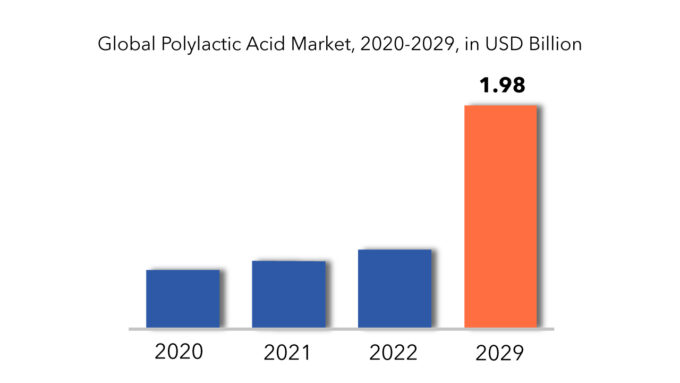
Polylactic Acid Market Players
The Polylactic acid market key players include Total Corbion PLA, Nature Works LLC, COFCO, Futerro, Jiangxi Keyuan Bio-Material Co., Ltd., Zhejiang Hisun Biomaterials Co., Ltd., Shanghai Tong-Jie-Liang Biomaterials Co., Ltd., Corbion Purac, Hisun Biomaterials, Synbra Technology bv.
To increase their market position, these businesses have implemented a variety of growth tactics. These companies are using expansion, new product development, mergers and acquisitions, and collaboration as important growth strategies to improve their product portfolio and geographical presence in order to meet the rising demand for Polylactic acid from emerging economies.
Industry News:- In October 2021, Total Corbion PLA launched recycled PLA range under the brand name Luminy rPLA, which is derived from post-industrial and post-consumer PLA waste. The new product is a chemically recycled product with similar characteristics as the existing Luminy PLA product.
- In April 2021, NatureWorks LLC developed a new PLA grade Ingeo 3D700. The new material is ideal for large-format additive manufacturing, along with the reduction in warping and print failures. Ingeo 3D700 is specially designed for 3D printing, having performance characteristics such as precise detail, good adhesion, reduced warping or curling, and low odor while printing.
- In November 2021, Danimer Scientific and Total Corbion PLA collaborated to manufacture biodegradable PLA. The collaboration will support the production of custom-built resin to meet the customers' requirements for biodegradable and functional aspects of the products.
- In June 2021, NatureWorks LLC is establishing a new fully integrated Ingeo PLA production facility in Thailand. NatureWorks LLC has invested USD 600 million for the new facility, which will have production sites for lactic acid, lactide, and polymer. The plant is expected to become fully operational by 2024, with an annual production capacity of 75,000 tons Ingeo PLA grades.
Who Should Buy? Or Key Stakeholders
- Resin & polymer industries.
- Chemicals & Materials
- Institutional & retail players.
- Investment research firms
Polylactic Acid Market Regional Analysis
The polylactic acid market by region includes North America, Asia-Pacific (APAC), Europe, South America, and Middle East & Africa (MEA).
- North America: includes the US, Canada, Mexico
- Asia Pacific: includes China, Japan, South Korea, India, Australia, ASEAN and Rest of APAC
- Europe: includes UK, Germany, France, Italy, Spain, Russia, and Rest of Europe
- South America: includes Brazil, Argentina and Rest of South America
- Middle East & Africa: includes Turkey, UAE, Saudi Arabia, South Africa, and Rest of MEA
North America accounted for the largest revenue share of over 42% in 2020. This large share is attributed to the high demand for bioplastics, which is one of the largest markets for PLA. Moreover, several initiatives promoting environmentally-friendly products by the regional government are supporting market growth.
Asia Pacific is expected to be the fastest-growing regional market from 2021 to 2028, owing to factors such as increasing demand for PLA from key end-use sectors (automobile, electronics, textile, appliance, and medical) of developing countries like Indonesia and Malaysia, fluctuating petroleum prices, and lack of resources for fossil fuels.
China led the Asia Pacific regional market in 2020. Furthermore, the richness of biomass, research-driven resources, strong downstream industry demand, material supply, and supporting government policies have created significant business opportunities for bioplastic in Thailand. This factor is also likely to drive the regional market of APAC over the forecast years. Moreover, the rapidly expanding food & beverage sector, particularly in India and China, is augmenting the market growth.
[caption id="attachment_10386" align="alignleft" width="680"]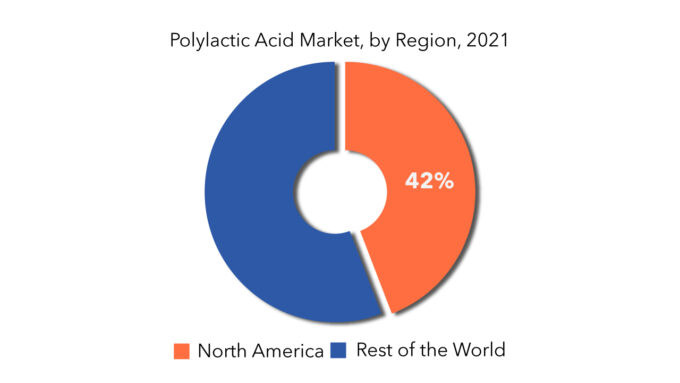
Key Market Segments: Polylactic acid Market
Polylactic Acid Market by End Use Industry, 2020-2029, (USD Million)- Packaging
- Textile
- Agricultural
- Electronics
- Bio-Medical
- Others
- North America
- Europe
- Asia Pacific
- South America
- Middle East and Africa
Key Question Answered
- What is the current size of the polylactic acid market?
- What are the key factors influencing the growth of polylactic acid?
- What are the major applications for polylactic acid?
- Who are the major key players in the polylactic acid market?
- Which region will provide more business opportunities for polylactic acid in future?
- Which segment holds the maximum share of the polylactic acid market?
- Introduzione
- Definizione di mercato
- Segmentazione del mercato
- Cronologie della ricerca
- Presupposti e limitazioni
- Metodologia di ricerca
- Estrazione dei dati
- Ricerca secondaria
- Ricerca primaria
- Consigli degli esperti in materia
- Controlli di qualità
- Revisione finale
- Triangolazione dei dati
- Approccio dal basso verso l'alto
- Approccio dall'alto verso il basso
- Flusso di ricerca
- Fonti dei dati
- Estrazione dei dati
- Sintesi
- Panoramica del mercato
- Prospettive di mercato globali dell'acido polilattico
- Fattori trainanti del mercato
- Limitazioni di mercato
- Opportunità di mercato
- Impatto del Covid-19 sul mercato dell'acido polilattico
- Modello delle cinque forze di Porter
- Minaccia da parte dei nuovi entranti
- Minaccia da sostituti
- Potere contrattuale dei fornitori
- Potere contrattuale dei clienti
- Grado di concorrenza
- Analisi della catena del valore del settore
- Prospettive di mercato globali dell'acido polilattico
- Mercato globale dell'acido polilattico per settore di utilizzo finale
- Confezione
- Tessile
- Agricolo
- Elettronica
- Bio-Medico
- Altri
- Mercato globale dell'acido polilattico per regione
- America del Nord
- NOI
- Canada
- Mexico
- South America
- Brazil
- Argentina
- Colombia
- Chile
- Rest Of South America
- Europe
- Germany
- UK
- France
- Italy
- Spain
- Russia
- Netherlands
- Belgium
- Rest Of Europe
- Asia Pacific
- India
- China
- Japan
- South Korea
- Australia
- New Zealand
- Indonesia
- Taiwan
- Malaysia
- Rest Of Asia Pacific
- Middle East and Africa
- UAE
- Saudi Arabia
- South Africa
- Rest Of Middle East and Africa
- America del Nord
- Company Profiles* (Business Overview, Company Snapshot, Products Offered, Recent Developments)
- Total Corbion PLA
- Nature Works LLC
- COFCO
- Futerro
- Jiangxi Keyuan Bio-Material Co., Ltd.
- Zhejiang Hisun Biomaterials Co., Ltd.
- Shanghai Tong-Jie-Liang Biomaterials Co., Ltd.
- Corbion Purac
- Hisun Biomaterials
- Synbra Technology *The Company List Is Indicative
LIST OF TABLES
TABLE 1 GLOBAL POLYLACTIC ACID MARKET BY END USERS (USD MILLIONS), 2020-2029
TABLE 2 GLOBAL POLYLACTIC ACID MARKET BY END USERS (THOUSAND UNITS), 2020-2029
TABLE 3 GLOBAL POLYLACTIC ACID MARKET BY REGION (USD MILLIONS), 2020-2029
TABLE 4 GLOBAL POLYLACTIC ACID MARKET BY REGION (THOUSAND UNITS), 2020-2029
TABLE 5 NORTH AMERICA POLYLACTIC ACID MARKET BY END USERS (USD MILLIONS), 2020-2029
TABLE 6 NORTH AMERICA POLYLACTIC ACID MARKET BY END USERS (THOUSAND UNITS), 2020-2029
TABLE 7 US POLYLACTIC ACID MARKET BY END USERS (USD MILLIONS), 2020-2029
TABLE 8 US POLYLACTIC ACID MARKET BY END USERS (THOUSAND UNITS), 2020-2029
TABLE 9 CANADA POLYLACTIC ACID MARKET BY END USERS (USD MILLIONS), 2020-2029
TABLE 10 CANADA POLYLACTIC ACID MARKET BY END USERS (THOUSAND UNITS), 2020-2029
TABLE 11 MEXICO POLYLACTIC ACID MARKET BY END USERS (USD MILLIONS), 2020-2029
TABLE 12 MEXICO POLYLACTIC ACID MARKET BY END USERS (THOUSAND UNITS), 2020-2029
TABLE 13 SOUTH AMERICA POLYLACTIC ACID MARKET BY END USERS (USD MILLIONS), 2020-2029
TABLE 14 SOUTH AMERICA POLYLACTIC ACID MARKET BY END USERS (THOUSAND UNITS), 2020-2029
TABLE 15 BRAZIL POLYLACTIC ACID MARKET BY END USERS (USD MILLIONS), 2020-2029
TABLE 16 BRAZIL POLYLACTIC ACID MARKET BY END USERS (THOUSAND UNITS), 2020-2029
TABLE 17 ARGENTINA POLYLACTIC ACID MARKET BY END USERS (USD MILLIONS), 2020-2029
TABLE 18 ARGENTINA POLYLACTIC ACID MARKET BY END USERS (THOUSAND UNITS), 2020-2029
TABLE 19 COLOMBIA POLYLACTIC ACID MARKET BY END USERS (USD MILLIONS), 2020-2029
TABLE 20 COLOMBIA POLYLACTIC ACID MARKET BY END USERS (THOUSAND UNITS), 2020-2029
TABLE 21 REST OF SOUTH AMERICA POLYLACTIC ACID MARKET BY END USERS (USD MILLIONS), 2020-2029
TABLE 22 REST OF SOUTH AMERICA POLYLACTIC ACID MARKET BY END USERS (THOUSAND UNITS), 2020-2029
TABLE 23 ASIA-PACIFIC POLYLACTIC ACID MARKET BY END USERS (USD MILLIONS), 2020-2029
TABLE 24 ASIA-PACIFIC POLYLACTIC ACID MARKET BY END USERS (THOUSAND UNITS), 2020-2029
TABLE 25 INDIA POLYLACTIC ACID MARKET BY END USERS (USD MILLIONS), 2020-2029
TABLE 26 INDIA POLYLACTIC ACID MARKET BY END USERS (THOUSAND UNITS), 2020-2029
TABLE 27 CHINA POLYLACTIC ACID MARKET BY END USERS (USD MILLIONS), 2020-2029
TABLE 28 CHINA POLYLACTIC ACID MARKET BY END USERS (THOUSAND UNITS), 2020-2029
TABLE 29 JAPAN POLYLACTIC ACID MARKET BY END USERS (USD MILLIONS), 2020-2029
TABLE 30 JAPAN POLYLACTIC ACID MARKET BY END USERS (THOUSAND UNITS), 2020-2029
TABLE 31 SOUTH KOREA POLYLACTIC ACID MARKET BY END USERS (USD MILLIONS), 2020-2029
TABLE 32 SOUTH KOREA POLYLACTIC ACID MARKET BY END USERS (THOUSAND UNITS), 2020-2029
TABLE 33 AUSTRALIA POLYLACTIC ACID MARKET BY END USERS (USD MILLIONS), 2020-2029
TABLE 34 AUSTRALIA POLYLACTIC ACID MARKET BY END USERS (THOUSAND UNITS), 2020-2029
TABLE 35 SOUTH EAST ASIA POLYLACTIC ACID MARKET BY END USERS (USD MILLIONS), 2020-2029
TABLE 36 SOUTH EAST ASIA POLYLACTIC ACID MARKET BY END USERS (THOUSAND UNITS), 2020-2029
TABLE 37 REST OF ASIA PACIFIC POLYLACTIC ACID MARKET BY END USERS (USD MILLIONS), 2020-2029
TABLE 38 REST OF ASIA PACIFIC POLYLACTIC ACID MARKET BY END USERS (THOUSAND UNITS), 2020-2029
TABLE 39 EUROPE POLYLACTIC ACID MARKET BY END USERS (USD MILLIONS), 2020-2029
TABLE 40 EUROPE POLYLACTIC ACID MARKET BY END USERS (THOUSAND UNITS), 2020-2029
TABLE 41 GERMANY POLYLACTIC ACID MARKET BY END USERS (USD MILLIONS), 2020-2029
TABLE 42 GERMANY POLYLACTIC ACID MARKET BY END USERS (THOUSAND UNITS), 2020-2029
TABLE 43 UK POLYLACTIC ACID MARKET BY END USERS (USD MILLIONS), 2020-2029
TABLE 44 UK POLYLACTIC ACID MARKET BY END USERS (THOUSAND UNITS), 2020-2029
TABLE 45 FRANCE POLYLACTIC ACID MARKET BY END USERS (USD MILLIONS), 2020-2029
TABLE 46 FRANCE POLYLACTIC ACID MARKET BY END USERS (THOUSAND UNITS), 2020-2029
TABLE 47 ITALY POLYLACTIC ACID MARKET BY END USERS (USD MILLIONS), 2020-2029
TABLE 48 ITALY POLYLACTIC ACID MARKET BY END USERS (THOUSAND UNITS), 2020-2029
TABLE 49 SPAIN POLYLACTIC ACID MARKET BY END USERS (USD MILLIONS), 2020-2029
TABLE 50 SPAIN POLYLACTIC ACID MARKET BY END USERS (THOUSAND UNITS), 2020-2029
TABLE 51 RUSSIA POLYLACTIC ACID MARKET BY END USERS (USD MILLIONS), 2020-2029
TABLE 52 RUSSIA POLYLACTIC ACID MARKET BY END USERS (THOUSAND UNITS), 2020-2029
TABLE 53 REST OF EUROPE POLYLACTIC ACID MARKET BY END USERS (USD MILLIONS), 2020-2029
TABLE 54 REST OF EUROPE POLYLACTIC ACID MARKET BY END USERS (THOUSAND UNITS), 2020-2029
TABLE 55 MIDDLE EAST AND AFRICA POLYLACTIC ACID MARKET BY END USERS (USD MILLIONS), 2020-2029
TABLE 56 MIDDLE EAST AND AFRICA POLYLACTIC ACID MARKET BY END USERS (THOUSAND UNITS), 2020-2029
TABLE 57 UAE POLYLACTIC ACID MARKET BY END USERS (USD MILLIONS), 2020-2029
TABLE 58 UAE POLYLACTIC ACID MARKET BY END USERS (THOUSAND UNITS), 2020-2029
TABLE 59 SAUDI ARABIA POLYLACTIC ACID MARKET BY END USERS (USD MILLIONS), 2020-2029
TABLE 60 SAUDI ARABIA POLYLACTIC ACID MARKET BY END USERS (THOUSAND UNITS), 2020-2029
TABLE 61 SOUTH AFRICA POLYLACTIC ACID MARKET BY END USERS (USD MILLIONS), 2020-2029
TABLE 62 SOUTH AFRICA POLYLACTIC ACID MARKET BY END USERS (THOUSAND UNITS), 2020-2029
TABLE 63 REST OF MIDDLE EAST AND AFRICA POLYLACTIC ACID MARKET BY END USERS (USD MILLIONS), 2020-2029
TABLE 64 REST OF MIDDLE EAST AND AFRICA POLYLACTIC ACID MARKET BY END USERS (THOUSAND UNITS), 2020-2029
LIST OF FIGURES
FIGURE 1 MARKET DYNAMICS
FIGURE 2 MARKET SEGMENTATION
FIGURE 3 REPORT TIMELINES: YEARS CONSIDERED
FIGURE 4 DATA TRIANGULATION
FIGURE 5 BOTTOM-UP APPROACH
FIGURE 6 TOP-DOWN APPROACH
FIGURE 7 RESEARCH FLOW
FIGURE 8 GLOBAL POLYLACTIC ACID MARKET BY END USERS, USD MILLION, 2020-2029
FIGURE 9 GLOBAL POLYLACTIC ACID MARKET BY REGION, USD MILLION, 2020-2029
FIGURE 10 PORTER’S FIVE FORCES MODEL
FIGURE 11 MARKET SHARE ANALYSIS
FIGURE 12 TOTAL CORBION PLA: COMPANY SNAPSHOT
FIGURE 13 NATURE WORKS LLC: COMPANY SNAPSHOT
FIGURE 14 COFCO: COMPANY SNAPSHOT
FIGURE 15 FUTERRO: COMPANY SNAPSHOT
FIGURE 16 JIANGXI KEYUAN BIO-MATERIAL CO., LTD.: COMPANY SNAPSHOT
FIGURE 17 ZHEJIANG HISUN BIOMATERIALS CO., LTD.: COMPANY SNAPSHOT
FIGURE 18 SHANGHAI TONG-JIE-LIANG BIOMATERIALS CO., LTD.: COMPANY SNAPSHOT
FIGURE 19 CORBION PURAC: COMPANY SNAPSHOT
FIGURE 20 HISUN BIOMATERIALS: COMPANY SNAPSHOT
FIGURE 21 SYNBRA TECHNOLOGY BV: COMPANY SNAPSHOT
DOWNLOAD FREE SAMPLE REPORT
License Type
SPEAK WITH OUR ANALYST
Want to know more about the report or any specific requirement?
WANT TO CUSTOMIZE THE REPORT?
Our Clients Speak
We asked them to research ‘ Equipment market’ all over the world, and their whole arrangement was helpful to us. thehealthanalytics.com insightful analysis and reports contributed to our current analysis and in creating a future strategy. Besides, the te
Yosuke Mitsui
Senior Associate Construction Equipment Sales & Marketing
We asked them to research ‘Equipment market’ all over the world, and their whole arrangement was helpful to us. thehealthanalytics.com insightful analysis and reports contributed to our current analysis and in creating a future strategy. Besides, the te