

Base Year Value ()
x.x %
x.x %
CAGR ()
x.x %
x.x %
Forecast Year Value ()
x.x %
x.x %
Historical Data Period
Largest Region
Forecast Period
Mercato dei demulsionanti per tipo (solubile in olio, solubile in acqua), applicazione (produzione di petrolio greggio, raffinerie di petrolio, processo di produzione di lubrificanti, centrali elettriche a base di petrolio, processo di trattamento dei fanghi di petrolio), regione Tendenze globali e previsioni dal 2023 al 2029
Instant access to hundreds of data points and trends
- Market estimates from 2014-2029
- Competitive analysis, industry segmentation, financial benchmarks
- Incorporates SWOT, Porter's Five Forces and risk management frameworks
- PDF report or online database with Word, Excel and PowerPoint export options
- 100% money back guarantee
Panoramica del mercato dei demulsionanti
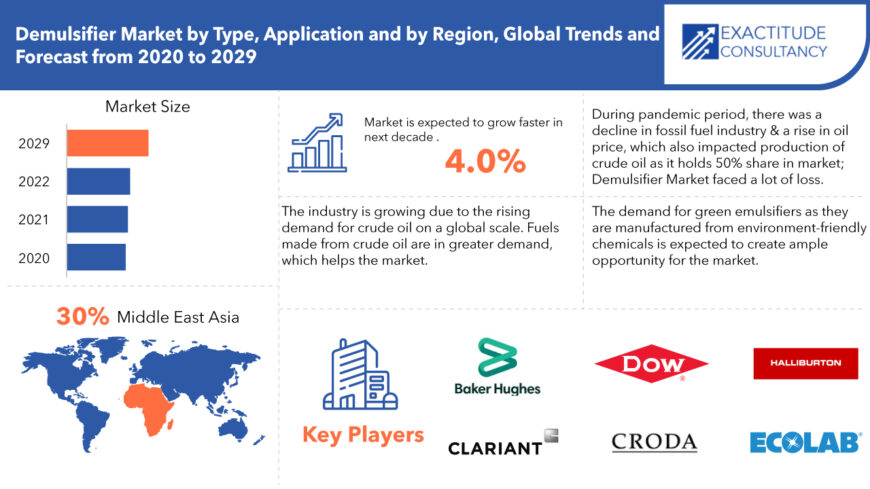
Il mercato globale dei demulsionanti è valutato a 2,1 miliardi di USD nel 2022 e si prevede che crescerà a un CAGR del 4% nel periodo di previsione, per poi raggiungere i 2,99 miliardi di USD nel 2029.
I demulsificanti, noti anche come emulsion breakers, formano una classe di prodotti chimici speciali che vengono utilizzati per separare le emulsioni. Di solito vengono utilizzati nella lavorazione del petrolio greggio, che viene solitamente prodotto insieme a notevoli quantità di acqua salina. Si prevede che l'aumento della produzione di petrolio greggio in tutto il mondo sarà un importante motore per l'industria dei demulsificanti nei prossimi anni, così come si prevede che la rapida industrializzazione, unita a un numero crescente di centrali elettriche per soddisfare i requisiti energetici della popolazione in continua crescita, guiderà il mercato.
I demulsificanti o anche chiamati disgreganti di emulsione sono prodotti chimici speciali che vengono utilizzati per separare emulsioni come l'acqua nell'olio. I demulsificanti trovano applicazioni principali nella lavorazione del petrolio greggio, che viene prodotto con una quantità sostanziale di acqua salina. I demulsificanti si basano su prodotti chimici come resine epossidiche , polioli, poliammine, fenolo-formaldeide, epossidi e poliammine . La forza di demulsificazione dei prodotti chimici indicati può essere regolata miscelando ossido di etilene o ossido di propilene. Le formulazioni disponibili sul mercato sono costituite da una miscela di due o più prodotti chimici con solventi vettore come metanolo, diesel, xilene, isopropanolo o nafta aromatica pesante.
C'è un numero crescente di giacimenti di petrolio greggio che ora producono sia petrolio greggio che emulsioni di acqua; tali giacimenti sono sia onshore che offshore. Queste emulsioni si formano durante lo sfruttamento del petrolio a causa della presenza di tensioattivi naturali, come asfalteni e resine. Queste molecole stabilizzano fortemente l'interfaccia acqua/olio e impediscono la coalescenza delle goccioline d'acqua. Poiché la separazione della fase acqua/olio è necessaria prima del trasporto e della raffinazione del petrolio, vengono utilizzati demulsionanti per rompere le emulsioni acqua-olio. I demulsionanti utilizzati nei giacimenti petroliferi sono sostanze che possono rompere le emulsioni acqua-olio in un giacimento petrolifero. I demulsionanti sono specificamente formulati per soddisfare i requisiti di separazione acqua-olio richiesti in una zona di produzione petrolifera.
| ATTRIBUTO | DETTAGLI |
| Periodo di studio | 2023-2029 |
| Anno base | 2022 |
| Anno stimato | 2023 |
| Anno previsto | 2023-2029 |
| Periodo storico | 2018-2022 |
| Unità | Valore (miliardi di USD), (chilotoni) |
| Segmentazione | Per TIPO, Per applicazione, Per regione |
| Per tipo |
|
| Per applicazione |
|
| Per regione |
|
L'epidemia di COVID-19 ha causato notevoli sconvolgimenti all'economia globale in molti settori. In particolare, quando si verifica una flessione strutturale nell'industria dei combustibili fossili, le nazioni esportatrici di petrolio sono state colpite due volte dalla pandemia e dallo shock del prezzo del petrolio. La produzione di petrolio greggio e la raffinazione del petrolio, che insieme rappresentano più della metà della quota di mercato, sono state influenzate negativamente dal blocco a livello statale.
Il calo dell'offerta è stato causato da un arresto delle operazioni di produzione a seguito di misure preventive raccomandate da organizzazioni come l'Organizzazione Mondiale della Sanità e dalla loro attuazione da parte dei governi nei paesi. I progetti di esplorazione di petrolio e gas dipendono fortemente dagli importatori di macchinari e attrezzature. L'epidemia
Lo scoppio del COVID-19 e la necessità di restrizioni internazionali hanno avuto ripercussioni sulla catena di fornitura di tali macchinari, determinando ulteriormente la sospensione dell'esecuzione del progetto.
La produzione e i movimenti globali hanno rallentato a causa delle misure di contenimento e dell'instabilità economica in seguito allo scoppio del COVID-19, che ha improvvisamente ridotto la domanda di petrolio. Il mercato ne ha quindi sofferto. L'Agenzia Internazionale per l'Energia (IEA) ha previsto che la domanda di petrolio fosse inferiore del 30% ad aprile 2020 rispetto al 2019. La scoperta di vaccini, insieme all'approvazione per le attività di produzione utilizzando una forza lavoro limitata e determinati protocolli, aiuterà la ripresa.
Si prevede che l'introduzione di severe normative ambientali sull'uso di demulsionanti chimici ostacolerà la crescita del mercato globale dei demulsionanti. Tuttavia, si prevede che la scoperta di nuovi giacimenti petroliferi, la domanda di demulsionanti ecologici e un aumento dei giacimenti invecchiati offriranno opportunità redditizie agli operatori del mercato. [caption id="attachment_11706" align="alignleft" width="870"]
Frequently Asked Questions
• What is the worth of global Demulsifier market?
The Demulsifier market size had crossed USD 2.1 billion in 2022 and will observe a CAGR of more than 4.0 % up to 2029 The surging economic growth and the expanding disposable income, living standards, and power requirements are major drivers for the increasing demand for crude oil. Its refining is greatly influenced by the increased industrialization, surge in global energy consumption, and rise in government investments to improve oil and gas infrastructure.
• What is the size of the Middle east Asia Demulsifier industry?
Middle east Asia held more than 30% of the Demulsifier market revenue share in 2022.
• What are some of the market's driving forces?
The production facilities and oil recovery activities are both impacted by emulsion formation. The industry is growing due to the rising demand for crude oil on a global scale. Fuels made from crude oil are in greater demand, which helps the market. More prospects for the growth of the demulsifier market are being created by the ongoing discovery of new oil reserves and oil fields. The demulsifier market is expanding due to the growing adoption of chemical products designed to separate the emulsion produced during exploration and subsequently transform it into petroleum products.
• Which are the top companies to hold the market share in Demulsifier market?
Key players profiled in the report include Baker Hughes Incorporated (US), Clariant (Switzerland), The Dow Chemical Company (US), Croda International (US), Ecolab Inc. (US), Halliburton (US), Schlumberger Limited (US), BASF SE (Germany), Nouryon (Netherlands), Momentive Performance Materials (US), Nova Star LP (US), SI Group (US), Impact Chemicals Technologies (US), Innospec Inc. (US), Dorf Ketal (India), Huntsman Corporation (US), Chemiphase Ltd. (UK), Direct-N Pakt Inc. (US), MCC Chemicals Inc.(US), Rimpro India (India), Oil Technics Holdings (UK), Egyptian Mud Engineering, Chemicals Company (Egypt), Roemex Limited (India), Reda Oilfield (UK), and Aurorachem (China)
• Which is the largest regional market for Demulsifier market?
The region's largest share is in Middle East Asia. Its refining is greatly influenced by the increased industrialization, surge in global energy consumption, and rise in government investments to improve oil and gas infrastructure.
Demulsifier Market Segment Analysis
The global Demulsifier market is segmented based on Type and application.
Depending on the type, water-soluble demulsifiers are seeing significant market growth. This is explained by the product's capacity to start the braking process by mixing with emulsion with ease. Additionally, factors including non-hazardous, non-toxic, and anti-inflammatory qualities, affordable price, minimal need for material handling safety measures, and the simplicity of removing salt from crude oil are expected to boost the segmental expansion through the forecast period. Furthermore, the development of the industry would be complemented by the growing body of research on the usage of water-soluble polymer demulsifiers.
Demulsifiers are widely employed in the oil recovery process from petroleum sludge, where the water is separated from the oil, to treat oil sludge. Oily sludge's moisture content can be reduced from 80%–98% to almost 50% by using the oil sludge resourceful treatment method. This can significantly lessen the complexity of sludge follow-up treatment while recycling the majority of the crude oil in the sludge. Additionally, freeze treatment is frequently used as an efficient method of demulsifying petroleum sludge in cold climates.
By application, the demulsifier market is bifurcated by crude oil production, Petro refineries, lubricant manufacturing process, oil-based power plants and sludge oil treatment process. Out of this Crude oil is estimated to be the major contributor towards the growth of the market. Given that it represented 30% of the market share in 2020, crude oil is now dominating the market and is predicted to continue doing so during the projected period. The market is being helped by the escalating demand from the crude oil exploration sector. The market will expand as a result of the discoveries of new oilfields and crude oil reserves. In addition to crude oil, the petroleum sector is anticipated to increase rapidly because of the rising demand for petroleum-based goods like gasoline, diesel, kerosene, etc., which will drive the demulsifier market size. [caption id="attachment_11707" align="alignleft" width="680"]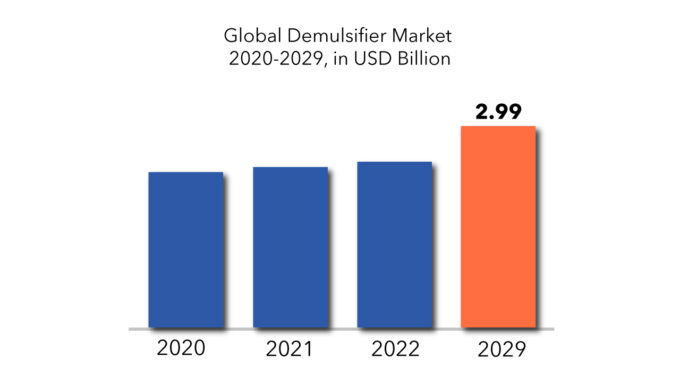
Demulsifier Market Players
The Demulsifier market key players include Baker Hughes Incorporated (US), Clariant (Switzerland), The Dow Chemical Company (US), Croda International (US), Ecolab Inc. (US), Halliburton (US), Schlumberger Limited (US), BASF SE (Germany), Nouryon (Netherlands), Momentive Performance Materials (US), Nova Star LP (US), SI Group (US), Impact Chemicals Technologies (US), Innospec Inc. (US), Dorf Ketal (India), Huntsman Corporation (US), Chemiphase Ltd. (UK), Direct-N Pakt Inc. (US), MCC Chemicals Inc.(US), Rimpro India (India), Oil Technics Holdings (UK), Egyptian Mud Engineering, Chemicals Company (Egypt), Roemex Limited (India), Reda Oilfield (UK), and Aurorachem (China).
For corporate expansion, these key leaders are implementing strategic formulations such as new product development and commercialization, commercial expansion, and distribution agreements. Moreover, these participants are substantially spending in product development, which is fueling revenue generation.
Who Should Buy? Or Key stakeholders
- Demulsifier Supplier
- Raw Materials Manufacturers
- Suppliers
- Manufacturing Companies
- End-user companies
- Research institutes
Demulsifier Market Regional Analysis
The Demulsifier market by region includes North America, Asia-Pacific (APAC), Europe, South America, and Middle East & Africa (MEA).
- North America: includes the US, Canada, Mexico
- Asia Pacific: includes China, Japan, South Korea, India, Australia, ASEAN and Rest of APAC
- Europe: includes UK, Germany, France, Italy, Spain, Russia, and Rest of Europe
- South America: includes Brazil, Argentina and Rest of South America
- Middle East & Africa: includes Kuwait, UAE, Saudi Arabia, Iran, Iraq and Rest of MEA
Additionally, research indicate that as the North American petroleum processing industry develops, demulsifier demand will rise. For instance, the United States produces the crudest oil internationally, whereas Canada possesses the third-largest reserve of the commodity. Furthermore, North America is currently ranked second in the world market due to the region's rising need for crude oil and the growing lubricants industry.
Additionally, over the course of the projection period, the APAC market is anticipated to expand significantly with a CAGR of more than 3.7%. Businesses are setting up industrial facilities in the area due to the region's booming economic growth, fast urbanization, and rising purchasing power, which in turn is boosting the demand for demulsifiers.
[caption id="attachment_11708" align="alignleft" width="680"]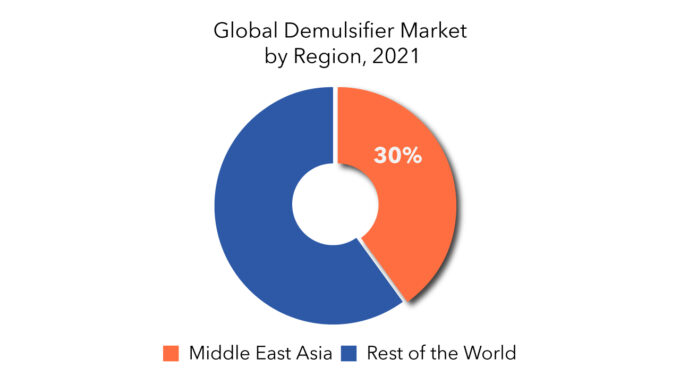
Key Market Segments: Demulsifier Market
Demulsifier Market by Type, 2023-2029, (USD Billion), (Kilotons)- Oil Soluble
- Water Soluble
- Crude Oil Production
- Petro Refineries
- Lubricant Manufacturing Process
- Oilbased Power Plants
- Sludge Oil Treatment Process
- North America
- Asia Pacific
- Europe
- Latin America
- Middle East And Africa
[video width="1920" height="1080" mp4="https://gwsdigital.com/exactitudeconsultancy/wp-content/uploads/2022/11/Demulsifier-Market.mp4" poster="https://gwsdigital.com/exactitudeconsultancy/wp-content/uploads/2022/02/exactitude-1-3.jpg"][/video]
Key Question Answered
- What is the current size of the Demulsifier market?
- What are the key factors influencing the growth of Demulsifier?
- What are the major applications for Demulsifier?
- Who are the major key players in the Demulsifier market?
- Which region will provide more business opportunities for Demulsifier in future?
- Which segment holds the maximum share of the Demulsifier market?
- Introduzione
- Definizione di mercato
- Segmentazione del mercato
- Cronologie della ricerca
- Presupposti e limitazioni
- Metodologia di ricerca
- Estrazione dei dati
- Ricerca secondaria
- Ricerca primaria
- Consigli degli esperti in materia
- Controlli di qualità
- Revisione finale
- Triangolazione dei dati
- Approccio dal basso verso l'alto
- Approccio dall'alto verso il basso
- Flusso di ricerca
- Fonti dei dati
- Estrazione dei dati
- Sintesi
- Panoramica del mercato
- Prospettive del mercato globale dei demulsionanti
- Fattori trainanti del mercato
- Limitazioni di mercato
- Opportunità di mercato
- Impatto del Covid-19 sul mercato dei demulsionanti
- Modello delle cinque forze di Porter
- Minaccia da parte dei nuovi entranti
- Minaccia da sostituti
- Potere contrattuale dei fornitori
- Potere contrattuale dei clienti
- Grado di concorrenza
- Analisi della catena del valore del settore
- Prospettive del mercato globale dei demulsionanti
- Mercato globale dei demulsionanti per tipo, 2020-2029, (MILIARDI DI USD), (KILOTONI)
- Solubile in olio
- Solubile in acqua
- Mercato globale dei demulsionanti per applicazione, 2020-2029, (MILIARDI DI USD), (KILOTONI)
- Produzione di petrolio greggio
- Raffinerie di petrolio
- Processo di produzione del lubrificante
- Oil based process plant, Sludge oil treatment process
- Global Demulsifier Market by Region, 2020-2029, (USD BILLION), (KILOTONS)
- North America
- US
- Canada
- Mexico
- South America
- Brazil
- Argentina
- Colombia
- Rest Of South America
- Europe
- Germany
- UK
- France
- Italy
- Spain
- Russia
- Rest Of Europe
- Asia Pacific
- India
- China
- Japan
- South Korea
- Australia
- South-East Asia
- Rest Of Asia Pacific
- Middle East and Africa
- UAE
- Saudi Arabia
- South Africa
- Kuwait
- Iran
- Iraq
- Rest Of Middle East and Africa
- North America
- Company Profiles* (Business Overview, Company Snapshot, Products Offered, Recent Developments)
- Baker Hughes Incorporated
- Clariant
- Croda International
- The Dow Chemical Company
- Ecolab Inc.
- Halliburton
- Schlumberger Limited
- Momentive Performance Materials
- Impact Chemicals Technologies
- Innospec Inc. *The Company List Is Indicative
LIST OF TABLES
TABLE 1 GLOBAL DEMULSIFIER MARKET BY TYPE (USD MILLIONS) 2020-2029
TABLE 2 GLOBAL DEMULSIFIER MARKET BY TYPE (KILOTONS) 2020-2029
TABLE 3 GLOBAL DEMULSIFIER MARKET BY APPLICATION (USD MILLIONS) 2020-2029
TABLE 4 GLOBAL DEMULSIFIER MARKET BY APPLICATION (KILOTONS) 2020-2029
TABLE 5 GLOBAL DEMULSIFIER MARKET BY REGION (USD MILLIONS) 2020-2029
TABLE 6 GLOBAL DEMULSIFIER MARKET BY REGION (KILOTONS) 2020-2029
TABLE 7 US DEMULSIFIER MARKET BY TYPE (USD MILLIONS) 2020-2029
TABLE 8 US DEMULSIFIER MARKET BY TYPE (KILOTONS) 2020-2029
TABLE 9 US DEMULSIFIER MARKET BY APPLICATION (USD MILLIONS) 2020-2029
TABLE 10 US DEMULSIFIER MARKET BY APPLICATION (KILOTONS) 2020-2029
TABLE 11 CANADA DEMULSIFIER MARKET BY TYPE (USD MILLIONS) 2020-2029
TABLE 12 CANADA DEMULSIFIER MARKET BY TYPE (KILOTONS) 2020-2029
TABLE 13 CANADA DEMULSIFIER MARKET BY APPLICATION (USD MILLIONS) 2020-2029
TABLE 14 CANADA DEMULSIFIER MARKET BY APPLICATION (KILOTONS) 2020-2029
TABLE 15 MEXICO DEMULSIFIER MARKET BY TYPE (USD MILLIONS) 2020-2029
TABLE 16 MEXICO DEMULSIFIER MARKET BY TYPE (KILOTONS) 2020-2029
TABLE 17 MEXICO DEMULSIFIER MARKET BY APPLICATION (USD MILLIONS) 2020-2029
TABLE 18 MEXICO DEMULSIFIER MARKET BY APPLICATION (KILOTONS) 2020-2029
TABLE 19 BRAZIL DEMULSIFIER MARKET BY TYPE (USD MILLIONS) 2020-2029
TABLE 20 BRAZIL DEMULSIFIER MARKET BY TYPE (KILOTONS) 2020-2029
TABLE 21 BRAZIL DEMULSIFIER MARKET BY APPLICATION (USD MILLIONS) 2020-2029
TABLE 22 BRAZIL DEMULSIFIER MARKET BY APPLICATION (KILOTONS) 2020-2029
TABLE 23 ARGENTINA DEMULSIFIER MARKET BY TYPE (USD MILLIONS) 2020-2029
TABLE 24 ARGENTINA DEMULSIFIER MARKET BY TYPE (KILOTONS) 2020-2029
TABLE 25 ARGENTINA DEMULSIFIER MARKET BY APPLICATION (USD MILLIONS) 2020-2029
TABLE 26 ARGENTINA DEMULSIFIER MARKET BY APPLICATION (KILOTONS) 2020-2029
TABLE 27 COLOMBIA DEMULSIFIER MARKET BY TYPE (USD MILLIONS) 2020-2029
TABLE 28 COLOMBIA DEMULSIFIER MARKET BY TYPE (KILOTONS) 2020-2029
TABLE 29 COLOMBIA DEMULSIFIER MARKET BY APPLICATION (USD MILLIONS) 2020-2029
TABLE 30 COLOMBIA DEMULSIFIER MARKET BY APPLICATION (KILOTONS) 2020-2029
TABLE 31 REST OF SOUTH AMERICA DEMULSIFIER MARKET BY TYPE (USD MILLIONS) 2020-2029
TABLE 32 REST OF SOUTH AMERICA DEMULSIFIER MARKET BY TYPE (KILOTONS) 2020-2029
TABLE 33 REST OF SOUTH AMERICA DEMULSIFIER MARKET BY APPLICATION (USD MILLIONS) 2020-2029
TABLE 34 REST OF SOUTH AMERICA DEMULSIFIER MARKET BY APPLICATION (KILOTONS) 2020-2029
TABLE 35 INDIA DEMULSIFIER MARKET BY TYPE (USD MILLIONS) 2020-2029
TABLE 36 INDIA DEMULSIFIER MARKET BY TYPE (KILOTONS) 2020-2029
TABLE 37 INDIA DEMULSIFIER MARKET BY APPLICATION (USD MILLIONS) 2020-2029
TABLE 38 INDIA DEMULSIFIER MARKET BY APPLICATION (KILOTONS) 2020-2029
TABLE 39 CHINA DEMULSIFIER MARKET BY TYPE (USD MILLIONS) 2020-2029
TABLE 40 CHINA DEMULSIFIER MARKET BY TYPE (KILOTONS) 2020-2029
TABLE 41 CHINA DEMULSIFIER MARKET BY APPLICATION (USD MILLIONS) 2020-2029
TABLE 42 CHINA DEMULSIFIER MARKET BY APPLICATION (KILOTONS) 2020-2029
TABLE 43 JAPAN DEMULSIFIER MARKET BY TYPE (USD MILLIONS) 2020-2029
TABLE 44 JAPAN DEMULSIFIER MARKET BY TYPE (KILOTONS) 2020-2029
TABLE 45 JAPAN DEMULSIFIER MARKET BY APPLICATION (USD MILLIONS) 2020-2029
TABLE 46 JAPAN DEMULSIFIER MARKET BY APPLICATION (KILOTONS) 2020-2029
TABLE 47 SOUTH KOREA DEMULSIFIER MARKET BY TYPE (USD MILLIONS) 2020-2029
TABLE 48 SOUTH KOREA DEMULSIFIER MARKET BY TYPE (KILOTONS) 2020-2029
TABLE 49 SOUTH KOREA DEMULSIFIER MARKET BY APPLICATION (USD MILLIONS) 2020-2029
TABLE 50 SOUTH KOREA DEMULSIFIER MARKET BY APPLICATION (KILOTONS) 2020-2029
TABLE 51 AUSTRALIA DEMULSIFIER MARKET BY TYPE (USD MILLIONS) 2020-2029
TABLE 52 AUSTRALIA DEMULSIFIER MARKET BY TYPE (KILOTONS) 2020-2029
TABLE 53 AUSTRALIA DEMULSIFIER MARKET BY APPLICATION (USD MILLIONS) 2020-2029
TABLE 54 AUSTRALIA DEMULSIFIER MARKET BY APPLICATION (KILOTONS) 2020-2029
TABLE 55 SOUTH-EAST ASIA DEMULSIFIER MARKET BY TYPE (USD MILLIONS) 2020-2029
TABLE 56 SOUTH-EAST ASIA DEMULSIFIER MARKET BY TYPE (KILOTONS) 2020-2029
TABLE 57 SOUTH-EAST ASIA DEMULSIFIER MARKET BY APPLICATION (USD MILLIONS) 2020-2029
TABLE 58 SOUTH-EAST ASIA DEMULSIFIER MARKET BY APPLICATION (KILOTONS) 2020-2029
TABLE 59 REST OF ASIA PACIFIC DEMULSIFIER MARKET BY TYPE (USD MILLIONS) 2020-2029
TABLE 60 REST OF ASIA PACIFIC DEMULSIFIER MARKET BY TYPE (KILOTONS) 2020-2029
TABLE 61 REST OF ASIA PACIFIC DEMULSIFIER MARKET BY APPLICATION (USD MILLIONS) 2020-2029
TABLE 62 REST OF ASIA PACIFIC DEMULSIFIER MARKET BY APPLICATION (KILOTONS) 2020-2029
TABLE 63 GERMANY DEMULSIFIER MARKET BY TYPE (USD MILLIONS) 2020-2029
TABLE 64 GERMANY DEMULSIFIER MARKET BY TYPE (KILOTONS) 2020-2029
TABLE 65 GERMANY DEMULSIFIER MARKET BY APPLICATION (USD MILLIONS) 2020-2029
TABLE 66 GERMANY DEMULSIFIER MARKET BY APPLICATION (KILOTONS) 2020-2029
TABLE 67 UK DEMULSIFIER MARKET BY TYPE (USD MILLIONS) 2020-2029
TABLE 68 UK DEMULSIFIER MARKET BY TYPE (KILOTONS) 2020-2029
TABLE 69 UK DEMULSIFIER MARKET BY APPLICATION (USD MILLIONS) 2020-2029
TABLE 70 UK DEMULSIFIER MARKET BY APPLICATION (KILOTONS) 2020-2029
TABLE 71 FRANCE DEMULSIFIER MARKET BY TYPE (USD MILLIONS) 2020-2029
TABLE 72 FRANCE DEMULSIFIER MARKET BY TYPE (KILOTONS) 2020-2029
TABLE 73 FRANCE DEMULSIFIER MARKET BY APPLICATION (USD MILLIONS) 2020-2029
TABLE 74 FRANCE DEMULSIFIER MARKET BY APPLICATION (KILOTONS) 2020-2029
TABLE 75 ITALY DEMULSIFIER MARKET BY TYPE (USD MILLIONS) 2020-2029
TABLE 76 ITALY DEMULSIFIER MARKET BY TYPE (KILOTONS) 2020-2029
TABLE 77 ITALY DEMULSIFIER MARKET BY APPLICATION (USD MILLIONS) 2020-2029
TABLE 78 ITALY DEMULSIFIER MARKET BY APPLICATION (KILOTONS) 2020-2029
TABLE 79 SPAIN DEMULSIFIER MARKET BY TYPE (USD MILLIONS) 2020-2029
TABLE 80 SPAIN DEMULSIFIER MARKET BY TYPE (KILOTONS) 2020-2029
TABLE 81 SPAIN DEMULSIFIER MARKET BY APPLICATION (USD MILLIONS) 2020-2029
TABLE 82 SPAIN DEMULSIFIER MARKET BY APPLICATION (KILOTONS) 2020-2029
TABLE 83 RUSSIA DEMULSIFIER MARKET BY TYPE (USD MILLIONS) 2020-2029
TABLE 84 RUSSIA DEMULSIFIER MARKET BY TYPE (KILOTONS) 2020-2029
TABLE 85 RUSSIA DEMULSIFIER MARKET BY APPLICATION (USD MILLIONS) 2020-2029
TABLE 86 RUSSIA DEMULSIFIER MARKET BY APPLICATION (KILOTONS) 2020-2029
TABLE 87 REST OF EUROPE DEMULSIFIER MARKET BY TYPE (USD MILLIONS) 2020-2029
TABLE 88 REST OF EUROPE DEMULSIFIER MARKET BY TYPE (KILOTONS) 2020-2029
TABLE 89 REST OF EUROPE DEMULSIFIER MARKET BY APPLICATION (USD MILLIONS) 2020-2029
TABLE 90 REST OF EUROPE DEMULSIFIER MARKET BY APPLICATION (KILOTONS) 2020-2029
TABLE 91 UAE DEMULSIFIER MARKET BY TYPE (USD MILLIONS) 2020-2029
TABLE 92 UAE DEMULSIFIER MARKET BY TYPE (KILOTONS) 2020-2029
TABLE 93 UAE DEMULSIFIER MARKET BY APPLICATION (USD MILLIONS) 2020-2029
TABLE 94 UAE DEMULSIFIER MARKET BY APPLICATION (KILOTONS) 2020-2029
TABLE 95 SAUDI ARABIA DEMULSIFIER MARKET BY TYPE (USD MILLIONS) 2020-2029
TABLE 96 SAUDI ARABIA DEMULSIFIER MARKET BY TYPE (KILOTONS) 2020-2029
TABLE 97 SAUDI ARABIA DEMULSIFIER MARKET BY APPLICATION (USD MILLIONS) 2020-2029
TABLE 98 SAUDI ARABIA DEMULSIFIER MARKET BY APPLICATION (KILOTONS) 2020-2029
TABLE 99 SOUTH AFRICA DEMULSIFIER MARKET BY TYPE (USD MILLIONS) 2020-2029
TABLE 100 SOUTH AFRICA DEMULSIFIER MARKET BY TYPE (KILOTONS) 2020-2029
TABLE 101 SOUTH AFRICA DEMULSIFIER MARKET BY APPLICATION (USD MILLIONS) 2020-2029
TABLE 102 SOUTH AFRICA DEMULSIFIER MARKET BY APPLICATION (KILOTONS) 2020-2029
TABLE 103 REST OF MIDDLE EAST AND AFRICA DEMULSIFIER MARKET BY TYPE (USD MILLIONS) 2020-2029
TABLE 104 REST OF MIDDLE EAST AND AFRICA DEMULSIFIER MARKET BY TYPE (KILOTONS) 2020-2029
TABLE 105 REST OF MIDDLE EAST AND AFRICA DEMULSIFIER MARKET BY APPLICATION (USD MILLIONS) 2020-2029
TABLE 106 REST OF MIDDLE EAST AND AFRICA DEMULSIFIER MARKET BY APPLICATION (KILOTONS) 2020-2029
LIST OF FIGURES
FIGURE 1 MARKET DYNAMICS
FIGURE 2 MARKET SEGMENTATION
FIGURE 3 REPORT TIMELINES: YEARS CONSIDERED
FIGURE 4 DATA TRIANGULATION
FIGURE 5 BOTTOM-UP APPROACH
FIGURE 6 TOP-DOWN APPROACH
FIGURE 7 RESEARCH FLOW
FIGURE 8 GLOBAL DEMULSIFIER MARKET BY COMPONENT, USD BILLION, 2020-2029
FIGURE 9 GLOBAL DEMULSIFIER MARKET BY APPLICATION, USD BILLION, 2020-2029
FIGURE 10 GLOBAL DEMULSIFIER MARKET BY REGION, USD BILLION, 2020-2029
FIGURE 11 PORTER’S FIVE FORCES MODEL
FIGURE 12 NORTH AMERICA DEMULSIFIER MARKET SNAPSHOT
FIGURE 13 EUROPE DEMULSIFIER MARKET SNAPSHOT
FIGURE 14 SOUTH AMERICA DEMULSIFIER MARKET SNAPSHOT
FIGURE 15 ASIA PACIFIC DEMULSIFIER MARKET SNAPSHOT
FIGURE 16 MIDDLE EAST ASIA AND AFRICA DEMULSIFIER MARKET SNAPSHOT
FIGURE 17 MARKET SHARE ANALYSIS
FIGURE 18 BAKER HUGHES INCORPORATED: COMPANY SNAPSHOT
FIGURE 19 CLARIANT: COMPANY SNAPSHOT
FIGURE 20 THE DOW CHEMICAL COMPANY: COMPANY SNAPSHOT
FIGURE 21 CRODA INTERNATIONAL.: COMPANY SNAPSHOT
FIGURE 22 ECOLAB INC: COMPANY SNAPSHOT
FIGURE 23 HALLIBURTON: COMPANY SNAPSHOT
FIGURE 24 SCHLUMBERGER LIMITED: COMPANY SNAPSHOT
FIGURE 25 BASF SE: COMPANY SNAPSHOT
FIGURE 26 NOURYON: COMPANY SNAPSHOT
FIGURE 27 MOMENTIVE PERFORMANCE MATERIALS: COMPANY SNAPSHOT
DOWNLOAD FREE SAMPLE REPORT
License Type
SPEAK WITH OUR ANALYST
Want to know more about the report or any specific requirement?
WANT TO CUSTOMIZE THE REPORT?
Our Clients Speak
We asked them to research ‘ Equipment market’ all over the world, and their whole arrangement was helpful to us. thehealthanalytics.com insightful analysis and reports contributed to our current analysis and in creating a future strategy. Besides, the te
Yosuke Mitsui
Senior Associate Construction Equipment Sales & Marketing
We asked them to research ‘Equipment market’ all over the world, and their whole arrangement was helpful to us. thehealthanalytics.com insightful analysis and reports contributed to our current analysis and in creating a future strategy. Besides, the te