

Base Year Value ()
x.x %
x.x %
CAGR ()
x.x %
x.x %
Forecast Year Value ()
x.x %
x.x %
Historical Data Period
Largest Region
Forecast Period
Mercato dei sistemi di trasmissione ibrida per autoveicoli per tipo (sistema di trasmissione ibrida di tipo seriale, sistema di trasmissione ibrida di tipo parallelo, sistema di trasmissione ibrida di tipo misto), applicazione (HEV completo, HEV leggero) e regione, tendenze globali e previsioni dal 2022 al 2029
Instant access to hundreds of data points and trends
- Market estimates from 2014-2029
- Competitive analysis, industry segmentation, financial benchmarks
- Incorporates SWOT, Porter's Five Forces and risk management frameworks
- PDF report or online database with Word, Excel and PowerPoint export options
- 100% money back guarantee
Panoramica del mercato dei sistemi di trasmissione ibrida per autoveicoli
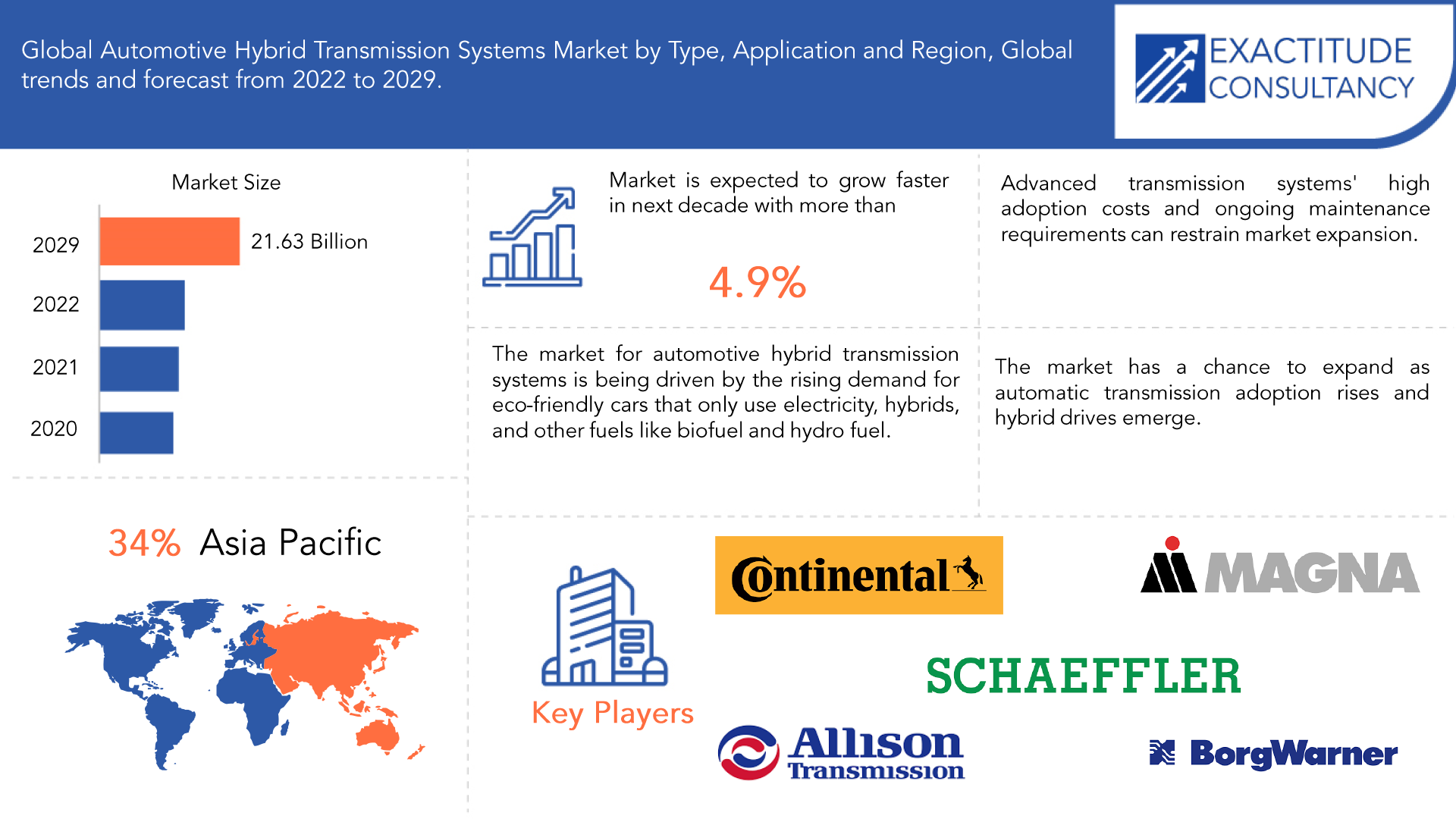
Si prevede che il mercato dei sistemi di trasmissione ibridi per autoveicoli crescerà al 4,9% di CAGR dal 2022 al 2029. Si prevede che raggiungerà oltre 21,63 miliardi di USD entro il 2029 dagli 11,49 miliardi di USD del 2020.
Un sistema che trasmette potenza dal motore alle ruote per guidare un veicolo ibrido è definito sistema di trasmissione ibrido per automobili. Nelle auto ibride sono disponibili molteplici fonti di propulsione. Gli obiettivi fondamentali di qualsiasi sistema di trasmissione sono di raggiungere efficienza di trasmissione, gamme di motori ad alta efficienza e cambi di marcia molto reattivi.
Un sistema di trasmissione ibrido automobilistico è un sistema che trae la sua potenza da due o più fonti diverse, come i sottomarini che funzionano a batterie quando sono immersi e a gasolio quando sono in superficie. Gli ibridi idraulici che utilizzano fluido pressurizzato sono un altro modo per immagazzinare energia. Il motore e il motore elettrico lavorano insieme nei sistemi di trasmissione ibrida automobilistica con trasmissioni ibride parallele per produrre la potenza che spinge le ruote. Rispetto alle trasmissioni in serie, gli ibridi paralleli hanno in genere un pacco batteria più piccolo e si affidano alla frenata rigenerativa per mantenere la batteria carica.
L'ascesa del settore dei trasporti è influenzata da una serie di variabili, tra cui la crescita della popolazione, la globalizzazione e la crescente urbanizzazione. L'espansione dell'eCommerce e dei servizi di trasporto merci è un altro fattore che contribuisce all'espansione del settore dei trasporti globali. La domanda di sistemi di trasmissione durevoli ed efficienti per le auto è aumentata da quando l'industria automobilistica globale è in forte crescita.
La necessità di grandi veicoli commerciali, come camion e rimorchi, che richiedono molta potenza per azionare le ruote, sta aumentando con la crescita del settore logistico e della catena di fornitura globale. La trasmissione e le ruote ricevono assistenza dal sistema di trasmissione nel trasferimento della coppia del motore.
| ATTRIBUTO | DETTAGLI |
| Periodo di studio | 2020-2029 |
| Anno base | 2022 |
| Anno stimato | 2022 |
| Anno previsto | 2022-2029 |
| Periodo storico | 2018-2020 |
| Unità | Valore (miliardi di USD) |
| Segmentazione | Per tipo, applicazione e regione |
| Per tipo |
|
| Per applicazione |
|
| Per regione |
|
Il mercato dei sistemi di trasmissione ibrida per autoveicoli è guidato dalla crescente domanda di auto ecologiche che utilizzano solo elettricità, ibridi e altri carburanti come biocarburanti e idrocarburi. Alcuni elementi principali di supporto che guidano l'espansione del mercato includono un aumento nello sviluppo del sistema di trasmissione avanzato da parte degli OEM e un aumento del numero di attori chiave per un veicolo ibrido . Inoltre, la crescente consapevolezza dei consumatori sui veicoli ibridi sta alimentando il mercato dei sistemi di trasmissione ibrida per autoveicoli.
Le norme governative per la sicurezza, le emissioni di carbonio e le automobili leggere hanno costretto gli OEM a utilizzare parti che contribuiranno a ridurre il peso complessivo del veicolo. Gli OEM sono sotto pressione costante per ridurre le emissioni inquinanti delle auto. A livello globale, gli acquirenti nei paesi industrializzati sono più propensi a scegliere auto nuove, a basso consumo di carburante, rispettose dell'ambiente con prestazioni migliorate e livelli di inquinamento più bassi. Per ridurre ulteriormente il peso del veicolo completo, i produttori stanno lavorando principalmente per alleggerire diversi componenti.
Uno dei principali ostacoli per i produttori è l'elevato costo dei sistemi di trasmissione. Ciò è dovuto principalmente al fatto che i consumatori privilegiano l'economicità rispetto alle prestazioni.
La spesa per l'utilizzo di materiali leggeri e leghe che riducono il peso si aggiunge al costo complessivo di produzione di sistemi di trasmissione efficaci e leggeri. Inoltre, questa significativa fluttuazione dei prezzi potrebbe anche essere responsabile di variazioni di qualità che potrebbero avere un impatto negativo sul mercato globale delle trasmissioni per auto. Pertanto, il problema è sviluppare trasmissioni che siano sia efficaci che convenienti.
[caption id="allegato_14383" align="aligncenter" width="1920"]
Frequently Asked Questions
What is the worth of automotive hybrid transmission systems market?
The automotive hybrid transmission systems market is expected to grow at 4.9% CAGR from 2022 to 2029. It is expected to reach above USD 21.63 billion by 2029 from USD 11.49 billion in 2020.
What is the size of the Asia Pacific automotive hybrid transmission systems market industry?
Asia Pacific held more than 34% of the automotive hybrid transmission systems market revenue share in 2020 and will witness expansion in the forecast period.
What are the main driving forces behind the automotive hybrid transmission systems market's expansion?
The market for automotive hybrid transmission systems is being driven by the rising demand for eco-friendly cars that only use electricity, hybrids, and other fuels like biofuel and hydro fuel.
Which are the top companies to hold the market share in automotive hybrid transmission systems market?
The top companies to hold the market share in automotive hybrid transmission systems market are Continental, Aisin, BorgWarner, ZF, Allison Transmission, AVL, Eaton, GETRAG, JATCO, Magna International, Schaeffler, and others.
Which is the largest regional market for automotive hybrid transmission systems market?
Asia Pacific is the largest regional market for automotive hybrid transmission systems market.
Automotive Hybrid Transmission Systems Market Segment Analysis
The automotive hybrid transmission systems market is segmented by type into series type hybrid transmission system, parallel type hybrid transmission system, and mixed type hybrid transmission system. According to estimates, the power split design will dominate the hybrid transmission market. The hybrid transmission industry will grow as a result of the power split design, which combines series and parallel hybrids to produce a highly effective system that will be widely employed in hybrid electric vehicles (HEV). Furthermore, a power split architecture can function as a hybrid in either series or parallel. Due to the power split architecture's decoupling of the generator and motor speeds, which gives drivers more control over their vehicles, the market for hybrid transmissions will experience tremendous development.
Further the automotive hybrid transmission systems market is segmented by application into full HEV and mild HEV. Full HEV segment accounted for the largest market share. A full hybrid (FHEV) vehicle can run solely on a combustion engine (diesel or gasoline), an electric engine (battery power), or a combination of both. Mild hybrid cars have an electric motor attached to the internal combustion engine (ICE), allowing the engine to be swiftly restarted while the car is coasting, braking, or halted. Mild hybrid vehicles don't have a mode of propulsion that is exclusively electric. These cars use regenerative braking and some form of ICE power assistance. The market's potential has been taken into account when analyzing the mild hybrid vehicles' aforementioned attributes.
[caption id="attachment_14392" align="aligncenter" width="1920"]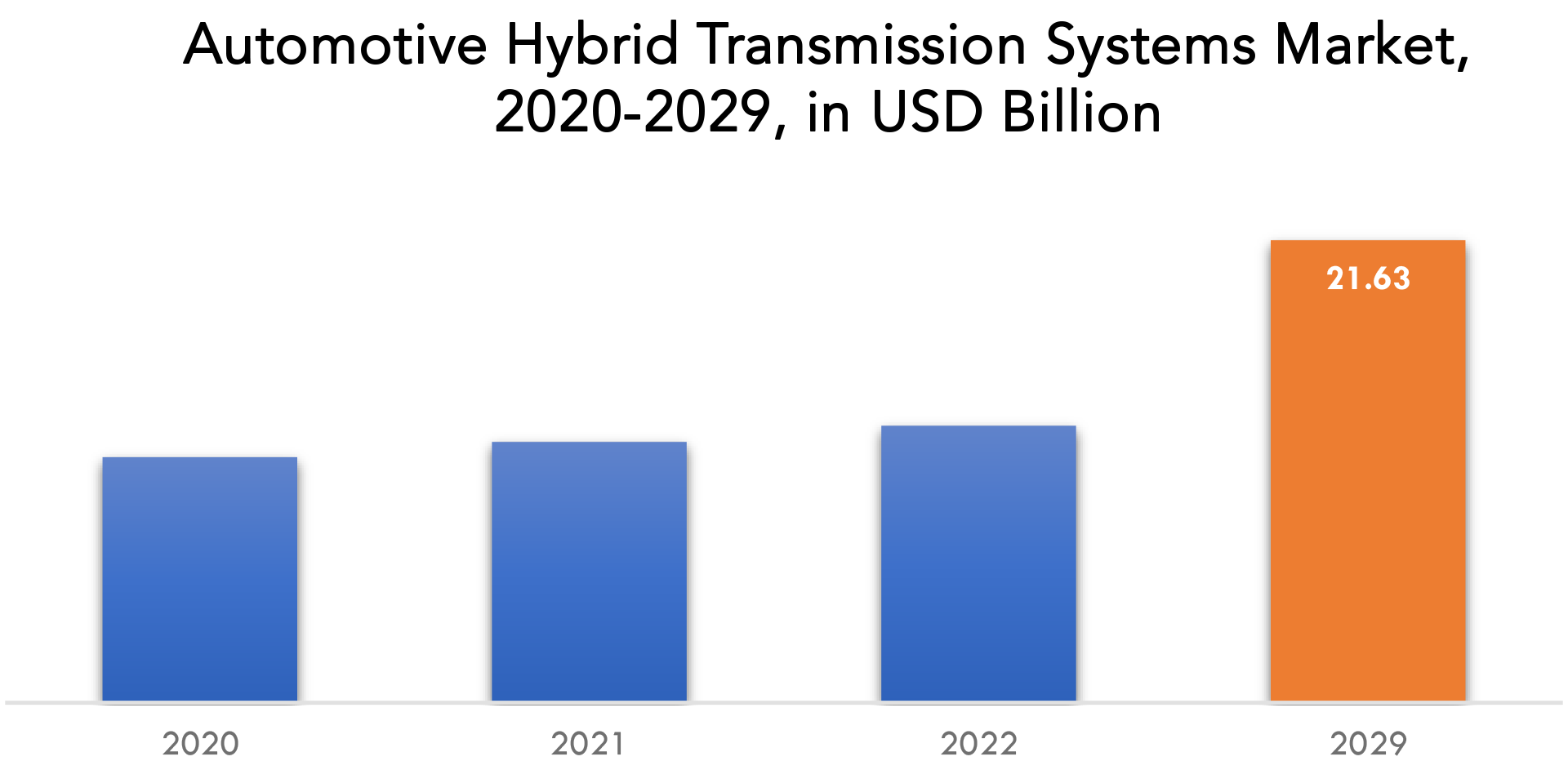
Automotive Hybrid Transmission Systems Market Key Players
The automotive hybrid transmission systems market key players include Continental, Aisin, BorgWarner, ZF, Allison Transmission, AVL, Eaton, GETRAG, JATCO, Magna International, Schaeffler, and others.
Recent Developments:Eaton launched the TVS® X3100 Twin Vortices Series supercharger in 2022 for aftermarket use. The X-Series is a brand-new design that draws inspiration from both the R-Series and V-Series rotors. It was created especially for aftermarket clients whose main objective is to achieve optimum airflow efficiency at faster supercharger speeds.
In 2022, Continental purchased NorrVulk AB, a Swedish company that specializes in conveyor belt systems and services, with headquarters in Gällivare. The technology company's portfolio for the sale of conveyor belt systems and related services is enhanced by this acquisition, which also enhances its relationships with industrial clients in the area.
Who Should Buy? Or Key stakeholders
- Automotive Hybrid Transmission Systems Market Suppliers
- Providers of Automotive Hybrid Transmission Systems
- Research Organizations
- Investors
- Regulatory Authorities
- Others
Automotive Hybrid Transmission Systems Market Regional Analysis
The automotive hybrid transmission systems market by region includes Asia Pacific, Asia-Pacific (APAC), Europe, South America, and Middle East & Africa (MEA).
- Asia Pacific: includes the US, Canada, Mexico
- Asia Pacific: includes China, Japan, South Korea, India, Australia, ASEAN and Rest of APAC
- Europe: includes UK, Germany, France, Italy, Spain, Russia, and Rest of Europe
- South America: includes Brazil, Argentina and Rest of South America
- Middle East & Africa: includes Turkey, UAE, Saudi Arabia, South Africa, and Rest of MEA
The primary growth markets are anticipated to be in Asia Pacific, Europe, and Asia Pacific due to the rising vehicle production and shifting consumer and adoption trends. During the anticipated period, the automotive hybrid transmission systems market in Asia Pacific is anticipated to be the largest and fastest-growing. The market for automotive hybrid transmission systems is anticipated to expand along with the growth of the global automotive industry. Emissions from the transportation industry will rise as car demand rises. In order to ensure sustainable mobility, the players in the automotive sector are concentrating on improving vehicle performance to reduce emissions. Maximizing fuel efficiency and reducing emissions are the main priorities.
[caption id="attachment_14395" align="aligncenter" width="1920"]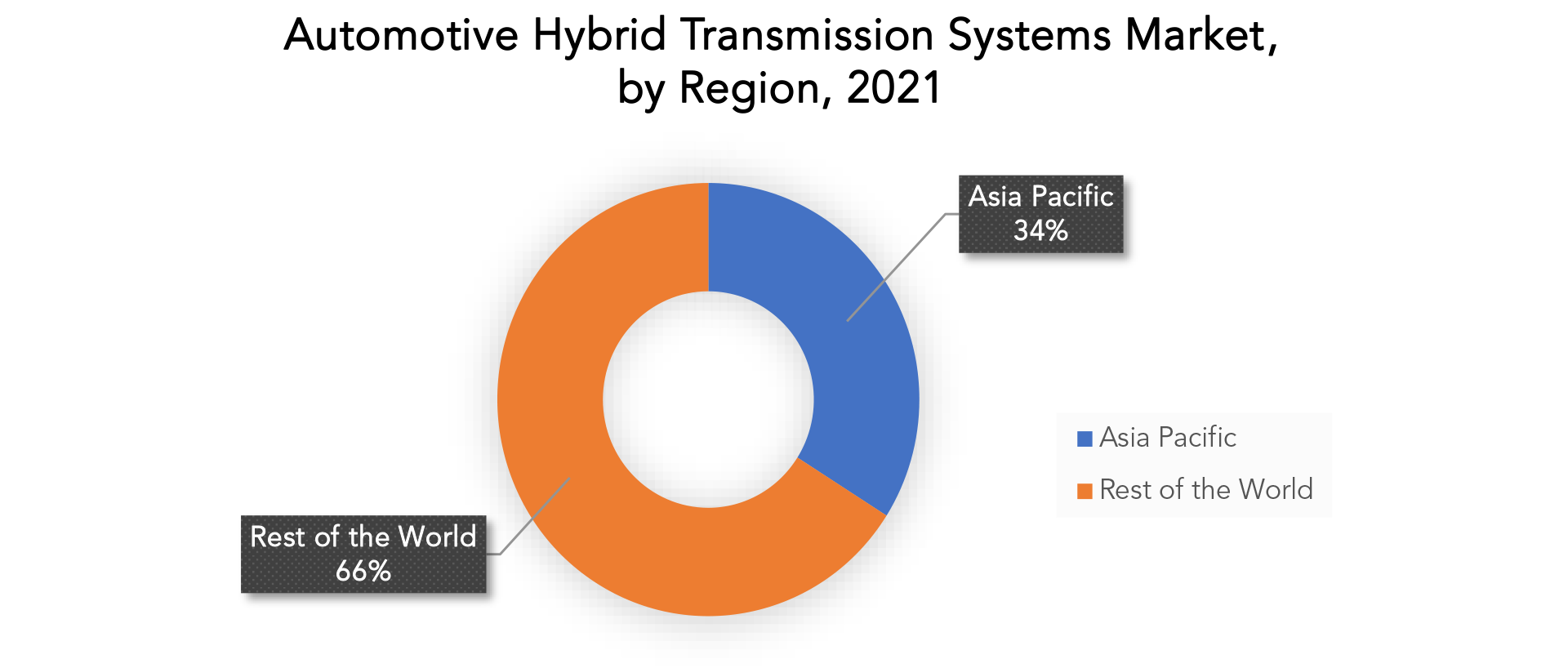
Key Market Segments: Automotive Hybrid Transmission Systems Market
Automotive Hybrid Transmission Systems Market By Type, 2020-2029, (Usd Billion)- Series Type Hybrid Transmission System
- Parallel Type Hybrid Transmission System
- Mixed Type Hybrid Transmission System
- Full Hev
- Mild Hev
- Asia Pacific
- Europe
- Asia Pacific
- South America
- Middle East And Africa
Key Question Answered
- What is the current size of the automotive hybrid transmission systems market?
- What are the key factors influencing the growth of automotive hybrid transmission systems market?
- What are the major applications for automotive hybrid transmission systems market?
- Who are the major key players in the automotive hybrid transmission systems market?
- Which region will provide more business opportunities automotive hybrid transmission systems market in future?
- Which segment holds the maximum share of the automotive hybrid transmission systems market?
- INTRODUZIONE
- DEFINIZIONE DI MERCATO
- SEGMENTAZIONE DEL MERCATO
- TEMPI DI RICERCA
- ASSUNZIONI E LIMITAZIONI
- METODOLOGIA DI RICERCA
- ESTRAZIONE DATI
- RICERCA SECONDARIA
- RICERCA PRIMARIA
- PARERI DEGLI ESPERTI IN MATERIA
- CONTROLLI DI QUALITÀ
- RECENSIONE FINALE
- TRIANGOLAZIONE DEI DATI
- APPROCCIO DAL BASSO VERSO L'ALTO
- APPROCCIO TOP-DOWN
- FLUSSO DI RICERCA
- FONTI DEI DATI
- ESTRAZIONE DATI
- SINTESI
- PANORAMICA DEL MERCATO
- PROSPETTIVE DEL MERCATO GLOBALE DEI SISTEMI DI TRASMISSIONE IBRIDI PER AUTOMOBILI
- FATTORI DI MERCATO
- LIMITAZIONI DI MERCATO
- OPPORTUNITÀ DI MERCATO
- IMPATTO DEL COVID-19 SUL MERCATO DEI SISTEMI DI TRASMISSIONE IBRIDI PER AUTOMOBILI
- MODELLO DELLE CINQUE FORZE DI PORTER
- MINACCIA DAI NUOVI ENTRANSI
- MINACCIA DA SOSTITUTI
- POTERE CONTRATTUALE DEI FORNITORI
- POTERE CONTRATTUALE DEI CLIENTI
- GRADO DI COMPETIZIONE
- ANALISI DELLA CATENA DEL VALORE DEL SETTORE
- PROSPETTIVE DEL MERCATO GLOBALE DEI SISTEMI DI TRASMISSIONE IBRIDI PER AUTOMOBILI
- MERCATO GLOBALE DEI SISTEMI DI TRASMISSIONE IBRIDI PER AUTOMOBILI PER TIPOLOGIA, 2022-2029, (MILIARDI DI USD)
- SISTEMA DI TRASMISSIONE IBRIDO TIPO SERIE
- SISTEMA DI TRASMISSIONE IBRIDO DI TIPO PARALLELO
- SISTEMA DI TRASMISSIONE IBRIDO DI TIPO MISTA
- MERCATO GLOBALE DEI SISTEMI DI TRASMISSIONE IBRIDI PER AUTOMOBILI PER APPLICAZIONE, 2022-2029, (MILIARDI DI USD)
- HEV COMPLETO
- HEV MITE
- GLOBAL AUTOMOTIVE HYBRID TRANSMISSION SYSTEMS MARKET BY REGION, 2022-2029, (USD BILLION)
- NORTH AMERICA
- US
- CANADA
- MEXICO
- SOUTH AMERICA
- BRAZIL
- ARGENTINA
- COLOMBIA
- REST OF SOUTH AMERICA
- EUROPE
- GERMANY
- UK
- FRANCE
- ITALY
- SPAIN
- RUSSIA
- REST OF EUROPE
- ASIA PACIFIC
- INDIA
- CHINA
- JAPAN
- SOUTH KOREA
- AUSTRALIA
- SOUTH-EAST ASIA
- REST OF ASIA PACIFIC
- MIDDLE EAST AND AFRICA
- UAE
- SAUDI ARABIA
- SOUTH AFRICA
- REST OF MIDDLE EAST AND AFRICA
- NORTH AMERICA
- COMPANY PROFILES*(BUSINESS OVERVIEW, COMPANY SNAPSHOT, PRODUCTS OFFERED, RECENT DEVELOPMENTS)
- CONTINENTAL
- AISIN, BORGWARNER
- ZF
- ALLISON TRANSMISSION
- AVL
- EATON
- GETRAG
- JATCO
- MAGNA INTERNATIONAL
- SCHAEFFLER *THE COMPANY LIST IS INDICATIVE
LIST OF TABLES
TABLE 1 GLOBAL AUTOMOTIVE HYBRID TRANSMISSION SYSTEMS MARKET BY TYPE (USD BILLION) 2020-2029
TABLE 2 GLOBAL AUTOMOTIVE HYBRID TRANSMISSION SYSTEMS MARKET BY APPLICATION (USD BILLION) 2020-2029
TABLE 3 GLOBAL AUTOMOTIVE HYBRID TRANSMISSION SYSTEMS MARKET BY REGION (USD BILLION) 2020-2029
TABLE 4 NORTH AMERICA AUTOMOTIVE HYBRID TRANSMISSION SYSTEMS MARKET BY COUNTRY (USD BILLION) 2020-2029
TABLE 5 NORTH AMERICA AUTOMOTIVE HYBRID TRANSMISSION SYSTEMS MARKET BY TYPE (USD BILLION) 2020-2029
TABLE 6 NORTH AMERICA AUTOMOTIVE HYBRID TRANSMISSION SYSTEMS MARKET BY APPLICATION (USD BILLION) 2020-2029
TABLE 7 US AUTOMOTIVE HYBRID TRANSMISSION SYSTEMS MARKET BY TYPE (USD BILLION) 2020-2029
TABLE 8 US AUTOMOTIVE HYBRID TRANSMISSION SYSTEMS MARKET BY APPLICATION (USD BILLION) 2020-2029
TABLE 9 CANADA AUTOMOTIVE HYBRID TRANSMISSION SYSTEMS MARKET BY TYPE (USD BILLION) 2020-2029
TABLE 10 CANADA AUTOMOTIVE HYBRID TRANSMISSION SYSTEMS MARKET BY APPLICATION (USD BILLION) 2020-2029
TABLE 11 MEXICO AUTOMOTIVE HYBRID TRANSMISSION SYSTEMS MARKET BY TYPE (USD BILLION) 2020-2029
TABLE 12 MEXICO AUTOMOTIVE HYBRID TRANSMISSION SYSTEMS MARKET BY APPLICATION (USD BILLION) 2020-2029
TABLE 13 SOUTH AMERICA AUTOMOTIVE HYBRID TRANSMISSION SYSTEMS MARKET BY COUNTRY (USD BILLION) 2020-2029
TABLE 14 SOUTH AMERICA AUTOMOTIVE HYBRID TRANSMISSION SYSTEMS MARKET BY TYPE (USD BILLION) 2020-2029
TABLE 15 SOUTH AMERICA AUTOMOTIVE HYBRID TRANSMISSION SYSTEMS MARKET BY APPLICATION (USD BILLION) 2020-2029
TABLE 16 BRAZIL AUTOMOTIVE HYBRID TRANSMISSION SYSTEMS MARKET BY TYPE (USD BILLION) 2020-2029
TABLE 17 BRAZIL AUTOMOTIVE HYBRID TRANSMISSION SYSTEMS MARKET BY APPLICATION (USD BILLION) 2020-2029
TABLE 18 ARGENTINA AUTOMOTIVE HYBRID TRANSMISSION SYSTEMS MARKET BY TYPE (USD BILLION) 2020-2029
TABLE 19 ARGENTINA AUTOMOTIVE HYBRID TRANSMISSION SYSTEMS MARKET BY APPLICATION (USD BILLION) 2020-2029
TABLE 20 COLOMBIA AUTOMOTIVE HYBRID TRANSMISSION SYSTEMS MARKET BY TYPE (USD BILLION) 2020-2029
TABLE 21 COLOMBIA AUTOMOTIVE HYBRID TRANSMISSION SYSTEMS MARKET BY APPLICATION (USD BILLION) 2020-2029
TABLE 22 REST OF SOUTH AMERICA AUTOMOTIVE HYBRID TRANSMISSION SYSTEMS MARKET BY TYPE (USD BILLION) 2020-2029
TABLE 23 REST OF SOUTH AMERICA AUTOMOTIVE HYBRID TRANSMISSION SYSTEMS MARKET BY APPLICATION (USD BILLION) 2020-2029
TABLE 24 ASIA-PACIFIC AUTOMOTIVE HYBRID TRANSMISSION SYSTEMS MARKET BY COUNTRY (USD BILLION) 2020-2029
TABLE 25 ASIA-PACIFIC AUTOMOTIVE HYBRID TRANSMISSION SYSTEMS MARKET BY TYPE (USD BILLION) 2020-2029
TABLE 26 ASIA-PACIFIC AUTOMOTIVE HYBRID TRANSMISSION SYSTEMS MARKET BY APPLICATION (USD BILLION) 2020-2029
TABLE 27 INDIA AUTOMOTIVE HYBRID TRANSMISSION SYSTEMS MARKET BY TYPE (USD BILLION) 2020-2029
TABLE 28 INDIA AUTOMOTIVE HYBRID TRANSMISSION SYSTEMS MARKET BY APPLICATION (USD BILLION) 2020-2029
TABLE 29 CHINA AUTOMOTIVE HYBRID TRANSMISSION SYSTEMS MARKET BY TYPE (USD BILLION) 2020-2029
TABLE 30 CHINA AUTOMOTIVE HYBRID TRANSMISSION SYSTEMS MARKET BY APPLICATION (USD BILLION) 2020-2029
TABLE 31 JAPAN AUTOMOTIVE HYBRID TRANSMISSION SYSTEMS MARKET BY TYPE (USD BILLION) 2020-2029
TABLE 32 JAPAN AUTOMOTIVE HYBRID TRANSMISSION SYSTEMS MARKET BY APPLICATION (USD BILLION) 2020-2029
TABLE 33 SOUTH KOREA AUTOMOTIVE HYBRID TRANSMISSION SYSTEMS MARKET BY TYPE (USD BILLION) 2020-2029
TABLE 34 SOUTH KOREA AUTOMOTIVE HYBRID TRANSMISSION SYSTEMS MARKET BY APPLICATION (USD BILLION) 2020-2029
TABLE 35 AUSTRALIA AUTOMOTIVE HYBRID TRANSMISSION SYSTEMS MARKET BY TYPE (USD BILLION) 2020-2029
TABLE 36 AUSTRALIA AUTOMOTIVE HYBRID TRANSMISSION SYSTEMS MARKET BY APPLICATION (USD BILLION) 2020-2029
TABLE 37 SOUTH-EAST ASIA AUTOMOTIVE HYBRID TRANSMISSION SYSTEMS MARKET BY TYPE (USD BILLION) 2020-2029
TABLE 38 SOUTH-EAST ASIA AUTOMOTIVE HYBRID TRANSMISSION SYSTEMS MARKET BY APPLICATION (USD BILLION) 2020-2029
TABLE 39 REST OF ASIA PACIFIC AUTOMOTIVE HYBRID TRANSMISSION SYSTEMS MARKET BY TYPE (USD BILLION) 2020-2029
TABLE 40 REST OF ASIA PACIFIC AUTOMOTIVE HYBRID TRANSMISSION SYSTEMS MARKET BY APPLICATION (USD BILLION) 2020-2029
TABLE 41 EUROPE AUTOMOTIVE HYBRID TRANSMISSION SYSTEMS MARKET BY COUNTRY (USD BILLION) 2020-2029
TABLE 42 ASIA-PACIFIC AUTOMOTIVE HYBRID TRANSMISSION SYSTEMS MARKET BY TYPE (USD BILLION) 2020-2029
TABLE 43 ASIA-PACIFIC AUTOMOTIVE HYBRID TRANSMISSION SYSTEMS MARKET BY APPLICATION (USD BILLION) 2020-2029
TABLE 44 GERMANY AUTOMOTIVE HYBRID TRANSMISSION SYSTEMS MARKET BY TYPE (USD BILLION) 2020-2029
TABLE 45 GERMANY AUTOMOTIVE HYBRID TRANSMISSION SYSTEMS MARKET BY APPLICATION (USD BILLION) 2020-2029
TABLE 46 UK AUTOMOTIVE HYBRID TRANSMISSION SYSTEMS MARKET BY TYPE (USD BILLION) 2020-2029
TABLE 47 UK AUTOMOTIVE HYBRID TRANSMISSION SYSTEMS MARKET BY APPLICATION (USD BILLION) 2020-2029
TABLE 48 FRANCE AUTOMOTIVE HYBRID TRANSMISSION SYSTEMS MARKET BY TYPE (USD BILLION) 2020-2029
TABLE 49 FRANCE AUTOMOTIVE HYBRID TRANSMISSION SYSTEMS MARKET BY APPLICATION (USD BILLION) 2020-2029
TABLE 50 ITALY AUTOMOTIVE HYBRID TRANSMISSION SYSTEMS MARKET BY TYPE (USD BILLION) 2020-2029
TABLE 51 ITALY AUTOMOTIVE HYBRID TRANSMISSION SYSTEMS MARKET BY APPLICATION (USD BILLION) 2020-2029
TABLE 52 SPAIN AUTOMOTIVE HYBRID TRANSMISSION SYSTEMS MARKET BY TYPE (USD BILLION) 2020-2029
TABLE 53 SPAIN AUTOMOTIVE HYBRID TRANSMISSION SYSTEMS MARKET BY APPLICATION (USD BILLION) 2020-2029
TABLE 54 RUSSIA AUTOMOTIVE HYBRID TRANSMISSION SYSTEMS MARKET BY TYPE (USD BILLION) 2020-2029
TABLE 55 RUSSIA AUTOMOTIVE HYBRID TRANSMISSION SYSTEMS MARKET BY APPLICATION (USD BILLION) 2020-2029
TABLE 56 REST OF EUROPE AUTOMOTIVE HYBRID TRANSMISSION SYSTEMS MARKET BY TYPE (USD BILLION) 2020-2029
TABLE 57 REST OF EUROPE AUTOMOTIVE HYBRID TRANSMISSION SYSTEMS MARKET BY APPLICATION (USD BILLION) 2020-2029
TABLE 58 MIDDLE EAST AND AFRICA AUTOMOTIVE HYBRID TRANSMISSION SYSTEMS MARKET BY COUNTRY (USD BILLION) 2020-2029
TABLE 59 MIDDLE EAST AND AFRICA AUTOMOTIVE HYBRID TRANSMISSION SYSTEMS MARKET BY TYPE (USD BILLION) 2020-2029
TABLE 60 MIDDLE EAST AND AFRICA AUTOMOTIVE HYBRID TRANSMISSION SYSTEMS MARKET BY APPLICATION (USD BILLION) 2020-2029
TABLE 61 UAE AUTOMOTIVE HYBRID TRANSMISSION SYSTEMS MARKET BY TYPE (USD BILLION) 2020-2029
TABLE 62 UAE AUTOMOTIVE HYBRID TRANSMISSION SYSTEMS MARKET BY APPLICATION (USD BILLION) 2020-2029
TABLE 63 SAUDI ARABIA AUTOMOTIVE HYBRID TRANSMISSION SYSTEMS MARKET BY TYPE (USD BILLION) 2020-2029
TABLE 64 SAUDI ARABIA AUTOMOTIVE HYBRID TRANSMISSION SYSTEMS MARKET BY APPLICATION (USD BILLION) 2020-2029
TABLE 65 SOUTH AFRICA AUTOMOTIVE HYBRID TRANSMISSION SYSTEMS MARKET BY TYPE (USD BILLION) 2020-2029
TABLE 66 SOUTH AFRICA AUTOMOTIVE HYBRID TRANSMISSION SYSTEMS MARKET BY APPLICATION (USD BILLION) 2020-2029
TABLE 67 REST OF MIDDLE EAST AND AFRICA AUTOMOTIVE HYBRID TRANSMISSION SYSTEMS MARKET BY TYPE (USD BILLION) 2020-2029
TABLE 68 REST OF MIDDLE EAST AND AFRICA AUTOMOTIVE HYBRID TRANSMISSION SYSTEMS MARKET BY APPLICATION (USD BILLION) 2020-2029
LIST OF FIGURES
FIGURE 1 MARKET DYNAMICS
FIGURE 2 MARKET SEGMENTATION
FIGURE 3 REPORT TIMELINES: YEARS CONSIDERED
FIGURE 4 DATA TRIANGULATION
FIGURE 5 BOTTOM-UP APPROACH
FIGURE 6 TOP-DOWN APPROACH
FIGURE 7 RESEARCH FLOW
FIGURE 8 GLOBAL AUTOMOTIVE HYBRID TRANSMISSION SYSTEMS MARKET BY RESIN TYPE, USD BILLION, 2022-2029
FIGURE 9 GLOBAL AUTOMOTIVE HYBRID TRANSMISSION SYSTEMS MARKET BY APPLICATION, USD BILLION, 2022-2029
FIGURE 10 GLOBAL AUTOMOTIVE HYBRID TRANSMISSION SYSTEMS MARKET BY REGION, USD BILLION, 2022-2029
FIGURE 11 PORTER’S FIVE FORCES MODEL
FIGURE 12 GLOBAL AUTOMOTIVE HYBRID TRANSMISSION SYSTEMS MARKET BY RESIN TYPE, USD BILLION, 2021
FIGURE 13 GLOBAL AUTOMOTIVE HYBRID TRANSMISSION SYSTEMS MARKET BY APPLICATION, USD BILLION, 2021
FIGURE 14 GLOBAL AUTOMOTIVE HYBRID TRANSMISSION SYSTEMS MARKET BY REGION, USD BILLION, 2021
FIGURE 15 MARKET SHARE ANALYSIS
FIGURE 16 CONTINENTAL: COMPANY SNAPSHOT
FIGURE 17 AISIN: COMPANY SNAPSHOT
FIGURE 18 BORGWARNER: COMPANY SNAPSHOT
FIGURE 19 ZF: COMPANY SNAPSHOT
FIGURE 20 ALLISON TRANSMISSION: COMPANY SNAPSHOT
FIGURE 21 AVL: COMPANY SNAPSHOT
FIGURE 22 EATON: COMPANY SNAPSHOT
FIGURE 23 GETRAG: COMPANY SNAPSHOT
FIGURE 24 JATCO: COMPANY SNAPSHOT
FIGURE 25 MAGNA INTERNATIONAL: COMPANY SNAPSHOT
FIGURE 26 SCHAEFFLER: COMPANY SNAPSHOT
DOWNLOAD FREE SAMPLE REPORT
License Type
SPEAK WITH OUR ANALYST
Want to know more about the report or any specific requirement?
WANT TO CUSTOMIZE THE REPORT?
Our Clients Speak
We asked them to research ‘ Equipment market’ all over the world, and their whole arrangement was helpful to us. thehealthanalytics.com insightful analysis and reports contributed to our current analysis and in creating a future strategy. Besides, the te
Yosuke Mitsui
Senior Associate Construction Equipment Sales & Marketing
We asked them to research ‘Equipment market’ all over the world, and their whole arrangement was helpful to us. thehealthanalytics.com insightful analysis and reports contributed to our current analysis and in creating a future strategy. Besides, the te