

Base Year Value ()
x.x %
x.x %
CAGR ()
x.x %
x.x %
Forecast Year Value ()
x.x %
x.x %
Historical Data Period
Largest Region
Forecast Period
Mercato della proteomica per prodotti (strumenti, reagenti e kit, servizi di proteomica di base), per tecnologia (strumenti per microarray, cristallografia a raggi X, spettroscopia, cromatografia, sistemi di frazionamento proteico, elettroforesi, sistemi di risonanza al plasma di superficie), per applicazione (scoperta di farmaci, diagnosi clinica, ricerca sul cancro), per utente finale (organizzazioni di ricerca a contratto, istituti di ricerca e accademici, aziende farmaceutiche e biotecnologiche) e regione, tendenze globali e previsioni dal 2023 al 2029
Instant access to hundreds of data points and trends
- Market estimates from 2014-2029
- Competitive analysis, industry segmentation, financial benchmarks
- Incorporates SWOT, Porter's Five Forces and risk management frameworks
- PDF report or online database with Word, Excel and PowerPoint export options
- 100% money back guarantee
Panoramica del mercato della proteomica
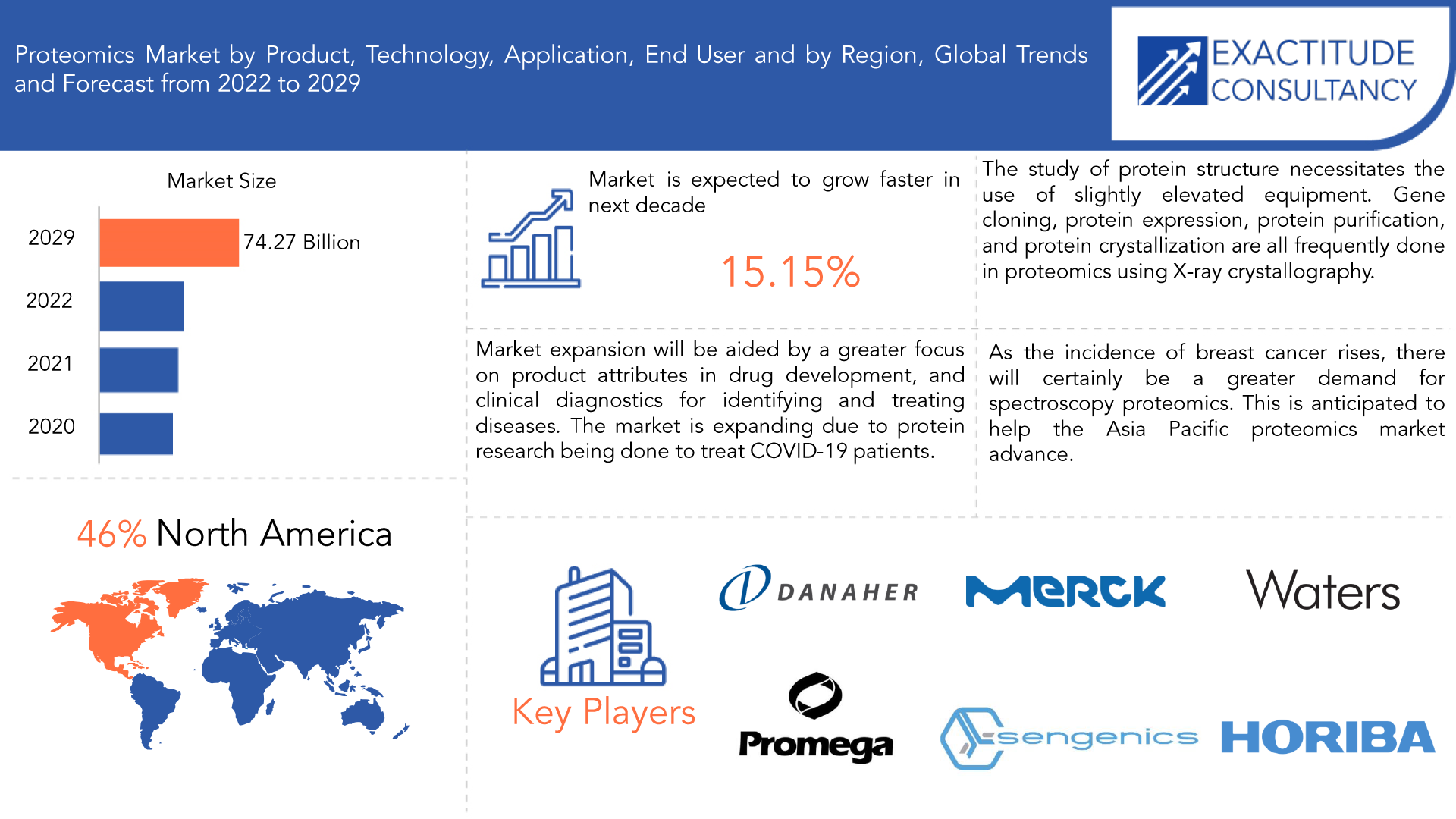
Si prevede che il mercato della proteomica crescerà al 15,15% di CAGR dal 2023 al 2029. Si prevede che raggiungerà oltre 74,27 miliardi di USD entro il 2029 dai 21,79 miliardi di USD del 2022.
Un proteoma è l'intero set di proteine che un sistema o un organismo genera. Può cambiare a seconda del tempo, delle specifiche e degli stress a cui un organismo è sottoposto. La proteomica è definita come il ramo della biotecnologia che si occupa di utilizzare la biologia molecolare, la biochimica e le tecniche genetiche per esaminare la struttura, la funzione e le interazioni delle proteine prodotte dai geni di una cellula, tessuto o organismo specifico, cercando di organizzare le informazioni in database e applicando i dati (come in medicina o biologia). La ricerca proteomica è lo studio sistematico su larga scala delle proteine. Poiché le proteine sono i mattoni fondamentali delle cellule, la ricerca proteomica cerca di rispondere a tutte le domande su di esse.
La ricerca sulla proteomica può trarre vantaggio dai progressi nella spettrometria di massa e nei database di sequenze di proteine e DNA. Per l'identificazione delle proteine, la determinazione quantitativa e il riconoscimento delle interazioni proteiche, la proteomica richiede un set diversificato di strumenti, macchinari, reagenti, supporti e software. Alcuni dei tipi più comuni di proteomica sono classificati come proteomica strutturale, proteomica di espressione e proteomica funzionale. La cristallografia a raggi X e la spettroscopia di risonanza magnetica nucleare sono due tecnologie utilizzate nella proteomica strutturale. Nella proteomica di espressione, vengono utilizzate tecnologie come 2D-PAGE e spettrometria di massa, mentre la cromatografia di affinità viene implementata per isolare i sub-proteomi.
| ATTRIBUTO | DETTAGLI |
| Periodo di studio | 2020-2029 |
| Anno base | 2021 |
| Anno stimato | 2022 |
| Anno previsto | 2022-2029 |
| Periodo storico | 2018-2020 |
| Unità | Valore (miliardi di USD) |
| Segmentazione | Per prodotto, per tecnologia, per applicazione, per utente finale, per regione |
| Con la tecnologia della resina |
|
| Per tecnologia |
|
| Per applicazione |
|
| Per utente finale |
|
| Per regione |
|
L'epidemia di COVID-19 ha ostacolato le operazioni nel settore sanitario globale. La malattia ha temporaneamente spinto diversi settori, tra cui parti del settore sanitario, a chiudere i battenti. La pandemia ha aumentato notevolmente la domanda di servizi di proteomica nel 2020, il che ha portato a una modesta crescita nel mercato mondiale della proteomica.
Inoltre, l'identificazione di proteine specifiche per il COVID-19 è stata resa possibile dall'applicazione di metodi di spettrometria di massa all'avanguardia. Tuttavia, si prevede che il mercato della proteomica crescerà costantemente nel 2021 e si espanderà a un CAGR considerevole per tutto il periodo di previsione. Ciò è spiegato dall'aumento dell'uso di medicinali su misura per il trattamento di malattie specifiche durante il COVID-19, nonché da un aumento dell'innovazione tecnologica nel campo della proteomica.
[caption id="allegato_15068" align="aligncenter" width="1024"]
Frequently Asked Questions
• What is the worth of Proteomics Market?
The Proteomics Market size had crossed USD 21.79 Billion in 2020 and will observe a CAGR of more than 15.15% up to 2029.
• What are some of the market's driving forces?
Major factors driving the proteomics market growth include the rise in the geriatric population demanding personalized medicines, growing demand for advanced diagnostics in targeted disease treatment, growing prevalence of target diseases, growing demand for therapeutic medicines, and outbreak of COVID-19.
• Which are the top companies to hold the market share in Proteomics Market?
Thermo Fisher Scientific Inc., Merck KGaA, Waters Corporation, GE Healthcare, Luminex Corporation, Bio-Rad Laboratories Inc, Agilent Technologies Inc., Li-Cor Inc, Bruker Corporation, Perkin Elmer Inc, Creative Proteomics, Promega Corporation, Sengenics, Danaher Corporation, Horiba Ltd. are the major Proteomics market players.
• Which is the largest regional market for Proteomics Market?
The region's largest share is in North America. Products manufactured in nations like US and Canada that perform similarly and are inexpensively accessible to the general public have led to the increasing appeal.
Proteomics Market Segment Analysis
The proteomics market is segmented based on products, technology, application, end user, and region, global trends and forecast.
On the basis of products, the market is segmented into instruments, reagents & kits, core proteomics services.
The worldwide proteomics market is divided into services, reagents & kits, and instruments based on product. In 2021, more than 70% of global revenue came from the reagents and kits market. The segment is anticipated to increase at the fastest rate throughout the course of the projection period. This is because academic institutions, research labs, and other institutions frequently employ reagents, kits, chemicals, and strips for the inspection of diverse biological samples, which will enhance demand for reagents & kits and support sector growth. Proteomics market expansion would also be supported by technological developments in sophisticated tools, such as 2-d electrophoresis protein analyzers, that increase the productivity, throughput, and speed of biological research.
On the basis of technology, the market is segmented into microarray instruments, x-ray crystallography, spectroscopy, chromatography, protein fractionation systems, electrophoresis, surface plasma resonance systems.
The segment with the largest income share in 2021—more than 47.00%—was spectroscopy. During the forecast period, it is anticipated to increase at the fastest rate going forward. The widespread use of spectroscopy-based technologies in numerous analytical applications, such as drug development procedures, proteomics, metabolomics, forensic analysis, and pharmaceutical analysis, is one of the key reasons fueling the segment's expansion.
On the basis of application, the market is segmented into drug discovery, clinical diagnosis, cancer research.
In 2021, the clinical diagnostics segment held a share of more than 51.65%, dominating the market. This is explained by the widespread use of protein analysis in clinical research to find illness biomarkers for early disease identification and to pinpoint specific risk factors. It is anticipated that this would open up new avenues for illness prevention and early intervention. Proteomics-based diagnostics makes it feasible to find prospective biomarkers and protein expression patterns that might be used to identify, forecast, and assess the prognosis of malignancies, which supports the segment's expansion.
On the other hand, it is predicted that during the projected time, the drug discovery segment will increase at the fastest rate. The expansion of this market can be attributed to the development of structure-based drug design, increased emphasis on developing specially chosen, and increased funding in these fields. Proteomics technologies also provide a mechanism to demonstrate a medicine's potential early in the drug discovery process, saving pharmaceutical companies a large sum of money and ultimately helping patients and healthcare systems, which supports the segment's expansion.
On the basis of end user, the market is segmented into contract research organizations, research & academic institutes, pharma & biotech companies.
By the ending of 2023, the research and academic institutions sector is anticipated to have a bigger market share of around 51.5%. An increase in research and development activities, a diversity of ongoing proteome studies for the treatment of various life-threatening diseases, and an increase in life science projects in research and academic settings are all contributing to the increased demand for molecular biology, enzymes, reagents, and kits.
[caption id="attachment_15083" align="aligncenter" width="1920"]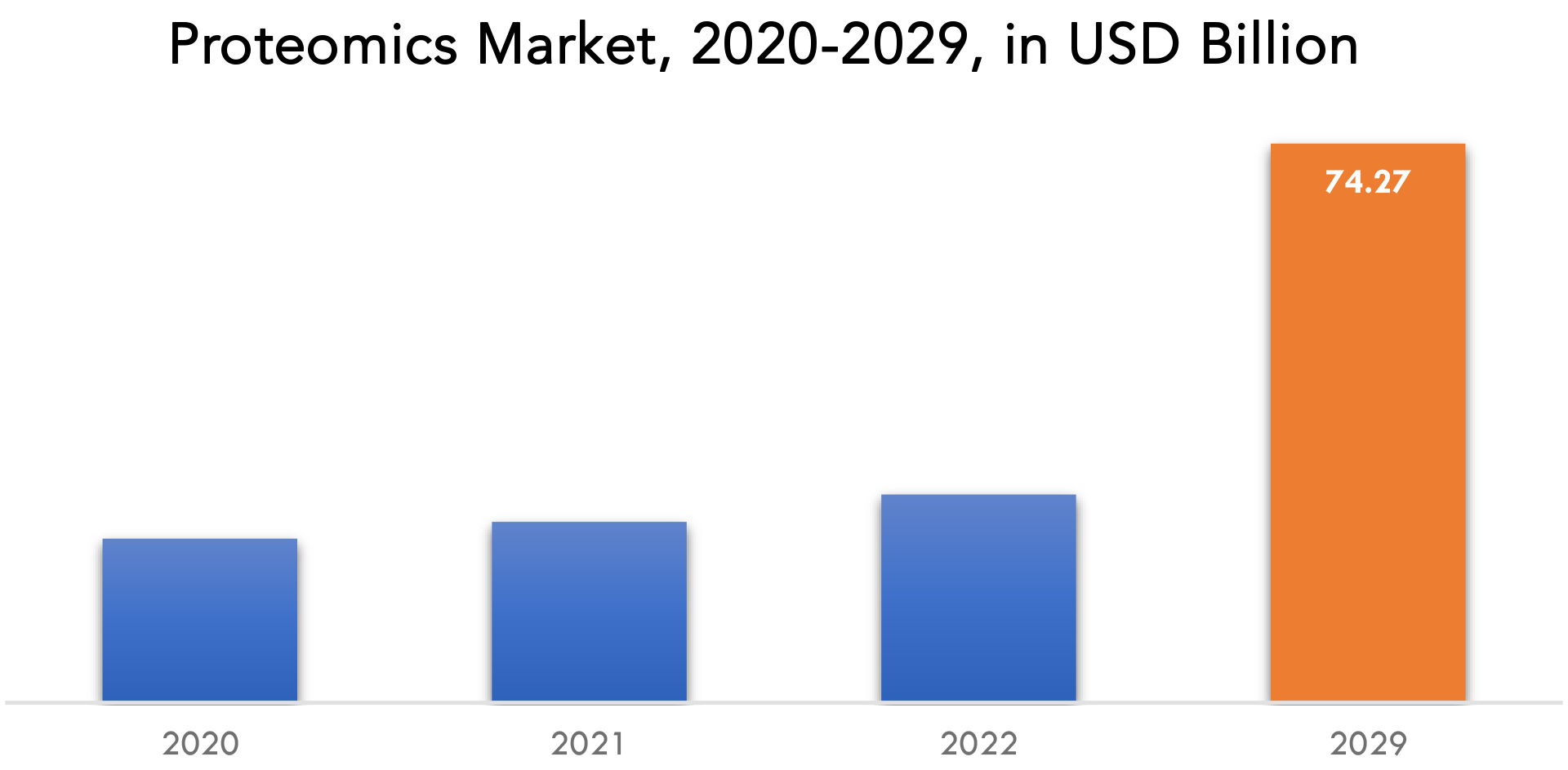
Proteomics Market Players
Thermo Fisher Scientific Inc., Merck KGaA, Waters Corporation, GE Healthcare, Luminex Corporation, Bio-Rad Laboratories Inc, Agilent Technologies Inc., Li-Cor Inc, Bruker Corporation, Perkin Elmer Inc, Creative Proteomics, Promega Corporation, Sengenics, Danaher Corporation, Horiba Ltd. are the major Proteomics market players.
6 February, 2023: Thermo Fisher Scientific announced its collaboration with Celltrio to bring a fully automated cell system to biotherapeutics customers. Thermo Fisher will take on responsibility for sales, installation and support in Europe.
22 December, 2022: Merck announced a research collaboration and commercial license agreement with Mersana Therapeutics, Inc., to discover novel antibody-drug conjugates leveraging Mersana’s proprietary Immunosynthen STING-agonist ADC platform.
Who Should Buy? Or Key Stakeholders
- Pharmaceutical Companies
- Research and Development (R&D) Companies
- Diagnostic Laboratories
- Government Research Institute
- Academic Institutes and Universities
- Investors
- Regulatory Authorities
Proteomics Market Regional Analysis
The Proteomics Market by region includes North America, Asia-Pacific (APAC), Europe, South America, and Middle East & Africa (MEA).
- North America: includes the US, Canada, Mexico
- Asia Pacific: includes China, Japan, South Korea, India, Australia, ASEAN and Rest of APAC
- Europe: includes UK, Germany, France, Italy, Spain, Russia, and Rest of Europe
- South America: includes Brazil, Argentina and Rest of South America
- Middle East & Africa: includes Turkey, UAE, Saudi Arabia, South Africa, and Rest of MEA
With a 45.90% revenue share in 2021, North America dominated the sector. The development of structure-based drug design, development of omics research, desire for high-quality research tools for data reproducibility, and focus on the creation of customized treatments are all attributed with this. Partnerships and cooperation among leading businesses in this area are also helping to expand this sector.
Due to increased outsourcing of proteomics-based projects, public and private funding for research and development for proteomics studies, advantageous government regulations, rising prevalence of target diseases with an older workforce, and rising proteomics adoption, the Asia Pacific region is predicted to grow at the fastest CAGR between 2022 and 2030. For instance, the Department of Biotechnology of the Indian tax payer funded 60 million dollars to the University of Hyderabad in November 2021 to study the tomato proteome. Such government initiatives to promote the proteomics study are driving the market in Asia Pacific.
[caption id="attachment_15090" align="aligncenter" width="1920"]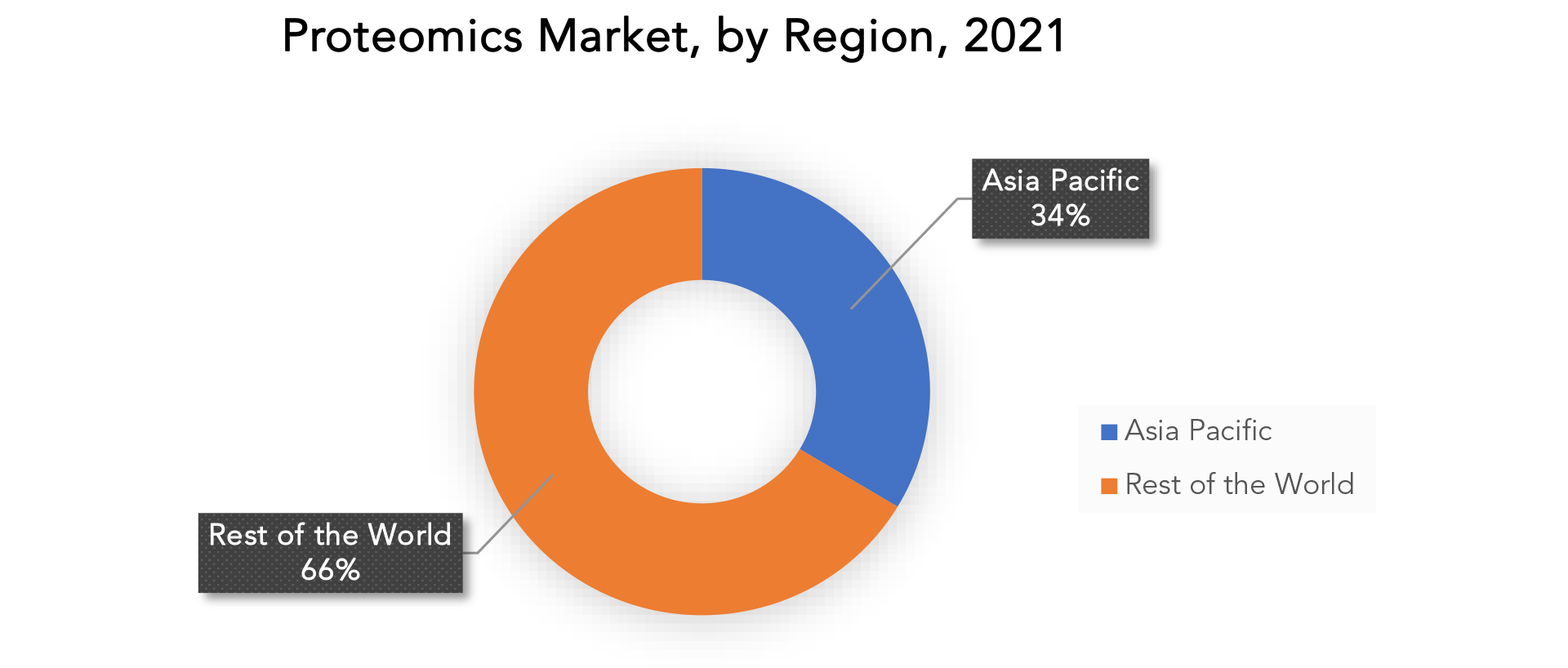
Key Market Segments: Proteomics Market
Proteomics Market By Product, 2020-2029, (USD Billion)- Instruments
- Reagents & Kits
- Core Proteomics Services
- Microarray Instruments
- X-Ray Crystallography
- Spectroscopy
- Chromatography
- Protein Fractionation Systems
- Electrophoresis
- Surface Plasma Resonance Systems
- Drug Discovery
- Clinical Diagnosis
- Cancer Research
- Contract Research Organizations
- Research & Academic Institutes
- Pharma & Biotech Companies
- North America
- Asia Pacific
- Europe
- South America
- Middle East and Africa
Exactitude Consultancy Core Proteomics Services Key Objectives:
- Increasing sales and market share
- Developing new technology
- Improving profitability
- Entering new markets
- Enhancing brand reputation
Key Question Answered
- What is the expected growth rate of the Proteomics market over the next 7 years?
- Who are the major players in the Proteomics market and what is their market share?
- What are the end-user industries driving demand for market and what is their outlook?
- What are the opportunities for growth in emerging markets such as Asia-Pacific, Middle East, and Africa?
- How is the economic environment affecting the Proteomics market, including factors such as interest rates, inflation, and exchange rates?
- What is the expected impact of government policies and regulations on the Proteomics market?
- What is the current and forecasted size and growth rate of the global Proteomics market?
- What are the key drivers of growth in the Proteomics market?
- What are the distribution channels and supply chain dynamics in the Proteomics market?
- What are the technological advancements and innovations in the Proteomics market and their impact on product development and growth?
- What are the regulatory considerations and their impact on the market?
- What are the challenges faced by players in the Proteomics market and how are they addressing these challenges?
- What are the opportunities for growth and expansion in the Proteomics market?
- What are the service offerings and specifications of leading players in the market?
- Introduzione
- Definizione di mercato
- Segmentazione del mercato
- Cronologie della ricerca
- Presupposti e limitazioni
- Metodologia di ricerca
- Estrazione dei dati
- Ricerca secondaria
- Ricerca primaria
- Consigli degli esperti in materia
- Controlli di qualità
- Revisione finale
- Triangolazione dei dati
- Approccio dal basso verso l'alto
- Approccio dall'alto verso il basso
- Flusso di ricerca
- Fonti dei dati
- Estrazione dei dati
- Sintesi
- Panoramica del mercato
- Prospettive del mercato globale della proteomica
- Fattori trainanti del mercato
- Limitazioni di mercato
- Opportunità di mercato
- Impatto del Covid-19 sul mercato della proteomica
- Modello delle cinque forze di Porter
- Minaccia da parte dei nuovi entranti
- Minaccia da sostituti
- Potere contrattuale dei fornitori
- Potere contrattuale dei clienti
- Grado di concorrenza
- Analisi della catena del valore del settore
- Prospettive del mercato globale della proteomica
- Mercato globale della proteomica per prodotto (miliardi di USD), 2020-2029
- Strumenti
- Reagenti e kit
- Servizi di proteomica di base
- Mercato globale della proteomica per tecnologia (miliardi di USD), 2020-2029
- Strumenti per microarray
- Cristallografia a raggi X
- Spettroscopia
- Cromatografia
- Sistemi di frazionamento proteico
- Elettroforesi
- Sistemi di risonanza al plasma di superficie
- Mercato globale della proteomica per applicazione (miliardi di USD), 2020-2029
- Scoperta di farmaci
- Diagnostica clinica
- Ricerca sul cancro
- Mercato globale della proteomica per utente finale (miliardi di USD), 2020-2029
- Organizzazioni di ricerca a contratto
- Ricerca e istituti accademici
- Aziende farmaceutiche e biotecnologiche
- Mercato globale della proteomica per regione (miliardi di USD), 2020-2029
- America del Nord
- NOI
- Canada
- Messico
- Sud America
- Brasile
- Argentina
- Colombia
- Resto del Sud America
- Europa
- Germania
- Regno Unito
- Francia
- Italia
- Spagna
- Russia
- Resto d'Europa
- Asia Pacifico
- India
- Cina
- Giappone
- Corea del Sud
- Australia
- Asia sud-orientale
- Resto dell'Asia Pacifica
- Medio Oriente e Africa
- Emirati Arabi Uniti
- Arabia Saudita
- Sudafrica
- Resto del Medio Oriente e Africa
- America del Nord
- Profili aziendali*
(Panoramica aziendale, istantanea aziendale, prodotti offerti, sviluppi recenti)
- Thermo Fisher Scientific Inc.
- Merck KGaA
- Società di acque
- Assistenza sanitaria GE
- Società Luminex
- Laboratori Bio-Rad Inc.
- Agilent Technologies Inc.
- Li-Cor Inc
- Bruker Corporation
- Perkin Elmer Inc
- Creative Proteomics
- Promega Corporation
- Sengenics
- Danaher Corporation
- Horiba Ltd
*The Company List Is Indicative
LIST OF TABLES
TABLE 1 GLOBAL PROTEOMICS MARKET BY APPLICATION (USD BILLION) 2020-2029
TABLE 2 GLOBAL PROTEOMICS MARKET BY PRODUCT (USD BILLION) 2020-2029
TABLE 3 GLOBAL PROTEOMICS MARKET BY END USER (USD BILLION) 2020-2029
TABLE 4 GLOBAL PROTEOMICS MARKET BY TECHNOLOGY (USD BILLION) 2020-2029
TABLE 5 GLOBAL PROTEOMICS MARKET BY REGION (USD BILLION) 2020-2029
TABLE 6 NORTH AMERICA PROTEOMICS MARKET BY COUNTRY (USD BILLION) 2020-2029
TABLE 7 NORTH AMERICA PROTEOMICS MARKET BY APPLICATION (USD BILLION) 2020-2029
TABLE 8 NORTH AMERICA PROTEOMICS MARKET BY PRODUCT (USD BILLION) 2020-2029
TABLE 9 NORTH AMERICA PROTEOMICS MARKET BY END USER (USD BILLION) 2020-2029
TABLE 10 NORTH AMERICA PROTEOMICS MARKET BY TECHNOLOGY (USD BILLION) 2020-2029
TABLE 11 US PROTEOMICS MARKET BY APPLICATION (USD BILLION) 2020-2029
TABLE 12 US PROTEOMICS MARKET BY PRODUCT (USD BILLION) 2020-2029
TABLE 13 US PROTEOMICS MARKET BY END USER (USD BILLION) 2020-2029
TABLE 14 US PROTEOMICS MARKET BY TECHNOLOGY (USD BILLION) 2020-2029
TABLE 15 CANADA PROTEOMICS MARKET BY APPLICATION (USD BILLION) 2020-2029
TABLE 16 CANADA PROTEOMICS MARKET BY PRODUCT (USD BILLION) 2020-2029
TABLE 17 CANADA PROTEOMICS MARKET BY END USER (USD BILLION) 2020-2029
TABLE 18 CANADA PROTEOMICS MARKET BY TECHNOLOGY (USD BILLION) 2020-2029
TABLE 19 MEXICO PROTEOMICS MARKET BY APPLICATION (USD BILLION) 2020-2029
TABLE 20 MEXICO PROTEOMICS MARKET BY PRODUCT (USD BILLION) 2020-2029
TABLE 21 MEXICO PROTEOMICS MARKET BY END USER (USD BILLION) 2020-2029
TABLE 22 MEXICO PROTEOMICS MARKET BY TECHNOLOGY (USD BILLION) 2020-2029
TABLE 23 SOUTH AMERICA PROTEOMICS MARKET BY COUNTRY (USD BILLION) 2020-2029
TABLE 24 SOUTH AMERICA PROTEOMICS MARKET BY APPLICATION (USD BILLION) 2020-2029
TABLE 25 SOUTH AMERICA PROTEOMICS MARKET BY PRODUCT (USD BILLION) 2020-2029
TABLE 26 SOUTH AMERICA PROTEOMICS MARKET BY END USER (USD BILLION) 2020-2029
TABLE 27 SOUTH AMERICA PROTEOMICS MARKET BY TECHNOLOGY (USD BILLION) 2020-2029
TABLE 28 BRAZIL PROTEOMICS MARKET BY APPLICATION (USD BILLION) 2020-2029
TABLE 29 BRAZIL PROTEOMICS MARKET BY PRODUCT (USD BILLION) 2020-2029
TABLE 30 BRAZIL PROTEOMICS MARKET BY END USER (USD BILLION) 2020-2029
TABLE 31 BRAZIL PROTEOMICS MARKET BY TECHNOLOGY (USD BILLION) 2020-2029
TABLE 32 ARGENTINA PROTEOMICS MARKET BY APPLICATION (USD BILLION) 2020-2029
TABLE 33 ARGENTINA PROTEOMICS MARKET BY PRODUCT (USD BILLION) 2020-2029
TABLE 34 ARGENTINA PROTEOMICS MARKET BY END USER (USD BILLION) 2020-2029
TABLE 35 ARGENTINA PROTEOMICS MARKET BY TECHNOLOGY (USD BILLION) 2020-2029
TABLE 36 COLOMBIA PROTEOMICS MARKET BY APPLICATION (USD BILLION) 2020-2029
TABLE 37 COLOMBIA PROTEOMICS MARKET BY PRODUCT (USD BILLION) 2020-2029
TABLE 38 COLOMBIA PROTEOMICS MARKET BY END USER (USD BILLION) 2020-2029
TABLE 39 COLOMBIA PROTEOMICS MARKET BY TECHNOLOGY (USD BILLION) 2020-2029
TABLE 40 REST OF SOUTH AMERICA PROTEOMICS MARKET BY APPLICATION (USD BILLION) 2020-2029
TABLE 41 REST OF SOUTH AMERICA PROTEOMICS MARKET BY PRODUCT (USD BILLION) 2020-2029
TABLE 42 REST OF SOUTH AMERICA PROTEOMICS MARKET BY END USER (USD BILLION) 2020-2029
TABLE 43 REST OF SOUTH AMERICA PROTEOMICS MARKET BY TECHNOLOGY (USD BILLION) 2020-2029
TABLE 44 ASIA-PACIFIC PROTEOMICS MARKET BY COUNTRY (USD BILLION) 2020-2029
TABLE 45 ASIA-PACIFIC PROTEOMICS MARKET BY APPLICATION (USD BILLION) 2020-2029
TABLE 46 ASIA-PACIFIC PROTEOMICS MARKET BY PRODUCT (USD BILLION) 2020-2029
TABLE 47 ASIA-PACIFIC PROTEOMICS MARKET BY END USER (USD BILLION) 2020-2029
TABLE 48 ASIA-PACIFIC PROTEOMICS MARKET BY TECHNOLOGY (USD BILLION) 2020-2029
TABLE 49 INDIA PROTEOMICS MARKET BY APPLICATION (USD BILLION) 2020-2029
TABLE 50 INDIA PROTEOMICS MARKET BY PRODUCT (USD BILLION) 2020-2029
TABLE 51 INDIA PROTEOMICS MARKET BY END USER (USD BILLION) 2020-2029
TABLE 52 INDIA PROTEOMICS MARKET BY TECHNOLOGY (USD BILLION) 2020-2029
TABLE 53 CHINA PROTEOMICS MARKET BY APPLICATION (USD BILLION) 2020-2029
TABLE 54 CHINA PROTEOMICS MARKET BY PRODUCT (USD BILLION) 2020-2029
TABLE 55 CHINA PROTEOMICS MARKET BY END USER (USD BILLION) 2020-2029
TABLE 56 CHINA PROTEOMICS MARKET BY TECHNOLOGY (USD BILLION) 2020-2029
TABLE 57 JAPAN PROTEOMICS MARKET BY APPLICATION (USD BILLION) 2020-2029
TABLE 58 JAPAN PROTEOMICS MARKET BY PRODUCT (USD BILLION) 2020-2029
TABLE 59 JAPAN PROTEOMICS MARKET BY END USER (USD BILLION) 2020-2029
TABLE 60 JAPAN PROTEOMICS MARKET BY TECHNOLOGY (USD BILLION) 2020-2029
TABLE 61 SOUTH KOREA PROTEOMICS MARKET BY APPLICATION (USD BILLION) 2020-2029
TABLE 62 SOUTH KOREA PROTEOMICS MARKET BY PRODUCT (USD BILLION) 2020-2029
TABLE 63 SOUTH KOREA PROTEOMICS MARKET BY END USER (USD BILLION) 2020-2029
TABLE 64 SOUTH KOREA PROTEOMICS MARKET BY TECHNOLOGY (USD BILLION) 2020-2029
TABLE 65 AUSTRALIA PROTEOMICS MARKET BY APPLICATION (USD BILLION) 2020-2029
TABLE 66 AUSTRALIA PROTEOMICS MARKET BY PRODUCT (USD BILLION) 2020-2029
TABLE 67 AUSTRALIA PROTEOMICS MARKET BY END USER (USD BILLION) 2020-2029
TABLE 68 AUSTRALIA PROTEOMICS MARKET BY TECHNOLOGY (USD BILLION) 2020-2029
TABLE 69 SOUTH-EAST ASIA PROTEOMICS MARKET BY APPLICATION (USD BILLION) 2020-2029
TABLE 70 SOUTH-EAST ASIA PROTEOMICS MARKET BY PRODUCT (USD BILLION) 2020-2029
TABLE 71 SOUTH-EAST ASIA PROTEOMICS MARKET BY END USER (USD BILLION) 2020-2029
TABLE 72 SOUTH-EAST ASIA PROTEOMICS MARKET BY TECHNOLOGY (USD BILLION) 2020-2029
TABLE 73 REST OF ASIA PACIFIC PROTEOMICS MARKET BY APPLICATION (USD BILLION) 2020-2029
TABLE 74 REST OF ASIA PACIFIC PROTEOMICS MARKET BY PRODUCT (USD BILLION) 2020-2029
TABLE 75 REST OF ASIA PACIFIC PROTEOMICS MARKET BY END USER (USD BILLION) 2020-2029
TABLE 76 REST OF ASIA PACIFIC PROTEOMICS MARKET BY TECHNOLOGY (USD BILLION) 2020-2029
TABLE 77 EUROPE PROTEOMICS MARKET BY COUNTRY (USD BILLION) 2020-2029
TABLE 78 ASIA-PACIFIC PROTEOMICS MARKET BY APPLICATION (USD BILLION) 2020-2029
TABLE 79 ASIA-PACIFIC PROTEOMICS MARKET BY PRODUCT (USD BILLION) 2020-2029
TABLE 80 ASIA-PACIFIC PROTEOMICS MARKET BY END USER (USD BILLION) 2020-2029
TABLE 81 ASIA-PACIFIC PROTEOMICS MARKET BY TECHNOLOGY (USD BILLION) 2020-2029
TABLE 82 GERMANY PROTEOMICS MARKET BY APPLICATION (USD BILLION) 2020-2029
TABLE 83 GERMANY PROTEOMICS MARKET BY PRODUCT (USD BILLION) 2020-2029
TABLE 84 GERMANY PROTEOMICS MARKET BY END USER (USD BILLION) 2020-2029
TABLE 85 GERMANY PROTEOMICS MARKET BY TECHNOLOGY (USD BILLION) 2020-2029
TABLE 86 UK PROTEOMICS MARKET BY APPLICATION (USD BILLION) 2020-2029
TABLE 87 UK PROTEOMICS MARKET BY PRODUCT (USD BILLION) 2020-2029
TABLE 88 UK PROTEOMICS MARKET BY END USER (USD BILLION) 2020-2029
TABLE 89 UK PROTEOMICS MARKET BY TECHNOLOGY (USD BILLION) 2020-2029
TABLE 90 FRANCE PROTEOMICS MARKET BY APPLICATION (USD BILLION) 2020-2029
TABLE 91 FRANCE PROTEOMICS MARKET BY PRODUCT (USD BILLION) 2020-2029
TABLE 92 FRANCE PROTEOMICS MARKET BY END USER (USD BILLION) 2020-2029
TABLE 93 FRANCE PROTEOMICS MARKET BY TECHNOLOGY (USD BILLION) 2020-2029
TABLE 94 ITALY PROTEOMICS MARKET BY APPLICATION (USD BILLION) 2020-2029
TABLE 95 ITALY PROTEOMICS MARKET BY PRODUCT (USD BILLION) 2020-2029
TABLE 96 ITALY PROTEOMICS MARKET BY END USER (USD BILLION) 2020-2029
TABLE 97 ITALY PROTEOMICS MARKET BY TECHNOLOGY (USD BILLION) 2020-2029
TABLE 98 SPAIN PROTEOMICS MARKET BY APPLICATION (USD BILLION) 2020-2029
TABLE 99 SPAIN PROTEOMICS MARKET BY PRODUCT (USD BILLION) 2020-2029
TABLE 100 SPAIN PROTEOMICS MARKET BY END USER (USD BILLION) 2020-2029
TABLE 101 SPAIN PROTEOMICS MARKET BY TECHNOLOGY (USD BILLION) 2020-2029
TABLE 102 RUSSIA PROTEOMICS MARKET BY APPLICATION (USD BILLION) 2020-2029
TABLE 103 RUSSIA PROTEOMICS MARKET BY PRODUCT (USD BILLION) 2020-2029
TABLE 104 RUSSIA PROTEOMICS MARKET BY END USER (USD BILLION) 2020-2029
TABLE 105 RUSSIA PROTEOMICS MARKET BY TECHNOLOGY (USD BILLION) 2020-2029
TABLE 106 REST OF EUROPE PROTEOMICS MARKET BY APPLICATION (USD BILLION) 2020-2029
TABLE 107 REST OF EUROPE PROTEOMICS MARKET BY PRODUCT (USD BILLION) 2020-2029
TABLE 108 REST OF EUROPE PROTEOMICS MARKET BY END USER (USD BILLION) 2020-2029
TABLE 109 REST OF EUROPE PROTEOMICS MARKET BY TECHNOLOGY (USD BILLION) 2020-2029
TABLE 110 MIDDLE EAST AND AFRICA PROTEOMICS MARKET BY COUNTRY (USD BILLION) 2020-2029
TABLE 111 MIDDLE EAST AND AFRICA PROTEOMICS MARKET BY APPLICATION (USD BILLION) 2020-2029
TABLE 112 MIDDLE EAST AND AFRICA PROTEOMICS MARKET BY PRODUCT (USD BILLION) 2020-2029
TABLE 113 MIDDLE EAST AND AFRICA PROTEOMICS MARKET BY END USER (USD BILLION) 2020-2029
TABLE 114 MIDDLE EAST AND AFRICA PROTEOMICS MARKET BY TECHNOLOGY (USD BILLION) 2020-2029
TABLE 115 UAE PROTEOMICS MARKET BY APPLICATION (USD BILLION) 2020-2029
TABLE 116 UAE PROTEOMICS MARKET BY PRODUCT (USD BILLION) 2020-2029
TABLE 117 UAE PROTEOMICS MARKET BY END USER (USD BILLION) 2020-2029
TABLE 118 UAE PROTEOMICS MARKET BY TECHNOLOGY (USD BILLION) 2020-2029
TABLE 119 SAUDI ARABIA PROTEOMICS MARKET BY APPLICATION (USD BILLION) 2020-2029
TABLE 120 SAUDI ARABIA PROTEOMICS MARKET BY PRODUCT (USD BILLION) 2020-2029
TABLE 121 SAUDI ARABIA PROTEOMICS MARKET BY END USER (USD BILLION) 2020-2029
TABLE 122 SAUDI ARABIA PROTEOMICS MARKET BY TECHNOLOGY (USD BILLION) 2020-2029
TABLE 123 SOUTH AFRICA PROTEOMICS MARKET BY APPLICATION (USD BILLION) 2020-2029
TABLE 124 SOUTH AFRICA PROTEOMICS MARKET BY PRODUCT (USD BILLION) 2020-2029
TABLE 125 SOUTH AFRICA PROTEOMICS MARKET BY END USER (USD BILLION) 2020-2029
TABLE 126 SOUTH AFRICA PROTEOMICS MARKET BY TECHNOLOGY (USD BILLION) 2020-2029
TABLE 127 REST OF MIDDLE EAST AND AFRICA PROTEOMICS MARKET BY APPLICATION (USD BILLION) 2020-2029
TABLE 128 REST OF MIDDLE EAST AND AFRICA PROTEOMICS MARKET BY PRODUCT (USD BILLION) 2020-2029
TABLE 129 REST OF MIDDLE EAST AND AFRICA PROTEOMICS MARKET BY END USER (USD BILLION) 2020-2029
TABLE 130 REST OF MIDDLE EAST AND AFRICA PROTEOMICS MARKET BY TECHNOLOGY (USD BILLION) 2020-2029
LIST OF FIGURES
FIGURE 1 MARKET DYNAMICS
FIGURE 2 REPORT TIMELINES: YEARS CONSIDERED
FIGURE 3 BOTTOM-UP APPROACH
FIGURE 4 RESEARCH FLOW
FIGURE 5 GLOBAL PROTEOMICS MARKET BY PRODUCTS, USD BILLION, 2020-2029
FIGURE 6 GLOBAL PROTEOMICS MARKET BY TECHNOLOGY, USD BILLION, 2020-2029
FIGURE 7 GLOBAL PROTEOMICS MARKET BY APPLICATION, USD BILLION, 2020-2029
FIGURE 8 GLOBAL PROTEOMICS MARKET BY END USER, USD BILLION, 2020-2029
FIGURE 9 GLOBAL PROTEOMICS MARKET BY REGION, USD BILLION, 2020-2029
FIGURE 10 PORTER’S FIVE FORCES MODEL
FIGURE 11 GLOBAL PROTEOMICS MARKET BY PRODUCT, USD BILLION, 2021
FIGURE 12 GLOBAL PROTEOMICS MARKET BY TECHNOLOGY, USD BILLION, 2021
FIGURE 13 GLOBAL PROTEOMICS MARKET BY APPLICATION, USD BILLION, 2021
FIGURE 14 GLOBAL PROTEOMICS MARKET BY END USER, USD BILLION, 2021
FIGURE 15 GLOBAL PROTEOMICS MARKET BY REGION, USD BILLION, 2021
FIGURE 16 MARKET SHARE ANALYSIS
FIGURE 17 THERMO FISHER SCIENTIFIC INC.: COMPANY SNAPSHOT
FIGURE 18 MERCK KGAA: COMPANY SNAPSHOT
FIGURE 19 WATERS CORPORATION: COMPANY SNAPSHOT
FIGURE 20 GE HEALTHCARE: COMPANY SNAPSHOT
FIGURE 21 LUMINEX CORPORATION: COMPANY SNAPSHOT
FIGURE 22 BIO-RAD LABORATORIES INC: COMPANY SNAPSHOT
FIGURE 23 AGILENT TECHNOLOGIES INC.: COMPANY SNAPSHOT
FIGURE 24 LI-COR INC.: COMPANY SNAPSHOT
FIGURE 25 BRUKER CORPORATION: COMPANY SNAPSHOT
FIGURE 26 PERKIN ELMER INC: COMPANY SNAPSHOT
FIGURE 27 CREATIVE PROTEOMICS: COMPANY SNAPSHOT
FIGURE 28 PROMEGA CORPORATION: COMPANY SNAPSHOT
FIGURE 29 SENGENICS: COMPANY SNAPSHOT
FIGURE 30 DANAHER CORPORATION: COMPANY SNAPSHOT
FIGURE 31 HORIBA LTD: COMPANY SNAPSHOT
DOWNLOAD FREE SAMPLE REPORT
License Type
SPEAK WITH OUR ANALYST
Want to know more about the report or any specific requirement?
WANT TO CUSTOMIZE THE REPORT?
Our Clients Speak
We asked them to research ‘ Equipment market’ all over the world, and their whole arrangement was helpful to us. thehealthanalytics.com insightful analysis and reports contributed to our current analysis and in creating a future strategy. Besides, the te
Yosuke Mitsui
Senior Associate Construction Equipment Sales & Marketing
We asked them to research ‘Equipment market’ all over the world, and their whole arrangement was helpful to us. thehealthanalytics.com insightful analysis and reports contributed to our current analysis and in creating a future strategy. Besides, the te