

Base Year Value ()
x.x %
x.x %
CAGR ()
x.x %
x.x %
Forecast Year Value ()
x.x %
x.x %
Historical Data Period
Largest Region
Forecast Period
IoT nel mercato dei dispositivi medici per prodotto (misuratore di pressione sanguigna, glucometro, monitor cardiaco, pulsossimetro, pompa per infusione), per tipo (indossabile, impiantabile, fisso), per utente finale (ospedali e cliniche, case di cura, altri) e regione, tendenze globali e previsioni dal 2022 al 2029.
Instant access to hundreds of data points and trends
- Market estimates from 2014-2029
- Competitive analysis, industry segmentation, financial benchmarks
- Incorporates SWOT, Porter's Five Forces and risk management frameworks
- PDF report or online database with Word, Excel and PowerPoint export options
- 100% money back guarantee
Panoramica del mercato dell'IoT nei dispositivi medici
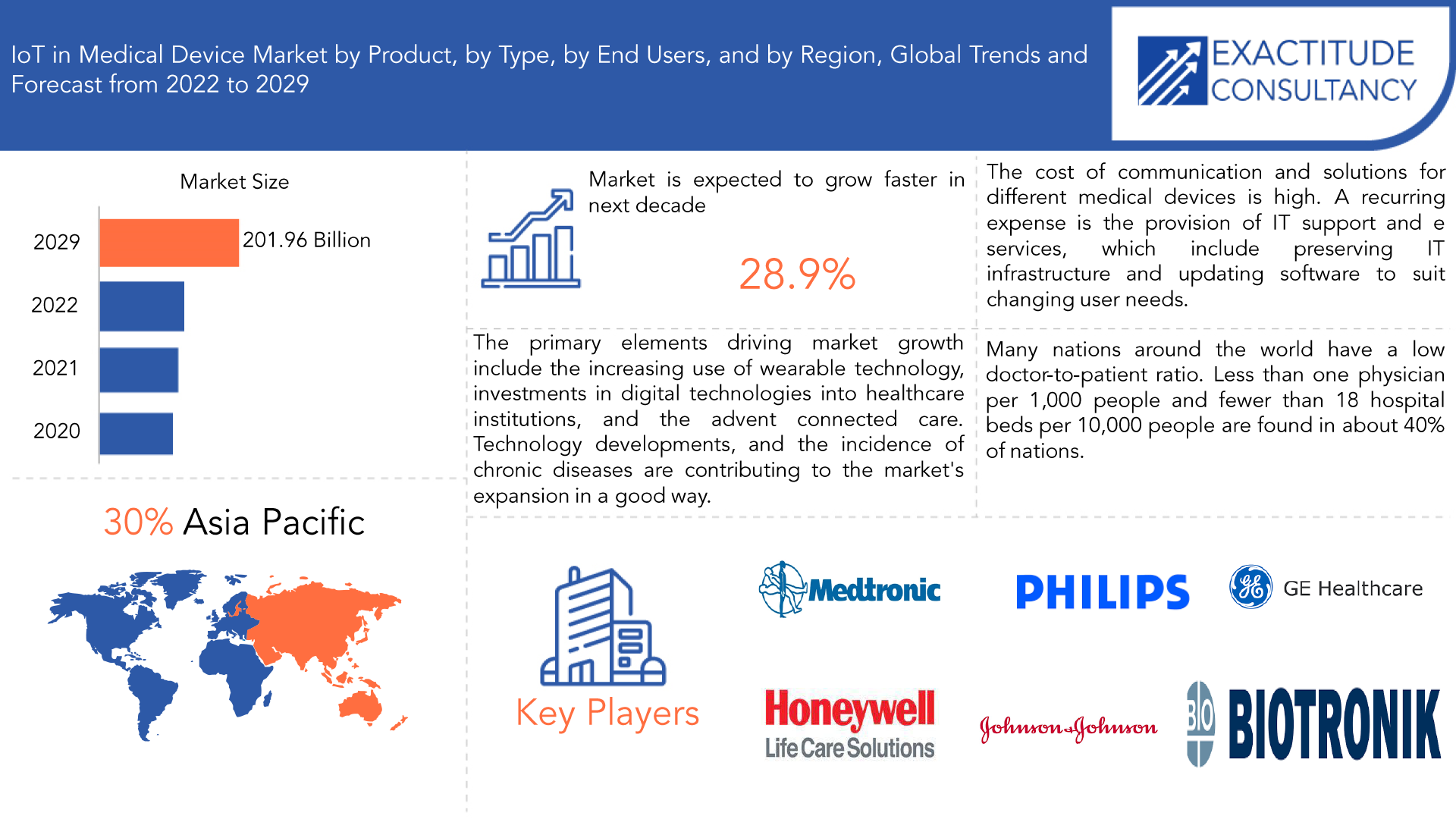
Si prevede che il mercato dell'IoT nei dispositivi medici crescerà al 28,9% di CAGR dal 2022 al 2029. Si prevede che raggiungerà oltre 201,96 miliardi di USD entro il 2029 dai 22,20 miliardi di USD del 2020.
Secondo le stime, il mercato globale dei dispositivi medici IoT crescerà a causa della necessità di controllare i costi di fornitura dell'assistenza sanitaria e di una crescente enfasi sul coinvolgimento del paziente e sull'assistenza centrata. L'aumento della domanda nel mercato globale durante il periodo di previsione sarà probabilmente anche stimolato dalle iniziative governative per incoraggiare la salute digitale. Il costo complessivo della fornitura dell'assistenza sanitaria è aumentato a due cifre negli ultimi decenni. I fattori principali che contribuiscono al forte aumento dei costi dell'assistenza sanitaria sono l'aumento dei premi dell'assicurazione sanitaria, la crescente domanda di cure mediche di alta qualità, l'invecchiamento della popolazione e l'aumento della prevalenza di malattie croniche a livello globale. La forte dipendenza da una tecnologia clinica antiquata, che aumenta il rischio di errori medici, riammissione dei pazienti e costi amministrativi, è un altro fattore importante in questa tendenza.
L' Internet of Things (IoT) è una rete di oggetti reali che impiega la connettività per consentire lo scambio di dati. Nel settore sanitario, l'IoT viene anche utilizzato per la raccolta di dati, l'analisi per la ricerca e il monitoraggio di cartelle cliniche elettroniche che contengono informazioni di identificazione personale, informazioni sanitarie protette e altri dati sanitari generati dalle macchine. Il tipo IoT nei dispositivi medici allevia anche la pressione sui professionisti sanitari e facilita compiti cruciali come il miglioramento dei risultati per i pazienti. I dispositivi medici con funzionalità Internet of Things (IoT) hanno consentito il monitoraggio remoto nel settore sanitario, sbloccando il potenziale per mantenere i pazienti al sicuro e in salute e consentendo ai medici di fornire un trattamento eccellente. L'Internet of Things è una parte cruciale della trasformazione digitale del settore sanitario e numerosi stakeholder stanno intensificando i loro sforzi in quest'area. Di conseguenza, si prevede senza dubbio che la crescita dell'IoT nei dispositivi medici accelererà dal 2017 al 2022.
| ATTRIBUTO | DETTAGLI |
| Periodo di studio | 2020-2029 |
| Anno base | 2021 |
| Anno stimato | 2022 |
| Anno previsto | 2022-2029 |
| Periodo storico | 2018-2020 |
| Unità | Valore (MILIARDI DI USD), (MIGLIAIA DI UNITÀ). |
| Segmentazione | Per prodotto, per tipo, per utente finale, per regione |
| Per prodotto |
|
| By Type |
|
| By End user |
|
| By Region |
|
IoT in medical devices have the ability to instantly evaluate and share vital medical data to enable seamless departmental communication, lower healthcare costs by streamlining general procedures, and optimise medicine dosage and delivery through monitoring drug effectiveness. These and other elements may increase the uptake of IoT in medical devices and fuel future market revenue growth. IoT in medical devices are currently on the market and offer services like remote temperature monitoring for vaccines, tools for transmitting medical data, monitoring of vital signs, remote care biometric scanners, and sleep monitors, among others. By utilising connected devices with IoT sensors to provide a continuous stream of real-time patient health data, IoT-enabled devices enhance patient outcomes and lower expenses. Other factors anticipated to help to the market's revenue growth in the future include an increase in joint research and development activities, the trend toward patient care at home, and an increase in the number of product releases.
The primary elements driving market growth include the increasing use of wearable technology, investments in integrating digital technologies into healthcare institutions, and the advent of connected care. Technology developments, a growing elderly population, and the incidence of chronic diseases are all contributing to the market's expansion in a good way. The adoption of supportive government regulatory policies, technological advancements, rising incidence rates of chronic diseases like COPD, genetic diseases, respiratory diseases, and others, and better access to high-speed internet are some of the main factors driving the growth of the internet of things in the healthcare market.
In addition, there is a growing need for affordable illness management and treatment, as well as a rise in the use of wearables and smart devices, a growing interest in measuring one's own health, and a decrease in healthcare costs due to the use of IoT in medical device products. Additionally, growing interest from startup businesses, like MedAngelONE, Amiko, SWORD health, and Aira, in the IoT healthcare sector is anticipated to fuel market expansion. The market's expansion is anticipated to be hampered by difficulties like high development costs for IoT infrastructure, data privacy and security concerns, a lack of public awareness in developing regions, and a lack of technical expertise. Several elements, including government actions to support IoT platforms, improvements in developing nations' healthcare infrastructure, and high R&D spending, are anticipated to boost market expansion.
Solutions for communication and interoperability across various medical equipment come at a hefty price. Additionally, IT support and maintenance services—which include updating software to meet changing user needs and keeping a productive IT infrastructure—represent a recurrent cost. This makes up a sizable portion of the overall ownership cost. Additionally, additional verification and validation are necessary for post-sale custom interface creation for device integration to guarantee solution accuracy and comprehensiveness. The total cost of ownership for healthcare providers is subsequently increased by this. Small healthcare facilities are hesitant to replace their outdated systems with cutting-edge loT-enabled devices because of the hefty expenses involved, especially in emerging nations.
The cost of communication and interoperability solutions for different medical devices is high. A recurring expense is the provision of IT support and maintenance services, which include preserving an effective IT infrastructure and updating software to suit changing user needs. This accounts for a considerable amount of the total cost of ownership. In order to ensure the accuracy and thoroughness of the solution, further validation and verification are required for the design of specific post-sale interfaces for device integration. This consequently results in an increase in the total cost of ownership for healthcare providers. Due to the high costs involved, especially in developing countries, small healthcare facilities are reluctant to replace their antiquated systems with cutting-edge loT-enabled devices.
The governments of numerous nations have started programmes to advance digital health. Measures like enacting required requirements for electronic health record (HER) systems are only two examples of the considerable changes being made to the healthcare sector. The demand for healthcare in disadvantaged areas, rising investment, and an increase in internet users are some of the drivers boosting the IoT healthcare market's expansion. Government attempts to promote digital health and a low doctor-to-patient ratio are expected to make for promising opportunities for industry participants.
Many nations around the world have a low doctor-to-patient ratio. Less than one physician per 1,000 people and fewer than 18 hospital beds per 10,000 people are found in about 40% of nations, according to the 2017 World Health Statistics report. In terms of residents' access to healthcare, there is also a considerable discrepancy between developed and developing markets. For instance, compared to rich countries, developing nations in APAC and Africa have much fewer hospital beds, doctors, nurses, and midwives per 10,000 people.
La pandemia ha alterato la prontezza dei provider ad adottare soluzioni IoT, aiutando nell'uso dell'Internet delle cose per diagnosticare l'infezione. Inoltre, un numero crescente di tecnologie IoT sta aiutando le autorità sia nel trattamento di coloro che hanno già contratto il COVID-19 sia nel prevenirne l'ulteriore diffusione. IoT, in particolare e soprattutto quando integrato con ulteriori tecnologie rivoluzionarie come il cloud computing e l'intelligenza artificiale (IA). Ciò ha portato a una varietà di tipi di IoT nei dispositivi medici durante questa crisi. Secondo l'OMS, ad esempio, nel 2020, il personale e i pazienti di un ospedale da campo a Wuhan, in Cina, indossavano braccialetti e anelli sincronizzati con un'IA. Questa piattaforma di CloudMinds, un provider di sistemi basati su cloud per robot intelligenti con sede a Pechino, offrirà un monitoraggio continuo degli indicatori vitali durante la pandemia di COVID-19, tra cui temperatura, frequenza cardiaca e livelli di ossigeno nel sangue. Sempre in India, il Ministero della Salute dell'Unione il 2 aprile 2020 ha rilasciato l'app mobile aarogya setu, che aiuta gli utenti a determinare se sono a rischio di infezione da COVID-19. Pertanto, il Covid-19 ha aumentato la necessità dell'Internet delle cose nel settore sanitario e offre ai produttori opportunità di vario tipo nel settore sanitario nel periodo di previsione.
[caption id="allegato_15174" align="aligncenter" width="1920"]
Frequently Asked Questions
• What is the worth of IoT in medical device Market?
The IoT in medical device Market is expected to grow at 28.9% CAGR from 2022 to 2029. It is expected to reach above USD 201.96 Billion by 2029 from USD 22.20 Billion in 2020.
• What is the size of the Asia pacific IoT in medical device industry?
North America held more than 30% of the IoT in medical device Market revenue share in 2021 and will witness expansion in the forecast period.
• What are some of the market's driving forces?
The primary elements driving market growth include the increasing use of wearable technology, investments in integrating digital technologies into healthcare institutions, and the advent of connected care. Technology developments, a growing elderly population, and the incidence of chronic diseases are all contributing to the market's expansion in a good way. The adoption of supportive government regulatory policies, technological advancements, rising incidence rates of chronic diseases like COPD, genetic diseases, respiratory diseases, and others, and better access to high-speed internet are some of the main factors driving the growth of the internet of things in the healthcare market.
• Which are the top companies to hold the market share in IoT in medical device Market?
The IoT in medical device Market key players includes Medtronic, GE Healthcare, Koninklijke Philips NV, Honeywell Life Care Solutions, BIOTRONIK , Boston Scientific Corporation , Johnson & Johnson Services, Inc., Siemens AG, Omron Healthcare, Inc, Bio Telemetry, Inc., AliveCor, Inc., iHealth Lab, Inc., AgaMatrix, Abbott Laboratories, Stanley Healthcare, and Hillrom-Welch Allyn.
• What is the leading application of IoT in medical device Market?
The internet of things (IoT) is a network of actual objects that employs connectivity to allow data exchange. In the healthcare industry, IoT is also utilised for data collecting, analysis for research, and monitoring of electronic health records that contain personally identifiable information, protected health information, and other machine-generated healthcare data. IoT type in medical devices also ease the strain on medical professionals and facilitate crucial tasks like improving patient outcomes. Medical devices with Internet of Things (IoT) capabilities have enabled remote monitoring in the healthcare industry, unlocking the potential to keep patients safe and healthy and enabling doctors to provide excellent treatment. The Internet of Things is a crucial part of the digital transformation of the healthcare business, and numerous stakeholders are ramping up their efforts in this area. As a result, growth in IoT in medical device is undoubtedly predicted to accelerate from 2017 to 2022.
• Which is the largest regional market for IoT in medical device Market?
Throughout the projected period, Asia Pacific is anticipated to gain the largest revenue share. The governments place a strong emphasis on eHealth solutions to cater to the diverse demographics of nations like China, India, South Korea, and others. The Chinese government is using telemedicine and digital healthcare to provide assistance in rural and isolated areas, according to the 2020 report. During the projection period, India is anticipated to demonstrate a high growth rate. Large prospects in healthcare are being presented by India's fast expanding population and the government's significant digital investments.
IoT in medical device Market Segment Analysis
The IoT in medical device market is segmented based on product, type, end user, and region, global trends and forecast.
By product type, the market is bifurcated into (Blood pressure monitor, Glucometer, Cardiac Monitor, Pulse Oximeter, and Infusion Pump). By type into (Wearable, Implantable, Stationary). By end user into (Hospitals and Clinics, Nursery homes, others) and region, global trends and forecast.
Among product segments, the blood pressure monitor segment is anticipated to expand at the fastest rate over the forecasted period. In terms of product segments, the blood pressure monitor sector is anticipated to increase at the greatest CAGR during the forecast period. This is primarily because of the rising prevalence of hypertension, the rising obesity rate, and the growing inclination for self-health management.
The market for loT medical devices is anticipated to be dominated by the stationary medical devices type segment. In 2020, the stationary medical devices market had the largest share of the overall lol medical devices market. The introduction of government policies requiring the use of EHR and the benefits provided by these devices are propelling the growth of this market.
According to end user, the hospitals and clinics segment is anticipated to hold the largest market share for loT medical devices. The market is further divided into nursing homes, assisted living facilities, long-term care facilities, and home care settings. The primary driver of this market's growth is the growing necessity to handle an expanding amount of patient data and the rising need for data accessibility and interoperability in hospitals and clinics.
[caption id="attachment_15175" align="aligncenter" width="1920"]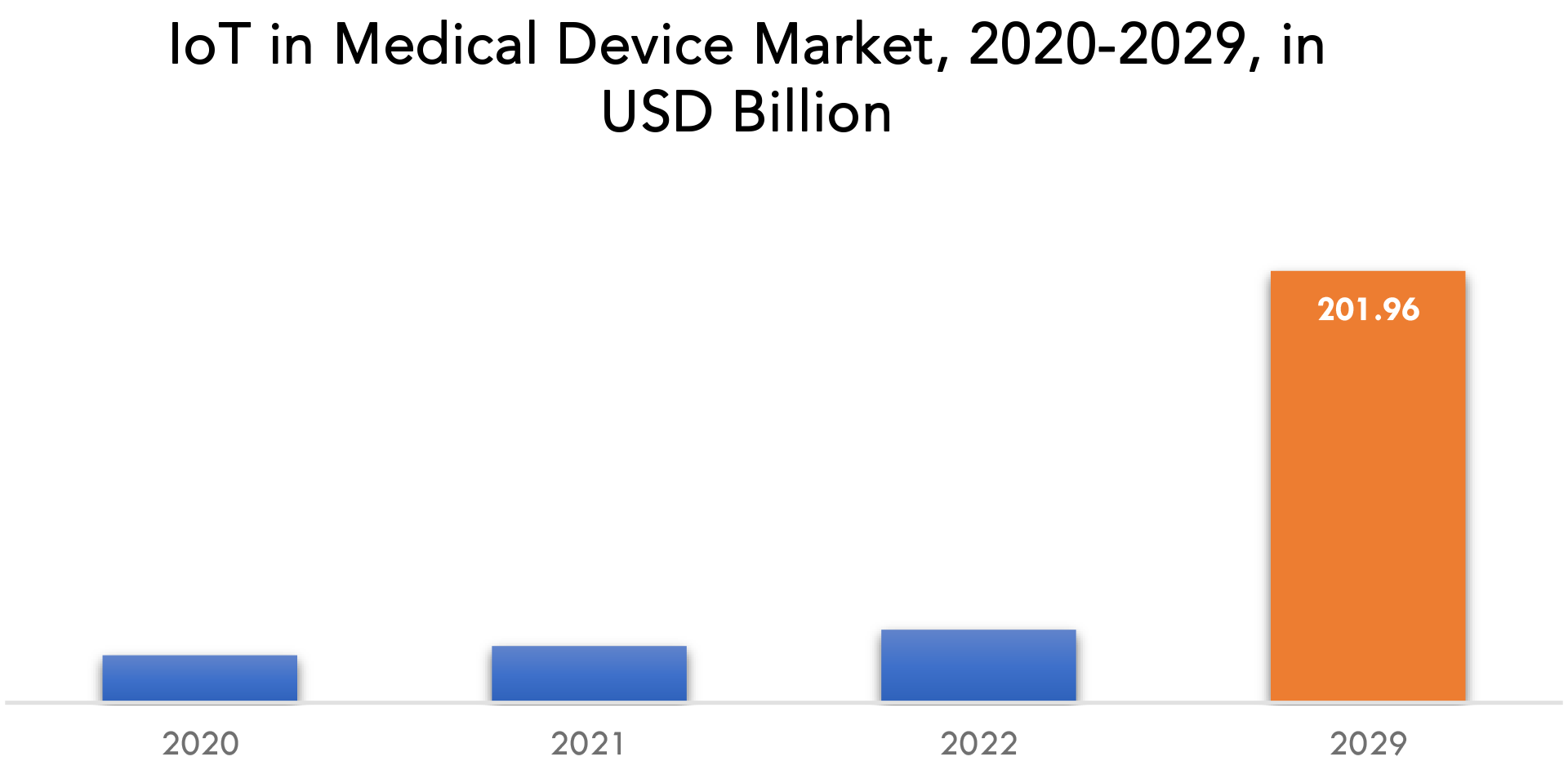
IoT in medical device Market Players
The IoT in medical device Market key players includes Medtronic, GE Healthcare, Koninklijke Philips NV, Honeywell Life Care Solutions, BIOTRONIK , Boston Scientific Corporation , Johnson & Johnson Services, Inc., Siemens AG, Omron Healthcare, Inc, Bio Telemetry, Inc., AliveCor, Inc., iHealth Lab, Inc., AgaMatrix, Abbott Laboratories, Stanley Healthcare, and Hillrom-Welch Allyn.
Industry Development:- 28 November 2022: GE Healthcare has announced an agreement with ulrich medical for a GE Healthcare branded contrast media injector in the U.S. The CT motion multi-dose syringeless injector, which delivers iodinated contrast media for Computed Tomography (CT) imaging procedures, reduces procedure setup time and increases patient throughput by eliminating time consuming preparation steps, while helping to optimize patient dosing and reduce wasted contrast media.
- 7 July 2022: GE Healthcare, a leading global medical technology, diagnostics, and digital solutions innovator, inaugurated its 5G Innovation Lab in Bengaluru, India, the first for GE Healthcare across the globe. With the advantage of massive bandwidth, high data speeds, low latency, and highly reliable connectivity.
Who Should Buy? Or Key stakeholders
- IoT in medical device Service provider
- Consultancy Firms/ Advisory Firms
- Healthcare Industries
- Hospitals
- Pharmaceutical Industries
- IT Industries
- Raw Materials Manufacturers
- Research Organizations
- Investors
- Regulatory Authorities
- Others
IoT in medical device Market Regional Analysis
The IoT in medical device Market by region includes North America, Asia-Pacific (APAC), Europe, South America, and Middle East & Africa (MEA).
- North America: includes the US, Canada, Mexico
- Asia Pacific: includes China, Japan, South Korea, India, Australia, ASEAN and Rest of APAC
- Europe: includes UK, Germany, France, Italy, Spain, Russia, and Rest of Europe
- South America: includes Brazil, Argentina and Rest of South America
- Middle East & Africa: includes Turkey, UAE, Saudi Arabia, South Africa, and Rest of MEA
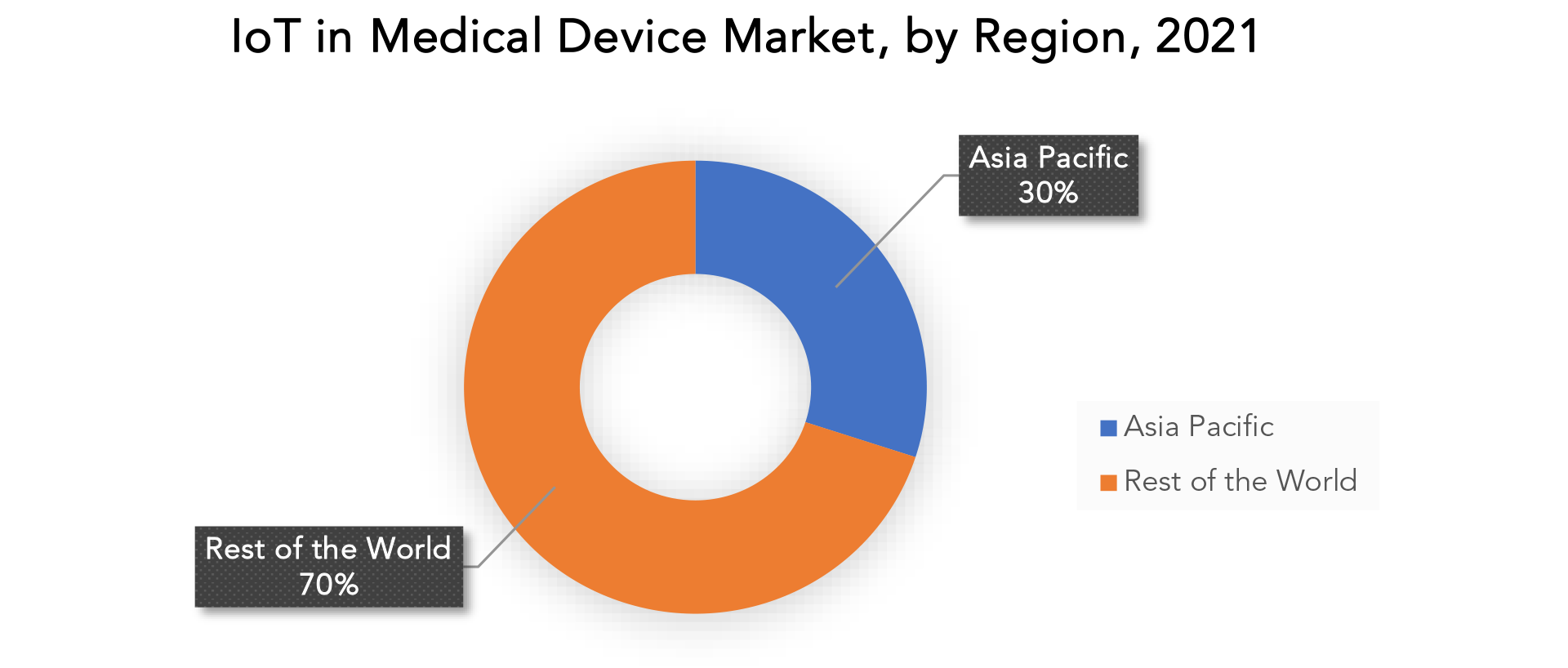
Throughout the projected period, Asia Pacific is anticipated to gain the largest revenue share. The governments place a strong emphasis on eHealth solutions to cater to the diverse demographics of nations like China, India, South Korea, and others. The Chinese government is using telemedicine and digital healthcare to provide assistance in rural and isolated areas, according to the 2020 report. During the projection period, India is anticipated to demonstrate a high growth rate. Large prospects in healthcare are being presented by India's fast expanding population and the government's significant digital investments.
After the Asia Pacific, North America is expected to hold a sizable portion of the market. In North America, there has been a tremendous uptake of cutting-edge technologies across all industries, including the IoT, which has fueled market expansion. Due to the healthcare sector's explosive growth, the United States is projected to dominate the market revenue. Demand for wearable and remote patient monitoring services in the nation is projected to increase as a result of changing lifestyles and increased attention to health management.
Throughout the predicted period, Europe is expected to have tremendous growth. IoT is being quickly adopted in the healthcare sector by European nations including France and the UK. The region's market is expanding as a result of rising hospital demand for mHealth, electronic health records, and telemedicine.
South America will have consistent growth over the predicted period as a result of increased government attention to improving the healthcare systems of the nations. For instance, various Brazilian Ministries of Healthcare, Innovation, and Technology announced a collaboration in February 2020 to implement internet-of-things programmes in the healthcare sector.
Significant market growth is projected for the Middle East and Africa. To propel loT in the healthcare market growth, the countries primarily concentrate on investments in healthcare sectors. For instance, HBKICare and Sure Universal introduced a general remote healthcare loT platform in September 2020 to support healthcare facilities in Israel and the United Arab Emirates (UAE). This is anticipated to accelerate the growth of healthcare in the area.
Key Market Segments: IoT in medical device Market
IoT In Medical Device Market By Product, 2020-2029, (USD Billion), (Thousand Units).- Blood Pressure Monitor
- Glucometer
- Cardiac Monitor
- Pulse Oximeter
- Infusion Pump
- Wearable
- Implantable
- Stationarity
- Hospitals And Clinics
- Nursing Home
- Others
- North America
- Asia Pacific
- Europe
- South America
- Middle East and Africa
Exactitude Consultancy Services Key Objectives:
- Increasing sales and market share
- Developing new technology
- Improving profitability
- Entering new markets
- Enhancing brand reputation
Key Question Answered
- What is the expected growth rate of the IoT in medical device market over the next 7 years?
- Who are the major players in the IoT in medical device market and what is their market share?
- What are the end-user industries driving demand for market and what is their outlook?
- What are the opportunities for growth in emerging markets such as Asia-Pacific, Middle East, and Africa?
- How is the economic environment affecting the IoT in medical device market, including factors such as interest rates, inflation, and exchange rates?
- What is the expected impact of government policies and regulations on the IoT in medical device market?
- What is the current and forecasted size and growth rate of the global IoT in medical device market?
- What are the key drivers of growth in the IoT in medical device market?
- What are the distribution channels and supply chain dynamics in the IoT in medical device market?
- What are the technological advancements and innovations in the IoT in medical device market and their impact on form development and growth?
- What are the regulatory considerations and their impact on the market?
- What are the challenges faced by players in the IoT in medical device market and how are they addressing these challenges?
- What are the opportunities for growth and expansion in the IoT in medical device market?
- What are the services offerings and specifications of leading players in the market?
- INTRODUZIONE
- DEFINIZIONE DI MERCATO
- SEGMENTAZIONE DEL MERCATO
- TEMPI DI RICERCA
- ASSUNZIONI E LIMITAZIONI
- METODOLOGIA DI RICERCA
- ESTRAZIONE DATI
- RICERCA SECONDARIA
- RICERCA PRIMARIA
- PARERI DEGLI ESPERTI IN MATERIA
- CONTROLLI DI QUALITÀ
- RECENSIONE FINALE
- TRIANGOLAZIONE DEI DATI
- APPROCCIO DAL BASSO VERSO L'ALTO
- APPROCCIO TOP-DOWN
- FLUSSO DI RICERCA
- FONTI DEI DATI
- ESTRAZIONE DATI
- SINTESI
- PANORAMICA DEL MERCATO
- PROSPETTIVE GLOBALI DELL'IOT NEI DISPOSITIVI MEDICI
- FATTORI DI MERCATO
- LIMITAZIONI DI MERCATO
- OPPORTUNITÀ DI MERCATO
- IMPATTO DEL COVID-19 SULL'IoT NEL MERCATO DEI DISPOSITIVI MEDICI
- MODELLO DELLE CINQUE FORZE DI PORTER
- MINACCIA DAI NUOVI ENTRANSI
- MINACCIA DA SOSTITUTI
- POTERE CONTRATTUALE DEI FORNITORI
- POTERE CONTRATTUALE DEI CLIENTI
- GRADO DI COMPETIZIONE
- ANALISI DELLA CATENA DEL VALORE DEL SETTORE
- PROSPETTIVE GLOBALI DELL'IOT NEI DISPOSITIVI MEDICI
- MERCATO GLOBALE DELL'IOT NEI DISPOSITIVI MEDICI PER PRODOTTO (MILIARDI DI USD, MIGLIAIA DI UNITÀ), 2020-2029
- MONITORAGGIO DELLA PRESSIONE ARTERIOSA
- GLUCOMETRO
- MONITORAGGIO CARDIACO
- PULSOSSIMETRO
- POMPA DI INFUSIONE
- MERCATO GLOBALE DELL'IOT NEI DISPOSITIVI MEDICI PER TIPOLOGIA (MILIARDI DI USD, MIGLIAIA DI UNITÀ), 2020-2029
- INDOSSABILE
- IMPIANTABILE
- STAZIONARIO
- MERCATO GLOBALE DELL'IOT NEI DISPOSITIVI MEDICI PER UTENTE FINALE (MILIARDI DI USD, MIGLIAIA DI UNITÀ), 2020-2029
- OSPEDALI E CLINICHE
- CASE NIDO
- ALTRI
- MERCATO GLOBALE DELL'IOT NEI DISPOSITIVI MEDICI PER REGIONE (MILIARDI DI USD, MIGLIAIA DI UNITÀ), 2020-2029
- AMERICA DEL NORD
- NOI
- CANADA
- MESSICO
- SUD AMERICA
- BRASILE
- ARGENTINA
- COLOMBIA
- RESTO DEL SUD AMERICA
- EUROPA
- GERMANIA
- Regno Unito
- FRANCIA
- ITALIA
- SPAGNA
- RUSSIA
- RESTO D'EUROPA
- ASIA PACIFICO
- INDIA
- CINA
- GIAPPONE
- COREA DEL SUD
- AUSTRALIA
- ASIA SUD-ORIENTALE
- RESTO DELL'ASIA PACIFICO
- MEDIO ORIENTE E AFRICA
- Emirati Arabi Uniti
- ARABIA SAUDITA
- SUDAFRICA
- RESTO DEL MEDIO ORIENTE E AFRICA
- AMERICA DEL NORD
- PROFILI AZIENDALI*
(BUSINESS OVERVIEW, COMPANY SNAPSHOT, PRODUCTS OFFERED, RECENT DEVELOPMENTS)
- MEDTRONIC
- GE HEALTHCARE
- KONINKLIJKE PHILIPS NV
- HONEYWELL LIFE CARE SOLUTIONS
- BIOTRONIK
- BOSTON SCIENTIFIC CORPORATION
- JOHNSON & JOHNSON SERVICES, INC.
- SIEMENS AG
- OMRON HEALTHCARE INC.
- BIO TELEMETRY, INC.
- ALIVECOR INC.
- IHEALTH LAB, INC.
- AGAMATRIX
- ABBOTT LABORATORIES
- STANLEY HEALTHCARE
- HILLROM-WELCH ALLYN
*THE COMPANY LIST IS INDICATIVE
LIST OF TABLES
TABLE 1 GLOBAL IOT IN MEDICAL DEVICE MARKET BY PRODUCT (USD BILLION), 2020-2029
TABLE 2 GLOBAL IOT IN MEDICAL DEVICE MARKET BY PRODUCT (THOUSAND UNITS), 2020-2029
TABLE 3 GLOBAL IOT IN MEDICAL DEVICE MARKET BY TYPE (USD BILLION), 2020-2029
TABLE 4 GLOBAL IOT IN MEDICAL DEVICE MARKET BY TYPE (THOUSAND UNITS), 2020-2029
TABLE 5 GLOBAL IOT IN MEDICAL DEVICE MARKET BY END USER (USD BILLION), 2020-2029
TABLE 6 GLOBAL IOT IN MEDICAL DEVICE MARKET BY END USER (THOUSAND UNITS), 2020-2029
TABLE 7 GLOBAL IOT IN MEDICAL DEVICE MARKET BY REGION (USD BILLION), 2020-2029
TABLE 8 GLOBAL IOT IN MEDICAL DEVICE MARKET BY REGION (THOUSAND UNITS), 2020-2029
TABLE 9 NORTH AMERICA IOT IN MEDICAL DEVICE MARKET BY PRODUCT (USD BILLION), 2020-2029
TABLE 10 NORTH AMERICA IOT IN MEDICAL DEVICE MARKET BY PRODUCT (THOUSAND UNITS), 2020-2029
TABLE 11 NORTH AMERICA IOT IN MEDICAL DEVICE MARKET BY TYPE (USD BILLION), 2020-2029
TABLE 12 NORTH AMERICA IOT IN MEDICAL DEVICE MARKET BY TYPE (THOUSAND UNITS), 2020-2029
TABLE 13 NORTH AMERICA IOT IN MEDICAL DEVICE MARKET BY END USER (USD BILLION), 2020-2029
TABLE 14 NORTH AMERICA IOT IN MEDICAL DEVICE MARKET BY END USER (THOUSAND UNITS), 2020-2029
TABLE 15 NORTH AMERICA IOT IN MEDICAL DEVICE MARKET BY COUNTRY (USD BILLION), 2020-2029
TABLE 16 NORTH AMERICA IOT IN MEDICAL DEVICE MARKET BY COUNTRY (THOUSAND UNITS), 2020-2029
TABLE 17 US IOT IN MEDICAL DEVICE MARKET BY PRODUCT (USD BILLION), 2020-2029
TABLE 18 US IOT IN MEDICAL DEVICE MARKET BY PRODUCT (THOUSAND UNITS), 2020-2029
TABLE 19 US IOT IN MEDICAL DEVICE MARKET BY TYPE (USD BILLION), 2020-2029
TABLE 20 US IOT IN MEDICAL DEVICE MARKET BY TYPE (THOUSAND UNITS), 2020-2029
TABLE 21 US IOT IN MEDICAL DEVICE MARKET BY END USER (USD BILLION), 2020-2029
TABLE 22 US IOT IN MEDICAL DEVICE MARKET BY END USER (THOUSAND UNITS), 2020-2029
TABLE 23 CANADA IOT IN MEDICAL DEVICE MARKET BY PRODUCT (BILLION), 2020-2029
TABLE 24 CANADA IOT IN MEDICAL DEVICE MARKET BY PRODUCT (THOUSAND UNITS), 2020-2029
TABLE 25 CANADA IOT IN MEDICAL DEVICE MARKET BY TYPE (USD BILLION), 2020-2029
TABLE 26 CANADA IOT IN MEDICAL DEVICE MARKET BY TYPE (THOUSAND UNITS), 2020-2029
TABLE 27 CANADA IOT IN MEDICAL DEVICE MARKET BY END USER (USD BILLION), 2020-2029
TABLE 28 CANADA IOT IN MEDICAL DEVICE MARKET BY END USER (THOUSAND UNITS), 2020-2029
TABLE 29 MEXICO IOT IN MEDICAL DEVICE MARKET BY PRODUCT (USD BILLION), 2020-2029
TABLE 30 MEXICO IOT IN MEDICAL DEVICE MARKET BY PRODUCT (THOUSAND UNITS), 2020-2029
TABLE 31 MEXICO IOT IN MEDICAL DEVICE MARKET BY TYPE (USD BILLION), 2020-2029
TABLE 32 MEXICO IOT IN MEDICAL DEVICE MARKET BY TYPE (THOUSAND UNITS), 2020-2029
TABLE 33 MEXICO IOT IN MEDICAL DEVICE MARKET BY END USER (USD BILLION), 2020-2029
TABLE 34 MEXICO IOT IN MEDICAL DEVICE MARKET BY END USER (THOUSAND UNITS), 2020-2029
TABLE 35 SOUTH AMERICA IOT IN MEDICAL DEVICE MARKET BY PRODUCT (USD BILLION), 2020-2029
TABLE 36 SOUTH AMERICA IOT IN MEDICAL DEVICE MARKET BY PRODUCT (THOUSAND UNITS), 2020-2029
TABLE 37 SOUTH AMERICA IOT IN MEDICAL DEVICE MARKET BY TYPE (USD BILLION), 2020-2029
TABLE 38 SOUTH AMERICA IOT IN MEDICAL DEVICE MARKET BY TYPE (THOUSAND UNITS), 2020-2029
TABLE 39 SOUTH AMERICA IOT IN MEDICAL DEVICE MARKET BY END USER (USD BILLION), 2020-2029
TABLE 40 SOUTH AMERICA IOT IN MEDICAL DEVICE MARKET BY END USER (THOUSAND UNITS), 2020-2029
TABLE 41 SOUTH AMERICA IOT IN MEDICAL DEVICE MARKET BY COUNTRY (USD BILLION), 2020-2029
TABLE 42 SOUTH AMERICA IOT IN MEDICAL DEVICE MARKET BY COUNTRY (THOUSAND UNITS), 2020-2029
TABLE 43 BRAZIL IOT IN MEDICAL DEVICE MARKET BY PRODUCT (USD BILLION), 2020-2029
TABLE 44 BRAZIL IOT IN MEDICAL DEVICE MARKET BY PRODUCT (THOUSAND UNITS), 2020-2029
TABLE 45 BRAZIL IOT IN MEDICAL DEVICE MARKET BY TYPE (USD BILLION), 2020-2029
TABLE 46 BRAZIL IOT IN MEDICAL DEVICE MARKET BY TYPE (THOUSAND UNITS), 2020-2029
TABLE 47 BRAZIL IOT IN MEDICAL DEVICE MARKET BY END USER (USD BILLION), 2020-2029
TABLE 48 BRAZIL IOT IN MEDICAL DEVICE MARKET BY END USER (THOUSAND UNITS), 2020-2029
TABLE 49 ARGENTINA IOT IN MEDICAL DEVICE MARKET BY PRODUCT (USD BILLION), 2020-2029
TABLE 50 ARGENTINA IOT IN MEDICAL DEVICE MARKET BY PRODUCT (THOUSAND UNITS), 2020-2029
TABLE 51 ARGENTINA IOT IN MEDICAL DEVICE MARKET BY TYPE (USD BILLION), 2020-2029
TABLE 52 ARGENTINA IOT IN MEDICAL DEVICE MARKET BY TYPE (THOUSAND UNITS), 2020-2029
TABLE 53 ARGENTINA IOT IN MEDICAL DEVICE MARKET BY END USER (USD BILLION), 2020-2029
TABLE 54 ARGENTINA IOT IN MEDICAL DEVICE MARKET BY END USER (THOUSAND UNITS), 2020-2029
TABLE 55 COLOMBIA IOT IN MEDICAL DEVICE MARKET BY PRODUCT (USD BILLION), 2020-2029
TABLE 56 COLOMBIA IOT IN MEDICAL DEVICE MARKET BY PRODUCT (THOUSAND UNITS), 2020-2029
TABLE 57 COLOMBIA IOT IN MEDICAL DEVICE MARKET BY TYPE (USD BILLION), 2020-2029
TABLE 58 COLOMBIA IOT IN MEDICAL DEVICE MARKET BY TYPE (THOUSAND UNITS), 2020-2029
TABLE 59 COLOMBIA IOT IN MEDICAL DEVICE MARKET BY END USER (USD BILLION), 2020-2029
TABLE 60 COLOMBIA IOT IN MEDICAL DEVICE MARKET BY END USER (THOUSAND UNITS), 2020-2029
TABLE 61 REST OF SOUTH AMERICA IOT IN MEDICAL DEVICE MARKET BY PRODUCT (USD BILLION), 2020-2029
TABLE 62 REST OF SOUTH AMERICA IOT IN MEDICAL DEVICE MARKET BY PRODUCT (THOUSAND UNITS), 2020-2029
TABLE 63 REST OF SOUTH AMERICA IOT IN MEDICAL DEVICE MARKET BY TYPE (USD BILLION), 2020-2029
TABLE 64 REST OF SOUTH AMERICA IOT IN MEDICAL DEVICE MARKET BY TYPE (THOUSAND UNITS), 2020-2029
TABLE 65 REST OF SOUTH AMERICA IOT IN MEDICAL DEVICE MARKET BY END USER (USD BILLION), 2020-2029
TABLE 66 REST OF SOUTH AMERICA IOT IN MEDICAL DEVICE MARKET BY END USER (THOUSAND UNITS), 2020-2029
TABLE 67 ASIA-PACIFIC IOT IN MEDICAL DEVICE MARKET BY PRODUCT (USD BILLION), 2020-2029
TABLE 68 ASIA-PACIFIC IOT IN MEDICAL DEVICE MARKET BY PRODUCT (THOUSAND UNITS), 2020-2029
TABLE 69 ASIA-PACIFIC IOT IN MEDICAL DEVICE MARKET BY TYPE (USD BILLION), 2020-2029
TABLE 70 ASIA-PACIFIC IOT IN MEDICAL DEVICE MARKET BY TYPE (THOUSAND UNITS), 2020-2029
TABLE 71 ASIA-PACIFIC IOT IN MEDICAL DEVICE MARKET BY END USER (USD BILLION), 2020-2029
TABLE 72 ASIA-PACIFIC IOT IN MEDICAL DEVICE MARKET BY END USER (THOUSAND UNITS), 2020-2029
TABLE 73 ASIA-PACIFIC IOT IN MEDICAL DEVICE MARKET BY COUNTRY (USD BILLION), 2020-2029
TABLE 74 ASIA-PACIFIC IOT IN MEDICAL DEVICE MARKET BY COUNTRY (THOUSAND UNITS), 2020-2029
TABLE 75 INDIA IOT IN MEDICAL DEVICE MARKET BY PRODUCT (USD BILLION), 2020-2029
TABLE 76 INDIA IOT IN MEDICAL DEVICE MARKET BY PRODUCT (THOUSAND UNITS), 2020-2029
TABLE 77 INDIA IOT IN MEDICAL DEVICE MARKET BY TYPE (USD BILLION), 2020-2029
TABLE 78 INDIA IOT IN MEDICAL DEVICE MARKET BY TYPE (THOUSAND UNITS), 2020-2029
TABLE 79 INDIA IOT IN MEDICAL DEVICE MARKET BY END USER (USD BILLION), 2020-2029
TABLE 80 INDIA IOT IN MEDICAL DEVICE MARKET BY END USER (THOUSAND UNITS), 2020-2029
TABLE 81 CHINA IOT IN MEDICAL DEVICE MARKET BY PRODUCT (USD BILLION), 2020-2029
TABLE 82 CHINA IOT IN MEDICAL DEVICE MARKET BY PRODUCT (THOUSAND UNITS), 2020-2029
TABLE 83 CHINA IOT IN MEDICAL DEVICE MARKET BY TYPE (USD BILLION), 2020-2029
TABLE 84 CHINA IOT IN MEDICAL DEVICE MARKET BY TYPE (THOUSAND UNITS), 2020-2029
TABLE 85 CHINA IOT IN MEDICAL DEVICE MARKET BY END USER (USD BILLION), 2020-2029
TABLE 86 CHINA IOT IN MEDICAL DEVICE MARKET BY END USER (THOUSAND UNITS), 2020-2029
TABLE 87 JAPAN IOT IN MEDICAL DEVICE MARKET BY PRODUCT (USD BILLION), 2020-2029
TABLE 88 JAPAN IOT IN MEDICAL DEVICE MARKET BY PRODUCT (THOUSAND UNITS), 2020-2029
TABLE 89 JAPAN IOT IN MEDICAL DEVICE MARKET BY TYPE (USD BILLION), 2020-2029
TABLE 90 JAPAN IOT IN MEDICAL DEVICE MARKET BY TYPE (THOUSAND UNITS), 2020-2029
TABLE 91 JAPAN IOT IN MEDICAL DEVICE MARKET BY END USER (USD BILLION), 2020-2029
TABLE 92 JAPAN IOT IN MEDICAL DEVICE MARKET BY END USER (THOUSAND UNITS), 2020-2029
TABLE 93 SOUTH KOREA IOT IN MEDICAL DEVICE MARKET BY PRODUCT (USD BILLION), 2020-2029
TABLE 94 SOUTH KOREA IOT IN MEDICAL DEVICE MARKET BY PRODUCT (THOUSAND UNITS), 2020-2029
TABLE 95 SOUTH KOREA IOT IN MEDICAL DEVICE MARKET BY TYPE (USD BILLION), 2020-2029
TABLE 96 SOUTH KOREA IOT IN MEDICAL DEVICE MARKET BY TYPE (THOUSAND UNITS), 2020-2029
TABLE 97 SOUTH KOREA IOT IN MEDICAL DEVICE MARKET BY END USER (USD BILLION), 2020-2029
TABLE 98 SOUTH KOREA IOT IN MEDICAL DEVICE MARKET BY END USER (THOUSAND UNITS), 2020-2029
TABLE 99 AUSTRALIA IOT IN MEDICAL DEVICE MARKET BY PRODUCT (USD BILLION), 2020-2029
TABLE 100 AUSTRALIA IOT IN MEDICAL DEVICEBY PRODUCT (THOUSAND UNITS), 2020-2029
TABLE 101 AUSTRALIA IOT IN MEDICAL DEVICE MARKET BY TYPE (USD BILLION), 2020-2029
TABLE 102 AUSTRALIA IOT IN MEDICAL DEVICE MARKET BY TYPE (THOUSAND UNITS), 2020-2029
TABLE 103 AUSTRALIA IOT IN MEDICAL DEVICE MARKET BY END USER (USD BILLION), 2020-2029
TABLE 104 AUSTRALIA IOT IN MEDICAL DEVICE MARKET BY END USER (THOUSAND UNITS), 2020-2029
TABLE 105 SOUTH EAST ASIA IOT IN MEDICAL DEVICE MARKET BY PRODUCT (USD BILLION), 2020-2029
TABLE 106 SOUTH EAST ASIA IOT IN MEDICAL DEVICEBY PRODUCT (THOUSAND UNITS), 2020-2029
TABLE 107 SOUTH EAST ASIA IOT IN MEDICAL DEVICE MARKET BY TYPE (USD BILLION), 2020-2029
TABLE 108 SOUTH EAST ASIA IOT IN MEDICAL DEVICE MARKET BY TYPE (THOUSAND UNITS), 2020-2029
TABLE 109 SOUTH EAST ASIA IOT IN MEDICAL DEVICE MARKET BY END USER (USD BILLION), 2020-2029
TABLE 110 SOUTH EAST ASIA IOT IN MEDICAL DEVICE MARKET BY END USER (THOUSAND UNITS), 2020-2029
TABLE 111 REST OF ASIA PACIFIC IOT IN MEDICAL DEVICE MARKET BY PRODUCT (USD BILLION), 2020-2029
TABLE 112 REST OF ASIA PACIFIC IOT IN MEDICAL DEVICEBY PRODUCT (THOUSAND UNITS), 2020-2029
TABLE 113 REST OF ASIA PACIFIC IOT IN MEDICAL DEVICE MARKET BY TYPE (USD BILLION), 2020-2029
TABLE 114 REST OF ASIA PACIFIC IOT IN MEDICAL DEVICE MARKET BY TYPE (THOUSAND UNITS), 2020-2029
TABLE 115 REST OF ASIA PACIFIC IOT IN MEDICAL DEVICE MARKET BY END USER (USD BILLION), 2020-2029
TABLE 116 REST OF ASIA PACIFIC IOT IN MEDICAL DEVICE MARKET BY END USER (THOUSAND UNITS), 2020-2029
TABLE 117 EUROPE IOT IN MEDICAL DEVICE MARKET BY PRODUCT (USD BILLION), 2020-2029
TABLE 118 EUROPE IOT IN MEDICAL DEVICE MARKET BY PRODUCT (THOUSAND UNITS), 2020-2029
TABLE 119 EUROPE IOT IN MEDICAL DEVICE MARKET BY TYPE (USD BILLION), 2020-2029
TABLE 120 EUROPE IOT IN MEDICAL DEVICE MARKET BY TYPE (THOUSAND UNITS), 2020-2029
TABLE 121 EUROPE IOT IN MEDICAL DEVICE MARKET BY END USER (USD BILLION), 2020-2029
TABLE 122 EUROPE IOT IN MEDICAL DEVICE MARKET BY END USER (THOUSAND UNITS), 2020-2029
TABLE 123 EUROPE IOT IN MEDICAL DEVICE MARKET BY COUNTRY (USD BILLION), 2020-2029
TABLE 124 EUROPE IOT IN MEDICAL DEVICE MARKET BY COUNTRY (THOUSAND UNITS), 2020-2029
TABLE 125 GERMANY IOT IN MEDICAL DEVICE MARKET BY PRODUCT (USD BILLION), 2020-2029
TABLE 126 GERMANY IOT IN MEDICAL DEVICE MARKET BY PRODUCT (THOUSAND UNITS), 2020-2029
TABLE 127 GERMANY IOT IN MEDICAL DEVICE MARKET BY TYPE (USD BILLION), 2020-2029
TABLE 128 GERMANY IOT IN MEDICAL DEVICE MARKET BY TYPE (THOUSAND UNITS), 2020-2029
TABLE 129 GERMANY IOT IN MEDICAL DEVICE MARKET BY END USER (USD BILLION), 2020-2029
TABLE 130 GERMANY IOT IN MEDICAL DEVICE MARKET BY END USER (THOUSAND UNITS), 2020-2029
TABLE 131 UK IOT IN MEDICAL DEVICE MARKET BY PRODUCT (USD BILLION), 2020-2029
TABLE 132 UK IOT IN MEDICAL DEVICE MARKET BY PRODUCT (THOUSAND UNITS), 2020-2029
TABLE 133 UK IOT IN MEDICAL DEVICE MARKET BY TYPE (USD BILLION), 2020-2029
TABLE 134 UK IOT IN MEDICAL DEVICE MARKET BY TYPE (THOUSAND UNITS), 2020-2029
TABLE 135 UK IOT IN MEDICAL DEVICE MARKET BY END USER (USD BILLION), 2020-2029
TABLE 136 UK IOT IN MEDICAL DEVICE MARKET BY END USER (THOUSAND UNITS), 2020-2029
TABLE 137 FRANCE IOT IN MEDICAL DEVICE MARKET BY PRODUCT (USD BILLION), 2020-2029
TABLE 138 FRANCE IOT IN MEDICAL DEVICE MARKET BY PRODUCT (THOUSAND UNITS), 2020-2029
TABLE 139 FRANCE IOT IN MEDICAL DEVICE MARKET BY TYPE (USD BILLION), 2020-2029
TABLE 140 FRANCE IOT IN MEDICAL DEVICE MARKET BY TYPE (THOUSAND UNITS), 2020-2029
TABLE 141 FRANCE IOT IN MEDICAL DEVICE MARKET BY END USER (USD BILLION), 2020-2029
TABLE 142 FRANCE IOT IN MEDICAL DEVICE MARKET BY END USER (THOUSAND UNITS), 2020-2029
TABLE 143 ITALY IOT IN MEDICAL DEVICE MARKET BY PRODUCT (USD BILLION), 2020-2029
TABLE 144 ITALY IOT IN MEDICAL DEVICE MARKET BY PRODUCT (THOUSAND UNITS), 2020-2029
TABLE 145 ITALY IOT IN MEDICAL DEVICE MARKET BY TYPE (USD BILLION), 2020-2029
TABLE 146 ITALY IOT IN MEDICAL DEVICE MARKET BY TYPE (THOUSAND UNITS), 2020-2029
TABLE 147 ITALY IOT IN MEDICAL DEVICE MARKET BY END USER (USD BILLION), 2020-2029
TABLE 148 ITALY IOT IN MEDICAL DEVICE MARKET BY END USER (THOUSAND UNITS), 2020-2029
TABLE 149 SPAIN IOT IN MEDICAL DEVICE MARKET BY PRODUCT (USD BILLION), 2020-2029
TABLE 150 SPAIN IOT IN MEDICAL DEVICE MARKET BY PRODUCT (THOUSAND UNITS), 2020-2029
TABLE 151 SPAIN IOT IN MEDICAL DEVICE MARKET BY TYPE (USD BILLION), 2020-2029
TABLE 152 SPAIN IOT IN MEDICAL DEVICE MARKET BY TYPE (THOUSAND UNITS), 2020-2029
TABLE 153 SPAIN IOT IN MEDICAL DEVICE MARKET BY END USER (USD BILLION), 2020-2029
TABLE 154 SPAIN IOT IN MEDICAL DEVICE MARKET BY END USER (THOUSAND UNITS), 2020-2029
TABLE 155 RUSSIA IOT IN MEDICAL DEVICE MARKET BY PRODUCT (USD BILLION), 2020-2029
TABLE 156 RUSSIA IOT IN MEDICAL DEVICE MARKET BY PRODUCT (THOUSAND UNITS), 2020-2029
TABLE 157 RUSSIA IOT IN MEDICAL DEVICE MARKET BY TYPE (USD BILLION), 2020-2029
TABLE 158 RUSSIA IOT IN MEDICAL DEVICE MARKET BY TYPE (THOUSAND UNITS), 2020-2029
TABLE 159 RUSSIA IOT IN MEDICAL DEVICE MARKET BY END USER (USD BILLION), 2020-2029
TABLE 160 RUSSIA IOT IN MEDICAL DEVICE MARKET BY END USER (THOUSAND UNITS), 2020-2029
TABLE 161 REST OF EUROPE IOT IN MEDICAL DEVICE MARKET BY PRODUCT (USD BILLION), 2020-2029
TABLE 162 REST OF EUROPE IOT IN MEDICAL DEVICE MARKET BY PRODUCT (THOUSAND UNITS), 2020-2029
TABLE 163 REST OF EUROPE IOT IN MEDICAL DEVICE MARKET BY TYPE (USD BILLION), 2020-2029
TABLE 164 REST OF EUROPE IOT IN MEDICAL DEVICE MARKET BY TYPE (THOUSAND UNITS), 2020-2029
TABLE 165 REST OF EUROPE IOT IN MEDICAL DEVICE MARKET BY END USER (USD BILLION), 2020-2029
TABLE 166 REST OF EUROPE IOT IN MEDICAL DEVICE MARKET BY END USER (THOUSAND UNITS), 2020-2029
TABLE 167 MIDDLE EAST AND AFRICA IOT IN MEDICAL DEVICE MARKET BY PRODUCT (USD BILLION), 2020-2029
TABLE 168 MIDDLE EAST AND AFRICA IOT IN MEDICAL DEVICE MARKET BY PRODUCT (THOUSAND UNITS), 2020-2029
TABLE 169 MIDDLE EAST AND AFRICA IOT IN MEDICAL DEVICE MARKET BY TYPE (USD BILLION), 2020-2029
TABLE 170 MIDDLE EAST AND AFRICA IOT IN MEDICAL DEVICE MARKET BY TYPE (THOUSAND UNITS), 2020-2029
TABLE 171 MIDDLE EAST AND AFRICA IOT IN MEDICAL DEVICE MARKET BY END USER (USD BILLION), 2020-2029
TABLE 172 MIDDLE EAST AND AFRICA IOT IN MEDICAL DEVICE MARKET BY END USER (THOUSAND UNITS), 2020-2029
TABLE 173 MIDDLE EAST AND AFRICA IOT IN MEDICAL DEVICE MARKET BY COUNTRY (USD BILLION), 2020-2029
TABLE 174 MIDDLE EAST AND AFRICA IOT IN MEDICAL DEVICE MARKET BY COUNTRY (THOUSAND UNITS), 2020-2029
TABLE 175 UAE IOT IN MEDICAL DEVICE MARKET BY PRODUCT (USD BILLION), 2020-2029
TABLE 176 UAE IOT IN MEDICAL DEVICE MARKET BY PRODUCT (THOUSAND UNITS), 2020-2029
TABLE 177 UAE IOT IN MEDICAL DEVICE MARKET BY TYPE (USD BILLION), 2020-2029
TABLE 178 UAE IOT IN MEDICAL DEVICE MARKET BY TYPE (THOUSAND UNITS), 2020-2029
TABLE 179 UAE IOT IN MEDICAL DEVICE MARKET BY END USER (USD BILLION), 2020-2029
TABLE 180 UAE IOT IN MEDICAL DEVICE MARKET BY END USER (THOUSAND UNITS), 2020-2029
TABLE 181 SAUDI ARABIA IOT IN MEDICAL DEVICE MARKET BY PRODUCT (USD BILLION), 2020-2029
TABLE 182 SAUDI ARABIA IOT IN MEDICAL DEVICE MARKET BY PRODUCT (THOUSAND UNITS), 2020-2029
TABLE 183 SAUDI ARABIA IOT IN MEDICAL DEVICE MARKET BY TYPE (USD BILLION), 2020-2029
TABLE 184 SAUDI ARABIA IOT IN MEDICAL DEVICE MARKET BY TYPE (THOUSAND UNITS), 2020-2029
TABLE 185 SAUDI ARABIA IOT IN MEDICAL DEVICE MARKET BY END USER (USD BILLION), 2020-2029
TABLE 186 SAUDI ARABIA IOT IN MEDICAL DEVICE MARKET BY END USER (THOUSAND UNITS), 2020-2029
TABLE 187 SOUTH AFRICA IOT IN MEDICAL DEVICE MARKET BY PRODUCT (USD BILLION), 2020-2029
TABLE 188 SOUTH AFRICA IOT IN MEDICAL DEVICE MARKET BY PRODUCT (THOUSAND UNITS), 2020-2029
TABLE 189 SOUTH AFRICA IOT IN MEDICAL DEVICE MARKET BY TYPE (USD BILLION), 2020-2029
TABLE 190 SOUTH AFRICA IOT IN MEDICAL DEVICE MARKET BY TYPE (THOUSAND UNITS), 2020-2029
TABLE 191 SOUTH AFRICA IOT IN MEDICAL DEVICE MARKET BY END USER (USD BILLION), 2020-2029
TABLE 192 SOUTH AFRICA IOT IN MEDICAL DEVICE MARKET BY END USER (THOUSAND UNITS), 2020-2029
TABLE 193 REST OF MIDDLE EAST AND AFRICA IOT IN MEDICAL DEVICE MARKET BY PRODUCT (USD BILLION), 2020-2029
TABLE 194 REST OF MIDDLE EAST AND AFRICA IOT IN MEDICAL DEVICE MARKET BY PRODUCT (THOUSAND UNITS), 2020-2029
TABLE 195 REST OF MIDDLE EAST AND AFRICA IOT IN MEDICAL DEVICE MARKET BY TYPE (USD BILLION), 2020-2029
TABLE 196 REST OF MIDDLE EAST AND AFRICA IOT IN MEDICAL DEVICE MARKET BY TYPE (THOUSAND UNITS), 2020-2029
TABLE 197 REST OF MIDDLE EAST AND AFRICA IOT IN MEDICAL DEVICE MARKET BY END USER (USD BILLION), 2020-2029
TABLE 198 REST OF MIDDLE EAST AND AFRICA IOT IN MEDICAL DEVICE MARKET BY END USER (THOUSAND UNITS), 2020-2029
LIST OF FIGURES
FIGURE 1 MARKET DYNAMICS
FIGURE 2 MARKET SEGMENTATION
FIGURE 3 REPORT TIMELINES: YEARS CONSIDERED
FIGURE 4 DATA TRIANGULATION
FIGURE 5 BOTTOM-UP APPROACH
FIGURE 6 TOP-DOWN APPROACH
FIGURE 7 RESEARCH FLOW
FIGURE 8 GLOBAL IOT IN MEDICAL DEVICE BY PRODUCT, USD BILLION, 2020-2029
FIGURE 9 GLOBAL IOT IN MEDICAL DEVICE BY TYPE, USD BILLION, 2020-2029
FIGURE 10 GLOBAL IOT IN MEDICAL DEVICE BY END USER, USD BILLION, 2020-2029
FIGURE 11 GLOBAL IOT IN MEDICAL DEVICE BY REGION, USD BILLION, 2020-2029
FIGURE 12 PORTER’S FIVE FORCES MODEL
FIGURE 13 GLOBAL IOT IN MEDICAL DEVICE MARKET BY PRODUCT, USD BILLION, 2021
FIGURE 14 GLOBAL IOT IN MEDICAL DEVICE MARKET BY TYPE, USD BILLION, 2021
FIGURE 15 GLOBAL IOT IN MEDICAL DEVICE MARKET BY END USER, USD BILLION, 2021
FIGURE 16 GLOBAL IOT IN MEDICAL DEVICE MARKET BY REGION 2021
FIGURE 17 MARKET SHARE ANALYSIS
FIGURE 18 MEDTRONIC: COMPANY SNAPSHOT
FIGURE 19 GE HEALTHCARE: COMPANY SNAPSHOT
FIGURE 20 KONINKLIJKE PHILIPS NV: COMPANY SNAPSHOT
FIGURE 21 HONEYWELL LIFE CARE SOLUTIONS: COMPANY SNAPSHOT
FIGURE 22 BIOTRONIK: COMPANY SNAPSHOT
FIGURE 23 BOSTON SCIENTIFIC CORPORATION: COMPANY SNAPSHOT
FIGURE 24 JOHNSON & JOHNSON SERVICES INC.: COMPANY SNAPSHOT
FIGURE 25 SIEMENS AG: COMPANY SNAPSHOT
FIGURE 26 OMRON HEALTHCARE INC.: COMPANY SNAPSHOT
FIGURE 27 BIO TELEMETRY INC.: COMPANY SNAPSHOT
FIGURE 28 IHEALTH LAB INC.: COMPANY SNAPSHOT
FIGURE 29 AGAMATRIX: COMPANY SNAPSHOT
FIGURE 30 ABBOTT LABORATORIES: COMPANY SNAPSHOT
FIGURE 31 STANLEY HEALTHCARE: COMPANY SNAPSHOT
FIGURE 32 HILLROM-WELCH ALLYN: COMPANY SNAPSHOT
DOWNLOAD FREE SAMPLE REPORT
License Type
SPEAK WITH OUR ANALYST
Want to know more about the report or any specific requirement?
WANT TO CUSTOMIZE THE REPORT?
Our Clients Speak
We asked them to research ‘ Equipment market’ all over the world, and their whole arrangement was helpful to us. thehealthanalytics.com insightful analysis and reports contributed to our current analysis and in creating a future strategy. Besides, the te
Yosuke Mitsui
Senior Associate Construction Equipment Sales & Marketing
We asked them to research ‘Equipment market’ all over the world, and their whole arrangement was helpful to us. thehealthanalytics.com insightful analysis and reports contributed to our current analysis and in creating a future strategy. Besides, the te