

Base Year Value ()
x.x %
x.x %
CAGR ()
x.x %
x.x %
Forecast Year Value ()
x.x %
x.x %
Historical Data Period
Largest Region
Forecast Period
Mercato della ceramica tecnica per materiale (ossido, non ossido), prodotto (ceramica monolitica, compositi a matrice ceramica, rivestimenti ceramici), settore di utilizzo finale (elettronica e semiconduttori, automotive, energia e potenza, medicina, altri) e regione, tendenze globali e previsioni dal 2022 al 2029
Instant access to hundreds of data points and trends
- Market estimates from 2014-2029
- Competitive analysis, industry segmentation, financial benchmarks
- Incorporates SWOT, Porter's Five Forces and risk management frameworks
- PDF report or online database with Word, Excel and PowerPoint export options
- 100% money back guarantee
Panoramica del mercato della ceramica tecnica
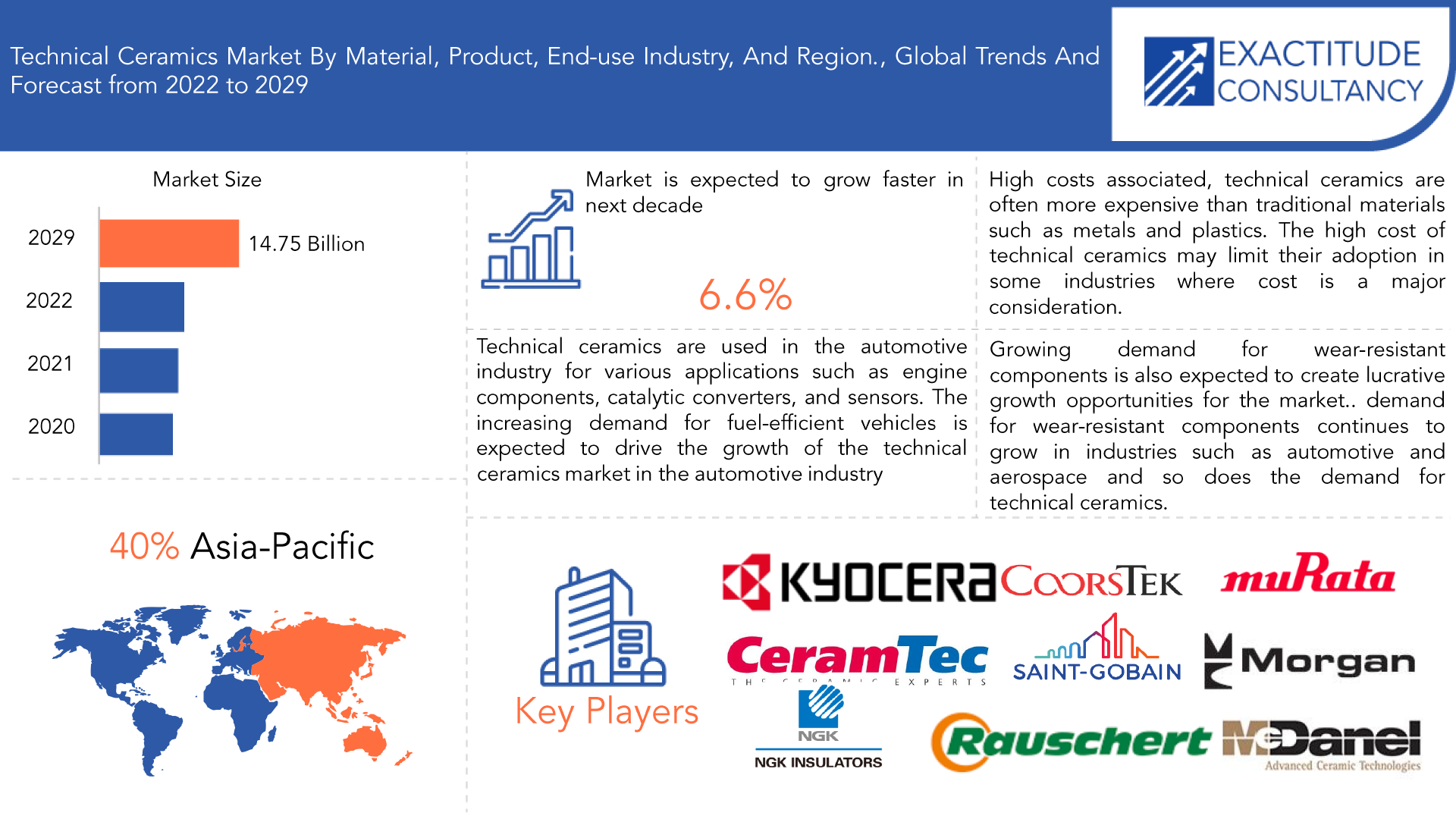
Si prevede che il mercato della ceramica tecnica crescerà al 6,6% di CAGR dal 2022 al 2029. Si prevede che raggiungerà oltre 14,75 miliardi di USD entro il 2029 dagli 8,3 miliardi di USD del 2020 .
Si prevede che il mercato globale della ceramica tecnica crescerà a un ritmo considerevole durante il periodo di previsione. Nel 2021, il mercato sta crescendo costantemente e si prevede che supererà l'orizzonte previsto grazie alla strategia adottata dai principali attori.
Ceramica avanzata , ceramica ingegneristica e ceramica tecnica sono tutti termini che indicano materiali ceramici creati e sviluppati per avere qualità e capacità uniche che vanno oltre quelle delle ceramiche convenzionali.
Queste ceramiche sono progettate per avere eccezionali qualità meccaniche, elettriche, termiche e chimiche, che le rendono perfette per una varietà di applicazioni in diversi settori. Sono utilizzate in situazioni difficili in cui i materiali convenzionali come metalli e plastiche non sono in grado di resistere alle circostanze difficili. Allumina, zirconia, carburo di silicio e nitruro di silicio sono alcuni tipi di ceramiche tecniche. Possono essere trovate in molti prodotti diversi, tra cui utensili da taglio, scambiatori di calore, parti resistenti all'usura, parti elettroniche, impianti medicinali e parti di aeromobili . Si prevede che il mercato globale delle ceramiche tecniche crescerà in modo significativo nei prossimi anni. Le ceramiche tecniche sono ampiamente utilizzate nei componenti elettronici come sensori, condensatori e isolanti grazie alle loro eccellenti proprietà elettriche e termiche. Poiché la domanda di dispositivi elettronici come smartphone, laptop e tablet continua ad aumentare, aumenta anche la domanda di ceramiche tecniche.
| ATTRIBUTO | DETTAGLI |
| Periodo di studio | 2020-2029 |
| Anno base | 2021 |
| Anno stimato | 2022 |
| Anno previsto | 2022-2029 |
| Periodo storico | 2018-2020 |
| Unità | Valore (MILIARDI DI USD), (KILOTONI) |
| Segmentazione | Per materiale, per prodotto, per settore di utilizzo finale per regione |
| Per materiale |
|
| Per prodotto |
|
| Per settore di utilizzo finale |
|
| Per regione |
|
Technical ceramics are used in the automotive industry for various applications such as engine components, catalytic converters, and sensors. The increasing demand for fuel-efficient vehicles is expected to drive the growth of the technical ceramics market in the automotive industry. Technical ceramics are used in the aerospace industry for applications such as turbine blades, heat shields, and insulation. The increasing demand for lightweight and high-performance materials in the aerospace industry is expected to drive the growth of the technical ceramics market. Technical ceramics are widely used in medical applications such as dental implants, joint replacements, and bone repair. As the demand for medical devices and implants continues to increase, so does the demand for technical ceramics. Technical ceramics are used in renewable energy applications such as fuel cells, solar panels, and wind turbines. The increasing demand for renewable energy sources is expected to drive the growth of the technical ceramics market in the energy sector. In conclusion, the global technical ceramics market is expected to grow significantly in the coming years due to the increasing demand for technical ceramics in various industries such as electronics, automotive, aerospace, medical, and energy. The market is expected to be driven by the need for high-performance materials that can withstand extreme conditions and offer superior properties compared to traditional materials. While the global technical ceramics market is expected to grow significantly in the coming years, there are also some restraints that may hinder the growth of the market such as high costs associated, technical ceramics are often more expensive than traditional materials such as metals and plastics. The high cost of technical ceramics may limit their adoption in some industries where cost is a major consideration. Additionally limited availability of raw materials is also one of the major restraints in the market growth The production of technical ceramics requires specific raw materials such as alumina, zirconia, and silicon carbide. The limited availability of these raw materials can limit the growth of the technical ceramics market.
Inoltre, la ceramica tecnica è difficile da lavorare e fabbricare a causa della sua elevata durezza e fragilità. La lavorazione e la fabbricazione di ceramiche tecniche richiedono attrezzature specializzate e manodopera qualificata, che possono aumentare i costi. La crescente domanda di dispositivi medici avanzati offre opportunità per il mercato della ceramica tecnica. L'industria medica sta rapidamente adottando tecnologie avanzate come robot chirurgici, dispositivi impiantabili e strumenti diagnostici. La ceramica tecnica offre una biocompatibilità e una durata superiori rispetto ai materiali tradizionali, rendendola ideale per l'uso in queste applicazioni. Si prevede inoltre che la crescente domanda di componenti resistenti all'usura creerà opportunità di crescita redditizie per il mercato. La ceramica tecnica è ampiamente utilizzata in componenti resistenti all'usura come utensili da taglio, cuscinetti e guarnizioni. Poiché la domanda di componenti resistenti all'usura continua a crescere in settori come l'automotive e l'aerospaziale, si prevede che anche il mercato della ceramica tecnica crescerà.
Inoltre, l'industria elettronica si sta espandendo rapidamente, con la crescente domanda di dispositivi elettronici come smartphone, laptop e tablet. Le ceramiche tecniche offrono eccellenti proprietà elettriche e termiche, rendendole ideali per l'uso in componenti elettronici come sensori, condensatori e isolanti. Si prevede che ciò genererà anche opportunità per il mercato delle ceramiche tecniche.
La pandemia di COVID-19 ha avuto un impatto sul mercato della ceramica tecnica in diversi modi. La pandemia ha causato un'interruzione nella catena di fornitura globale e una diminuzione della domanda di ceramica tecnica a causa della chiusura degli impianti di produzione e della chiusura temporanea di settori di utilizzo finale come l'automotive e l'aerospaziale. Ciò ha comportato una riduzione della produzione e della fornitura di ceramica tecnica, con conseguente calo dei ricavi per le aziende del settore.
Tuttavia, la pandemia ha anche presentato alcune opportunità per il mercato della ceramica tecnica. La domanda di apparecchiature mediche come ventilatori e dispositivi diagnostici è aumentata e la ceramica tecnica è utilizzata in molti di questi dispositivi. Ciò ha portato a un'impennata della domanda di ceramica tecnica nel settore medico, compensando parte del calo della domanda da parte di altri settori.
Nel complesso, l'impatto a lungo termine della pandemia di COVID-19 sul mercato della ceramica tecnica rimane incerto e dipenderà dalla durata e dalla gravità della pandemia, nonché dalla velocità della ripresa economica. Tuttavia, le aziende del settore della ceramica tecnica si stanno adattando alle mutevoli condizioni di mercato esplorando nuove opportunità e investendo in ricerca e sviluppo per soddisfare i mutevoli modelli di domanda.
[caption id="allegato_18946" align="aligncenter" width="1920"]
Frequently Asked Questions
• What is the worth of technical ceramics market?
The technical ceramics market is expected to grow at 6.6% CAGR from 2022 to 2029. It is expected to reach above USD 14.75 billion by 2029 from USD 8.3 billion in 2020.
• What is the size of the Asia-Pacific technical ceramics industry?
In 2020, the Asia-Pacific technical ceramics market was estimated to be worth USD 5.79 billion, and by 2027, it was predicted to be worth USD 8.05 billion, expanding at a CAGR of 4.6%. (2020-2027).
• What are some of the market's driving forces?
The technical ceramics market is being driven by increasing demand from end-use industries due to the unique properties of ceramics such as high-temperature stability, wear and corrosion resistance, and high mechanical strength. Other driving forces include technological advancements, increasing investments in research and development, and growing demand for eco-friendly and sustainable materials.
• Which are the top companies to hold the market share in technical ceramics market?
The major players in the technical ceramics market include Kyocera Corporation, CeramTec GmbH, CoorsTek Inc., Saint-Gobain Ceramic Materials, Morgan Advanced Materials, NGK Insulators Ltd., Rauschert GmbH, McDanel Advanced Ceramic Technologies, Murata Manufacturing Co., Ltd., Superior Technical Ceramics, H.C. Starck Ceramics GmbH, IBIDEN CO., LTD
• What is the leading application of technical ceramics?
Technical ceramics find a wide range of applications in various industries, including automotive, aerospace, electronics, medical, and energy. However, one of the leading applications of technical ceramics is in the electronics industry. Technical ceramics are used in the manufacturing of electronic components such as capacitors, substrates, sensors, and insulators, due to their excellent dielectric, thermal, and mechanical properties. These properties make technical ceramics ideal for use in electronic devices that require high-performance, reliability, and durability.
• Which is the largest regional market for technical ceramics market?
The Asia Pacific region holds the largest share of the global technical ceramics market. The Asia Pacific region is home to some of the world's fastest-growing economies, such as China and India. These economies are experiencing rapid growth in various end-use industries, such as automotive, electronics, and medical, which are major consumers of technical ceramics. The increasing demand from these industries is driving the growth of the technical ceramics market in the region.
Technical Ceramics Market Segment Analysis
The technical ceramics market is segmented based on material, product, end-use industry, and region.
By material, oxide-based ceramics dominate the market, the strong demand for alumina in the energy & utility, automotive, electronics & electrical, and other industries is mostly to blame for this. Titanate ceramic is also frequently combined with aluminum to create solid ceramics, which is highly advised for use in applications like industrial process heating and heavy industrial processing. They are therefore widely used in process industries for a variety of purposes.
By product, the monolithic ceramics segment holds the largest share for the technical ceramics market and is anticipated to continue dominating the market during the forecast period. Because to the explosive growth in the sales of consumer electronics like computers, cellphones, televisions, cameras, and other items, there was a rising need for monolithic ceramics. This is due to the efficient usage of monolithic ceramics in the manufacture of capacitors for consumer electronics products.
In terms of end-use industries, the electronics and semiconductor segment ranked first in 2021. Technical ceramics are regarded as being crucial to the manufacturing of semiconductor and electronics goods. Moreover, they are employed in the manufacturing of capacitors, a fundamental element found in home and office electronics. As a result, the usage of technical ceramics in the electronics and semiconductor industries is greatly driven by the rise in sales of items like smartphones, laptops, tablets, chargers, and other high-end appliances.
[caption id="attachment_18947" align="aligncenter" width="1920"]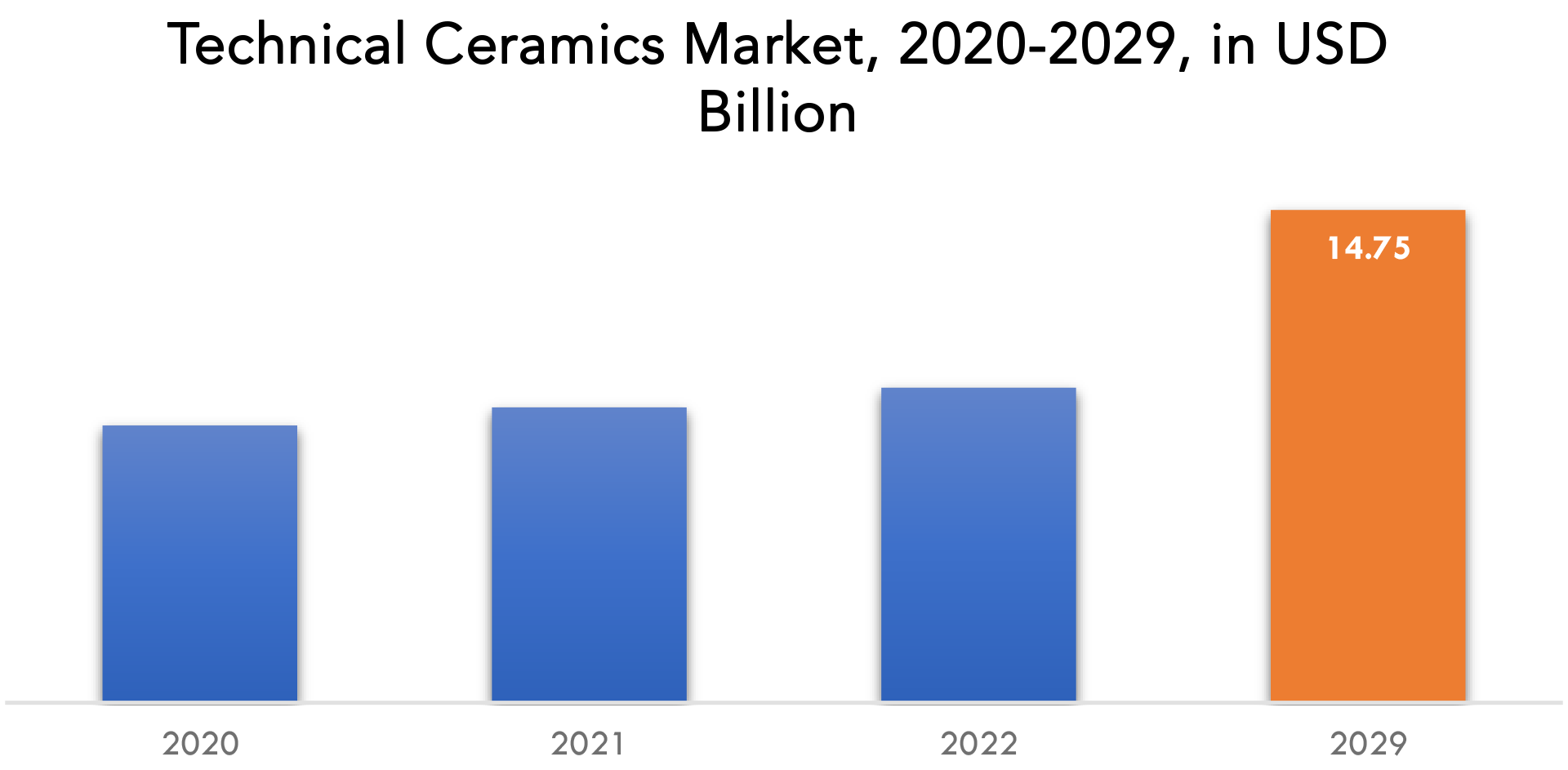
Technical Ceramics Market Key Players
The major players in the technical ceramics include Kyocera Corporation, CeramTec GmbH, CoorsTek Inc., Saint-Gobain Ceramic Materials, Morgan Advanced Materials, NGK Insulators Ltd., Rauschert GmbH, McDanel Advanced Ceramic Technologies, Murata Manufacturing Co., Ltd., Superior Technical Ceramics, H.C. Starck Ceramics GmbH, IBIDEN CO., LTD.
Recent News May 10, 2022; A consortium set-up to develop the next generation in battery technology has received a significant boost, with the donation of a pioneering advanced material to the project. Morgan Advanced Materials has provided Lucideon with a high-performance lithium conducting solid-electrolyte material, which is not yet available in the marketplace. The solid electrolyte will be used to support the ongoing research and development project being carried out by the consortium, led by Lucideon, along with project partners KWSP and Loughborough University. Together they are working as part of UK Research and Innovation’s Faraday battery challenge fund to assess two complementary technologies to manufacture components for solid-state batteries; Additive Manufacturing at Loughborough University and contactless Field Enhanced Sintering at Lucideon to manufacture thin, textured/designed films of solid electrolytes for Li-ion and Na-ion batteries. In parallel, KWSP are leading an assessment of pilot scale manufacturing approaches to expedite technology exploitation. July 06, 2022; Standard Gas' Technical Director, Laurence Sharrock, expressed his delight as the construction of the company's first SG100 plant progressed rapidly. According to Laurence, the plant was being supplied with ceramic pipes for the gas cracking system by Saint-Gobain. The pipes were made with Saint-Gobain's advanced silicon carbide and were ideal for the process due to their higher heat resistance compared to steel and metal alloy alternatives. The significant order comprised bespoke engineered components for the SG100. According to Laurence, the ceramic pipes were chosen because they were performance critical and could comfortably cope with the gas-cracking stages and conditions of the SG100. He further stated that Saint-Gobain had helped the company achieve an improved solution to a previous design iteration, and that the pipes could tolerate up to 1,350°C, which was higher than the required tolerance of 1,150°C.Who Should Buy? Or Key stakeholders
- Investors
- Institutional & retail players.
- Chemical Industry
- Investment research firms
- Manufacturing companies
- Government Institution
- Research Organizations
- Environment, Health, and Safety Professionals
- Regulatory Authorities
- End-User Companies
- Others
Technical Ceramics Market Regional Analysis
The technical ceramics market by region includes North America, Asia-Pacific (APAC), Europe, South America, and Middle East & Africa (MEA).
- North America: includes the US, Canada, Mexico
- Asia Pacific: includes China, Japan, South Korea, India, Australia, ASEAN and Rest of APAC
- Europe: includes UK, Germany, France, Italy, Spain, Russia, and Rest of Europe
- South America: includes Brazil, Argentina, and Rest of South America
- Middle East & Africa: includes Turkey, UAE, Saudi Arabia, South Africa, and Rest of MEA
The Asia Pacific region holds the largest share of the global technical ceramics market. The Asia Pacific region is home to some of the world's fastest-growing economies, such as China and India. These economies are experiencing rapid growth in various end-use industries, such as automotive, electronics, and medical, which are major consumers of technical ceramics. The increasing demand from these industries is driving the growth of the technical ceramics market in the region.
Further, governments in the Asia Pacific region are implementing policies and initiatives to promote the growth of various industries, including those that use technical ceramics. For example, the Chinese government has launched initiatives such as "Made in China 2025" to promote the growth of the country's high-tech industries, which include the technical ceramics industry.
Moreover, the Asia Pacific region is home to some of the world's leading research and development centers for technical ceramics. Companies in the region are investing heavily in research and development to develop new products and applications for technical ceramics, which is driving the growth of the market.
The Asia Pacific region is rich in raw materials such as alumina, zirconia, and silicon carbide, which are used in the production of technical ceramics. The availability of these raw materials in the region is an advantage for manufacturers and contributes to the growth of the market.Labor costs in the Asia Pacific region are generally lower compared to other regions, which is an advantage for manufacturers of technical ceramics. This allows manufacturers to produce technical ceramics at a lower cost, which is attractive to end-users in the region and contributes to the growth of the market.
In conclusion, the Asia Pacific region dominates the global technical ceramics market due to a combination of factors such as growing demand from end-use industries, favorable government policies and initiatives, increasing investments in research and development, availability of raw materials, and low labor costs. As the region continues to grow economically and technologically, it is expected to maintain its position as the largest market for technical ceramics in the coming years.
[caption id="attachment_18948" align="aligncenter" width="1920"]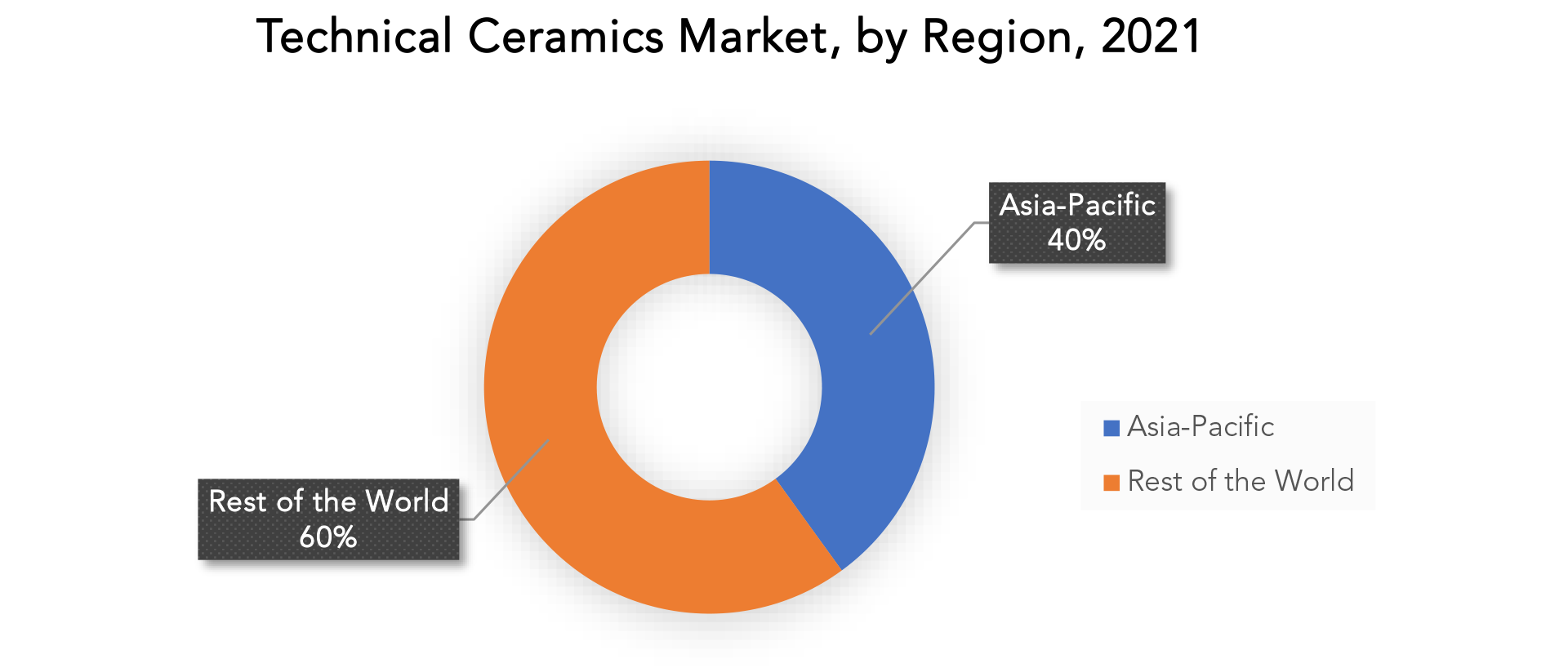
Key Market Segments: Technical ceramics Market
Technical Ceramics Market by Material, 2020-2029, (USD Billion), (Kilotons)- Oxide
- Non-Oxide
- Monolithic Ceramics
- Ceramic Coatings
- Ceramic Matrix Composites
- Electronics & Semiconductor
- Automotive
- Energy & Power
- Medical
- North America
- Asia Pacific
- Europe
- South America
- Middle East And Africa
Exactitude Consultancy Services Key Objectives
- Increasing sales and market share
- Developing new technology
- Improving profitability
- Entering new markets
- Enhancing brand reputation
Key Question Answered
- What is the expected growth rate of the technical ceramics market over the next 7 years?
- Who are the major players in the technical ceramics market and what is their market share?
- What are the end-user industries driving demand for market and what is their outlook?
- What are the opportunities for growth in emerging markets such as Asia-Pacific, Middle East, and Africa?
- How is the economic environment affecting the technical ceramics market, including factors such as interest rates, inflation, and exchange rates?
- What is the expected impact of government policies and regulations on the technical ceramics market?
- What is the current and forecasted size and growth rate of the global technical ceramics market?
- What are the key drivers of growth in the technical ceramics market?
- Who are the major players in the market and what is their market share?
- What are the distribution channels and supply chain dynamics in the technical ceramics market?
- What are the technological advancements and innovations in the technical ceramics market and their impact on product development and growth?
- What are the regulatory considerations and their impact on the market?
- What are the challenges faced by players in the technical ceramics market and how are they addressing these challenges?
- What are the opportunities for growth and expansion in the technical ceramics market?
- What are the product applications and specifications of leading players in the market?
- INTRODUZIONE
- DEFINIZIONE DI MERCATO
- SEGMENTAZIONE DEL MERCATO
- TEMPI DI RICERCA
- ASSUNZIONI E LIMITAZIONI
- METODOLOGIA DI RICERCA
- ESTRAZIONE DATI
- RICERCA SECONDARIA
- PRIMARY RESEARCH
- SUBJECT-MATTER EXPERTS’ ADVICE
- QUALITY CHECKS
- FINAL REVIEW
- DATA TRIANGULATION
- BOTTOM-UP APPROACH
- TOP-DOWN APPROACH
- RESEARCH FLOW
- DATA SOURCES
- ESTRAZIONE DATI
- EXECUTIVE SUMMARY
- MARKET OVERVIEW
- GLOBAL TECHNICAL CERAMICS MARKET OUTLOOK
- MARKET DRIVERS
- MARKET RESTRAINTS
- MARKET OPPORTUNITIES
- IMPACT OF COVID-19 ON TECHNICAL CERAMICS MARKET
- PORTER’S FIVE FORCES MODEL
- THREAT FROM NEW ENTRANTS
- THREAT FROM SUBSTITUTES
- BARGAINING POWER OF SUPPLIERS
- BARGAINING POWER OF CUSTOMERS
- DEGREE OF COMPETITION
- INDUSTRY VALUE CHAIN ANALYSIS
- GLOBAL TECHNICAL CERAMICS MARKET OUTLOOK
- GLOBAL TECHNICAL CERAMICS MARKET BY MATERIAL, (USD BILLION), KILOTONS, 2020-2029
- OXIDE
- NON-OXIDE
- GLOBAL TECHNICAL CERAMICS MARKET BY PRODUCT (USD BILLION), KILOTONS, 2020-2029
- MONOLITHIC CERAMICS
- CERAMIC MATRIX COMPOSITES
- CERAMIC COATINGS
- GLOBAL TECHNICAL CERAMICS MARKET BY END-USE INDUSTRY (USD BILLION), KILOTONS, 2020-2029
- ELECTRONICS & SEMICONDUCTOR
- AUTOMOTIVE
- ENERGY & POWER
- MEDICAL
- GLOBAL TECHNICAL CERAMICS MARKET BY REGION (USD BILLION), KILOTONS, 2020-2029
- NORTH AMERICA
- US
- CANADA
- MEXICO
- SOUTH AMERICA
- BRAZIL
- ARGENTINA
- COLOMBIA
- REST OF SOUTH AMERICA
- EUROPE
- GERMANY
- UK
- FRANCE
- ITALY
- SPAIN
- RUSSIA
- REST OF EUROPE
- ASIA PACIFIC
- INDIA
- CHINA
- JAPAN
- SOUTH KOREA
- AUSTRALIA
- SOUTH-EAST ASIA
- REST OF ASIA PACIFIC
- MIDDLE EAST AND AFRICA
- UAE
- SAUDI ARABIA
- SOUTH AFRICA
- REST OF MIDDLE EAST AND AFRICA
- NORTH AMERICA
- COMPANY PROFILES* (BUSINESS OVERVIEW, COMPANY SNAPSHOT, PRODUCTS OFFERED, RECENT DEVELOPMENTS)
- KYOCERA CORPORATION
- CERAMTEC GMBH
- COORSTEK INC.
- SAINT-GOBAIN CERAMIC MATERIALS
- MORGAN ADVANCED MATERIALS
- NGK INSULATORS LTD.
- RAUSCHERT GMBH
- MCDANEL ADVANCED CERAMIC TECHNOLOGIES
- MURATA MANUFACTURING CO., LTD.
- SUPERIOR TECHNICAL CERAMICS
- H.C. STARCK CERAMICS GMBH *THE COMPANY LIST IS INDICATIVE
LIST OF TABLES
TABLE 1 GLOBAL TECHNICAL CERAMICS MARKET BY MATERIAL (USD BILLION), 2020-2029
TABLE 2 GLOBAL TECHNICAL CERAMICS MARKET BY MATERIAL (KILOTONS), 2020-2029
TABLE 3 GLOBAL TECHNICAL CERAMICS MARKET BY PRODUCT (USD BILLION), 2020-2029
TABLE 4 GLOBAL TECHNICAL CERAMICS MARKET BY PRODUCT (KILOTONS), 2020-2029
TABLE 5 GLOBAL TECHNICAL CERAMICS MARKET BY END-USE INDUSTRY (USD BILLION), 2020-2029
TABLE 6 GLOBAL TECHNICAL CERAMICS MARKET BY END-USE INDUSTRY (KILOTONS), 2020-2029
TABLE 7 GLOBAL TECHNICAL CERAMICS MARKET BY REGION (KILOTONS), 2020-2029
TABLE 8 GLOBAL TECHNICAL CERAMICS MARKET BY REGION (KILOTONS), 2020-2029
TABLE 9 NORTH AMERICA TECHNICAL CERAMICS MARKET BY COUNTRY (USD BILLION), 2020-2029
TABLE 10 NORTH AMERICA TECHNICAL CERAMICS MARKET BY COUNTRY (KILOTONS), 2020-2029
TABLE 11 NORTH AMERICA TECHNICAL CERAMICS MARKET BY MATERIAL (USD BILLION), 2020-2029
TABLE 12 NORTH AMERICA TECHNICAL CERAMICS MARKET BY MATERIAL (KILOTONS), 2020-2029
TABLE 13 NORTH AMERICA TECHNICAL CERAMICS MARKET BY PRODUCT (USD BILLION), 2020-2029
TABLE 14 NORTH AMERICA TECHNICAL CERAMICS MARKET BY PRODUCT (KILOTONS), 2020-2029
TABLE 15 NORTH AMERICA TECHNICAL CERAMICS MARKET BY END-USE INDUSTRY (USD BILLION), 2020-2029
TABLE 16 NORTH AMERICA TECHNICAL CERAMICS MARKET BY END-USE INDUSTRY (KILOTONS), 2020-2029
TABLE 17 US TECHNICAL CERAMICS MARKET BY MATERIAL (USD BILLION), 2020-2029
TABLE 18 US TECHNICAL CERAMICS MARKET BY MATERIAL (KILOTONS), 2020-2029
TABLE 19 US TECHNICAL CERAMICS MARKET BY PRODUCT (USD BILLION), 2020-2029
TABLE 20 US TECHNICAL CERAMICS MARKET BY PRODUCT (KILOTONS), 2020-2029
TABLE 21 US TECHNICAL CERAMICS MARKET BY END-USE INDUSTRY (USD BILLION), 2020-2029
TABLE 22 US TECHNICAL CERAMICS MARKET BY END-USE INDUSTRY (KILOTONS), 2020-2029
TABLE 23 CANADA TECHNICAL CERAMICS MARKET BY MATERIAL (BILLION), 2020-2029
TABLE 24 CANADA TECHNICAL CERAMICS MARKET BY MATERIAL (KILOTONS), 2020-2029
TABLE 25 CANADA TECHNICAL CERAMICS MARKET BY PRODUCT (USD BILLION), 2020-2029
TABLE 26 CANADA TECHNICAL CERAMICS MARKET BY PRODUCT (KILOTONS), 2020-2029
TABLE 27 CANADA TECHNICAL CERAMICS MARKET BY END-USE INDUSTRY (USD BILLION), 2020-2029
TABLE 28 CANADA TECHNICAL CERAMICS MARKET BY END-USE INDUSTRY (KILOTONS), 2020-2029
TABLE 29 MEXICO TECHNICAL CERAMICS MARKET BY MATERIAL (USD BILLION), 2020-2029
TABLE 30 MEXICO TECHNICAL CERAMICS MARKET BY MATERIAL (KILOTONS), 2020-2029
TABLE 31 MEXICO TECHNICAL CERAMICS MARKET BY PRODUCT (USD BILLION), 2020-2029
TABLE 32 MEXICO TECHNICAL CERAMICS MARKET BY PRODUCT (KILOTONS), 2020-2029
TABLE 33 MEXICO TECHNICAL CERAMICS MARKET BY END-USE INDUSTRY (USD BILLION), 2020-2029
TABLE 34 MEXICO TECHNICAL CERAMICS MARKET BY END-USE INDUSTRY (KILOTONS), 2020-2029
TABLE 35 SOUTH AMERICA TECHNICAL CERAMICS MARKET BY COUNTRY (USD BILLION), 2020-2029
TABLE 36 SOUTH AMERICA TECHNICAL CERAMICS MARKET BY COUNTRY (KILOTONS), 2020-2029
TABLE 37 SOUTH AMERICA TECHNICAL CERAMICS MARKET BY MATERIAL (USD BILLION), 2020-2029
TABLE 38 SOUTH AMERICA TECHNICAL CERAMICS MARKET BY MATERIAL (KILOTONS), 2020-2029
TABLE 39 SOUTH AMERICA TECHNICAL CERAMICS MARKET BY PRODUCT (USD BILLION), 2020-2029
TABLE 40 SOUTH AMERICA TECHNICAL CERAMICS MARKET BY PRODUCT (KILOTONS), 2020-2029
TABLE 41 SOUTH AMERICA TECHNICAL CERAMICS MARKET BY END-USE INDUSTRY (USD BILLION), 2020-2029
TABLE 42 SOUTH AMERICA TECHNICAL CERAMICS MARKET BY END-USE INDUSTRY (KILOTONS), 2020-2029
TABLE 43 BRAZIL TECHNICAL CERAMICS MARKET BY MATERIAL (USD BILLION), 2020-2029
TABLE 44 BRAZIL TECHNICAL CERAMICS MARKET BY MATERIAL (KILOTONS), 2020-2029
TABLE 45 BRAZIL TECHNICAL CERAMICS MARKET BY PRODUCT (USD BILLION), 2020-2029
TABLE 46 BRAZIL TECHNICAL CERAMICS MARKET BY PRODUCT (KILOTONS), 2020-2029
TABLE 47 BRAZIL TECHNICAL CERAMICS MARKET BY END-USE INDUSTRY (USD BILLION), 2020-2029
TABLE 48 BRAZIL TECHNICAL CERAMICS MARKET BY END-USE INDUSTRY (KILOTONS), 2020-2029
TABLE 49 ARGENTINA TECHNICAL CERAMICS MARKET BY MATERIAL (USD BILLION), 2020-2029
TABLE 50 ARGENTINA TECHNICAL CERAMICS MARKET BY MATERIAL (KILOTONS), 2020-2029
TABLE 51 ARGENTINA TECHNICAL CERAMICS MARKET BY PRODUCT (USD BILLION), 2020-2029
TABLE 52 ARGENTINA TECHNICAL CERAMICS MARKET BY PRODUCT (KILOTONS), 2020-2029
TABLE 53 ARGENTINA TECHNICAL CERAMICS MARKET BY END-USE INDUSTRY (USD BILLION), 2020-2029
TABLE 54 ARGENTINA TECHNICAL CERAMICS MARKET BY END-USE INDUSTRY (KILOTONS), 2020-2029
TABLE 55 COLOMBIA TECHNICAL CERAMICS MARKET BY MATERIAL (USD BILLION), 2020-2029
TABLE 56 COLOMBIA TECHNICAL CERAMICS MARKET BY MATERIAL (KILOTONS), 2020-2029
TABLE 57 COLOMBIA TECHNICAL CERAMICS MARKET BY PRODUCT (USD BILLION), 2020-2029
TABLE 58 COLOMBIA TECHNICAL CERAMICS MARKET BY PRODUCT (KILOTONS), 2020-2029
TABLE 59 COLOMBIA TECHNICAL CERAMICS MARKET BY END-USE INDUSTRY (USD BILLION), 2020-2029
TABLE 60 COLOMBIA TECHNICAL CERAMICS MARKET BY END-USE INDUSTRY (KILOTONS), 2020-2029
TABLE 61 REST OF SOUTH AMERICA TECHNICAL CERAMICS MARKET BY MATERIAL (USD BILLION), 2020-2029
TABLE 62 REST OF SOUTH AMERICA TECHNICAL CERAMICS MARKET BY MATERIAL (KILOTONS), 2020-2029
TABLE 63 REST OF SOUTH AMERICA TECHNICAL CERAMICS MARKET BY PRODUCT (USD BILLION), 2020-2029
TABLE 64 REST OF SOUTH AMERICA TECHNICAL CERAMICS MARKET BY PRODUCT (KILOTONS), 2020-2029
TABLE 65 REST OF SOUTH AMERICA TECHNICAL CERAMICS MARKET BY END-USE INDUSTRY (USD BILLION), 2020-2029
TABLE 66 REST OF SOUTH AMERICA TECHNICAL CERAMICS MARKET BY END-USE INDUSTRY (KILOTONS), 2020-2029
TABLE 67 ASIA-PACIFIC TECHNICAL CERAMICS MARKET BY COUNTRY (USD BILLION), 2020-2029
TABLE 68 ASIA-PACIFIC TECHNICAL CERAMICS MARKET BY COUNTRY (KILOTONS), 2020-2029
TABLE 69 ASIA-PACIFIC TECHNICAL CERAMICS MARKET BY MATERIAL (USD BILLION), 2020-2029
TABLE 70 ASIA-PACIFIC TECHNICAL CERAMICS MARKET BY MATERIAL (KILOTONS), 2020-2029
TABLE 71 ASIA-PACIFIC TECHNICAL CERAMICS MARKET BY PRODUCT (USD BILLION), 2020-2029
TABLE 72 ASIA-PACIFIC TECHNICAL CERAMICS MARKET BY PRODUCT (KILOTONS), 2020-2029
TABLE 73 ASIA-PACIFIC TECHNICAL CERAMICS MARKET BY END-USE INDUSTRY (USD BILLION), 2020-2029
TABLE 74 ASIA-PACIFIC TECHNICAL CERAMICS MARKET BY END-USE INDUSTRY (KILOTONS), 2020-2029
TABLE 75 INDIA TECHNICAL CERAMICS MARKET BY MATERIAL (USD BILLION), 2020-2029
TABLE 76 INDIA TECHNICAL CERAMICS MARKET BY MATERIAL (KILOTONS), 2020-2029
TABLE 77 INDIA TECHNICAL CERAMICS MARKET BY PRODUCT (USD BILLION), 2020-2029
TABLE 78 INDIA TECHNICAL CERAMICS MARKET BY PRODUCT (KILOTONS), 2020-2029
TABLE 79 INDIA TECHNICAL CERAMICS MARKET BY END-USE INDUSTRY (USD BILLION), 2020-2029
TABLE 80 INDIA TECHNICAL CERAMICS MARKET BY END-USE INDUSTRY (KILOTONS), 2020-2029
TABLE 81 CHINA TECHNICAL CERAMICS MARKET BY MATERIAL (USD BILLION), 2020-2029
TABLE 82 CHINA TECHNICAL CERAMICS MARKET BY MATERIAL (KILOTONS), 2020-2029
TABLE 83 CHINA TECHNICAL CERAMICS MARKET BY PRODUCT (USD BILLION), 2020-2029
TABLE 84 CHINA TECHNICAL CERAMICS MARKET BY PRODUCT (KILOTONS), 2020-2029
TABLE 85 CHINA TECHNICAL CERAMICS MARKET BY END-USE INDUSTRY (USD BILLION), 2020-2029
TABLE 86 CHINA TECHNICAL CERAMICS MARKET BY END-USE INDUSTRY (KILOTONS), 2020-2029
TABLE 87 JAPAN TECHNICAL CERAMICS MARKET BY MATERIAL (USD BILLION), 2020-2029
TABLE 88 JAPAN TECHNICAL CERAMICS MARKET BY MATERIAL (KILOTONS), 2020-2029
TABLE 89 JAPAN TECHNICAL CERAMICS MARKET BY PRODUCT (USD BILLION), 2020-2029
TABLE 90 JAPAN TECHNICAL CERAMICS MARKET BY PRODUCT (KILOTONS), 2020-2029
TABLE 91 JAPAN TECHNICAL CERAMICS MARKET BY END-USE INDUSTRY (USD BILLION), 2020-2029
TABLE 92 JAPAN TECHNICAL CERAMICS MARKET BY END-USE INDUSTRY (KILOTONS), 2020-2029
TABLE 93 SOUTH KOREA TECHNICAL CERAMICS MARKET BY MATERIAL (USD BILLION), 2020-2029
TABLE 94 SOUTH KOREA TECHNICAL CERAMICS MARKET BY MATERIAL (KILOTONS), 2020-2029
TABLE 95 SOUTH KOREA TECHNICAL CERAMICS MARKET BY PRODUCT (USD BILLION), 2020-2029
TABLE 96 SOUTH KOREA TECHNICAL CERAMICS MARKET BY PRODUCT (KILOTONS), 2020-2029
TABLE 97 SOUTH KOREA TECHNICAL CERAMICS MARKET BY END-USE INDUSTRY (USD BILLION), 2020-2029
TABLE 98 SOUTH KOREA TECHNICAL CERAMICS MARKET BY END-USE INDUSTRY (KILOTONS), 2020-2029
TABLE 99 AUSTRALIA TECHNICAL CERAMICS MARKET BY MATERIAL (USD BILLION), 2020-2029
TABLE 100 AUSTRALIA CONNECTED TRUCKBY MATERIAL (KILOTONS), 2020-2029
TABLE 101 AUSTRALIA TECHNICAL CERAMICS MARKET BY PRODUCT (USD BILLION), 2020-2029
TABLE 102 AUSTRALIA TECHNICAL CERAMICS MARKET BY PRODUCT (KILOTONS), 2020-2029
TABLE 103 AUSTRALIA TECHNICAL CERAMICS MARKET BY END-USE INDUSTRY (USD BILLION), 2020-2029
TABLE 104 AUSTRALIA TECHNICAL CERAMICS MARKET BY END-USE INDUSTRY (KILOTONS), 2020-2029
TABLE 105 SOUTH EAST ASIA TECHNICAL CERAMICS MARKET BY MATERIAL (USD BILLION), 2020-2029
TABLE 106 SOUTH EAST ASIA CONNECTED TRUCKBY MATERIAL (KILOTONS), 2020-2029
TABLE 107 SOUTH EAST ASIA TECHNICAL CERAMICS MARKET BY PRODUCT (USD BILLION), 2020-2029
TABLE 108 SOUTH EAST ASIA TECHNICAL CERAMICS MARKET BY PRODUCT (KILOTONS), 2020-2029
TABLE 109 SOUTH EAST ASIA TECHNICAL CERAMICS MARKET BY END-USE INDUSTRY (USD BILLION), 2020-2029
TABLE 110 SOUTH EAST ASIA TECHNICAL CERAMICS MARKET BY END-USE INDUSTRY (KILOTONS), 2020-2029
TABLE 111 REST OF ASIA PACIFIC TECHNICAL CERAMICS MARKET BY MATERIAL (USD BILLION), 2020-2029
TABLE 112 REST OF ASIA PACIFIC CONNECTED TRUCKBY MATERIAL (KILOTONS), 2020-2029
TABLE 113 REST OF ASIA PACIFIC TECHNICAL CERAMICS MARKET BY PRODUCT (USD BILLION), 2020-2029
TABLE 114 REST OF ASIA PACIFIC TECHNICAL CERAMICS MARKET BY PRODUCT (KILOTONS), 2020-2029
TABLE 115 REST OF ASIA PACIFIC TECHNICAL CERAMICS MARKET BY END-USE INDUSTRY (USD BILLION), 2020-2029
TABLE 116 REST OF ASIA PACIFIC TECHNICAL CERAMICS MARKET BY END-USE INDUSTRY (KILOTONS), 2020-2029
TABLE 117 EUROPE TECHNICAL CERAMICS MARKET BY COUNTRY (USD BILLION), 2020-2029
TABLE 118 EUROPE TECHNICAL CERAMICS MARKET BY COUNTRY MATERIAL (KILOTONS), 2020-2029
TABLE 119 EUROPE TECHNICAL CERAMICS MARKET BY MATERIAL (USD BILLION), 2020-2029
TABLE 120 EUROPE TECHNICAL CERAMICS MARKET BY MATERIAL (KILOTONS), 2020-2029
TABLE 121 EUROPE TECHNICAL CERAMICS MARKET BY PRODUCT (USD BILLION), 2020-2029
TABLE 122 EUROPE TECHNICAL CERAMICS MARKET BY PRODUCT (KILOTONS), 2020-2029
TABLE 123 EUROPE TECHNICAL CERAMICS MARKET BY END-USE INDUSTRY (USD BILLION), 2020-2029
TABLE 124 EUROPE TECHNICAL CERAMICS MARKET BY END-USE INDUSTRY (KILOTONS), 2020-2029
TABLE 125 GERMANY TECHNICAL CERAMICS MARKET BY MATERIAL (USD BILLION), 2020-2029
TABLE 126 GERMANY TECHNICAL CERAMICS MARKET BY MATERIAL (KILOTONS), 2020-2029
TABLE 127 GERMANY TECHNICAL CERAMICS MARKET BY PRODUCT (USD BILLION), 2020-2029
TABLE 128 GERMANY TECHNICAL CERAMICS MARKET BY PRODUCT (KILOTONS), 2020-2029
TABLE 129 GERMANY TECHNICAL CERAMICS MARKET BY END-USE INDUSTRY (USD BILLION), 2020-2029
TABLE 130 GERMANY TECHNICAL CERAMICS MARKET BY END-USE INDUSTRY (KILOTONS), 2020-2029
TABLE 131 UK TECHNICAL CERAMICS MARKET BY MATERIAL (USD BILLION), 2020-2029
TABLE 132 UK TECHNICAL CERAMICS MARKET BY MATERIAL (KILOTONS), 2020-2029
TABLE 133 UK TECHNICAL CERAMICS MARKET BY PRODUCT (USD BILLION), 2020-2029
TABLE 134 UK TECHNICAL CERAMICS MARKET BY PRODUCT (KILOTONS), 2020-2029
TABLE 135 UK TECHNICAL CERAMICS MARKET BY END-USE INDUSTRY (USD BILLION), 2020-2029
TABLE 136 UK TECHNICAL CERAMICS MARKET BY END-USE INDUSTRY (KILOTONS), 2020-2029
TABLE 137 FRANCE TECHNICAL CERAMICS MARKET BY MATERIAL (USD BILLION), 2020-2029
TABLE 138 FRANCE TECHNICAL CERAMICS MARKET BY MATERIAL (KILOTONS), 2020-2029
TABLE 139 FRANCE TECHNICAL CERAMICS MARKET BY PRODUCT (USD BILLION), 2020-2029
TABLE 140 FRANCE TECHNICAL CERAMICS MARKET BY PRODUCT (KILOTONS), 2020-2029
TABLE 141 FRANCE TECHNICAL CERAMICS MARKET BY END-USE INDUSTRY (USD BILLION), 2020-2029
TABLE 142 FRANCE TECHNICAL CERAMICS MARKET BY END-USE INDUSTRY (KILOTONS), 2020-2029
TABLE 143 ITALY TECHNICAL CERAMICS MARKET BY MATERIAL (USD BILLION), 2020-2029
TABLE 144 ITALY TECHNICAL CERAMICS MARKET BY MATERIAL (KILOTONS), 2020-2029
TABLE 145 ITALY TECHNICAL CERAMICS MARKET BY PRODUCT (USD BILLION), 2020-2029
TABLE 146 ITALY TECHNICAL CERAMICS MARKET BY PRODUCT (KILOTONS), 2020-2029
TABLE 147 ITALY TECHNICAL CERAMICS MARKET BY END-USE INDUSTRY (USD BILLION), 2020- 2029
TABLE 148 ITALY TECHNICAL CERAMICS MARKET BY END-USE INDUSTRY (KILOTONS), 2020-2029
TABLE 149 SPAIN TECHNICAL CERAMICS MARKET BY MATERIAL (USD BILLION), 2020-2029
TABLE 150 SPAIN TECHNICAL CERAMICS MARKET BY MATERIAL (KILOTONS), 2020-2029
TABLE 151 SPAIN TECHNICAL CERAMICS MARKET BY PRODUCT (USD BILLION), 2020-2029
TABLE 152 SPAIN TECHNICAL CERAMICS MARKET BY PRODUCT (KILOTONS), 2020-2029
TABLE 153 SPAIN TECHNICAL CERAMICS MARKET BY END-USE INDUSTRY (USD BILLION), 2020-2029
TABLE 154 SPAIN TECHNICAL CERAMICS MARKET BY END-USE INDUSTRY (KILOTONS), 2020-2029
TABLE 155 RUSSIA TECHNICAL CERAMICS MARKET BY MATERIAL (USD BILLION), 2020-2029
TABLE 156 RUSSIA TECHNICAL CERAMICS MARKET BY MATERIAL (KILOTONS), 2020-2029
TABLE 157 RUSSIA TECHNICAL CERAMICS MARKET BY PRODUCT (USD BILLION), 2020-2029
TABLE 158 RUSSIA TECHNICAL CERAMICS MARKET BY PRODUCT (KILOTONS), 2020-2029
TABLE 159 RUSSIA TECHNICAL CERAMICS MARKET BY END-USE INDUSTRY (USD BILLION), 2020-2029
TABLE 160 RUSSIA TECHNICAL CERAMICS MARKET BY END-USE INDUSTRY (KILOTONS), 2020-2029
TABLE 161 REST OF EUROPE TECHNICAL CERAMICS MARKET BY MATERIAL (USD BILLION), 2020-2029
TABLE 162 REST OF EUROPE TECHNICAL CERAMICS MARKET BY MATERIAL (KILOTONS), 2020-2029
TABLE 163 REST OF EUROPE TECHNICAL CERAMICS MARKET BY PRODUCT (USD BILLION), 2020-2029
TABLE 164 REST OF EUROPE TECHNICAL CERAMICS MARKET BY PRODUCT (KILOTONS), 2020-2029
TABLE 165 REST OF EUROPE TECHNICAL CERAMICS MARKET BY END-USE INDUSTRY (USD BILLION), 2020-2029
TABLE 166 REST OF EUROPE TECHNICAL CERAMICS MARKET BY END-USE INDUSTRY (KILOTONS), 2020-2029
TABLE 167 MIDDLE EAST AND AFRICA TECHNICAL CERAMICS MARKET BY COUNTRY (USD BILLION), 2020-2029
TABLE 168 MIDDLE EAST AND AFRICA TECHNICAL CERAMICS MARKET BY COUNTRY (KILOTONS), 2020-2029
TABLE 169 MIDDLE EAST AND AFRICA TECHNICAL CERAMICS MARKET BY MATERIAL (USD BILLION), 2020-2029
TABLE 170 MIDDLE EAST AND AFRICA TECHNICAL CERAMICS MARKET BY MATERIAL (KILOTONS), 2020-2029
TABLE 171 MIDDLE EAST AND AFRICA TECHNICAL CERAMICS MARKET BY PRODUCT (USD BILLION), 2020-2029
TABLE 172 MIDDLE EAST AND AFRICA TECHNICAL CERAMICS MARKET BY PRODUCT (KILOTONS), 2020-2029
TABLE 173 MIDDLE EAST AND AFRICA TECHNICAL CERAMICS MARKET BY END-USE INDUSTRY (USD BILLION), 2020-2029
TABLE 174 MIDDLE EAST AND AFRICA TECHNICAL CERAMICS MARKET BY END-USE INDUSTRY (KILOTONS), 2020-2029
TABLE 175 UAE TECHNICAL CERAMICS MARKET BY MATERIAL (USD BILLION), 2020-2029
TABLE 176 UAE TECHNICAL CERAMICS MARKET BY MATERIAL (KILOTONS), 2020-2029
TABLE 177 UAE TECHNICAL CERAMICS MARKET BY PRODUCT (USD BILLION), 2020-2029
TABLE 178 UAE TECHNICAL CERAMICS MARKET BY PRODUCT (KILOTONS), 2020-2029
TABLE 179 UAE TECHNICAL CERAMICS MARKET BY END-USE INDUSTRY (USD BILLION), 2020-2029
TABLE 180 UAE TECHNICAL CERAMICS MARKET BY END-USE INDUSTRY (KILOTONS), 2020-2029
TABLE 181 SAUDI ARABIA TECHNICAL CERAMICS MARKET BY MATERIAL (USD BILLION), 2020-2029
TABLE 182 SAUDI ARABIA TECHNICAL CERAMICS MARKET BY MATERIAL (KILOTONS), 2020-2029
TABLE 183 SAUDI ARABIA TECHNICAL CERAMICS MARKET BY PRODUCT (USD BILLION), 2020-2029
TABLE 184 SAUDI ARABIA TECHNICAL CERAMICS MARKET BY PRODUCT (KILOTONS), 2020-2029
TABLE 185 SAUDI ARABIA TECHNICAL CERAMICS MARKET BY END-USE INDUSTRY (USD BILLION), 2020-2029
TABLE 186 SAUDI ARABIA TECHNICAL CERAMICS MARKET BY END-USE INDUSTRY (KILOTONS), 2020-2029
TABLE 187 SOUTH AFRICA TECHNICAL CERAMICS MARKET BY MATERIAL (USD BILLION), 2020-2029
TABLE 188 SOUTH AFRICA TECHNICAL CERAMICS MARKET BY MATERIAL (KILOTONS), 2020-2029
TABLE 189 SOUTH AFRICA TECHNICAL CERAMICS MARKET BY PRODUCT (USD BILLION), 2020-2029
TABLE 190 SOUTH AFRICA TECHNICAL CERAMICS MARKET BY PRODUCT (KILOTONS), 2020-2029
TABLE 191 SOUTH AFRICA TECHNICAL CERAMICS MARKET BY END-USE INDUSTRY (USD BILLION), 2020-2029
TABLE 192 SOUTH AFRICA TECHNICAL CERAMICS MARKET BY END-USE INDUSTRY (KILOTONS), 2020-2029
TABLE 193 REST OF MIDDLE EAST AND AFRICA TECHNICAL CERAMICS MARKET BY MATERIAL (USD BILLION), 2020-2029
TABLE 194 REST OF MIDDLE EAST AND AFRICA TECHNICAL CERAMICS MARKET BY MATERIAL (KILOTONS), 2020-2029
TABLE 195 REST OF MIDDLE EAST AND AFRICA TECHNICAL CERAMICS MARKET BY PRODUCT (USD BILLION), 2020-2029
TABLE 196 REST OF MIDDLE EAST AND AFRICA TECHNICAL CERAMICS MARKET BY PRODUCT (KILOTONS), 2020-2029
TABLE 197 REST OF MIDDLE EAST AND AFRICA TECHNICAL CERAMICS MARKET BY END-USE INDUSTRY (USD BILLION), 2020-2029
TABLE 198 REST OF MIDDLE EAST AND AFRICA TECHNICAL CERAMICS MARKET BY END-USE INDUSTRY (KILOTONS), 2020-2029
LIST OF FIGURES
FIGURE 1 MARKET DYNAMICS
FIGURE 2 MARKET SEGMENTATION
FIGURE 3 REPORT TIMELINES: YEARS CONSIDERED
FIGURE 4 DATA TRIANGULATION
FIGURE 5 BOTTOM-UP APPROACH
FIGURE 6 TOP-DOWN APPROACH
FIGURE 7 RESEARCH FLOW
FIGURE 8 GLOBAL TECHNICAL CERAMICS MARKET BY MATERIAL, USD BILLION, 2020-2029
FIGURE 9 GLOBAL TECHNICAL CERAMICS MARKET BY PRODUCT, USD BILLION, 2020-2029
FIGURE 10 GLOBAL TECHNICAL CERAMICS MARKET BY END-USE INDUSTRY, USD BILLION, 2020-2029
FIGURE 11 GLOBAL TECHNICAL CERAMICS MARKET REGION, USD BILLION, 2020-2029
FIGURE 12 PORTER’S FIVE FORCES MODEL
FIGURE 13 GLOBAL TECHNICAL CERAMICS MARKET BY MATERIAL, USD BILLION, 2021
FIGURE 14 GLOBAL TECHNICAL CERAMICS MARKET BY PRODUCT, USD BILLION, 2021
FIGURE 15 GLOBAL TECHNICAL CERAMICS MARKET BY END-USE INDUSTRY, USD BILLION, 2021
FIGURE 16 GLOBAL TECHNICAL CERAMICS MARKET BY REGION, USD BILLION, 2021
FIGURE 17 MARKET SHARE ANALYSIS
FIGURE 18 KYOCERA CORPORATION: COMPANY SNAPSHOT
FIGURE 19 CERAMTEC GMBH: COMPANY SNAPSHOT
FIGURE 20 COORSTEK INC.: COMPANY SNAPSHOT
FIGURE 21 SAINT-GOBAIN CERAMIC MATERIALS: COMPANY SNAPSHOT
FIGURE 22 MORGAN ADVANCED MATERIALS: COMPANY SNAPSHOT
FIGURE 23 NGK INSULATORS LTD.: COMPANY SNAPSHOT
FIGURE 24 RAUSCHERT GMBH: COMPANY SNAPSHOT
FIGURE 25 MCDANEL ADVANCED CERAMIC TECHNOLOGIES: COMPANY SNAPSHOT
FIGURE 26 MURATA MANUFACTURING CO.LTD.: COMPANY SNAPSHOT
FIGURE 27 SUPERIOR TECHNICAL CERAMICS: COMPANY SNAPSHOT
FIGURE 28 H.C. STARCK CERAMICS GMBH: COMPANY SNAPSHOT
DOWNLOAD FREE SAMPLE REPORT
License Type
SPEAK WITH OUR ANALYST
Want to know more about the report or any specific requirement?
WANT TO CUSTOMIZE THE REPORT?
Our Clients Speak
We asked them to research ‘ Equipment market’ all over the world, and their whole arrangement was helpful to us. thehealthanalytics.com insightful analysis and reports contributed to our current analysis and in creating a future strategy. Besides, the te
Yosuke Mitsui
Senior Associate Construction Equipment Sales & Marketing
We asked them to research ‘Equipment market’ all over the world, and their whole arrangement was helpful to us. thehealthanalytics.com insightful analysis and reports contributed to our current analysis and in creating a future strategy. Besides, the te