

Base Year Value ()
x.x %
x.x %
CAGR ()
x.x %
x.x %
Forecast Year Value ()
x.x %
x.x %
Historical Data Period
Largest Region
Forecast Period
Mercato High Dynamic Range per tipo di prodotto (dispositivi di acquisizione, dispositivi di visualizzazione), tipo (HDR10, HDR10+, Hybrid Log-Gamma, Dolby Vision, 4K), applicazione (streaming video, intrattenimento, sicurezza e sorveglianza, giochi) e regione, tendenze globali e previsioni dal 2022 al 2029
Instant access to hundreds of data points and trends
- Market estimates from 2014-2029
- Competitive analysis, industry segmentation, financial benchmarks
- Incorporates SWOT, Porter's Five Forces and risk management frameworks
- PDF report or online database with Word, Excel and PowerPoint export options
- 100% money back guarantee
Panoramica del mercato dell'High Dynamic Range
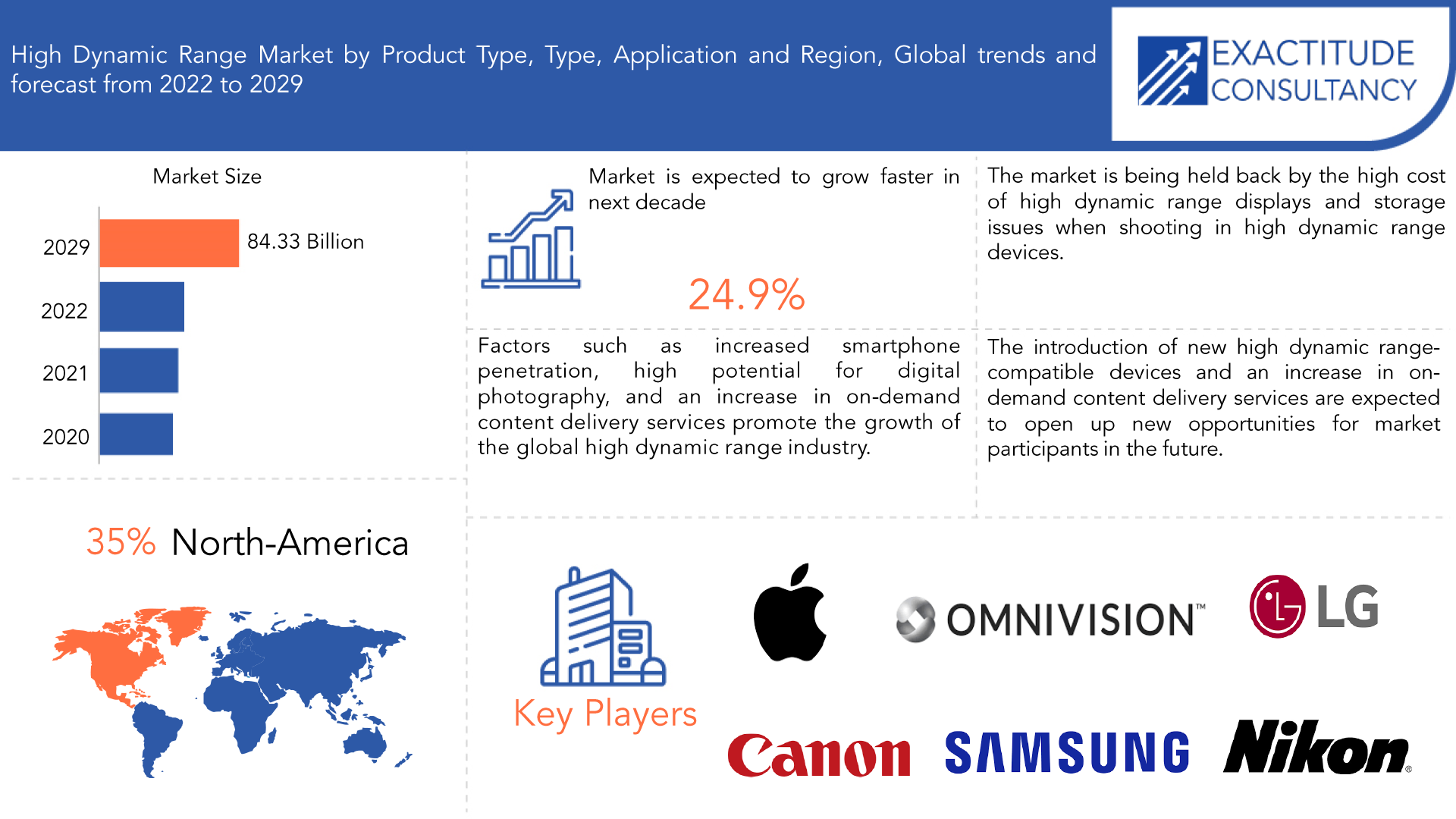
Si prevede che il mercato dell'high dynamic range crescerà al 24,9% di CAGR dal 2022 al 2029. Si prevede che raggiungerà oltre 84,33 miliardi di USD entro il 2029 dagli 11,4 miliardi di USD del 2020.
L'High Dynamic Range (HDR) è una tecnica di post-elaborazione utilizzata nell'imaging e nella fotografia per aumentare la "gamma dinamica" (rapporto tra luce e oscurità) in una fotografia per imitare ciò che l'occhio umano può vedere. L'occhio umano può vedere i dettagli anche quando la scena contiene sia aree chiare che scure, mentre una fotocamera avrà spesso un contrasto elevato tra queste aree, con conseguenti aree in ombra più scure con meno dettagli perché sono principalmente scure. Aggiungendo dettagli alle aree scure, l'HDR imita il modo in cui i nostri occhi percepiscono la gamma dinamica. Ciò si ottiene combinando foto dello stesso soggetto scattate con diverse esposizioni.
Un'immagine HDR viene in genere creata scattando tre immagini della stessa scena a tre diverse velocità di otturazione. In base alla quantità di luce che è passata attraverso l'obiettivo, l'immagine è luminosa, media o scura. Il sensore di immagine quindi unisce tutte le foto per creare l'immagine finale. Ciò contribuisce alla creazione di un'immagine simile a quella che vedrebbe l'occhio umano. Le immagini HDR vengono create scattando una singola immagine o una serie di immagini, combinandole e regolando i rapporti di contrasto con una singola apertura e velocità di otturazione.
| ATTRIBUTO | DETTAGLI |
| Periodo di studio | 2020-2029 |
| Anno base | 2021 |
| Anno stimato | 2022 |
| Anno previsto | 2022-2029 |
| Periodo storico | 2018-2020 |
| Unità | Valore (miliardi di USD) |
| Segmentazione | Per tipo di prodotto, Per tipo, Per applicazione, Per regione |
| Per tipo di prodotto |
|
| Per tipo |
|
| Per applicazione |
|
| Per regione |
|
Fattori quali la crescente diffusione degli smartphone, l'elevato potenziale della fotografia digitale e l'incremento dei servizi di distribuzione di contenuti on-demand favoriscono la crescita del settore globale dell'alta gamma dinamica.
La crescente trazione nel settore dell'intrattenimento, che è stato in prima linea nell'incorporazione della tecnologia HDR, sta guidando la crescita. Dal 2017 al 2021, la domanda di apparecchiature ad alta gamma dinamica è aumentata in modo significativo e si prevede che questa tendenza continuerà tra il 2022 e il 2029. Anche il mercato delle videocamere ad alta gamma dinamica si sta espandendo poiché vi è una maggiore domanda di telecamere potenti per l'uso in fotografia e media. Questo modello è un fattore significativo di espansione del mercato.
Il mercato è frenato dall'elevato costo dei display ad alta gamma dinamica e dai problemi di archiviazione quando si scatta con dispositivi ad alta gamma dinamica. Uno dei principali svantaggi di questa tecnica è che le fotografie ad alta gamma dinamica richiedono molto spazio di archiviazione sui dispositivi. È anche estremamente difficile utilizzare la tecnologia HDR per catturare immagini senza l'uso di un treppiede e bracketing. Per creare il prodotto finale di tali immagini ad alta gamma dinamica, è spesso richiesta una varietà di software. La necessità di elaborazione e perfezionamento aggiuntivi ha il potenziale di soffocare la crescita del mercato.
Il mercato HDR è plasmato dalla tecnologia HDR per il rendering 3D. L'HDR può essere utilizzato in una varietà di applicazioni grazie al rendering 3D. Il rendering 3D è il processo di conversione di un modello 3D in un'immagine 2D per la visualizzazione su uno schermo. Inoltre, si prevede che l'introduzione di nuovi dispositivi compatibili con l'alta gamma dinamica e un aumento dei servizi di distribuzione di contenuti on-demand apriranno nuove opportunità per i partecipanti al mercato in futuro.
Durante la pandemia di Covid-19, si è registrato un aumento della domanda di streaming video e intrattenimento, che ha aumentato la domanda di soluzioni ad alta gamma dinamica. Tuttavia, la pandemia ha avuto un impatto negativo sul mercato a causa di una supply chain interrotta e di un calo nella produzione di display. Inoltre, il mercato è stato ostacolato dalla mancanza di supporto logistico , procedure di quarantena e manodopera.
[caption id="allegato_21330" align="aligncenter" width="1920"]
Frequently Asked Questions
What is the expected CAGR in terms of revenue for the global high dynamic range market over the forecast period (2020–2029)?
The global high dynamic range market revenue is projected to expand at a CAGR of 24.9% during the forecast period.
What was the global high dynamic range market valued at in 2020?
The global high dynamic range market was valued at USD 11.4 billion in 2020.
Who are the key players in the high dynamic range market?
Some key players operating in the high dynamic range market include Apple, Inc., Canon, Nikon Corporation, Samsung Electronics Co., Ltd., LG Display Co., Ltd., Omnivision Technologies, Olympus Corp., Sony Corporation, Fujifilm Holding Corporation, Casio Computer Co., Ltd.
What are the factors driving the high dynamic range market?
Rising Adoption of Smartphones are driving the market in coming years, however, a shortage of stable contracts, storage and other problems while shooting in HDR growth of the market.
What are the different segments of the global high dynamic range market?
The global high dynamic range market is divided into product type, type, application, and region.
Which region will lead the global high dynamic range market?
North America region will lead the global high dynamic range Market during the forecast period 2022 to 2029.
High Dynamic Range Market Segment Analysis
The high dynamic range market is segmented based on platform, range, frequency band, and region, global trends and forecast. By product type the market is bifurcated into capturing devices, display devices; by type the market is bifurcated into HDR10, HDR10+, hybrid log-gamma, Dolby vision, 4K,; by application the market is bifurcated into video streaming, entertainment, security & surveillance, gaming.The display devices segment noticed the most growth in the market, owing to the high demand for advanced display systems that provide improved and immersive viewing experiences. These displays are intended to project a wider range of color levels and brightness, resulting in a more vivid experience.
With more than one-third of the global high dynamic range market, the HDR 10+ segment had the largest market share by type in 2020. This is so that the image appears more realistically because it uses dynamic metadata rather than static metadata. However, the Dolby Vision segment is expected to grow at the fastest rate of 28.2% during the forecast period, as it offers several advantages over HDR formats.
In terms of application, the entertainment segment dominated in 2020, accounting for nearly half of the global high dynamic range industry. However, the video streaming segment is expected to grow at the fastest rate of 24.9% between 2021 and 2029, owing to increased demand for high dynamic range video streaming, which provides higher contrast and precise & detailed shadows with greater clarity.
[caption id="attachment_21332" align="aligncenter" width="1920"]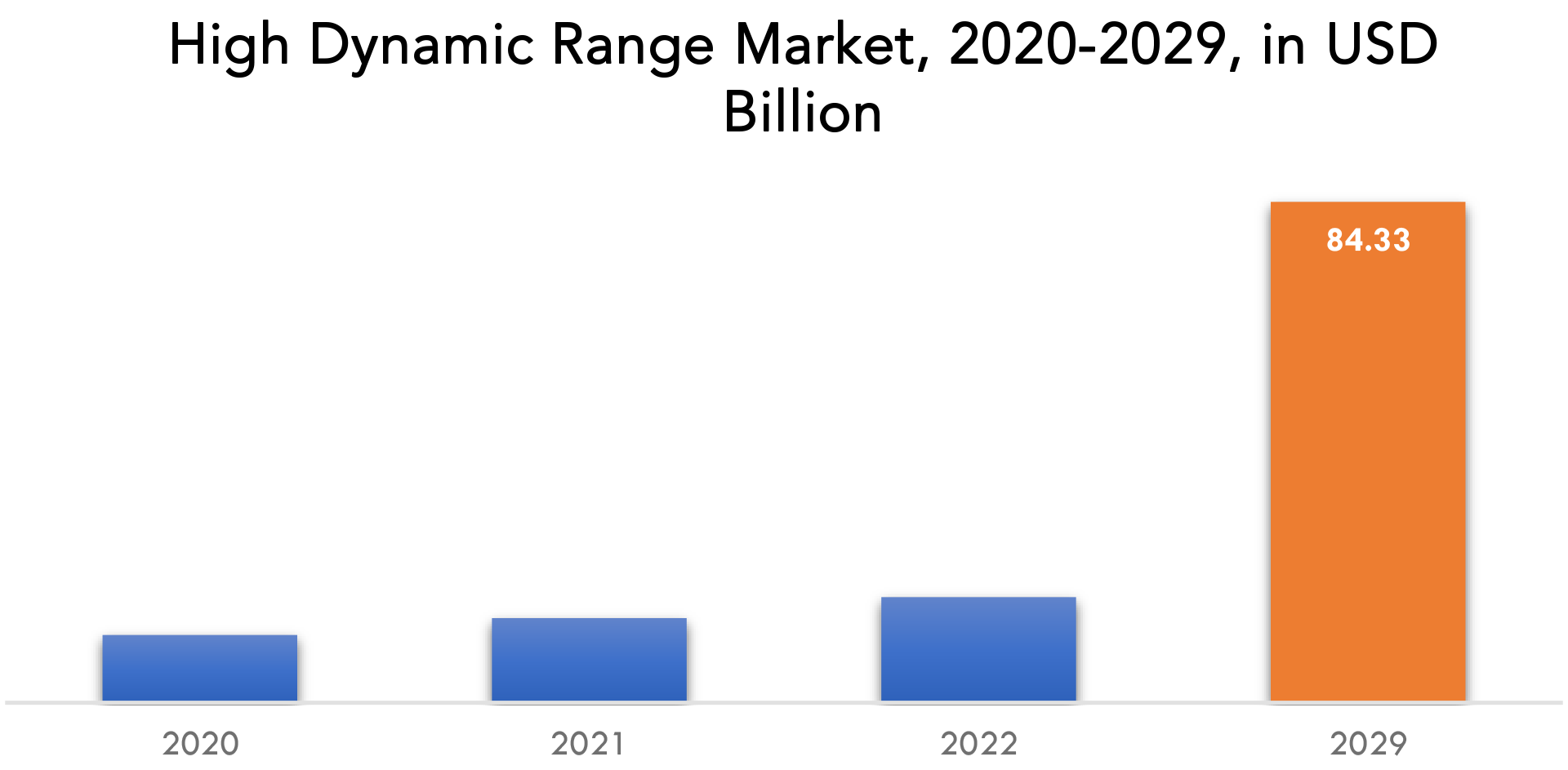
High Dynamic Range Market Key Players
The high dynamic range market key players include Apple, Inc., Canon, Nikon Corporation, Samsung Electronics Co., Ltd., LG Display Co., Ltd., Omnivision Technologies, Olympus Corp., Sony Corporation, Fujifilm Holding Corporation, Casio Computer Co., Ltd., and others. Recent Developments:- 14 March 2023: Apple launched Shop with a Specialist over Video, a new live shopping experience on apple.com for customers in the U.S. Shop with a Specialist over Video connects customers looking to purchase iPhone with a retail team member via a safe and secure, one-way video shopping session.
- 07 March 2023: Apple announced a new yellow iPhone 14 and iPhone 14 Plus, adding even more color choices to the lineup this spring
Who Should Buy? Or Key Stakeholders
- Scientific Research & Development
- End-users Companies
- Investors
- Government Organization
- Regulatory Authorities
- Others
High Dynamic Range Market Regional Analysis
The high dynamic range market by region includes North America, Asia-Pacific (APAC), Europe, South America, and Middle East & Africa (MEA).- North America: includes the US, Canada, Mexico, and Rest of North America
- Asia Pacific: includes China, Japan, South Korea, India, Australia, and Rest of APAC
- Europe: includes UK, Germany, France, Italy, Spain, Russia, and Rest of Europe
- South America: includes Brazil, Argentina, and Rest of South America
- Middle East & Africa: includes UAE, South Africa, Saudi Arabia and Rest of MEA
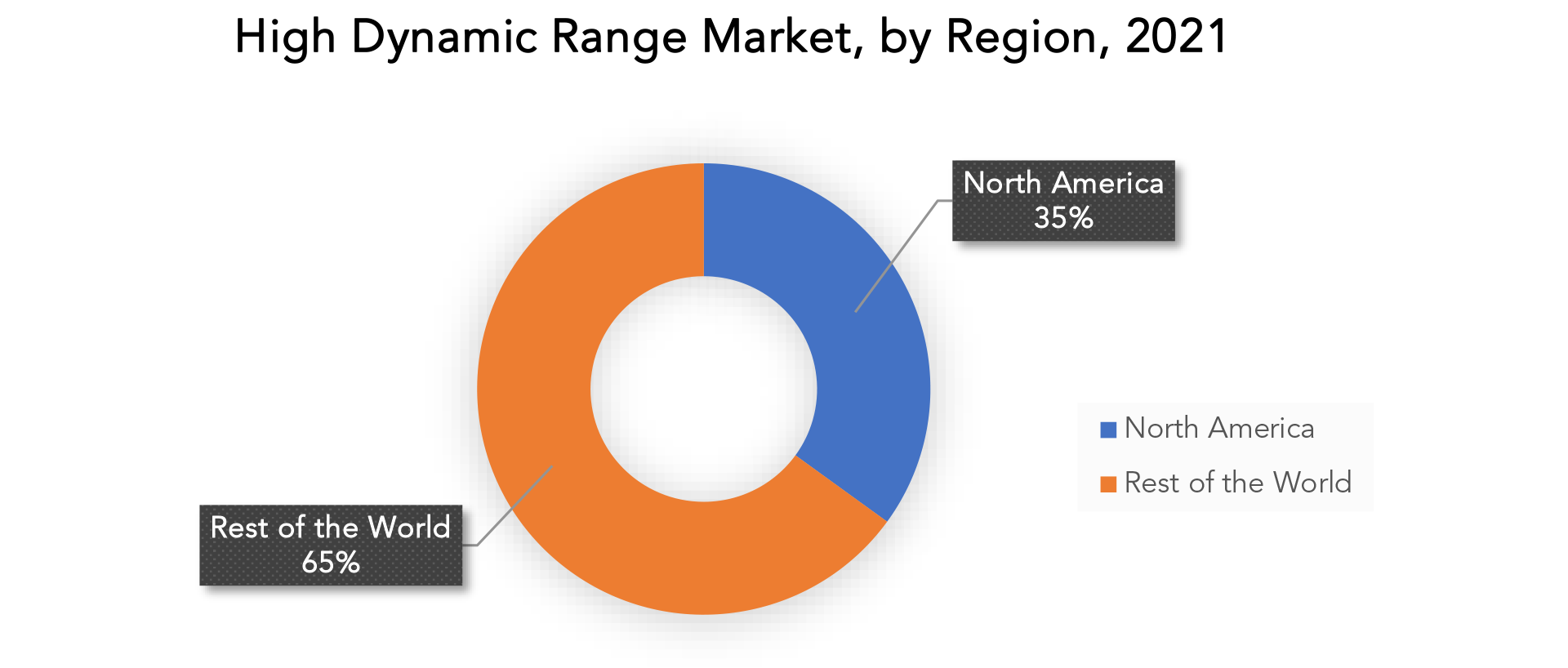
In 2021, North America will have the largest revenue share in the high dynamic range market. This is due to the availability of multiple video streaming software suppliers in the United States, as well as increased company awareness of the benefits of video streaming solutions. Furthermore, rising investments in a wide range of technologies such as IoT, AI, AR, big data, and VR, as well as an increase in the use of cloud services, are expected to drive the regional video streaming software market during the forecast period.
APAC is expected to grow at the fastest CAGR of 19.16% between 2021 and 2026, owing to a growing consumer base in the entertainment industry and rising disposable income. According to a recent report published in January 2021, the total number of ASIAN paid subscribers to Netflix reached 25.5 million, a 64% increase over the previous year, and the region became the second largest contributor in terms of subscribers.
Key Market Segments: High Dynamic Range Market
High Dynamic Range Market By Product Type, 2020-2029, (USD Billion)- Capturing Devices
- Display Devices
- HDR10
- HDR10+
- Hybrid Log-Gamma
- Dolby Vision
- 4k
- Video Streaming
- Entertainment
- Security And Surveillance
- Gaming
- North America
- Asia Pacific
- Europe
- South America
- Middle East And Africa
Exactitude Consultancy Services Key Objectives:
- Increasing sales and market share
- Developing new technology
- Improving profitability
- Entering new markets
- Enhancing brand reputation
Key Question Answered
- What is the expected growth rate of the high dynamic range market over the next 7 years?
- Who are the major players in the high dynamic range market and what is their market share?
- What are the end-user industries driving demand for market and what is their outlook?
- What are the opportunities for growth in emerging markets such as Asia-pacific, Middle East, and Africa?
- How is the economic environment affecting the high dynamic range market, including factors such as interest rates, inflation, and exchange rates?
- What is the expected impact of government policies and regulations on the high dynamic range market?
- What is the current and forecasted size and growth rate of the global high dynamic range market?
- What are the key drivers of growth in the high dynamic range market?
- Who are the major players in the market and what is their market share?
- What are the distribution channels and supply chain dynamics in the high dynamic range market?
- What are the technological advancements and innovations in the high dynamic range market and their impact on product development and growth?
- What are the regulatory considerations and their impact on the market?
- What are the challenges faced by players in the high dynamic range market and how are they addressing these challenges?
- What are the opportunities for growth and expansion in the high dynamic range market?
- What are the service offerings and specifications of leading players in the market?
- INTRODUZIONE
- DEFINIZIONE DI MERCATO
- SEGMENTAZIONE DEL MERCATO
- TEMPI DI RICERCA
- ASSUNZIONI E LIMITAZIONI
- METODOLOGIA DI RICERCA
- ESTRAZIONE DATI
- RICERCA SECONDARIA
- RICERCA PRIMARIA
- PARERI DEGLI ESPERTI IN MATERIA
- CONTROLLI DI QUALITÀ
- RECENSIONE FINALE
- TRIANGOLAZIONE DEI DATI
- APPROCCIO DAL BASSO VERSO L'ALTO
- APPROCCIO TOP-DOWN
- FLUSSO DI RICERCA
- FONTI DEI DATI
- ESTRAZIONE DATI
- SINTESI
- PANORAMICA DEL MERCATO
- PROSPETTIVE DEL MERCATO GLOBALE DELL'ALTA GAMMA DINAMICA
- FATTORI DI MERCATO
- LIMITAZIONI DI MERCATO
- OPPORTUNITÀ DI MERCATO
- IMPATTO DEL COVID-19 SUL MERCATO DELL'ALTA GAMMA DINAMICA
- MODELLO DELLE CINQUE FORZE DI PORTER
- MINACCIA DAI NUOVI ENTRANSI
- MINACCIA DA SOSTITUTI
- POTERE CONTRATTUALE DEI FORNITORI
- POTERE CONTRATTUALE DEI CLIENTI
- GRADO DI COMPETIZIONE
- ANALISI DELLA CATENA DEL VALORE DEL SETTORE
- PROSPETTIVE DEL MERCATO GLOBALE DELL'ALTA GAMMA DINAMICA
- MERCATO GLOBALE HIGH DYNAMIC RANGE PER TIPOLOGIA DI PRODOTTO (MILIARDI DI USD), 2020-2029
- DISPOSITIVI DI CATTURA
- DISPOSITIVI DI VISUALIZZAZIONE
- MERCATO GLOBALE HIGH DYNAMIC RANGE PER TIPOLOGIA (MILIARDI DI USD), 2020-2029
- L'HDR10
- HDR10+
- HYBRID LOG-GAMMA
- DOLBY VISION
- 4K
- GLOBAL HIGH DYNAMIC RANGE MARKET BY APPLICATION (USD BILLION), 2020-2029
- VIDEO STREAMING
- ENTERTAINMENT
- SECURITY & SURVEILLANCE
- GAMING
- GLOBAL HIGH DYNAMIC RANGE MARKET BY REGION (USD BILLION), 2020-2029
- NORTH AMERICA
- US
- CANADA
- MEXICO
- SOUTH AMERICA
- BRAZIL
- ARGENTINA
- COLOMBIA
- REST OF SOUTH AMERICA
- EUROPE
- GERMANY
- UK
- FRANCE
- ITALY
- SPAIN
- RUSSIA
- REST OF EUROPE
- ASIA PACIFIC
- INDIA
- CHINA
- JAPAN
- SOUTH KOREA
- AUSTRALIA
- REST OF ASIA PACIFIC
- MIDDLE EAST AND AFRICA
- UAE
- SAUDI ARABIA
- SOUTH AFRICA
- REST OF MIDDLE EAST AND AFRICA
- NORTH AMERICA
- COMPANY PROFILES* (BUSINESS OVERVIEW, COMPANY SNAPSHOT, PRODUCTS OFFERED, RECENT DEVELOPMENTS)
- APPLE, INC.
- CANON
- NIKON CORPORATION
- SAMSUNG ELECTRONICS CO., LTD.
- LG DISPLAY CO., LTD.
- OMNIVISION TECHNOLOGIES
- OLYMPUS CORP.
- SONY CORPORATION
- FUJIFILM HOLDING CORPORATION
- CASIO COMPUTER CO., LTD. *THE COMPANY LIST IS INDICATIVE
LIST OF TABLES
TABLE 1 GLOBAL HIGH DYNAMIC RANGE MARKET BY PRODUCT TYPE (USD BILLION), 2020-2029
TABLE 2 GLOBAL HIGH DYNAMIC RANGE MARKET BY TYPE (USD BILLION), 2020-2029
TABLE 3 GLOBAL HIGH DYNAMIC RANGE MARKET BY APPLICATION (USD BILLION), 2020-2029
TABLE 4 GLOBAL HIGH DYNAMIC RANGE MARKET BY REGION (USD BILLION), 2020-2029
TABLE 5 NORTH AMERICA HIGH DYNAMIC RANGE MARKET BY PRODUCT TYPE (USD BILLION), 2020-2029
TABLE 6 NORTH AMERICA HIGH DYNAMIC RANGE MARKET BY TYPE (USD BILLION), 2020-2029
TABLE 7 NORTH AMERICA HIGH DYNAMIC RANGE MARKET BY APPLICATION (USD BILLION), 2020-2029
TABLE 8 NORTH AMERICA HIGH DYNAMIC RANGE MARKET BY COUNTRY (USD BILLION), 2020-2029
TABLE 9 US HIGH DYNAMIC RANGE MARKET BY PRODUCT TYPE (USD BILLION), 2020-2029
TABLE 10 US HIGH DYNAMIC RANGE MARKET BY TYPE (USD BILLION), 2020-2029
TABLE 11 US HIGH DYNAMIC RANGE MARKET BY APPLICATION (USD BILLION), 2020-2029
TABLE 12 CANADA HIGH DYNAMIC RANGE MARKET BY PRODUCT TYPE (BILLION), 2020-2029
TABLE 13 CANADA HIGH DYNAMIC RANGE MARKET BY TYPE (USD BILLION), 2020-2029
TABLE 14 CANADA HIGH DYNAMIC RANGE MARKET BY APPLICATION (USD BILLION), 2020-2029
TABLE 15 MEXICO HIGH DYNAMIC RANGE MARKET BY PRODUCT TYPE (USD BILLION), 2020-2029
TABLE 16 MEXICO HIGH DYNAMIC RANGE MARKET BY TYPE (USD BILLION), 2020-2029
TABLE 17 MEXICO HIGH DYNAMIC RANGE MARKET BY APPLICATION (USD BILLION), 2020-2029
TABLE 18 REST OF NORTH AMERICA HIGH DYNAMIC RANGE MARKET BY PRODUCT TYPE (USD BILLION), 2020-2029
TABLE 19 REST OF NORTH AMERICA HIGH DYNAMIC RANGE MARKET BY TYPE (USD BILLION), 2020-2029
TABLE 20 REST OF NORTH AMERICA HIGH DYNAMIC RANGE MARKET BY APPLICATION (USD BILLION), 2020-2029
TABLE 21 SOUTH AMERICA HIGH DYNAMIC RANGE MARKET BY PRODUCT TYPE (USD BILLION), 2020-2029
TABLE 22 SOUTH AMERICA HIGH DYNAMIC RANGE MARKET BY TYPE (USD BILLION), 2020-2029
TABLE 23 SOUTH AMERICA HIGH DYNAMIC RANGE MARKET BY APPLICATION (USD BILLION), 2020-2029
TABLE 24 SOUTH AMERICA HIGH DYNAMIC RANGE MARKET BY COUNTRY (USD BILLION), 2020-2029
TABLE 25 BRAZIL HIGH DYNAMIC RANGE MARKET BY PRODUCT TYPE (USD BILLION), 2020-2029
TABLE 26 BRAZIL HIGH DYNAMIC RANGE MARKET BY TYPE (USD BILLION), 2020-2029
TABLE 27 BRAZIL HIGH DYNAMIC RANGE MARKET BY APPLICATION (USD BILLION), 2020-2029
TABLE 28 ARGENTINA HIGH DYNAMIC RANGE MARKET BY PRODUCT TYPE (USD BILLION), 2020-2029
TABLE 29 ARGENTINA HIGH DYNAMIC RANGE MARKET BY TYPE (USD BILLION), 2020-2029
TABLE 30 ARGENTINA HIGH DYNAMIC RANGE MARKET BY APPLICATION (USD BILLION), 2020-2029
TABLE 31 COLOMBIA HIGH DYNAMIC RANGE MARKET BY PRODUCT TYPE (USD BILLION), 2020-2029
TABLE 32 COLOMBIA HIGH DYNAMIC RANGE MARKET BY TYPE (USD BILLION), 2020-2029
TABLE 33 COLOMBIA HIGH DYNAMIC RANGE MARKET BY APPLICATION (USD BILLION), 2020-2029
TABLE 34 REST OF SOUTH AMERICA HIGH DYNAMIC RANGE MARKET BY PRODUCT TYPE (USD BILLION), 2020-2029
TABLE 35 REST OF SOUTH AMERICA HIGH DYNAMIC RANGE MARKET BY TYPE (USD BILLION), 2020-2029
TABLE 36 REST OF SOUTH AMERICA HIGH DYNAMIC RANGE MARKET BY APPLICATION (USD BILLION), 2020-2029
TABLE 37 ASIA-PACIFIC HIGH DYNAMIC RANGE MARKET BY PRODUCT TYPE (USD BILLION), 2020-2029
TABLE 38 ASIA-PACIFIC HIGH DYNAMIC RANGE MARKET BY TYPE (USD BILLION), 2020-2029
TABLE 39 ASIA-PACIFIC HIGH DYNAMIC RANGE MARKET BY APPLICATION (USD BILLION), 2020-2029
TABLE 40 ASIA-PACIFIC HIGH DYNAMIC RANGE MARKET BY COUNTRY (USD BILLION), 2020-2029
TABLE 41 INDIA HIGH DYNAMIC RANGE MARKET BY PRODUCT TYPE (USD BILLION), 2020-2029
TABLE 42 INDIA HIGH DYNAMIC RANGE MARKET BY TYPE (USD BILLION), 2020-2029
TABLE 43 INDIA HIGH DYNAMIC RANGE MARKET BY APPLICATION (USD BILLION), 2020-2029
TABLE 44 CHINA HIGH DYNAMIC RANGE MARKET BY PRODUCT TYPE (USD BILLION), 2020-2029
TABLE 45 CHINA HIGH DYNAMIC RANGE MARKET BY TYPE (USD BILLION), 2020-2029
TABLE 46 CHINA HIGH DYNAMIC RANGE MARKET BY APPLICATION (USD BILLION), 2020-2029
TABLE 47 JAPAN HIGH DYNAMIC RANGE MARKET BY PRODUCT TYPE (USD BILLION), 2020-2029
TABLE 48 JAPAN HIGH DYNAMIC RANGE MARKET BY TYPE (USD BILLION), 2020-2029
TABLE 49 JAPAN HIGH DYNAMIC RANGE MARKET BY APPLICATION (USD BILLION), 2020-2029
TABLE 50 SOUTH KOREA HIGH DYNAMIC RANGE MARKET BY PRODUCT TYPE (USD BILLION), 2020-2029
TABLE 51 SOUTH KOREA HIGH DYNAMIC RANGE MARKET BY TYPE (USD BILLION), 2020-2029
TABLE 52 SOUTH KOREA HIGH DYNAMIC RANGE MARKET BY APPLICATION (USD BILLION), 2020-2029
TABLE 53 AUSTRALIA HIGH DYNAMIC RANGE MARKET BY PRODUCT TYPE (USD BILLION), 2020-2029
TABLE 54 AUSTRALIA HIGH DYNAMIC RANGE MARKET BY TYPE (USD BILLION), 2020-2029
TABLE 55 AUSTRALIA HIGH DYNAMIC RANGE MARKET BY APPLICATION (USD BILLION), 2020-2029
TABLE 56 REST OF ASIA PACIFIC HIGH DYNAMIC RANGE MARKET BY PRODUCT TYPE (USD BILLION), 2020-2029
TABLE 57 REST OF ASIA PACIFIC HIGH DYNAMIC RANGE MARKET BY TYPE (USD BILLION), 2020-2029
TABLE 58 REST OF ASIA PACIFIC HIGH DYNAMIC RANGE MARKET BY APPLICATION (USD BILLION), 2020-2029
TABLE 59 EUROPE HIGH DYNAMIC RANGE MARKET BY PRODUCT TYPE (USD BILLION), 2020-2029
TABLE 60 EUROPE HIGH DYNAMIC RANGE MARKET BY TYPE (USD BILLION), 2020-2029
TABLE 61 EUROPE HIGH DYNAMIC RANGE MARKET BY APPLICATION (USD BILLION), 2020-2029
TABLE 62 EUROPE HIGH DYNAMIC RANGE MARKET BY COUNTRY (USD BILLION), 2020-2029
TABLE 63 GERMANY HIGH DYNAMIC RANGE MARKET BY PRODUCT TYPE (USD BILLION), 2020-2029
TABLE 64 GERMANY HIGH DYNAMIC RANGE MARKET BY TYPE (USD BILLION), 2020-2029
TABLE 65 GERMANY HIGH DYNAMIC RANGE MARKET BY APPLICATION (USD BILLION), 2020-2029
TABLE 66 UK HIGH DYNAMIC RANGE MARKET BY PRODUCT TYPE (USD BILLION), 2020-2029
TABLE 67 UK HIGH DYNAMIC RANGE MARKET BY TYPE (USD BILLION), 2020-2029
TABLE 68 UK HIGH DYNAMIC RANGE MARKET BY APPLICATION (USD BILLION), 2020-2029
TABLE 69 FRANCE HIGH DYNAMIC RANGE MARKET BY PRODUCT TYPE (USD BILLION), 2020-2029
TABLE 70 FRANCE HIGH DYNAMIC RANGE MARKET BY TYPE (USD BILLION), 2020-2029
TABLE 71 FRANCE HIGH DYNAMIC RANGE MARKET BY APPLICATION (USD BILLION), 2020-2029
TABLE 72 ITALY HIGH DYNAMIC RANGE MARKET BY PRODUCT TYPE (USD BILLION), 2020-2029
TABLE 73 ITALY HIGH DYNAMIC RANGE MARKET BY TYPE (USD BILLION), 2020-2029
TABLE 74 ITALY HIGH DYNAMIC RANGE MARKET BY APPLICATION (USD BILLION), 2020-2029
TABLE 75 SPAIN HIGH DYNAMIC RANGE MARKET BY PRODUCT TYPE (USD BILLION), 2020-2029
TABLE 76 SPAIN HIGH DYNAMIC RANGE MARKET BY TYPE (USD BILLION), 2020-2029
TABLE 77 SPAIN HIGH DYNAMIC RANGE MARKET BY APPLICATION (USD BILLION), 2020-2029
TABLE 78 RUSSIA HIGH DYNAMIC RANGE MARKET BY PRODUCT TYPE (USD BILLION), 2020-2029
TABLE 79 RUSSIA HIGH DYNAMIC RANGE MARKET BY TYPE (USD BILLION), 2020-2029
TABLE 80 RUSSIA HIGH DYNAMIC RANGE MARKET BY APPLICATION (USD BILLION), 2020-2029
TABLE 81 REST OF EUROPE HIGH DYNAMIC RANGE MARKET BY PRODUCT TYPE (USD BILLION), 2020-2029
TABLE 82 REST OF EUROPE HIGH DYNAMIC RANGE MARKET BY TYPE (USD BILLION), 2020-2029
TABLE 83 REST OF EUROPE HIGH DYNAMIC RANGE MARKET BY APPLICATION (USD BILLION), 2020-2029
TABLE 84 MIDDLE EAST AND AFRICA HIGH DYNAMIC RANGE MARKET BY PRODUCT TYPE (USD BILLION), 2020-2029
TABLE 85 MIDDLE EAST AND AFRICA HIGH DYNAMIC RANGE MARKET BY TYPE (USD BILLION), 2020-2029
TABLE 86 MIDDLE EAST AND AFRICA HIGH DYNAMIC RANGE MARKET BY APPLICATION (USD BILLION), 2020-2029
TABLE 87 MIDDLE EAST AND AFRICA HIGH DYNAMIC RANGE MARKET BY COUNTRY (USD BILLION), 2020-2029
TABLE 88 UAE HIGH DYNAMIC RANGE MARKET BY PRODUCT TYPE (USD BILLION), 2020-2029
TABLE 89 UAE HIGH DYNAMIC RANGE MARKET BY TYPE (USD BILLION), 2020-2029
TABLE 90 UAE HIGH DYNAMIC RANGE MARKET BY APPLICATION (USD BILLION), 2020-2029
TABLE 91 SAUDI ARABIA HIGH DYNAMIC RANGE MARKET BY PRODUCT TYPE (USD BILLION), 2020-2029
TABLE 92 SAUDI ARABIA HIGH DYNAMIC RANGE MARKET BY TYPE (USD BILLION), 2020-2029
TABLE 93 SAUDI ARABIA HIGH DYNAMIC RANGE MARKET BY APPLICATION (USD BILLION), 2020-2029
TABLE 94 SOUTH AFRICA HIGH DYNAMIC RANGE MARKET BY PRODUCT TYPE (USD BILLION), 2020-2029
TABLE 95 SOUTH AFRICA HIGH DYNAMIC RANGE MARKET BY TYPE (USD BILLION), 2020-2029
TABLE 96 SOUTH AFRICA HIGH DYNAMIC RANGE MARKET BY APPLICATION (USD BILLION), 2020-2029
TABLE 97 REST OF MIDDLE EAST AND AFRICA HIGH DYNAMIC RANGE MARKET BY PRODUCT TYPE (USD BILLION), 2020-2029
TABLE 98 REST OF MIDDLE EAST AND AFRICA HIGH DYNAMIC RANGE MARKET BY TYPE (USD BILLION), 2020-2029
TABLE 99 REST OF MIDDLE EAST AND AFRICA HIGH DYNAMIC RANGE MARKET BY APPLICATION (USD BILLION), 2020-2029
LIST OF FIGURES
FIGURE 1 MARKET DYNAMICS
FIGURE 2 MARKET SEGMENTATION
FIGURE 3 REPORT TIMELINES: YEARS CONSIDERED
FIGURE 4 DATA TRIANGULATION
FIGURE 5 BOTTOM-UP APPROACH
FIGURE 6 TOP-DOWN APPROACH
FIGURE 7 RESEARCH FLOW
FIGURE 8 GLOBAL HIGH DYNAMIC RANGE MARKET BY PRODUCT TYPE, USD BILLION, 2020-2029
FIGURE 9 GLOBAL HIGH DYNAMIC RANGE MARKET BY TYPE, USD BILLION, 2020-2029
FIGURE 10 GLOBAL HIGH DYNAMIC RANGE MARKET BY APPLICATION, USD BILLION, 2020-2029
FIGURE 11 GLOBAL HIGH DYNAMIC RANGE MARKET BY REGION, USD BILLION, 2020-2029
FIGURE 12 PORTER’S FIVE FORCES MODEL
FIGURE 13 HIGH DYNAMIC RANGE MARKET BY REGION, USD BILLION, 2021
FIGURE 14 HIGH DYNAMIC RANGE MARKET BY PRODUCT TYPE, USD BILLION, 2021
FIGURE 15 HIGH DYNAMIC RANGE MARKET BY TYPE, USD BILLION, 2021
FIGURE 16 HIGH DYNAMIC RANGE MARKET BY APPLICATION, USD BILLION, 2021
FIGURE 17 MARKET SHARE ANALYSIS
FIGURE 18 APPLE, INC.: COMPANY SNAPSHOT
FIGURE 19 CANON: COMPANY SNAPSHOT
FIGURE 20 NIKON CORPORATION: COMPANY SNAPSHOT
FIGURE 21 SAMSUNG ELECTRONICS CO., LTD.: COMPANY SNAPSHOT
FIGURE 22 LG DISPLAY CO., LTD.: COMPANY SNAPSHOT
FIGURE 23 OMNIVISION TECHNOLOGIES: COMPANY SNAPSHOT
FIGURE 24 OLYMPUS CORP.: COMPANY SNAPSHOT
FIGURE 25 SONY CORPORATION: COMPANY SNAPSHOT
FIGURE 26 FUJIFILM HOLDING CORPORATION: COMPANY SNAPSHOT
FIGURE 27 CASIO COMPUTER CO., LTD.: COMPANY SNAPSHOT
DOWNLOAD FREE SAMPLE REPORT
License Type
SPEAK WITH OUR ANALYST
Want to know more about the report or any specific requirement?
WANT TO CUSTOMIZE THE REPORT?
Our Clients Speak
We asked them to research ‘ Equipment market’ all over the world, and their whole arrangement was helpful to us. thehealthanalytics.com insightful analysis and reports contributed to our current analysis and in creating a future strategy. Besides, the te
Yosuke Mitsui
Senior Associate Construction Equipment Sales & Marketing
We asked them to research ‘Equipment market’ all over the world, and their whole arrangement was helpful to us. thehealthanalytics.com insightful analysis and reports contributed to our current analysis and in creating a future strategy. Besides, the te