

Base Year Value ()
x.x %
x.x %
CAGR ()
x.x %
x.x %
Forecast Year Value ()
x.x %
x.x %
Historical Data Period
Largest Region
Forecast Period
Mercato dei microdisplay per tecnologia (LCD, OLED, DLP e LCoS), tipo (Near-To-Eye e proiezione), applicazione (elettronica di consumo, militare e difesa, applicazione medica, sistema industriale e automobilistico) e per regione (Nord America, Europa, Asia Pacifico, Sud America, Medio Oriente e Africa) Tendenze globali e previsioni dal 2022 al 2029
Instant access to hundreds of data points and trends
- Market estimates from 2014-2029
- Competitive analysis, industry segmentation, financial benchmarks
- Incorporates SWOT, Porter's Five Forces and risk management frameworks
- PDF report or online database with Word, Excel and PowerPoint export options
- 100% money back guarantee
Panoramica del mercato dei microdisplay:
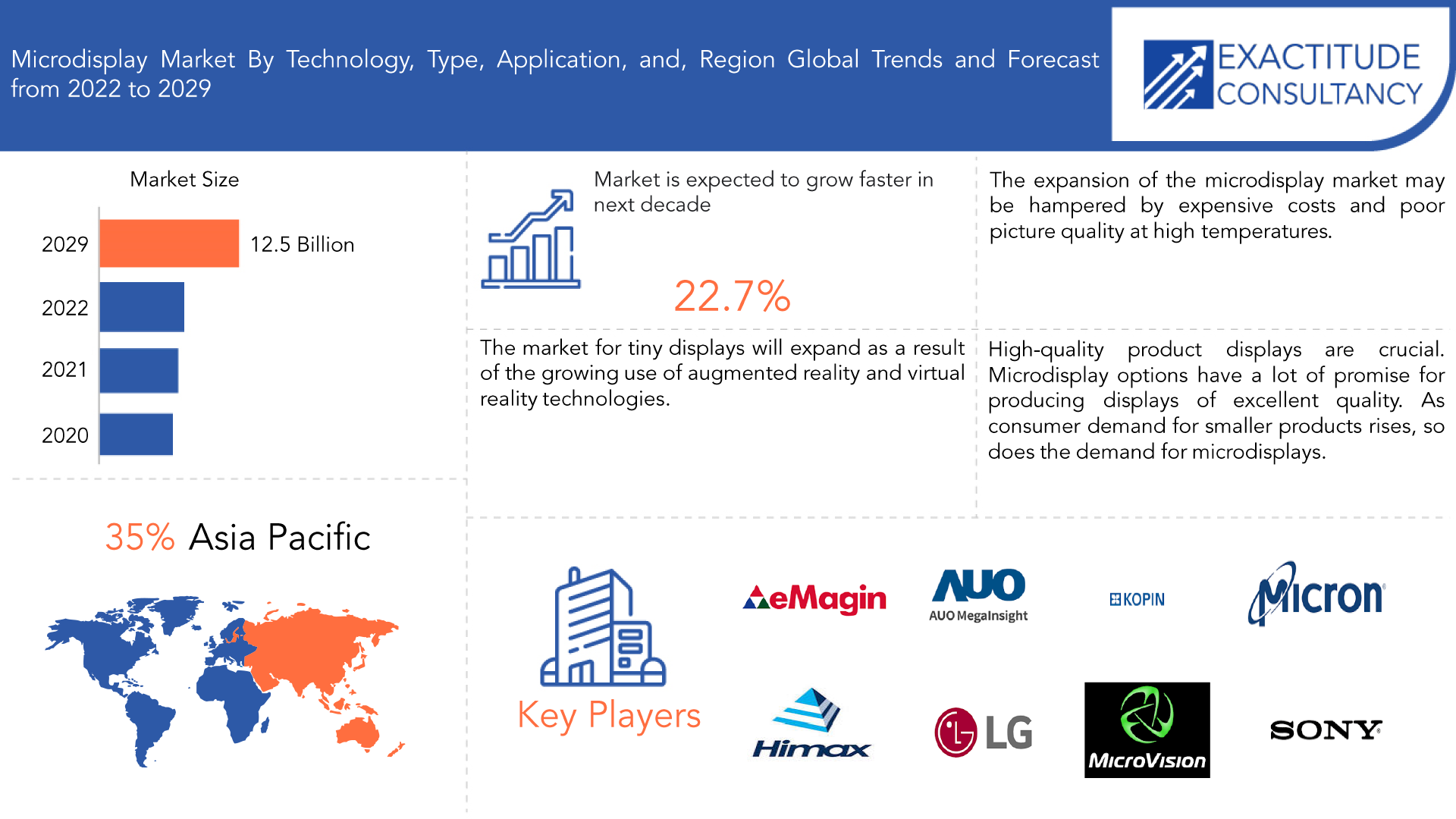
Nel 2022 il mercato globale dei microdisplay era stimato in 2,99 miliardi e si prevede che raggiungerà i 12,5 miliardi entro il 2029, con un CAGR del 22,7% dal 2022 al 2029.
I microdisplay sono la forma più semplice, un microdisplay è un display molto piccolo che misura da 0,75 a 1 pollice da un angolo all'altro. I microdisplay OLED possono essere prodotti in dimensioni estremamente ridotte utilizzando circuiti su un backplane in silicio per controllare i singoli pixel. Le TV a retroproiezione e i display montati sulla testa sono due degli usi più tipici dei microdisplay. A seconda di come la luce può attraversare l'unità display, i microdisplay possono essere riflettenti o trasmissivi. Un microdisplay è essenzialmente un piccolo display con una diagonale inferiore a un quarto di pollice. È comunemente utilizzato negli smartwatch, nelle smartband e negli occhiali intelligenti per consentire immagini di alta qualità e un elevato rapporto di contrasto. Ha una tecnologia configurabile dall'utente, alta risoluzione e alta densità di pixel. Inoltre, ha una risoluzione SEGA (super extended graphics array) per una migliore visualizzazione da tutte le angolazioni e una maggiore luminosità. Le tre tecnologie di microdisplay più diffuse sono LCD, DLP e LCoS. Per il monitoraggio in tempo reale e prestazioni più rapide, i microdisplay stanno attualmente trovando un'ampia gamma di applicazioni nell'industria militare e della difesa.
| ATTRIBUTO | DETTAGLI |
| Periodo di studio | 2022-2029 |
| Anno base | 2021 |
| Anno stimato | 2022 |
| Anno previsto | 2022-2029 |
| Periodo storico | 2018-2020 |
| Unità | Valore (miliardi di USD), Volume (migliaia di unità) |
| Segmentazione | Per tecnologia, tipo, applicazione e regione. |
| Per tecnologia |
|
| Per tipo |
|
| Per applicazione |
|
| Per regione0 |
|
Il mercato dei microdisplay si sta espandendo a seguito della crescente domanda di tecnologia indossabile. Il mercato dei display minuscoli si espanderà a seguito del crescente utilizzo delle tecnologie di realtà aumentata e realtà virtuale. Inoltre, la qualità del display di un prodotto è fondamentale per creare un ambiente immersivo per l'utente e i sistemi di microdisplay hanno grandi potenzialità per farlo. Tra le altre tecnologie, il prodotto microdisplay può essere offerto utilizzando display a cristalli liquidi (LCD), diodi organici a emissione di luce (OLED) ed elaborazione digitale della luce. Grazie ai loro rapidi tempi di commutazione, i diodi organici a emissione di luce stanno diventando sempre più popolari. Ciò fornisce un display con un'elevata frequenza di aggiornamento, che riduce la cinetosi. La maggiore qualità del display probabilmente accelererà l'adozione dei microdisplay in settori quali giochi e intrattenimento, trasporti, assistenza sanitaria e istruzione, tra gli altri.
[caption id="allegato_22297" align="aligncenter" width="1029"]
Frequently Asked Questions
What is the worth of the global microdisplay market?
The global Microdisplay market was valued at 2.99 billion in 2022 and is projected to reach 12.5 billion by 2029, growing at a CAGR of 22.7% from 2022 to 2029
Which market segments are covered in the report on the microdisplay market?
Based on technology, type, application, and region the microdisplay market reports divisions are broken down.
What is the CAGR of the microdisplay market?
The global microdisplay market registered a CAGR of 22.7% from 2022 to 2029. The industry segment was the highest revenue contributor to the market.
Which are the top companies to hold the market share in the microdisplay market?
Key players profiled in the report include eMagin Corporation, Universal Display Corporation, AU Optronics Corp, KopIn Corporation Inc, Micron Technology Inc, Himax Technology Inc, LG Display Co. Ltd., Microvision Inc, Sony Corporation, Syndiant Inc, and others
Which is the largest regional market for the microdisplay market?
Asia Pacific is home to a sizable number of microdisplay producers, which has also lowered microdisplay pricing and increased the use of microdisplay-based devices in the region. Furthermore, China, Japan, and South Korea account for a sizable percentage of the microdisplay market in APAC.
Microdisplay Market Segment Analysis
Based on technology, type, application, and region, the global market for microdisplays is divided into these categories.On the basis of technology, microdisplays are subdivided into LCD, OLED, DLP, and LCoS. A type of flat panel display known as an LCD (Liquid Crystal Display) operates primarily using liquid crystals. Since they are frequently used in cellphones, televisions, computers, and instrument panels, LEDs offer a wide range of applications for consumers and enterprises. A flat-panel display or other electronically controlled optical device that makes use of polarizers and the light-modulating capabilities of liquid crystals is known as a liquid-crystal display (LCD). Liquid crystals don't directly emit light, instead creating color or monochromatic pictures with a backlight or reflector. There are LCDs that can show random images (like on a general-purpose computer display) or fixed displays with little information that can be seen or hidden. Examples of gadgets using these displays include preset words, figures, and seven-segment displays, such as those seen in digital clocks. They both make use of the same fundamental technology, although some displays have larger components, whereas others employ a grid of tiny pixels to create random images. There are many different applications for LCDs, such as LCD televisions, computer monitors, instrument panels, cockpit displays for airplanes, and interior and outdoor signs. LCD projectors and portable consumer electronics like digital cameras, watches, calculators, and mobile phones, including smartphones, frequently include small LCD panels. In almost all applications, LCD screens have taken the role of cathode-ray tube (CRT) displays, which were large, heavy, and less energy-efficient.
Thin films of organic light-emitting (OLED) materials are used in OLED technology to create thin, effective, and bright displays that generate light when power is applied to them. Many industry insiders predict that OLEDs will eventually replace current display ecosystem technologies. As a result, a sizable number of businesses have begun to invest more money in OLED-related research and development projects. OLED Microdisplays produce outstanding image quality while maintaining high resolution with a high contrast ratio, wide color gamut, and quick reaction by combining rich OLED technology with backplane technology for image sensors. A light-emitting diode (LED) with an organic compound film as the emissive electroluminescent layer generates light in response to an electric current and is referred to as an organic light-emitting diode (OLED), also known as an organic electroluminescent (organic EL) diode. This organic layer is sandwiched between two electrodes, usually with at least one transparent electrode. OLEDs are utilized to make digital displays in gadgets like televisions, computer monitors, and portable gaming systems like smartphones. While Liquid crystal on silicon (LCoS or LCOS) is a reflective active-matrix liquid crystal display or "microdisplay" that is scaled down. It uses a liquid crystal layer on top of a silicon backplane. It is also known as a modulator of spatial light. LCoS was primarily created for projector TVs, but it is currently utilized for structured lighting, near-eye displays, wavelength selective switching, and optical pulse shaping. Comparatively speaking, certain LCD projectors make use of transmissive LCD, which permits light to pass through the liquid crystal.
Near-To-Eye and Projection are the types of microdisplays market. Also, the microdisplay market is separated on the basis of applications in Consumer Electronics, Military & Defense, Medical Applications, Industrial Systems, and Automotive. Due to the high resolution and outstanding picture quality, low power consumption, and compact size of microdisplays, they are widely used in consumer electronics, consumer and military electronics, and medical and industrial applications. This rapid market expansion is due to these factors. Electronic (analog or digital) equipment designed for regular use, often in private homes, is referred to as consumer electronics or home electronics. Devices for entertainment, communication, and recreation are all considered to be consumer electronics.
[caption id="attachment_22298" align="aligncenter" width="1920"]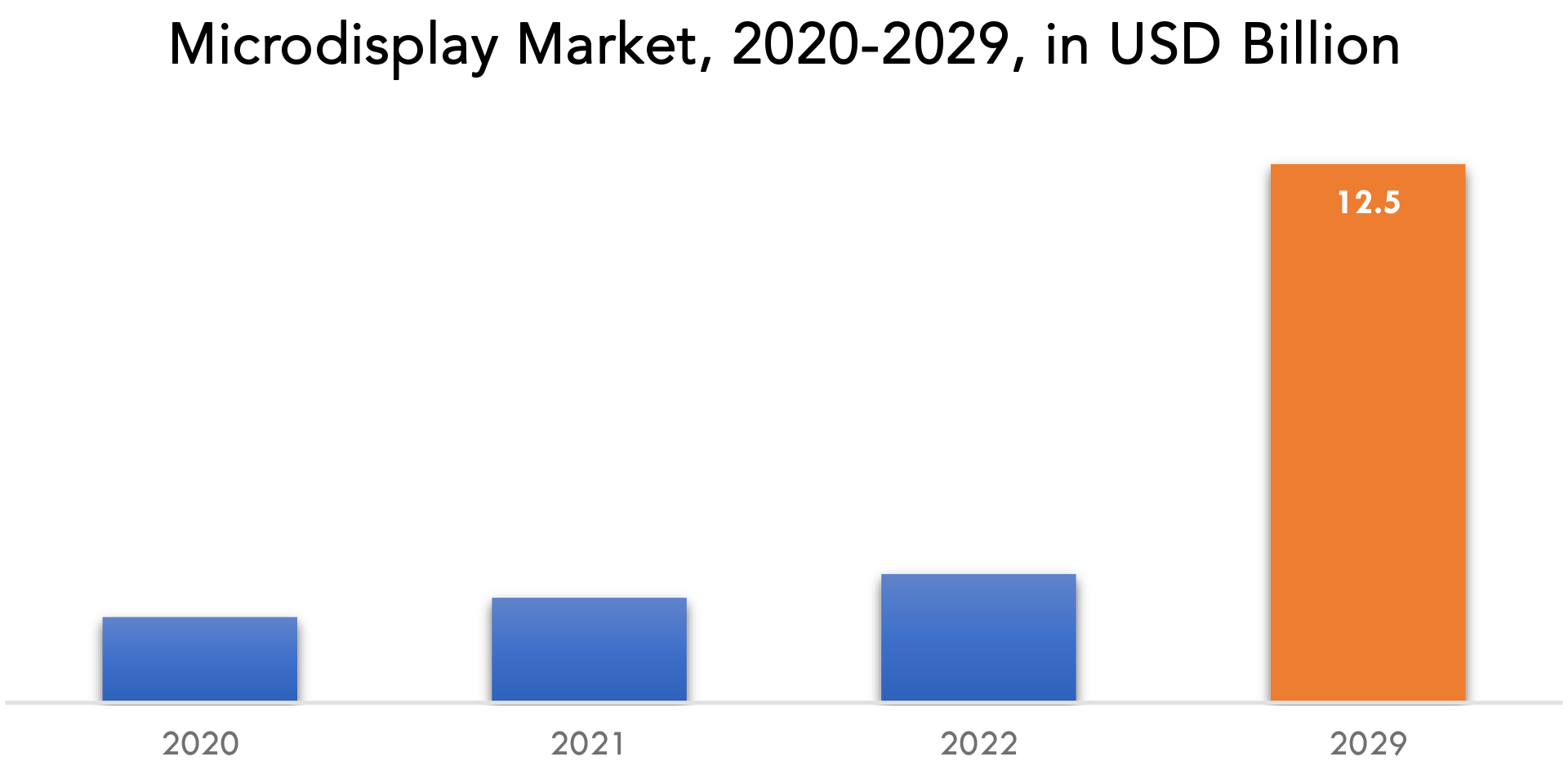
Microdisplay Market Players
The major players operating in the global Microdisplay industry include the major market players are eMagin Corporation, Universal Display Corporation, AU Optronics Corp, KopIn Corporation Inc, Micron Technology Inc, Himax Technology Inc, LG Display Co. Ltd., Microvision Inc, Sony Corporation, Syndiant Inc and others Industry News: 13 September 2022: Sony and WS Audiology Have Entered into a Partnership Agreement in the Over-the-Counter Self-Fitting Hearing Aid Business. 10 June 2021: Sony Launched Professional-Use Drone Airpeak S1.Who Should Buy? Or Key stakeholders
- Manufacturing
- End-Use Industries
- BFSI
- Automotive
- Manufacturing & Construction
- Regulatory Authorities
- Research Organizations
- Information Technology
- Materials & Chemicals
Microdisplay Market Regional Analysis
Geographically, the Microdisplay market is segmented into North America, South America, Europe, APAC, and MEA.- North America: includes the US, Canada, Mexico
- Europe: includes the UK, Germany, France, Italy, Spain, Russia, and the Rest of Europe
- Asia Pacific: includes China, Japan, South Korea, India, Australia, ASEAN, and the Rest of APAC
- South America: includes Brazil, Argentina, and the Rest of South America
- Middle East & Africa: includes Turkey, UAE, Saudi Arabia, South Africa, and the Rest of MEA
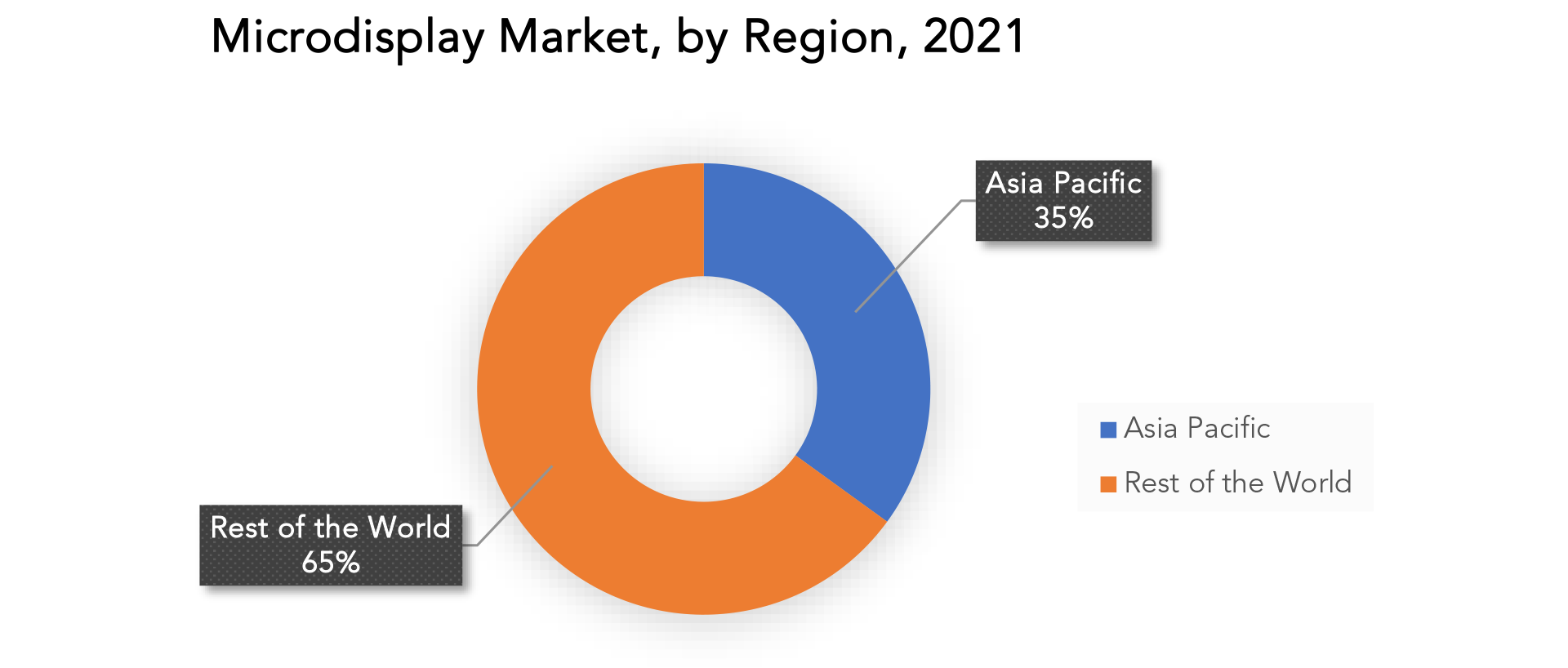
Microdisplays are in high demand, particularly for usage in goods like cameras/EVF, projectors, and HUD, throughout the Asia Pacific. The fast industrialization, the existence of several OEMs and customers in the area, and the growth of the microdisplay market in APAC are all factors. The major APAC industries that significantly contribute to the expansion of the microdisplay market are consumer, industrial & enterprise, automotive, military, defense & aerospace, and industrial & enterprise. APAC is home to a sizable number of microdisplay producers, which has also lowered microdisplay pricing and increased the use of microdisplay-based devices in the region. Furthermore, China, Japan, and South Korea account for a sizable percentage of the microdisplay market in APAC. The utilization of ICT in the educational sector in North America has made the region the market leader for microdisplays. Also due to the top manufacturer of hardware gadgets like head-mounted displays, smart glasses, and wearables, Asia Pacific is predicted to take off. Due to the existence of firms like LG Electronics, Samsung Electronics, and Sony Corporation, Japan and China are anticipated to grow.
Key Market Segments: Microdisplay Market
Microdisplay Market by Technology, 2020-2029, (USD Billion) (Thousand Units)- LCD
- OLED
- DLP
- LCoS
- Near-To-Eye
- Projection
- Consumer Electronics
- Military & Defense
- Medical Application
- Industrial System
- Automotive
- North America
- Europe
- Asia Pacific
- South America
- Middle East and Africa
Exactitude Consultancy Services Key Objectives:
- Increasing sales and market share
- Developing new technology
- Improving profitability
- Entering new markets
- Enhancing brand reputation
Key Question Answered:
- What is the expected growth rate of the microdisplay market over the next 7 years?
- Who are the major players in the microdisplay market and what is their market share?
- What are the end-user industries driving demand for the market and what is their outlook?
- What are the opportunities for growth in emerging markets such as Asia-Pacific, the middle east, and Africa?
- How is the economic environment affecting the microdisplay market, including factors such as interest rates, inflation, and exchange rates?
- What is the expected impact of government policies and regulations on the microdisplay market?
- What is the current and forecasted size and growth rate of the global microdisplay market?
- What are the key drivers of growth in the microdisplay market?
- Who are the major players in the market and what is their market share?
- What are the distribution channels and supply chain dynamics in the microdisplay market?
- What are the technological advancements and innovations in the microdisplay market and their impact on product development and growth?
- What are the regulatory considerations and their impact on the market?
- What are the challenges faced by players in the microdisplay market and how are they addressing these challenges?
- What are the opportunities for growth and expansion in the microdisplay market?
- What are the product offerings and specifications of leading players in the market?
- INTRODUZIONE
- DEFINIZIONE DI MERCATO
- SEGMENTAZIONE DEL MERCATO
- TEMPI DI RICERCA
- ASSUNZIONI E LIMITAZIONI
- METODOLOGIA DI RICERCA
- ESTRAZIONE DATI
- RICERCA SECONDARIA
- RICERCA PRIMARIA
- PARERI DEGLI ESPERTI IN MATERIA
- CONTROLLI DI QUALITÀ
- RECENSIONE FINALE
- TRIANGOLAZIONE DEI DATI
- APPROCCIO DAL BASSO VERSO L'ALTO
- APPROCCIO TOP-DOWN
- FLUSSO DI RICERCA
- FONTI DEI DATI
- ESTRAZIONE DATI
- SINTESI
- PANORAMICA DEL MERCATO
- PROSPETTIVE DEL MERCATO GLOBALE DEI MICRODISPLAY
- FATTORI DI MERCATO
- LIMITAZIONI DI MERCATO
- OPPORTUNITÀ DI MERCATO
- IMPATTO DEL COVID-19 SUL MERCATO DEI MICRODISPLAY
- MODELLO DELLE CINQUE FORZE DI PORTER
- MINACCIA DAI NUOVI ENTRANSI
- MINACCIA DA SOSTITUTI
- POTERE CONTRATTUALE DEI FORNITORI
- POTERE CONTRATTUALE DEI CLIENTI
- GRADO DI COMPETIZIONE
- ANALISI DELLA CATENA DEL VALORE DEL SETTORE
- PROSPETTIVE DEL MERCATO GLOBALE DEI MICRODISPLAY
- MERCATO GLOBALE DEI MICRODISPLAY PER TECNOLOGIA, 2020-2029, (MILIARDI DI USD) (MIGLIAIA DI UNITÀ)
- LCD
- OLED
- DLP
- LCOS
- MERCATO GLOBALE DEI MICRODISPLAY PER TIPOLOGIA, 2020-2029, (MILIARDI DI USD) (MIGLIAIA DI UNITÀ)
- VICINO ALL'OCCHIO
- PROIEZIONE
- MERCATO GLOBALE DEI MICRODISPLAY PER APPLICAZIONE, 2020-2029, (MILIARDI DI USD) (MIGLIAIA DI UNITÀ)
- ELETTRONICA DI CONSUMO
- MILITARE E DIFESA
- APPLICAZIONE MEDICA
- SISTEMA INDUSTRIALE
- AUTOMOBILISTICO
- MERCATO GLOBALE DEI MICRODISPLAY PER REGIONE, 2020-2029, (MILIARDI DI USD) (MIGLIAIA DI UNITÀ)
- AMERICA DEL NORD
- NOI
- CANADA
- MESSICO
- SUD AMERICA
- BRASILE
- ARGENTINA
- COLOMBIA
- RESTO DEL SUD AMERICA
- EUROPA
- GERMANIA
- Regno Unito
- FRANCIA
- ITALIA
- SPAGNA
- RUSSIA
- RESTO D'EUROPA
- ASIA PACIFICO
- INDIA
- CINA
- GIAPPONE
- COREA DEL SUD
- AUSTRALIA
- ASIA SUD-ORIENTALE
- RESTO DELL'ASIA PACIFICO
- MEDIO ORIENTE E AFRICA
- Emirati Arabi Uniti
- ARABIA SAUDITA
- SUDAFRICA
- RESTO DEL MEDIO ORIENTE E AFRICA
- AMERICA DEL NORD
- PROFILI AZIENDALI* (PANORAMICA AZIENDALE, PANORAMICA AZIENDALE, PRODOTTI OFFERTI, SVILUPPI RECENTI)
- CORPORAZIONE EMAGIN
- CORPORAZIONE UNIVERSALE DISPLAY
- AU OPTRONICS CORP
- Società per azioni KOPIN CORPORATION INC.
- TECNOLOGIA MICRON INC.
- TECNOLOGIA HIMAX INC.
- LG DISPLAY CO. LTD.
- MICROVISIONE INC.
- SONY CORPORAZIONE
- SYNDIANT INC *L'ELENCO DELLE SOCIETÀ È INDICATIVO
ELENCO DELLE TABELLE
TABLE 1 GLOBAL MICRODISPLAY MARKET BY TECHNOLOGY (USD BILLION) 2020-2029
TABLE 2 GLOBAL MICRODISPLAY MARKET BY TECHNOLOGY (THOUSAND UNITS) 2020-2029
TABLE 3 GLOBAL MICRODISPLAY MARKET BY TYPE (USD BILLION) 2020-2029
TABLE 4 GLOBAL MICRODISPLAY MARKET BY TYPE (THOUSAND UNITS) 2020-2029
TABLE 5 GLOBAL MICRODISPLAY MARKET BY APPLICATION (USD BILLION) 2020-2029
TABLE 6 GLOBAL MICRODISPLAY MARKET BY APPLICATION (THOUSAND UNITS) 2020-2029
TABLE 7 GLOBAL MICRODISPLAY MARKET BY REGION (USD BILLION) 2020-2029
TABLE 8 GLOBAL MICRODISPLAY MARKET BY REGION (THOUSAND UNITS) 2020-2029
TABLE 9 NORTH AMERICA MICRODISPLAY MARKET BY TECHNOLOGY (USD BILLION) 2020-2029
TABLE 10 NORTH AMERICA MICRODISPLAY MARKET BY TECHNOLOGY (THOUSAND UNITS) 2020-2029
TABLE 11 NORTH AMERICA MICRODISPLAY MARKET BY TYPE (USD BILLION) 2020-2029
TABLE 12 NORTH AMERICA MICRODISPLAY MARKET BY TYPE (THOUSAND UNITS) 2020-2029
TABLE 13 NORTH AMERICA MICRODISPLAY MARKET BY APPLICATION (USD BILLION) 2020-2029
TABLE 14 NORTH AMERICA MICRODISPLAY MARKET BY APPLICATION (THOUSAND UNITS) 2020-2029
TABLE 15 NORTH AMERICA MICRODISPLAY MARKET BY COUNTRY (USD BILLION) 2020-2029
TABLE 16 NORTH AMERICA MICRODISPLAY MARKET BY COUNTRY (THOUSAND UNITS) 2020-2029
TABLE 17 US MICRODISPLAY MARKET BY TECHNOLOGY (USD BILLION) 2020-2029
TABLE 18 US MICRODISPLAY MARKET BY TECHNOLOGY (THOUSAND UNITS) 2020-2029
TABLE 19 US MICRODISPLAY MARKET BY TYPE (USD BILLION) 2020-2029
TABLE 20 US MICRODISPLAY MARKET BY TYPE (THOUSAND UNITS) 2020-2029
TABLE 21 US MICRODISPLAY MARKET BY APPLICATION (USD BILLION) 2020-2029
TABLE 22 US MICRODISPLAY MARKET BY APPLICATION (THOUSAND UNITS) 2020-2029
TABLE 23 CANADA MICRODISPLAY MARKET BY TECHNOLOGY (USD BILLION) 2020-2029
TABLE 24 CANADA MICRODISPLAY MARKET BY TECHNOLOGY (THOUSAND UNITS) 2020-2029
TABLE 25 CANADA MICRODISPLAY MARKET BY TYPE (USD BILLION) 2020-2029
TABLE 26 CANADA MICRODISPLAY MARKET BY TYPE (THOUSAND UNITS) 2020-2029
TABLE 27 CANADA MICRODISPLAY MARKET BY APPLICATION (USD BILLION) 2020-2029
TABLE 28 CANADA MICRODISPLAY MARKET BY APPLICATION (THOUSAND UNITS) 2020-2029
TABLE 29 MEXICO MICRODISPLAY MARKET BY TECHNOLOGY (USD BILLION) 2020-2029
TABLE 30 MEXICO MICRODISPLAY MARKET BY TECHNOLOGY (THOUSAND UNITS) 2020-2029
TABLE 31 MEXICO MICRODISPLAY MARKET BY TYPE (USD BILLION) 2020-2029
TABLE 32 MEXICO MICRODISPLAY MARKET BY TYPE (THOUSAND UNITS) 2020-2029
TABLE 33 MEXICO MICRODISPLAY MARKET BY APPLICATION (USD BILLION) 2020-2029
TABLE 34 MEXICO MICRODISPLAY MARKET BY APPLICATION (THOUSAND UNITS) 2020-2029
TABLE 35 SOUTH AMERICA MICRODISPLAY MARKET BY TECHNOLOGY (USD BILLION) 2020-2029
TABLE 36 SOUTH AMERICA MICRODISPLAY MARKET BY TECHNOLOGY (THOUSAND UNITS) 2020-2029
TABLE 37 SOUTH AMERICA MICRODISPLAY MARKET BY TYPE (USD BILLION) 2020-2029
TABLE 38 SOUTH AMERICA MICRODISPLAY MARKET BY TYPE (THOUSAND UNITS) 2020-2029
TABLE 39 SOUTH AMERICA MICRODISPLAY MARKET BY APPLICATION (USD BILLION) 2020-2029
TABLE 40 SOUTH AMERICA MICRODISPLAY MARKET BY APPLICATION (THOUSAND UNITS) 2020-2029
TABLE 41 SOUTH AMERICA MICRODISPLAY MARKET BY COUNTRY (USD BILLION) 2020-2029
TABLE 42 SOUTH AMERICA MICRODISPLAY MARKET BY COUNTRY (THOUSAND UNITS) 2020-2029
TABLE 43 BRAZIL MICRODISPLAY MARKET BY TECHNOLOGY (USD BILLION) 2020-2029
TABLE 44 BRAZIL MICRODISPLAY MARKET BY TECHNOLOGY (THOUSAND UNITS) 2020-2029
TABLE 45 BRAZIL MICRODISPLAY MARKET BY TYPE (USD BILLION) 2020-2029
TABLE 46 BRAZIL MICRODISPLAY MARKET BY TYPE (THOUSAND UNITS) 2020-2029
TABLE 47 BRAZIL MICRODISPLAY MARKET BY APPLICATION (USD BILLION) 2020-2029
TABLE 48 BRAZIL MICRODISPLAY MARKET BY APPLICATION (THOUSAND UNITS) 2020-2029
TABLE 49 ARGENTINA MICRODISPLAY MARKET BY TECHNOLOGY (USD BILLION) 2020-2029
TABLE 50 ARGENTINA MICRODISPLAY MARKET BY TECHNOLOGY (THOUSAND UNITS) 2020-2029
TABLE 51 ARGENTINA MICRODISPLAY MARKET BY TYPE (USD BILLION) 2020-2029
TABLE 52 ARGENTINA MICRODISPLAY MARKET BY TYPE (THOUSAND UNITS) 2020-2029
TABLE 53 ARGENTINA MICRODISPLAY MARKET BY APPLICATION (USD BILLION) 2020-2029
TABLE 54 ARGENTINA MICRODISPLAY MARKET BY APPLICATION (THOUSAND UNITS) 2020-2029
TABLE 55 COLOMBIA MICRODISPLAY MARKET BY TECHNOLOGY (USD BILLION) 2020-2029
TABLE 56 COLOMBIA MICRODISPLAY MARKET BY TECHNOLOGY (THOUSAND UNITS) 2020-2029
TABLE 57 COLOMBIA MICRODISPLAY MARKET BY TYPE (USD BILLION) 2020-2029
TABLE 58 COLOMBIA MICRODISPLAY MARKET BY TYPE (THOUSAND UNITS) 2020-2029
TABLE 59 COLOMBIA MICRODISPLAY MARKET BY APPLICATION (USD BILLION) 2020-2029
TABLE 60 COLOMBIA MICRODISPLAY MARKET BY APPLICATION (THOUSAND UNITS) 2020-2029
TABLE 61 REST OF SOUTH AMERICA MICRODISPLAY MARKET BY TECHNOLOGY (USD BILLION) 2020-2029
TABLE 62 REST OF SOUTH AMERICA MICRODISPLAY MARKET BY TECHNOLOGY (THOUSAND UNITS) 2020-2029
TABLE 63 REST OF SOUTH AMERICA MICRODISPLAY MARKET BY TYPE (USD BILLION) 2020-2029
TABLE 64 REST OF SOUTH AMERICA MICRODISPLAY MARKET BY TYPE (THOUSAND UNITS) 2020-2029
TABLE 65 REST OF SOUTH AMERICA MICRODISPLAY MARKET BY APPLICATION (USD BILLION) 2020-2029
TABLE 66 REST OF SOUTH AMERICA MICRODISPLAY MARKET BY APPLICATION (THOUSAND UNITS) 2020-2029
TABLE 67 ASIA-PACIFIC MICRODISPLAY MARKET BY TECHNOLOGY (USD BILLION) 2020-2029
TABLE 68 ASIA-PACIFIC MICRODISPLAY MARKET BY TECHNOLOGY (THOUSAND UNITS) 2020-2029
TABLE 69 ASIA-PACIFIC MICRODISPLAY MARKET BY TYPE (USD BILLION) 2020-2029
TABLE 70 ASIA-PACIFIC MICRODISPLAY MARKET BY TYPE (THOUSAND UNITS) 2020-2029
TABLE 71 ASIA-PACIFIC MICRODISPLAY MARKET BY APPLICATION (USD BILLION) 2020-2029
TABLE 72 ASIA-PACIFIC MICRODISPLAY MARKET BY APPLICATION (THOUSAND UNITS) 2020-2029
TABLE 73 ASIA-PACIFIC MICRODISPLAY MARKET BY COUNTRY (USD BILLION) 2020-2029
TABLE 74 ASIA-PACIFIC MICRODISPLAY MARKET BY COUNTRY (THOUSAND UNITS) 2020-2029
TABLE 75 INDIA MICRODISPLAY MARKET BY TECHNOLOGY (USD BILLION) 2020-2029
TABLE 76 INDIA MICRODISPLAY MARKET BY TECHNOLOGY (THOUSAND UNITS) 2020-2029
TABLE 77 INDIA MICRODISPLAY MARKET BY TYPE (USD BILLION) 2020-2029
TABLE 78 INDIA MICRODISPLAY MARKET BY TYPE (THOUSAND UNITS) 2020-2029
TABLE 79 INDIA MICRODISPLAY MARKET BY APPLICATION (USD BILLION) 2020-2029
TABLE 80 INDIA MICRODISPLAY MARKET BY APPLICATION (THOUSAND UNITS) 2020-2029
TABLE 81 CHINA MICRODISPLAY MARKET BY TECHNOLOGY (USD BILLION) 2020-2029
TABLE 82 CHINA MICRODISPLAY MARKET BY TECHNOLOGY (THOUSAND UNITS) 2020-2029
TABLE 83 CHINA MICRODISPLAY MARKET BY TYPE (USD BILLION) 2020-2029
TABLE 84 CHINA MICRODISPLAY MARKET BY TYPE (THOUSAND UNITS) 2020-2029
TABLE 85 CHINA MICRODISPLAY MARKET BY APPLICATION (USD BILLION) 2020-2029
TABLE 86 CHINA MICRODISPLAY MARKET BY APPLICATION (THOUSAND UNITS) 2020-2029
TABLE 87 JAPAN MICRODISPLAY MARKET BY TECHNOLOGY (USD BILLION) 2020-2029
TABLE 88 JAPAN MICRODISPLAY MARKET BY TECHNOLOGY (THOUSAND UNITS) 2020-2029
TABLE 89 JAPAN MICRODISPLAY MARKET BY TYPE (USD BILLION) 2020-2029
TABLE 90 JAPAN MICRODISPLAY MARKET BY TYPE (THOUSAND UNITS) 2020-2029
TABLE 91 JAPAN MICRODISPLAY MARKET BY APPLICATION (USD BILLION) 2020-2029
TABLE 92 JAPAN MICRODISPLAY MARKET BY APPLICATION (THOUSAND UNITS) 2020-2029
TABLE 93 SOUTH KOREA MICRODISPLAY MARKET BY TECHNOLOGY (USD BILLION) 2020-2029
TABLE 94 SOUTH KOREA MICRODISPLAY MARKET BY TECHNOLOGY (THOUSAND UNITS) 2020-2029
TABLE 95 SOUTH KOREA MICRODISPLAY MARKET BY TYPE (USD BILLION) 2020-2029
TABLE 96 SOUTH KOREA MICRODISPLAY MARKET BY TYPE (THOUSAND UNITS) 2020-2029
TABLE 97 SOUTH KOREA MICRODISPLAY MARKET BY APPLICATION (USD BILLION) 2020-2029
TABLE 98 SOUTH KOREA MICRODISPLAY MARKET BY APPLICATION (THOUSAND UNITS) 2020-2029
TABLE 99 AUSTRALIA MICRODISPLAY MARKET BY TECHNOLOGY (USD BILLION) 2020-2029
TABLE 100 AUSTRALIA MICRODISPLAY MARKET BY TECHNOLOGY (THOUSAND UNITS) 2020-2029
TABLE 101 AUSTRALIA MICRODISPLAY MARKET BY TYPE (USD BILLION) 2020-2029
TABLE 102 AUSTRALIA MICRODISPLAY MARKET BY TYPE (THOUSAND UNITS) 2020-2029
TABLE 103 AUSTRALIA MICRODISPLAY MARKET BY APPLICATION (USD BILLION) 2020-2029
TABLE 104 AUSTRALIA MICRODISPLAY MARKET BY APPLICATION (THOUSAND UNITS) 2020-2029
TABLE 105 SOUTH-EAST ASIA MICRODISPLAY MARKET BY TECHNOLOGY (USD BILLION) 2020-2029
TABLE 106 SOUTH-EAST ASIA MICRODISPLAY MARKET BY TECHNOLOGY (THOUSAND UNITS) 2020-2029
TABLE 107 SOUTH-EAST ASIA MICRODISPLAY MARKET BY TYPE (USD BILLION) 2020-2029
TABLE 108 SOUTH-EAST ASIA MICRODISPLAY MARKET BY TYPE (THOUSAND UNITS) 2020-2029
TABLE 109 SOUTH-EAST ASIA MICRODISPLAY MARKET BY APPLICATION (USD BILLION) 2020-2029
TABLE 110 SOUTH-EAST ASIA MICRODISPLAY MARKET BY APPLICATION (THOUSAND UNITS) 2020-2029
TABLE 111 REST OF ASIA PACIFIC MICRODISPLAY MARKET BY TECHNOLOGY (USD BILLION) 2020-2029
TABLE 112 REST OF ASIA PACIFIC MICRODISPLAY MARKET BY TECHNOLOGY (THOUSAND UNITS) 2020-2029
TABLE 113 REST OF ASIA PACIFIC MICRODISPLAY MARKET BY TYPE (USD BILLION) 2020-2029
TABLE 114 REST OF ASIA PACIFIC MICRODISPLAY MARKET BY TYPE (THOUSAND UNITS) 2020-2029
TABLE 115 REST OF ASIA PACIFIC MICRODISPLAY MARKET BY APPLICATION (USD BILLION) 2020-2029
TABLE 116 REST OF ASIA PACIFIC MICRODISPLAY MARKET BY APPLICATION (THOUSAND UNITS) 2020-2029
TABLE 117 EUROPE MICRODISPLAY MARKET BY TECHNOLOGY (USD BILLION) 2020-2029
TABLE 118 EUROPE MICRODISPLAY MARKET BY TECHNOLOGY (THOUSAND UNITS) 2020-2029
TABLE 119 EUROPE MICRODISPLAY MARKET BY TYPE (USD BILLION) 2020-2029
TABLE 120 EUROPE MICRODISPLAY MARKET BY TYPE (THOUSAND UNITS) 2020-2029
TABLE 121 EUROPE MICRODISPLAY MARKET BY APPLICATION (USD BILLION) 2020-2029
TABLE 122 EUROPE MICRODISPLAY MARKET BY APPLICATION (THOUSAND UNITS) 2020-2029
TABLE 123 EUROPE MICRODISPLAY MARKET BY COUNTRY (USD BILLION) 2020-2029
TABLE 124 EUROPE MICRODISPLAY MARKET BY COUNTRY (THOUSAND UNITS) 2020-2029
TABLE 125 GERMANY MICRODISPLAY MARKET BY TECHNOLOGY (USD BILLION) 2020-2029
TABLE 126 GERMANY MICRODISPLAY MARKET BY TECHNOLOGY (THOUSAND UNITS) 2020-2029
TABLE 127 GERMANY MICRODISPLAY MARKET BY TYPE (USD BILLION) 2020-2029
TABLE 128 GERMANY MICRODISPLAY MARKET BY TYPE (THOUSAND UNITS) 2020-2029
TABLE 129 GERMANY MICRODISPLAY MARKET BY APPLICATION (USD BILLION) 2020-2029
TABLE 130 GERMANY MICRODISPLAY MARKET BY APPLICATION (THOUSAND UNITS) 2020-2029
TABLE 131 UK MICRODISPLAY MARKET BY TECHNOLOGY (USD BILLION) 2020-2029
TABLE 132 UK MICRODISPLAY MARKET BY TECHNOLOGY (THOUSAND UNITS) 2020-2029
TABLE 133 UK MICRODISPLAY MARKET BY TYPE (USD BILLION) 2020-2029
TABLE 134 UK MICRODISPLAY MARKET BY TYPE (THOUSAND UNITS) 2020-2029
TABLE 135 UK MICRODISPLAY MARKET BY APPLICATION (USD BILLION) 2020-2029
TABLE 136 UK MICRODISPLAY MARKET BY APPLICATION (THOUSAND UNITS) 2020-2029
TABLE 137 FRANCE MICRODISPLAY MARKET BY TECHNOLOGY (USD BILLION) 2020-2029
TABLE 138 FRANCE MICRODISPLAY MARKET BY TECHNOLOGY (THOUSAND UNITS) 2020-2029
TABLE 139 FRANCE MICRODISPLAY MARKET BY TYPE (USD BILLION) 2020-2029
TABLE 140 FRANCE MICRODISPLAY MARKET BY TYPE (THOUSAND UNITS) 2020-2029
TABLE 141 FRANCE MICRODISPLAY MARKET BY APPLICATION (USD BILLION) 2020-2029
TABLE 142 FRANCE MICRODISPLAY MARKET BY APPLICATION (THOUSAND UNITS) 2020-2029
TABLE 143 ITALY MICRODISPLAY MARKET BY TECHNOLOGY (USD BILLION) 2020-2029
TABLE 144 ITALY MICRODISPLAY MARKET BY TECHNOLOGY (THOUSAND UNITS) 2020-2029
TABLE 145 ITALY MICRODISPLAY MARKET BY TYPE (USD BILLION) 2020-2029
TABLE 146 ITALY MICRODISPLAY MARKET BY TYPE (THOUSAND UNITS) 2020-2029
TABLE 147 ITALY MICRODISPLAY MARKET BY APPLICATION (USD BILLION) 2020-2029
TABLE 148 ITALY MICRODISPLAY MARKET BY APPLICATION (THOUSAND UNITS) 2020-2029
TABLE 149 SPAIN MICRODISPLAY MARKET BY TECHNOLOGY (USD BILLION) 2020-2029
TABLE 150 SPAIN MICRODISPLAY MARKET BY TECHNOLOGY (THOUSAND UNITS) 2020-2029
TABLE 151 SPAIN MICRODISPLAY MARKET BY TYPE (USD BILLION) 2020-2029
TABLE 152 SPAIN MICRODISPLAY MARKET BY TYPE (THOUSAND UNITS) 2020-2029
TABLE 153 SPAIN MICRODISPLAY MARKET BY APPLICATION (USD BILLION) 2020-2029
TABLE 154 SPAIN MICRODISPLAY MARKET BY APPLICATION (THOUSAND UNITS) 2020-2029
TABLE 155 RUSSIA MICRODISPLAY MARKET BY TECHNOLOGY (USD BILLION) 2020-2029
TABLE 156 RUSSIA MICRODISPLAY MARKET BY TECHNOLOGY (THOUSAND UNITS) 2020-2029
TABLE 157 RUSSIA MICRODISPLAY MARKET BY TYPE (USD BILLION) 2020-2029
TABLE 158 RUSSIA MICRODISPLAY MARKET BY TYPE (THOUSAND UNITS) 2020-2029
TABLE 159 RUSSIA MICRODISPLAY MARKET BY APPLICATION (USD BILLION) 2020-2029
TABLE 160 RUSSIA MICRODISPLAY MARKET BY APPLICATION (THOUSAND UNITS) 2020-2029
TABLE 161 REST OF EUROPE MICRODISPLAY MARKET BY TECHNOLOGY (USD BILLION) 2020-2029
TABLE 162 REST OF EUROPE MICRODISPLAY MARKET BY TECHNOLOGY (THOUSAND UNITS) 2020-2029
TABLE 163 REST OF EUROPE MICRODISPLAY MARKET BY TYPE (USD BILLION) 2020-2029
TABLE 164 REST OF EUROPE MICRODISPLAY MARKET BY TYPE (THOUSAND UNITS) 2020-2029
TABLE 165 REST OF EUROPE MICRODISPLAY MARKET BY APPLICATION (USD BILLION) 2020-2029
TABLE 166 REST OF EUROPE MICRODISPLAY MARKET BY APPLICATION (THOUSAND UNITS) 2020-2029
TABLE 167 MIDDLE EAST AND AFRICA MICRODISPLAY MARKET BY TECHNOLOGY (USD BILLION) 2020-2029
TABLE 168 MIDDLE EAST AND AFRICA MICRODISPLAY MARKET BY TECHNOLOGY (THOUSAND UNITS) 2020-2029
TABLE 169 MIDDLE EAST AND AFRICA MICRODISPLAY MARKET BY TYPE (USD BILLION) 2020-2029
TABLE 170 MIDDLE EAST AND AFRICA MICRODISPLAY MARKET BY TYPE (THOUSAND UNITS) 2020-2029
TABLE 171 MIDDLE EAST AND AFRICA MICRODISPLAY MARKET BY APPLICATION (USD BILLION) 2020-2029
TABLE 172 MIDDLE EAST AND AFRICA MICRODISPLAY MARKET BY APPLICATION (THOUSAND UNITS) 2020-2029
TABLE 173 MIDDLE EAST AND AFRICA MICRODISPLAY MARKET BY COUNTRY (USD BILLION) 2020-2029
TABLE 174 MIDDLE EAST AND AFRICA MICRODISPLAY MARKET BY COUNTRY (THOUSAND UNITS) 2020-2029
TABLE 175 UAE MICRODISPLAY MARKET BY TECHNOLOGY (USD BILLION) 2020-2029
TABLE 176 UAE MICRODISPLAY MARKET BY TECHNOLOGY (THOUSAND UNITS) 2020-2029
TABLE 177 UAE MICRODISPLAY MARKET BY TYPE (USD BILLION) 2020-2029
TABLE 178 UAE MICRODISPLAY MARKET BY TYPE (THOUSAND UNITS) 2020-2029
TABLE 179 UAE MICRODISPLAY MARKET BY APPLICATION (USD BILLION) 2020-2029
TABLE 180 UAE MICRODISPLAY MARKET BY APPLICATION (THOUSAND UNITS) 2020-2029
TABLE 181 SAUDI ARABIA MICRODISPLAY MARKET BY TECHNOLOGY (USD BILLION) 2020-2029
TABLE 182 SAUDI ARABIA MICRODISPLAY MARKET BY TECHNOLOGY (THOUSAND UNITS) 2020-2029
TABLE 183 SAUDI ARABIA MICRODISPLAY MARKET BY TYPE (USD BILLION) 2020-2029
TABLE 184 SAUDI ARABIA MICRODISPLAY MARKET BY TYPE (THOUSAND UNITS) 2020-2029
TABLE 185 SAUDI ARABIA MICRODISPLAY MARKET BY APPLICATION (USD BILLION) 2020-2029
TABLE 186 SAUDI ARABIA MICRODISPLAY MARKET BY APPLICATION (THOUSAND UNITS) 2020-2029
TABLE 187 SOUTH AFRICA MICRODISPLAY MARKET BY TECHNOLOGY (USD BILLION) 2020-2029
TABLE 188 SOUTH AFRICA MICRODISPLAY MARKET BY TECHNOLOGY (THOUSAND UNITS) 2020-2029
TABLE 189 SOUTH AFRICA MICRODISPLAY MARKET BY TYPE (USD BILLION) 2020-2029
TABLE 190 SOUTH AFRICA MICRODISPLAY MARKET BY TYPE (THOUSAND UNITS) 2020-2029
TABLE 191 SOUTH AFRICA MICRODISPLAY MARKET BY APPLICATION (USD BILLION) 2020-2029
TABLE 192 SOUTH AFRICA MICRODISPLAY MARKET BY APPLICATION (THOUSAND UNITS) 2020-2029
TABLE 193 REST OF MIDDLE EAST AND AFRICA MICRODISPLAY MARKET BY TECHNOLOGY (USD BILLION) 2020-2029
TABLE 194 REST OF MIDDLE EAST AND AFRICA MICRODISPLAY MARKET BY TECHNOLOGY (THOUSAND UNITS) 2020-2029
TABLE 195 REST OF MIDDLE EAST AND AFRICA MICRODISPLAY MARKET BY TYPE (USD BILLION) 2020-2029
TABLE 196 REST OF MIDDLE EAST AND AFRICA MICRODISPLAY MARKET BY TYPE (THOUSAND UNITS) 2020-2029
TABLE 197 REST OF MIDDLE EAST AND AFRICA MICRODISPLAY MARKET BY APPLICATION (USD BILLION) 2020-2029
TABLE 198 REST OF MIDDLE EAST AND AFRICA MICRODISPLAY MARKET BY APPLICATION (THOUSAND UNITS) 2020-2029
LIST OF FIGURES
FIGURE 1 MARKET DYNAMICS
FIGURE 2 MARKET SEGMENTATION
FIGURE 3 REPORT TIMELINES: YEARS CONSIDERED
FIGURE 4 DATA TRIANGULATION
FIGURE 5 BOTTOM-UP APPROACH
FIGURE 6 TOP-DOWN APPROACH
FIGURE 7 RESEARCH FLOW
FIGURE 8 GLOBAL MICRODISPLAY MARKET BY TECHNOLOGY, USD BILLION, 2020-2029
FIGURE 9 GLOBAL MICRODISPLAY MARKET BY TYPE, USD BILLION, 2020-2029
FIGURE 10 GLOBAL MICRODISPLAY MARKET BY APPLICATION, USD BILLION, 2020-2029
FIGURE 11 GLOBAL MICRODISPLAY MARKET BY REGION, USD BILLION, 2020-2029
FIGURE 12 PORTER’S FIVE FORCES MODEL
FIGURE 13 GLOBAL MICRODISPLAY MARKET BY TECHNOLOGY, USD BILLION, 2021
FIGURE 14 GLOBAL MICRODISPLAY MARKET BY TYPE, USD BILLION, 2021
FIGURE 15 GLOBAL MICRODISPLAY MARKET BY APPLICATION, USD BILLION, 2021
FIGURE 16 GLOBAL MICRODISPLAY MARKET BY REGION, USD BILLION 2021
FIGURE 17 MARKET SHARE ANALYSIS
FIGURE 18 EMAGIN CORPORATION: COMPANY SNAPSHOT
FIGURE 19 UNIVERSAL DISPLAY CORPORATION: COMPANY SNAPSHOT
FIGURE 20 AU OPTRONICS CORP: COMPANY SNAPSHOT
FIGURE 21 KOPIN CORPORATION INC: COMPANY SNAPSHOT
FIGURE 22 MICRON TECHNOLOGY INC: COMPANY SNAPSHOT
FIGURE 23 HIMAX TECHNOLOGY INC: COMPANY SNAPSHOT
FIGURE 24 LG DISPLAY CO. LTD.: COMPANY SNAPSHOT
FIGURE 25 MICROVISION INC: COMPANY SNAPSHOT
FIGURE 26 SONY CORPORATION: COMPANY SNAPSHOT
FIGURE 27 SYNDIANT INC: COMPANY SNAPSHOT
DOWNLOAD FREE SAMPLE REPORT
License Type
SPEAK WITH OUR ANALYST
Want to know more about the report or any specific requirement?
WANT TO CUSTOMIZE THE REPORT?
Our Clients Speak
We asked them to research ‘ Equipment market’ all over the world, and their whole arrangement was helpful to us. thehealthanalytics.com insightful analysis and reports contributed to our current analysis and in creating a future strategy. Besides, the te
Yosuke Mitsui
Senior Associate Construction Equipment Sales & Marketing
We asked them to research ‘Equipment market’ all over the world, and their whole arrangement was helpful to us. thehealthanalytics.com insightful analysis and reports contributed to our current analysis and in creating a future strategy. Besides, the te