

Base Year Value ()
x.x %
x.x %
CAGR ()
x.x %
x.x %
Forecast Year Value ()
x.x %
x.x %
Historical Data Period
Largest Region
Forecast Period
Mercato della fecondazione in vitro (FIV) per prodotto (micromanipolatori, incubatori, armadi, sistema di imaging, sistema laser, reagenti e accessori), tipo di ciclo (cicli di fecondazione in vitro freschi, cicli di fecondazione in vitro scongelati, cicli di fecondazione in vitro con ovuli donati), utenti finali (cliniche per la fertilità, ospedali, criobanche) Analisi delle opportunità globali, previsioni per regione e settore, 2022-2029
Instant access to hundreds of data points and trends
- Market estimates from 2014-2029
- Competitive analysis, industry segmentation, financial benchmarks
- Incorporates SWOT, Porter's Five Forces and risk management frameworks
- PDF report or online database with Word, Excel and PowerPoint export options
- 100% money back guarantee
Panoramica del mercato della fecondazione in vitro (FIV)
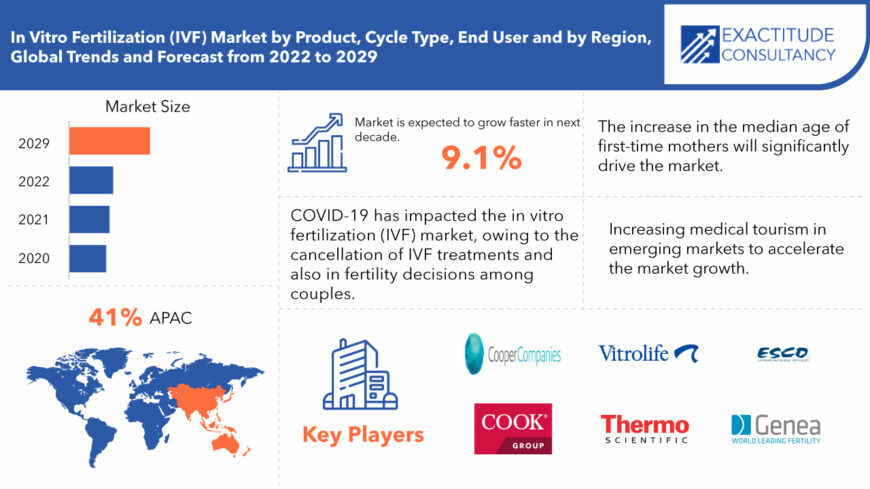
Si prevede che il mercato globale della fecondazione in vitro (FIVET) raggiungerà i 1.280,61 milioni di dollari entro il 2029, rispetto ai 584,78 milioni di dollari del 2020, con un CAGR del 9,1% dal 2020 al 2029.
A livello globale, e in particolare nelle nazioni sviluppate, si è verificata una tendenza al rialzo nell'età media delle neomamme. Questo cambiamento è attribuito a vari fattori, tra cui le donne che perseguono un'istruzione superiore e opportunità di carriera, il ritardo del matrimonio e la crescente accettazione delle donne non sposate che diventano madri. Poiché sempre più coppie si rivolgono ai trattamenti per la fertilità per concepire, la domanda di servizi di fecondazione in vitro (FIV) è in aumento. Di conseguenza, si prevede che il mercato della fecondazione in vitro crescerà durante il periodo di previsione, spinto dall'aumento dell'età media delle neomamme.
| ATTRIBUTO | DETTAGLI |
| Periodo di studio | 2020-2029 |
| Anno base | 2021 |
| Anno stimato | 2022 |
| Anno previsto | 2022-2029 |
| Periodo storico | 2018-2020 |
| Unità | Valore (milioni di USD) |
| Segmentazione | Per prodotto, per tipo di ciclo, per utenti finali, per regione |
| Per Prodotto |
|
| Per tipo di ciclo |
|
| Da parte degli utenti finali |
|
| Per regione |
|
Nei prossimi anni, il mercato della fecondazione in vitro è pronto per una significativa espansione, in gran parte dovuta all'aumento del turismo medico tra le economie emergenti. La propensione dei pazienti odierni a viaggiare all'estero alla ricerca di servizi sanitari superiori ha dato origine a un'industria fiorente nota come turismo medico. Con una tecnologia medica avanzata facilmente accessibile e trattamenti offerti a prezzi accessibili, i pazienti dei paesi in via di sviluppo preferiscono cercare assistenza sanitaria nei paesi sviluppati. La fecondazione in vitro sta guadagnando popolarità tra le coppie nelle economie emergenti, stimolando così la crescita del mercato. Inoltre, si prevede che una maggiore consapevolezza della disponibilità di trattamenti per la fertilità e la proliferazione di cliniche e ospedali per l'infertilità contribuiranno alla traiettoria di crescita del mercato nei prossimi anni.
Efforts by governments and various organizations to launch educational campaigns aimed at informing the public about fertility care, treatment options, and factors influencing infertility are on the rise. For instance, in August 2022, Pinnacle Fertility initiated the Save IVF campaign to raise awareness about potential new legislation threatening family-building treatments. Similarly, in July 2022, Oasis Fertility launched the Infertility Knows No Gender campaign in commemoration of World IVF Day. IVF stands as a beacon of hope for millions of couples grappling with infertility.
Frequently Asked Questions
• What is the worth of global In-Vitro Fertilization (IVF) market?
The In-Vitro Fertilization (IVF) market size had crossed USD 584.78 Million in 2020 and will observe a CAGR of more than 9.1 % up to 2027 driven by the increase in the median age of first-time mothers, declining fertility rates, rising male fertility, increased public awareness about fertility and treatments.
• What is the size of the North America In-Vitro Fertilization (IVF) industry?
Asia Pacific held more than 41% of the In-Vitro Fertilization (IVF) market revenue share in 2020 and will witness expansion with the healthcare infrastructure and rising medical tourism in Asian countries along with, rising healthcare expenditure and growing awareness of infertility among people.
• What are the upcoming trends of In-Vitro Fertilization (IVF) market, globally?
The upcoming trends in In-Vitro Fertilization (IVF) market are techniques such as testicular sperm extraction (PESA and TESE) and the development of new products to increase the success rate of IVF.
• Which are the top companies to hold the market share in In-Vitro Fertilization (IVF) market?
Key players profiled in the report include The Cooper Companies Inc., Cook Group, Vitrolife, Thermo Fisher Scientific, Inc., Esco Micro Pte. Ltd., Genea Limited, IVFtech ApS, FUJIFILM Irvine Scientific, The Baker Company, Inc., Kitazato Corporation, Corning Corporation, Hamilton Thorne Ltd., ZEISS Group, FERTIPRO NV, and Eppendorf.
• What are the most important trends in the In-Vitro Fertilization (IVF) market?
Women's pregnancies being delayed and global infertility rates rising will assist the accelerated growth in the near future.
• Which is the largest regional market for In-Vitro Fertilization (IVF) market?
With a CAGR of 10.1 percent over the projection period, Asia Pacific is the fastest-growing regional category in the in vitro fertilization market. This is due to increased medical tourism in Asian countries, rising healthcare expenditure, rising use of assisted reproductive technology in emerging countries, and rising public awareness of IVF therapy, all of which are contributing to the region's in vitro fertilization market growth.
In Vitro Fertilization (IVF) Market Segment Analysis
The global in vitro fertilization (IVF) market is segmented based on product, cycle type, end users. By product, the market is bifurcated into micromanipulators, incubators, cabinets, imaging system, laser system, reagents & accessories. During the forecast period, the equipment segment is expected to grow at the fastest rate. The high growth in this is due to the increasing number of IVF procedures and the introduction of highly advanced IVF equipment by market-leading manufacturers.
By cycle type, the market is divided into fresh IVF cycles, thawed IVF cycles, donor egg IVF cycles. Fresh IVF cycles (non-donor) accounted for the majority of revenue, and this trend is expected to continue during the forecast period, owing to higher success rates, as fresh embryo transfers result in higher pregnancy and birth rates compared to those who received frozen embryos.
By end user, the market is segmented into fertility clinics, hospitals, cryobanks. In 2021, the fertility clinics segment dominated the IVF market, accounting for more than 79.0 percent of revenue. From 2022 to 2030, the segment is expected to grow at the fastest rate. With an increase in demand for ART treatments, the number of fertility clinics and ART centres is rapidly increasing. Cost-effectiveness, availability of specialists, and low or no risk of Hospital-acquired Infections (HAIs) are expected to drive the growth of fertility clinics. Hospitals also provide IVF treatments.
[caption id="attachment_6736" align="alignleft" width="680"]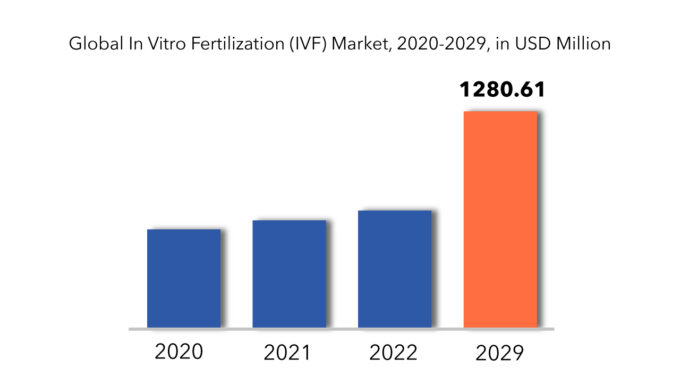
In Vitro Fertilization (IVF) Market Players
The in vitro fertilization (IVF) market key players include The Cooper Companies Inc., Cook Group, Vitrolife, Thermo Fisher Scientific, Inc., Esco Micro Pte. Ltd., Genea Limited, IVFtech ApS, FUJIFILM Irvine Scientific, The Baker Company, Inc., Kitazato Corporation, Corning Corporation, Hamilton Thorne Ltd., ZEISS Group, FERTIPRO NV, and Eppendorf.
For corporate expansion, these key leaders are implementing strategic formulations such as new product development and commercialization, commercial expansion, and distribution agreements. Moreover, these participants are substantially spending in product development, which is fueling revenue generation.
Who Should Buy? Or Key Stakeholders
- Medical Technology Companies
- Scientific Research & Development
- Medical Devices Manufacturers
- End-users
- Regulatory Authorities
- Others
Key Takeaways:
- The global in vitro fertilization (IVF) market is projected to reach at a CAGR of 9.1%
- Based on cycle type, Fresh IVF cycles (non-donor) accounted for the majority of revenue, and this trend is expected to continue during the forecast period.
- Based on end-user, the fertility clinics segment dominated the IVF market.
- Asia Pacific is the market leader in in vitro fertilization.
- The increasing demand for fertility treatments among older couples and single individuals drives the growth of the IVF market.
In Vitro Fertilization (IVF) Market Regional Analysis
The in vitro fertilization (IVF) market by region includes North America, Asia-Pacific (APAC), Europe, South America, and Middle East & Africa (MEA).
- North America: includes the US, Canada
- Asia Pacific: includes China, Japan, South Korea, India, Australia, ASEAN and Rest of APAC
- Europe: includes UK, Germany, France, Italy, Spain, Russia, and Rest of Europe
- Latin America: includes Brazil, Argentina and Mexico
- Middle East & Africa: includes Turkey, UAE, Saudi Arabia, South Africa, and Rest of MEA
Asia Pacific is the market leader in in vitro fertilization. Significant increase in medical tourism, increased awareness of the availability of in vitro fertilization procedures, decreased IVF treatment procedures, growing fertility clinics in the region, rising healthcare expenditures, and increasing adoption of assisted reproductive technology in emerging nations. Expansion of healthcare infrastructure and increase in disposable personal income, rising medical tourism in Asian countries, rising healthcare expenditure, and growing awareness of infertility among people all contribute to the region's in vitro fertilization market growth.
[caption id="attachment_6737" align="alignleft" width="680"]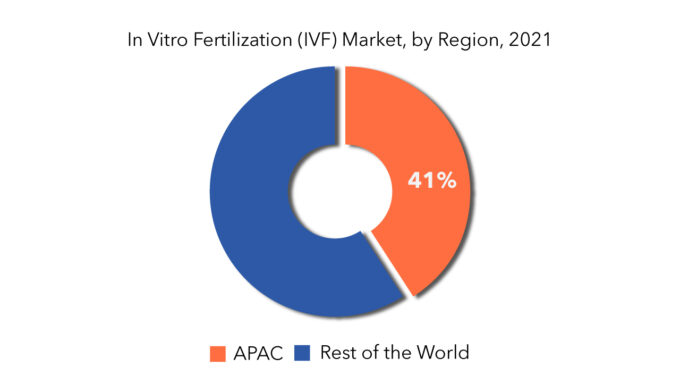
Key Market Segments: In Vitro Fertilization (IVF) Market
In Vitro Fertilization (IVF) Market by Product, 2020-2029, (USD Million)- Micromanipulators
- Incubators
- Cabinets
- Imaging System
- Laser System
- Reagents & Accessories
- Fresh IVF Cycle
- Thawed IVF Cycle
- Donor IVF Cycle
- Fertility Clinics
- Hospitals
- Cryobanks
- North America
- Asia Pacific
- Europe
- Latin America
- Middle East And Africa
Key Question Answered
- What is the current size of the in vitro fertilization (IVF) market?
- What are the key factors influencing the growth of in vitro fertilization (IVF)?
- What are the major applications for in vitro fertilization (IVF)?
- Who are the major key players in the in vitro fertilization (IVF) market?
- Which region will provide more business opportunities for in vitro fertilization (IVF) in future?
- Which segment holds the maximum share of the in vitro fertilization (IVF) market?
- Introduction
- Market Definition
- Market Segmentation
- Research Timelines
- Assumptions and Limitations
- Research Methodology
- Data Mining
- Secondary Research
- Primary Research
- Subject-Matter Experts’ Advice
- Quality Checks
- Final Review
- Data Triangulation
- Bottom-Up Approach
- Top-Down Approach
- Research Flow
- Data Sources
- Data Mining
- Executive Summary
- Market Overview
- Global In Vitro Fertilization (IVF) Market Outlook
- Market Drivers
- Market Restraints
- Market Opportunities
- Impact of Covid-19 On In Vitro Fertilization (IVF) Market
- Porter’s five forces model
- Threat from new entrants
- Threat from substitutes
- Bargaining power of suppliers
- Bargaining power of customers
- Degree of competition
- Industry value chain Analysis
- Global In Vitro Fertilization (IVF) Market Outlook
- Global In Vitro Fertilization (IVF) Market by Products, 2020-2029, (USD MILLION)
- Plasma
- Whole Blood
- Urine
- Global In Vitro Fertilization (IVF) Market by Cycle Type, 2020-2029, (USD MILLION)
- Immunoassay
- Hematology
- Microbiology
- Molecular Diagnostics
- Global In Vitro Fertilization (IVF) Market by End User, 2020-2029, (USD MILLION)
- Hospitals
- Labs
- Global In Vitro Fertilization (IVF) Market by Region, 2020-2029, (USD MILLION)
- North America
- US
- Canada
- Mexico
- South America
- Brazil
- Argentina
- Colombia
- Rest Of South America
- Europe
- Germany
- UK
- France
- Italy
- Spain
- Russia
- Rest Of Europe
- Asia Pacific
- India
- China
- Japan
- South Korea
- Australia
- South-East Asia
- Rest Of Asia Pacific
- Middle East and Africa
- UAE
- Saudi Arabia
- South Africa
- Rest Of Middle East and Africa
- North America
- Company Profiles* (Business Overview, Company Snapshot, Products Offered, Recent Developments)
- The Cooper Companies Inc.
- Cook Group
- Vitrolife
- Thermo Fisher Scientific
- Esco Micro Pte. Ltd.
- Genea Limited
- IVFtech ApS
- FUJIFILM Irvine Scientific
- The Baker Company
- Kitazato Corporation
- Corning Corporation
- Hamilton Thorne Ltd.
- ZEISS Group
- FERTIPRO NV
- Eppendorf
*The Company List Is Indicative
LIST OF TABLES
TABLE 1 GLOBAL IN VITRO FERTILIZATION (IVF) MARKET BY PRODUCT (USD MILLIONS) 2020-2029
TABLE 2 GLOBAL IN VITRO FERTILIZATION (IVF) MARKET BY CYCLE TYPE (USD MILLIONS) 2020-2029
TABLE 3 GLOBAL IN VITRO FERTILIZATION (IVF) MARKET BY END USER (USD MILLIONS) 2020-2029
TABLE 4 GLOBAL IN VITRO FERTILIZATION (IVF) MARKET BY REGION (USD MILLIONS) 2020-2029
TABLE 5 US IN VITRO FERTILIZATION (IVF) MARKET BY PRODUCT (USD MILLIONS) 2020-2029
TABLE 6 US IN VITRO FERTILIZATION (IVF) MARKET BY CYCLE TYPE (USD MILLIONS) 2020-2029
TABLE 7 US IN VITRO FERTILIZATION (IVF) MARKET BY END USER (USD MILLIONS) 2020-2029
TABLE 8 CANADA IN VITRO FERTILIZATION (IVF) MARKET BY PRODUCT (USD MILLIONS) 2020-2029
TABLE 9 CANADA IN VITRO FERTILIZATION (IVF) MARKET BY CYCLE TYPE (USD MILLIONS) 2020-2029
TABLE 10 CANADA IN VITRO FERTILIZATION (IVF) MARKET BY END USER (USD MILLIONS) 2020-2029
TABLE 11 MEXICO IN VITRO FERTILIZATION (IVF) MARKET BY PRODUCT (USD MILLIONS) 2020-2029
TABLE 12 MEXICO IN VITRO FERTILIZATION (IVF) MARKET BY CYCLE TYPE (USD MILLIONS) 2020-2029
TABLE 13 MEXICO IN VITRO FERTILIZATION (IVF) MARKET BY END USER (USD MILLIONS) 2020-2029
TABLE 14 BRAZIL IN VITRO FERTILIZATION (IVF) MARKET BY PRODUCT (USD MILLIONS) 2020-2029
TABLE 15 BRAZIL IN VITRO FERTILIZATION (IVF) MARKET BY CYCLE TYPE (USD MILLIONS) 2020-2029
TABLE 16 BRAZIL IN VITRO FERTILIZATION (IVF) MARKET BY END USER (USD MILLIONS) 2020-2029
TABLE 17 ARGENTINA IN VITRO FERTILIZATION (IVF) MARKET BY PRODUCT (USD MILLIONS) 2020-2029
TABLE 18 ARGENTINA IN VITRO FERTILIZATION (IVF) MARKET BY CYCLE TYPE (USD MILLIONS) 2020-2029
TABLE 19 ARGENTINA IN VITRO FERTILIZATION (IVF) MARKET BY END USER (USD MILLIONS) 2020-2029
TABLE 20 COLOMBIA IN VITRO FERTILIZATION (IVF) MARKET BY PRODUCT (USD MILLIONS) 2020-2029
TABLE 21 COLOMBIA IN VITRO FERTILIZATION (IVF) MARKET BY CYCLE TYPE (USD MILLIONS) 2020-2029
TABLE 22 COLOMBIA IN VITRO FERTILIZATION (IVF) MARKET BY END USER (USD MILLIONS) 2020-2029
TABLE 23 REST OF SOUTH AMERICA IN VITRO FERTILIZATION (IVF) MARKET BY PRODUCT (USD MILLIONS) 2020-2029
TABLE 24 REST OF SOUTH AMERICA IN VITRO FERTILIZATION (IVF) MARKET BY CYCLE TYPE (USD MILLIONS) 2020-2029
TABLE 25 REST OF SOUTH AMERICA IN VITRO FERTILIZATION (IVF) MARKET BY END USER (USD MILLIONS) 2020-2029
TABLE 26 INDIA IN VITRO FERTILIZATION (IVF) MARKET BY PRODUCT (USD MILLIONS) 2020-2029
TABLE 27 INDIA IN VITRO FERTILIZATION (IVF) MARKET BY CYCLE TYPE (USD MILLIONS) 2020-2029
TABLE 28 INDIA IN VITRO FERTILIZATION (IVF) MARKET BY END USER (USD MILLIONS) 2020-2029
TABLE 29 CHINA IN VITRO FERTILIZATION (IVF) MARKET BY PRODUCT (USD MILLIONS) 2020-2029
TABLE 30 CHINA IN VITRO FERTILIZATION (IVF) MARKET BY CYCLE TYPE (USD MILLIONS) 2020-2029
TABLE 31 CHINA IN VITRO FERTILIZATION (IVF) MARKET BY END USER (USD MILLIONS) 2020-2029
TABLE 32 JAPAN IN VITRO FERTILIZATION (IVF) MARKET BY PRODUCT (USD MILLIONS) 2020-2029
TABLE 33 JAPAN IN VITRO FERTILIZATION (IVF) MARKET BY CYCLE TYPE (USD MILLIONS) 2020-2029
TABLE 34 JAPAN IN VITRO FERTILIZATION (IVF) MARKET BY END USER (USD MILLIONS) 2020-2029
TABLE 35 SOUTH KOREA IN VITRO FERTILIZATION (IVF) MARKET BY PRODUCT (USD MILLIONS) 2020-2029
TABLE 36 SOUTH KOREA IN VITRO FERTILIZATION (IVF) MARKET BY CYCLE TYPE (USD MILLIONS) 2020-2029
TABLE 37 SOUTH KOREA IN VITRO FERTILIZATION (IVF) MARKET BY END USER (USD MILLIONS) 2020-2029
TABLE 38 AUSTRALIA IN VITRO FERTILIZATION (IVF) MARKET BY PRODUCT (USD MILLIONS) 2020-2029
TABLE 39 AUSTRALIA IN VITRO FERTILIZATION (IVF) MARKET BY CYCLE TYPE (USD MILLIONS) 2020-2029
TABLE 40 AUSTRALIA IN VITRO FERTILIZATION (IVF) MARKET BY END USER (USD MILLIONS) 2020-2029
TABLE 41 SOUTH-EAST ASIA IN VITRO FERTILIZATION (IVF) MARKET BY PRODUCT (USD MILLIONS) 2020-2029
TABLE 42 SOUTH-EAST ASIA IN VITRO FERTILIZATION (IVF) MARKET BY CYCLE TYPE (USD MILLIONS) 2020-2029
TABLE 43 SOUTH-EAST ASIA IN VITRO FERTILIZATION (IVF) MARKET BY END USER (USD MILLIONS) 2020-2029
TABLE 44 REST OF ASIA PACIFIC IN VITRO FERTILIZATION (IVF) MARKET BY PRODUCT (USD MILLIONS) 2020-2029
TABLE 45 REST OF ASIA PACIFIC IN VITRO FERTILIZATION (IVF) MARKET BY CYCLE TYPE (USD MILLIONS) 2020-2029
TABLE 46 REST OF ASIA PACIFIC IN VITRO FERTILIZATION (IVF) MARKET BY END USER (USD MILLIONS) 2020-2029
TABLE 47 GERMANY IN VITRO FERTILIZATION (IVF) MARKET BY PRODUCT (USD MILLIONS) 2020-2029
TABLE 48 GERMANY IN VITRO FERTILIZATION (IVF) MARKET BY CYCLE TYPE (USD MILLIONS) 2020-2029
TABLE 49 GERMANY IN VITRO FERTILIZATION (IVF) MARKET BY END USER (USD MILLIONS) 2020-2029
TABLE 50 UK IN VITRO FERTILIZATION (IVF) MARKET BY PRODUCT (USD MILLIONS) 2020-2029
TABLE 51 UK IN VITRO FERTILIZATION (IVF) MARKET BY CYCLE TYPE (USD MILLIONS) 2020-2029
TABLE 52 UK IN VITRO FERTILIZATION (IVF) MARKET BY END USER (USD MILLIONS) 2020-2029
TABLE 53 FRANCE IN VITRO FERTILIZATION (IVF) MARKET BY PRODUCT (USD MILLIONS) 2020-2029
TABLE 54 FRANCE IN VITRO FERTILIZATION (IVF) MARKET BY CYCLE TYPE (USD MILLIONS) 2020-2029
TABLE 55 FRANCE IN VITRO FERTILIZATION (IVF) MARKET BY END USER (USD MILLIONS) 2020-2029
TABLE 56 ITALY IN VITRO FERTILIZATION (IVF) MARKET BY PRODUCT (USD MILLIONS) 2020-2029
TABLE 57 ITALY IN VITRO FERTILIZATION (IVF) MARKET BY CYCLE TYPE (USD MILLIONS) 2020-2029
TABLE 58 ITALY IN VITRO FERTILIZATION (IVF) MARKET BY END USER (USD MILLIONS) 2020-2029
TABLE 59 SPAIN IN VITRO FERTILIZATION (IVF) MARKET BY PRODUCT (USD MILLIONS) 2020-2029
TABLE 60 SPAIN IN VITRO FERTILIZATION (IVF) MARKET BY CYCLE TYPE (USD MILLIONS) 2020-2029
TABLE 61 SPAIN IN VITRO FERTILIZATION (IVF) MARKET BY END USER (USD MILLIONS) 2020-2029
TABLE 62 RUSSIA IN VITRO FERTILIZATION (IVF) MARKET BY PRODUCT (USD MILLIONS) 2020-2029
TABLE 63 RUSSIA IN VITRO FERTILIZATION (IVF) MARKET BY CYCLE TYPE (USD MILLIONS) 2020-2029
TABLE 64 RUSSIA IN VITRO FERTILIZATION (IVF) MARKET BY END USER (USD MILLIONS) 2020-2029
TABLE 65 REST OF EUROPE IN VITRO FERTILIZATION (IVF) MARKET BY PRODUCT (USD MILLIONS) 2020-2029
TABLE 66 REST OF EUROPE IN VITRO FERTILIZATION (IVF) MARKET BY CYCLE TYPE (USD MILLIONS) 2020-2029
TABLE 67 REST OF EUROPE IN VITRO FERTILIZATION (IVF) MARKET BY END USER (USD MILLIONS) 2020-2029
TABLE 68 UAE IN VITRO FERTILIZATION (IVF) MARKET BY PRODUCT (USD MILLIONS) 2020-2029
TABLE 69 UAE IN VITRO FERTILIZATION (IVF) MARKET BY CYCLE TYPE (USD MILLIONS) 2020-2029
TABLE 70 UAE IN VITRO FERTILIZATION (IVF) MARKET BY END USER (USD MILLIONS) 2020-2029
TABLE 71 SAUDI ARABIA IN VITRO FERTILIZATION (IVF) MARKET BY PRODUCT (USD MILLIONS) 2020-2029
TABLE 72 SAUDI ARABIA IN VITRO FERTILIZATION (IVF) MARKET BY CYCLE TYPE (USD MILLIONS) 2020-2029
TABLE 73 SAUDI ARABIA IN VITRO FERTILIZATION (IVF) MARKET BY END USER (USD MILLIONS) 2020-2029
TABLE 74 SOUTH AFRICA IN VITRO FERTILIZATION (IVF) MARKET BY PRODUCT (USD MILLIONS) 2020-2029
TABLE 75 SOUTH AFRICA IN VITRO FERTILIZATION (IVF) MARKET BY CYCLE TYPE (USD MILLIONS) 2020-2029
TABLE 76 SOUTH AFRICA IN VITRO FERTILIZATION (IVF) MARKET BY END USER (USD MILLIONS) 2020-2029
TABLE 77 REST OF MIDDLE EAST AND AFRICA IN VITRO FERTILIZATION (IVF) MARKET BY PRODUCT (USD MILLIONS) 2020-2029
TABLE 78 REST OF MIDDLE EAST AND AFRICA IN VITRO FERTILIZATION (IVF) MARKET BY CYCLE TYPE (USD MILLIONS) 2020-2029
TABLE 79 REST OF MIDDLE EAST AND AFRICA IN VITRO FERTILIZATION (IVF) MARKET BY END USER (USD MILLIONS) 2020-2029
LIST OF FIGURES
FIGURE 1 MARKET DYNAMICS
FIGURE 2 MARKET SEGMENTATION
FIGURE 3 REPORT TIMELINES: YEARS CONSIDERED
FIGURE 4 DATA TRIANGULATION
FIGURE 5 BOTTOM-UP APPROACH
FIGURE 6 TOP-DOWN APPROACH
FIGURE 7 RESEARCH FLOW
FIGURE 8 GLOBAL IN VITRO FERTILIZATION (IVF) MARKET BY PRODUCT, USD MILLION, 2020-2029
FIGURE 9 GLOBAL IN VITRO FERTILIZATION (IVF) MARKET BY CYCLE TYPE, USD MILLION, 2020-2029
FIGURE 10 GLOBAL IN VITRO FERTILIZATION (IVF) MARKET BY END USER, USD MILLION, 2020-2029
FIGURE 11 GLOBAL IN VITRO FERTILIZATION (IVF) MARKET BY REGION, USD MILLION, 2020-2029
FIGURE 12 PORTER’S FIVE FORCES MODEL
FIGURE 13 NORTH AMERICA IN VITRO FERTILIZATION (IVF) MARKET SNAPSHOT
FIGURE 14 EUROPE IN VITRO FERTILIZATION (IVF) MARKET SNAPSHOT
FIGURE 15 SOUTH AMERICA IN VITRO FERTILIZATION (IVF) MARKET SNAPSHOT
FIGURE 16 ASIA PACIFIC IN VITRO FERTILIZATION (IVF) MARKET SNAPSHOT
FIGURE 17 MIDDLE EAST ASIA AND AFRICA IN VITRO FERTILIZATION (IVF) MARKET SNAPSHOT
FIGURE 18 MARKET SHARE ANALYSIS
FIGURE 19 THE COOPER COMPANIES INC.: COMPANY SNAPSHOT
FIGURE 20 COOK GROUP: COMPANY SNAPSHOT
FIGURE 21 VITROLIFE: COMPANY SNAPSHOT
FIGURE 22 THERMO FISHER SCIENTIFIC: COMPANY SNAPSHOT
FIGURE 23 ESCO MICRO PTE. LTD.: COMPANY SNAPSHOT
FIGURE 24 GENEA LIMITED: COMPANY SNAPSHOT
FIGURE 25 IVFTECH APS: COMPANY SNAPSHOT
FIGURE 26 FUJIFILM IRVINE SCIENTIFIC: COMPANY SNAPSHOT
FIGURE 27 THE BAKER COMPANY: COMPANY SNAPSHOT
FIGURE 28 KITAZATO CORPORATION: COMPANY SNAPSHOT
FIGURE 29 CORNING CORPORATION: COMPANY SNAPSHOT
FIGURE 30 HAMILTON THORNE LTD.: COMPANY SNAPSHOT
FIGURE 31 ZEISS GROUP: COMPANY SNAPSHOT
FIGURE 32 FERTIPRO NV: COMPANY SNAPSHOT
FIGURE 33 EPPENDORF: COMPANY SNAPSHOT
DOWNLOAD FREE SAMPLE REPORT
License Type
SPEAK WITH OUR ANALYST
Want to know more about the report or any specific requirement?
WANT TO CUSTOMIZE THE REPORT?
Our Clients Speak
We asked them to research ‘ Equipment market’ all over the world, and their whole arrangement was helpful to us. thehealthanalytics.com insightful analysis and reports contributed to our current analysis and in creating a future strategy. Besides, the te
Yosuke Mitsui
Senior Associate Construction Equipment Sales & Marketing
We asked them to research ‘Equipment market’ all over the world, and their whole arrangement was helpful to us. thehealthanalytics.com insightful analysis and reports contributed to our current analysis and in creating a future strategy. Besides, the te