

Base Year Value ()
x.x %
x.x %
CAGR ()
x.x %
x.x %
Forecast Year Value ()
x.x %
x.x %
Historical Data Period
Largest Region
Forecast Period
결제 유형(모바일 결제, 온라인 뱅킹, 판매 시점, 디지털 지갑), 배포 모드(클라우드 및 온프레미스), 최종 사용자(소매, 엔터테인먼트, 의료, BFSI, 운송, 기타) 및 지역별 디지털 결제 시장, 2022년부터 2029년까지의 글로벌 추세 및 예측.
Instant access to hundreds of data points and trends
- Market estimates from 2014-2029
- Competitive analysis, industry segmentation, financial benchmarks
- Incorporates SWOT, Porter's Five Forces and risk management frameworks
- PDF report or online database with Word, Excel and PowerPoint export options
- 100% money back guarantee
디지털 결제 시장 개요
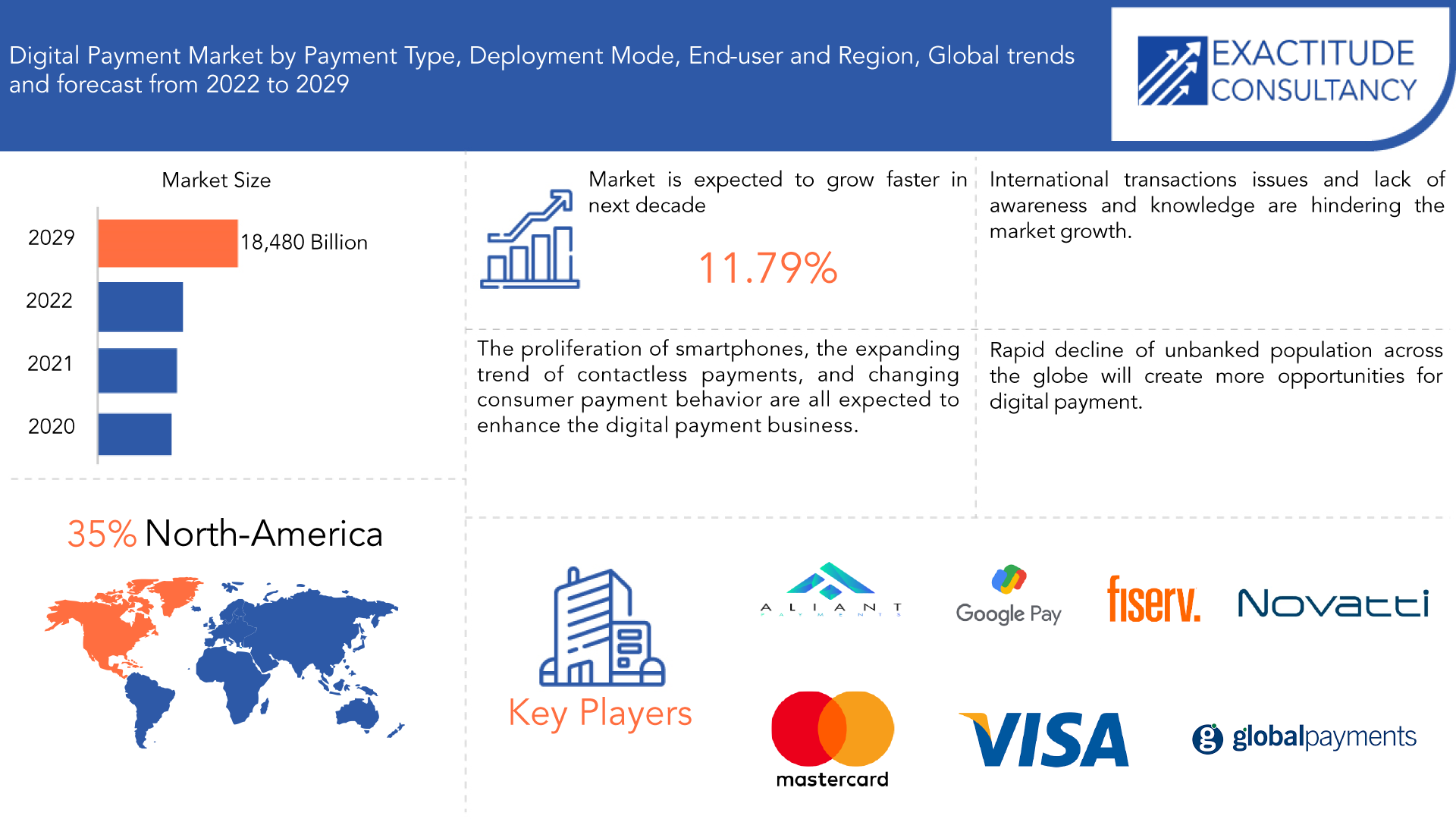
디지털 결제 시장은 2022년부터 2029년까지 11.79%의 CAGR로 성장할 것으로 예상됩니다. 2020년 67,800 억 달러에서 2029년까지 18,4800억 달러를 넘어설 것으로 예상됩니다 .
디지털 결제는 실제 통화 교환을 수반하지 않는 디지털 또는 온라인 채널을 통해 이루어지는 결제입니다. 전자 결제(e-결제)라고도 하는 이러한 유형의 결제는 지불인과 수취인이 모두 휴대전화, 컴퓨터 또는 신용, 직불 또는 선불 카드와 같은 디지털 장치를 사용하여 한 결제 계정에서 다른 결제 계정으로 가치를 이전하는 것입니다. 상인, 고객, 결제 네트워크 및 은행은 모두 디지털 결제 거래 처리에 참여합니다. 개인, 정부, 기업 및 국제 개발 기구는 모두 비용 절감, 투명성 및 보안 측면에서 이로부터 이익을 얻을 수 있습니다 . 디지털 결제 및 영수증으로 마이그레이션하는 기능은 전 세계의 소규모 기업이 위험이나 처벌 없이 더 빠르고 안전한 결제를 하는 데 큰 도움이 되었습니다.
디지털 결제의 가장 중요한 이점 중 하나는 고객에게 제공하는 매끄러운 경험입니다. 현금 및 수표와 같은 기존 결제 방법은 상당한 위험, 단계 및 물리적 존재를 추가합니다. 디지털 결제를 사용하면 버튼 하나만 터치하면 전 세계 어디에서나 현금을 보내고 받을 수 있습니다. 현금을 처리하고 거래하는 것은 어렵고 시간이 많이 걸리는 활동입니다. 디지털 결제를 사용하면 온라인 방식으로 현금을 쉽게 안전하게 보관할 수 있습니다. UPI, 넷뱅킹 및 모바일 지갑 덕분에 이제 휴대폰으로 결제를 하고 받을 수 있습니다. 게다가 대부분의 디지털 결제 채널은 정기적인 업데이트, 알림 및 명세서를 제공하여 고객이 현금을 추적할 수 있도록 합니다.
| 기인하다 | 세부 |
| 학습 기간 | 2020-2029 |
| 기준년도 | 2021 |
| 추정 연도 | 2022 |
| 예상 연도 | 2022-2029 |
| 역사적 기간 | 2018-2020 |
| 단위 | 가치(USD 십억) |
| 분할 | 결제 유형별, 배포 모드별, 최종 사용자별, 지역별 |
| 결제 유형별 |
|
| 배포 모드별 |
|
| 최종 사용자별 |
|
| 지역별로 |
|
The global digital payment market has grown as a result of factors such as a shift away from cash and increased smartphone usage. Furthermore, the widespread use of the Internet has boosted the global e-commerce sector. E-commerce is also driving the evolution of non-financial companies' point-of-sale services such as digital payments, insurance, and credit. In addition, e-commerce platforms such as Alibaba, Jumia, Mercado Libre, and Amazon have recently begun to integrate payment processing into their platforms. This is known as the embedding finance trend, and it is expected to accelerate digital payment transactions even further. This increase in e-commerce has contributed to an increase in digital financial services associated with small businesses and consumers, thereby boosting the global digital payment market's growth. On the other hand, an expanding digital payments industry has grown in recent years across emerging economies around the world as a result of the availability of low-cost smartphones and increasing Internet penetration. In addition, governments and regulators in emerging markets have been working on a digital transformation roadmap to encourage citizens to go cashless. For example, the Indian government established the National Payments Corporation of India (NPCI) as a separate entity to promote retail payments. Such government initiatives focusing on the evolution of digital payments are advantageous for global market growth.
Despite the fact that the global digital payment sector is expanding significantly, there are still no standards in place for international transfers. Further limiting the usage of digital channels for international transactions are issues including hidden costs, exchange rates, payment tracking, and payment identification. Because of this, businesses, particularly small and medium-sized ones (SMEs), are hesitant to enter global markets. For instance, only around 50% of businesses and SMEs, according to a survey by Visa Inc., have a competent payment processing infrastructure for cross-border payments. During the projected period, these factors are anticipated to limit market growth to some level. The rate of growth will also be slowed down by people's hesitation and anxiety about the security and safety of such interfaces in poor regions around the world. Additionally, a combination of poor banking infrastructure in these areas and a lack of awareness and knowledge among the populace will limit the potential for growth.
전 세계적으로 은행 계좌가 없는 인구가 급격히 감소함에 따라 디지털 결제에 대한 기회가 더 많아질 것입니다. 지구상의 대부분의 사람들은 농촌과 고립된 지역에 거주합니다. 이 그룹에서는 디지털 리터러시와 연결성이 부족합니다. 정부, 지원 기관 및 사업 주체는 이제 농촌과 먼 지역에 거주하는 상당수의 인구에게 금융 서비스가 중요하다는 것을 인정합니다. 그 결과 더 많은 사람들이 금융 서비스를 활용하고 있습니다. 정부는 금융 포용성을 촉진하기 위해 이러한 사람들을 연결하는 여러 프로그램을 시작합니다. 지불 은행 시설은 원격지에서도 모바일 폰을 사용하여 은행 계좌를 개설하고 관리할 수 있기 때문에 디지털 결제는 은행 계좌를 가진 개인 수를 늘리는 데 중요합니다. 디지털 지갑의 도입은 큰 영향을 미쳤으며 금융 포용성을 돕고 있습니다. 또한 전자 상거래의 증가 추세와 인터넷 도입은 디지털 결제 시장에 수익성 있는 기회를 창출할 것입니다.
COVID-19 전염병은 금융 포용성을 강화하여 전 세계적으로 공식 금융 서비스가 확대되면서 디지털 결제가 크게 증가했습니다. 이러한 성장은 새로운 경제적 가능성을 제공하고 계좌 소유의 성별 격차를 줄였으며 가계의 회복력을 높여 재정적 충격을 더 잘 관리했습니다. 반면에 COVID-19 전염병은 정부, 교육자, 기업 및 개인이 정기적인 업무를 수행하기 위해 "새로운 정상"에 적응하도록 강요했습니다. 이로 인해 고객 선호도와 구매 행동이 바뀌어 개인이 디지털 방식을 통해 소매, 기업, 금융 및 정부 거래를 수행할 수 있게 되었습니다. 전염병 기간 동안 비접촉 결제 기술, 특히 전자 지갑 사용이 증가했습니다. 제조 산업이 심각한 영향을 받았음에도 불구하고 디지털 결제 시장은 폐쇄 기간 동안 청구서 지불, P2P(Peer-to-Peer) 이체 및 C2B(Customer-to-Business) 지불이 증가했습니다.
[캡션 id="attachment_16178" 정렬="정렬센터" 너비="913"]
Frequently Asked Questions
• What is the expected CAGR in terms of revenue for the global Digital Payment Market over the forecast period (2020–2029)?
The global Digital Payment Market revenue is projected to expand at a CAGR of 11.79% during the forecast period.
• What was the global Digital Payment Market valued at in 2020?
The global Digital Payment Market was valued at USD 6780 Billion in 2020.
• Who are the key players in the Digital Payment Market?
Some key players operating in the Digital Payment Market include Aliant Payments, Total System Services Inc, Aurus Inc., Adyen, Wirecard, Financial Software & Systems Pvt. Ltd., Global Payments Inc., PayPal Holdings Inc., ACI Worldwide Inc., Novatti Group, Fiserv Inc., Sage Pay Europe Ltd., WEX Inc.
• Which region dominated the Digital Payment Market in 2020?
The North America market dominated the Global Software Defined Security Market by Region in 2020, and would continue to be a dominant market till 2029.
• What are the key driving factors in the Digital Payment Market?
Availability of various payment options and increased government support are driving the market growth.
Digital Payment Market Segment Analysis
The digital payment market is segmented based on payment type, deployment mode, end-user and region, global trends and forecast.
By Payment Type the market is bifurcated into mobile payment, online banking, point of sale, digital wallet; by Deployment Mode market is bifurcated into Cloud and On-premise, by End-user market is bifurcated into retail, entertainment, healthcare, BFSI, transportation, and others; and Region.
In 2022, the point of sales industry led the market and generated more than 51.0% of total revenue. Retail establishments employ point-of-sale systems to handle transactions. These systems provide advantages like quick checkout alternatives, a personalized client experience, and several payment methods. To boost productivity and enhance customer satisfaction, retailers all over the world are implementing cloud-based point-of-sale systems. Over the course of the forecast period, the internet banking segment is anticipated to increase at a high rate. One of the main elements influencing the segment's growth is the advantages provided by online banking, such as increased time efficiency, simplicity of banking, and activity tracking. As a result, more people are using online banking in many different nations around the globe.
In 2022, the market was dominated by the on-premise segment, which brought in more than 64.0% of worldwide revenue. Digital payment deployment on-premises gives businesses total control over their systems and apps, which their IT team can simply manage. Furthermore, one of the main causes influencing the demand for on-premise solutions among enterprises is the rise in financial scams in the COVID-19 epidemic. Over the forecast period, the cloud segment is expected to grow at the fastest CAGR. One of the major factors driving the segment's growth is the continued rollout of smart city projects, combined with an increase in the number of unmanned retail stores. Furthermore, payment companies' efforts to integrate artificial intelligence features into their payment systems are expected to boost segment growth.
The Banking, Financial Services, and Insurance (BFSI) industry is the dominant in terms of end-user and is expected to have the greatest impact on the digital payment market. The way insurance, financial services, and stockbroking companies disburse and receive funds has changed dramatically in recent years. As a result, an increase in demand for digital payment for domestic and cross-border transactions primarily drives growth in the BFSI sector. Furthermore, the BFSI sector is witnessing an increase in consumer preferences for digital payments as a result of increased internet usage and the rapid adoption of smartphones. Banks, on the other hand, are improving their digital payment offerings in order to compete with other solution providers such as Google, Facebook, and Amazon. However, the retail & e-commerce segment is expected to grow at the fastest rate during the forecast period due to a significant increase in consumer use of mobile-based payment solutions for retail payments. Furthermore, the ongoing trend of unmanned convenience stores is expected to create lucrative growth opportunities for this segment.
[caption id="attachment_16186" align="aligncenter" width="1920"]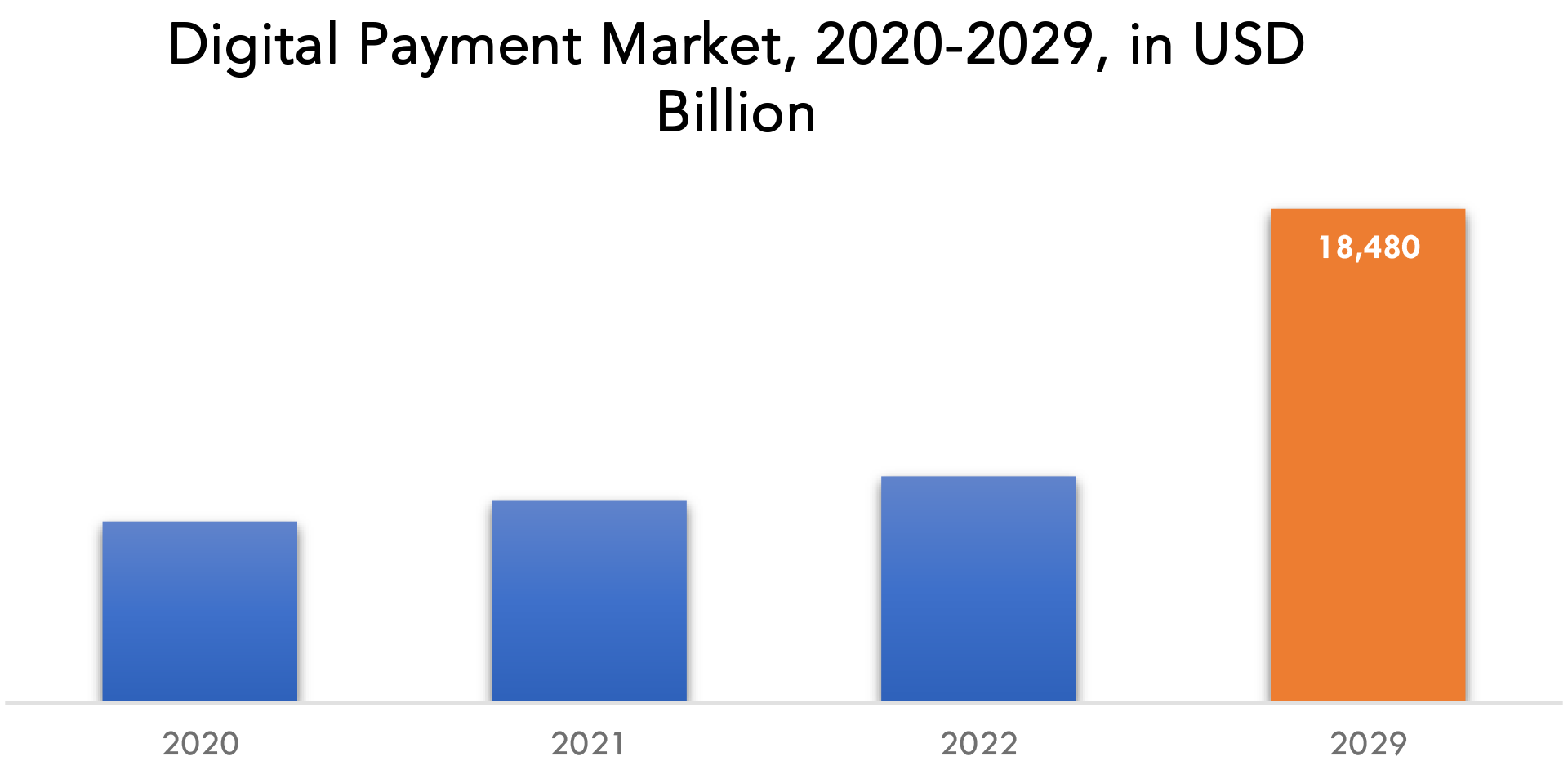
Digital Payment Market Key Players
The Digital Payment Market key players include Aliant Payments, Google LLC, Aurus Inc., Adyen, Mastercard Inc., Financial Software & Systems Pvt. Ltd., Global Payments Inc., PayPal Holdings Inc., ACI Worldwide Inc., Novatti Group, Fiserv Inc., Sage Pay Europe Ltd., Visa Inc., and others. Recent development:- 29 November 2022: Visa announced a seven-year global partnership with GoHenry, the prepaid card and financial education app for 6-to 18-year-olds. Visa will provide support as the exclusive global network partner for GoHenry’s prepaid cards for kids and teens in the US, UK, and Europe.
- 11 October 2022: PayPal Holdings, Inc. announced the rollout of the PayPal Zettle Terminal to small businesses in the US following its launch in European markets last year. Terminal is an all-in-one point-of-sale solution that offers increased mobility in-store for small businesses.
Who Should Buy? Or Key Stakeholders
- Investors
- Environment, Health and Safety Professionals
- Computer Hardware Industry
- Research Organizations
- Banking and Financial Organizations
- Regulatory Authorities
- Electronics and Telecommunication Industry
- E- Commerce Industries
- Others
Digital Payment Market Regional Analysis
The Digital Payment Market by region includes North America, Asia-Pacific (APAC), Europe, South America, and Middle East & Africa (MEA).
- North America: includes the US, Canada, Mexico
- Asia Pacific: includes China, Japan, South Korea, India, Australia, and Rest of APAC
- Europe: includes UK, Germany, France, Italy, Spain, Russia, and Rest of Europe
- South America: includes Brazil, Argentina, and Rest of South America
- Middle East & Africa: includes UAE, South Africa, Saudi Arabia and Rest of MEA
In terms of revenue share, the North American region dominated the market in 2021. US and Canada are included in this region. The US consumer population's ongoing use of digital wallets and mobile payments is largely responsible for the market's expansion in this area. It is anticipated that technological developments in the North American digital payment sector would open up attractive new market prospects. This platform provides the option to split payments for online purchases using different credit and debit cards without incurring interest or other fees. In this way, it is anticipated that the platform would assist users in lowering the cost load on individual cards, enhancing financial privacy, and raising credit scores.
In the market for digital payments, Asia-Pacific is regarded as having the fastest growth. China, India, Japan, South Korea, and the rest of the world are all included in this region. One of the key reasons propelling market expansion is the major countries in this region's initiatives to improve the digital payment industry. For instance, the Indian government is actively pursuing its plan to digitise the financial and economic sectors. Bharat Interface for Money-Unified Payments Interface (BHIM-UPI), which was recently introduced, has become one of the preferred payment methods for Indian citizens. The Asia-Pacific area is expanding due to China's rapid growth in the digital payment sector. The two most popular digital payment systems in the nation, WeChat Pay and Alipay, are used by more than 90% of urban Chinese consumers.
Europe has a developed banking and mobile sector. Since the majority of people in Europe have bank accounts, the rise of digital wallets is expected to peak around 2026. The technology is anticipated to increase market size in the region as numerous companies, like Telefonica and Vodafone, invest in NFC services through phones and cards, mainly in the UK and Germany.
[caption id="attachment_16189" align="aligncenter" width="1920"]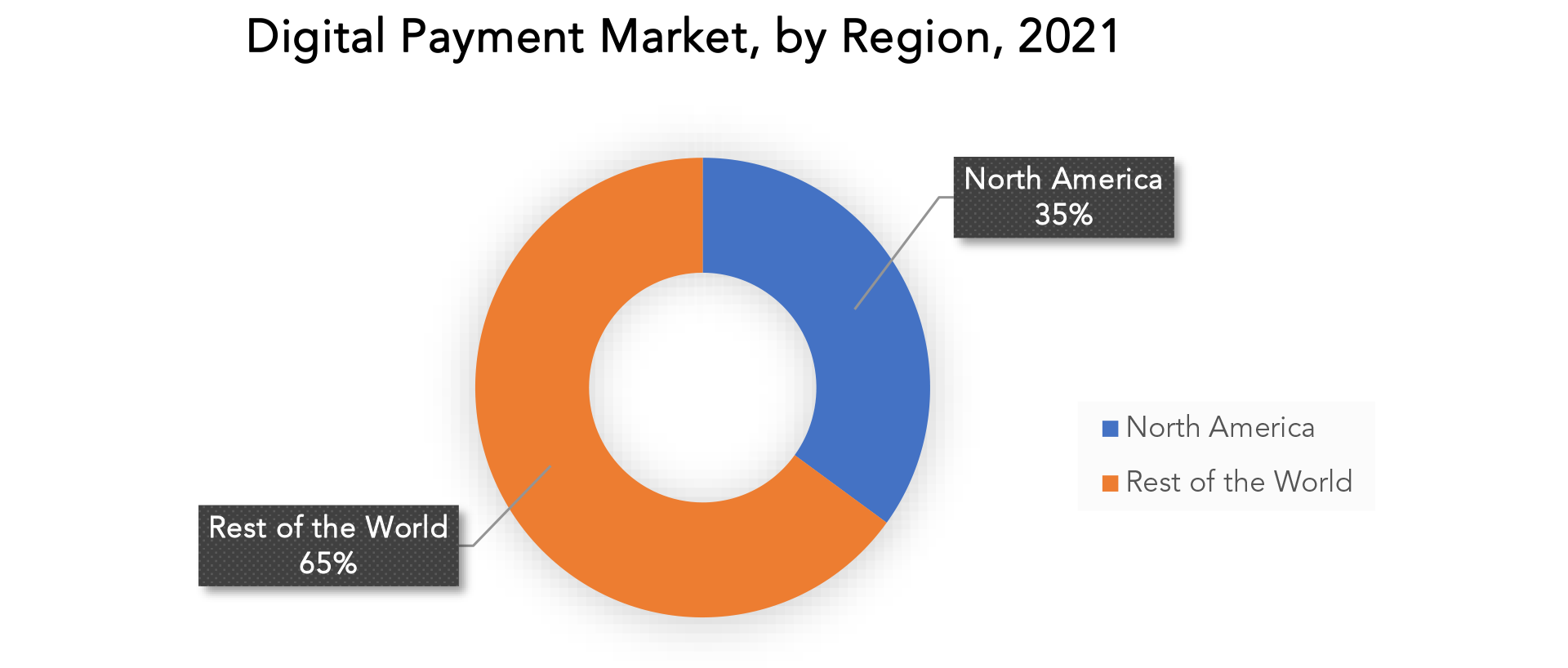
Key Market Segments: Digital Payment Market
Digital Payment Market By Payment Type, 2020-2029, (Usd Billion)- Mobile Payment
- Online Banking
- Point Of Sale
- Digital Wallet
- Cloud
- On-Premise
- Retail
- Entertainment
- Healthcare
- Bfsi
- Transportation
- Others
- North America
- Asia Pacific
- Europe
- South America
- Middle East And Africa
Exactitude Consultancy Services Key Objectives:
- Increasing sales and market share
- Developing new technology
- Improving profitability
- Entering new markets
- Enhancing brand reputation
Key Question Answered
- What is the expected growth rate of the Digital Payment Market over the next 7 years?
- Who are the major players in the Digital Payment Market and what is their market share?
- What are the end-user industries driving demand for market and what is their outlook?
- What are the opportunities for growth in emerging markets such as Asia-Pacific, Middle East, and Africa?
- How is the economic environment affecting the Digital Payment Market, including factors such as interest rates, inflation, and exchange rates?
- What is the expected impact of government policies and regulations on the Digital Payment Market?
- What is the current and forecasted size and growth rate of the global Digital Payment Market?
- What are the key drivers of growth in the Digital Payment Market?
- Who are the major players in the market and what is their market share?
- What are the distribution channels and supply chain dynamics in the Digital Payment Market?
- What are the technological advancements and innovations in the Digital Payment Market and their impact on product development and growth?
- What are the regulatory considerations and their impact on the market?
- What are the challenges faced by players in the Digital Payment Market and how are they addressing these challenges?
- What are the opportunities for growth and expansion in the Digital Payment Market?
- What are the service offerings and specifications of leading players in the market?
- 소개
- 시장 정의
- 시장 세분화
- 연구 일정
- 가정 및 제한
- 연구 방법론
- 데이터 마이닝
- 2차 연구
- 1차 연구
- 주제별 전문가의 조언
- 품질 검사
- 최종 검토
- 데이터 삼각 측량
- 바텀업 방식
- 탑다운 접근 방식
- 연구 흐름
- 데이터 소스
- 데이터 마이닝
- 요약
- 시장 개요
- 글로벌 디지털 결제 시장 전망
- 시장 동인
- 시장 제약
- 시장 기회
- COVID-19가 디지털 결제 시장에 미치는 영향
- 포터의 5가지 힘 모델
- 신규 진입자의 위협
- 대체품으로부터의 위협
- 공급업체의 협상력
- 고객의 협상력
- 경쟁의 정도
- 산업 가치 사슬 분석
- 글로벌 디지털 결제 시장 전망
- 결제 유형별 글로벌 디지털 결제 시장(USD 십억), 2020-2029
- 모바일 결제
- 온라인 뱅킹
- 판매 시점
- 디지털 지갑
- GLOBAL DIGITAL PAYMENT MARKET BY DEPLOYMENT MODE (USD BILLION), 2020-2029
- CLOUD
- ON-PREMISE
- GLOBAL DIGITAL PAYMENT MARKET BY END-USER (USD BILLION), 2020-2029
- RETAIL
- ENTERTAINMENT
- HEALTHCARE
- BFSI
- TRANSPORTATION
- OTHERS
- GLOBAL DIGITAL PAYMENT MARKET BY REGION (USD BILLION), 2020-2029
- NORTH AMERICA
- US
- CANADA
- MEXICO
- SOUTH AMERICA
- BRAZIL
- ARGENTINA
- COLOMBIA
- REST OF SOUTH AMERICA
- EUROPE
- GERMANY
- UK
- FRANCE
- ITALY
- SPAIN
- RUSSIA
- REST OF EUROPE
- ASIA PACIFIC
- INDIA
- CHINA
- JAPAN
- SOUTH KOREA
- AUSTRALIA
- REST OF ASIA PACIFIC
- MIDDLE EAST AND AFRICA
- UAE
- SAUDI ARABIA
- SOUTH AFRICA
- REST OF MIDDLE EAST AND AFRICA
- NORTH AMERICA
- COMPANY PROFILES* (BUSINESS OVERVIEW, COMPANY SNAPSHOT, PRODUCTS OFFERED, RECENT DEVELOPMENTS)
- ALIANT PAYMENTS
- GOOGLE LLC
- AURUS INC.
- ADYEN
- MASTERCARD INC.
- FINANCIAL SOFTWARE & SYSTEMS PVT. LTD.
- GLOBAL PAYMENTS INC.
- PAYPAL HOLDINGS INC.
- ACI WORLDWIDE INC.
- NOVATTI GROUP
- FISERV INC.
- SAGE PAY EUROPE LTD.
- VISA INC. *THE COMPANY LIST IS INDICATIVE
LIST OF TABLES
TABLE 1 GLOBAL DIGITAL PAYMENT MARKET BY PAYMENT TYPE (USD BILLION), 2020-2029
TABLE 2 GLOBAL DIGITAL PAYMENT MARKET BY DEPLOYMENT MODE (USD BILLION), 2020-2029
TABLE 3 GLOBAL DIGITAL PAYMENT MARKET BY END-USER (USD BILLION), 2020-2029
TABLE 4 GLOBAL DIGITAL PAYMENT MARKET BY REGION (USD BILLION), 2020-2029
TABLE 5 NORTH AMERICA DIGITAL PAYMENT MARKET BY PAYMENT TYPE (USD BILLION), 2020-2029
TABLE 6 NORTH AMERICA DIGITAL PAYMENT MARKET BY DEPLOYMENT MODE (USD BILLION), 2020-2029
TABLE 7 NORTH AMERICA DIGITAL PAYMENT MARKET BY END-USER (USD BILLION), 2020-2029
TABLE 8 NORTH AMERICA DIGITAL PAYMENT MARKET BY COUNTRY (USD BILLION), 2020-2029
TABLE 9 US DIGITAL PAYMENT MARKET BY PAYMENT TYPE (USD BILLION), 2020-2029
TABLE 10 US DIGITAL PAYMENT MARKET BY DEPLOYMENT MODE (USD BILLION), 2020-2029
TABLE 11 US DIGITAL PAYMENT MARKET BY END-USER (USD BILLION), 2020-2029
TABLE 12 CANADA DIGITAL PAYMENT MARKET BY PAYMENT TYPE (BILLION), 2020-2029
TABLE 13 CANADA DIGITAL PAYMENT MARKET BY DEPLOYMENT MODE (USD BILLION), 2020-2029
TABLE 14 CANADA DIGITAL PAYMENT MARKET BY END-USER (USD BILLION), 2020-2029
TABLE 15 MEXICO DIGITAL PAYMENT MARKET BY PAYMENT TYPE (USD BILLION), 2020-2029
TABLE 16 MEXICO DIGITAL PAYMENT MARKET BY DEPLOYMENT MODE (USD BILLION), 2020-2029
TABLE 17 MEXICO DIGITAL PAYMENT MARKET BY END-USER (USD BILLION), 2020-2029
TABLE 18 REST OF NORTH AMERICA DIGITAL PAYMENT MARKET BY PAYMENT TYPE (USD BILLION), 2020-2029
TABLE 19 REST OF NORTH AMERICA DIGITAL PAYMENT MARKET BY DEPLOYMENT MODE (USD BILLION), 2020-2029
TABLE 20 REST OF NORTH AMERICA DIGITAL PAYMENT MARKET BY END-USER (USD BILLION), 2020-2029
TABLE 21 SOUTH AMERICA DIGITAL PAYMENT MARKET BY PAYMENT TYPE (USD BILLION), 2020-2029
TABLE 22 SOUTH AMERICA DIGITAL PAYMENT MARKET BY DEPLOYMENT MODE (USD BILLION), 2020-2029
TABLE 23 SOUTH AMERICA DIGITAL PAYMENT MARKET BY END-USER (USD BILLION), 2020-2029
TABLE 24 SOUTH AMERICA DIGITAL PAYMENT MARKET BY COUNTRY (USD BILLION), 2020-2029
TABLE 25 BRAZIL DIGITAL PAYMENT MARKET BY PAYMENT TYPE (USD BILLION), 2020-2029
TABLE 26 BRAZIL DIGITAL PAYMENT MARKET BY DEPLOYMENT MODE (USD BILLION), 2020-2029
TABLE 27 BRAZIL DIGITAL PAYMENT MARKET BY END-USER (USD BILLION), 2020-2029
TABLE 28 ARGENTINA DIGITAL PAYMENT MARKET BY PAYMENT TYPE (USD BILLION), 2020-2029
TABLE 29 ARGENTINA DIGITAL PAYMENT MARKET BY DEPLOYMENT MODE (USD BILLION), 2020-2029
TABLE 30 ARGENTINA DIGITAL PAYMENT MARKET BY END-USER (USD BILLION), 2020-2029
TABLE 31 COLOMBIA DIGITAL PAYMENT MARKET BY PAYMENT TYPE (USD BILLION), 2020-2029
TABLE 32 COLOMBIA DIGITAL PAYMENT MARKET BY DEPLOYMENT MODE (USD BILLION), 2020-2029
TABLE 33 COLOMBIA DIGITAL PAYMENT MARKET BY END-USER (USD BILLION), 2020-2029
TABLE 34 REST OF SOUTH AMERICA DIGITAL PAYMENT MARKET BY PAYMENT TYPE (USD BILLION), 2020-2029
TABLE 35 REST OF SOUTH AMERICA DIGITAL PAYMENT MARKET BY DEPLOYMENT MODE (USD BILLION), 2020-2029
TABLE 36 REST OF SOUTH AMERICA DIGITAL PAYMENT MARKET BY END-USER (USD BILLION), 2020-2029
TABLE 37 ASIA-PACIFIC DIGITAL PAYMENT MARKET BY PAYMENT TYPE (USD BILLION), 2020-2029
TABLE 38 ASIA-PACIFIC DIGITAL PAYMENT MARKET BY DEPLOYMENT MODE (USD BILLION), 2020-2029
TABLE 39 ASIA-PACIFIC DIGITAL PAYMENT MARKET BY END-USER (USD BILLION), 2020-2029
TABLE 40 ASIA-PACIFIC DIGITAL PAYMENT MARKET BY COUNTRY (USD BILLION), 2020-2029
TABLE 41 INDIA DIGITAL PAYMENT MARKET BY PAYMENT TYPE (USD BILLION), 2020-2029
TABLE 42 INDIA DIGITAL PAYMENT MARKET BY DEPLOYMENT MODE (USD BILLION), 2020-2029
TABLE 43 INDIA DIGITAL PAYMENT MARKET BY END-USER (USD BILLION), 2020-2029
TABLE 44 CHINA DIGITAL PAYMENT MARKET BY PAYMENT TYPE (USD BILLION), 2020-2029
TABLE 45 CHINA DIGITAL PAYMENT MARKET BY DEPLOYMENT MODE (USD BILLION), 2020-2029
TABLE 46 CHINA DIGITAL PAYMENT MARKET BY END-USER (USD BILLION), 2020-2029
TABLE 47 JAPAN DIGITAL PAYMENT MARKET BY PAYMENT TYPE (USD BILLION), 2020-2029
TABLE 48 JAPAN DIGITAL PAYMENT MARKET BY DEPLOYMENT MODE (USD BILLION), 2020-2029
TABLE 49 JAPAN DIGITAL PAYMENT MARKET BY END-USER (USD BILLION), 2020-2029
TABLE 50 SOUTH KOREA DIGITAL PAYMENT MARKET BY PAYMENT TYPE (USD BILLION), 2020-2029
TABLE 51 SOUTH KOREA DIGITAL PAYMENT MARKET BY DEPLOYMENT MODE (USD BILLION), 2020-2029
TABLE 52 SOUTH KOREA DIGITAL PAYMENT MARKET BY END-USER (USD BILLION), 2020-2029
TABLE 53 AUSTRALIA DIGITAL PAYMENT MARKET BY PAYMENT TYPE (USD BILLION), 2020-2029
TABLE 54 AUSTRALIA DIGITAL PAYMENT MARKET BY DEPLOYMENT MODE (USD BILLION), 2020-2029
TABLE 55 AUSTRALIA DIGITAL PAYMENT MARKET BY END-USER (USD BILLION), 2020-2029
TABLE 56 REST OF ASIA PACIFIC DIGITAL PAYMENT MARKET BY PAYMENT TYPE (USD BILLION), 2020-2029
TABLE 57 REST OF ASIA PACIFIC DIGITAL PAYMENT MARKET BY DEPLOYMENT MODE (USD BILLION), 2020-2029
TABLE 58 REST OF ASIA PACIFIC DIGITAL PAYMENT MARKET BY END-USER (USD BILLION), 2020-2029
TABLE 59 EUROPE DIGITAL PAYMENT MARKET BY PAYMENT TYPE (USD BILLION), 2020-2029
TABLE 60 EUROPE DIGITAL PAYMENT MARKET BY DEPLOYMENT MODE (USD BILLION), 2020-2029
TABLE 61 EUROPE DIGITAL PAYMENT MARKET BY END-USER (USD BILLION), 2020-2029
TABLE 62 EUROPE DIGITAL PAYMENT MARKET BY COUNTRY (USD BILLION), 2020-2029
TABLE 63 GERMANY DIGITAL PAYMENT MARKET BY PAYMENT TYPE (USD BILLION), 2020-2029
TABLE 64 GERMANY DIGITAL PAYMENT MARKET BY DEPLOYMENT MODE (USD BILLION), 2020-2029
TABLE 65 GERMANY DIGITAL PAYMENT MARKET BY END-USER (USD BILLION), 2020-2029
TABLE 66 UK DIGITAL PAYMENT MARKET BY PAYMENT TYPE (USD BILLION), 2020-2029
TABLE 67 UK DIGITAL PAYMENT MARKET BY DEPLOYMENT MODE (USD BILLION), 2020-2029
TABLE 68 UK DIGITAL PAYMENT MARKET BY END-USER (USD BILLION), 2020-2029
TABLE 69 FRANCE DIGITAL PAYMENT MARKET BY PAYMENT TYPE (USD BILLION), 2020-2029
TABLE 70 FRANCE DIGITAL PAYMENT MARKET BY DEPLOYMENT MODE (USD BILLION), 2020-2029
TABLE 71 FRANCE DIGITAL PAYMENT MARKET BY END-USER (USD BILLION), 2020-2029
TABLE 72 ITALY DIGITAL PAYMENT MARKET BY PAYMENT TYPE (USD BILLION), 2020-2029
TABLE 73 ITALY DIGITAL PAYMENT MARKET BY DEPLOYMENT MODE (USD BILLION), 2020-2029
TABLE 74 ITALY DIGITAL PAYMENT MARKET BY END-USER (USD BILLION), 2020-2029
TABLE 75 SPAIN DIGITAL PAYMENT MARKET BY PAYMENT TYPE (USD BILLION), 2020-2029
TABLE 76 SPAIN DIGITAL PAYMENT MARKET BY DEPLOYMENT MODE (USD BILLION), 2020-2029
TABLE 77 SPAIN DIGITAL PAYMENT MARKET BY END-USER (USD BILLION), 2020-2029
TABLE 78 RUSSIA DIGITAL PAYMENT MARKET BY PAYMENT TYPE (USD BILLION), 2020-2029
TABLE 79 RUSSIA DIGITAL PAYMENT MARKET BY DEPLOYMENT MODE (USD BILLION), 2020-2029
TABLE 80 RUSSIA DIGITAL PAYMENT MARKET BY END-USER (USD BILLION), 2020-2029
TABLE 81 REST OF EUROPE DIGITAL PAYMENT MARKET BY PAYMENT TYPE (USD BILLION), 2020-2029
TABLE 82 REST OF EUROPE DIGITAL PAYMENT MARKET BY DEPLOYMENT MODE (USD BILLION), 2020-2029
TABLE 83 REST OF EUROPE DIGITAL PAYMENT MARKET BY END-USER (USD BILLION), 2020-2029
TABLE 84 MIDDLE EAST AND AFRICA DIGITAL PAYMENT MARKET BY PAYMENT TYPE (USD BILLION), 2020-2029
TABLE 85 MIDDLE EAST AND AFRICA DIGITAL PAYMENT MARKET BY DEPLOYMENT MODE (USD BILLION), 2020-2029
TABLE 86 MIDDLE EAST AND AFRICA DIGITAL PAYMENT MARKET BY END-USER (USD BILLION), 2020-2029
TABLE 87 MIDDLE EAST AND AFRICA DIGITAL PAYMENT MARKET BY COUNTRY (USD BILLION), 2020-2029
TABLE 88 UAE DIGITAL PAYMENT MARKET BY PAYMENT TYPE (USD BILLION), 2020-2029
TABLE 89 UAE DIGITAL PAYMENT MARKET BY DEPLOYMENT MODE (USD BILLION), 2020-2029
TABLE 90 UAE DIGITAL PAYMENT MARKET BY END-USER (USD BILLION), 2020-2029
TABLE 91 SAUDI ARABIA DIGITAL PAYMENT MARKET BY PAYMENT TYPE (USD BILLION), 2020-2029
TABLE 92 SAUDI ARABIA DIGITAL PAYMENT MARKET BY DEPLOYMENT MODE (USD BILLION), 2020-2029
TABLE 93 SAUDI ARABIA DIGITAL PAYMENT MARKET BY END-USER (USD BILLION), 2020-2029
TABLE 94 SOUTH AFRICA DIGITAL PAYMENT MARKET BY PAYMENT TYPE (USD BILLION), 2020-2029
TABLE 95 SOUTH AFRICA DIGITAL PAYMENT MARKET BY DEPLOYMENT MODE (USD BILLION), 2020-2029
TABLE 96 SOUTH AFRICA DIGITAL PAYMENT MARKET BY END-USER (USD BILLION), 2020-2029
TABLE 97 REST OF MIDDLE EAST AND AFRICA DIGITAL PAYMENT MARKET BY PAYMENT TYPE (USD BILLION), 2020-2029
TABLE 98 REST OF MIDDLE EAST AND AFRICA DIGITAL PAYMENT MARKET BY DEPLOYMENT MODE (USD BILLION), 2020-2029
TABLE 99 REST OF MIDDLE EAST AND AFRICA DIGITAL PAYMENT MARKET BY END-USER (USD BILLION), 2020-2029
LIST OF FIGURES
FIGURE 1 MARKET DYNAMICS
FIGURE 2 MARKET SEGMENTATION
FIGURE 3 REPORT TIMELINES: YEARS CONSIDERED
FIGURE 4 DATA TRIANGULATION
FIGURE 5 BOTTOM-UP APPROACH
FIGURE 6 TOP-DOWN APPROACH
FIGURE 7 RESEARCH FLOW
FIGURE 8 GLOBAL DIGITAL PAYMENT MARKET BY PAYMENT TYPE, USD BILLION, 2020-2029
FIGURE 9 GLOBAL DIGITAL PAYMENT MARKET BY DEPLOYMENT MODE, USD BILLION, 2020-2029
FIGURE 10 GLOBAL DIGITAL PAYMENT MARKET BY END-USER, USD BILLION, 2020-2029
FIGURE 11 GLOBAL DIGITAL PAYMENT MARKET BY REGION, USD BILLION, 2020-2029
FIGURE 12 PORTER’S FIVE FORCES MODEL
FIGURE 13 GLOBAL DIGITAL PAYMENT MARKET BY REGION 2021
FIGURE 14 GLOBAL DIGITAL PAYMENT MARKET BY PAYMENT TYPE 2021
FIGURE 15 GLOBAL DIGITAL PAYMENT MARKET BY DEPLOYMENT MODE 2021
FIGURE 16 GLOBAL DIGITAL PAYMENT MARKET BY END-USER 2021
FIGURE 17 MARKET SHARE ANALYSIS
FIGURE 18 ALIANT PAYMENTS: COMPANY SNAPSHOT
FIGURE 19 GOOGLE LLC.: COMPANY SNAPSHOT
FIGURE 20 AURUS INC: COMPANY SNAPSHOT
FIGURE 21 ADYEN: COMPANY SNAPSHOT
FIGURE 22 MASTERCARD INC.: COMPANY SNAPSHOT
FIGURE 23 FINANCIAL SOFTWARE & SYSTEMS PVT. LTD.: COMPANY SNAPSHOT
FIGURE 24 GLOBAL PAYMENTS INC.: COMPANY SNAPSHOT
FIGURE 25 PAYPAL HOLDINGS INC.: COMPANY SNAPSHOT
FIGURE 26 ACI WORLDWIDE INC.: COMPANY SNAPSHOT
FIGURE 27 NOVATTI GROUP: COMPANY SNAPSHOT
FIGURE 28 FISERV INC.: COMPANY SNAPSHOT
FIGURE 29 SAGE PAY EUROPE LTD.: COMPANY SNAPSHOT
FIGURE 30 VISA INC.: COMPANY SNAPSHOT
DOWNLOAD FREE SAMPLE REPORT
License Type
SPEAK WITH OUR ANALYST
Want to know more about the report or any specific requirement?
WANT TO CUSTOMIZE THE REPORT?
Our Clients Speak
We asked them to research ‘ Equipment market’ all over the world, and their whole arrangement was helpful to us. thehealthanalytics.com insightful analysis and reports contributed to our current analysis and in creating a future strategy. Besides, the te
Yosuke Mitsui
Senior Associate Construction Equipment Sales & Marketing
We asked them to research ‘Equipment market’ all over the world, and their whole arrangement was helpful to us. thehealthanalytics.com insightful analysis and reports contributed to our current analysis and in creating a future strategy. Besides, the te