

Base Year Value ()
x.x %
x.x %
CAGR ()
x.x %
x.x %
Forecast Year Value ()
x.x %
x.x %
Historical Data Period
Largest Region
Forecast Period
Automotive Electric Motor Market by Type (Small Automotive Motor, Automotive Starter and Generator, NEV Motor), by Application (Passenger car, Commercial Vehicle, New Energy Vehicle (NEV)) and Region, Global trends and forecast from 2023 to 2029
Instant access to hundreds of data points and trends
- Market estimates from 2014-2029
- Competitive analysis, industry segmentation, financial benchmarks
- Incorporates SWOT, Porter's Five Forces and risk management frameworks
- PDF report or online database with Word, Excel and PowerPoint export options
- 100% money back guarantee
Automotive Electric Motor Market Overview
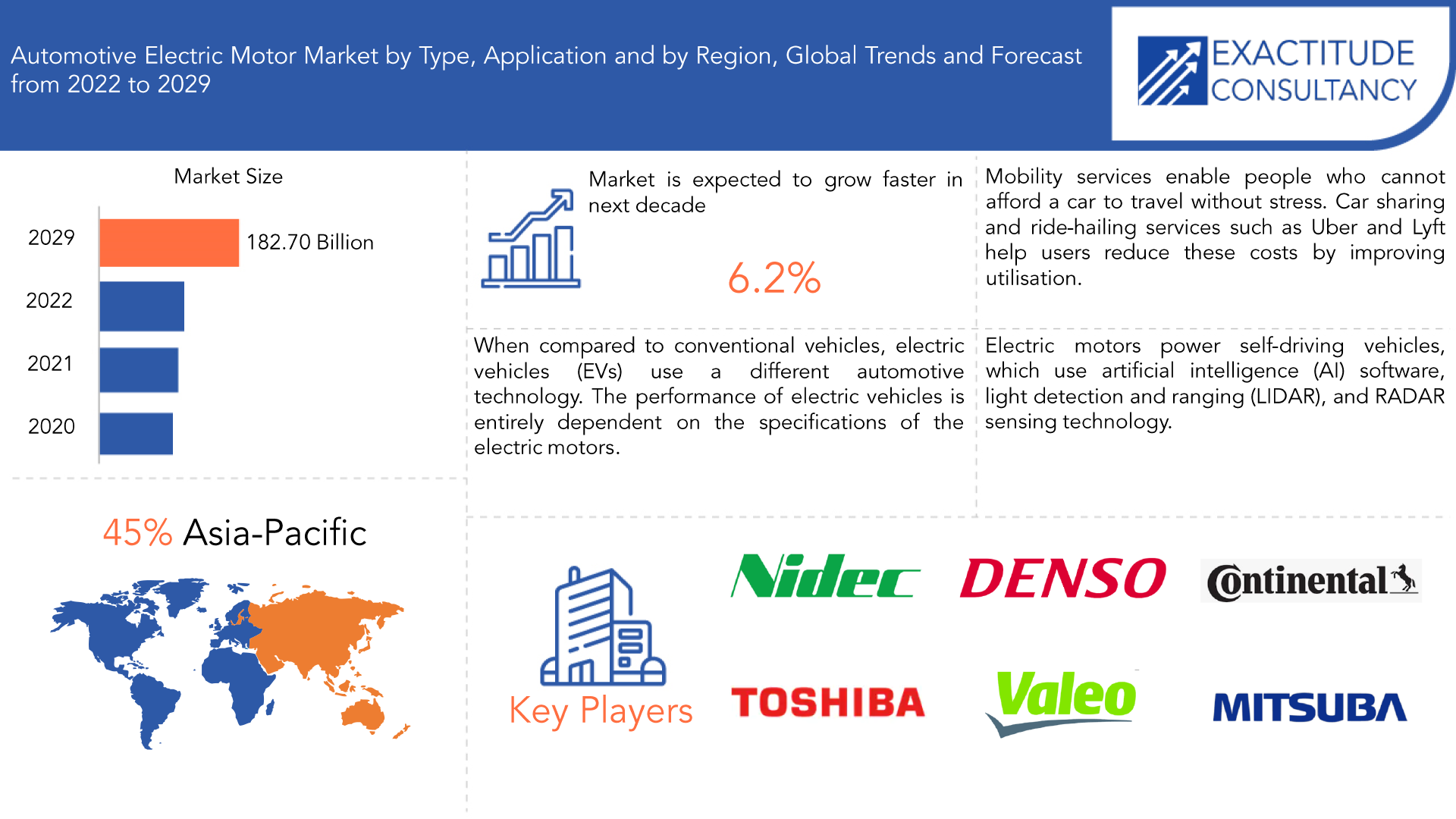
From 2022 to 2029, the global automotive electric motor market is expected to grow at a 6.5% CAGR from 106.3 USD Billion in 2020 to 182.7 USD Billion in 2029.
The market's expansion can be attributed to rising global demand for electric vehicles (EVs) and hybrid vehicles. Furthermore, stringent emission standards imposed by regulatory authorities are driving up demand for electric motors in automobiles.
Automotive electric motors are embedded devices in automobiles that operate on the electro-magnetic induction principle, converting electrical energy into mechanical energy. The growing global adoption of electric vehicles is driving the automotive electric motors market. The electric motors embedded in the automotive provide certain benefits such as longer operating life, low maintenance for fluctuating voltages, and low energy consumption. Electric motors can be integrated with controls and gearing, making them more suitable for use in automobiles.
| ATTRIBUTE | DETAILS |
| Study period | 2020-2029 |
| Base year | 2021 |
| Estimated year | 2022 |
| Forecasted year | 2022-2029 |
| Historical period | 2018-2020 |
| Unit | Value (USD Billion), (THOUSAND UNITS) |
| Segmentation | By Type, By Application, By Region |
| By Type |
|
| By Application |
|
| By Region |
|
The motor number is bound to rise with the rise of premium branded vehicles and the general trend for more comfort features in vehicles. Motors that are smaller, lighter, and more efficient, like most components, are in high demand. Brushless DC motors are increasingly being used in applications that require high efficiency, smoothness, and precise control.
Electric motors perform a variety of tasks that were previously performed by cranks, gears, and levers. Window-lifts, fuel pumps, mirror and headlamp adjusters, ABS, clutches, automated manual transmissions, parking brakes, and steering systems are examples of where they can be found. Although electric motors have long been used to power various vehicle components, new markets are emerging. Manufacturers anticipate that more DC electric motors will be used in automotive interiors in the future, as there is a general trend toward greater electrification.
Motors that run continuously, such as blowers, must also be highly efficient. Manufacturers report a growing demand for smaller, lighter motors to fit in the increasingly slim doors of modern vehicles. Manufacturers of wiper motors note that weight and size reductions, as well as improved exterior appearance, are priorities for windscreen washer systems. Brushless DC motor manufacturers are also attempting to develop smaller motors while maintaining power and speed.
Motors are essential vehicle components because they ensure that the vehicle operates smoothly. It is inherent in any vehicle process that involves continuous rotational motion. Power steering motors, seat cooling fans, battery cooling fans, power window motors, engine cooling fans, wiper system motors, and other applications all use motors. These motors are used in applications where passenger comfort is as important as the vehicle's ability to efficiently move the driver.
Several factors are driving the market's expansion, including an increase in vehicle production around the world, a high demand for safety and convenience features, and an increase in the demand for electric vehicles. The increased weight and cost of the overall system are expected to act as a barrier to market expansion. Furthermore, the proliferation of applications that use electric motors, as well as the introduction of the concept of autonomous vehicles, are expected to create numerous opportunities for market expansion.
COVID-19 is likely to reduce demand and profitability in the auto industry. The discovery of a new coronavirus strain at the end of 2019 has far-reaching consequences for the entire automotive industry. In the short term, demand for vehicles and, by extension, the parts that go into making them has dropped significantly, resulting in rapid declines in revenues and profits at most suppliers and OEMs.
[caption id="attachment_15569" align="aligncenter" width="1920"]
Frequently Asked Questions
• What is the worth of Automotive Electric motors market?
The Automotive Electric motors market size crossed USD 106.3 billion in 2020 and will observe a CAGR of more than 6.2% up to 2029.
• What is the size of the Asia-Pacific Automotive Electric motors industry?
Asia-Pacific held more than 45% of the Automotive Electric motors market revenue share in 2021 and will witness expansion in the forecast period.
• What are some of the market's driving forces?
Consumers in developed economies have a growing demand for improved convenience, safety, and comfort levels in automobiles. Significant demand for electric vehicles has emerged in recent years as the number of people concerned about the potentially devastating effects of climate change and the alarming levels of pollution recorded in the world’s major cities continues to rise.
• Which are the top companies to hold the market share in Automotive Electric motors market?
The automotive electric motors market key players include NIDEC Corporation, Mabuchi Motor, Mitsuba, ASMO, BorgWarner INC., Valeo, Denso Corporation, BOSCH, Mitsubichi Electric, Johnson Electric, Siemens AG, Continental AG, Toshiba Corporation.
• What is the leading Application of Automotive Electric motors market?
The Passenger car application of system segment of Automotive Electric motors market is the leading segment.
• Which is the largest regional market for Automotive Electric motors market?
The region's largest share is in Asia Pacific. Products manufactured in nations like China and South Korea that perform similarly and are inexpensively accessible to the general public have led to the product's increasing appeal. The market has expanded as a result of the material’s substantial uptake in nations like China, India, and Japan.
Automotive Electric Motor Market Segment Analysis
The automotive electric motors market is segmented based on Type, Application, and Region, Global trends and forecast.
By Type, the Automotive Electric Motor Market is segmented into Small automotive, Automotive Starter and generator, and NEV motor. Small automotive motors are used in a variety of applications, including power steering, power windows, sunroof actuators, and other motor-driven systems. Because of their small size, these motors are suitable for installation in automobile engine compartments. Automotive starters and generators are devices used to start an automobile's electric motor. It generates electrical energy by creating a magnetic field that rotates the armature inside the stator. The electrical energy is then transferred to the battery to be charged.
A Neighborhood Electric Vehicle (NEV) is a category in the United States for battery electric vehicles with a top speed of 25 miles per hour (40 km/h) and a maximum loaded weight of 3,000 lbs. (1,400 kg). A NEV battery pack is recharged by plugging it into a standard outlet, and because it is an all-electric vehicle, no tailpipe emissions are produced. Nevs do not emit greenhouse gases after they are manufactured if they are recharged using clean energy sources such as solar or wind power.
Passenger car applications dominates the global automotive electric motor market, accounting for more than 60% of total revenue. Because of rising demand for passenger cars in developing countries such as China, India, and Brazil, the segment is expected to maintain its dominance over the forecast period. Furthermore, rising passenger car sales in developed countries such as Germany and France are expected to boost segment growth during the forecast period.
Commercial vehicle application is expected to grow 2022 to 2029, owing to rising demand for commercial vehicles in developing countries such as China and India due to increased industrialization and improved infrastructure facilities, resulting in increased production units per capita, which will boost commercial vehicle sales, eventually leading to an increase in electric motors used across various applications such as trucks, buses, and construction equipment.
[caption id="attachment_15575" align="aligncenter" width="1920"]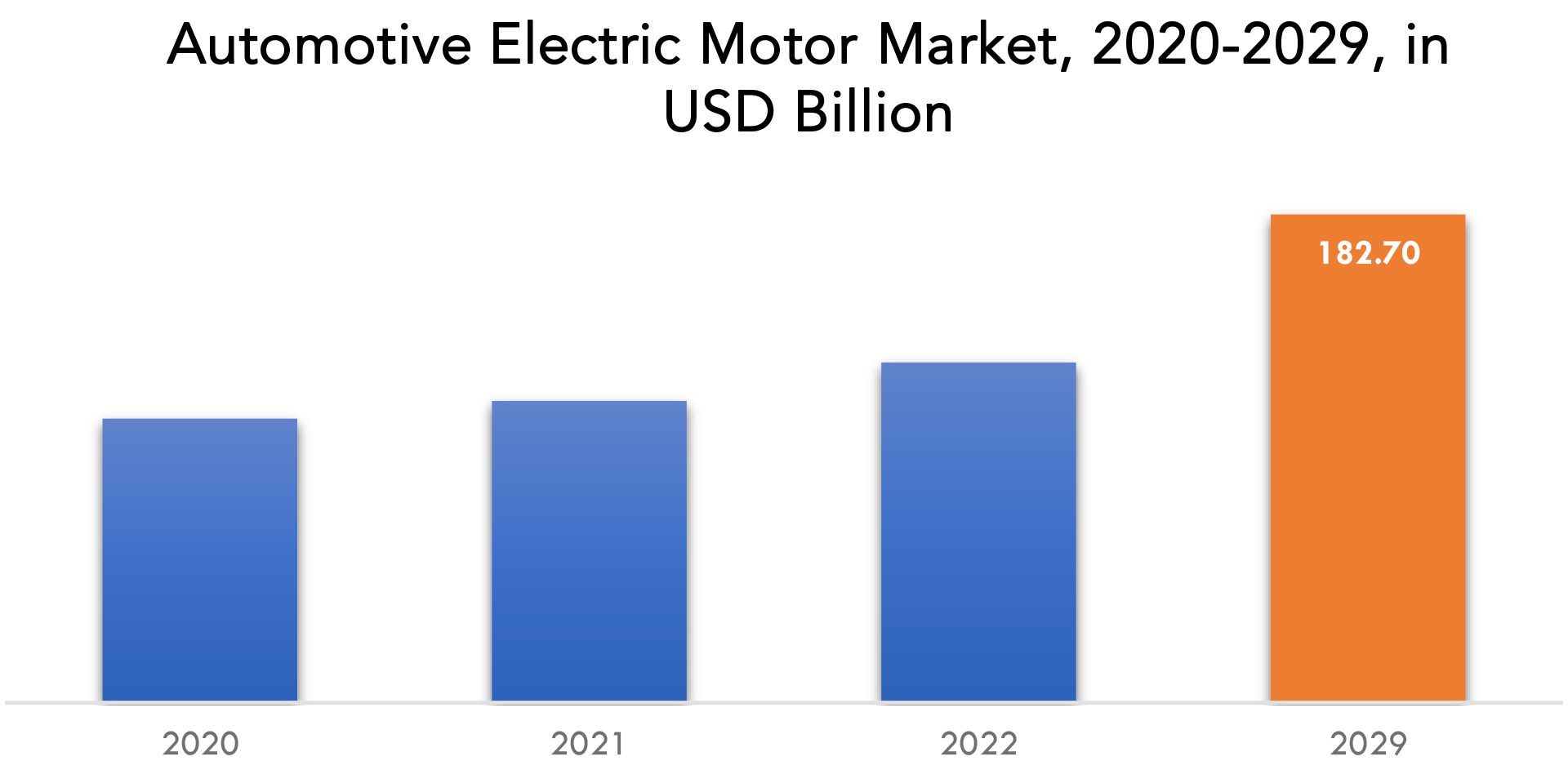
Automotive Electric Motor Market Players
The automotive electric motors market key players include NIDEC Corporation, Mabuchi Motor, Mitsuba, ASMO, BorgWarner INC., Valeo, Denso Corporation, BOSCH, Mitsubichi Electric, Johnson Electric, Siemens AG, Continental AG, Toshiba Corporation.
Recent Developments (April. 13, 2022) – DENSO Corporation announced it is providing key electrification components to Toyota and Subaru’s all-new, all-electric bZ4X and SOLTERRA, scheduled to be released in May 12, 2022 and mid-2022 respectively. DENSO products help the battery electric vehicle (BEV) go farther, charge faster, optimize battery use, and most importantly, perform better. 27 October, 2022: BorgWarner to Supply Electric Motors for E-Axles of European Commercial Vehicle OEM. BorgWarner electric motor will power e-axle for light duty commercial trucks. This e-axle is designed to equip new electric light commercial trucks ranging up to 7.5 tons as well as conversions of existing internal combustion engine powered fleets of city center delivery vehicles. Production is expected to begin early 2023. 13 September, 2022: BorgWarner Presents New Products for the Aftermarket at Automechanika Frankfurt 2022. Joint booth for BorgWarner’s aftermarket brands: BorgWarner Aftermarket and Delphi Technologies present new products and future market opportunities. Product highlights include Dual Clutch Modules and High Voltage Coolant Heater as well as light-weight bi-metallic brake discs and a repair program for Euro 6 heavy-duty vehicle diesel injectorsWho Should Buy? Or Key stakeholders
- Automotive Electric Motor Suppliers
- Automotive Electric Motor Distributer
- Raw Materials Manufacturers
- Industrial sector
- End Users
- Research Organizations
- Investment bankers and Consultants
- Government
- Regulatory Authorities
Automotive Electric Motor Market Regional Analysis
The Automotive Electric Motor market by region includes North America, Asia-Pacific (APAC), Europe, South America, and Middle East & Africa (MEA).
- North America: includes the US, Canada, Mexico
- Asia Pacific: includes China, Japan, South Korea, India, Australia, ASEAN and Rest of APAC
- Europe: includes UK, Germany, France, Italy, Spain, Russia, and Rest of Europe
- South America: includes Brazil, Argentina and Rest of South America
- Middle East & Africa: includes Turkey, UAE, Saudi Arabia, South Africa, and Rest of MEA
Because of rising demand for automobiles in China and India, Asia Pacific is expected to have the highest CAGR of 7% from 2022 to 2029. It is expected to dominate the automotive electric motors market as a result of the region's manufacturing industries, including automotive manufacturers. Furthermore, favourable government regulations aimed at encouraging the use of electric vehicles are expected to boost regional growth over the forecast period.
Europe accounted for a significant share of revenue in 2021 and is expected to grow moderately during the forecast period due to declining sales volume as a result of stringent emission norms enforced by governments in countries such as Germany, France, Italy, and the United Kingdom, which negatively impacted industry revenues by around USD billion in 2020. (excluding taxes). The constant advancement of the automobile manufacturing sector, as well as the increasing emphasis on the adoption of energy efficient electric motors in various automotive in the region, are expected to contribute to the region's automotive electric motors market growth. Developed nations such as North America and Europe are becoming more aware of the importance of using efficient electric motors in automotive and have increased their adoption of electric motors due to increased energy efficiency and low electric motor costs.Asia Pacific, Europe, and North America held a large market share in 2020 and are experiencing rising demand for the product. These are the most important markets for high-efficiency motors, which are used in HVAC, industrial applications, and electric vehicles. Growth opportunities for the market in Latin America, the Middle East, and Africa are expected to increase soon as government funding increases. Rising demand for motors in the oil and gas industry, rapid development in the mining industry, and significant demand for cement in the construction industry benefit the market in these regions.
[caption id="attachment_15576" align="aligncenter" width="1920"]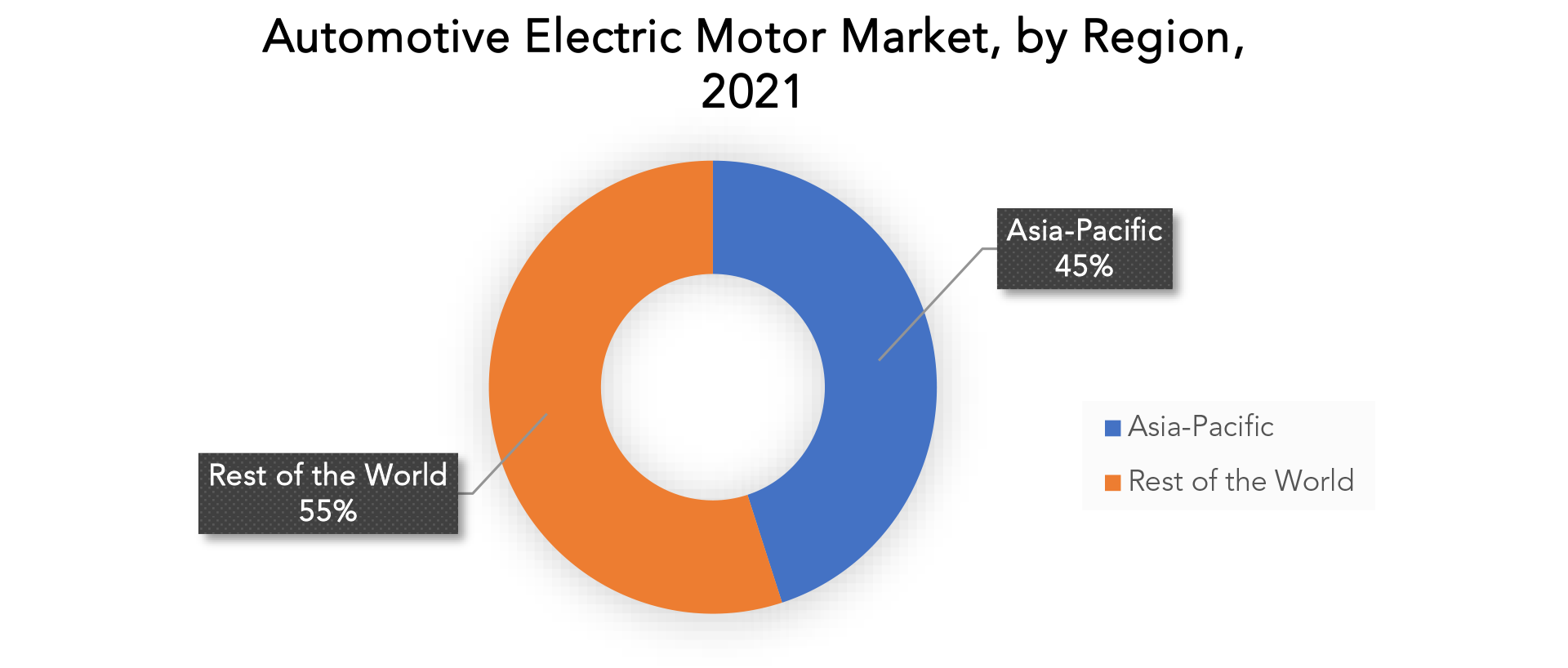
Key Market Segments: Automotive Electric Motors Market
Automotive Electric Motor Market by Type, 2020-2029, (USD Billion), (Thousand Units)- Small Automotive Motor
- Automotive Starter And Generator
- Nev Motor
- Passenger Car
- Commercial Vehicle
- New Energy Vehicle (NEV)
- North America
- Asia Pacific
- Europe
- South America
- Middle East And Africa
Key Question Answered
- What is automotive electric motor technology?
- What are the potential applications of electric motors in automotive technology?
- What are the key factors influencing the growth of Automotive Electric motors during 2019-2029?
- What is the role of autonomous vehicles and electric vehicle in the growth of electric motors?
- Who are the major key players in the Automotive Electric motors market?
- Which region will provide more business opportunities Automotive Electric motors in future?
- Which segment holds the maximum share of the Automotive Electric motors market?
- INTRODUCTION
- MARKET DEFINITION
- MARKET SEGMENTATION
- RESEARCH TIMELINES
- ASSUMPTIONS AND LIMITATIONS
- RESEARCH METHODOLOGY
- DATA MINING
- SECONDARY RESEARCH
- PRIMARY RESEARCH
- SUBJECT-MATTER EXPERTS’ ADVICE
- QUALITY CHECKS
- FINAL REVIEW
- DATA TRIANGULATION
- BOTTOM-UP APPROACH
- TOP-DOWN APPROACH
- RESEARCH FLOW
- DATA SOURCES
- DATA MINING
- EXECUTIVE SUMMARY
- MARKET OVERVIEW
- GLOBAL AUTOMOTIVE ELECTRIC MOTOR OUTLOOK
- MARKET DRIVERS
- MARKET RESTRAINTS
- MARKET OPPORTUNITIES
- IMPACT OF COVID-19 ON AUTOMOTIVE ELECTRIC MOTOR MARKET
- PORTER’S FIVE FORCES MODEL
- THREAT FROM NEW ENTRANTS
- THREAT FROM SUBSTITUTES
- BARGAINING POWER OF SUPPLIERS
- BARGAINING POWER OF CUSTOMERS
- DEGREE OF COMPETITION
- INDUSTRY VALUE CHAIN ANALYSIS
- GLOBAL AUTOMOTIVE ELECTRIC MOTOR OUTLOOK
- GLOBAL AUTOMOTIVE ELECTRIC MOTOR MARKET BY TYPE (USD BILLION, THOUSAND UNITS), 2020-2029
- SMALL AUTOMOTIVE MOTOR
- AUTOMOTIVE STARTER AND GENERATOR
- NEV MOTOR
- GLOBAL AUTOMOTIVE ELECTRIC MOTOR MARKET BY APPLICATION (USD BILLION, THOUSAND UNITS), 2020-2029
- PASSENGER CAR
- COMMERCIAL VEHICLE
- NEW ENERGY VEHICLE (NEV)
- GLOBAL AUTOMOTIVE ELECTRIC MOTOR MARKET BY REGION (USD BILLION, THOUSAND UNITS), 2020-2029
- NORTH AMERICA
- US
- CANADA
- MEXICO
- SOUTH AMERICA
- BRAZIL
- ARGENTINA
- COLOMBIA
- REST OF SOUTH AMERICA
- EUROPE
- GERMANY
- UK
- FRANCE
- ITALY
- SPAIN
- RUSSIA
- REST OF EUROPE
- ASIA PACIFIC
- INDIA
- CHINA
- JAPAN
- SOUTH KOREA
- AUSTRALIA
- SOUTH-EAST ASIA
- REST OF ASIA PACIFIC
- MIDDLE EAST AND AFRICA
- UAE
- SAUDI ARABIA
- SOUTH AFRICA
- REST OF MIDDLE EAST AND AFRICA
- NORTH AMERICA
- COMPANY PROFILES* (BUSINESS OVERVIEW, COMPANY SNAPSHOT, PRODUCTS OFFERED, RECENT DEVELOPMENTS)
- NIDEC CORPORATION
- MABUCHI MOTOR
- MITSUBA
- ASMO
- BORGWARNER INC.
- VALEO
- DENSO CORPORATION
- BOSCH
- MITSUBICHI ELECTRIC
- JOHNSON ELECTRIC
- SIEMENS AG
- CONTINENTAL AG
- TOSHIBA CORPORATION *THE COMPANY LIST IS INDICATIVE
LIST OF TABLES
TABLE 1 GLOBAL AUTOMOTIVE ELECTRIC MOTOR MARKET BY TYPE (USD BILLION), 2020-2029
TABLE 2 GLOBAL AUTOMOTIVE ELECTRIC MOTOR MARKET BY TYPE (THOUSAND UNITS), 2020-2029
TABLE 3 GLOBAL AUTOMOTIVE ELECTRIC MOTOR MARKET BY APPLICATION (USD BILLION), 2020-2029
TABLE 4 GLOBAL AUTOMOTIVE ELECTRIC MOTOR MARKET BY APPLICATION (THOUSAND UNITS), 2020-2029
TABLE 5 GLOBAL AUTOMOTIVE ELECTRIC MOTOR MARKET BY REGION (USD BILLION), 2020-2029
TABLE 6 GLOBAL AUTOMOTIVE ELECTRIC MOTOR MARKET BY REGION (THOUSAND UNITS), 2020-2029
TABLE 7 NORTH AMERICA AUTOMOTIVE ELECTRIC MOTOR MARKET BY TYPE (USD BILLION), 2020-2029
TABLE 8 NORTH AMERICA AUTOMOTIVE ELECTRIC MOTOR MARKET BY TYPE (THOUSAND UNITS), 2020-2029
TABLE 9 NORTH AMERICA AUTOMOTIVE ELECTRIC MOTOR MARKET BY APPLICATION (USD BILLION), 2020-2029
TABLE 10 NORTH AMERICA AUTOMOTIVE ELECTRIC MOTOR MARKET BY APPLICATION (THOUSAND UNITS), 2020-2029
TABLE 11 NORTH AMERICA AUTOMOTIVE ELECTRIC MOTOR MARKET BY COUNTRY (USD BILLION), 2020-2029
TABLE 12 NORTH AMERICA AUTOMOTIVE ELECTRIC MOTOR MARKET BY COUNTRY (THOUSAND UNITS), 2020-2029
TABLE 13 US AUTOMOTIVE ELECTRIC MOTOR MARKET BY TYPE (USD BILLION), 2020-2029
TABLE 14 US AUTOMOTIVE ELECTRIC MOTOR MARKET BY TYPE (THOUSAND UNITS), 2020-2029
TABLE 15 US AUTOMOTIVE ELECTRIC MOTOR MARKET BY APPLICATION (USD BILLION), 2020-2029
TABLE 16 US AUTOMOTIVE ELECTRIC MOTOR MARKET BY APPLICATION (THOUSAND UNITS), 2020-2029
TABLE 17 CANADA AUTOMOTIVE ELECTRIC MOTOR MARKET BY TYPE (BILLION), 2020-2029
TABLE 18 CANADA AUTOMOTIVE ELECTRIC MOTOR MARKET BY TYPE (THOUSAND UNITS), 2020-2029
TABLE 19 CANADA AUTOMOTIVE ELECTRIC MOTOR MARKET BY APPLICATION (USD BILLION), 2020-2029
TABLE 20 CANADA AUTOMOTIVE ELECTRIC MOTOR MARKET BY APPLICATION (THOUSAND UNITS), 2020-2029
TABLE 21 MEXICO AUTOMOTIVE ELECTRIC MOTOR MARKET BY TYPE (USD BILLION), 2020-2029
TABLE 22 MEXICO AUTOMOTIVE ELECTRIC MOTOR MARKET BY TYPE (THOUSAND UNITS), 2020-2029
TABLE 23 MEXICO AUTOMOTIVE ELECTRIC MOTOR MARKET BY APPLICATION (USD BILLION), 2020-2029
TABLE 24 MEXICO AUTOMOTIVE ELECTRIC MOTOR MARKET BY APPLICATION (THOUSAND UNITS), 2020-2029
TABLE 25 SOUTH AMERICA AUTOMOTIVE ELECTRIC MOTOR MARKET BY TYPE (USD BILLION), 2020-2029
TABLE 26 SOUTH AMERICA AUTOMOTIVE ELECTRIC MOTOR MARKET BY TYPE (THOUSAND UNITS), 2020-2029
TABLE 27 SOUTH AMERICA AUTOMOTIVE ELECTRIC MOTOR MARKET BY APPLICATION (USD BILLION), 2020-2029
TABLE 28 SOUTH AMERICA AUTOMOTIVE ELECTRIC MOTOR MARKET BY APPLICATION (THOUSAND UNITS), 2020-2029
TABLE 29 SOUTH AMERICA AUTOMOTIVE ELECTRIC MOTOR MARKET BY COUNTRY (USD BILLION), 2020-2029
TABLE 30 SOUTH AMERICA AUTOMOTIVE ELECTRIC MOTOR MARKET BY COUNTRY (THOUSAND UNITS), 2020-2029
TABLE 31 BRAZIL AUTOMOTIVE ELECTRIC MOTOR MARKET BY TYPE (USD BILLION), 2020-2029
TABLE 32 BRAZIL AUTOMOTIVE ELECTRIC MOTOR MARKET BY TYPE (THOUSAND UNITS), 2020-2029
TABLE 33 BRAZIL AUTOMOTIVE ELECTRIC MOTOR MARKET BY APPLICATION (USD BILLION), 2020-2029
TABLE 34 BRAZIL AUTOMOTIVE ELECTRIC MOTOR MARKET BY APPLICATION (THOUSAND UNITS), 2020-2029
TABLE 35 ARGENTINA AUTOMOTIVE ELECTRIC MOTOR MARKET BY TYPE (USD BILLION), 2020-2029
TABLE 36 ARGENTINA AUTOMOTIVE ELECTRIC MOTOR MARKET BY TYPE (THOUSAND UNITS), 2020-2029
TABLE 37 ARGENTINA AUTOMOTIVE ELECTRIC MOTOR MARKET BY APPLICATION (USD BILLION), 2020-2029
TABLE 38 ARGENTINA AUTOMOTIVE ELECTRIC MOTOR MARKET BY APPLICATION (THOUSAND UNITS), 2020-2029
TABLE 39 COLOMBIA AUTOMOTIVE ELECTRIC MOTOR MARKET BY TYPE (USD BILLION), 2020-2029
TABLE 40 COLOMBIA AUTOMOTIVE ELECTRIC MOTOR MARKET BY TYPE (THOUSAND UNITS), 2020-2029
TABLE 41 COLOMBIA AUTOMOTIVE ELECTRIC MOTOR MARKET BY APPLICATION (USD BILLION), 2020-2029
TABLE 42 COLOMBIA AUTOMOTIVE ELECTRIC MOTOR MARKET BY APPLICATION (THOUSAND UNITS), 2020-2029
TABLE 43 REST OF SOUTH AMERICA AUTOMOTIVE ELECTRIC MOTOR MARKET BY TYPE (USD BILLION), 2020-2029
TABLE 44 REST OF SOUTH AMERICA AUTOMOTIVE ELECTRIC MOTOR MARKET BY TYPE (THOUSAND UNITS), 2020-2029
TABLE 45 REST OF SOUTH AMERICA AUTOMOTIVE ELECTRIC MOTOR MARKET BY APPLICATION (USD BILLION), 2020-2029
TABLE 46 REST OF SOUTH AMERICA AUTOMOTIVE ELECTRIC MOTOR MARKET BY APPLICATION (THOUSAND UNITS), 2020-2029
TABLE 47 ASIA-PACIFIC AUTOMOTIVE ELECTRIC MOTOR MARKET BY TYPE (USD BILLION), 2020-2029
TABLE 48 ASIA-PACIFIC AUTOMOTIVE ELECTRIC MOTOR MARKET BY TYPE (THOUSAND UNITS), 2020-2029
TABLE 49 ASIA-PACIFIC AUTOMOTIVE ELECTRIC MOTOR MARKET BY APPLICATION (USD BILLION), 2020-2029
TABLE 50 ASIA-PACIFIC AUTOMOTIVE ELECTRIC MOTOR MARKET BY APPLICATION (THOUSAND UNITS), 2020-2029
TABLE 51 ASIA-PACIFIC AUTOMOTIVE ELECTRIC MOTOR MARKET BY COUNTRY (USD BILLION), 2020-2029
TABLE 52 ASIA-PACIFIC AUTOMOTIVE ELECTRIC MOTOR MARKET BY COUNTRY (THOUSAND UNITS), 2020-2029
TABLE 53 INDIA AUTOMOTIVE ELECTRIC MOTOR MARKET BY TYPE (USD BILLION), 2020-2029
TABLE 54 INDIA AUTOMOTIVE ELECTRIC MOTOR MARKET BY TYPE (THOUSAND UNITS), 2020-2029
TABLE 55 INDIA AUTOMOTIVE ELECTRIC MOTOR MARKET BY APPLICATION (USD BILLION), 2020-2029
TABLE 56 INDIA AUTOMOTIVE ELECTRIC MOTOR MARKET BY APPLICATION (THOUSAND UNITS), 2020-2029
TABLE 57 CHINA AUTOMOTIVE ELECTRIC MOTOR MARKET BY TYPE (USD BILLION), 2020-2029
TABLE 58 CHINA AUTOMOTIVE ELECTRIC MOTOR MARKET BY TYPE (THOUSAND UNITS), 2020-2029
TABLE 59 CHINA AUTOMOTIVE ELECTRIC MOTOR MARKET BY APPLICATION (USD BILLION), 2020-2029
TABLE 60 CHINA AUTOMOTIVE ELECTRIC MOTOR MARKET BY APPLICATION (THOUSAND UNITS), 2020-2029
TABLE 61 JAPAN AUTOMOTIVE ELECTRIC MOTOR MARKET BY TYPE (USD BILLION), 2020-2029
TABLE 62 JAPAN AUTOMOTIVE ELECTRIC MOTOR MARKET BY TYPE (THOUSAND UNITS), 2020-2029
TABLE 63 JAPAN AUTOMOTIVE ELECTRIC MOTOR MARKET BY APPLICATION (USD BILLION), 2020-2029
TABLE 64 JAPAN AUTOMOTIVE ELECTRIC MOTOR MARKET BY APPLICATION (THOUSAND UNITS), 2020-2029
TABLE 65 SOUTH KOREA AUTOMOTIVE ELECTRIC MOTOR MARKET BY TYPE (USD BILLION), 2020-2029
TABLE 66 SOUTH KOREA AUTOMOTIVE ELECTRIC MOTOR MARKET BY TYPE (THOUSAND UNITS), 2020-2029
TABLE 67 SOUTH KOREA AUTOMOTIVE ELECTRIC MOTOR MARKET BY APPLICATION (USD BILLION), 2020-2029
TABLE 68 SOUTH KOREA AUTOMOTIVE ELECTRIC MOTOR MARKET BY APPLICATION (THOUSAND UNITS), 2020-2029
TABLE 69 AUSTRALIA AUTOMOTIVE ELECTRIC MOTOR MARKET BY TYPE (USD BILLION), 2020-2029
TABLE 70 AUSTRALIA AUTOMOTIVE ELECTRIC MOTOR MARKET BY TYPE (THOUSAND UNITS), 2020-2029
TABLE 71 AUSTRALIA AUTOMOTIVE ELECTRIC MOTOR MARKET BY APPLICATION (USD BILLION), 2020-2029
TABLE 72 AUSTRALIA AUTOMOTIVE ELECTRIC MOTOR MARKET BY APPLICATION (THOUSAND UNITS), 2020-2029
TABLE 73 SOUTH EAST ASIA AUTOMOTIVE ELECTRIC MOTOR MARKET BY TYPE (USD BILLION), 2020-2029
TABLE 74 SOUTH EAST ASIA AUTOMOTIVE ELECTRIC MOTOR MARKET BY TYPE (THOUSAND UNITS), 2020-2029
TABLE 75 SOUTH EAST ASIA AUTOMOTIVE ELECTRIC MOTOR MARKET BY APPLICATION (USD BILLION), 2020-2029
TABLE 76 SOUTH EAST ASIA AUTOMOTIVE ELECTRIC MOTOR MARKET BY APPLICATION (THOUSAND UNITS), 2020-2029
TABLE 77 REST OF ASIA PACIFIC AUTOMOTIVE ELECTRIC MOTOR MARKET BY TYPE (USD BILLION), 2020-2029
TABLE 78 REST OF ASIA PACIFIC AUTOMOTIVE ELECTRIC MOTOR MARKET BY TYPE (THOUSAND UNITS), 2020-2029
TABLE 79 REST OF ASIA PACIFIC AUTOMOTIVE ELECTRIC MOTOR MARKET BY APPLICATION (USD BILLION), 2020-2029
TABLE 80 REST OF ASIA PACIFIC AUTOMOTIVE ELECTRIC MOTOR MARKET BY APPLICATION (THOUSAND UNITS), 2020-2029
TABLE 81 EUROPE AUTOMOTIVE ELECTRIC MOTOR MARKET BY TYPE (USD BILLION), 2020-2029
TABLE 82 EUROPE AUTOMOTIVE ELECTRIC MOTOR MARKET BY TYPE (THOUSAND UNITS), 2020-2029
TABLE 83 EUROPE AUTOMOTIVE ELECTRIC MOTOR MARKET BY APPLICATION (USD BILLION), 2020-2029
TABLE 84 EUROPE AUTOMOTIVE ELECTRIC MOTOR MARKET BY APPLICATION (THOUSAND UNITS), 2020-2029
TABLE 85 EUROPE AUTOMOTIVE ELECTRIC MOTOR MARKET BY COUNTRY (USD BILLION), 2020-2029
TABLE 86 EUROPE AUTOMOTIVE ELECTRIC MOTOR MARKET BY COUNTRY (THOUSAND UNITS), 2020-2029
TABLE 87 GERMANY AUTOMOTIVE ELECTRIC MOTOR MARKET BY TYPE (USD BILLION), 2020-2029
TABLE 88 GERMANY AUTOMOTIVE ELECTRIC MOTOR MARKET BY TYPE (THOUSAND UNITS), 2020-2029
TABLE 89 GERMANY AUTOMOTIVE ELECTRIC MOTOR MARKET BY APPLICATION (USD BILLION), 2020-2029
TABLE 90 GERMANY AUTOMOTIVE ELECTRIC MOTOR MARKET BY APPLICATION (THOUSAND UNITS), 2020-2029
TABLE 91 UK AUTOMOTIVE ELECTRIC MOTOR MARKET BY TYPE (USD BILLION), 2020-2029
TABLE 92 UK AUTOMOTIVE ELECTRIC MOTOR MARKET BY TYPE (THOUSAND UNITS), 2020-2029
TABLE 93 UK AUTOMOTIVE ELECTRIC MOTOR MARKET BY APPLICATION (USD BILLION), 2020-2029
TABLE 94 UK AUTOMOTIVE ELECTRIC MOTOR MARKET BY APPLICATION (THOUSAND UNITS), 2020-2029
TABLE 95 FRANCE AUTOMOTIVE ELECTRIC MOTOR MARKET BY TYPE (USD BILLION), 2020-2029
TABLE 96 FRANCE AUTOMOTIVE ELECTRIC MOTOR MARKET BY TYPE (THOUSAND UNITS), 2020-2029
TABLE 97 FRANCE AUTOMOTIVE ELECTRIC MOTOR MARKET BY APPLICATION (USD BILLION), 2020-2029
TABLE 98 FRANCE AUTOMOTIVE ELECTRIC MOTOR MARKET BY APPLICATION (THOUSAND UNITS), 2020-2029
TABLE 99 ITALY AUTOMOTIVE ELECTRIC MOTOR MARKET BY TYPE (USD BILLION), 2020-2029
TABLE 100 ITALY AUTOMOTIVE ELECTRIC MOTOR MARKET BY TYPE (THOUSAND UNITS), 2020-2029
TABLE 101 ITALY AUTOMOTIVE ELECTRIC MOTOR MARKET BY APPLICATION (USD BILLION), 2020-2029
TABLE 102 ITALY AUTOMOTIVE ELECTRIC MOTOR MARKET BY APPLICATION (THOUSAND UNITS), 2020-2029
TABLE 103 SPAIN AUTOMOTIVE ELECTRIC MOTOR MARKET BY TYPE (USD BILLION), 2020-2029
TABLE 104 SPAIN AUTOMOTIVE ELECTRIC MOTOR MARKET BY TYPE (THOUSAND UNITS), 2020-2029
TABLE 105 SPAIN AUTOMOTIVE ELECTRIC MOTOR MARKET BY APPLICATION (USD BILLION), 2020-2029
TABLE 106 SPAIN AUTOMOTIVE ELECTRIC MOTOR MARKET BY APPLICATION (THOUSAND UNITS), 2020-2029
TABLE 107 RUSSIA AUTOMOTIVE ELECTRIC MOTOR MARKET BY TYPE (USD BILLION), 2020-2029
TABLE 108 RUSSIA AUTOMOTIVE ELECTRIC MOTOR MARKET BY TYPE (THOUSAND UNITS), 2020-2029
TABLE 109 RUSSIA AUTOMOTIVE ELECTRIC MOTOR MARKET BY APPLICATION (USD BILLION), 2020-2029
TABLE 110 RUSSIA AUTOMOTIVE ELECTRIC MOTOR MARKET BY APPLICATION (THOUSAND UNITS), 2020-2029
TABLE 111 REST OF EUROPE AUTOMOTIVE ELECTRIC MOTOR MARKET BY TYPE (USD BILLION), 2020-2029
TABLE 112 REST OF EUROPE AUTOMOTIVE ELECTRIC MOTOR MARKET BY TYPE (THOUSAND UNITS), 2020-2029
TABLE 113 REST OF EUROPE AUTOMOTIVE ELECTRIC MOTOR MARKET BY APPLICATION (USD BILLION), 2020-2029
TABLE 114 REST OF EUROPE AUTOMOTIVE ELECTRIC MOTOR MARKET BY APPLICATION (THOUSAND UNITS), 2020-2029
TABLE 115 MIDDLE EAST AND AFRICA AUTOMOTIVE ELECTRIC MOTOR MARKET BY TYPE (USD BILLION), 2020-2029
TABLE 116 MIDDLE EAST AND AFRICA AUTOMOTIVE ELECTRIC MOTOR MARKET BY TYPE (THOUSAND UNITS), 2020-2029
TABLE 117 MIDDLE EAST AND AFRICA AUTOMOTIVE ELECTRIC MOTOR MARKET BY APPLICATION (USD BILLION), 2020-2029
TABLE 118 MIDDLE EAST AND AFRICA AUTOMOTIVE ELECTRIC MOTOR MARKET BY APPLICATION (THOUSAND UNITS), 2020-2029
TABLE 119 MIDDLE EAST AND AFRICA AUTOMOTIVE ELECTRIC MOTOR MARKET BY COUNTRY (USD BILLION), 2020-2029
TABLE 120 MIDDLE EAST AND AFRICA AUTOMOTIVE ELECTRIC MOTOR MARKET BY COUNTRY (THOUSAND UNITS), 2020-2029
TABLE 121 UAE AUTOMOTIVE ELECTRIC MOTOR MARKET BY TYPE (USD BILLION), 2020-2029
TABLE 122 UAE AUTOMOTIVE ELECTRIC MOTOR MARKET BY TYPE (THOUSAND UNITS), 2020-2029
TABLE 123 UAE AUTOMOTIVE ELECTRIC MOTOR MARKET BY APPLICATION (USD BILLION), 2020-2029
TABLE 124 UAE AUTOMOTIVE ELECTRIC MOTOR MARKET BY APPLICATION (THOUSAND UNITS), 2020-2029
TABLE 125 SAUDI ARABIA AUTOMOTIVE ELECTRIC MOTOR MARKET BY TYPE (USD BILLION), 2020-2029
TABLE 126 SAUDI ARABIA AUTOMOTIVE ELECTRIC MOTOR MARKET BY TYPE (THOUSAND UNITS), 2020-2029
TABLE 127 SAUDI ARABIA AUTOMOTIVE ELECTRIC MOTOR MARKET BY APPLICATION (USD BILLION), 2020-2029
TABLE 128 SAUDI ARABIA AUTOMOTIVE ELECTRIC MOTOR MARKET BY APPLICATION (THOUSAND UNITS), 2020-2029
TABLE 129 SOUTH AFRICA AUTOMOTIVE ELECTRIC MOTOR MARKET BY TYPE (USD BILLION), 2020-2029
TABLE 130 SOUTH AFRICA AUTOMOTIVE ELECTRIC MOTOR MARKET BY TYPE (THOUSAND UNITS), 2020-2029
TABLE 131 SOUTH AFRICA AUTOMOTIVE ELECTRIC MOTOR MARKET BY APPLICATION (USD BILLION), 2020-2029
TABLE 132 SOUTH AFRICA AUTOMOTIVE ELECTRIC MOTOR MARKET BY APPLICATION (THOUSAND UNITS), 2020-2029
TABLE 133 REST OF MIDDLE EAST AND AFRICA AUTOMOTIVE ELECTRIC MOTOR MARKET BY TYPE (USD BILLION), 2020-2029
TABLE 134 REST OF MIDDLE EAST AND AFRICA AUTOMOTIVE ELECTRIC MOTOR MARKET BY TYPE (THOUSAND UNITS), 2020-2029
TABLE 135 REST OF MIDDLE EAST AND AFRICA AUTOMOTIVE ELECTRIC MOTOR MARKET BY APPLICATION (USD BILLION), 2020-2029
TABLE 136 REST OF MIDDLE EAST AND AFRICA AUTOMOTIVE ELECTRIC MOTOR MARKET BY APPLICATION (THOUSAND UNITS), 2020-2029
LIST OF FIGURES
FIGURE 1 MARKET DYNAMICS
FIGURE 2 MARKET SEGMENTATION
FIGURE 3 REPORT TIMELINES: YEARS CONSIDERED
FIGURE 4 DATA TRIANGULATION
FIGURE 5 BOTTOM-UP APPROACH
FIGURE 6 TOP-DOWN APPROACH
FIGURE 7 RESEARCH FLOW
FIGURE 8 GLOBAL AUTOMOTIVE ELECTRIC MOTOR BY TYPE, USD BILLION, 2020-2029
FIGURE 9 GLOBAL AUTOMOTIVE ELECTRIC MOTOR BY APPLICATION, USD BILLION, 2020-2029
FIGURE 10 GLOBAL AUTOMOTIVE ELECTRIC MOTOR BY REGION, USD BILLION, 2020-2029
FIGURE 11 PORTER’S FIVE FORCES MODEL
FIGURE 12 GLOBAL AUTOMOTIVE ELECTRIC MOTOR BY TYPE, USD BILLION, 2021
FIGURE 13 GLOBAL AUTOMOTIVE ELECTRIC MOTOR BY APPLICATION, USD BILLION, 2021
FIGURE 14 GLOBAL AUTOMOTIVE ELECTRIC MOTOR BY REGION, USD BILLION, 2021
FIGURE 15 MARKET SHARE ANALYSIS
FIGURE 16 NIDEC CORPORATION: COMPANY SNAPSHOT
FIGURE 17 MABUCHI MOTOR: COMPANY SNAPSHOT
FIGURE 18 MITSUBA: COMPANY SNAPSHOT
FIGURE 19 ASMO: COMPANY SNAPSHOT
FIGURE 20 BORGWARNER INC.: COMPANY SNAPSHOT
FIGURE 21 VALEO: COMPANY SNAPSHOT
FIGURE 22 DENSO CORPORATION: COMPANY SNAPSHOT
FIGURE 23 BOSCH: COMPANY SNAPSHOT
FIGURE 24 MITSUBICHI ELECTRIC: COMPANY SNAPSHOT
FIGURE 25 JOHNSON ELECTRIC: COMPANY SNAPSHOT
FIGURE 26 SIEMENS AG: COMPANY SNAPSHOT
FIGURE 27 CONTINENTAL AG: COMPANY SNAPSHOT
FIGURE 28 TOSHIBA CORPORATION: COMPANY SNAPSHOT
DOWNLOAD FREE SAMPLE REPORT
License Type
SPEAK WITH OUR ANALYST
Want to know more about the report or any specific requirement?
WANT TO CUSTOMIZE THE REPORT?
Our Clients Speak
We asked them to research ‘ Equipment market’ all over the world, and their whole arrangement was helpful to us. thehealthanalytics.com insightful analysis and reports contributed to our current analysis and in creating a future strategy. Besides, the te
Yosuke Mitsui
Senior Associate Construction Equipment Sales & Marketing
We asked them to research ‘Equipment market’ all over the world, and their whole arrangement was helpful to us. thehealthanalytics.com insightful analysis and reports contributed to our current analysis and in creating a future strategy. Besides, the te