

Base Year Value ()
x.x %
x.x %
CAGR ()
x.x %
x.x %
Forecast Year Value ()
x.x %
x.x %
Historical Data Period
Largest Region
Forecast Period
Membranes Market by Material (Polymeric, Ceramic) by Technology (RO, MF, UF, NF), by Application (Water & Wastewater Treatment, Industrial Processing, Food & Beverages, Pharmaceutical), and Region, Global Trends and Forecast From 2022 To 2029
Instant access to hundreds of data points and trends
- Market estimates from 2014-2029
- Competitive analysis, industry segmentation, financial benchmarks
- Incorporates SWOT, Porter's Five Forces and risk management frameworks
- PDF report or online database with Word, Excel and PowerPoint export options
- 100% money back guarantee
Membranes Market Overview
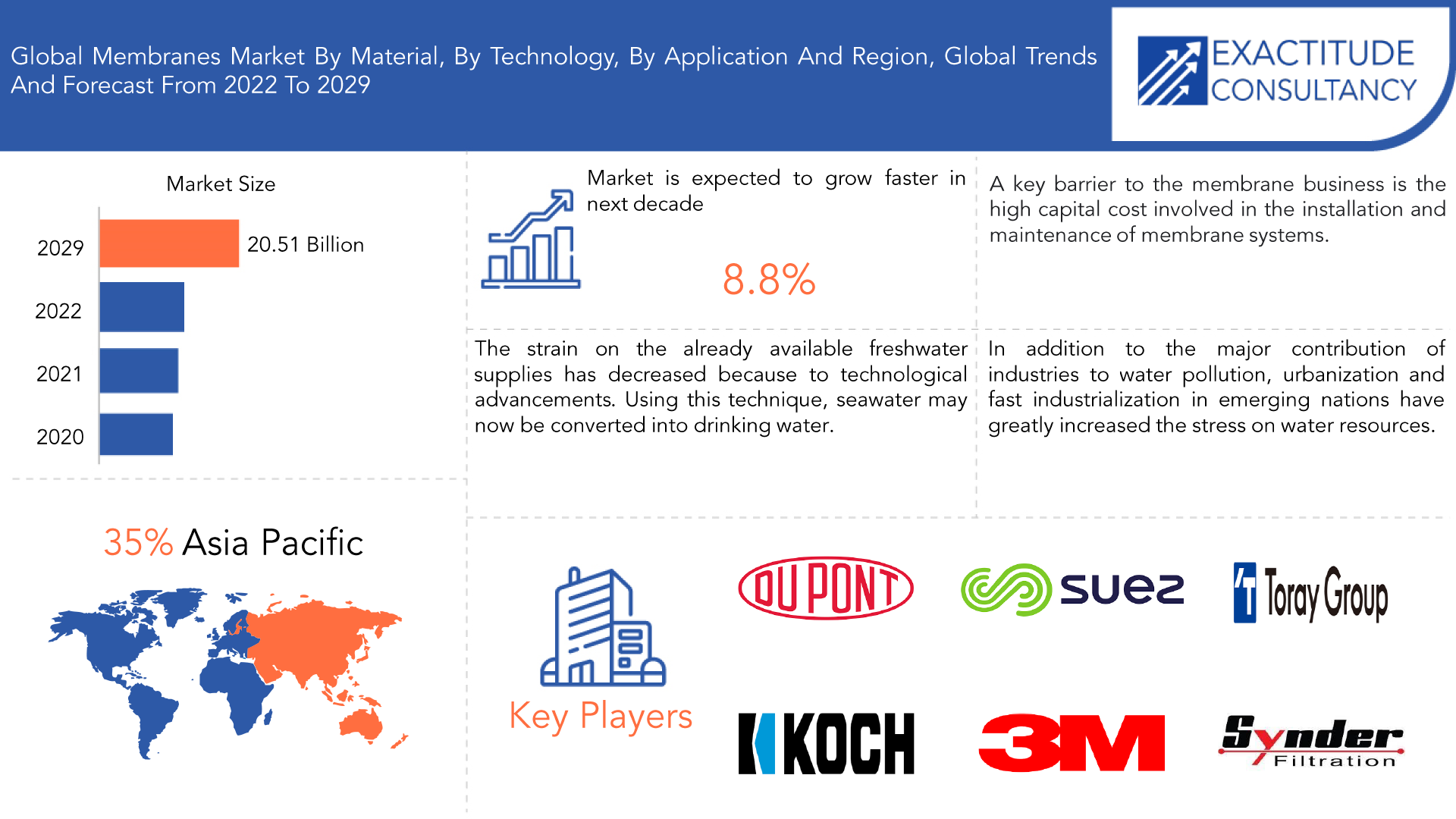
The global Membranes market is expected to grow at 8.80 % CAGR from 2020 to 2029. It is expected to reach above USD 20.51 Billion by 2029 from USD 9.60 Billion in 2020.
Membranes are any sheet-like structured materials that function as a selective barrier in a fluid flow or stream of gas. They can have a variety of polymers (bulk polymers and designed polymers), ceramic, bitumen, etc. in their composition and can be permeable, extremely low permeability, or non-permeable in structure. Very low permeability membranes are mostly employed as geomembranes, whereas permeable membranes are primarily used for separation/filtration activities. The majority of non-permeable membrane uses are in waterproofing.
| ATTRIBUTE | DETAILS |
| Study period | 2020-2029 |
| Base year | 2021 |
| Estimated year | 2022 |
| Forecasted year | 2022-2029 |
| Historical period | 2018-2020 |
| Unit | Value (USD Billion) |
| Segmentation | By Material, Technology, Application and Region. |
| By Material |
|
| By Technology |
|
| By Application |
|
| By Region |
|
A key barrier to the membrane business is the high capital cost involved in the installation and maintenance of membrane systems. The existence of human life depends on having access to freshwater for drinking. Using resources effectively is now essential as a result of the water issue, which has gotten worse with the increasing population growth. The strain on the already available freshwater supplies has decreased because to technological advancements. Using this technique, seawater may now be converted into drinking water. For individuals and nations with scarce water supplies, desalination facilities utilizing this technique have shown to be beneficial. For example, desalination facilities are extremely important for various activities, including farming, industry, and daily needs, in places like the Middle East and Africa. As the world's population grows, water shortages become more severe, and it is clear from the growing number of desalination projects that this technology is developing as a game-changer. However, a growing number of water purifiers for homes that employ this technology also considerably increase usage.
Depending on the size and complexity of the system, buying and installing membrane systems might be expensive at first. Moreover, membrane system running costs which include energy use and maintenance can be substantial.
In addition to the major contribution of industries to water pollution, urbanization and fast industrialization in emerging nations have greatly increased the stress on water resources. Legislators have been forced by growing environmental concerns to create strict industry discharge standards to reduce water contamination. In order to comply with regulations, many enterprises employ this technology to lessen the severity and quantity of contaminants in their output streams. Membranes are crucial to attaining zero liquid discharge (ZLD), which lessens the environmental effect of enterprises. The idea of zero discharge is very new. The only option to maintain steady growth while industrialization pushes the development process forward is to reduce the effect. These elements are propelling the membranes market's expansion.
The COVID-19 pandemic's detrimental effects disrupted international trade, industry, and logistical operations. The global economies have suffered greatly from a halt in industrial activity, which finally led to an economic recession. Market productivity is being hampered by disruptions in the supply and demand for industrial inputs such polymers, such as polysulfides, polyacrylonitrile, and others, as well as a shortage of labourers.
[caption id="attachment_16765" align="aligncenter" width="1920"]
Frequently Asked Questions
• What is the worth of the global Membranes Market?
The global Membranes Market is expected to grow at 8.80% CAGR from 2020 to 2029. It is expected to reach above USD 20.51 Billion by 2029 from USD 9.60 Billion in 2020.
• What is the size of the Asia Pacific Membranes Market?
Asia Pacific held more than 35% of the Membranes Market revenue share in 2020 and will witness tremendous expansion during the forecast period.
• What are some of the market's driving forces?
As the world's population grows, water shortages become more severe, and it is clear from the growing number of desalination projects that this technology is developing as a game-changer. However, a growing number of water purifiers for homes that employ this technology also considerably increase usage.
• Which are the top companies to hold the market share in the Membranes Market?
The Membranes Market key players include Toray Industries Inc., DuPont, SUEZ, KOCH, Pentair Plc, Toyoba, Pall Corporation, Seccua GmbH, Synder Filtration, 3M.
• What is the leading Material of the Membranes Market?
The water & wastewater treatment are major sector where the Material of Membranes has seen more.
• Which is the largest regional market for Membranes Market?
The Markets largest share is in the Asia Pacific region.
Membranes Market Segment Analysis
The market is segmented based on Material into Polymeric and Ceramic. Among the Material -based market segments, polymeric is anticipated to account for the greatest market shares during the course of the estimate. Fluorinated polymers, polyether sulfones, and polyamides are only a few of the polymers that were employed to build the membrane. Polymeric membranes are extensively employed in a variety of applications because they are simple to use and offer high selectivity. These membranes are also more affordable than ceramic membranes.
The market is split up into four segments based on technology which are RO, MF, UF, NF. The RO category had the biggest market share and is predicted to grow at the fastest rate throughout the projection period. In order to properly remove contaminants and salts from wastewater, RO membranes are used. The pore size of these membranes is smaller than 0.0001 microns, and they are mostly made of polyamides, cellulose acetate, and nitrocellulose. Moreover, RO membranes are employed in industrial processing applications in a number of end-use industries, including the food, beverage, and pharmaceutical sectors.
The market is segmented by application in 4 parts Water & Wastewater Treatment, Industrial Processing, Food & Beverages, Pharmaceutical. The main objective in the development of membranes has been the treatment of water and wastewater. Eventually, as technology advanced, the uses spread into many different sectors, including the food and beverage, pharmaceutical industries. Purification technologies have emerged as viable methods of supplying and meeting the demand for potable water due to the depletion of water resources. The second-largest market share belongs to the food and beverage sector. The main reasons supporting the expansion of the food and beverage categories are the growing disposable income in combination with the shifting customer preference towards processed foods and tight food safety laws. [caption id="attachment_16766" align="aligncenter" width="1920"]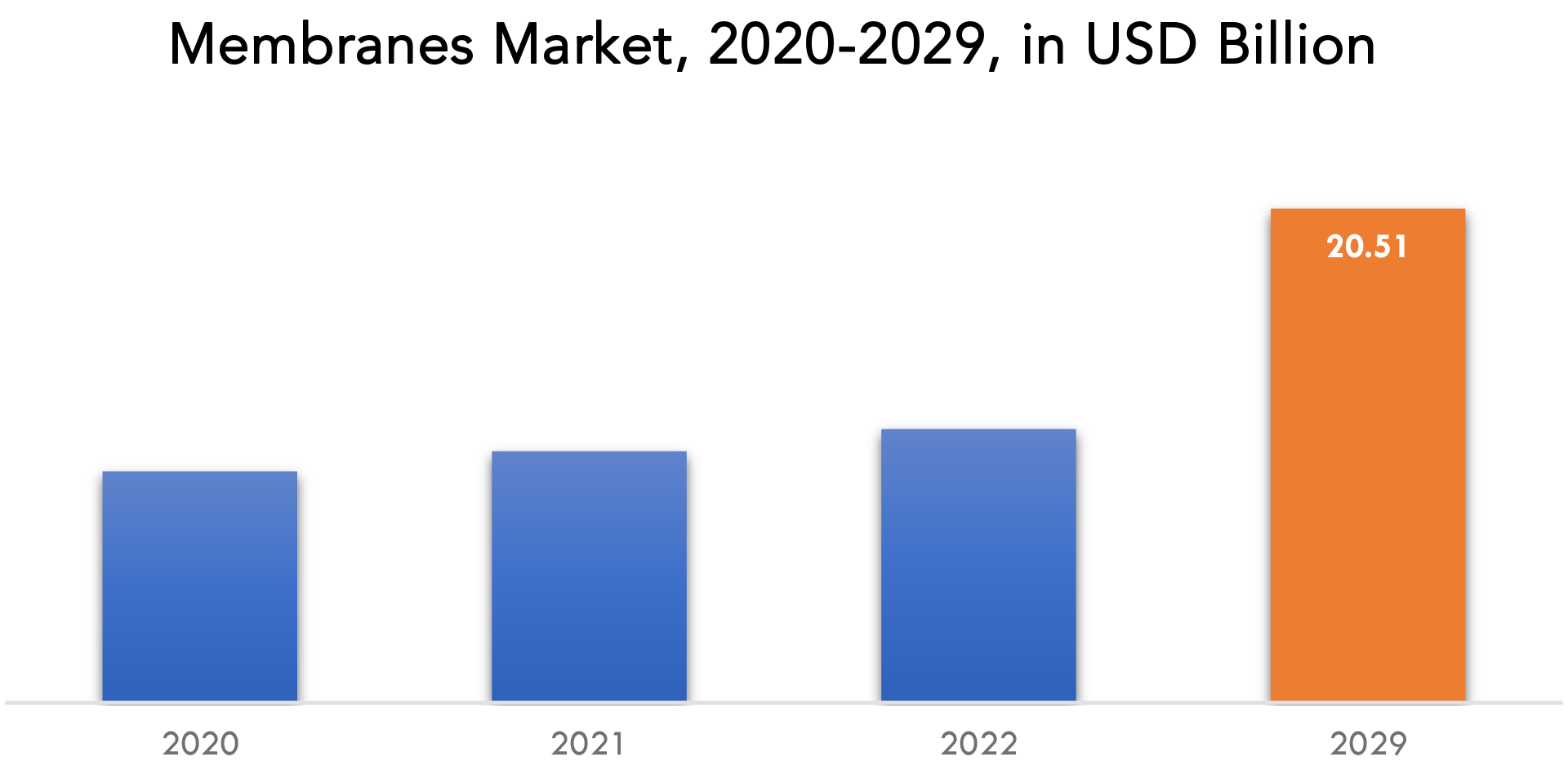
Membranes Market Players
The Membranes Market key players include Toray Industries Inc., DuPont, SUEZ, KOCH, Pentair Plc, Toyoba, Pall Corporation, Seccua GmbH, Synder Filtration, 3M, LG Chem Ltd.
Recent Developments September 2021: Synder announced the opening of a new sales office in its Vacaville, California headquarters. The Technical Sales Team and Project Engineers will operate in the 2600 sq. ft. office space, which is part of the 53,000 sq. ft. R&D center, system fabrication, and a production facility. April 2021: KOCH Separation Solutions unveiled the addition of its new technology named INDU-COR HD (High Density) to its tubular membrane range, which is developed to treat industrial waste streams efficiently. INDU-COR HD has a 300% high packing density than standard INDU-COR, making crossflow filtration more cost-effective while taking up less space. This new product configuration boosts operating efficiency and sustainability while lowering waste treatment costs for clients.Who Should Buy? Or Key stakeholders
- Investors
- Pharmaceutical Companies
- Water Treatment Industry
- Beverages Industry
- Food Companies
- Research Organizations
- Regulatory Authorities
- Institutional & retail players
- Others
Membranes Market Regional Analysis
The Membranes Market by region includes North America, Asia-Pacific (APAC), Europe, South America, and Middle East & Africa (MEA).
- North America: includes the US, Canada, Mexico
- Asia Pacific: includes China, Japan, South Korea, India, Australia, ASEAN, and Rest of APAC
- Europe: includes the UK, Germany, France, Italy, Spain, Russia, and the Rest of Europe
- South America: includes Brazil, Argentina, and Rest of South America
- Middle East & Africa: includes Turkey, UAE, Saudi Arabia, South Africa, and the Rest of MEA
The Asia Pacific Membranes market is the largest market for Membranes globally. Throughout the projection period, a considerable increase in the Asia Pacific market is anticipated. The fast industrialization and growing environmental concerns in the region's developing economies are likely to support market expansion. In addition, expanding government initiatives in China and India to build water and wastewater treatment facilities are anticipated to benefit market expansion over the projection period.
Europe is the world's second-largest area and a major market thanks to the western European nations of Germany, France, Spain, and Italy. The market's expansion in Europe is linked to government efforts to conserve freshwater supplies and growing public awareness of the problem of water shortage. The expansion of the market in the rest of Europe is being fueled by an increase in freshwater shortages and a strong demand for clean drinking water in developing countries. Market expansion in the rest of Europe will be aided by a growing population and continually rising food and beverage consumption.
[caption id="attachment_16767" align="aligncenter" width="1920"]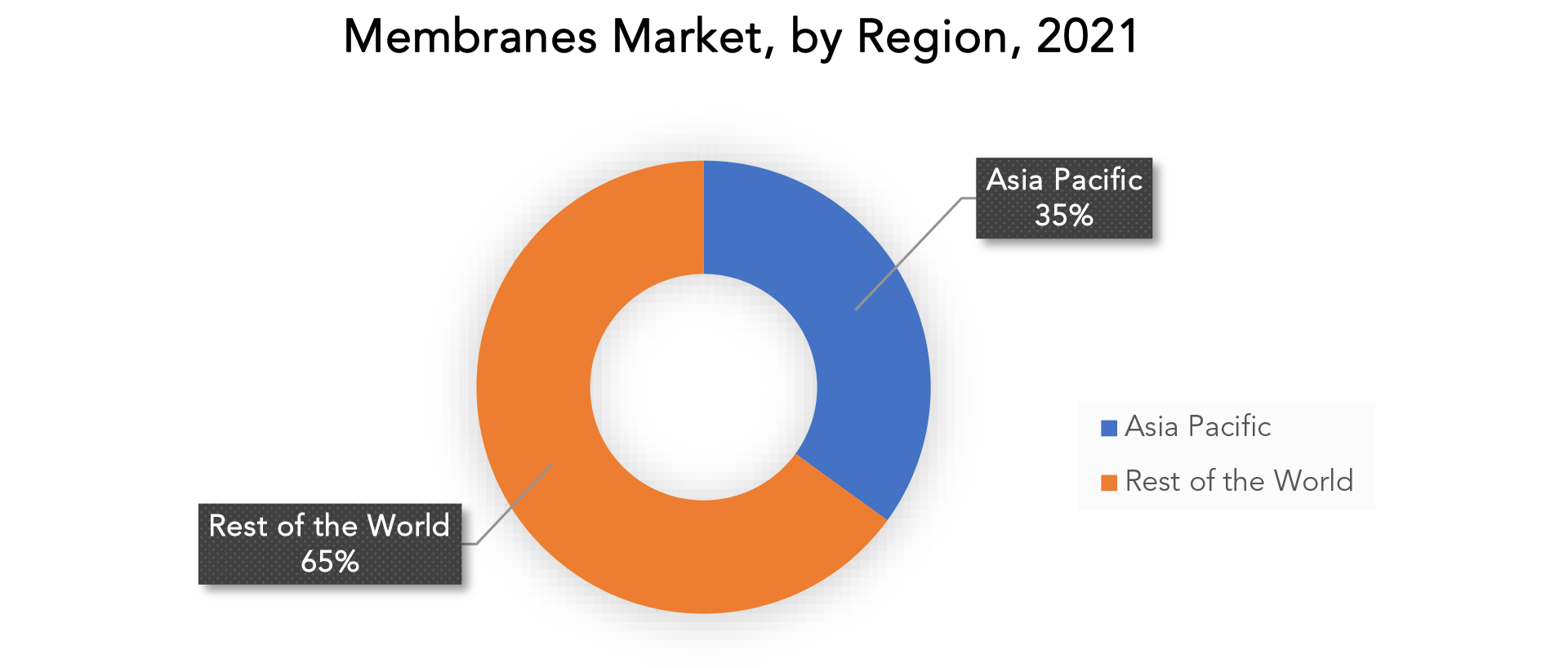
Key Market Segments: Membranes Market
Membranes Market by Material, 2020-2029, (USD Billion)- Polymeric
- Ceramic
- Ro
- Uf
- Mf
- Nf
- Water & Wastewater Treatment
- Industrial Processing
- Food & Beverages
- Pharmaceutical
- North America
- Asia Pacific
- Europe
- South America
- Middle East And Africa
Exactitude Consultancy Services Key Objectives
- Increasing sales and market share
- Developing new technology
- Improving profitability
- Entering new markets
- Enhancing brand reputation
Key Question Answered
- What is the expected growth rate of the membranes market over the next 7 years?
- Who are the major players in the membranes market and what is their market share?
- What are the end-user industries driving demand for market and what is their outlook?
- What are the opportunities for growth in emerging markets such as Asia-pacific, middle east, and Africa?
- How is the economic environment affecting the membranes market, including factors such as interest rates, inflation, and exchange rates?
- What is the expected impact of government policies and regulations on the membranes market?
- What is the current and forecasted size and growth rate of the global membranes market?
- What are the key drivers of growth in the membranes market?
- Who are the major players in the market and what is their market share?
- What are the distribution channels and supply chain dynamics in the membranes market?
- What are the technological advancements and innovations in the membranes market and their impact on product development and growth?
- What are the regulatory considerations and their impact on the market?
- What are the challenges faced by players in the membranes market and how are they addressing these challenges?
- What are the opportunities for growth and expansion in the membranes market?
- What are the services offerings and specifications of leading players in the market?
- INTRODUCTION
- MARKET DEFINITION
- MARKET SEGMENTATION
- RESEARCH TIMELINES
- ASSUMPTIONS AND LIMITATIONS
- RESEARCH METHODOLOGY
- DATA MINING
- SECONDARY RESEARCH
- PRIMARY RESEARCH
- SUBJECT-MATTER EXPERTS’ ADVICE
- QUALITY CHECKS
- FINAL REVIEW
- DATA TRIANGULATION
- BOTTOM-UP APPROACH
- TOP-DOWN APPROACH
- RESEARCH FLOW
- DATA SOURCES
- DATA MINING
- EXECUTIVE SUMMARY
- MARKET OVERVIEW
- GLOBAL MEMBRANES MARKET OUTLOOK
- MARKET DRIVERS
- MARKET RESTRAINTS
- MARKET OPPORTUNITIES
- IMPACT OF COVID-19 ON MEMBRANES MARKET
- PORTER’S FIVE FORCES MODEL
- THREAT FROM NEW ENTRANTS
- THREAT FROM SUBSTITUTES
- BARGAINING POWER OF SUPPLIERS
- BARGAINING POWER OF CUSTOMERS
- DEGREE OF COMPETITION
- INDUSTRY VALUE CHAIN ANALYSIS
- GLOBAL MEMBRANES MARKET OUTLOOK
- GLOBAL MEMBRANES MARKET BY MATERIAL (USD BILLION), 2020-2029
- POLYMERIC
- CERAMIC
- GLOBAL MEMBRANES MARKET BY TECHNOLOGY (USD BILLION),2020-2029
- RO
- UF
- MF
- NF
- GLOBAL MEMBRANES MARKET BY APPLICATION (USD BILLION),2020-2029
- WATER & WASTEWATER TREATMENT
- INDUSTRIAL PROCESSING
- FOOD & BEVERAGES
- PHARMACEUTICAL
- GLOBAL MEMBRANES MARKET BY REGION (USD BILLION),2020-2029
- NORTH AMERICA
- US
- CANADA
- MEXICO
- SOUTH AMERICA
- BRAZIL
- ARGENTINA
- COLOMBIA
- REST OF SOUTH AMERICA
- EUROPE
- GERMANY
- UK
- FRANCE
- ITALY
- SPAIN
- RUSSIA
- REST OF EUROPE
- ASIA PACIFIC
- INDIA
- CHINA
- JAPAN
- SOUTH KOREA
- AUSTRALIA
- SOUTH-EAST ASIA
- REST OF ASIA PACIFIC
- MIDDLE EAST AND AFRICA
- UAE
- SAUDI ARABIA
- SOUTH AFRICA
- REST OF MIDDLE EAST AND AFRICA
- NORTH AMERICA
- COMPANY PROFILES* (BUSINESS OVERVIEW, COMPANY SNAPSHOT, PRODUCTS OFFERED, RECENT DEVELOPMENTS)
- TORAY INDUSTRIES INC.
- DUPONT
- SUEZ
- KOCH
- PENTAIR PLC
- TOYOBA PALL CORPORATION
- SECCUA GMBH
- SYNDER FILTRATION
- 3M
- LG CHEM LTD *THE COMPANY LIST IS INDICATIVE
LIST OF TABLES
TABLE 1 GLOBAL MEMBRANES MARKET BY MATERIAL (USD BILLION) 2020-2029
TABLE 2 GLOBAL MEMBRANES MARKET BY TECHNOLOGY (USD BILLION) 2020-2029
TABLE 3 GLOBAL MEMBRANES MARKET BY APPLICATION (USD BILLION) 2020-2029
TABLE 4 GLOBAL MEMBRANES MARKET BY REGION (USD BILLION) 2020-2029
TABLE 5 NORTH AMERICA MEMBRANES MARKET BY COUNTRY (USD BILLION) 2020-2029
TABLE 6 NORTH AMERICA MEMBRANES MARKET BY MATERIAL (USD BILLION) 2020-2029
TABLE 7 NORTH AMERICA MEMBRANES MARKET BY TECHNOLOGY (USD BILLION) 2020-2029
TABLE 8 NORTH AMERICA MEMBRANES MARKET BY APPLICATION (USD BILLION) 2020-2029
TABLE 9 US MEMBRANES MARKET BY MATERIAL (USD BILLION) 2020-2029
TABLE 10 US MEMBRANES MARKET BY TECHNOLOGY (USD BILLION) 2020-2029
TABLE 11 US MEMBRANES MARKET BY APPLICATION (USD BILLION) 2020-2029
TABLE 12 CANADA MEMBRANES MARKET BY MATERIAL (USD BILLION) 2020-2029
TABLE 13 CANADA MEMBRANES MARKET BY TECHNOLOGY (USD BILLION) 2020-2029
TABLE 14 CANADA MEMBRANES MARKET BY APPLICATION (USD BILLION) 2020-2029
TABLE 15 MEXICO MEMBRANES MARKET BY MATERIAL (USD BILLION) 2020-2029
TABLE 16 MEXICO MEMBRANES MARKET BY TECHNOLOGY (USD BILLION) 2020-2029
TABLE 17 MEXICO MEMBRANES MARKET BY APPLICATION (USD BILLION) 2020-2029
TABLE 18 SOUTH AMERICA MEMBRANES MARKET BY COUNTRY (USD BILLION) 2020-2029
TABLE 19 SOUTH AMERICA MEMBRANES MARKET BY MATERIAL (USD BILLION) 2020-2029
TABLE 20 SOUTH AMERICA MEMBRANES MARKET BY TECHNOLOGY (USD BILLION) 2020-2029
TABLE 21 SOUTH AMERICA MEMBRANES MARKET BY APPLICATION (USD BILLION) 2020-2029
TABLE 22 BRAZIL MEMBRANES MARKET BY MATERIAL (USD BILLION) 2020-2029
TABLE 23 BRAZIL MEMBRANES MARKET BY TECHNOLOGY (USD BILLION) 2020-2029
TABLE 24 BRAZIL MEMBRANES MARKET BY APPLICATION (USD BILLION) 2020-2029
TABLE 25 ARGENTINA MEMBRANES MARKET BY MATERIAL (USD BILLION) 2020-2029
TABLE 26 ARGENTINA MEMBRANES MARKET BY TECHNOLOGY (USD BILLION) 2020-2029
TABLE 27 ARGENTINA MEMBRANES MARKET BY APPLICATION (USD BILLION) 2020-2029
TABLE 28 COLOMBIA MEMBRANES MARKET BY MATERIAL (USD BILLION) 2020-2029
TABLE 29 COLOMBIA MEMBRANES MARKET BY TECHNOLOGY (USD BILLION) 2020-2029
TABLE 30 COLOMBIA MEMBRANES MARKET BY APPLICATION (USD BILLION) 2020-2029
TABLE 31 REST OF SOUTH AMERICA MEMBRANES MARKET BY MATERIAL (USD BILLION) 2020-2029
TABLE 32 REST OF SOUTH AMERICA MEMBRANES MARKET BY TECHNOLOGY (USD BILLION) 2020-2029
TABLE 33 REST OF SOUTH AMERICA MEMBRANES MARKET BY APPLICATION (USD BILLION) 2020-2029
TABLE 34 ASIA-PACIFIC MEMBRANES MARKET BY COUNTRY (USD BILLION) 2020-2029
TABLE 35 ASIA-PACIFIC MEMBRANES MARKET BY MATERIAL (USD BILLION) 2020-2029
TABLE 36 ASIA-PACIFIC MEMBRANES MARKET BY TECHNOLOGY (USD BILLION) 2020-2029
TABLE 37 ASIA-PACIFIC MEMBRANES MARKET BY APPLICATION (USD BILLION) 2020-2029
TABLE 38 INDIA MEMBRANES MARKET BY MATERIAL (USD BILLION) 2020-2029
TABLE 39 INDIA MEMBRANES MARKET BY TECHNOLOGY (USD BILLION) 2020-2029
TABLE 40 INDIA MEMBRANES MARKET BY APPLICATION (USD BILLION) 2020-2029
TABLE 41 CHINA MEMBRANES MARKET BY MATERIAL (USD BILLION) 2020-2029
TABLE 42 CHINA MEMBRANES MARKET BY TECHNOLOGY (USD BILLION) 2020-2029
TABLE 43 CHINA MEMBRANES MARKET BY APPLICATION (USD BILLION) 2020-2029
TABLE 44 JAPAN MEMBRANES MARKET BY MATERIAL (USD BILLION) 2020-2029
TABLE 45 JAPAN MEMBRANES MARKET BY TECHNOLOGY (USD BILLION) 2020-2029
TABLE 46 JAPAN MEMBRANES MARKET BY APPLICATION (USD BILLION) 2020-2029
TABLE 47 SOUTH KOREA MEMBRANES MARKET BY MATERIAL (USD BILLION) 2020-2029
TABLE 48 SOUTH KOREA MEMBRANES MARKET BY TECHNOLOGY (USD BILLION) 2020-2029
TABLE 49 SOUTH KOREA MEMBRANES MARKET BY APPLICATION (USD BILLION) 2020-2029
TABLE 50 AUSTRALIA MEMBRANES MARKET BY MATERIAL (USD BILLION) 2020-2029
TABLE 51 AUSTRALIA MEMBRANES MARKET BY TECHNOLOGY (USD BILLION) 2020-2029
TABLE 52 AUSTRALIA MEMBRANES MARKET BY APPLICATION (USD BILLION) 2020-2029
TABLE 53 SOUTH-EAST ASIA MEMBRANES MARKET BY MATERIAL (USD BILLION) 2020-2029
TABLE 54 SOUTH-EAST ASIA MEMBRANES MARKET BY TECHNOLOGY (USD BILLION) 2020-2029
TABLE 55 SOUTH-EAST ASIA MEMBRANES MARKET BY APPLICATION (USD BILLION) 2020-2029
TABLE 56 REST OF ASIA PACIFIC MEMBRANES MARKET BY MATERIAL (USD BILLION) 2020-2029
TABLE 57 REST OF ASIA PACIFIC MEMBRANES MARKET BY TECHNOLOGY (USD BILLION) 2020-2029
TABLE 58 REST OF ASIA PACIFIC MEMBRANES MARKET BY APPLICATION (USD BILLION) 2020-2029
TABLE 59 EUROPE MEMBRANES MARKET BY COUNTRY (USD BILLION) 2020-2029
TABLE 60 GERMANY MEMBRANES MARKET BY MATERIAL (USD BILLION) 2020-2029
TABLE 61 GERMANY MEMBRANES MARKET BY TECHNOLOGY (USD BILLION) 2020-2029
TABLE 62 GERMANY MEMBRANES MARKET BY APPLICATION (USD BILLION) 2020-2029
TABLE 63 UK MEMBRANES MARKET BY MATERIAL (USD BILLION) 2020-2029
TABLE 64 UK MEMBRANES MARKET BY TECHNOLOGY (USD BILLION) 2020-2029
TABLE 65 UK MEMBRANES MARKET BY APPLICATION (USD BILLION) 2020-2029
TABLE 66 FRANCE MEMBRANES MARKET BY MATERIAL (USD BILLION) 2020-2029
TABLE 67 FRANCE MEMBRANES MARKET BY TECHNOLOGY (USD BILLION) 2020-2029
TABLE 68 FRANCE MEMBRANES MARKET BY APPLICATION (USD BILLION) 2020-2029
TABLE 69 ITALY MEMBRANES MARKET BY MATERIAL (USD BILLION) 2020-2029
TABLE 70 ITALY MEMBRANES MARKET BY TECHNOLOGY (USD BILLION) 2020-2029
TABLE 71 ITALY MEMBRANES MARKET BY APPLICATION (USD BILLION) 2020-2029
TABLE 72 SPAIN MEMBRANES MARKET BY MATERIAL (USD BILLION) 2020-2029
TABLE 73 SPAIN MEMBRANES MARKET BY TECHNOLOGY (USD BILLION) 2020-2029
TABLE 74 SPAIN MEMBRANES MARKET BY APPLICATION (USD BILLION) 2020-2029
TABLE 75 RUSSIA MEMBRANES MARKET BY MATERIAL (USD BILLION) 2020-2029
TABLE 76 RUSSIA MEMBRANES MARKET BY TECHNOLOGY (USD BILLION) 2020-2029
TABLE 77 RUSSIA MEMBRANES MARKET BY APPLICATION (USD BILLION) 2020-2029
TABLE 78 REST OF EUROPE MEMBRANES MARKET BY MATERIAL (USD BILLION) 2020-2029
TABLE 79 REST OF EUROPE MEMBRANES MARKET BY TECHNOLOGY (USD BILLION) 2020-2029
TABLE 80 REST OF EUROPE MEMBRANES MARKET BY APPLICATION (USD BILLION) 2020-2029
TABLE 81 MIDDLE EAST AND AFRICA MEMBRANES MARKET BY COUNTRY (USD BILLION) 2020-2029
TABLE 82 MIDDLE EAST AND AFRICA MEMBRANES MARKET BY MATERIAL (USD BILLION) 2020-2029
TABLE 83 MIDDLE EAST AND AFRICA MEMBRANES MARKET BY TECHNOLOGY (USD BILLION) 2020-2029
TABLE 84 MIDDLE EAST AND AFRICA MEMBRANES MARKET BY APPLICATION (USD BILLION) 2020-2029
TABLE 85 UAE MEMBRANES MARKET BY MATERIAL (USD BILLION) 2020-2029
TABLE 86 UAE MEMBRANES MARKET BY TECHNOLOGY (USD BILLION) 2020-2029
TABLE 87 UAE MEMBRANES MARKET BY APPLICATION (USD BILLION) 2020-2029
TABLE 88 SAUDI ARABIA MEMBRANES MARKET BY MATERIAL (USD BILLION) 2020-2029
TABLE 89 SAUDI ARABIA MEMBRANES MARKET BY TECHNOLOGY (USD BILLION) 2020-2029
TABLE 90 SAUDI ARABIA MEMBRANES MARKET BY APPLICATION (USD BILLION) 2020-2029
TABLE 91 SOUTH AFRICA MEMBRANES MARKET BY MATERIAL (USD BILLION) 2020-2029
TABLE 92 SOUTH AFRICA MEMBRANES MARKET BY TECHNOLOGY (USD BILLION) 2020-2029
TABLE 93 SOUTH AFRICA MEMBRANES MARKET BY APPLICATION (USD BILLION) 2020-2029
TABLE 94 REST OF MIDDLE EAST AND AFRICA MEMBRANES MARKET BY MATERIAL (USD BILLION) 2020-2029
TABLE 95 REST OF MIDDLE EAST AND AFRICA MEMBRANES MARKET BY TECHNOLOGY (USD BILLION) 2020-2029
TABLE 96 REST OF MIDDLE EAST AND AFRICA MEMBRANES MARKET BY APPLICATION (USD BILLION) 2020-2029
LIST OF FIGURES
FIGURE 1 MARKET DYNAMICS
FIGURE 2 MARKET SEGMENTATION
FIGURE 3 REPORT TIMELINES: YEARS CONSIDERED
FIGURE 4 DATA TRIANGULATION
FIGURE 5 BOTTOM-UP APPROACH
FIGURE 6 TOP-DOWN APPROACH
FIGURE 7 RESEARCH FLOW
FIGURE 8 GLOBAL MEMBRANES BY COMPONENT, USD BILLION, 2020-2029
FIGURE 9 GLOBAL MEMBRANES BY APPLICATION, USD BILLION, 2020-2029
FIGURE 10 GLOBAL MEMBRANES BY END USER, USD BILLION, 2020-2029
FIGURE 11 GLOBAL MEMBRANES BY REGION, USD BILLION, 2020-2029
FIGURE 12 PORTER’S FIVE FORCES MODEL
FIGURE 13 GLOBAL MEMBRANES MARKET BY COMPONENT, USD BILLION, 2021
FIGURE 14 GLOBAL MEMBRANES MARKET BY APPLICATION, USD BILLION, 2021
FIGURE 15 GLOBAL MEMBRANES MARKET BY END USER, USD BILLION, 2021
FIGURE 16 GLOBAL MEMBRANES MARKET BY REGION 2021
FIGURE 17 MARKET SHARE ANALYSIS
FIGURE 18 TORAY INDUSTRIES INC.: COMPANY SNAPSHOT
FIGURE 19 DUPONT: COMPANY SNAPSHOT
FIGURE 20 SUEZ: COMPANY SNAPSHOT
FIGURE 21 KOCH: COMPANY SNAPSHOT
FIGURE 22 PENTAIR PLC: COMPANY SNAPSHOT
FIGURE 23 TOYOBA PALL CORPORATION: COMPANY SNAPSHOT
FIGURE 24 SECCUA GMBH: COMPANY SNAPSHOT
FIGURE 25 SYNDER FILTRATION: COMPANY SNAPSHOT
FIGURE 26 3M: COMPANY SNAPSHOT
FIGURE 27 LG CHEM LTD.: COMPANY SNAPSHOT
DOWNLOAD FREE SAMPLE REPORT
License Type
SPEAK WITH OUR ANALYST
Want to know more about the report or any specific requirement?
WANT TO CUSTOMIZE THE REPORT?
Our Clients Speak
We asked them to research ‘ Equipment market’ all over the world, and their whole arrangement was helpful to us. thehealthanalytics.com insightful analysis and reports contributed to our current analysis and in creating a future strategy. Besides, the te
Yosuke Mitsui
Senior Associate Construction Equipment Sales & Marketing
We asked them to research ‘Equipment market’ all over the world, and their whole arrangement was helpful to us. thehealthanalytics.com insightful analysis and reports contributed to our current analysis and in creating a future strategy. Besides, the te