

Base Year Value ()
x.x %
x.x %
CAGR ()
x.x %
x.x %
Forecast Year Value ()
x.x %
x.x %
Historical Data Period
Largest Region
Forecast Period
Nanocomposites Market by Type (Polymer Matrix, Metal Matrix, Ceramic Matrix), by Product (Carbon Nanotube, Nanoclay, Metal/Metal Oxide), by Application (Packaging, Automotive, Electronics Electrical) and Region, Global trends and forecast from 2022 to 2029
Instant access to hundreds of data points and trends
- Market estimates from 2014-2029
- Competitive analysis, industry segmentation, financial benchmarks
- Incorporates SWOT, Porter's Five Forces and risk management frameworks
- PDF report or online database with Word, Excel and PowerPoint export options
- 100% money back guarantee
Nanocomposites Market Overview
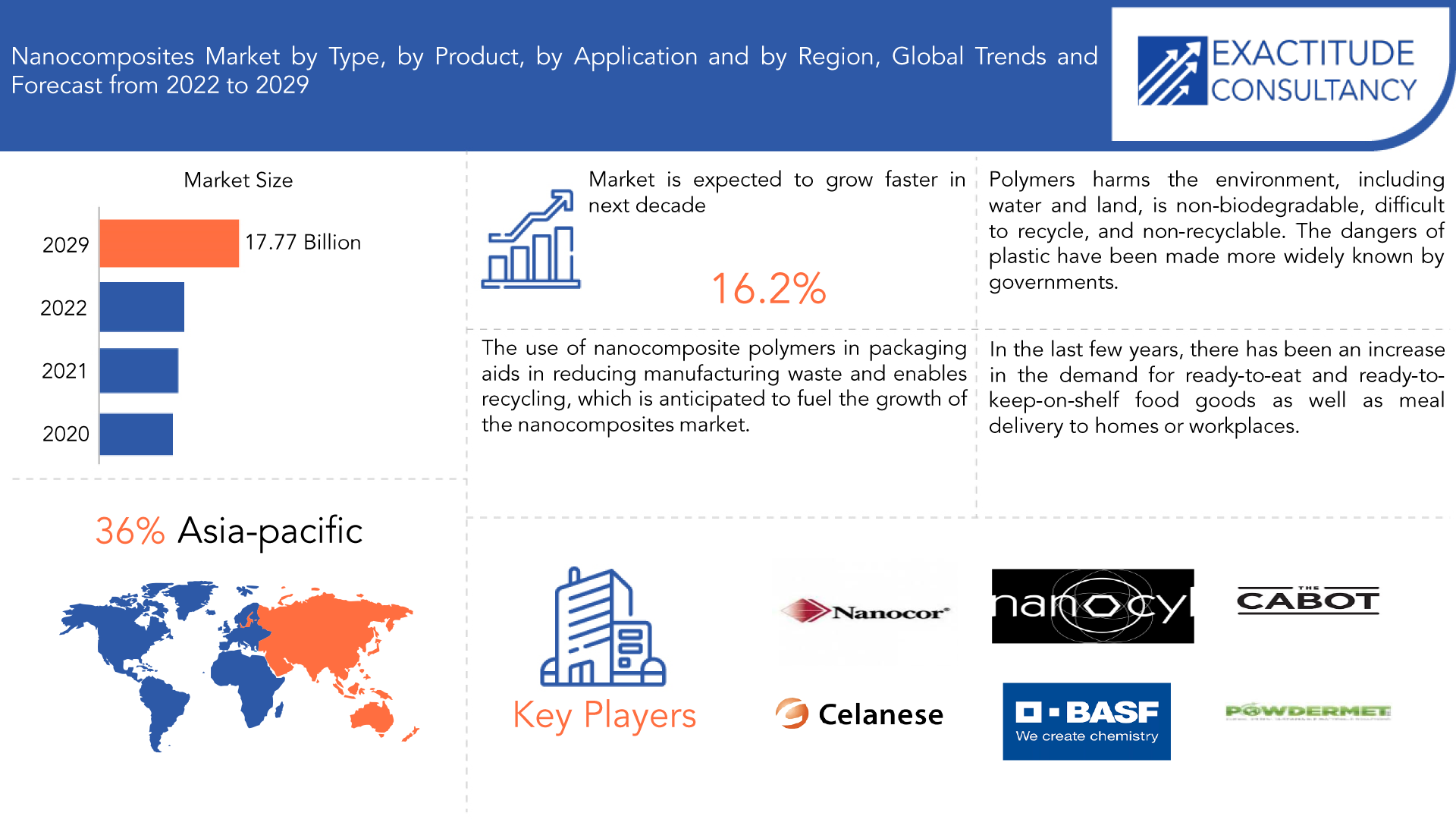
The Nanocomposites Market is expected to grow at 16.2% CAGR from 2022 to 2029. It is expected to reach above USD 17.77 Billion by 2029 from USD 4.6 Billion in 2020.
Composites with a phase with a dimension in the nanoscale range are known as nanocomposites. They are made by mixing inorganic materials like oxides, clays, and nanoscale polymers with inorganic solids like inorganic solids. Organic polymer matrices with a nano range dimension are the building blocks of nanocomposites, which are made of inorganic particles. Due to its many benefits, including as high tensile strength, improved optical and magnetic characteristics, high corrosion resistance, and high thermal and electronic conductivity, nanocomposites are becoming more and more important in recent years. Moreover, one of the strongest and longest-lasting materials on earth is graphene. The thermal conductivity of it is also very high. Hence, graphene-polymer nanocomposites have demonstrated significant potential as functional or structural materials of the future. The creation of Nanocomposites goods typically uses the nanotechnology technique. By combining chemistry, physics, material science, and biology, nanotechnology aims to produce novel materials with unique features that can be used to easily produce high-performance materials, electronics, and biomedical devices. Market expansion is being driven by the packaging industry's quick adoption of nanocomposites. They function as an active and intelligent food packaging material and have a number of different qualities, including mechanical, thermal, and biodegradable ones. There is a lot of interest in creating packaging materials with less processing and longer shelf life in the current market. The market for nanocomposites is expanding due to the rising demand from numerous end-use industries, including the automotive, aerospace, energy, and construction sectors. The biomedical applications are used in procedures like tissue engineering, wound dressings, cancer therapy, stem cell therapy, cardiac prostheses, and enzyme immobilization. One of the main elements that could have a negative impact on the market's overall revenue in the upcoming years is the high cost of manufacturing nanocomposites.
| ATTRIBUTE | DETAILS |
| Study period | 2020-2029 |
| Base year | 2022 |
| Estimated year | 2022 |
| Forecasted year | 2022-2029 |
| Historical period | 2018-2020 |
| Unit | Value (USD Billion) (Kilotons) |
| Segmentation | By Type, By Product, By Application, By Region |
| By Type |
|
| By Product |
|
| By Application |
|
| By Region |
|
Over the forecast period, the worldwide nanocomposites market is expected to be driven by the rising use of lightweight aluminium composite panels for insulation in the construction sector. Nanocomposites are increasingly employed in the food packaging business, notably in the packaging of cheese, confectionery, processed meat, boil-in-the-bag food, and cereals, among other foods, due to their low permeability to gases, water, and hydrocarbons. Moreover, the use of nanocomposite polymers in packaging aids in reducing manufacturing waste and enables recycling, which is anticipated to fuel the growth of the nanocomposites market.
Due to the strict regulations set by the local governments and organizations, the ongoing COVID-19 pandemic has significantly impacted the worldwide nanocomposite industry. The pandemic had a detrimental impact on the operations of many companies, but the food packaging sector saw a sharp increase in the use of nanocomposites. Due to social distance standards, there has been a significant rise in the need for packaged food items and takeout parcels, which has increased the demand for nanocomposite packaging films and cartons. In addition, the use of e-learning in schools, universities, and other educational institutions is creating an opportunity and increasing demand for touch screen electronics devices like smartphones, laptops, TV displays, and other gadgets. The only sectors that have not been seriously impacted are those that produce medical supplies and items for life support, however the nanocomposites sector has suffered significant losses. Because to the government's travel and shutdown restrictions, the market growth for nanocomposites was stifled. Due to reasons including the global shutdown of raw material supply chains, the COVID-19 pandemic had an impact on the growth of the nanocomposites industry. The operations of sectors that used nanocomposite materials in packaging, manufacturing, and other areas were also impacted by travel restrictions put in place around the world.
[caption id="attachment_16916" align="aligncenter" width="1920"]
Frequently Asked Questions
• What is the worth of Nanocomposites Market?
The Nanocomposites Market is expected to grow at 16.2% CAGR from 2022 to 2029. It is expected to reach above USD 17.77 Billion by 2029 from USD 4.6 Billion in 2020.
• What is the size of the Asia Pacific in Nanocomposites Market?
Asia Pacific held more than 36% of the Nanocomposites Market revenue share in 2021 and will witness expansion in the forecast period.
• What are some of the Nanocomposites Market's driving forces?
One of the industries that has seen a number of modern-era modifications in the past twenty years is packaging. Films, cartons, boxes, and other packaging materials are frequently made with nanocomposite. Due to its high quality, adaptability, flexibility, high tensile strength, and reduced price when compared to other packaging products, the product is widely used in the packaging industry. The market's expansion has been significantly impacted by rising packaging demand from the food and beverage industry. These products have superior thermal, mechanical, biodegradable, and microbial and other contaminating agent resistance qualities. The market will be driven by the use of intelligent and active food packaging technologies. The demand for ready-to-cook, pre-cooked, and other convenience food products has significantly increased as working women become more prevalent throughout the world.
• Which are the top companies to hold the Market share in Nanocomposites Market?
The Market research report covers the analysis of Market players. Key companies profiled in the report include Nanocor Inc., Arkema Inc, Powdermet Inc., RTP Company, Unidym Inc., Nanocyl SA, Gnanomat, BASF, Celanese Corporation, Cabot.
• Which is the largest regional Market for Nanocomposites Market?
The greatest revenue share was accounted for by Asia Pacific. The proliferation of producers in Southeast Asia will contribute to the expansion of the product's demand across a range of end-use sectors. The local market is expected to benefit from the growing use in the pharmaceutical, automotive, food and beverage, electronics and semiconductors, packaging, and other industries and continue its dominance. The use of carbon nanotubes in multiple transistors, sensors, ICs, atomic force microscope probes, and other electrical components, combined with their remarkable properties, will lead to a growth in demand in countries like India, Japan, China, and South Korea. The rapidly expanding electronic manufacturing sector in these countries, which may be related to the rising demand for electronic devices from end-user sectors, will be the region's market's primary driver.
Nanocomposites Market Segment Analysis
Nanocomposite’s market is segmented based on type, product, application and region.
Based on type, a significant portion of the market was made up of polymer matrix. The market for polymer product type will be fueled by favorable government laws for product usage in the packaging, aerospace, and automotive industries. Due to its mechanical strength, gas barrier qualities, flame retardancy, superior thermal conductivity, electrical conductivity, and rheology, the product contributes to the advancement of synthetic plastic materials. Moreover, it is gradually replacing heavy metals used in the aerospace and automobile industries. Due to qualities like fracture toughness, high temperature, corrosion resistance, wear, and high damage tolerance, it is extensively employed in the aerospace and defense industry. They offer improved space conditions and electromagnetic shielding for aircraft.
Based on product, a significant portion of the market was made up of carbon nanotubes. Due to their better heat and thermal conductivity, carbon nanotubes are being used more and more in the production of automotive parts. Over the projected period, segment development is likely to be aided by rising demand for carbon nanotubes in the automotive industry as a multifunctional coating material and in the production of vehicle parts. Due to its ability to lessen biofouling and corrosion resistance, it is also being utilized more and more as a coating material for boat and ship hulls.
Based on application, a significant portion of the market was made up of packaging. Graphene nanoparticles and carbon nanotubes are appealing materials for enhancing the mechanical characteristics, barrier performances, and functional features of biodegradable polymers in packaging applications. The market for packaging is being driven by the quick development of e-commerce services and the food and beverage industry, which in turn is driving the market for nanocomposites.
[caption id="attachment_16928" align="aligncenter" width="1920"]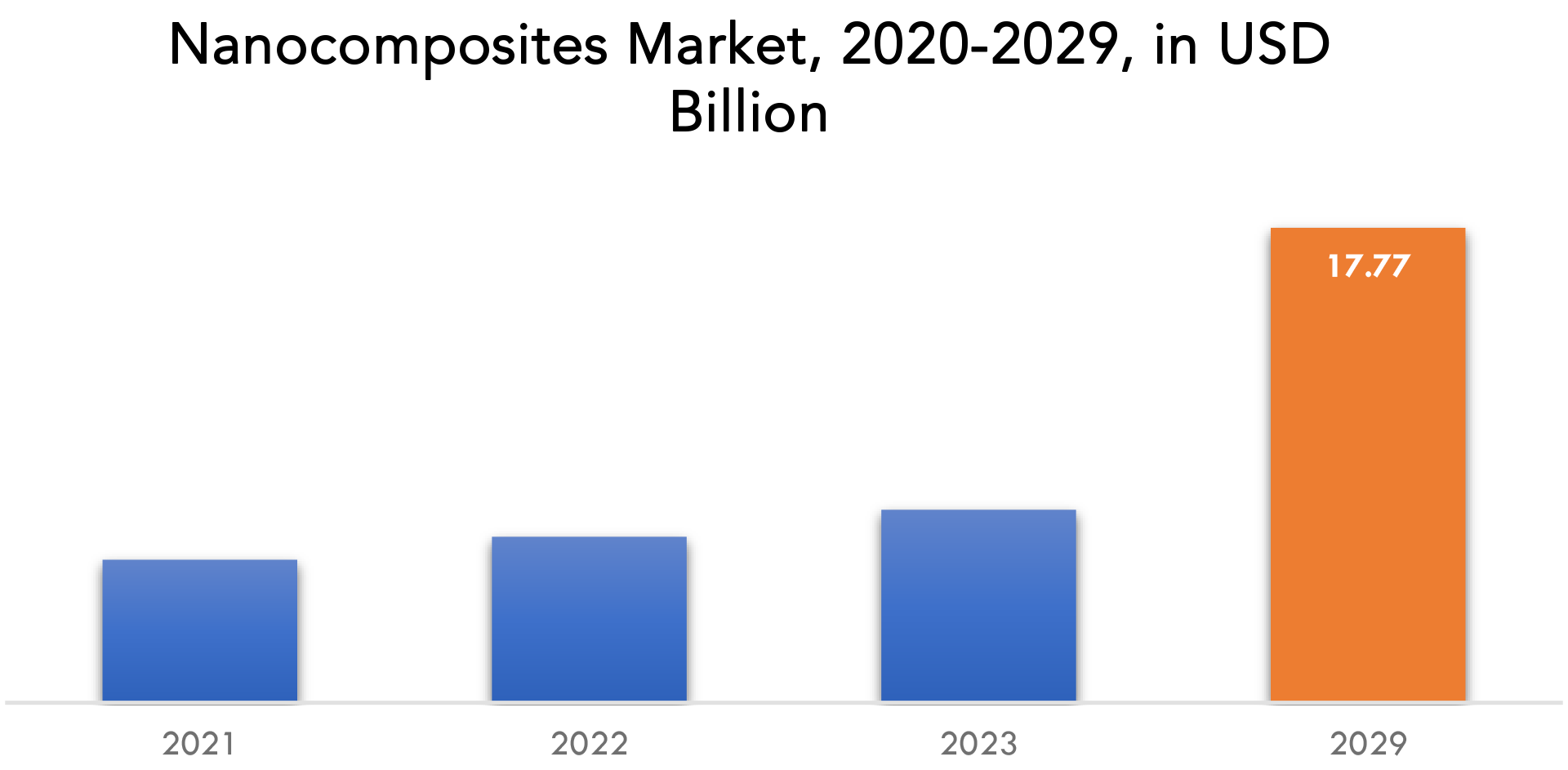
Nanocomposites Market Players
The Market research report covers the analysis of Market players. Key companies profiled in the report include Nanocor Inc., Arkema Inc, Powdermet Inc., RTP Company, Unidym Inc., Nanocyl SA, Gnanomat, BASF, Celanese Corporation, Cabot Recent Developments:- In October 2020, Gnanomat launched two graphene-based nanocomposites namely “Graphene-Manganese Oxide nanocomposite” and “Graphene-Zinc Oxide nanocomposite”. These products are used in pseudocapacitors, electrodes for energy storage devices, catalyst and others
- On November 01, 2022, an American technology and specialty materials company, Celanese, completed the acquisition of Mobility & Materials (M&M) business of DuPont, a US-based multinational chemical company.
Who Should Buy? Or Key stakeholders
- Government and research organizations
- Nanocomposites manufactures
- Potential investors
- Raw material suppliers
- Nationalized laboratories
Nanocomposites Market Regional Analysis
The Nanocomposites Market by region includes North America, Asia-Pacific (APAC), Europe, South America, and Middle East & Africa (MEA).
- North America: includes the US, Canada, Mexico
- Asia Pacific: includes China, Japan, South Korea, India, Australia, ASEAN and Rest of APAC
- Europe: includes UK, Germany, France, Italy, Spain, Russia, and Rest of Europe
- South America: includes Brazil, Argentina and Rest of South America
- Middle East & Africa: includes Turkey, UAE, Saudi Arabia, South Africa, and Rest of MEA
The greatest revenue share in 2021 over 36% was accounted for by Asia Pacific. The fact that there are numerous manufacturers in Southeast Asia will help to fuel the rising demand for the product across a variety of end-use industries. The expanding use in pharmaceutical, automotive, food and beverage, electronics and semiconductors, packaging, and other industries is projected to have a beneficial effect on the local market and maintain its dominance. Due to its amazing qualities, carbon nanotubes are employed in numerous transistors, sensors, ICs, atomic force microscope probes, and other electrical components, which will increase demand in nations like India, Japan, China, and South Korea. The region's market will be driven by the fast growing electronic manufacturing industry in these nations, which may be linked to the increasing demand for electronic devices from end-user industries.
[caption id="attachment_16929" align="aligncenter" width="1920"]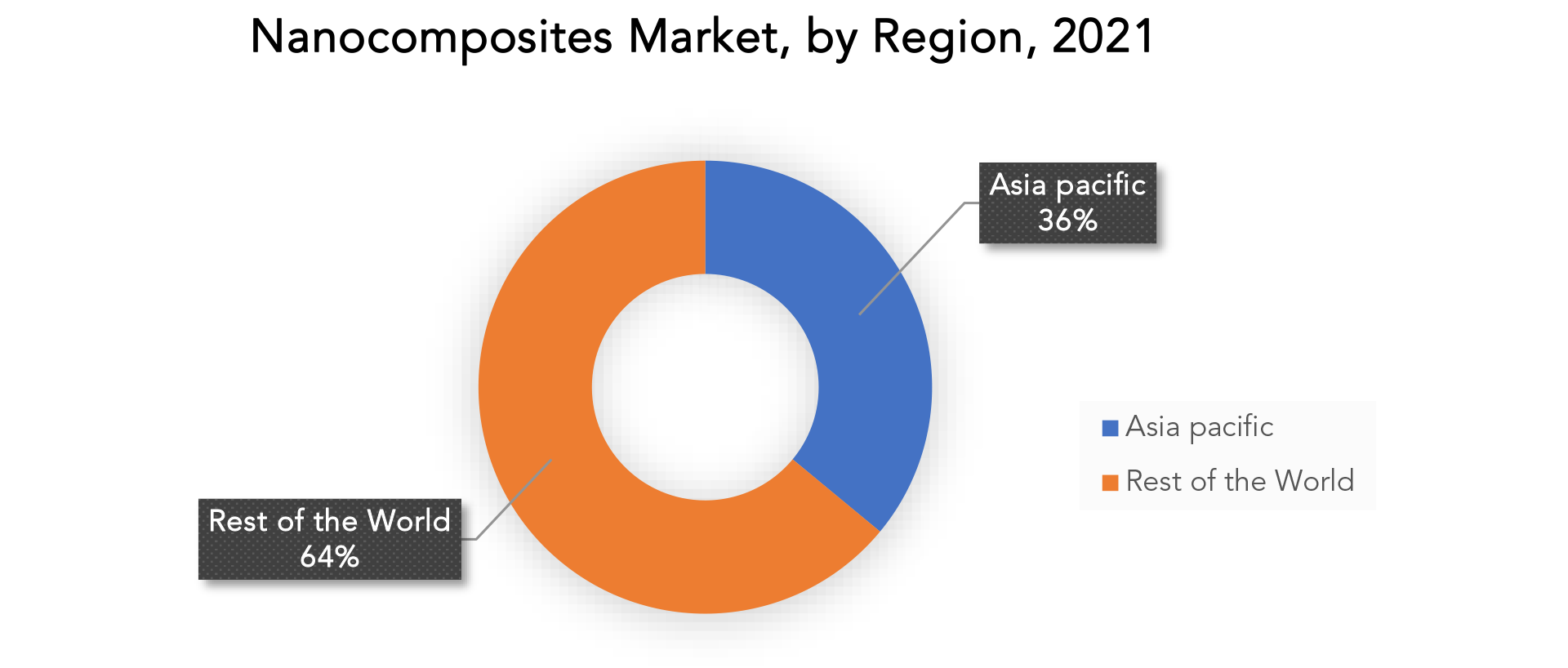
Key Market Segments: Nanocomposites Market
Nanocomposites Market By Type, 2020-2029, (USD Billion), (Kilotons)- Polymer Matrix
- Metral Matrix
- Ceramic Matrix
- Carbon Nanotube
- Nanoclay
- Metal/Metal Oxide
- Packaging
- Automotive
- Electronics Electrical
- North America
- Asia Pacific
- Europe
- South America
- Middle East And Africa
Exactitude Consultancy Services Key Objectives:
- Increasing sales and Market share
- Developing new technology
- Improving profitability
- Entering new markets
- Enhancing brand reputation
Key Question Answered
- What is the expected growth rate of the nanocomposites market over the next 7 years?
- Who are the major players in the nanocomposites market and what is their market share?
- What are the end-user industries driving demand for market and what is their outlook?
- What are the opportunities for growth in emerging markets such as asia-pacific, middle east, and africa?
- How is the economic environment affecting the nanocomposites market, including factors such as interest rates, inflation, and exchange rates?
- What is the expected impact of government policies and regulations on the nanocomposites market?
- What is the current and forecasted size and growth rate of the global nanocomposites market?
- What are the key drivers of growth in the nanocomposites market?
- Who are the major players in the market and what is their market share?
- What are the distribution channels and supply chain dynamics in the nanocomposites market?
- What are the technological advancements and innovations in the nanocomposites market and their impact on product development and growth?
- What are the regulatory considerations and their impact on the market?
- What are the challenges faced by players in the nanocomposites market and how are they addressing these challenges?
- What are the opportunities for growth and expansion in the nanocomposites market?
- What are the products offerings and specifications of leading players in the market?
- INTRODUCTION
- MARKET DEFINITION
- MARKET SEGMENTATION
- RESEARCH TIMELINES
- ASSUMPTIONS AND LIMITATIONS
- RESEARCH METHODOLOGY
- DATA MINING
- SECONDARY RESEARCH
- PRIMARY RESEARCH
- SUBJECT-MATTER EXPERTS’ ADVICE
- QUALITY CHECKS
- FINAL REVIEW
- DATA TRIANGULATION
- BOTTOM-UP APPROACH
- TOP-DOWN APPROACH
- RESEARCH FLOW
- DATA SOURCES
- DATA MINING
- EXECUTIVE SUMMARY
- MARKET OVERVIEW
- GLOBAL NANOCOMPOSITES MARKET OUTLOOK
- MARKET DRIVERS
- MARKET RESTRAINTS
- MARKET OPPORTUNITIES
- IMPACT OF COVID-19 ON NANOCOMPOSITES MARKET
- PORTER’S FIVE FORCES MODEL
- THREAT FROM NEW ENTRANTS
- THREAT FROM SUBSTITUTES
- BARGAINING POWER OF SUPPLIERS
- BARGAINING POWER OF CUSTOMERS
- DEGREE OF COMPETITION
- INDUSTRY VALUE CHAIN ANALYSIS
- GLOBAL NANOCOMPOSITES MARKET OUTLOOK
- GLOBAL NANOCOMPOSITES MARKET BY TYPE, 2020-2029, (USD BILLION), (KILOTONS)
- POLYMER MATRIX
- METAL MATRIX
- CERAMIC MATRIX
- GLOBAL NANOCOMPOSITES MARKET BY PRODUCT, 2020-2029, (USD BILLION), (KILOTONS)
- CARBON NANOTUBE
- NANOCLAY
- METAL/METAL OXIDE
- GLOBAL NANOCOMPOSITES MARKET BY APPLICATION, 2020-2029, (USD BILLION), (KILOTONS)
- PACKAGING
- AUTOMOTIVE
- ELECTRONICS ELECTRICAL
- GLOBAL NANOCOMPOSITES MARKET BY REGION, 2020-2029, (USD BILLION), (KILOTONS)
- NORTH AMERICA
- US
- CANADA
- MEXICO
- SOUTH AMERICA
- BRAZIL
- ARGENTINA
- COLOMBIA
- REST OF SOUTH AMERICA
- EUROPE
- GERMANY
- UK
- FRANCE
- ITALY
- SPAIN
- RUSSIA
- REST OF EUROPE
- ASIA PACIFIC
- INDIA
- CHINA
- JAPAN
- SOUTH KOREA
- AUSTRALIA
- SOUTH-EAST ASIA
- REST OF ASIA PACIFIC
- MIDDLE EAST AND AFRICA
- UAE
- SAUDI ARABIA
- SOUTH AFRICA
- REST OF MIDDLE EAST AND AFRICA
- NORTH AMERICA
- COMPANY PROFILES* (BUSINESS OVERVIEW, COMPANY SNAPSHOT, PRODUCT OFFERED, RECENT DEVELOPMENTS)
- NANOCOR INC.,
- ARKEMA INC
- POWDERMET INC.,
- RTP COMPANY
- UNIDYM INC
- NANOCYL SA
- GNANOMAT
- BASF
- CELANESE CORPORATION
- CABOT *THE COMPANY LIST IS INDICATIVE
LIST OF TABLES
TABLE 1 GLOBAL NANOCOMPOSITES MARKET BY TYPE (USD BILLION) 2020-2029
TABLE 2 GLOBAL NANOCOMPOSITES MARKET BY TYPE (KILOTONS) 2020-2029
TABLE 3 GLOBAL NANOCOMPOSITES MARKET BY PRODUCT (USD BILLION) 2020-2029
TABLE 4 GLOBAL NANOCOMPOSITES MARKET BY PRODUCT (KILOTONS) 2020-2029
TABLE 5 GLOBAL NANOCOMPOSITES MARKET BY APPLICATION (USD BILLION) 2020-2029
TABLE 6 GLOBAL NANOCOMPOSITES MARKET BY APPLICATION (KILOTONS) 2020-2029
TABLE 7 GLOBAL NANOCOMPOSITES MARKET BY REGION (USD BILLION) 2020-2029
TABLE 8 GLOBAL NANOCOMPOSITES MARKET BY REGION (KILOTONS) 2020-2029
TABLE 9 NORTH AMERICA NANOCOMPOSITES MARKET BY COUNTRY (USD BILLION) 2020-2029
TABLE 10 NORTH AMERICA NANOCOMPOSITES MARKET BY COUNTRY (KILOTONS) 2020-2029
TABLE 11 NORTH AMERICA NANOCOMPOSITES MARKET BY TYPE (USD BILLION) 2020-2029
TABLE 12 NORTH AMERICA NANOCOMPOSITES MARKET BY TYPE (KILOTONS) 2020-2029
TABLE 13 NORTH AMERICA NANOCOMPOSITES MARKET BY PRODUCT (USD BILLION) 2020-2029
TABLE 14 NORTH AMERICA NANOCOMPOSITES MARKET BY PRODUCT (KILOTONS) 2020-2029
TABLE 15 NORTH AMERICA NANOCOMPOSITES MARKET BY APPLICATION (USD BILLION) 2020-2029
TABLE 16 NORTH AMERICA NANOCOMPOSITES MARKET BY APPLICATION (KILOTONS) 2020-2029
TABLE 17 US NANOCOMPOSITES MARKET BY TYPE (USD BILLION) 2020-2029
TABLE 18 US NANOCOMPOSITES MARKET BY TYPE (KILOTONS) 2020-2029
TABLE 19 US NANOCOMPOSITES MARKET BY PRODUCT (USD BILLION) 2020-2029
TABLE 20 US NANOCOMPOSITES MARKET BY PRODUCT (KILOTONS) 2020-2029
TABLE 21 US NANOCOMPOSITES MARKET BY APPLICATION (USD BILLION) 2020-2029
TABLE 22 US NANOCOMPOSITES MARKET BY APPLICATION (KILOTONS) 2020-2029
TABLE 23 CANADA NANOCOMPOSITES MARKET BY TYPE (USD BILLION) 2020-2029
TABLE 24 CANADA NANOCOMPOSITES MARKET BY TYPE (KILOTONS) 2020-2029
TABLE 25 CANADA NANOCOMPOSITES MARKET BY PRODUCT (USD BILLION) 2020-2029
TABLE 26 CANADA NANOCOMPOSITES MARKET BY PRODUCT (KILOTONS) 2020-2029
TABLE 27 CANADA NANOCOMPOSITES MARKET BY APPLICATION (USD BILLION) 2020-2029
TABLE 28 CANADA NANOCOMPOSITES MARKET BY APPLICATION (KILOTONS) 2020-2029
TABLE 29 MEXICO NANOCOMPOSITES MARKET BY TYPE (USD BILLION) 2020-2029
TABLE 30 MEXICO NANOCOMPOSITES MARKET BY TYPE (KILOTONS) 2020-2029
TABLE 31 MEXICO NANOCOMPOSITES MARKET BY PRODUCT (USD BILLION) 2020-2029
TABLE 32 MEXICO NANOCOMPOSITES MARKET BY PRODUCT (KILOTONS) 2020-2029
TABLE 33 MEXICO NANOCOMPOSITES MARKET BY APPLICATION (USD BILLION) 2020-2029
TABLE 34 MEXICO NANOCOMPOSITES MARKET BY APPLICATION (KILOTONS) 2020-2029
TABLE 35 SOUTH AMERICA NANOCOMPOSITES MARKET BY COUNTRY (USD BILLION) 2020-2029
TABLE 36 SOUTH AMERICA NANOCOMPOSITES MARKET BY COUNTRY (KILOTONS) 2020-2029
TABLE 37 SOUTH AMERICA NANOCOMPOSITES MARKET BY TYPE (USD BILLION) 2020-2029
TABLE 38 SOUTH AMERICA NANOCOMPOSITES MARKET BY TYPE (KILOTONS) 2020-2029
TABLE 39 SOUTH AMERICA NANOCOMPOSITES MARKET BY PRODUCT (USD BILLION) 2020-2029
TABLE 40 SOUTH AMERICA NANOCOMPOSITES MARKET BY PRODUCT (KILOTONS) 2020-2029
TABLE 41 SOUTH AMERICA NANOCOMPOSITES MARKET BY APPLICATION (USD BILLION) 2020-2029
TABLE 42 SOUTH AMERICA NANOCOMPOSITES MARKET BY APPLICATION (KILOTONS) 2020-2029
TABLE 43 BRAZIL NANOCOMPOSITES MARKET BY TYPE (USD BILLION) 2020-2029
TABLE 44 BRAZIL NANOCOMPOSITES MARKET BY TYPE (KILOTONS) 2020-2029
TABLE 45 BRAZIL NANOCOMPOSITES MARKET BY PRODUCT (USD BILLION) 2020-2029
TABLE 46 BRAZIL NANOCOMPOSITES MARKET BY PRODUCT (KILOTONS) 2020-2029
TABLE 47 BRAZIL NANOCOMPOSITES MARKET BY APPLICATION (USD BILLION) 2020-2029
TABLE 48 BRAZIL NANOCOMPOSITES MARKET BY APPLICATION (KILOTONS) 2020-2029
TABLE 49 ARGENTINA NANOCOMPOSITES MARKET BY TYPE (USD BILLION) 2020-2029
TABLE 50 ARGENTINA NANOCOMPOSITES MARKET BY TYPE (KILOTONS) 2020-2029
TABLE 51 ARGENTINA NANOCOMPOSITES MARKET BY PRODUCT (USD BILLION) 2020-2029
TABLE 52 ARGENTINA NANOCOMPOSITES MARKET BY PRODUCT (KILOTONS) 2020-2029
TABLE 53 ARGENTINA NANOCOMPOSITES MARKET BY APPLICATION (USD BILLION) 2020-2029
TABLE 54 ARGENTINA NANOCOMPOSITES MARKET BY APPLICATION (KILOTONS) 2020-2029
TABLE 55 COLOMBIA NANOCOMPOSITES MARKET BY TYPE (USD BILLION) 2020-2029
TABLE 56 COLOMBIA NANOCOMPOSITES MARKET BY TYPE (KILOTONS) 2020-2029
TABLE 57 COLOMBIA NANOCOMPOSITES MARKET BY PRODUCT (USD BILLION) 2020-2029
TABLE 58 COLOMBIA NANOCOMPOSITES MARKET BY PRODUCT (KILOTONS) 2020-2029
TABLE 59 COLOMBIA NANOCOMPOSITES MARKET BY APPLICATION (USD BILLION) 2020-2029
TABLE 60 COLOMBIA NANOCOMPOSITES MARKET BY APPLICATION (KILOTONS) 2020-2029
TABLE 61 REST OF SOUTH AMERICA NANOCOMPOSITES MARKET BY TYPE (USD BILLION) 2020-2029
TABLE 62 REST OF SOUTH AMERICA NANOCOMPOSITES MARKET BY TYPE (KILOTONS) 2020-2029
TABLE 63 REST OF SOUTH AMERICA NANOCOMPOSITES MARKET BY PRODUCT (USD BILLION) 2020-2029
TABLE 64 REST OF SOUTH AMERICA NANOCOMPOSITES MARKET BY PRODUCT (KILOTONS) 2020-2029
TABLE 65 REST OF SOUTH AMERICA NANOCOMPOSITES MARKET BY APPLICATION (USD BILLION) 2020-2029
TABLE 66 REST OF SOUTH AMERICA NANOCOMPOSITES MARKET BY APPLICATION (KILOTONS) 2020-2029
TABLE 67 ASIA-PACIFIC NANOCOMPOSITES MARKET BY COUNTRY (USD BILLION) 2020-2029
TABLE 68 ASIA-PACIFIC NANOCOMPOSITES MARKET BY COUNTRY (KILOTONS) 2020-2029
TABLE 69 ASIA-PACIFIC NANOCOMPOSITES MARKET BY TYPE (USD BILLION) 2020-2029
TABLE 70 ASIA-PACIFIC NANOCOMPOSITES MARKET BY TYPE (KILOTONS) 2020-2029
TABLE 71 ASIA-PACIFIC NANOCOMPOSITES MARKET BY PRODUCT (USD BILLION) 2020-2029
TABLE 72 ASIA-PACIFIC NANOCOMPOSITES MARKET BY PRODUCT (KILOTONS) 2020-2029
TABLE 73 ASIA-PACIFIC NANOCOMPOSITES MARKET BY APPLICATION (USD BILLION) 2020-2029
TABLE 74 ASIA-PACIFIC NANOCOMPOSITES MARKET BY APPLICATION (KILOTONS) 2020-2029
TABLE 75 INDIA NANOCOMPOSITES MARKET BY TYPE (USD BILLION) 2020-2029
TABLE 76 INDIA NANOCOMPOSITES MARKET BY TYPE (KILOTONS) 2020-2029
TABLE 77 INDIA NANOCOMPOSITES MARKET BY PRODUCT (USD BILLION) 2020-2029
TABLE 78 INDIA NANOCOMPOSITES MARKET BY PRODUCT (KILOTONS) 2020-2029
TABLE 79 INDIA NANOCOMPOSITES MARKET BY APPLICATION (USD BILLION) 2020-2029
TABLE 80 INDIA NANOCOMPOSITES MARKET BY APPLICATION (KILOTONS) 2020-2029
TABLE 81 CHINA NANOCOMPOSITES MARKET BY TYPE (USD BILLION) 2020-2029
TABLE 82 CHINA NANOCOMPOSITES MARKET BY TYPE (KILOTONS) 2020-2029
TABLE 83 CHINA NANOCOMPOSITES MARKET BY PRODUCT (USD BILLION) 2020-2029
TABLE 84 CHINA NANOCOMPOSITES MARKET BY PRODUCT (KILOTONS) 2020-2029
TABLE 85 CHINA NANOCOMPOSITES MARKET BY APPLICATION (USD BILLION) 2020-2029
TABLE 86 CHINA NANOCOMPOSITES MARKET BY APPLICATION (KILOTONS) 2020-2029
TABLE 87 JAPAN NANOCOMPOSITES MARKET BY TYPE (USD BILLION) 2020-2029
TABLE 88 JAPAN NANOCOMPOSITES MARKET BY TYPE (KILOTONS) 2020-2029
TABLE 89 JAPAN NANOCOMPOSITES MARKET BY PRODUCT (USD BILLION) 2020-2029
TABLE 90 JAPAN NANOCOMPOSITES MARKET BY PRODUCT (KILOTONS) 2020-2029
TABLE 91 JAPAN NANOCOMPOSITES MARKET BY APPLICATION (USD BILLION) 2020-2029
TABLE 92 JAPAN NANOCOMPOSITES MARKET BY APPLICATION (KILOTONS) 2020-2029
TABLE 93 SOUTH KOREA NANOCOMPOSITES MARKET BY TYPE (USD BILLION) 2020-2029
TABLE 94 SOUTH KOREA NANOCOMPOSITES MARKET BY TYPE (KILOTONS) 2020-2029
TABLE 95 SOUTH KOREA NANOCOMPOSITES MARKET BY PRODUCT (USD BILLION) 2020-2029
TABLE 96 SOUTH KOREA NANOCOMPOSITES MARKET BY PRODUCT (KILOTONS) 2020-2029
TABLE 97 SOUTH KOREA NANOCOMPOSITES MARKET BY APPLICATION (USD BILLION) 2020-2029
TABLE 98 SOUTH KOREA NANOCOMPOSITES MARKET BY APPLICATION (KILOTONS) 2020-2029
TABLE 99 AUSTRALIA NANOCOMPOSITES MARKET BY TYPE (USD BILLION) 2020-2029
TABLE 100 AUSTRALIA NANOCOMPOSITES MARKET BY TYPE (KILOTONS) 2020-2029
TABLE 101 AUSTRALIA NANOCOMPOSITES MARKET BY PRODUCT (USD BILLION) 2020-2029
TABLE 102 AUSTRALIA NANOCOMPOSITES MARKET BY PRODUCT (KILOTONS) 2020-2029
TABLE 103 AUSTRALIA NANOCOMPOSITES MARKET BY APPLICATION (USD BILLION) 2020-2029
TABLE 104 AUSTRALIA NANOCOMPOSITES MARKET BY APPLICATION (KILOTONS) 2020-2029
TABLE 105 SOUTH-EAST ASIA NANOCOMPOSITES MARKET BY TYPE (USD BILLION) 2020-2029
TABLE 106 SOUTH-EAST ASIA NANOCOMPOSITES MARKET BY TYPE (KILOTONS) 2020-2029
TABLE 107 SOUTH-EAST ASIA NANOCOMPOSITES MARKET BY PRODUCT (USD BILLION) 2020-2029
TABLE 108 SOUTH-EAST ASIA NANOCOMPOSITES MARKET BY PRODUCT (KILOTONS) 2020-2029
TABLE 109 SOUTH-EAST ASIA NANOCOMPOSITES MARKET BY APPLICATION (USD BILLION) 2020-2029
TABLE 110 SOUTH-EAST ASIA NANOCOMPOSITES MARKET BY APPLICATION (KILOTONS) 2020-2029
TABLE 111 REST OF ASIA PACIFIC NANOCOMPOSITES MARKET BY TYPE (USD BILLION) 2020-2029
TABLE 112 REST OF ASIA PACIFIC NANOCOMPOSITES MARKET BY TYPE (KILOTONS) 2020-2029
TABLE 113 REST OF ASIA PACIFIC NANOCOMPOSITES MARKET BY PRODUCT (USD BILLION) 2020-2029
TABLE 114 REST OF ASIA PACIFIC NANOCOMPOSITES MARKET BY PRODUCT (KILOTONS) 2020-2029
TABLE 115 REST OF ASIA PACIFIC NANOCOMPOSITES MARKET BY APPLICATION (USD BILLION) 2020-2029
TABLE 116 REST OF ASIA PACIFIC NANOCOMPOSITES MARKET BY APPLICATION (KILOTONS) 2020-2029
TABLE 117 EUROPE NANOCOMPOSITES MARKET BY COUNTRY (USD BILLION) 2020-2029
TABLE 118 EUROPE NANOCOMPOSITES MARKET BY COUNTRY (KILOTONS) 2020-2029
TABLE 119 ASIA-PACIFIC NANOCOMPOSITES MARKET BY TYPE (USD BILLION) 2020-2029
TABLE 120 ASIA-PACIFIC NANOCOMPOSITES MARKET BY TYPE (KILOTONS) 2020-2029
TABLE 121 ASIA-PACIFIC NANOCOMPOSITES MARKET BY PRODUCT (USD BILLION) 2020-2029
TABLE 122 ASIA-PACIFIC NANOCOMPOSITES MARKET BY PRODUCT (KILOTONS) 2020-2029
TABLE 123 ASIA-PACIFIC NANOCOMPOSITES MARKET BY APPLICATION (USD BILLION) 2020-2029
TABLE 124 ASIA-PACIFIC NANOCOMPOSITES MARKET BY APPLICATION (KILOTONS) 2020-2029
TABLE 125 GERMANY NANOCOMPOSITES MARKET BY TYPE (USD BILLION) 2020-2029
TABLE 126 GERMANY NANOCOMPOSITES MARKET BY TYPE (KILOTONS) 2020-2029
TABLE 127 GERMANY NANOCOMPOSITES MARKET BY PRODUCT (USD BILLION) 2020-2029
TABLE 128 GERMANY NANOCOMPOSITES MARKET BY PRODUCT (KILOTONS) 2020-2029
TABLE 129 GERMANY NANOCOMPOSITES MARKET BY APPLICATION (USD BILLION) 2020-2029
TABLE 130 GERMANY NANOCOMPOSITES MARKET BY APPLICATION (KILOTONS) 2020-2029
TABLE 131 UK NANOCOMPOSITES MARKET BY TYPE (USD BILLION) 2020-2029
TABLE 132 UK NANOCOMPOSITES MARKET BY TYPE (KILOTONS) 2020-2029
TABLE 133 UK NANOCOMPOSITES MARKET BY PRODUCT (USD BILLION) 2020-2029
TABLE 134 UK NANOCOMPOSITES MARKET BY PRODUCT (KILOTONS) 2020-2029
TABLE 135 UK NANOCOMPOSITES MARKET BY APPLICATION (USD BILLION) 2020-2029
TABLE 136 UK NANOCOMPOSITES MARKET BY APPLICATION (KILOTONS) 2020-2029
TABLE 137 FRANCE NANOCOMPOSITES MARKET BY TYPE (USD BILLION) 2020-2029
TABLE 138 FRANCE NANOCOMPOSITES MARKET BY TYPE (KILOTONS) 2020-2029
TABLE 139 FRANCE NANOCOMPOSITES MARKET BY PRODUCT (USD BILLION) 2020-2029
TABLE 140 FRANCE NANOCOMPOSITES MARKET BY PRODUCT (KILOTONS) 2020-2029
TABLE 141 FRANCE NANOCOMPOSITES MARKET BY APPLICATION (USD BILLION) 2020-2029
TABLE 142 FRANCE NANOCOMPOSITES MARKET BY APPLICATION (KILOTONS) 2020-2029
TABLE 143 ITALY NANOCOMPOSITES MARKET BY TYPE (USD BILLION) 2020-2029
TABLE 144 ITALY NANOCOMPOSITES MARKET BY TYPE (KILOTONS) 2020-2029
TABLE 145 ITALY NANOCOMPOSITES MARKET BY PRODUCT (USD BILLION) 2020-2029
TABLE 146 ITALY NANOCOMPOSITES MARKET BY PRODUCT (KILOTONS) 2020-2029
TABLE 147 ITALY NANOCOMPOSITES MARKET BY APPLICATION (USD BILLION) 2020-2029
TABLE 148 ITALY NANOCOMPOSITES MARKET BY APPLICATION (KILOTONS) 2020-2029
TABLE 149 SPAIN NANOCOMPOSITES MARKET BY TYPE (USD BILLION) 2020-2029
TABLE 150 SPAIN NANOCOMPOSITES MARKET BY TYPE (KILOTONS) 2020-2029
TABLE 151 SPAIN NANOCOMPOSITES MARKET BY PRODUCT (USD BILLION) 2020-2029
TABLE 152 SPAIN NANOCOMPOSITES MARKET BY PRODUCT (KILOTONS) 2020-2029
TABLE 153 SPAIN NANOCOMPOSITES MARKET BY APPLICATION (USD BILLION) 2020-2029
TABLE 154 SPAIN NANOCOMPOSITES MARKET BY APPLICATION (KILOTONS) 2020-2029
TABLE 155 RUSSIA NANOCOMPOSITES MARKET BY TYPE (USD BILLION) 2020-2029
TABLE 156 RUSSIA NANOCOMPOSITES MARKET BY TYPE (KILOTONS) 2020-2029
TABLE 157 RUSSIA NANOCOMPOSITES MARKET BY PRODUCT (USD BILLION) 2020-2029
TABLE 158 RUSSIA NANOCOMPOSITES MARKET BY PRODUCT (KILOTONS) 2020-2029
TABLE 159 RUSSIA NANOCOMPOSITES MARKET BY APPLICATION (USD BILLION) 2020-2029
TABLE 160 RUSSIA NANOCOMPOSITES MARKET BY APPLICATION (KILOTONS) 2020-2029
TABLE 161 REST OF EUROPE NANOCOMPOSITES MARKET BY TYPE (USD BILLION) 2020-2029
TABLE 162 REST OF EUROPE NANOCOMPOSITES MARKET BY TYPE (KILOTONS) 2020-2029
TABLE 163 REST OF EUROPE NANOCOMPOSITES MARKET BY PRODUCT (USD BILLION) 2020-2029
TABLE 164 REST OF EUROPE NANOCOMPOSITES MARKET BY PRODUCT (KILOTONS) 2020-2029
TABLE 165 REST OF EUROPE NANOCOMPOSITES MARKET BY APPLICATION (USD BILLION) 2020-2029
TABLE 166 REST OF EUROPE NANOCOMPOSITES MARKET BY APPLICATION (KILOTONS) 2020-2029
TABLE 167 MIDDLE EAST AND AFRICA NANOCOMPOSITES MARKET BY COUNTRY (USD BILLION) 2020-2029
TABLE 168 MIDDLE EAST AND AFRICA NANOCOMPOSITES MARKET BY COUNTRY (KILOTONS) 2020-2029
TABLE 169 MIDDLE EAST AND AFRICA NANOCOMPOSITES MARKET BY TYPE (USD BILLION) 2020-2029
TABLE 170 MIDDLE EAST AND AFRICA NANOCOMPOSITES MARKET BY TYPE (KILOTONS) 2020-2029
TABLE 171 MIDDLE EAST AND AFRICA NANOCOMPOSITES MARKET BY PRODUCT (USD BILLION) 2020-2029
TABLE 172 MIDDLE EAST AND AFRICA NANOCOMPOSITES MARKET BY PRODUCT (KILOTONS) 2020-2029
TABLE 173 MIDDLE EAST AND AFRICA NANOCOMPOSITES MARKET BY APPLICATION (USD BILLION) 2020-2029
TABLE 174 MIDDLE EAST AND AFRICA NANOCOMPOSITES MARKET BY APPLICATION (KILOTONS) 2020-2029
TABLE 175 UAE NANOCOMPOSITES MARKET BY TYPE (USD BILLION) 2020-2029
TABLE 176 UAE NANOCOMPOSITES MARKET BY TYPE (KILOTONS) 2020-2029
TABLE 177 UAE NANOCOMPOSITES MARKET BY PRODUCT (USD BILLION) 2020-2029
TABLE 178 UAE NANOCOMPOSITES MARKET BY PRODUCT (KILOTONS) 2020-2029
TABLE 179 UAE NANOCOMPOSITES MARKET BY APPLICATION (USD BILLION) 2020-2029
TABLE 180 UAE NANOCOMPOSITES MARKET BY APPLICATION (KILOTONS) 2020-2029
TABLE 181 SAUDI ARABIA NANOCOMPOSITES MARKET BY TYPE (USD BILLION) 2020-2029
TABLE 182 SAUDI ARABIA NANOCOMPOSITES MARKET BY TYPE (KILOTONS) 2020-2029
TABLE 183 SAUDI ARABIA NANOCOMPOSITES MARKET BY PRODUCT (USD BILLION) 2020-2029
TABLE 184 SAUDI ARABIA NANOCOMPOSITES MARKET BY PRODUCT (KILOTONS) 2020-2029
TABLE 185 SAUDI ARABIA NANOCOMPOSITES MARKET BY APPLICATION (USD BILLION) 2020-2029
TABLE 186 SAUDI ARABIA NANOCOMPOSITES MARKET BY APPLICATION (KILOTONS) 2020-2029
TABLE 187 SOUTH AFRICA NANOCOMPOSITES MARKET BY TYPE (USD BILLION) 2020-2029
TABLE 188 SOUTH AFRICA NANOCOMPOSITES MARKET BY TYPE (KILOTONS) 2020-2029
TABLE 189 SOUTH AFRICA NANOCOMPOSITES MARKET BY PRODUCT (USD BILLION) 2020-2029
TABLE 190 SOUTH AFRICA NANOCOMPOSITES MARKET BY PRODUCT (KILOTONS) 2020-2029
TABLE 191 SOUTH AFRICA NANOCOMPOSITES MARKET BY APPLICATION (USD BILLION) 2020-2029
TABLE 192 SOUTH AFRICA NANOCOMPOSITES MARKET BY APPLICATION (KILOTONS) 2020-2029
TABLE 193 REST OF MIDDLE EAST AND AFRICA NANOCOMPOSITES MARKET BY TYPE (USD BILLION) 2020-2029
TABLE 194 REST OF MIDDLE EAST AND AFRICA NANOCOMPOSITES MARKET BY TYPE (KILOTONS) 2020-2029
TABLE 195 REST OF MIDDLE EAST AND AFRICA NANOCOMPOSITES MARKET BY PRODUCT (USD BILLION) 2020-2029
TABLE 196 REST OF MIDDLE EAST AND AFRICA NANOCOMPOSITES MARKET BY PRODUCT (KILOTONS) 2020-2029
TABLE 197 REST OF MIDDLE EAST AND AFRICA NANOCOMPOSITES MARKET BY APPLICATION (USD BILLION) 2020-2029
TABLE 198 REST OF MIDDLE EAST AND AFRICA NANOCOMPOSITES MARKET BY APPLICATION (KILOTONS) 2020-2029
LIST OF FIGURES
FIGURE 1 MARKET DYNAMICS
FIGURE 2 MARKET SEGMENTATION
FIGURE 3 REPORT TIMELINES: YEARS CONSIDERED
FIGURE 4 DATA TRIANGULATION
FIGURE 5 BOTTOM-UP APPROACH
FIGURE 6 TOP-DOWN APPROACH
FIGURE 7 RESEARCH FLOW
FIGURE 8 GLOBAL NANOCOMPOSITES MARKET BY TYPE, USD BILLION, 2020-2029
FIGURE 9 GLOBAL NANOCOMPOSITES MARKET BY PRODUCT, USD BILLION, 2020-2029
FIGURE 10 GLOBAL NANOCOMPOSITES MARKET BY APPLICATION, USD BILLION, 2020-2029
FIGURE 11 GLOBAL NANOCOMPOSITES MARKET BY REGION, USD BILLION, 2020-2029
FIGURE 12 PORTER’S FIVE FORCES MODEL
FIGURE 13 GLOBAL NANOCOMPOSITES MARKET BY TYPE, USD BILLION, 2021
FIGURE 14 GLOBAL NANOCOMPOSITES MARKET BY PRODUCT, USD BILLION, 2021
FIGURE 15 GLOBAL NANOCOMPOSITES MARKET BY APPLICATION, USD BILLION, 2021
FIGURE 16 GLOBAL NANOCOMPOSITES MARKET BY REGION, USD BILLION, 2021
FIGURE 17 NORTH AMERICA NANOCOMPOSITES MARKET SNAPSHOT
FIGURE 18 EUROPE NANOCOMPOSITES MARKET SNAPSHOT
FIGURE 19 SOUTH AMERICA NANOCOMPOSITES MARKET SNAPSHOT
FIGURE 20 ASIA PACIFIC NANOCOMPOSITES MARKET SNAPSHOT
FIGURE 21 MIDDLE EAST ASIA AND AFRICA NANOCOMPOSITES MARKET SNAPSHOT
FIGURE 22 MARKET SHARE ANALYSIS
FIGURE 23 NANOCOR INC.: COMPANY SNAPSHOT
FIGURE 24 ARKEMA INC: COMPANY SNAPSHOT
FIGURE 25 POWDERMET INC.: COMPANY SNAPSHOT
FIGURE 26 RTP COMPANY: COMPANY SNAPSHOT
FIGURE 27 UNIDYM INC.: COMPANY SNAPSHOT
FIGURE 28 NANOCYL SA: COMPANY SNAPSHOT
FIGURE 29 GNANOMAT: COMPANY SNAPSHOT
FIGURE 30 BASF: COMPANY SNAPSHOT
FIGURE 31 CELANESE CORPORATION: COMPANY SNAPSHOT
FIGURE 32 CABOT: COMPANY SNAPSHOT
DOWNLOAD FREE SAMPLE REPORT
License Type
SPEAK WITH OUR ANALYST
Want to know more about the report or any specific requirement?
WANT TO CUSTOMIZE THE REPORT?
Our Clients Speak
We asked them to research ‘ Equipment market’ all over the world, and their whole arrangement was helpful to us. thehealthanalytics.com insightful analysis and reports contributed to our current analysis and in creating a future strategy. Besides, the te
Yosuke Mitsui
Senior Associate Construction Equipment Sales & Marketing
We asked them to research ‘Equipment market’ all over the world, and their whole arrangement was helpful to us. thehealthanalytics.com insightful analysis and reports contributed to our current analysis and in creating a future strategy. Besides, the te