

Base Year Value ()
x.x %
x.x %
CAGR ()
x.x %
x.x %
Forecast Year Value ()
x.x %
x.x %
Historical Data Period
Largest Region
Forecast Period
Soft Magnetic Materials Market by Type (Soft Ferrite, Electrical Steel, Cobalt), by Applications (Motor, Transformer, Alternator), by End-Use (Automotive, Electronics & Telecommunication, Electrical) and Region, Global trends and forecast from 2023 to 2029
Instant access to hundreds of data points and trends
- Market estimates from 2014-2029
- Competitive analysis, industry segmentation, financial benchmarks
- Incorporates SWOT, Porter's Five Forces and risk management frameworks
- PDF report or online database with Word, Excel and PowerPoint export options
- 100% money back guarantee
Soft Magnetic Materials Market Overview
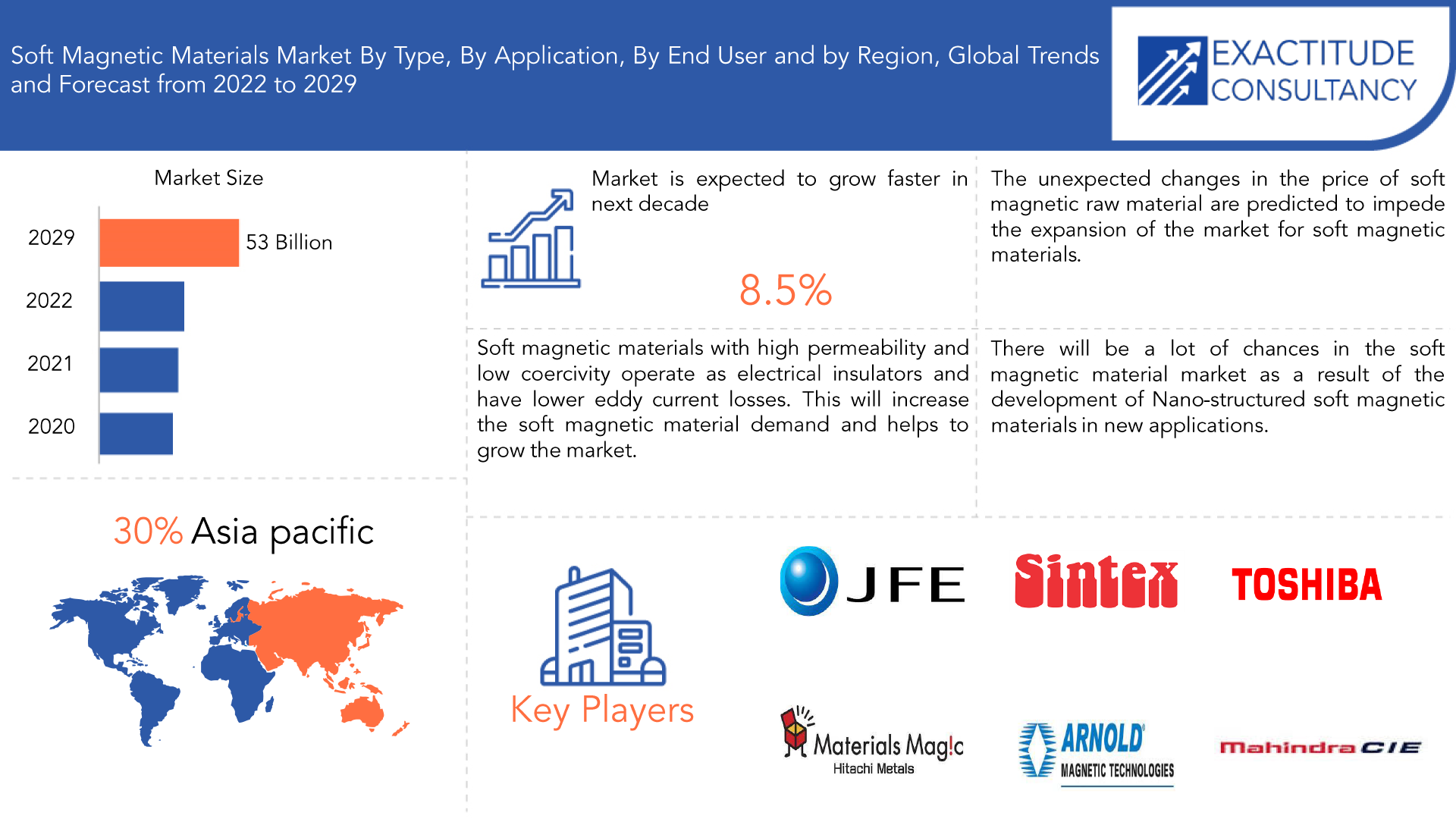
The soft magnetic materials market is expected to grow at 8.5% CAGR from 2020 to 2029. It is expected to reach above USD 53 billion by 2029 from USD 26.1 billion in 2020.
In many of the items we use every day, soft magnetic materials are used. Traditional soft magnetic materials have been utilized for more than or almost a century, including electronic iron, Si-steel, and soft ferrite. Even the most recent kinds of soft magnetic materials, such as amorphous and nanocrystalline alloys, have been produced for more than 40 years. The manufacturing process and alloy composition have continuously improved. For instance, the core loss at 1.7 T, 50 Hz was reduced from 1.2 to 0.7 W/kg, while the thickness of Si steel was reduced from 0.30 to 0.23 mm. The core loss falls to 0.21 W/kg as the sheet thickness is further reduced to 32 m.
Soft magnetic materials are those with a steep rising magnetization curve, a small and narrow hysteresis loop, and hence low energy losses for each cycle of magnetization. Because it improves the field created by the motor winding, soft magnetic material is frequently employed in motor applications. Moreover, iron-based materials, such as iron-silicon and iron-cobalt alloys, are mostly used in motor applications. Nowadays, motor components are primarily made using the powder metallurgical technique. Soft magnetic materials reduce eddy current loss, increasing the motors' efficiency.
Functional components for measuring the magnetic field, electric current, displacement, and mechanical stress include soft magnetic materials. High saturation magnetization, minimal coercive force, little hysteresis loss, and maximum permeability are all features they provide. The magnetic cores of transformers, inductors, motors, and generators all over the world use them. Pure iron, silicon iron alloys, and nickel-iron alloys are a few of the often-utilized soft magnetic materials.
Due to advantages including minimal noise, compact design, and energy savings, soft magnetic materials are typically utilized in electric motors, which are commonly seen in electric vehicles. Moreover, brushless DC motors, stepper motors, brushed DC motors, switch reluctance motors, claw pole motors, transformers, and alternators all frequently employ soft magnetic materials in their stators. Soft magnetic materials with high permeability and low coercivity operate as electrical insulators and have lower eddy current losses. They also have high electrical resistivity to iron. This will likely result in a significant increase in soft magnetic material demand, which will propel the market for these materials to expand.
| ATTRIBUTE | DETAILS |
| Study period | 2020-2029 |
| Base year | 2021 |
| Estimated year | 2022 |
| Forecasted year | 2022-2029 |
| Historical period | 2018-2020 |
| Unit | Value (USD BILLION) |
| Segmentation | By Type, By Application, By End-User, By Region |
| By Type
|
|
| By Application
|
|
| By End-User
|
|
| By Region
|
|
Iron, nickel, and/or cobalt are the principal metals in amorphous alloys, together with boron, carbon, phosphorus, or silicon. Industrial users are using magnetic components made from amorphous alloys to run processes more effectively, save energy, and save operating costs. Amorphous soft magnetic materials are ideal for the majority of electrical and electronic applications due to important characteristics like lower core losses at higher frequencies, higher & wide range of permeability, increased operational temperatures, low coercive field, core weight & volume reduction ability, excellent corrosion resistance, versatility, good mechanical strength, flux density, and various hysteresis loops, among others. It would fuel the expansion of this market even further.
To get a competitive edge, the main corporations are typically refocusing their efforts on creating new and inventive goods and expanding their production capabilities in the market for soft magnetic materials. There will be a lot of chances in the soft magnetic material market as a result of the development of nano-structured soft magnetic materials in new applications. The growing investments by major market players further offer the numerous growth opportunities within the market.
The unexpected changes in the price of soft magnetic raw material are predicted to impede the expansion of the market for soft magnetic materials. As a result, it hampered the flow of soft magnetic raw materials and presented difficulties for producers. The prices of iron ore saw a substantial decline 2019, due to the seasonal decline in superalloy demand and the recovery of supply by iron ore majors restrain for the market growth.
In terms of supply and demand, the COVID-19 pandemic epidemic has had a negative impact on a number of markets, including soft magnetic materials. The demand for medical devices like ventilators has increased as a result of the pandemic, which increases the need of motors for optimal control, regulated airflow, high torque density, and little noise. Because of the rise in patients around the world brought on by the coronavirus, there is a greater demand for ventilators, which is likely to raise demand for motors and ultimately propel the expansion of the soft magnetic material market. COVID-19 can affect the global economy in three main ways: by directly affecting production and demand, by creating supply chain and market disruption, and by its financial impact on firms and financial markets
[caption id="attachment_17072" align="aligncenter" width="1920"]
Frequently Asked Questions
• What is the worth of soft magnetic materials market?
The soft magnetic materials market is expected to grow at 8.5% CAGR from 2020 to 2029. It is expected to reach above USD 53 billion by 2029 from USD 26.1 billion in 2020.
• What is the size of the Asia pacific soft magnetic materials industry?
Asia Pacific held more than 30 % of the soft magnetic materials market revenue share in 2021 and will witness expansion in the forecast period.
• What are some of the market's driving forces?
Due to advantages including minimal noise, compact design, and energy savings, soft magnetic materials are typically utilized in electric motors, which are commonly seen in electric vehicles. Moreover, brushless DC motors, stepper motors, brushed DC motors, switch reluctance motors, claw pole motors, transformers, and alternators all frequently employ soft magnetic materials in their stators. Soft magnetic materials with high permeability and low coercivity operate as electrical insulators and have lower eddy current losses. They also have high electrical resistivity to iron. This will likely result in a significant increase in soft magnetic material demand, which will propel the market for these materials to expand.
• Which are the top companies to hold the market share in soft magnetic materials market?
The soft magnetic materials market key players Hitachi Metals.ltd, Toshiba Materials, GKN Sinter Metals inc, Sintex, Mate Co.Ltd, JFE Steel Group, Mahindra CIE, Meyer Sintermetal AG, Arnold Magnetic Technologies.
• What is the leading type of soft magnetic materials market?
Based on type, the electric steel market captured a sizable portion. Electric steel decreases magnetic losses while also providing electrical insulation, high permeability, low coercivity, and high electrical resistivity to iron. It is utilized in a variety of devices, including inductors, motors, generators, and electrical power transformers. Moreover, it provides a small hysteresis area that eventually results in decreased eddy current loss, boosting the application's effectiveness. Electric steel is widely used in a variety of applications due to its beneficial qualities, which is causing its utilization to rise rapidly and fostering the expansion of the market as a whole.
• Which is the largest regional market for soft magnetic materials market?
Asia Pacific held 30% of the overall market share of soft magnetic materials. Due to the presence of iron ore mining, the market for soft magnetic materials in the world was dominated by the Asia-Pacific region. The biggest producers and consumers in the Asia-Pacific region are underdeveloped nations like China and India. Manufacturers of soft magnetic materials from North American and European nations are motivated to invest in the Asia-Pacific region by the availability of cheap labor and the desire to pursue new market niches. The Asia-Pacific region's countries are experiencing robust industrialization, and this region's geographic advantages—such as the presence of iron mines in China and India—are what are driving the market for soft magnetic materials there.
Soft Magnetic Materials Market Segment Analysis
The soft magnetic materials market is segmented based on type, applications, end-use and region.
By type (soft ferrite, electrical steel, cobalt), by applications (motor, transformer, alternator), by end-use (automotive, electronics & telecommunication, electrical) and region.
Based on type, the electric steel market captured a sizable portion. Electric steel decreases magnetic losses while also providing electrical insulation, high permeability, low coercivity, and high electrical resistivity to iron. It is utilized in a variety of devices, including inductors, motors, generators, and electrical power transformers. Moreover, it provides a small hysteresis area that eventually results in decreased eddy current loss, boosting the application's effectiveness. Electric steel is widely used in a variety of applications due to its beneficial qualities, which is causing its utilization to rise rapidly and fostering the expansion of the market as a whole.
Based on Applications, the majority of revenues more than 50% were generated by electric motors. Several end-use industries, including electric transmission, consumer electronics, electric vehicles, and medical equipment, use electric motors. The soft magnetic material market's second-leading application sector is transformers, where soft magnetic materials are used in transformer cores. Expansion in the transformer sector, which is evident from numerous investments, is anticipated to accelerate market growth.
Based on end use, the electrical and electronics industry held a sizable market share for soft magnetic materials. This resulted from a significant demand for soft magnetic materials in the electricity-generating industry's key power transmission components. Nonetheless, given the industry's transition from a fossil fuel to an electric eco-system, the automobile sector is expected to show positive growth.
[caption id="attachment_17091" align="aligncenter" width="1920"]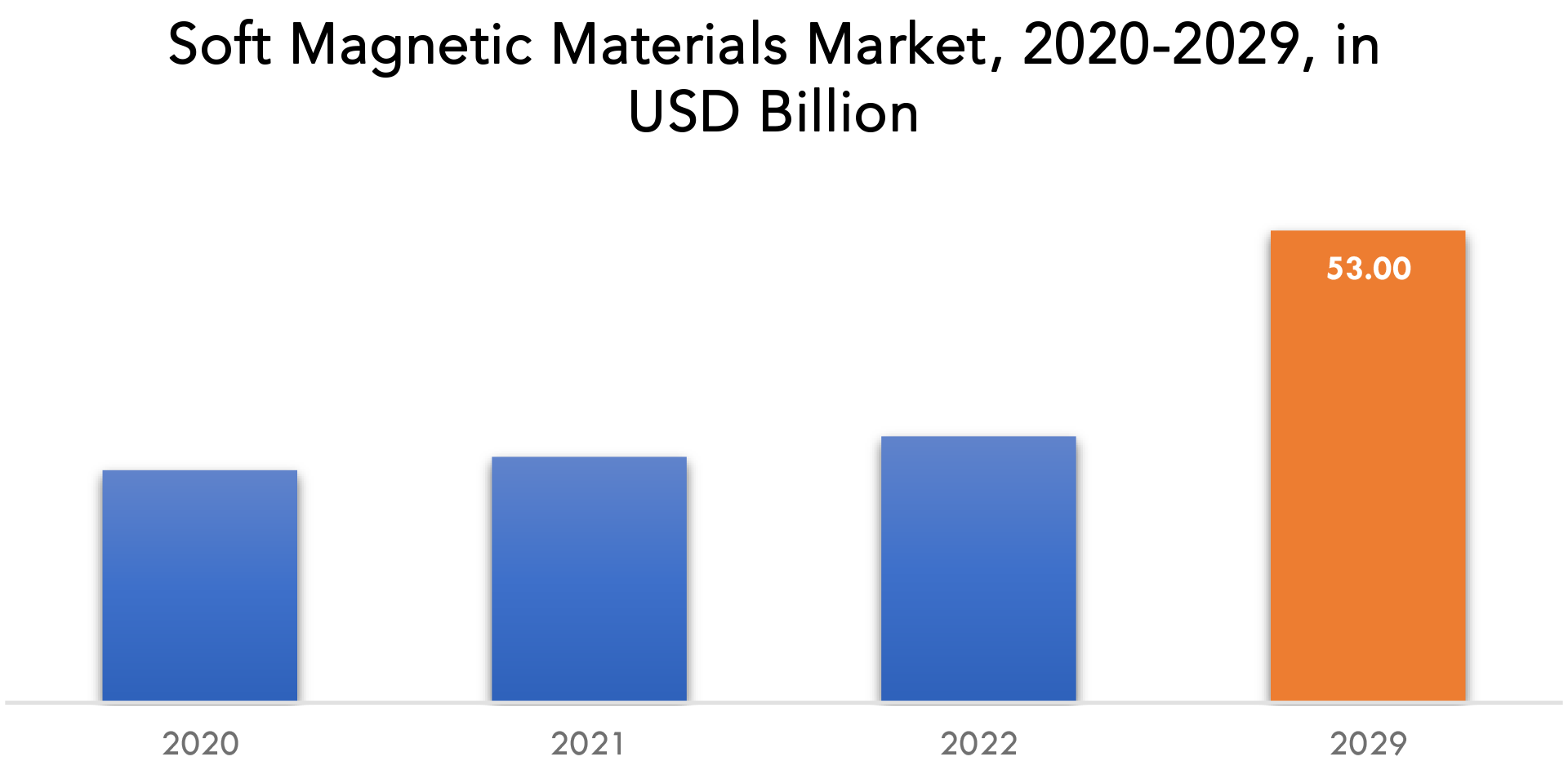
Soft Magnetic Materials Market Players
The Soft Magnetic Materials market key players Hitachi Metals.ltd, Toshiba Materials, GKN Sinter Metals inc, Sintex, Mate Co.Ltd, JFE Steel Group, Mahindra CIE, Meyer Sintermetal AG, Arnold Magnetic Technologies.
06-02-2023: - JFE Steel Corporation, which is expanding the electrical steel sheet capacity of its West Japan Works (Kurashiki Area) for startup targeted at the first half of the fiscal year starting in April 2024, announced today that it is now planning an additional expansion targeted at a startup in the fiscal year beginning April 2026
21-12-2022: - JFE Steel Corporation today announced that together with IHI Corporation it will conduct a demonstration test of an automated transport system using retrofitted vehicles at its East Japan Works (Keihin District) from February 2023, aiming to test all sections of the demonstration route within the fiscal year ending in March 2024.
Who Should Buy? Or Key Stakeholders
- Soft magnetic materials Suppliers
- Manufacturing
- Construction
- Auto sector
- Investors
- Others
Soft Magnetic Materials Market Regional Analysis
The Soft Magnetic Materials market by region includes North America, Asia-Pacific (APAC), Europe, South America, and Middle East & Africa (MEA).
- North America: includes the US, Canada, Mexico
- Asia Pacific: includes China, Japan, South Korea, India, Australia, ASEAN and Rest of APAC
- Europe: includes UK, Germany, France, Italy, Spain, Russia, and Rest of Europe
- South America: includes Brazil, Argentina and Rest of South America
- Middle East & Africa: includes Turkey, UAE, Saudi Arabia, South Africa, and Rest of MEA
Asia Pacific held 30% of the overall market share of soft magnetic materials. Due to the presence of iron ore mining, the market for soft magnetic materials in the world was dominated by the Asia-Pacific region. The biggest producers and consumers in the Asia-Pacific region are underdeveloped nations like China and India. Manufacturers of soft magnetic materials from North American and European nations are motivated to invest in the Asia-Pacific region by the availability of cheap labor and the desire to pursue new market niches. The Asia-Pacific region's countries are experiencing robust industrialization, and this region's geographic advantages—such as the presence of iron mines in China and India—are what are driving the market for soft magnetic materials there.
The second-largest regional category, with a revenue share of more than 15.0%, was North America. The U.S. is the primary source of the growth. Electric motors, which are widely employed in many industrial applications like pumping, compressed air, fans, refrigeration, material processing, and handling, are heavily consumed in the nation. Despite a decline in industrial production in 2019 that was prolonged by COVID-19, there was some relief for the nation in May 2020 as some industries, including consumer goods, business equipment, transit equipment, defense and space equipment, and construction supplies, reported gains as they partially resumed operations. Over the projection period, it is anticipated that rising industrial activity would fuel demand for electric motors and ultimately soft magnetic materials.
[caption id="attachment_17100" align="aligncenter" width="1920"]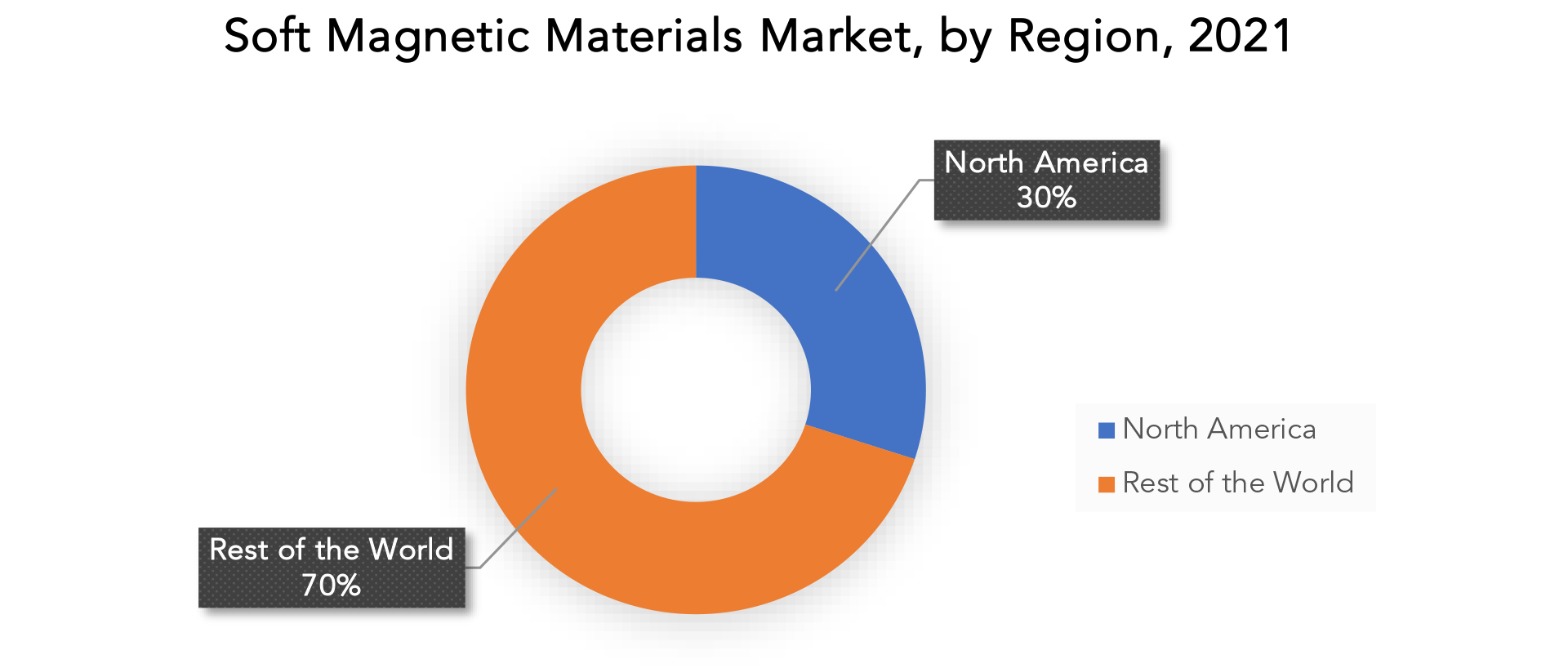
Key Market Segments: Soft Magnetic Materials Market
Soft Magnetic Materials Market By Type, 2020-2029, (USD Billion) (Tons)- Soft Ferrite
- Electrical Steel
- Cobalt
- Motor
- Transformer
- Alternator
- Automotive
- Electronics & Telecommunication
- Electrical
- North America
- Asia Pacific
- Europe
- South America
- Middle East And Africa
Exactitude Consultancy Services Key Objectives:
- Increasing sales and market share
- Developing new technology
- Improving profitability
- Entering new markets
- Enhancing brand reputation
Key Question Answered
- What is the expected growth rate of the soft magnetic materials market over the next 7 years?
- Who are the major players in the soft magnetic materials market and what is their market share?
- What are the end-user industries driving demand for market and what is their outlook?
- What are the opportunities for growth in emerging markets such as Asia-Pacific, Middle East, and Africa?
- How is the economic environment affecting the soft magnetic materials market, including factors such as interest rates, inflation, and exchange rates?
- What is the expected impact of government policies and regulations on the soft magnetic materials market?
- What is the current and forecasted size and growth rate of the global soft magnetic materials market?
- What are the key drivers of growth in the soft magnetic materials market?
- Who are the major players in the market and what is their market share?
- What are the distribution channels and supply chain dynamics in the soft magnetic materials market?
- What are the technological advancements and innovations in the soft magnetic materials market and their impact on product development and growth?
- What are the regulatory considerations and their impact on the market?
- What are the challenges faced by players in the soft magnetic materials market and how are they addressing these challenges?
- What are the opportunities for growth and expansion in the soft magnetic materials market?
- What are the service offerings and specifications of leading players in the market?
- What is the pricing trend of Soft Magnetic Materials in the market and what is the impact of raw material prices on the price trend?
- Introduction
- Market Definition
- Market Segmentation
- Research Timelines
- Assumptions and Limitations
- Research Methodology
- Data Mining
- Secondary Research
- Primary Research
- Subject-Matter Experts’ Advice
- Quality Checks
- Final Review
- Data Triangulation
- Bottom-Up Approach
- Top-Down Approach
- Research Flow
- Data Sources
- Data Mining
- Executive Summary
- Market Overview
- Global Soft magnetic materials outlook
- Market Drivers
- Market Restraints
- Market Opportunities
- Impact of Covid-19 on soft magnetic materials market
- Porter’s five forces model
- Threat from new entrants
- Threat from substitutes
- Bargaining power of suppliers
- Bargaining power of customers
- Degree of competition
- Industry Value Chain Analysis
- Global Soft magnetic materials outlook
- Global Soft Magnetic Materials Market by Type (USD Billion) (Tons) 2020-2029
- Soft Ferrite
- Electrical Steel
- Cobalt
- Global Soft Magnetic Materials Market By Application (USD Billion) (Tons) 2020-2029
- Motor
- Transformer
- Alternator
- Global Soft Magnetic Materials Market By End Use (USD Billion) (Tons) 2020-2029
- Automotive
- Electronics & Telecommunication
- Electrical
- Global Soft Magnetic Materials Market By Region (USD Billion) (Tons) 2020-2029
- NORTH AMERICA
- US
- Canada
- Mexico
- South America
- Brazil
- Argentina
- Colombia
- Rest Of South America
- Europe
- Germany
- UK
- France
- Italy
- Spain
- Russia
- Rest Of Europe
- Asia Pacific
- India
- China
- Japan
- South Korea
- Australia
- South-East Asia
- Rest Of Asia Pacific
- Middle East and Africa
- UAE
- Saudi Arabia
- South Africa
- Rest Of Middle East and Africa
- NORTH AMERICA
- Company Profiles*
(Business Overview, Company Snapshot, Products Offered, Recent Developments)
- Hitachi Metals ltd
- Toshiba Materials
- GKN Sinter Metals
- Sintex
- Mate Co.ltd
- JFE Steel Group
- Mahindra CIE
- Meyer Sintermetal AG
- Arnold Magnetic Technologies
*The Company List Is Indicative
LIST OF TABLES
TABLE 1 GLOBAL SOFT MAGNETIC MATERIALS MARKET BY TYPE (USD BILLION) 2020-2029
TABLE 2 GLOBAL SOFT MAGNETIC MATERIALS MARKET BY TYPE (TONS) 2020-2029
TABLE 3 GLOBAL SOFT MAGNETIC MATERIALS MARKET BY APPLICATION (USD BILLION) 2020-2029
TABLE 4 GLOBAL SOFT MAGNETIC MATERIALS MARKET BY APPLICATION (TONS) 2020-2029
TABLE 5 GLOBAL SOFT MAGNETIC MATERIALS MARKET BY END USER (USD BILLION) 2020-2029
TABLE 6 GLOBAL SOFT MAGNETIC MATERIALS MARKET BY END USER (TONS) 2020-2029
TABLE 7 GLOBAL SOFT MAGNETIC MATERIALS MARKET BY REGION (USD BILLION) 2020-2029
TABLE 8 GLOBAL SOFT MAGNETIC MATERIALS MARKET BY REGION (TONS) 2020-2029
TABLE 9 NORTH AMERICA SOFT MAGNETIC MATERIALS MARKET BY COUNTRY (USD BILLION) 2020-2029
TABLE 10 NORTH AMERICA SOFT MAGNETIC MATERIALS MARKET BY COUNTRY (TONS) 2020-2029
TABLE 11 US SOFT MAGNETIC MATERIALS MARKET BY TYPE (USD BILLION) 2020-2029
TABLE 12 US SOFT MAGNETIC MATERIALS MARKET BY TYPE (TONS) 2020-2029
TABLE 13 US SOFT MAGNETIC MATERIALS MARKET BY APPLICATION (USD BILLION) 2020-2029
TABLE 14 US SOFT MAGNETIC MATERIALS MARKET BY APPLICATION (TONS) 2020-2029
TABLE 15 US SOFT MAGNETIC MATERIALS MARKET BY END USER (USD BILLION) 2020-2029
TABLE 16 US SOFT MAGNETIC MATERIALS MARKET BY END USER (TONS) 2020-2029
TABLE 17 CANADA SOFT MAGNETIC MATERIALS MARKET BY TYPE (USD BILLION) 2020-2029
TABLE 18 CANADA SOFT MAGNETIC MATERIALS MARKET BY TYPE (TONS) 2020-2029
TABLE 19 CANADA SOFT MAGNETIC MATERIALS MARKET BY APPLICATION (USD BILLION) 2020-2029
TABLE 20 CANADA SOFT MAGNETIC MATERIALS MARKET BY APPLICATION (TONS) 2020-2029
TABLE 21 CANADA SOFT MAGNETIC MATERIALS MARKET BY END USER (USD BILLION) 2020-2029
TABLE 22 CANADA SOFT MAGNETIC MATERIALS MARKET BY END USER (TONS) 2020-2029
TABLE 23 MEXICO SOFT MAGNETIC MATERIALS MARKET BY TYPE (USD BILLION) 2020-2029
TABLE 24 MEXICO SOFT MAGNETIC MATERIALS MARKET BY TYPE (TONS) 2020-2029
TABLE 25 MEXICO SOFT MAGNETIC MATERIALS MARKET BY APPLICATION (USD BILLION) 2020-2029
TABLE 26 MEXICO SOFT MAGNETIC MATERIALS MARKET BY APPLICATION (TONS) 2020-2029
TABLE 27 MEXICO SOFT MAGNETIC MATERIALS MARKET BY END USER (USD BILLION) 2020-2029
TABLE 28 MEXICO SOFT MAGNETIC MATERIALS MARKET BY END USER (TONS) 2020-2029
TABLE 29 SOUTH AMERICA SOFT MAGNETIC MATERIALS MARKET BY COUNTRY (USD BILLION) 2020-2029
TABLE 30 SOUTH AMERICA SOFT MAGNETIC MATERIALS MARKET BY COUNTRY (TONS) 2020-2029
TABLE 31 BRAZIL SOFT MAGNETIC MATERIALS MARKET BY TYPE (USD BILLION) 2020-2029
TABLE 32 BRAZIL SOFT MAGNETIC MATERIALS MARKET BY TYPE (TONS) 2020-2029
TABLE 33 BRAZIL SOFT MAGNETIC MATERIALS MARKET BY APPLICATION (USD BILLION) 2020-2029
TABLE 34 BRAZIL SOFT MAGNETIC MATERIALS MARKET BY APPLICATION (TONS) 2020-2029
TABLE 35 BRAZIL SOFT MAGNETIC MATERIALS MARKET BY END USER (USD BILLION) 2020-2029
TABLE 36 BRAZIL SOFT MAGNETIC MATERIALS MARKET BY END USER (TONS) 2020-2029
TABLE 37 ARGENTINA SOFT MAGNETIC MATERIALS MARKET BY TYPE (USD BILLION) 2020-2029
TABLE 38 ARGENTINA SOFT MAGNETIC MATERIALS MARKET BY TYPE (TONS) 2020-2029
TABLE 39 ARGENTINA SOFT MAGNETIC MATERIALS MARKET BY APPLICATION (USD BILLION) 2020-2029
TABLE 40 ARGENTINA SOFT MAGNETIC MATERIALS MARKET BY APPLICATION (TONS) 2020-2029
TABLE 41 ARGENTINA SOFT MAGNETIC MATERIALS MARKET BY END USER (USD BILLION) 2020-2029
TABLE 42 ARGENTINA SOFT MAGNETIC MATERIALS MARKET BY END USER (TONS) 2020-2029
TABLE 43 COLOMBIA SOFT MAGNETIC MATERIALS MARKET BY TYPE (USD BILLION) 2020-2029
TABLE 44 COLOMBIA SOFT MAGNETIC MATERIALS MARKET BY TYPE (TONS) 2020-2029
TABLE 45 COLOMBIA SOFT MAGNETIC MATERIALS MARKET BY APPLICATION (USD BILLION) 2020-2029
TABLE 46 COLOMBIA SOFT MAGNETIC MATERIALS MARKET BY APPLICATION (TONS) 2020-2029
TABLE 47 COLOMBIA SOFT MAGNETIC MATERIALS MARKET BY END USER (USD BILLION) 2020-2029
TABLE 48 COLOMBIA SOFT MAGNETIC MATERIALS MARKET BY END USER (TONS) 2020-2029
TABLE 49 REST OF SOUTH AMERICA SOFT MAGNETIC MATERIALS MARKET BY TYPE (USD BILLION) 2020-2029
TABLE 50 REST OF SOUTH AMERICA SOFT MAGNETIC MATERIALS MARKET BY TYPE (TONS) 2020-2029
TABLE 51 REST OF SOUTH AMERICA SOFT MAGNETIC MATERIALS MARKET BY APPLICATION (USD BILLION) 2020-2029
TABLE 52 REST OF SOUTH AMERICA SOFT MAGNETIC MATERIALS MARKET BY APPLICATION (TONS) 2020-2029
TABLE 53 REST OF SOUTH AMERICA SOFT MAGNETIC MATERIALS MARKET BY END USER (USD BILLION) 2020-2029
TABLE 54 REST OF SOUTH AMERICA SOFT MAGNETIC MATERIALS MARKET BY END USER (TONS) 2020-2029
TABLE 55 ASIA-PACIFIC SOFT MAGNETIC MATERIALS MARKET BY COUNTRY (USD BILLION) 2020-2029
TABLE 56 ASIA-PACIFIC SOFT MAGNETIC MATERIALS MARKET BY COUNTRY (TONS) 2020-2029
TABLE 57 INDIA SOFT MAGNETIC MATERIALS MARKET BY TYPE (USD BILLION) 2020-2029
TABLE 58 INDIA SOFT MAGNETIC MATERIALS MARKET BY TYPE (TONS) 2020-2029
TABLE 59 INDIA SOFT MAGNETIC MATERIALS MARKET BY APPLICATION (USD BILLION) 2020-2029
TABLE 60 INDIA SOFT MAGNETIC MATERIALS MARKET BY APPLICATION (TONS) 2020-2029
TABLE 61 INDIA SOFT MAGNETIC MATERIALS MARKET BY END USER (USD BILLION) 2020-2029
TABLE 62 INDIA SOFT MAGNETIC MATERIALS MARKET BY END USER (TONS) 2020-2029
TABLE 63 CHINA SOFT MAGNETIC MATERIALS MARKET BY TYPE (USD BILLION) 2020-2029
TABLE 64 CHINA SOFT MAGNETIC MATERIALS MARKET BY TYPE (TONS) 2020-2029
TABLE 65 CHINA SOFT MAGNETIC MATERIALS MARKET BY APPLICATION (USD BILLION) 2020-2029
TABLE 66 CHINA SOFT MAGNETIC MATERIALS MARKET BY APPLICATION (TONS) 2020-2029
TABLE 67 CHINA SOFT MAGNETIC MATERIALS MARKET BY END USER (USD BILLION) 2020-2029
TABLE 68 CHINA SOFT MAGNETIC MATERIALS MARKET BY END USER (TONS) 2020-2029
TABLE 69 JAPAN SOFT MAGNETIC MATERIALS MARKET BY TYPE (USD BILLION) 2020-2029
TABLE 70 JAPAN SOFT MAGNETIC MATERIALS MARKET BY TYPE (TONS) 2020-2029
TABLE 71 JAPAN SOFT MAGNETIC MATERIALS MARKET BY APPLICATION (USD BILLION) 2020-2029
TABLE 72 JAPAN SOFT MAGNETIC MATERIALS MARKET BY APPLICATION (TONS) 2020-2029
TABLE 73 JAPAN SOFT MAGNETIC MATERIALS MARKET BY END USER (USD BILLION) 2020-2029
TABLE 74 JAPAN SOFT MAGNETIC MATERIALS MARKET BY END USER (TONS) 2020-2029
TABLE 75 SOUTH KOREA SOFT MAGNETIC MATERIALS MARKET BY TYPE (USD BILLION) 2020-2029
TABLE 76 SOUTH KOREA SOFT MAGNETIC MATERIALS MARKET BY TYPE (TONS) 2020-2029
TABLE 77 SOUTH KOREA SOFT MAGNETIC MATERIALS MARKET BY APPLICATION (USD BILLION) 2020-2029
TABLE 78 SOUTH KOREA SOFT MAGNETIC MATERIALS MARKET BY APPLICATION (TONS) 2020-2029
TABLE 79 SOUTH KOREA SOFT MAGNETIC MATERIALS MARKET BY END USER (USD BILLION) 2020-2029
TABLE 80 SOUTH KOREA SOFT MAGNETIC MATERIALS MARKET BY END USER (TONS) 2020-2029
TABLE 81 AUSTRALIA SOFT MAGNETIC MATERIALS MARKET BY TYPE (USD BILLION) 2020-2029
TABLE 82 AUSTRALIA SOFT MAGNETIC MATERIALS MARKET BY TYPE (TONS) 2020-2029
TABLE 83 AUSTRALIA SOFT MAGNETIC MATERIALS MARKET BY APPLICATION (USD BILLION) 2020-2029
TABLE 84 AUSTRALIA SOFT MAGNETIC MATERIALS MARKET BY APPLICATION (TONS) 2020-2029
TABLE 85 AUSTRALIA SOFT MAGNETIC MATERIALS MARKET BY END USER (USD BILLION) 2020-2029
TABLE 86 AUSTRALIA SOFT MAGNETIC MATERIALS MARKET BY END USER (TONS) 2020-2029
TABLE 87 SOUTH-EAST ASIA SOFT MAGNETIC MATERIALS MARKET BY TYPE (USD BILLION) 2020-2029
TABLE 88 SOUTH-EAST ASIA SOFT MAGNETIC MATERIALS MARKET BY TYPE (TONS) 2020-2029
TABLE 89 SOUTH-EAST ASIA SOFT MAGNETIC MATERIALS MARKET BY APPLICATION (USD BILLION) 2020-2029
TABLE 90 SOUTH-EAST ASIA SOFT MAGNETIC MATERIALS MARKET BY APPLICATION (TONS) 2020-2029
TABLE 91 SOUTH-EAST ASIA SOFT MAGNETIC MATERIALS MARKET BY END USER (USD BILLION) 2020-2029
TABLE 92 SOUTH-EAST ASIA SOFT MAGNETIC MATERIALS MARKET BY END USER (TONS) 2020-2029
TABLE 93 REST OF ASIA PACIFIC SOFT MAGNETIC MATERIALS MARKET BY TYPE (USD BILLION) 2020-2029
TABLE 94 REST OF ASIA PACIFIC SOFT MAGNETIC MATERIALS MARKET BY TYPE (TONS) 2020-2029
TABLE 95 REST OF ASIA PACIFIC SOFT MAGNETIC MATERIALS MARKET BY APPLICATION (USD BILLION) 2020-2029
TABLE 96 REST OF ASIA PACIFIC SOFT MAGNETIC MATERIALS MARKET BY APPLICATION (TONS) 2020-2029
TABLE 97 REST OF ASIA PACIFIC SOFT MAGNETIC MATERIALS MARKET BY END USER (USD BILLION) 2020-2029
TABLE 98 REST OF ASIA PACIFIC SOFT MAGNETIC MATERIALS MARKET BY END USER (TONS) 2020-2029
TABLE 99 EUROPE SOFT MAGNETIC MATERIALS MARKET BY COUNTRY (USD BILLION) 2020-2029
TABLE 100 EUROPE SOFT MAGNETIC MATERIALS MARKET BY COUNTRY (TONS) 2020-2029
TABLE 101 GERMANY SOFT MAGNETIC MATERIALS MARKET BY TYPE (USD BILLION) 2020-2029
TABLE 102 GERMANY SOFT MAGNETIC MATERIALS MARKET BY TYPE (TONS) 2020-2029
TABLE 103 GERMANY SOFT MAGNETIC MATERIALS MARKET BY APPLICATION (USD BILLION) 2020-2029
TABLE 104 GERMANY SOFT MAGNETIC MATERIALS MARKET BY APPLICATION (TONS) 2020-2029
TABLE 105 GERMANY SOFT MAGNETIC MATERIALS MARKET BY END USER (USD BILLION) 2020-2029
TABLE 106 GERMANY SOFT MAGNETIC MATERIALS MARKET BY END USER (TONS) 2020-2029
TABLE 107 UK SOFT MAGNETIC MATERIALS MARKET BY TYPE (USD BILLION) 2020-2029
TABLE 108 UK SOFT MAGNETIC MATERIALS MARKET BY TYPE (TONS) 2020-2029
TABLE 109 UK SOFT MAGNETIC MATERIALS MARKET BY APPLICATION (USD BILLION) 2020-2029
TABLE 110 UK SOFT MAGNETIC MATERIALS MARKET BY APPLICATION (TONS) 2020-2029
TABLE 111 UK SOFT MAGNETIC MATERIALS MARKET BY END USER (USD BILLION) 2020-2029
TABLE 112 UK SOFT MAGNETIC MATERIALS MARKET BY END USER (TONS) 2020-2029
TABLE 113 FRANCE SOFT MAGNETIC MATERIALS MARKET BY TYPE (USD BILLION) 2020-2029
TABLE 114 FRANCE SOFT MAGNETIC MATERIALS MARKET BY TYPE (TONS) 2020-2029
TABLE 115 FRANCE SOFT MAGNETIC MATERIALS MARKET BY APPLICATION (USD BILLION) 2020-2029
TABLE 116 FRANCE SOFT MAGNETIC MATERIALS MARKET BY APPLICATION (TONS) 2020-2029
TABLE 117 FRANCE SOFT MAGNETIC MATERIALS MARKET BY END USER (USD BILLION) 2020-2029
TABLE 118 FRANCE SOFT MAGNETIC MATERIALS MARKET BY END USER (TONS) 2020-2029
TABLE 119 ITALY SOFT MAGNETIC MATERIALS MARKET BY TYPE (USD BILLION) 2020-2029
TABLE 120 ITALY SOFT MAGNETIC MATERIALS MARKET BY TYPE (TONS) 2020-2029
TABLE 121 ITALY SOFT MAGNETIC MATERIALS MARKET BY APPLICATION (USD BILLION) 2020-2029
TABLE 122 ITALY SOFT MAGNETIC MATERIALS MARKET BY APPLICATION (TONS) 2020-2029
TABLE 123 ITALY SOFT MAGNETIC MATERIALS MARKET BY END USER (USD BILLION) 2020-2029
TABLE 124 ITALY SOFT MAGNETIC MATERIALS MARKET BY END USER (TONS) 2020-2029
TABLE 125 SPAIN SOFT MAGNETIC MATERIALS MARKET BY TYPE (USD BILLION) 2020-2029
TABLE 126 SPAIN SOFT MAGNETIC MATERIALS MARKET BY TYPE (TONS) 2020-2029
TABLE 127 SPAIN SOFT MAGNETIC MATERIALS MARKET BY APPLICATION (USD BILLION) 2020-2029
TABLE 128 SPAIN SOFT MAGNETIC MATERIALS MARKET BY APPLICATION (TONS) 2020-2029
TABLE 129 SPAIN SOFT MAGNETIC MATERIALS MARKET BY END USER (USD BILLION) 2020-2029
TABLE 130 SPAIN SOFT MAGNETIC MATERIALS MARKET BY END USER (TONS) 2020-2029
TABLE 131 RUSSIA SOFT MAGNETIC MATERIALS MARKET BY TYPE (USD BILLION) 2020-2029
TABLE 132 RUSSIA SOFT MAGNETIC MATERIALS MARKET BY TYPE (TONS) 2020-2029
TABLE 133 RUSSIA SOFT MAGNETIC MATERIALS MARKET BY APPLICATION (USD BILLION) 2020-2029
TABLE 134 RUSSIA SOFT MAGNETIC MATERIALS MARKET BY APPLICATION (TONS) 2020-2029
TABLE 135 RUSSIA SOFT MAGNETIC MATERIALS MARKET BY END USER (USD BILLION) 2020-2029
TABLE 136 RUSSIA SOFT MAGNETIC MATERIALS MARKET BY END USER (TONS) 2020-2029
TABLE 137 REST OF EUROPE SOFT MAGNETIC MATERIALS MARKET BY TYPE (USD BILLION) 2020-2029
TABLE 138 REST OF EUROPE SOFT MAGNETIC MATERIALS MARKET BY TYPE (TONS) 2020-2029
TABLE 139 REST OF EUROPE SOFT MAGNETIC MATERIALS MARKET BY APPLICATION (USD BILLION) 2020-2029
TABLE 140 REST OF EUROPE SOFT MAGNETIC MATERIALS MARKET BY APPLICATION (TONS) 2020-2029
TABLE 141 REST OF EUROPE SOFT MAGNETIC MATERIALS MARKET BY END USER (USD BILLION) 2020-2029
TABLE 142 REST OF EUROPE SOFT MAGNETIC MATERIALS MARKET BY END USER (TONS) 2020-2029
TABLE 143 MIDDLE EAST AND AFRICA SOFT MAGNETIC MATERIALS MARKET BY COUNTRY (USD BILLION) 2020-2029
TABLE 144 MIDDLE EAST AND AFRICA SOFT MAGNETIC MATERIALS MARKET BY COUNTRY (TONS) 2020-2029
TABLE 145 UAE SOFT MAGNETIC MATERIALS MARKET BY TYPE (USD BILLION) 2020-2029
TABLE 146 UAE SOFT MAGNETIC MATERIALS MARKET BY TYPE (TONS) 2020-2029
TABLE 147 UAE SOFT MAGNETIC MATERIALS MARKET BY APPLICATION (USD BILLION) 2020-2029
TABLE 148 UAE SOFT MAGNETIC MATERIALS MARKET BY APPLICATION (TONS) 2020-2029
TABLE 149 UAE SOFT MAGNETIC MATERIALS MARKET BY END USER (USD BILLION) 2020-2029
TABLE 150 UAE SOFT MAGNETIC MATERIALS MARKET BY END USER (TONS) 2020-2029
TABLE 151 SAUDI ARABIA SOFT MAGNETIC MATERIALS MARKET BY TYPE (USD BILLION) 2020-2029
TABLE 152 SAUDI ARABIA SOFT MAGNETIC MATERIALS MARKET BY TYPE (TONS) 2020-2029
TABLE 153 SAUDI ARABIA SOFT MAGNETIC MATERIALS MARKET BY APPLICATION (USD BILLION) 2020-2029
TABLE 154 SAUDI ARABIA SOFT MAGNETIC MATERIALS MARKET BY APPLICATION (TONS) 2020-2029
TABLE 155 SAUDI ARABIA SOFT MAGNETIC MATERIALS MARKET BY END USER (USD BILLION) 2020-2029
TABLE 156 SAUDI ARABIA SOFT MAGNETIC MATERIALS MARKET BY END USER (TONS) 2020-2029
TABLE 157 SOUTH AFRICA SOFT MAGNETIC MATERIALS MARKET BY TYPE (USD BILLION) 2020-2029
TABLE 158 SOUTH AFRICA SOFT MAGNETIC MATERIALS MARKET BY TYPE (TONS) 2020-2029
TABLE 159 SOUTH AFRICA SOFT MAGNETIC MATERIALS MARKET BY APPLICATION (USD BILLION) 2020-2029
TABLE 160 SOUTH AFRICA SOFT MAGNETIC MATERIALS MARKET BY APPLICATION (TONS) 2020-2029
TABLE 161 SOUTH AFRICA SOFT MAGNETIC MATERIALS MARKET BY END USER (USD BILLION) 2020-2029
TABLE 162 SOUTH AFRICA SOFT MAGNETIC MATERIALS MARKET BY END USER (TONS) 2020-2029
TABLE 163 REST OF MIDDLE EAST AND AFRICA SOFT MAGNETIC MATERIALS MARKET BY TYPE (USD BILLION) 2020-2029
TABLE 164 REST OF MIDDLE EAST AND AFRICA SOFT MAGNETIC MATERIALS MARKET BY TYPE (TONS) 2020- 2029
TABLE 165 REST OF MIDDLE EAST AND AFRICA SOFT MAGNETIC MATERIALS MARKET BY APPLICATION (USD BILLION) 2020-2029
TABLE 166 REST OF MIDDLE EAST AND AFRICA SOFT MAGNETIC MATERIALS MARKET BY APPLICATION (TONS) 2020-2029
TABLE 167 REST OF MIDDLE EAST AND AFRICA SOFT MAGNETIC MATERIALS MARKET BY END USER (USD BILLION) 2020-2029
TABLE 168 REST OF MIDDLE EAST AND AFRICA SOFT MAGNETIC MATERIALS MARKET BY END USER (TONS) 2020-2029
TABLE 169 REST OF MIDDLE EAST AND AFRICA SOFT MAGNETIC MATERIALS MARKET BY END USER (TONS) 2020-2029
LIST OF FIGURES
FIGURE 1 MARKET DYNAMICS
FIGURE 2 MARKET SEGMENTATION
FIGURE 3 REPORT TIMELINES: YEARS CONSIDERED
FIGURE 4 DATA TRIANGULATION
FIGURE 5 BOTTOM-UP APPROACH
FIGURE 6 TOP-DOWN APPROACH
FIGURE 7 RESEARCH FLOW
FIGURE 8 GLOBAL SOFT MAGNETIC MATERIALS BY TYPE, USD BILLION, 2020-2029
FIGURE 9 GLOBAL SOFT MAGNETIC MATERIALS BY END USER, USD BILLION, 2020-2029
FIGURE 10 GLOBAL SOFT MAGNETIC MATERIALS BY APPLICATION USD BILLION, 2020-2029
FIGURE 11 GLOBAL SOFT MAGNETIC MATERIALS BY REGION, USD BILLION, 2020-2029
FIGURE 12 GLOBAL SOFT MAGNETIC MATERIALS BY TYPE, USD BILLION, 2021
FIGURE 13 GLOBAL SOFT MAGNETIC MATERIALSBY END USER, USD BILLION, 2021
FIGURE 14 GLOBAL SOFT MAGNETIC MATERIAL SBY APPLICATION USD BILLION, 2021
FIGURE 15 GLOBAL SOFT MAGNETIC MATERIALS BY REGION, USD BILLION, 2021
FIGURE 16 PORTER’S FIVE FORCES MODEL
FIGURE 17 MARKET SHARE ANALYSIS
FIGURE 18 HITACHI METALS: COMPANY SNAPSHOT
FIGURE 19 TOSHIBA MATERIALS: COMPANY SNAPSHOT
FIGURE 20 GKN SINTER METALS: COMPANY SNAPSHOT
FIGURE 21 SINTEX: COMPANY SNAPSHOT
FIGURE 22 MATE CO.LTD: COMPANY SNAPSHOT
FIGURE 23 JFE STEEL GROUP: COMPANY SNAPSHOT
FIGURE 24 MAHINDRA CIE: COMPANY SNAPSHOT
FIGURE 25 MEYER SINTERMETAL AG: COMPANY SNAPSHOT
FIGURE 26 ARNOLD MAGNETIC TECHNOLOGIES: COMPANY SNAPSHOT
DOWNLOAD FREE SAMPLE REPORT
License Type
SPEAK WITH OUR ANALYST
Want to know more about the report or any specific requirement?
WANT TO CUSTOMIZE THE REPORT?
Our Clients Speak
We asked them to research ‘ Equipment market’ all over the world, and their whole arrangement was helpful to us. thehealthanalytics.com insightful analysis and reports contributed to our current analysis and in creating a future strategy. Besides, the te
Yosuke Mitsui
Senior Associate Construction Equipment Sales & Marketing
We asked them to research ‘Equipment market’ all over the world, and their whole arrangement was helpful to us. thehealthanalytics.com insightful analysis and reports contributed to our current analysis and in creating a future strategy. Besides, the te