

Base Year Value ()
x.x %
x.x %
CAGR ()
x.x %
x.x %
Forecast Year Value ()
x.x %
x.x %
Historical Data Period
Largest Region
Forecast Period
Low GWP Refrigerants Market by Type (Inorganics, Hydrocarbons, Fluorocarbons), Application (Commercial Refrigeration, Industrial Refrigeration, Domestic Refrigeration), And Region, Global Trends And Forecast From 2022 To 2029
Instant access to hundreds of data points and trends
- Market estimates from 2014-2029
- Competitive analysis, industry segmentation, financial benchmarks
- Incorporates SWOT, Porter's Five Forces and risk management frameworks
- PDF report or online database with Word, Excel and PowerPoint export options
- 100% money back guarantee
Low GWP Refrigerants Market Overview
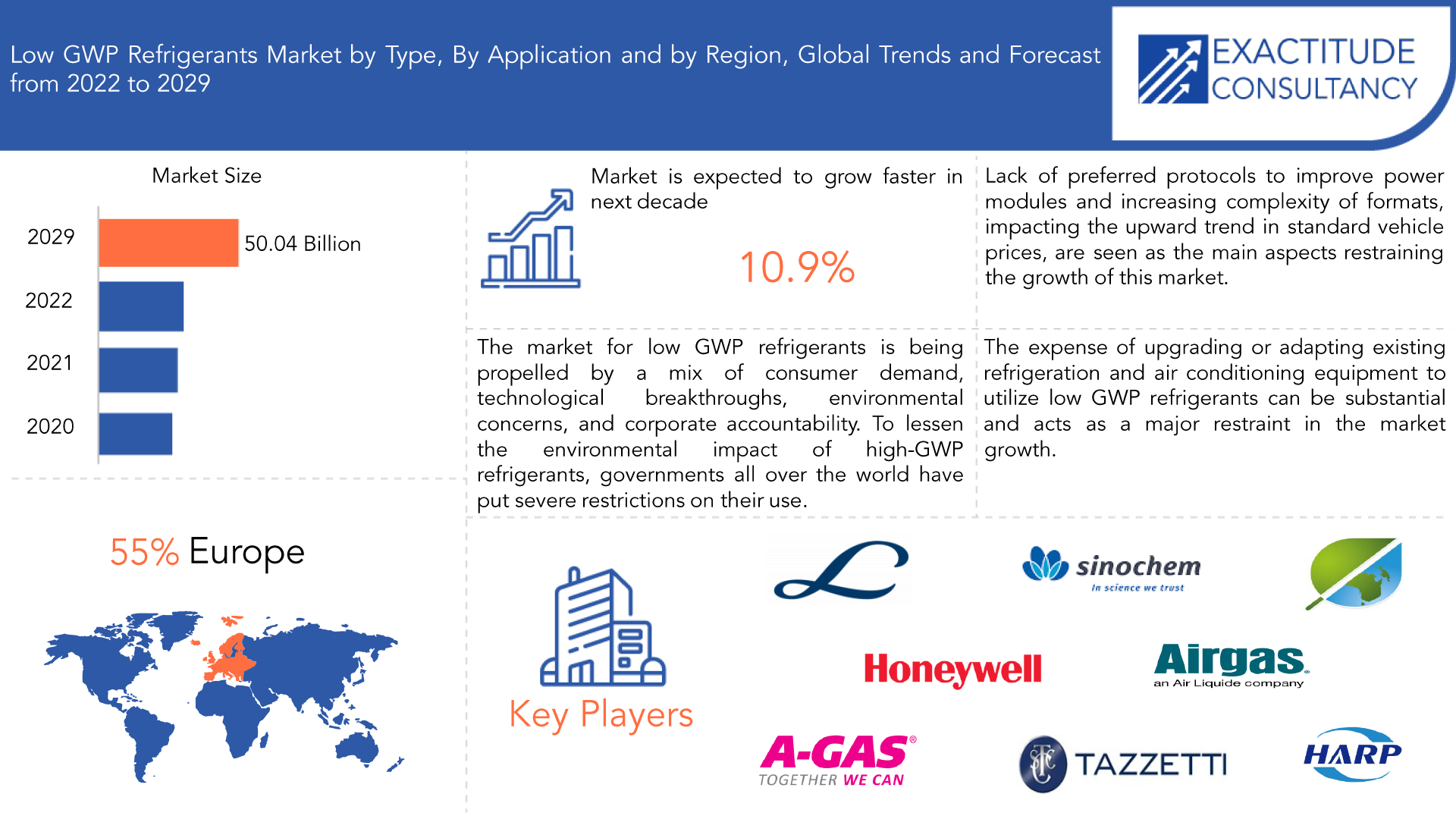
The Low GWP Refrigerants Market is expected to grow at 10.9 % CAGR from 2022 to 2029. It is expected to reach above USD 50.04 billion by 2029 from USD 20.67 billion in 2020.
Low GWP (Global Warming Potential) refrigerants are those that, when compared to conventional high GWP refrigerants, have a much smaller negative environmental impact. To compare the effects of various greenhouse gases, the global warming potential (GWP) is a measurement of how much heat a greenhouse gas retains in the atmosphere. Traditional refrigerants with high GWP values and strong warming potential include hydrofluorocarbons (HFCs) and chlorofluorocarbons (CFCs).
The global low GWP refrigerants market is expected to rise at a considerable rate during the forecast period. In 2021, the market is growing steadily and is expected to rise above the projected horizon because of the strategy adopted by key players.
The market for low GWP refrigerants is being propelled by a mix of consumer demand, technological breakthroughs, environmental concerns, and corporate accountability. To lessen the environmental impact of high-GWP refrigerants, governments all over the world have put severe restrictions on their use. Customers are seeking more ecologically friendly items as they become more conscious of how their decisions affect the environment. As a result, low-GWP refrigerants are becoming more and more in demand for refrigeration systems. Since they frequently require less energy than their high-GWP counterparts, low-GWP refrigerants can help lower energy expenditures and greenhouse gas emissions. Low-GWP refrigerants are becoming more widely available and economically viable because to advances in low-GWP refrigerant research and development and alternative refrigeration technologies.
| ATTRIBUTE | DETAILS |
| Study period | 2020-2029 |
| Base year | 2022 |
| Estimated year | 2022 |
| Forecasted year | 2022-2029 |
| Historical period | 2018-2020 |
| Unit | Value (USD BILLION), (THOUSAND UNITS) |
| Segmentation | By type, by application, by region |
| By Type |
|
| By Application |
|
| By Region
|
|
Low GWP refrigerants are anticipated to become more popular as HFC manufacture is phased out in more and more nations. The market for low GWP refrigerants is anticipated to develop as a result in the future years and this is also expected to provide ample opportunities for the growth of this market.
While the market for low GWP refrigerants is expanding overall, there are still several obstacles that need to be removed to assure their widespread use and success. The expense of upgrading or adapting existing refrigeration and air conditioning equipment to utilize low GWP refrigerants can be substantial, and low GWP refrigerants can be more expensive than conventional high-GWP refrigerants. Certain low GWP refrigerants, especially natural ones like ammonia and carbon dioxide, might not be widely available in some areas or might have constrained supply chains, which could limit their use in some applications. Moreover, given that some low GWP refrigerants, like hydrocarbons, may be explosive or flammable, extra safety measures and regulations may be necessary.
The COVID-19 epidemic had a large effect on the market for low GWP (global warming potential) refrigerants. To lessen their environmental impact, low-GWP refrigerants are utilized in place of high-GWP ones. Due to the implementation of stringent environmental rules and the Montreal Protocol, which aims to phase out ozone-depleting compounds, the demand for low GWP refrigerants was already rising.
The COVID-19 pandemic had a mixed impact on the Low GWP refrigerants market .On the one hand, a fall in the production and consumption of refrigerants in general, including low GWP refrigerants, was brought on by the closure of manufacturing facilities, problems in the supply chain, and decreased demand as a result of the economic slowdown. On the other hand, the pandemic increased demand for low GWP refrigerants as hospitals, laboratories, and other important buildings needed air conditioning and refrigeration equipment more quickly.
The pandemic also caused changes in the regulatory environment, with several nations delaying the implementation of environmental legislation because of the outbreak's financial impact. Nonetheless, given that governments and businesses continue to place a high priority on environmental sustainability and the reduction of greenhouse gas emissions, the long-term outlook for the market for low GWP refrigerants is still favorable.
[caption id="attachment_17530" align="aligncenter" width="1920"]
Frequently Asked Questions
• What is the worth of Low GWP Refrigerants Market?
The low GWP refrigerants market is expected to grow at 10.9 % CAGR from 2022 to 2029. It is expected to reach above USD 50.04 billion by 2029 from USD 20.67 billion in 2020.
• What is the size of the Europe’s low GWP refrigerants market?
Europe low GWP refrigerants market size was valued at USD 1.61 billion in 2021 and is projected to reach USD 5.2 billion by 2029, growing at a compound annual growth rate (CAGR) of 15.89 % during the forecast period.
• What are some of the market's driving forces?
The market for low GWP refrigerants is being propelled by a mix of consumer demand, technological breakthroughs, environmental concerns, and corporate accountability. To lessen the environmental impact of high-GWP refrigerants, governments all over the world have put severe restrictions on their use. Customers are seeking more ecologically friendly items as they become more conscious of how their decisions affect the environment. As a result, low-GWP refrigerants are becoming more and more in demand for refrigeration systems.
• Which are the top companies to hold the market share in Low GWP Refrigerants Market?
The Low GWP Refrigerants Market key players include The Low GWP Refrigerants Market key players include Linde Group, Honeywell, Sinochem Group , Airgas Inc. , Engas Australasia , A-Gas , Puyang Zhongwei Fine Chemical, Harp International, Tazzetti , Shandong Yueon Chemical Industry, HyChill Australia, GTS , Chemours, Mexichem, Daikin , and Arkema
• What is the leading application of Low GWP Refrigerants Market?
As an environmentally benign substitute for high-GWP refrigerants, low-GWP refrigerants are being employed more often in a variety of applications. The air conditioning and refrigeration industries is where low GWP refrigerants are most used. Low GWP refrigerants are employed in a variety of air conditioning applications, such as residential, commercial, and automotive air conditioning systems. Central air conditioning units, split air conditioners, and portable air conditioners all use these refrigerants. Low GWP refrigerants are employed in a variety of refrigeration-related applications, such as transport refrigeration, industrial refrigeration, and commercial refrigeration. These refrigerants are used in cooling systems such as chillers, freezers, and refrigerators.
• Which is the largest regional market for Low GWP Refrigerants Market?
The region with the biggest market share for low GWP refrigerants as of 2021 was Europe. This is a result of the region's strict environmental laws and policies that have been put in place to cut greenhouse gas emissions. The F-Gas regulation, which intends to gradually reduce the use of high GWP refrigerants and consequently increase demand for low GWP refrigerants, has been spearheaded by the European Union.
Low GWP Refrigerants Market Segment Analysis
The low GWP refrigerants market is segmented based on type, application and region.
By type the market is bifurcated into Inorganics, Hydrocarbons, Fluorocarbons.
In terms of type hydrocarbon type segment expected to hold the largest share and to grow at the highest CAGR due to the increasing demand from the industrial refrigeration sector. thermodynamic qualities are found in hydrocarbon refrigerants, which are also used in extremely energy-efficient refrigeration and air-conditioning systems. Hydrocarbon refrigerants have a rather high critical temperature and are miscible with traditional refrigerating oils.
Commercial refrigeration application segment is projected to be the largest segment due to the increasing demand from the retail sector. Most food processors, distributors, and retailers are moving from manually operated outdated facilities to high bay deep-freeze warehouses, where commercial refrigeration is widely used, because of the rising demand for frozen food products and the existence of a highly competitive market with low margins. The need for cold chain processes has also increased because of the expansion of retail food chains by multinational corporations and the growth in global trade (as a result of trade liberalization). The need for commercial refrigeration as a result is rising globally.
[caption id="attachment_17543" align="aligncenter" width="1920"]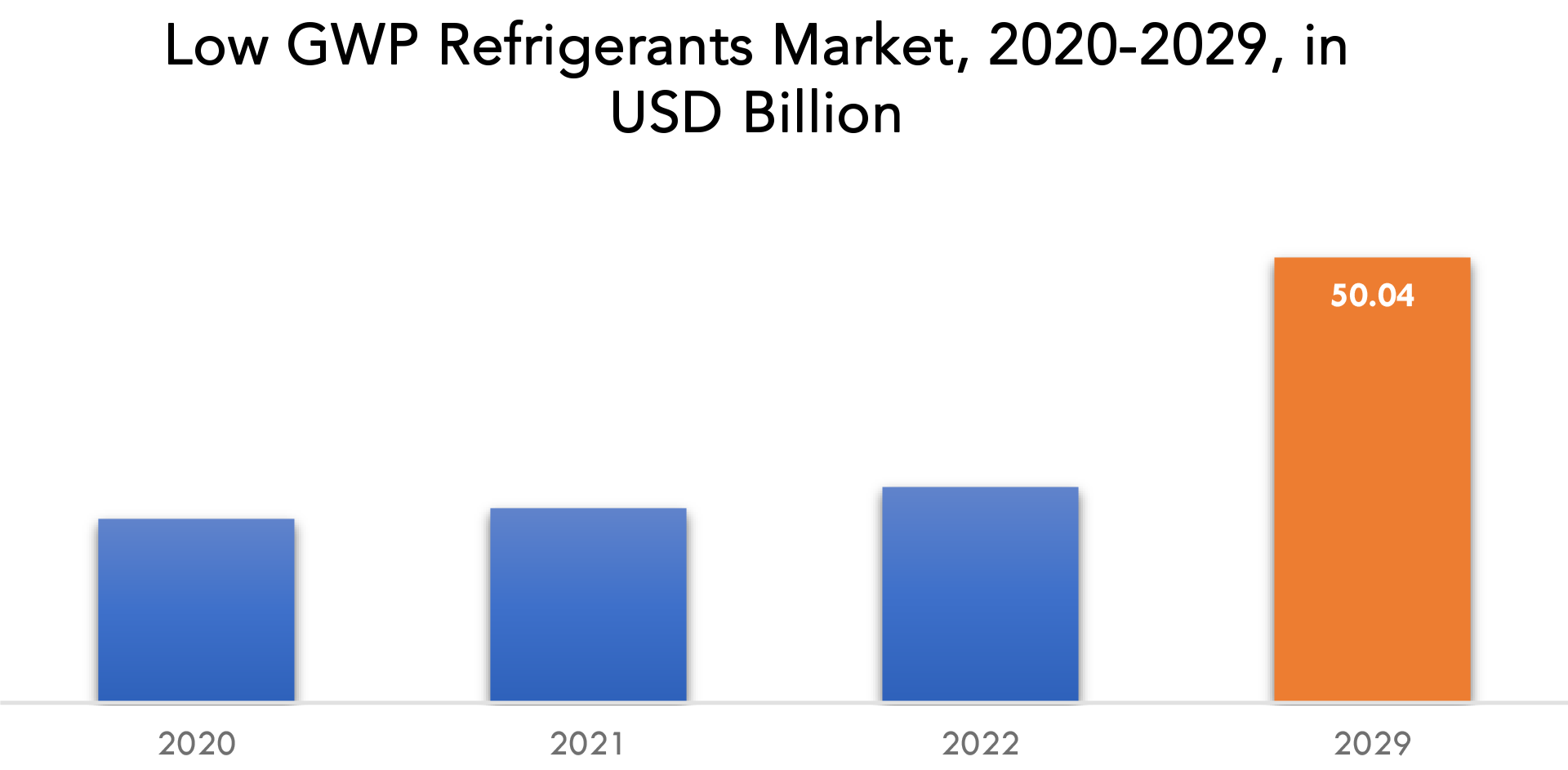
Low GWP Refrigerants Market Key Market Players
The Low GWP Refrigerants Market key players include Linde Group, Honeywell, Sinochem Group , Airgas Inc. , Engas Australasia , A-Gas , Puyang Zhongwei Fine Chemical, Harp International, Tazzetti , Shandong Yueon Chemical Industry, HyChill Australia, GTS , Chemours, Mexichem, Daikin , and Arkema. Recent Development: March 7, 2023: Honeywell (Nasdaq: HON), a global leader in fire and life safety, launched the first fire alarm system with UL-approved self-testing smoke detectors that can be tested automatically, changing the way fire and life safety systems are installed, tested and maintained. The NOTIFIER INSPIRE™ fire alarm system with Self-Test detectors is designed to help create a safer building environment by increasing facility managers awareness of system needs while equipping service providers with digital self-testing tools that streamline maintenance and support regulatory compliance and system uptime. MARCH 14, 2023: Honeywell (Nasdaq: HON) announced its expanded capabilities to help companies achieve automation interoperability in the distribution center (DC). The company will demonstrate many of its automation solutions and robotics at ProMat 2023 in Chicago, March 20-23 (booth #S618).Who Should Buy? Or Key stakeholders
- Investors
- Manufacturing companies
- Automotive Industry
- Government Institution
- Research Organizations
- Environment, Health, and Safety Professionals
- Regulatory Authorities
- Others
Low GWP Refrigerants Market Regional Analysis
The Low GWP Refrigerants Market by region includes North America, Asia-Pacific (APAC), Europe, South America, and Middle East & Africa (MEA).
- North America: includes the US, Canada, Mexico
- Asia Pacific: includes China, Japan, South Korea, India, Australia, ASEAN and Rest of APAC
- Europe: includes UK, Germany, France, Italy, Spain, Russia, and Rest of Europe
- South America: includes Brazil, Argentina, and Rest of South America
- Middle East & Africa: includes Turkey, UAE, Saudi Arabia, South Africa, and Rest of MEA
The region with the biggest market share for low GWP refrigerants as of 2021 was Europe. This is a result of the region's strict environmental laws and policies that have been put in place to cut greenhouse gas emissions. The F-Gas regulation, which intends to gradually reduce the use of high GWP refrigerants and consequently increase demand for low GWP refrigerants, has been spearheaded by the European Union. The market for low GWP refrigerants in Europe has expanded in part due to the existence of important low GWP refrigerant producers in the area and the widespread use of natural refrigerants like CO2 and ammonia in commercial and industrial settings. To reduce greenhouse gas emissions, the European Union has been at the forefront of putting strict environmental policies into effect.
The region's adoption of low GWP refrigerants has been significantly influenced by the F-Gas regulation, which intends to gradually reduce the usage of high GWP refrigerants. Natural refrigerants like CO2 and ammonia have been widely adopted in Europe's commercial and industrial sectors. Regulatory considerations as well as an increasing understanding of the advantages of using natural refrigerants for the environment have prompted this. Some significant producers of low GWP refrigerants, including Honeywell, Arkema, and Chemours, are based in Europe. Low GWP refrigerants are now widely available in the area as a result, which has accelerated their uptake. As a result of Europe's commitment to lowering greenhouse gas emissions, there has been a significant market demand for low GWP refrigerants. This has also been reinforced by the rising demand for low GWP substitutes because of growing knowledge of the negative environmental effects of high GWP refrigerants.
[caption id="attachment_17550" align="aligncenter" width="1920"]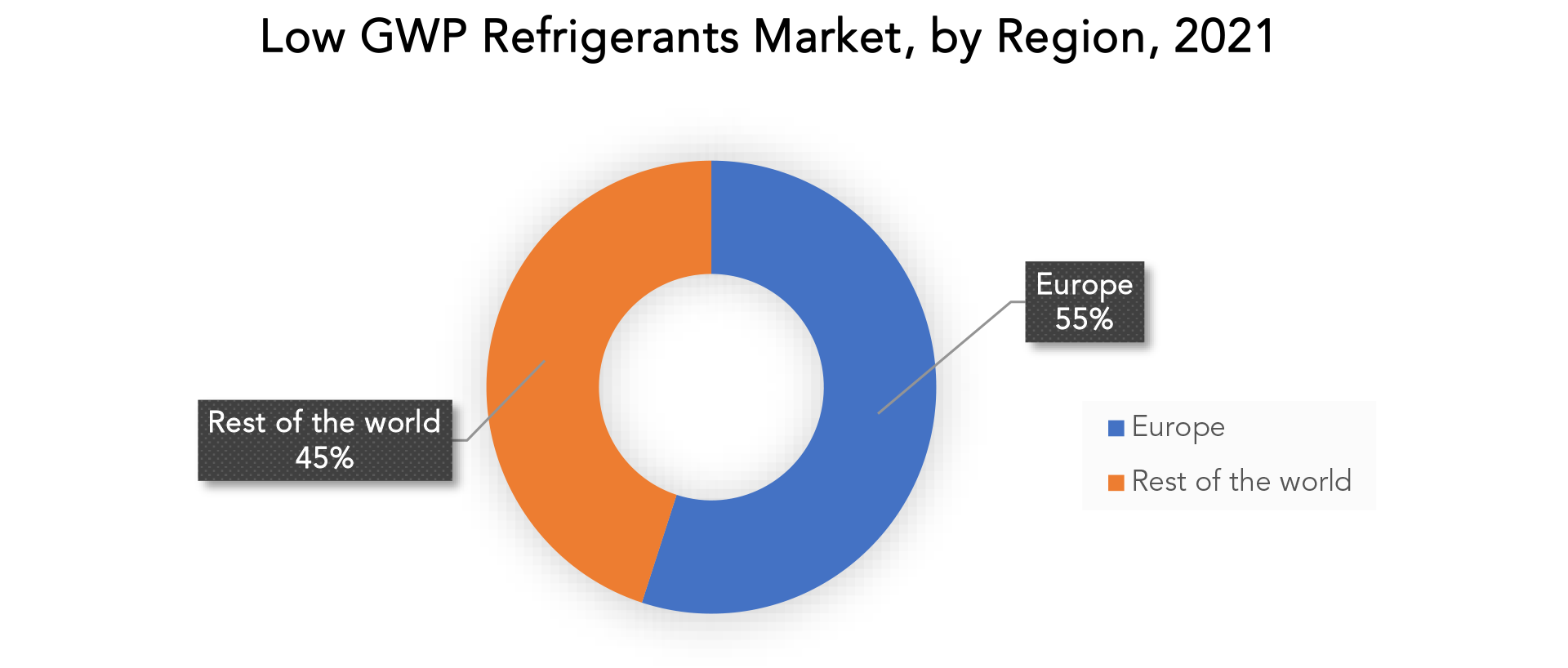
Key Market Segments: Low GWP Refrigerants Market
Low GWP Refrigerants Market By Type, 2020-2029, (USD Billion), (Thousand Units)- Inorganics
- Hydrocarbons
- Fluorocarbons
- Commercial Refrigeration
- Industrial Refrigeration
- Domestic Refrigeration
- North America
- Asia Pacific
- Europe
- Latin America
- Middle East And Africa
Exactitude Consultancy Services Key Objectives:
- Increasing sales and market share
- Developing new technology
- Improving profitability
- Entering new markets
- Enhancing brand reputation
Key Question Answered
- What is the expected growth rate of the low GWP refrigerants market over the next 7 years?
- Who are the major players in the low GWP refrigerants market and what is their market share?
- What are the end-user industries driving demand for market and what is their outlook?
- What are the opportunities for growth in emerging markets such as Asia-Pacific, Middle East, and Africa?
- How is the economic environment affecting the low GWP refrigerants market, including factors such as interest rates, inflation, and exchange rates?
- What is the expected impact of government policies and regulations on the low GWP refrigerants market?
- What is the current and forecasted size and growth rate of the global low GWP refrigerants market?
- What are the key drivers of growth in the low GWP refrigerants market?
- Who are the major players in the market and what is their market share?
- What are the distribution channels and supply chain dynamics in the low GWP refrigerants market?
- What are the technological advancements and innovations in the low GWP refrigerants market and their impact on product development and growth?
- What are the regulatory considerations and their impact on the market?
- What are the challenges faced by players in the low GWP refrigerants market and how are they addressing these challenges?
- What are the opportunities for growth and expansion in the low GWP refrigerants market?
- What are the product applications and specifications of leading players in the market?
- INTRODUCTION
- MARKET DEFINITION
- MARKET SEGMENTATION
- RESEARCH TIMELINES
- ASSUMPTIONS AND LIMITATIONS
- RESEARCH METHODOLOGY
- DATA MINING
- SECONDARY RESEARCH
- PRIMARY RESEARCH
- SUBJECT-MATTER EXPERTS’ ADVICE
- QUALITY CHECKS
- FINAL REVIEW
- DATA TRIANGULATION
- BOTTOM-UP APPROACH
- TOP-DOWN APPROACH
- RESEARCH FLOW
- DATA SOURCES
- DATA MINING
- EXECUTIVE SUMMARY
- MARKET OVERVIEW
- GLOBAL LOW GWP REFRIGERANTS MARKET OUTLOOK
- MARKET DRIVERS
- MARKET RESTRAINTS
- MARKET OPPORTUNITIES
- IMPACT OF COVID-19 ON LOW GWP REFRIGERANTS MARKET
- PORTER’S FIVE FORCES MODEL
- THREAT FROM NEW ENTRANTS
- THREAT FROM SUBSTITUTES
- BARGAINING POWER OF SUPPLIERS
- BARGAINING POWER OF CUSTOMERS
- DEGREE OF COMPETITION
- INDUSTRY VALUE CHAIN ANALYSIS
- GLOBAL LOW GWP REFRIGERANTS MARKET OUTLOOK
- GLOBAL LOW GWP REFRIGERANTS MARKET BY TYPE (USD BILLION), (THOUSAND UNITS), 2020-2029
- INORGANICS
- HYDROCARBONS
- FLUOROCARBONS
- GLOBAL LOW GWP REFRIGERANTS MARKET BY APPLICATION (USD BILLION), (THOUSAND UNITS), 2020-2029
- COMMERCIAL REFRIGERATION
- INDUSTRIAL REFRIGERATION
- DOMESTIC REFRIGERATION
- GLOBAL LOW GWP REFRIGERANTS MARKET BY REGION (USD BILLION), (THOUSAND UNITS), 2020-2029
- NORTH AMERICA
- US
- CANADA
- MEXICO
- SOUTH AMERICA
- BRAZIL
- ARGENTINA
- COLOMBIA
- REST OF SOUTH AMERICA
- EUROPE
- GERMANY
- UK
- FRANCE
- ITALY
- SPAIN
- RUSSIA
- REST OF EUROPE
- ASIA PACIFIC
- INDIA
- CHINA
- JAPAN
- SOUTH KOREA
- AUSTRALIA
- SOUTH-EAST ASIA
- REST OF ASIA PACIFIC
- MIDDLE EAST AND AFRICA
- UAE
- SAUDI ARABIA
- SOUTH AFRICA
- REST OF MIDDLE EAST AND AFRICA
- NORTH AMERICA
- COMPANY PROFILES* (BUSINESS OVERVIEW, COMPANY SNAPSHOT, PRODUCTS OFFERED, RECENT DEVELOPMENTS)
- LINDE GROUP
- HONEYWELL
- SINOCHEM GROUP
- AIRGAS INC.
- ENGAS AUSTRALASIA
- A-GAS
- PUYANG ZHONGWEI FINE CHEMICAL
- HARP INTERNATIONAL
- TAZZETTI
- SHANDONG YUEON CHEMICAL INDUSTRY *THE COMPANY LIST IS INDICATIVE
LIST OF TABLES
TABLE 1 GLOBAL LOW GWP REFRIGERANTS MARKET BY TYPE (USD BILLION), 2020-2029
TABLE 2 GLOBAL LOW GWP REFRIGERANTS MARKET BY TYPE (THOUSAND UNITS), 2020-2029
TABLE 3 GLOBAL LOW GWP REFRIGERANTS MARKET BY APPLICATION (USD BILLION), 2020-2029
TABLE 4 GLOBAL LOW GWP REFRIGERANTS MARKET BY APPLICATION (THOUSAND UNITS), 2020-2029
TABLE 5 GLOBAL LOW GWP REFRIGERANTS MARKET BY REGION (USD BILLION), 2020-2029
TABLE 6 GLOBAL LOW GWP REFRIGERANTS MARKET BY REGION (THOUSAND UNITS), 2020-2029
TABLE 7 NORTH AMERICA LOW GWP REFRIGERANTS MARKET BY COUNTRY (USD BILLION), 2020-2029
TABLE 8 NORTH AMERICA LOW GWP REFRIGERANTS MARKET BY COUNTRY (THOUSAND UNITS), 2020-2029
TABLE 9 NORTH AMERICA LOW GWP REFRIGERANTS MARKET BY TYPE (USD BILLION), 2020-2029
TABLE 10 NORTH AMERICA LOW GWP REFRIGERANTS MARKET BY TYPE (THOUSAND UNITS), 2020-2029
TABLE 11 NORTH AMERICA LOW GWP REFRIGERANTS MARKET BY APPLICATION (USD BILLION), 2020-2029
TABLE 12 NORTH AMERICA LOW GWP REFRIGERANTS MARKET BY APPLICATION (THOUSAND UNITS), 2020-2029
TABLE 13 US LOW GWP REFRIGERANTS MARKET BY TYPE (USD BILLION), 2020-2029
TABLE 14 US LOW GWP REFRIGERANTS MARKET BY TYPE (THOUSAND UNITS), 2020-2029
TABLE 15 US LOW GWP REFRIGERANTS MARKET BY APPLICATION (USD BILLION), 2020-2029
TABLE 16 US LOW GWP REFRIGERANTS MARKET BY APPLICATION (THOUSAND UNITS), 2020-2029
TABLE 17 CANADA LOW GWP REFRIGERANTS MARKET BY TYPE (BILLION), 2020-2029
TABLE 18 CANADA LOW GWP REFRIGERANTS MARKET BY TYPE (THOUSAND UNITS), 2020-2029
TABLE 19 CANADA LOW GWP REFRIGERANTS MARKET BY APPLICATION (USD BILLION), 2020-2029
TABLE 20 CANADA LOW GWP REFRIGERANTS MARKET BY APPLICATION (THOUSAND UNITS), 2020-2029
TABLE 21 MEXICO LOW GWP REFRIGERANTS MARKET BY TYPE (USD BILLION), 2020-2029
TABLE 22 MEXICO LOW GWP REFRIGERANTS MARKET BY TYPE (THOUSAND UNITS), 2020-2029
TABLE 23 MEXICO LOW GWP REFRIGERANTS MARKET BY APPLICATION (USD BILLION), 2020-2029
TABLE 24 MEXICO LOW GWP REFRIGERANTS MARKET BY APPLICATION (THOUSAND UNITS), 2020-2029
TABLE 25 SOUTH AMERICA LOW GWP REFRIGERANTS MARKET BY COUNTRY (USD BILLION), 2020-2029
TABLE 26 SOUTH AMERICA LOW GWP REFRIGERANTS MARKET BY COUNTRY (THOUSAND UNITS), 2020-2029
TABLE 27 SOUTH AMERICA LOW GWP REFRIGERANTS MARKET BY TYPE (USD BILLION), 2020-2029
TABLE 28 SOUTH AMERICA LOW GWP REFRIGERANTS MARKET BY TYPE (THOUSAND UNITS), 2020-2029
TABLE 29 SOUTH AMERICA LOW GWP REFRIGERANTS MARKET BY APPLICATION (USD BILLION), 2020-2029
TABLE 30 SOUTH AMERICA LOW GWP REFRIGERANTS MARKET BY APPLICATION (THOUSAND UNITS), 2020-2029
TABLE 31 BRAZIL LOW GWP REFRIGERANTS MARKET BY TYPE (USD BILLION), 2020-2029
TABLE 32 BRAZIL LOW GWP REFRIGERANTS MARKET BY TYPE (THOUSAND UNITS), 2020-2029
TABLE 33 BRAZIL LOW GWP REFRIGERANTS MARKET BY APPLICATION (USD BILLION), 2020-2029
TABLE 34 BRAZIL LOW GWP REFRIGERANTS MARKET BY APPLICATION (THOUSAND UNITS), 2020-2029
TABLE 35 ARGENTINA LOW GWP REFRIGERANTS MARKET BY TYPE (USD BILLION), 2020-2029
TABLE 36 ARGENTINA LOW GWP REFRIGERANTS MARKET BY TYPE (THOUSAND UNITS), 2020-2029
TABLE 37 ARGENTINA LOW GWP REFRIGERANTS MARKET BY APPLICATION (USD BILLION), 2020-2029
TABLE 38 ARGENTINA LOW GWP REFRIGERANTS MARKET BY APPLICATION (THOUSAND UNITS), 2020-2029
TABLE 39 COLOMBIA LOW GWP REFRIGERANTS MARKET BY TYPE (USD BILLION), 2020-2029
TABLE 40 COLOMBIA LOW GWP REFRIGERANTS MARKET BY TYPE (THOUSAND UNITS), 2020-2029
TABLE 41 COLOMBIA LOW GWP REFRIGERANTS MARKET BY APPLICATION (USD BILLION), 2020-2029
TABLE 42 COLOMBIA LOW GWP REFRIGERANTS MARKET BY APPLICATION (THOUSAND UNITS), 2020-2029
TABLE 43 REST OF SOUTH AMERICA LOW GWP REFRIGERANTS MARKET BY TYPE (USD BILLION), 2020-2029
TABLE 44 REST OF SOUTH AMERICA LOW GWP REFRIGERANTS MARKET BY TYPE (THOUSAND UNITS), 2020-2029
TABLE 45 REST OF SOUTH AMERICA LOW GWP REFRIGERANTS MARKET BY APPLICATION (USD BILLION), 2020-2029
TABLE 46 REST OF SOUTH AMERICA LOW GWP REFRIGERANTS MARKET BY APPLICATION (THOUSAND UNITS), 2020-2029
TABLE 47 ASIA-PACIFIC LOW GWP REFRIGERANTS MARKET BY COUNTRY (USD BILLION), 2020-2029
TABLE 48 ASIA-PACIFIC LOW GWP REFRIGERANTS MARKET BY COUNTRY (THOUSAND UNITS), 2020-2029
TABLE 49 ASIA-PACIFIC LOW GWP REFRIGERANTS MARKET BY TYPE (USD BILLION), 2020-2029
TABLE 50 ASIA-PACIFIC LOW GWP REFRIGERANTS MARKET BY TYPE (THOUSAND UNITS), 2020-2029
TABLE 51 ASIA-PACIFIC LOW GWP REFRIGERANTS MARKET BY APPLICATION (USD BILLION), 2020-2029
TABLE 52 ASIA-PACIFIC LOW GWP REFRIGERANTS MARKET BY APPLICATION (THOUSAND UNITS), 2020-2029
TABLE 53 INDIA LOW GWP REFRIGERANTS MARKET BY TYPE (USD BILLION), 2020-2029
TABLE 54 INDIA LOW GWP REFRIGERANTS MARKET BY TYPE (THOUSAND UNITS), 2020-2029
TABLE 55 INDIA LOW GWP REFRIGERANTS MARKET BY APPLICATION (USD BILLION), 2020-2029
TABLE 56 INDIA LOW GWP REFRIGERANTS MARKET BY APPLICATION (THOUSAND UNITS), 2020-2029
TABLE 57 CHINA LOW GWP REFRIGERANTS MARKET BY TYPE (USD BILLION), 2020-2029
TABLE 58 CHINA LOW GWP REFRIGERANTS MARKET BY TYPE (THOUSAND UNITS), 2020-2029
TABLE 59 CHINA LOW GWP REFRIGERANTS MARKET BY APPLICATION (USD BILLION), 2020-2029
TABLE 60 CHINA LOW GWP REFRIGERANTS MARKET BY APPLICATION (THOUSAND UNITS), 2020-2029
TABLE 61 JAPAN LOW GWP REFRIGERANTS MARKET BY TYPE (USD BILLION), 2020-2029
TABLE 62 JAPAN LOW GWP REFRIGERANTS MARKET BY TYPE (THOUSAND UNITS), 2020-2029
TABLE 63 JAPAN LOW GWP REFRIGERANTS MARKET BY APPLICATION (USD BILLION), 2020-2029
TABLE 64 JAPAN LOW GWP REFRIGERANTS MARKET BY APPLICATION (THOUSAND UNITS), 2020-2029
TABLE 65 SOUTH KOREA LOW GWP REFRIGERANTS MARKET BY TYPE (USD BILLION), 2020-2029
TABLE 66 SOUTH KOREA LOW GWP REFRIGERANTS MARKET BY TYPE (THOUSAND UNITS), 2020-2029
TABLE 67 SOUTH KOREA LOW GWP REFRIGERANTS MARKET BY APPLICATION (USD BILLION), 2020-2029
TABLE 68 SOUTH KOREA LOW GWP REFRIGERANTS MARKET BY APPLICATION (THOUSAND UNITS), 2020-2029
TABLE 69 AUSTRALIA LOW GWP REFRIGERANTS MARKET BY TYPE (USD BILLION), 2020-2029
TABLE 70 AUSTRALIA CONNECTED TRUCKBY TYPE (THOUSAND UNITS), 2020-2029
TABLE 71 AUSTRALIA LOW GWP REFRIGERANTS MARKET BY APPLICATION (USD BILLION), 2020-2029
TABLE 72 AUSTRALIA LOW GWP REFRIGERANTS MARKET BY APPLICATION (THOUSAND UNITS), 2020-2029
TABLE 73 SOUTH EAST ASIA LOW GWP REFRIGERANTS MARKET BY TYPE (USD BILLION), 2020-2029
TABLE 74 SOUTH EAST ASIA LOW GWP REFRIGERANTSBY TYPE (THOUSAND UNITS), 2020-2029
TABLE 75 SOUTH EAST ASIA LOW GWP REFRIGERANTS MARKET BY APPLICATION (USD BILLION), 2020-2029
TABLE 76 SOUTH EAST ASIA LOW GWP REFRIGERANTS MARKET BY APPLICATION (THOUSAND UNITS), 2020-2029
TABLE 77 REST OF ASIA PACIFIC LOW GWP REFRIGERANTS MARKET BY TYPE (USD BILLION), 2020-2029
TABLE 78 REST OF ASIA PACIFIC CONNECTED TRUCKBY TYPE (THOUSAND UNITS), 2020-2029
TABLE 79 REST OF ASIA PACIFIC LOW GWP REFRIGERANTS MARKET BY APPLICATION (USD BILLION), 2020-2029
TABLE 80 REST OF ASIA PACIFIC LOW GWP REFRIGERANTS MARKET BY APPLICATION (THOUSAND UNITS), 2020-2029
TABLE 81 EUROPE LOW GWP REFRIGERANTS MARKET BY COUNTRY (USD BILLION), 2020-2029
TABLE 82 EUROPE LOW GWP REFRIGERANTS MARKET BY COUNTRY TYPE (THOUSAND UNITS), 2020-2029
TABLE 83 EUROPE LOW GWP REFRIGERANTS MARKET BY TYPE (USD BILLION), 2020-2029
TABLE 84 EUROPE LOW GWP REFRIGERANTS MARKET BY TYPE (THOUSAND UNITS), 2020-2029
TABLE 85 EUROPE LOW GWP REFRIGERANTS MARKET BY APPLICATION (USD BILLION), 2020-2029
TABLE 86 EUROPE LOW GWP REFRIGERANTS MARKET BY APPLICATION (THOUSAND UNITS), 2020-2029
TABLE 87 GERMANY LOW GWP REFRIGERANTS MARKET BY TYPE (USD BILLION), 2020-2029
TABLE 88 GERMANY LOW GWP REFRIGERANTS MARKET BY TYPE (THOUSAND UNITS), 2020-2029
TABLE 89 GERMANY LOW GWP REFRIGERANTS MARKET BY APPLICATION (USD BILLION), 2020-2029
TABLE 90 GERMANY LOW GWP REFRIGERANTS MARKET BY APPLICATION (THOUSAND UNITS), 2020-2029
TABLE 91 UK LOW GWP REFRIGERANTS MARKET BY TYPE (USD BILLION), 2020-2029
TABLE 92 UK LOW GWP REFRIGERANTS MARKET BY TYPE (THOUSAND UNITS), 2020-2029
TABLE 93 UK LOW GWP REFRIGERANTS MARKET BY APPLICATION (USD BILLION), 2020-2029
TABLE 94 UK LOW GWP REFRIGERANTS MARKET BY APPLICATION (THOUSAND UNITS), 2020-2029
TABLE 95 FRANCE LOW GWP REFRIGERANTS MARKET BY TYPE (USD BILLION), 2020-2029
TABLE 96 FRANCE LOW GWP REFRIGERANTS MARKET BY TYPE (THOUSAND UNITS), 2020-2029
TABLE 97 FRANCE LOW GWP REFRIGERANTS MARKET BY APPLICATION (USD BILLION), 2020-2029
TABLE 98 FRANCE LOW GWP REFRIGERANTS MARKET BY APPLICATION (THOUSAND UNITS), 2020-2029
TABLE 99 ITALY LOW GWP REFRIGERANTS MARKET BY TYPE (USD BILLION), 2020-2029
TABLE 100 ITALY LOW GWP REFRIGERANTS MARKET BY TYPE (THOUSAND UNITS), 2020-2029
TABLE 101 ITALY LOW GWP REFRIGERANTS MARKET BY APPLICATION (USD BILLION), 2020-2029
TABLE 102 ITALY LOW GWP REFRIGERANTS MARKET BY APPLICATION (THOUSAND UNITS), 2020-2029
TABLE 103 SPAIN LOW GWP REFRIGERANTS MARKET BY TYPE (USD BILLION), 2020-2029
TABLE 104 SPAIN LOW GWP REFRIGERANTS MARKET BY TYPE (THOUSAND UNITS), 2020-2029
TABLE 105 SPAIN LOW GWP REFRIGERANTS MARKET BY APPLICATION (USD BILLION), 2020-2029
TABLE 106 SPAIN LOW GWP REFRIGERANTS MARKET BY APPLICATION (THOUSAND UNITS), 2020-2029
TABLE 107 RUSSIA LOW GWP REFRIGERANTS MARKET BY TYPE (USD BILLION), 2020-2029
TABLE 108 RUSSIA LOW GWP REFRIGERANTS MARKET BY TYPE (THOUSAND UNITS), 2020-2029
TABLE 109 RUSSIA LOW GWP REFRIGERANTS MARKET BY APPLICATION (USD BILLION), 2020-2029
TABLE 110 RUSSIA LOW GWP REFRIGERANTS MARKET BY APPLICATION (THOUSAND UNITS), 2020-2029
TABLE 111 REST OF EUROPE LOW GWP REFRIGERANTS MARKET BY TYPE (USD BILLION), 2020-2029
TABLE 112 REST OF EUROPE LOW GWP REFRIGERANTS MARKET BY TYPE (THOUSAND UNITS), 2020-2029
TABLE 113 REST OF EUROPE LOW GWP REFRIGERANTS MARKET BY APPLICATION (USD BILLION), 2020-2029
TABLE 114 REST OF EUROPE LOW GWP REFRIGERANTS MARKET BY APPLICATION (THOUSAND UNITS), 2020-2029
TABLE 115 MIDDLE EAST AND AFRICA LOW GWP REFRIGERANTS MARKET BY COUNTRY (USD BILLION), 2020-2029
TABLE 116 MIDDLE EAST AND AFRICA LOW GWP REFRIGERANTS MARKET BY COUNTRY (THOUSAND UNITS), 2020-2029
TABLE 117 MIDDLE EAST AND AFRICA LOW GWP REFRIGERANTS MARKET BY TYPE (USD BILLION), 2020-2029
TABLE 118 MIDDLE EAST AND AFRICA LOW GWP REFRIGERANTS MARKET BY TYPE (THOUSAND UNITS), 2020-2029
TABLE 119 MIDDLE EAST AND AFRICA LOW GWP REFRIGERANTS MARKET BY APPLICATION (USD BILLION), 2020-2029
TABLE 120 MIDDLE EAST AND AFRICA LOW GWP REFRIGERANTS MARKET BY APPLICATION (THOUSAND UNITS), 2020-2029
TABLE 121 UAE LOW GWP REFRIGERANTS MARKET BY TYPE (USD BILLION), 2020-2029
TABLE 122 UAE LOW GWP REFRIGERANTS MARKET BY TYPE (THOUSAND UNITS), 2020-2029
TABLE 123 UAE LOW GWP REFRIGERANTS MARKET BY APPLICATION (USD BILLION), 2020-2029
TABLE 124 UAE LOW GWP REFRIGERANTS MARKET BY APPLICATION (THOUSAND UNITS), 2020-2029
TABLE 125 SAUDI ARABIA LOW GWP REFRIGERANTS MARKET BY TYPE (USD BILLION), 2020-2029
TABLE 126 SAUDI ARABIA LOW GWP REFRIGERANTS MARKET BY TYPE (THOUSAND UNITS), 2020-2029
TABLE 127 SAUDI ARABIA LOW GWP REFRIGERANTS MARKET BY APPLICATION (USD BILLION), 2020-2029
TABLE 128 SAUDI ARABIA LOW GWP REFRIGERANTS MARKET BY APPLICATION (THOUSAND UNITS), 2020-2029
TABLE 129 SOUTH AFRICA LOW GWP REFRIGERANTS MARKET BY TYPE (USD BILLION), 2020-2029
TABLE 130 SOUTH AFRICA LOW GWP REFRIGERANTS MARKET BY TYPE (THOUSAND UNITS), 2020-2029
TABLE 131 SOUTH AFRICA LOW GWP REFRIGERANTS MARKET BY APPLICATION (USD BILLION), 2020-2029
TABLE 132 SOUTH AFRICA LOW GWP REFRIGERANTS MARKET BY APPLICATION (THOUSAND UNITS), 2020-2029
TABLE 133 REST OF MIDDLE EAST AND AFRICA LOW GWP REFRIGERANTS MARKET BY TYPE (USD BILLION), 2020-2029
TABLE 134 REST OF MIDDLE EAST AND AFRICA LOW GWP REFRIGERANTS MARKET BY TYPE (THOUSAND UNITS), 2020-2029
TABLE 135 REST OF MIDDLE EAST AND AFRICA LOW GWP REFRIGERANTS MARKET BY APPLICATION (USD BILLION), 2020-2029
TABLE 136 REST OF MIDDLE EAST AND AFRICA LOW GWP REFRIGERANTS MARKET BY APPLICATION (THOUSAND UNITS), 2020-2029
LIST OF FIGURES
FIGURE 1 MARKET DYNAMICS
FIGURE 2 MARKET SEGMENTATION
FIGURE 3 REPORT TIMELINES: YEARS CONSIDERED
FIGURE 4 DATA TRIANGULATION
FIGURE 5 BOTTOM-UP APPROACH
FIGURE 6 TOP-DOWN APPROACH
FIGURE 7 RESEARCH FLOW
FIGURE 8 GLOBAL LOW GWP REFRIGERANTS MARKET BY TYPE, USD BILLION, 2020-2029
FIGURE 9 GLOBAL LOW GWP REFRIGERANTS MARKET BY APPLICATION, USD BILLION, 2020-2029
FIGURE 8 GLOBAL LOW GWP REFRIGERANTS MARKET REGION, USD BILLION, 2020-2029
FIGURE 9 PORTER’S FIVE FORCES MODEL
FIGURE 10 GLOBAL LOW GWP REFRIGERANTS MARKET BY TYPE, USD BILLION, 2021
FIGURE 11 GLOBAL LOW GWP REFRIGERANTS MARKET BY APPLICATION, USD BILLION, 2021
FIGURE 12 GLOBAL LOW GWP REFRIGERANTS MARKET BY REGION, USD BILLION, 2021
FIGURE 13 MARKET SHARE ANALYSIS
FIGURE 14 LINDE GROUP : COMPANY SNAPSHOT
FIGURE 15 HONEYWELL: COMPANY SNAPSHOT
FIGURE 16 SINOCHEM GROUP: COMPANY SNAPSHOT
FIGURE 17 AIRGAS INC.: COMPANY SNAPSHOT
FIGURE 18 ENGAS AUSTRALASIA: COMPANY SNAPSHOT
FIGURE 19 A-GAS: COMPANY SNAPSHOT
FIGURE 20 PUYANG ZHONGWEI FINE CHEMICAL: COMPANY SNAPSHOT
FIGURE 21 HARP INTERNATIONAL: COMPANY SNAPSHOT
FIGURE 22 TAZZETTI: COMPANY SNAPSHOT
FIGURE 23 SHANDONG YUEON CHEMICAL INDUSTRY: COMPANY SNAPSHOT
FIGURE 24 HYCHILL AUSTRALIA: COMPANY SNAPSHOT
DOWNLOAD FREE SAMPLE REPORT
License Type
SPEAK WITH OUR ANALYST
Want to know more about the report or any specific requirement?
WANT TO CUSTOMIZE THE REPORT?
Our Clients Speak
We asked them to research ‘ Equipment market’ all over the world, and their whole arrangement was helpful to us. thehealthanalytics.com insightful analysis and reports contributed to our current analysis and in creating a future strategy. Besides, the te
Yosuke Mitsui
Senior Associate Construction Equipment Sales & Marketing
We asked them to research ‘Equipment market’ all over the world, and their whole arrangement was helpful to us. thehealthanalytics.com insightful analysis and reports contributed to our current analysis and in creating a future strategy. Besides, the te