

Base Year Value ()
x.x %
x.x %
CAGR ()
x.x %
x.x %
Forecast Year Value ()
x.x %
x.x %
Historical Data Period
Largest Region
Forecast Period
Metal Nanoparticles Market by Metal (Platinum, Gold, Silver, Iron, Copper, nickel), by Process (Chemical, Physical), by End-User (Pharmaceutical & Healthcare, Electrical & Electronics, Catalyst, Personal Care) and Region, Global trends and forecast from 2022 to 2029
Instant access to hundreds of data points and trends
- Market estimates from 2014-2029
- Competitive analysis, industry segmentation, financial benchmarks
- Incorporates SWOT, Porter's Five Forces and risk management frameworks
- PDF report or online database with Word, Excel and PowerPoint export options
- 100% money back guarantee
Metal Nanoparticles Market Overview
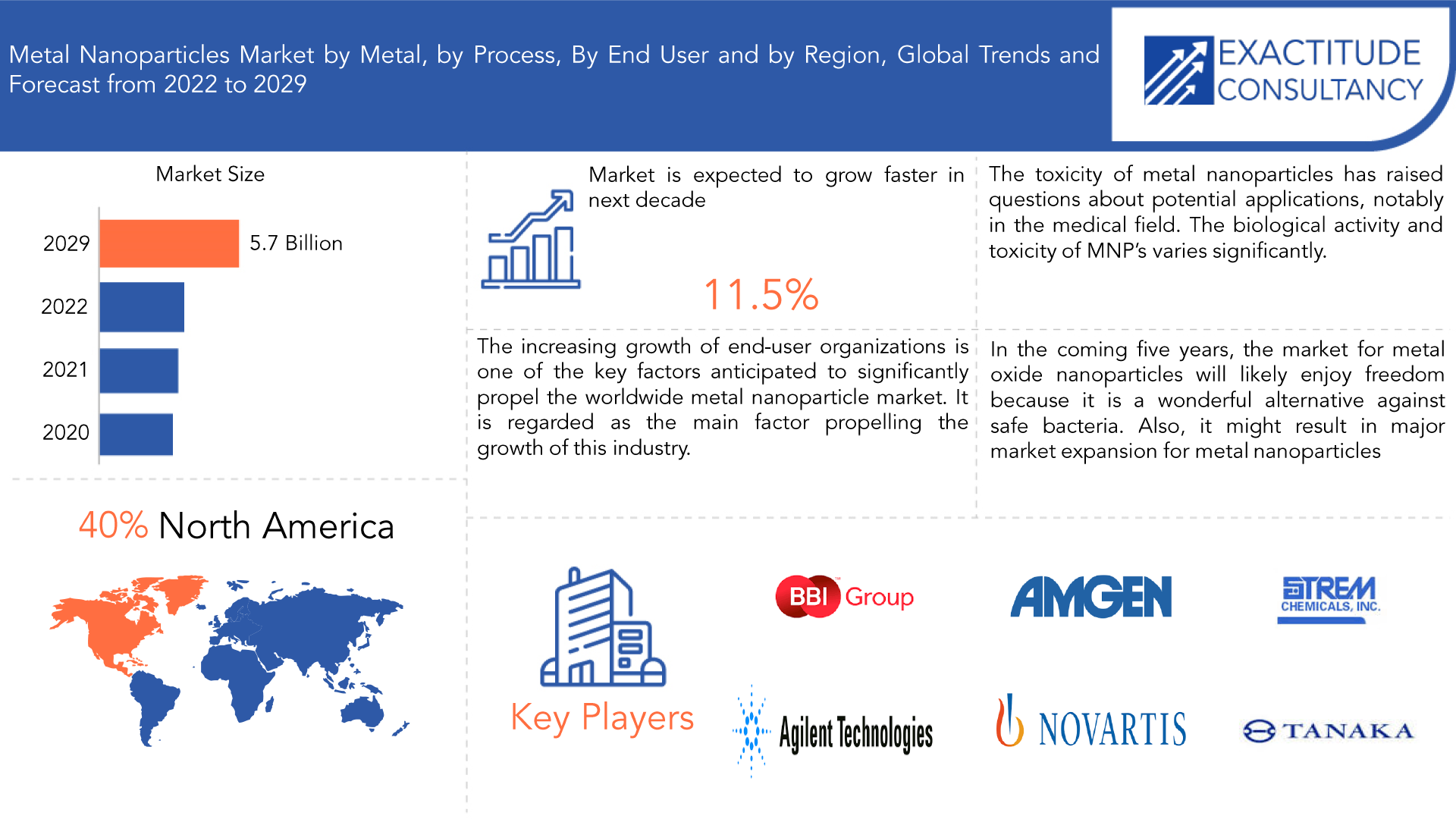
The metal nanoparticles market is expected to grow at 11.5% CAGR from 2020 to 2029. It is expected to reach above USD 5.7 billion by 2029 from USD 2.1billion in 2020.
Inorganic metal or metal oxide makes up the metal core of metal nanoparticles (Metal nanoparticles), which are typically encased in an organic, inorganic, or metal oxide shell. There are numerous uses for metal nanoparticles in daily life. A range of consumer goods, including lotions, shampoos, clothing, shoes, and plastic containers, have found a market for Metal nanoparticles thanks to the invention of new economically viable methods of making them.
New antimicrobial specialists are learning more and more about metal oxide nanoparticles. The ability to mix these materials with antibodies, ligands, and medicines of interest will enable them to be generated and modified with diverse chemical functional groups, opening up a wide range of potential applications in biotechnology and magnetic separation. This is a great option for safe microorganisms and is anticipated to liberate the metal oxide nanoparticle market in the upcoming year.
The technical uses of metal nanoparticles (M-NPs) in numerous scientific domains have drawn the attention of the international research community. For numerous applications, the selective and repeatable synthesis of M-NPs is essential. Metal nanoparticles are created via a variety of chemical and biological processes. While biological procedures avoid the use of harmful ingredients, chemical approaches do.
| ATTRIBUTE | DETAILS |
| Study period | 2020-2029 |
| Base year | 2021 |
| Estimated year | 2022 |
| Forecasted year | 2022-2029 |
| Historical period | 2018-2020 |
| Unit | Value (USD BILLION) (Kilotons) |
| Segmentation | By Metal, By Process, By End-User, By Region |
| By Metal |
|
| By Process |
|
| By End-User |
|
| By Region |
|
The increasing growth of end-user organizations is one of the key factors anticipated to significantly propel the worldwide metal nanoparticle market. It is regarded as the main factor propelling the growth of this industry. Also, excellent financial support from public and private entities is spurring innovation in the metal nanoparticle business. A few brand-new, highly developed metal nanoparticles have entered the market, helping with treatments and objective explicit conclusion in the field of medical services. Such developments are anticipated to significantly fuel the global market for metal nanoparticles throughout the anticipated timeframe.
More products are available for nanoparticle characterization thanks to growing research spending on nanotechnology. Many nations are spending considerably in nanotechnology R&D programmers. Throughout the past ten years, significant public investments have been made in the company. Emerging nations' science, technology, and innovation (ST&I) strategies have also incorporated nanotechnology. Other nations, such as Australia, Canada, India, Israel, Malaysia, New Zealand, the Philippines, and the Caribbean, are putting a lot more of an emphasis on nanotechnology research.
One of the best chances to find new antimicrobial experts in the metal nanoparticle market has come from metal oxide nanoparticles. In the coming five years, the market for metal oxide nanoparticles will likely enjoy freedom because it is a wonderful alternative against safe bacteria. Also, it might result in major market expansion for metal nanoparticles.
The toxicity of metal nanoparticles has raised questions about potential applications, notably in the medical field. The biological activity and toxicity of metal nanoparticles varies significantly from those of their bulk counterparts. The production and use of metal nanoparticles are increasing, which exposes humans and the environment to them more frequently and raises concerns about their toxicity. Metal nanoparticles are likely to accumulate in sensitive organs like the heart, spleen, liver, brain, and kidney after ingestion, inhalation, and skin contact. Metal nanoparticles exhibit distinctive physicochemical properties that may harm tissues, organs, and levels of cellular and protein synthesis.
The COVID-19 epidemic caused a worldwide lockdown, which is what caused the manufacture of several items in the metal nanoparticles business to stop. This has slowed the market's expansion for metal nanoparticles over the past few years. Metal nanoparticle sales were impacted by COVID-19 in the first quarter of 2021, and it is projected that this will have a negative effect on market growth throughout the year. The lockdown's potential effects are presently unknown, and organizations’ ability to recover financially depends entirely on their cash reserves. Manufacturers of metal nanoparticles can afford a complete lockdown for only a few months before the players must change their investment strategies.
[caption id="attachment_18338" align="aligncenter" width="1920"]
Frequently Asked Questions
• What is the worth of metal nanoparticles market?
The metal nanoparticles market are expected to grow at 11.5% CAGR from 2020 to 2029. It is expected to reach above USD 5.7 billion by 2029 from USD 2.1billion in 2020.
• What is the size of the North America metal nanoparticles market?
North America held more than 40 % of the metal nanoparticles revenue share in 2021 and will witness expansion in the forecast period.
• What are some of the market's driving forces?
The increasing growth of end-user organizations is one of the key factors anticipated to significantly propel the worldwide metal nanoparticle market. It is regarded as the main factor propelling the growth of this industry. Also, excellent financial support from public and private entities is spurring innovation in the metal nanoparticle business. A few brand-new, highly developed metal nanoparticles have entered the market, helping with treatments and objective explicit conclusion in the field of medical services. Such developments are anticipated to significantly fuel the global market for metal nanoparticles throughout the anticipated timeframe.
• Which are the top companies to hold the market share in metal nanoparticles market?
The Metal Nanoparticles key players Tnaka Holdings, Meliorum Technologies, BBI Group, Strem Chemicals, Nano labs, Nanopartz, Blacktrace, Malvern agilent techanalytical ltd, Novartis AG, Amgen, Agilent Technologies.
• What is the leading metal of metal nanoparticles market?
The market for metal nanoparticles is divided into segments for titanium, iron, gold, platinum, and other metals. Throughout the expected era, it was anticipated that the silver sub-part would expand quickly. Silver nanoparticles are anticipated to dominate the market for metal nanoparticles. Throughout the projected period, the revenue growth rate for the gold segment is anticipated to be moderate. Several chronic diseases and ailments, such as cancer, kidney disease, fungal infections, excessive cholesterol, multiple sclerosis, chronic pain, and asthma, are treated with gold nanoparticle-based nanomedicines.
Metal Nanoparticles Market Regional Analysis
The Metal Nanoparticles by region includes North America, Asia-Pacific (APAC), Europe, South America, and Middle East & Africa (MEA).
- North America: includes the US, Canada, Mexico
- Asia Pacific: includes China, Japan, South Korea, India, Australia, ASEAN and Rest of APAC
- Europe: includes UK, Germany, France, Italy, Spain, Russia, and Rest of Europe
- South America: includes Brazil, Argentina and Rest of South America
- Middle East & Africa: includes Turkey, UAE, Saudi Arabia, South Africa, and Rest of MEA
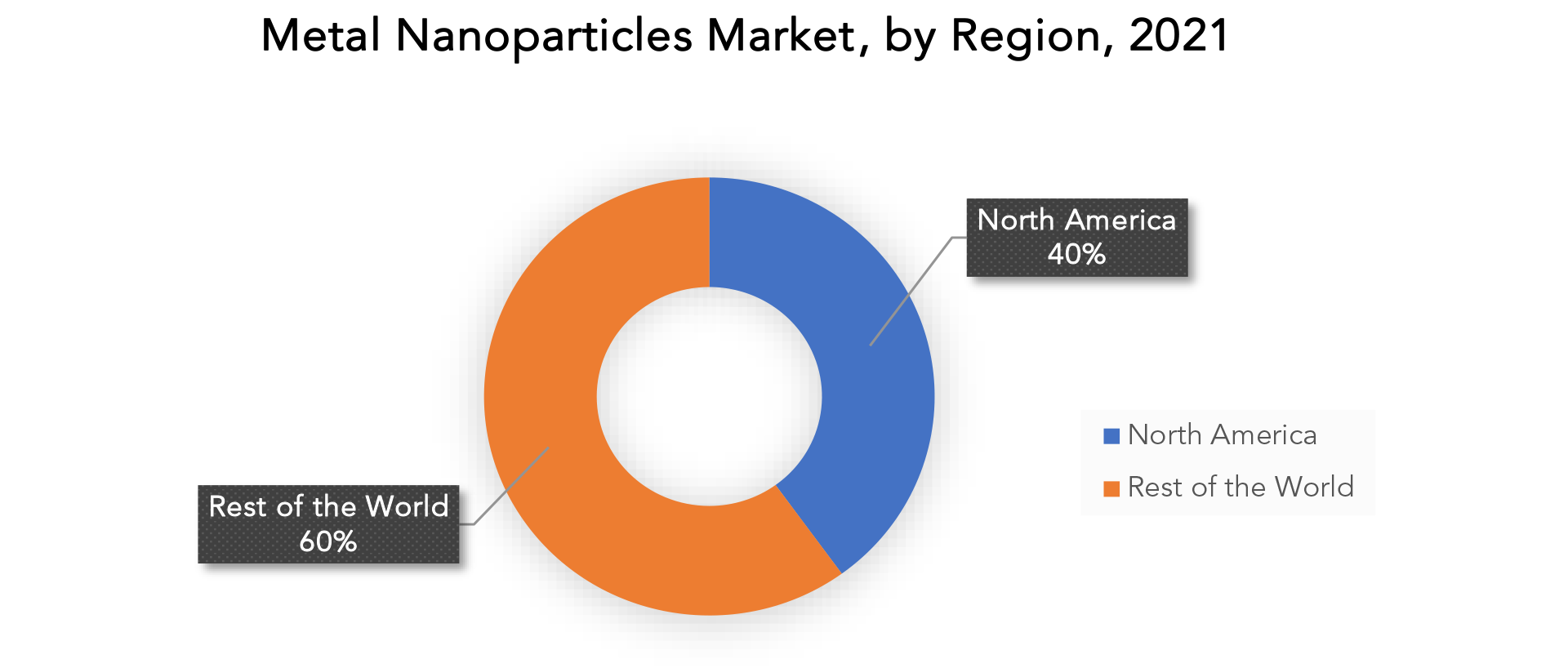
The largest portion of the entire sector is accounted for by the North American market holding 40% of the overall market size, which controls the global market for metal nanoparticles. This is a result of growing demand for the product from innovative medication projects in the area. The leading country is the United States, followed by Canada, as a result of the region's important central members, for instance. The local market is expanding due to ongoing developments in the creation of unique metal nanoparticles for use in a variety of applications. Also, the market for metal nanoparticles is expanding as a result of the rising popularity of solar cells.
The fastest market growth for metal nanoparticles is found in Asia Pacific. Due to innovation, affordability, and rising household incomes in the region, particularly in Asia Pacific's emerging nations, consumer electronics are in high demand. Several industrial giants with significant manufacturing capacity in industries directly related to electronic devices, including as microelectronics, optoelectronics, printed electronics, photovoltaics, and flexible displays, are based in the nations of this region.
Key Market Segments: Metal Nanoparticles Market
Metal Nanoparticles Market By Metal, 2020-2029, (USD Billion) (Kilotons)- Platinum
- Gold
- Silver
- Iron
- Copper
- Nickel
- Chemical
- Physical
- Pharmaceutical & Healthcare
- Electrical & Electronics
- Catalyst
- Personal Care
- North America
- Asia Pacific
- Europe
- South America
- Middle East and Africa
Exactitude Consultancy Services Key Objectives:
- Increasing sales and market share
- Developing new technology
- Improving profitability
- Entering new markets
- Enhancing brand reputation
Key Question Answered
- What is the expected growth rate of the metal nanoparticles market over the next 7 years?
- Who are the major players in the metal nanoparticles market and what is their market share?
- What are the end-user industries driving demand for market and what is their outlook?
- What are the opportunities for growth in emerging markets such as Asia-Pacific, Middle East, and Africa?
- How is the economic environment affecting the metal nanoparticles market, including factors such as interest rates, inflation, and exchange rates?
- What is the expected impact of government policies and regulations on the metal nanoparticles market?
- What is the current and forecasted size and growth rate of the global metal nanoparticles market?
- What are the key drivers of growth in the metal nanoparticles market?
- Who are the major players in the market and what is their market share?
- What are the distribution channels and supply chain dynamics in the metal nanoparticles market?
- What are the technological advancements and innovations in the metal nanoparticles market and their impact on product development and growth?
- What are the regulatory considerations and their impact on the market?
- What are the challenges faced by players in the metal nanoparticles market and how are they addressing these challenges?
- What are the opportunities for growth and expansion in the metal nanoparticles market?
- What are the service offerings and specifications of leading players in the market?
- What is the pricing trend of metal nanoparticles in the market and what is the impact of raw Process prices on the price trend?
Metal Nanoparticles Market Segment Analysis
Based on Metal, the market for metal nanoparticles is divided into segments for titanium, iron, gold, platinum, and other metals. Throughout the expected era, it was anticipated that the silver sub-part would expand quickly. Silver nanoparticles are anticipated to dominate the market for metal nanoparticles. Throughout the projected period, the revenue growth rate for the gold segment is anticipated to be moderate. Several chronic diseases and ailments, such as cancer, kidney disease, fungal infections, excessive cholesterol, multiple sclerosis, chronic pain, and asthma, are treated with gold nanoparticle-based nanomedicines.
Based on Process, it is projected that the physical method would dominate the industry. Over the projection period, the physical synthesis process is anticipated to grow to be the second-largest market segment for metal nanoparticles. Chemical processes come in all shapes and sizes. Ball milling is the most straightforward technique for producing powdered metal nanoparticles. This technique for producing metal nanoparticles has the advantage of being ecologically friendly, making it a possible approach. It replaces hydrogen reduction at high temperatures in a quick and simple manner.
Based on end-user, Over the forecast period, the pharmaceutical and healthcare industry is expected to grow at a substantial CAGR. Metal nanoparticles are being employed more frequently in the medical industry for therapeutic agents, drug delivery, bioimaging, and the diagnosis and treatment of cancer, among other applications. Metal nanoparticles are used in image-based in-vivo therapies to detect anomalies in organs and tissues, diagnose Alzheimer's disease, and treat heart-related conditions. Metal nanoparticles can easily interact with biomolecules both within and outside of cells due to their tiny size. This enables more accurate target detection for diagnostics and therapy.
[caption id="attachment_18339" align="aligncenter" width="1920"]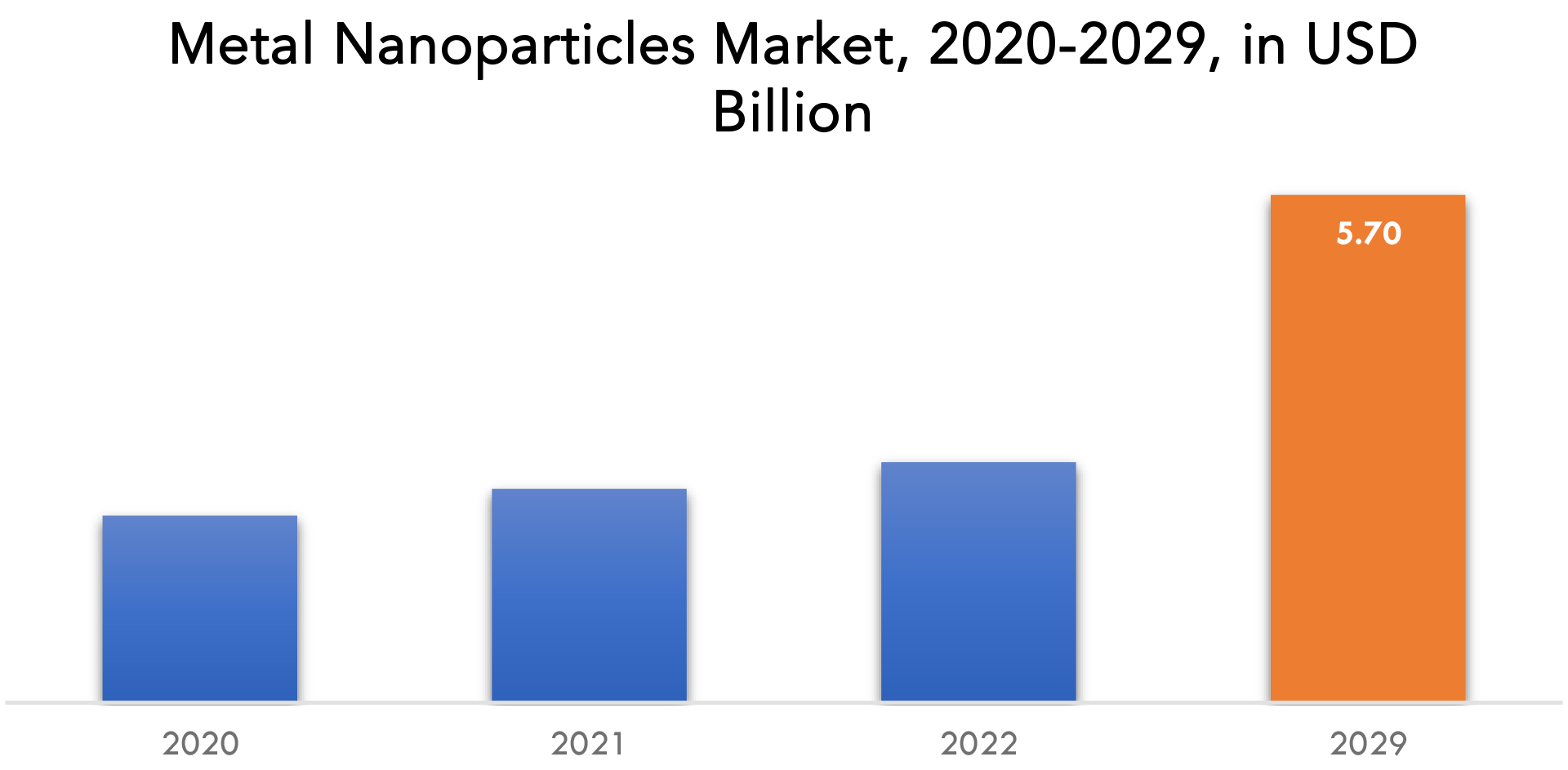
Metal Nanoparticles Market Players
The Metal Nanoparticles Market key players Tanaka Holdings, Meliorum Technologies, BBI Group, Strem Chemicals, Nano labs, Nanopartz, Blacktrace, Novartis AG, Amgen, Agilent Technologies.
Industry Development:- 04-03-2023: -- Nano Labs signed a cooperation framework agreement with the School of Innovation and Entrepreneurship of Zhejiang University to become a practice base for students of the School of Innovation and Entrepreneurship of Zhejiang University.
- 09-03-2023: - Agilent Technologies Inc. (NYSE: A) today announced the acquisition of e-MSion, an early-stage company behind the innovative electron capture dissociation (ECD) technology known as the ExD cell.
Who Should Buy? Or Key stakeholders
- Medicine sector
- Pharma sector
- Electrical sector
- Electronics
- Investors
- Retailers & wholesalers
- Manufacturers & Suppliers
- Distributors & Buyers
- Others
- INTRODUCTION
- MARKET DEFINITION
- MARKET SEGMENTATION
- RESEARCH TIMELINES
- ASSUMPTIONS AND LIMITATIONS
- RESEARCH METHODOLOGY
- DATA MINING
- SECONDARY RESEARCH
- PRIMARY RESEARCH
- SUBJECT-MATTER EXPERTS’ ADVICE
- QUALITY CHECKS
- FINAL REVIEW
- DATA TRIANGULATION
- BOTTOM-UP APPROACH
- TOP-DOWN APPROACH
- RESEARCH FLOW
- DATA SOURCES
- DATA MINING
- EXECUTIVE SUMMARY
- MARKET OVERVIEW
- GLOBAL METAL NANOPARTICLES MARKET OUTLOOK
- MARKET DRIVERS
- MARKET RESTRAINTS
- MARKET OPPORTUNITIES
- IMPACT OF COVID-19 ON METAL NANOPARTICLES MARKET
- PORTER’S FIVE FORCES MODEL
- THREAT FROM NEW ENTRANTS
- THREAT FROM SUBSTITUTES
- BARGAINING POWER OF SUPPLIERS
- BARGAINING POWER OF CUSTOMERS
- DEGREE OF COMPETITION
- INDUSTRY VALUE CHAIN ANALYSIS
- GLOBAL METAL NANOPARTICLES MARKET OUTLOOK
- GLOBAL METAL NANOPARTICLES MARKET BY METAL (USD BILLION) (KILOTONS) 2020-2029
- PLATINUM
- GOLD
- SILVER
- IRON
- COPPER
- NICKEL
- GLOBAL METAL NANOPARTICLES MARKET BY PROCESS (USD BILLION) (KILOTONS) 2020-2029
- CHEMICAL
- PHYSICAL
- GLOBAL METAL NANOPARTICLES MARKET BY END USE (USD BILLION) (KILOTONS) 2020-2029
- PHARMACEUTICAL & HEALTHCARE
- ELECTRICAL & ELECTRONICS
- CATALYST
- PERSONAL CARE
- GLOBAL METAL NANOPARTICLES MARKET BY REGION (USD BILLION) (KILOTONS) 2020-2029
- NORTH AMERICA
- US
- CANADA
- MEXICO
- SOUTH AMERICA
- BRAZIL
- ARGENTINA
- COLOMBIA
- REST OF SOUTH AMERICA
- EUROPE
- GERMANY
- UK
- FRANCE
- ITALY
- SPAIN
- RUSSIA
- REST OF EUROPE
- ASIA PACIFIC
- INDIA
- CHINA
- JAPAN
- SOUTH KOREA
- AUSTRALIA
- SOUTH-EAST ASIA
- REST OF ASIA PACIFIC
- MIDDLE EAST AND AFRICA
- UAE
- SAUDI ARABIA
- SOUTH AFRICA
- REST OF MIDDLE EAST AND AFRICA
- NORTH AMERICA
- COMPANY PROFILES* (BUSINESS OVERVIEW, COMPANY SNAPSHOT, PRODUCT’S OFFERED, RECENT DEVELOPMENTS)
-
- TANAKA HOLDINGS
- MELIORUM TECHNOLOGIES
- BBI GROUP
- STREM CHEMICALS
- NANO LABS
- NANOPARTZ
- BLACKTRACE
- MALVERN
- AGILENT TECHNOLOGIES
- AMGEN
- NOVARTIS AH
*THE COMPANY LIST IS INDICATIVE
LIST OF TABLES
TABLE 1 GLOBAL METAL NANOPARTICLES MARKET BY METAL (USD BILLION) 2020-2029
TABLE 2 GLOBAL METAL NANOPARTICLES MARKET BY METAL (KILOTONS) 2020-2029
TABLE 3 GLOBAL METAL NANOPARTICLES MARKET BY PROCESS (USD BILLION) 2020-2029
TABLE 4 GLOBAL METAL NANOPARTICLES MARKET BY PROCESS (KILOTONS) 2020-2029
TABLE 5 GLOBAL METAL NANOPARTICLES MARKET BY END USER (USD BILLION) 2020-2029
TABLE 6 GLOBAL METAL NANOPARTICLES MARKET BY END USER (KILOTONS) 2020-2029
TABLE 7 GLOBAL METAL NANOPARTICLES MARKET BY REGION (USD BILLION) 2020-2029
TABLE 8 GLOBAL METAL NANOPARTICLES MARKET BY REGION (KILOTONS) 2020-2029
TABLE 9 NORTH AMERICA METAL NANOPARTICLES MARKET BY COUNTRY (USD BILLION) 2020-2029
TABLE 10 NORTH AMERICA METAL NANOPARTICLES MARKET BY COUNTRY (KILOTONS) 2020-2029
TABLE 11 US METAL NANOPARTICLES MARKET BY METAL (USD BILLION) 2020-2029
TABLE 12 US METAL NANOPARTICLES MARKET BY METAL (KILOTONS) 2020-2029
TABLE 13 US METAL NANOPARTICLES MARKET BY PROCESS (USD BILLION) 2020-2029
TABLE 14 US METAL NANOPARTICLES MARKET BY PROCESS (KILOTONS) 2020-2029
TABLE 15 US METAL NANOPARTICLES MARKET BY END USER (USD BILLION) 2020-2029
TABLE 16 US METAL NANOPARTICLES MARKET BY END USER (KILOTONS) 2020-2029
TABLE 17 CANADA METAL NANOPARTICLES MARKET BY METAL (USD BILLION) 2020-2029
TABLE 18 CANADA METAL NANOPARTICLES MARKET BY METAL (KILOTONS) 2020-2029
TABLE 19 CANADA METAL NANOPARTICLES MARKET BY PROCESS (USD BILLION) 2020-2029
TABLE 20 CANADA METAL NANOPARTICLES MARKET BY PROCESS (KILOTONS) 2020-2029
TABLE 21 CANADA METAL NANOPARTICLES MARKET BY END USER (USD BILLION) 2020-2029
TABLE 22 CANADA METAL NANOPARTICLES MARKET BY END USER (KILOTONS) 2020-2029
TABLE 23 MEXICO METAL NANOPARTICLES MARKET BY METAL (USD BILLION) 2020-2029
TABLE 24 MEXICO METAL NANOPARTICLES MARKET BY METAL (KILOTONS) 2020-2029
TABLE 25 MEXICO METAL NANOPARTICLES MARKET BY PROCESS (USD BILLION) 2020-2029
TABLE 26 MEXICO METAL NANOPARTICLES MARKET BY PROCESS (KILOTONS) 2020-2029
TABLE 27 MEXICO METAL NANOPARTICLES MARKET BY END USER (USD BILLION) 2020-2029
TABLE 28 MEXICO METAL NANOPARTICLES MARKET BY END USER (KILOTONS) 2020-2029
TABLE 29 SOUTH AMERICA METAL NANOPARTICLES MARKET BY COUNTRY (USD BILLION) 2020-2029
TABLE 30 SOUTH AMERICA METAL NANOPARTICLES MARKET BY COUNTRY (KILOTONS) 2020-2029
TABLE 31 BRAZIL METAL NANOPARTICLES MARKET BY METAL (USD BILLION) 2020-2029
TABLE 32 BRAZIL METAL NANOPARTICLES MARKET BY METAL (KILOTONS) 2020-2029
TABLE 33 BRAZIL METAL NANOPARTICLES MARKET BY PROCESS (USD BILLION) 2020-2029
TABLE 34 BRAZIL METAL NANOPARTICLES MARKET BY PROCESS (KILOTONS) 2020-2029
TABLE 35 BRAZIL METAL NANOPARTICLES MARKET BY END USER (USD BILLION) 2020-2029
TABLE 36 BRAZIL METAL NANOPARTICLES MARKET BY END USER (KILOTONS) 2020-2029
TABLE 37 ARGENTINA METAL NANOPARTICLES MARKET BY METAL (USD BILLION) 2020-2029
TABLE 38 ARGENTINA METAL NANOPARTICLES MARKET BY METAL (KILOTONS) 2020-2029
TABLE 39 ARGENTINA METAL NANOPARTICLES MARKET BY PROCESS (USD BILLION) 2020-2029
TABLE 40 ARGENTINA METAL NANOPARTICLES MARKET BY PROCESS (KILOTONS) 2020-2029
TABLE 41 ARGENTINA METAL NANOPARTICLES MARKET BY END USER (USD BILLION) 2020-2029
TABLE 42 ARGENTINA METAL NANOPARTICLES MARKET BY END USER (KILOTONS) 2020-2029
TABLE 43 COLOMBIA METAL NANOPARTICLES MARKET BY METAL (USD BILLION) 2020-2029
TABLE 44 COLOMBIA METAL NANOPARTICLES MARKET BY METAL (KILOTONS) 2020-2029
TABLE 45 COLOMBIA METAL NANOPARTICLES MARKET BY PROCESS (USD BILLION) 2020-2029
TABLE 46 COLOMBIA METAL NANOPARTICLES MARKET BY PROCESS (KILOTONS) 2020-2029
TABLE 47 COLOMBIA METAL NANOPARTICLES MARKET BY END USER (USD BILLION) 2020-2029
TABLE 48 COLOMBIA METAL NANOPARTICLES MARKET BY END USER (KILOTONS) 2020-2029
TABLE 49 REST OF SOUTH AMERICA METAL NANOPARTICLES MARKET BY METAL (USD BILLION) 2020-2029
TABLE 50 REST OF SOUTH AMERICA METAL NANOPARTICLES MARKET BY METAL (KILOTONS) 2020-2029
TABLE 51 REST OF SOUTH AMERICA METAL NANOPARTICLES MARKET BY PROCESS (USD BILLION) 2020-2029
TABLE 52 REST OF SOUTH AMERICA METAL NANOPARTICLES MARKET BY PROCESS (KILOTONS) 2020-2029
TABLE 53 REST OF SOUTH AMERICA METAL NANOPARTICLES MARKET BY END USER (USD BILLION) 2020-2029
TABLE 54 REST OF SOUTH AMERICA METAL NANOPARTICLES MARKET BY END USER (KILOTONS) 2020-2029
TABLE 55 ASIA-PACIFIC METAL NANOPARTICLES MARKET BY COUNTRY (USD BILLION) 2020-2029
TABLE 56 ASIA-PACIFIC METAL NANOPARTICLES MARKET BY COUNTRY (KILOTONS) 2020-2029
TABLE 57 INDIA METAL NANOPARTICLES MARKET BY METAL (USD BILLION) 2020-2029
TABLE 58 INDIA METAL NANOPARTICLES MARKET BY METAL (KILOTONS) 2020-2029
TABLE 59 INDIA METAL NANOPARTICLES MARKET BY PROCESS (USD BILLION) 2020-2029
TABLE 60 INDIA METAL NANOPARTICLES MARKET BY PROCESS (KILOTONS) 2020-2029
TABLE 61 INDIA METAL NANOPARTICLES MARKET BY END USER (USD BILLION) 2020-2029
TABLE 62 INDIA METAL NANOPARTICLES MARKET BY END USER (KILOTONS) 2020-2029
TABLE 63 CHINA METAL NANOPARTICLES MARKET BY METAL (USD BILLION) 2020-2029
TABLE 64 CHINA METAL NANOPARTICLES MARKET BY METAL (KILOTONS) 2020-2029
TABLE 65 CHINA METAL NANOPARTICLES MARKET BY PROCESS (USD BILLION) 2020-2029
TABLE 66 CHINA METAL NANOPARTICLES MARKET BY PROCESS (KILOTONS) 2020-2029
TABLE 67 CHINA METAL NANOPARTICLES MARKET BY END USER (USD BILLION) 2020-2029
TABLE 68 CHINA METAL NANOPARTICLES MARKET BY END USER (KILOTONS) 2020-2029
TABLE 69 JAPAN METAL NANOPARTICLES MARKET BY METAL (USD BILLION) 2020-2029
TABLE 70 JAPAN METAL NANOPARTICLES MARKET BY METAL (KILOTONS) 2020-2029
TABLE 71 JAPAN METAL NANOPARTICLES MARKET BY PROCESS (USD BILLION) 2020-2029
TABLE 72 JAPAN METAL NANOPARTICLES MARKET BY PROCESS (KILOTONS) 2020-2029
TABLE 73 JAPAN METAL NANOPARTICLES MARKET BY END USER (USD BILLION) 2020-2029
TABLE 74 JAPAN METAL NANOPARTICLES MARKET BY END USER (KILOTONS) 2020-2029
TABLE 75 SOUTH KOREA METAL NANOPARTICLES MARKET BY METAL (USD BILLION) 2020-2029
TABLE 76 SOUTH KOREA METAL NANOPARTICLES MARKET BY METAL (KILOTONS) 2020-2029
TABLE 77 SOUTH KOREA METAL NANOPARTICLES MARKET BY PROCESS (USD BILLION) 2020-2029
TABLE 78 SOUTH KOREA METAL NANOPARTICLES MARKET BY PROCESS (KILOTONS) 2020-2029
TABLE 79 SOUTH KOREA METAL NANOPARTICLES MARKET BY END USER (USD BILLION) 2020-2029
TABLE 80 SOUTH KOREA METAL NANOPARTICLES MARKET BY END USER (KILOTONS) 2020-2029
TABLE 81 AUSTRALIA METAL NANOPARTICLES MARKET BY METAL (USD BILLION) 2020-2029
TABLE 82 AUSTRALIA METAL NANOPARTICLES MARKET BY METAL (KILOTONS) 2020-2029
TABLE 83 AUSTRALIA METAL NANOPARTICLES MARKET BY PROCESS (USD BILLION) 2020-2029
TABLE 84 AUSTRALIA METAL NANOPARTICLES MARKET BY PROCESS (KILOTONS) 2020-2029
TABLE 85 AUSTRALIA METAL NANOPARTICLES MARKET BY END USER (USD BILLION) 2020-2029
TABLE 86 AUSTRALIA METAL NANOPARTICLES MARKET BY END USER (KILOTONS) 2020-2029
TABLE 87 SOUTH-EAST ASIA METAL NANOPARTICLES MARKET BY METAL (USD BILLION) 2020-2029
TABLE 88 SOUTH-EAST ASIA METAL NANOPARTICLES MARKET BY METAL (KILOTONS) 2020-2029
TABLE 89 SOUTH-EAST ASIA METAL NANOPARTICLES MARKET BY PROCESS (USD BILLION) 2020-2029
TABLE 90 SOUTH-EAST ASIA METAL NANOPARTICLES MARKET BY PROCESS (KILOTONS) 2020-2029
TABLE 91 SOUTH-EAST ASIA METAL NANOPARTICLES MARKET BY END USER (USD BILLION) 2020-2029
TABLE 92 SOUTH-EAST ASIA METAL NANOPARTICLES MARKET BY END USER (KILOTONS) 2020-2029
TABLE 93 REST OF ASIA PACIFIC METAL NANOPARTICLES MARKET BY METAL (USD BILLION) 2020-2029
TABLE 94 REST OF ASIA PACIFIC METAL NANOPARTICLES MARKET BY METAL (KILOTONS) 2020-2029
TABLE 95 REST OF ASIA PACIFIC METAL NANOPARTICLES MARKET BY PROCESS (USD BILLION) 2020-2029
TABLE 96 REST OF ASIA PACIFIC METAL NANOPARTICLES MARKET BY PROCESS (KILOTONS) 2020-2029
TABLE 97 REST OF ASIA PACIFIC METAL NANOPARTICLES MARKET BY END USER (USD BILLION) 2020-2029
TABLE 98 REST OF ASIA PACIFIC METAL NANOPARTICLES MARKET BY END USER (KILOTONS) 2020-2029
TABLE 99 EUROPE METAL NANOPARTICLES MARKET BY COUNTRY (USD BILLION) 2020-2029
TABLE 100 EUROPE METAL NANOPARTICLES MARKET BY COUNTRY (KILOTONS) 2020-2029
TABLE 101 GERMANY METAL NANOPARTICLES MARKET BY METAL (USD BILLION) 2020-2029
TABLE 102 GERMANY METAL NANOPARTICLES MARKET BY METAL (KILOTONS) 2020-2029
TABLE 103 GERMANY METAL NANOPARTICLES MARKET BY PROCESS (USD BILLION) 2020-2029
TABLE 104 GERMANY METAL NANOPARTICLES MARKET BY PROCESS (KILOTONS) 2020-2029
TABLE 105 GERMANY METAL NANOPARTICLES MARKET BY END USER (USD BILLION) 2020-2029
TABLE 106 GERMANY METAL NANOPARTICLES MARKET BY END USER (KILOTONS) 2020-2029
TABLE 107 UK METAL NANOPARTICLES MARKET BY METAL (USD BILLION) 2020-2029
TABLE 108 UK METAL NANOPARTICLES MARKET BY METAL (KILOTONS) 2020-2029
TABLE 109 UK METAL NANOPARTICLES MARKET BY PROCESS (USD BILLION) 2020-2029
TABLE 110 UK METAL NANOPARTICLES MARKET BY PROCESS (KILOTONS) 2020-2029
TABLE 111 UK METAL NANOPARTICLES MARKET BY END USER (USD BILLION) 2020-2029
TABLE 112 UK METAL NANOPARTICLES MARKET BY END USER (KILOTONS) 2020-2029
TABLE 113 FRANCE METAL NANOPARTICLES MARKET BY METAL (USD BILLION) 2020-2029
TABLE 114 FRANCE METAL NANOPARTICLES MARKET BY METAL (KILOTONS) 2020-2029
TABLE 115 FRANCE METAL NANOPARTICLES MARKET BY PROCESS (USD BILLION) 2020-2029
TABLE 116 FRANCE METAL NANOPARTICLES MARKET BY PROCESS (KILOTONS) 2020-2029
TABLE 117 FRANCE METAL NANOPARTICLES MARKET BY END USER (USD BILLION) 2020-2029
TABLE 118 FRANCE METAL NANOPARTICLES MARKET BY END USER (KILOTONS) 2020-2029
TABLE 119 ITALY METAL NANOPARTICLES MARKET BY METAL (USD BILLION) 2020-2029
TABLE 120 ITALY METAL NANOPARTICLES MARKET BY METAL (KILOTONS) 2020-2029
TABLE 121 ITALY METAL NANOPARTICLES MARKET BY PROCESS (USD BILLION) 2020-2029
TABLE 122 ITALY METAL NANOPARTICLES MARKET BY PROCESS (KILOTONS) 2020-2029
TABLE 123 ITALY METAL NANOPARTICLES MARKET BY END USER (USD BILLION) 2020-2029
TABLE 124 ITALY METAL NANOPARTICLES MARKET BY END USER (KILOTONS) 2020-2029
TABLE 125 SPAIN METAL NANOPARTICLES MARKET BY METAL (USD BILLION) 2020-2029
TABLE 126 SPAIN METAL NANOPARTICLES MARKET BY METAL (KILOTONS) 2020-2029
TABLE 127 SPAIN METAL NANOPARTICLES MARKET BY PROCESS (USD BILLION) 2020-2029
TABLE 128 SPAIN METAL NANOPARTICLES MARKET BY PROCESS (KILOTONS) 2020-2029
TABLE 129 SPAIN METAL NANOPARTICLES MARKET BY END USER (USD BILLION) 2020-2029
TABLE 130 SPAIN METAL NANOPARTICLES MARKET BY END USER (KILOTONS) 2020-2029
TABLE 131 RUSSIA METAL NANOPARTICLES MARKET BY METAL (USD BILLION) 2020-2029
TABLE 132 RUSSIA METAL NANOPARTICLES MARKET BY METAL (KILOTONS) 2020-2029
TABLE 133 RUSSIA METAL NANOPARTICLES MARKET BY PROCESS (USD BILLION) 2020-2029
TABLE 134 RUSSIA METAL NANOPARTICLES MARKET BY PROCESS (KILOTONS) 2020-2029
TABLE 135 RUSSIA METAL NANOPARTICLES MARKET BY END USER (USD BILLION) 2020-2029
TABLE 136 RUSSIA METAL NANOPARTICLES MARKET BY END USER (KILOTONS) 2020-2029
TABLE 137 REST OF EUROPE METAL NANOPARTICLES MARKET BY METAL (USD BILLION) 2020-2029
TABLE 138 REST OF EUROPE METAL NANOPARTICLES MARKET BY METAL (KILOTONS) 2020-2029
TABLE 139 REST OF EUROPE METAL NANOPARTICLES MARKET BY PROCESS (USD BILLION) 2020-2029
TABLE 140 REST OF EUROPE METAL NANOPARTICLES MARKET BY PROCESS (KILOTONS) 2020-2029
TABLE 141 REST OF EUROPE METAL NANOPARTICLES MARKET BY END USER (USD BILLION) 2020-2029
TABLE 142 REST OF EUROPE METAL NANOPARTICLES MARKET BY END USER (KILOTONS) 2020-2029
TABLE 143 MIDDLE EAST AND AFRICA METAL NANOPARTICLES MARKET BY COUNTRY (USD BILLION) 2020-2029
TABLE 144 MIDDLE EAST AND AFRICA METAL NANOPARTICLES MARKET BY COUNTRY (KILOTONS) 2020-2029
TABLE 145 UAE METAL NANOPARTICLES MARKET BY METAL (USD BILLION) 2020-2029
TABLE 146 UAE METAL NANOPARTICLES MARKET BY METAL (KILOTONS) 2020-2029
TABLE 147 UAE METAL NANOPARTICLES MARKET BY PROCESS (USD BILLION) 2020-2029
TABLE 148 UAE METAL NANOPARTICLES MARKET BY PROCESS (KILOTONS) 2020-2029
TABLE 149 UAE METAL NANOPARTICLES MARKET BY END USER (USD BILLION) 2020-2029
TABLE 150 UAE METAL NANOPARTICLES MARKET BY END USER (KILOTONS) 2020-2029
TABLE 151 SAUDI ARABIA METAL NANOPARTICLES MARKET BY METAL (USD BILLION) 2020-2029
TABLE 152 SAUDI ARABIA METAL NANOPARTICLES MARKET BY METAL (KILOTONS) 2020-2029
TABLE 153 SAUDI ARABIA METAL NANOPARTICLES MARKET BY PROCESS (USD BILLION) 2020-2029
TABLE 154 SAUDI ARABIA METAL NANOPARTICLES MARKET BY PROCESS (KILOTONS) 2020-2029
TABLE 155 SAUDI ARABIA METAL NANOPARTICLES MARKET BY END USER (USD BILLION) 2020-2029
TABLE 156 SAUDI ARABIA METAL NANOPARTICLES MARKET BY END USER (KILOTONS) 2020-2029
TABLE 157 SOUTH AFRICA METAL NANOPARTICLES MARKET BY METAL (USD BILLION) 2020-2029
TABLE 158 SOUTH AFRICA METAL NANOPARTICLES MARKET BY METAL (KILOTONS) 2020-2029
TABLE 159 SOUTH AFRICA METAL NANOPARTICLES MARKET BY PROCESS (USD BILLION) 2020-2029
TABLE 160 SOUTH AFRICA METAL NANOPARTICLES MARKET BY PROCESS (KILOTONS) 2020-2029
TABLE 161 SOUTH AFRICA METAL NANOPARTICLES MARKET BY END USER (USD BILLION) 2020-2029
TABLE 162 SOUTH AFRICA METAL NANOPARTICLES MARKET BY END USER (KILOTONS) 2020-2029
TABLE 163 REST OF MIDDLE EAST AND AFRICA METAL NANOPARTICLES MARKET BY METAL (USD BILLION) 2020-2029
TABLE 164 REST OF MIDDLE EAST AND AFRICA METAL NANOPARTICLES MARKET BY METAL (KILOTONS) 2020- 2029
TABLE 165 REST OF MIDDLE EAST AND AFRICA METAL NANOPARTICLES MARKET BY PROCESS (USD BILLION) 2020-2029
TABLE 166 REST OF MIDDLE EAST AND AFRICA METAL NANOPARTICLES MARKET BY PROCESS (KILOTONS) 2020-2029
TABLE 167 REST OF MIDDLE EAST AND AFRICA METAL NANOPARTICLES MARKET BY END USER (USD BILLION) 2020-2029
TABLE 168 REST OF MIDDLE EAST AND AFRICA METAL NANOPARTICLES MARKET BY END USER (KILOTONS) 2020-2029
TABLE 169 REST OF MIDDLE EAST AND AFRICA METAL NANOPARTICLES MARKET BY END USER (KILOTONS) 2020-2029
LIST OF FIGURES
FIGURE 1 MARKET DYNAMICS
FIGURE 2 MARKET SEGMENTATION
FIGURE 3 REPORT TIMELINES: YEARS CONSIDERED
FIGURE 4 DATA TRIANGULATION
FIGURE 5 BOTTOM-UP APPROACH
FIGURE 6 TOP-DOWN APPROACH
FIGURE 7 RESEARCH FLOW
FIGURE 8 GLOBAL METAL NANOPARTICLES MARKET BY METAL, USD BILLION, 2020-2029
FIGURE 9 GLOBAL METAL NANOPARTICLES MARKET BY END USER, USD BILLION, 2020-2029
FIGURE 10 GLOBAL METAL NANOPARTICLES MARKET BY PROCESS, USD BILLION, 2020-2029
FIGURE 11 GLOBAL METAL NANOPARTICLES MARKET BY REGION, USD BILLION, 2020-2029
FIGURE 12 GLOBAL METAL NANOPARTICLES MARKET BY METAL, USD BILLION, 2021
FIGURE 13 GLOBAL METAL NANOPARTICLES MARKET BY END USER, USD BILLION, 2021
FIGURE 14 GLOBAL METAL NANOPARTICLES MARKET BY PROCESS, USD BILLION, 2021
FIGURE 15 GLOBAL METAL NANOPARTICLES MARKET BY REGION, USD BILLION, 2021
FIGURE 16 PORTER’S FIVE FORCES MODEL
FIGURE 17 MARKET SHARE ANALYSIS
FIGURE 18 TANAKA HOLDINGS: COMPANY SNAPSHOT
FIGURE 19 MELIORUM TECHNOLOGIES: COMPANY SNAPSHOT
FIGURE 20BBI GROUP COMPANY SNAPSHOT
FIGURE 21 STREM CHEMICALS: COMPANY SNAPSHOT
FIGURE 22 NANO LABS: COMPANY SNAPSHOT
FIGURE 23 NANOPARTZ: COMPANY SNAPSHOT
FIGURE 24BLACKTRACE: COMPANY SNAPSHOT
FIGURE 25 AGILENT TECHNOLOGIES: COMPANY SNAPSHOT
DOWNLOAD FREE SAMPLE REPORT
License Type
SPEAK WITH OUR ANALYST
Want to know more about the report or any specific requirement?
WANT TO CUSTOMIZE THE REPORT?
Our Clients Speak
We asked them to research ‘ Equipment market’ all over the world, and their whole arrangement was helpful to us. thehealthanalytics.com insightful analysis and reports contributed to our current analysis and in creating a future strategy. Besides, the te
Yosuke Mitsui
Senior Associate Construction Equipment Sales & Marketing
We asked them to research ‘Equipment market’ all over the world, and their whole arrangement was helpful to us. thehealthanalytics.com insightful analysis and reports contributed to our current analysis and in creating a future strategy. Besides, the te