

Base Year Value ()
x.x %
x.x %
CAGR ()
x.x %
x.x %
Forecast Year Value ()
x.x %
x.x %
Historical Data Period
Largest Region
Forecast Period
Low-Light Imaging Market by Technology (Complementary metal-oxide-semiconductor (CMOS), Charge-coupled Device (CCD)), by Application (Security and Surveillance, Monitoring, Photography) by End User (Consumer Electronics, Automotive, Medical and Life sciences, Military and Defense, Industrial, Commercial and Residential Infrastructure) and Region, Global trends and forecast from 2022 to 2029.
Instant access to hundreds of data points and trends
- Market estimates from 2014-2029
- Competitive analysis, industry segmentation, financial benchmarks
- Incorporates SWOT, Porter's Five Forces and risk management frameworks
- PDF report or online database with Word, Excel and PowerPoint export options
- 100% money back guarantee
Low-Light Imaging Market Overview
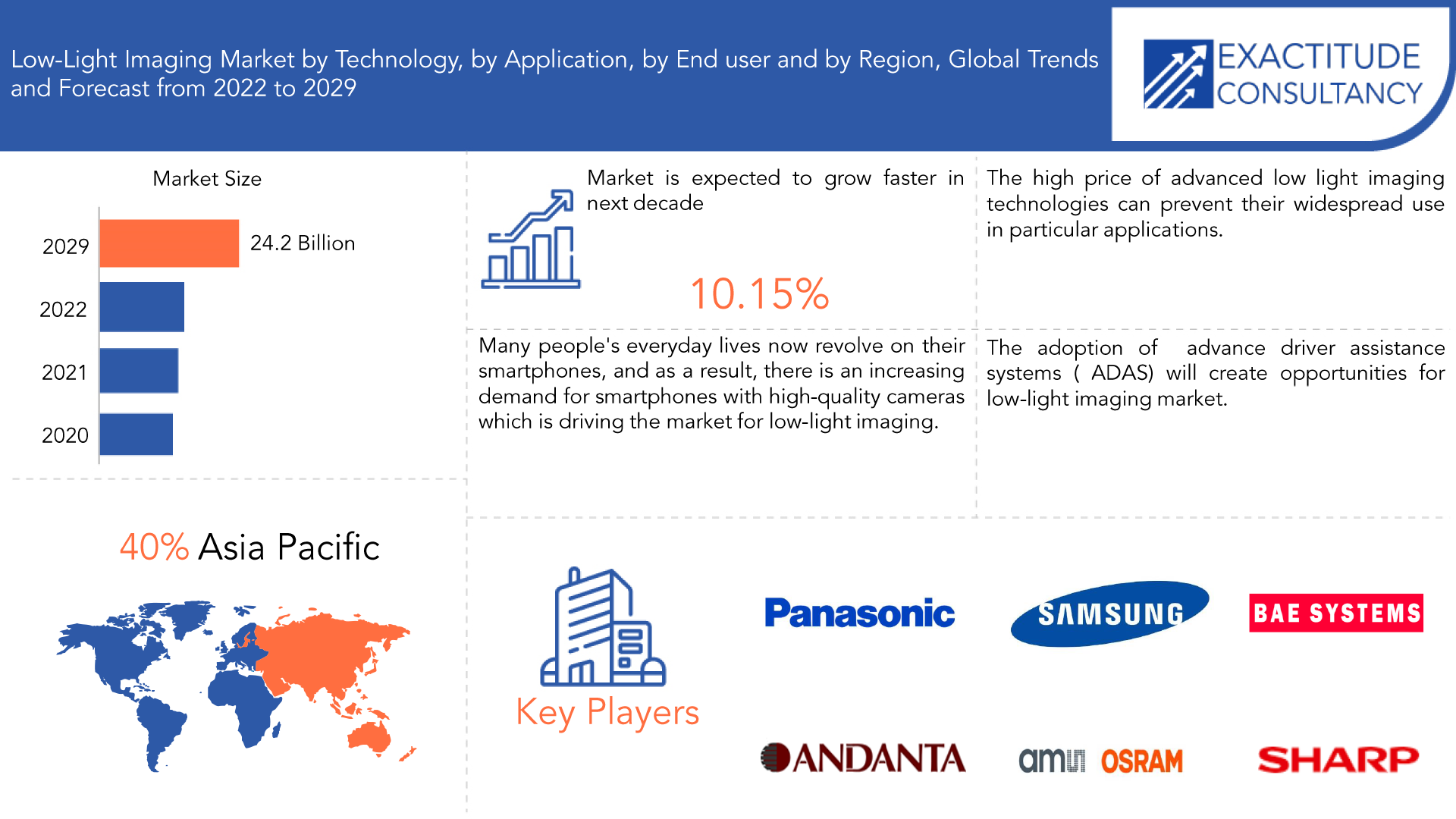
The low-light imaging market is expected to grow at 10.15% CAGR from 2022 to 2029. It is expected to reach above USD 24.2 billion by 2029 from USD 11.98 billion in 2021.
Low light imaging is the process of taking photos or films in dimly lit or low light situations, such as at night. As a result of the camera sensor's inability to capture enough light in these circumstances, photos may have noise, blur, and diminished detail.
Several methods can be employed to enhance low light imaging in order to get over these difficulties. These include extending the exposure time to give the sensor more time to capture light, opening the aperture wider to let more light into the camera, and raising the ISO sensitivity to amplify the data from the sensor. Other methods include using artificial light sources to illuminate the environment more abundantly and image stabilization to lessen blur brought on by camera or subject movement.
| ATTRIBUTE | DETAILS |
| Study period | 2020-2029 |
| Base year | 2021 |
| Estimated year | 2022 |
| Forecasted year | 2022-2029 |
| Historical period | 2018-2020 |
| Unit | Value (USD Billion) |
| Segmentation | By technology, by application, by end user |
| By Technology
|
|
| BY Application
|
|
| By End User
|
|
| By Region
|
|
Image stacking and computational photography are two examples of cutting-edge technology that are frequently used into modern cameras and smartphones to enhance low light pictures. To improve image quality in low light situations, computational photography employs algorithms and software in addition to several photographs that are combined to decrease distortion. Even in difficult low light situations, it is feasible to take high-quality pictures and films by combining these techniques.
Many people's everyday lives now revolve on their smartphones, and as a result, there is an increasing demand for smartphones with high-quality cameras. Advanced camera technology has been developed as a result of low light photography skills becoming a significant differentiator for smartphone makers. Low light imaging has emerged as a key component of the continuous camera quality innovation that smartphone makers are pursuing. In order to capture high-quality photographs in low light, many smartphones now come equipped with cutting-edge low light imaging features like bigger sensors, wider apertures, and optical image stabilization.
The high price of advanced low light imaging technologies can prevent their widespread use in particular applications. For certain clients, the price of sensors, lenses, and other components can be a substantial entrance barrier. The developers of low-light imaging systems are always trying to come up with innovative ways to increase efficiency and lower prices. For instance, the introduction of novel sensor technologies like stacked CMOS sensors and backside-illuminated (BSI) sensors has increased low light performance while lowering costs.
Advanced driver assistance systems (ADAS) and autonomous vehicles are examples of automotive applications that can benefit from the use of low light imaging technology to increase performance and safety. Night vision systems are one of the major low light imaging applications in the automotive sector. These technologies give drivers a more precise view of the road ahead by using infrared or thermal imaging to detect objects and people in poor light. By lowering the possibility of accidents brought on by poor visibility, this can increase safety.
Due to lockdowns and restrictions on gatherings, the demand for low light imaging products, such as night vision cameras, decreased as people were less likely to engage in nighttime activities. The manufacturing and supply chain for low light imaging products were also disrupted, leading to shortages and delays in production. However, some segments of the market, such as surveillance and security, experienced an increase in demand due to the need for enhanced safety measures. Overall, the low light imaging market experienced a slowdown in growth during the pandemic, but some sectors remained resilient.
[caption id="attachment_21410" align="aligncenter" width="1068"]
Frequently Asked Questions
What is the worth of low light imaging market?
The low-light imaging market was USD 11.98 Billion in the year 2021.
What is the size of share of the Asia Pacific low-light imaging industry?
Asia Pacific held more than 40 % of the low-light imaging market revenue share in 2021 and will witness expansion in the forecast period.
What are some of the market's driving forces?
Many people's everyday lives now revolve on their smartphones, and as a result, there is an increasing demand for smartphones with high-quality cameras which is driving the market for low-light imaging market.
Which are the top companies to hold the market share in Low-Light Imaging market?
The low light imaging market key players include Panasonic Corporation Co, Ltd, Samsung, BAE Systems, Andanta GmbH, ams-OSRAM AG, STMicroelectronics, Sharp Corporation, Teledyne FLIR LLC, Hamamatsu Photonics K.K., Semiconductor Components Industries, LLC, PIXELPLUS.
Who is the leading end user of low-light imaging market?
The largest end-user for low light imaging technology is currently the military and defense sector.
Which is the largest regional market for low-light imaging market?
Asia Pacific is the largest regional market for low-light imaging market.
Low-Light Imaging Market Segment Analysis
The low-light imaging market is segmented based on technology, application and end user.Charge-coupled Device (CCD) sensors now hold a dominant position on the market for low-light imaging technology, while complementary metal-oxide-semiconductor (CMOS) sensors are quickly overtaking them. Due to their high sensitivity and low noise levels, CCD sensors have traditionally been the preferred option for low light imaging applications, such as scientific imaging and surveillance. But in recent years, CMOS sensors have made steady progress and can now compete with CCD sensors in many low-light imaging applications.
Security and surveillance are the two most common application fields in the low light imaging market. For applications including night vision cameras, thermal imaging cameras, and other kinds of surveillance equipment that are used to watch over and safeguard people and property in low light situations, low light imaging is essential.
The largest end-user for low light imaging technology is currently the military and defense sector since low light imaging is critical for military and defense applications such as night vision, target identification, and reconnaissance. Military and defense organizations invest heavily in low light imaging technology to gain a strategic advantage in low light or nighttime conditions.
[caption id="attachment_21420" align="aligncenter" width="1920"]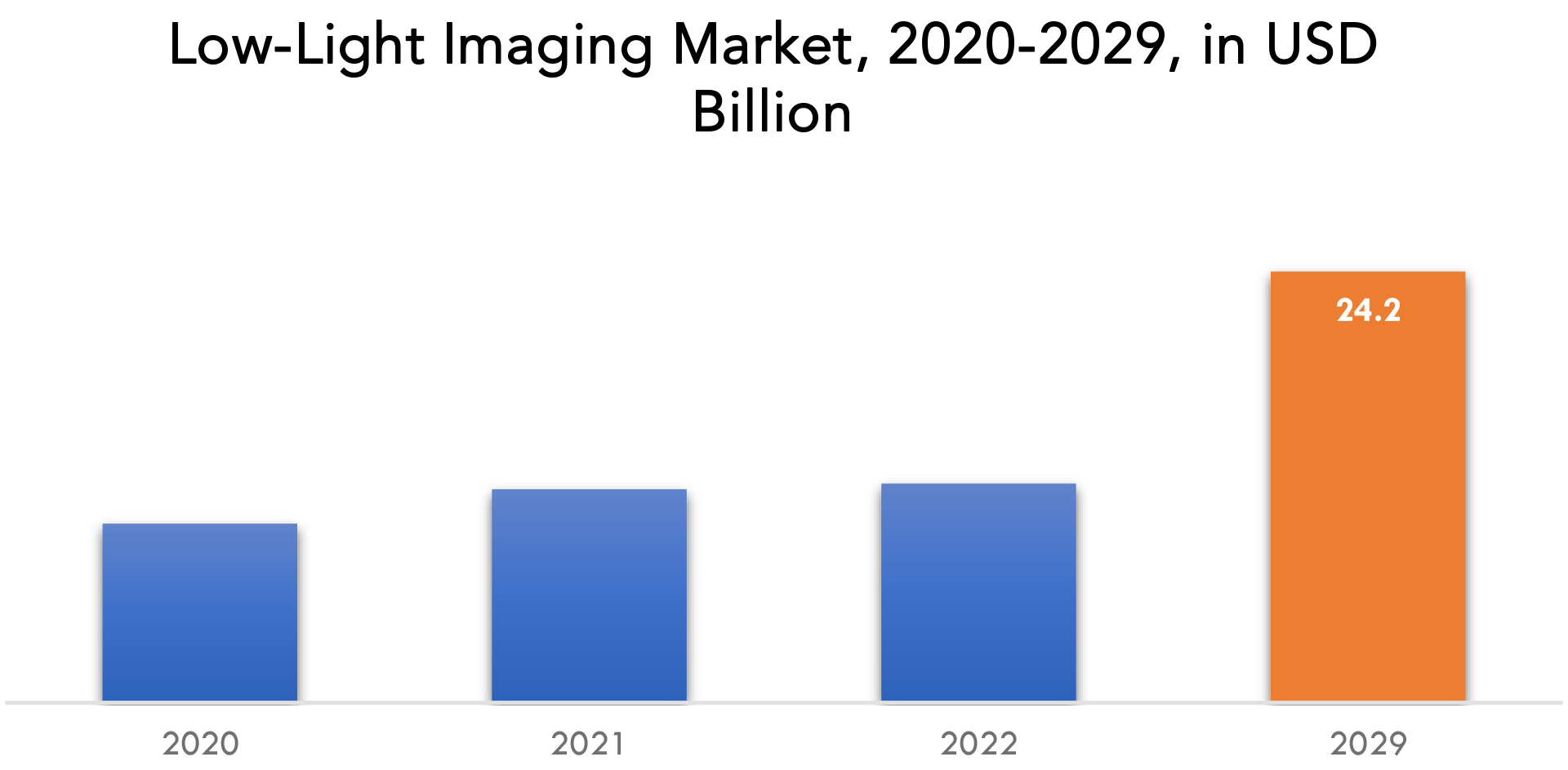
Low-Light Imaging Market Players
The low light imaging market key players include Panasonic Corporation Co, Ltd, Samsung, BAE Systems, Andanta GmbH, ams-OSRAM AG, STMicroelectronics, Sharp Corporation, Teledyne FLIR LLC, Hamamatsu Photonics K.K, Semiconductor Components Industries, LLC, PIXELPLUS.
Industry Developments:
- February 28, 2023: Samsung Electronics debuted its revolutionary Nightography feature. First introduced in the Galaxy S22 series, Galaxy users can now enjoy even more vivid, highly optimized photos, even in the dark, with enhanced Nightogaphy for the Galaxy S23 series.
- September 2, 2021: Samsung Electronics, a world leader in advanced semiconductor technology, introduced the ISOCELL HP1, the industry’s first 200-megapixel (MP) image sensor with 0.64μm pixels, and ISOCELL GN5, the first image sensor to adopt all-directional focusing Dual Pixel Pro technology with two photodiodes in a single 1.0μm pixel.
Who Should Buy? Or Key stakeholders
- Research organizations and consulting companies
- Associations, forums, and alliances related to chip antenna
- Investors
- Start-up companies
- Raw material suppliers
- Government and other regulatory bodies
- Market research and consulting firms
Low-Light Imaging Market Regional Analysis
The low-light imaging market by region includes North America, Asia-Pacific (APAC), Europe, South America, and Middle East & Africa (MEA).
- North America: includes the US, Canada, Mexico
- Asia Pacific: includes China, Japan, South Korea, India, Australia, ASEAN and Rest of APAC
- Europe: includes UK, Germany, France, Italy, Spain, Russia, and Rest of Europe
- South America: includes Brazil, Argentina and Rest of South America
- Middle East & Africa: includes Turkey, UAE, Saudi Arabia, South Africa, and Rest of MEA
The market for low-light imaging in Asia and the Pacific is enormous and expanding quickly. Due to the region's huge and expanding population as well as some of the world's largest and fastest-growing economies, including China, India, Japan, and South Korea, there is an increasing need for low light imaging technologies in a variety of fields. Security and surveillance, which encompasses uses including video surveillance, border security, and law enforcement, is the largest market for low light imaging technology in the Asia Pacific area. This is a result of growing concerns about public safety and security in many regional nations. The automotive industry is also a significant market for low light imaging technology in the Asia Pacific region, particularly in countries such as Japan and South Korea, where there is a strong focus on advanced driver assistance systems (ADAS) and autonomous driving.
The North American low light imaging market is a significant contributor to the global imaging industry, which is projected to grow at a compound annual growth rate (CAGR) of 5.3% between 2021 and 2026. The market is driven by the increasing demand for low-light imaging technologies in security and surveillance applications, as well as the growing use of these technologies in the automotive, aerospace, and defense industries.
[caption id="attachment_21421" align="aligncenter" width="1920"]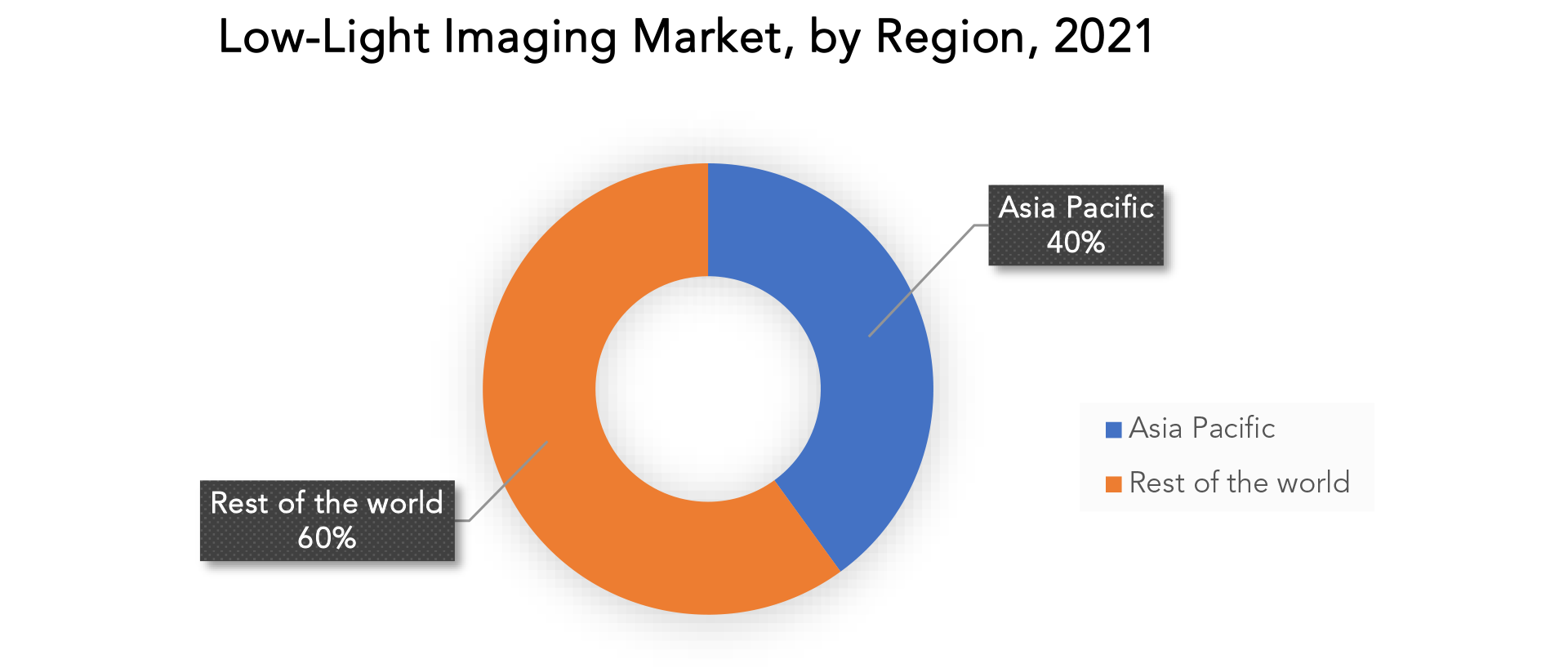
Key Market Segments: Low-Light Imaging Market
Low-Light Imaging Market by Technology, 2020-2029, (USD Billion)- Complementary Metal-Oxide-Semiconductor (CMOS)
- Charge-Coupled Device (CCD)
- Security And Surveillance
- Monitoring
- Photography
- Consumer Electronics
- Automotive
- Medical And Life Sciences
- Military And Defense
- Industrial
- Commercial And Residential Infrastructure
- North America
- Asia Pacific
- Europe
- South America
- Middle East and Africa
Exactitude Consultancy Services Key Objectives:
- Increasing sales and market share
- Developing new technology
- Improving profitability
- Entering new markets
- Enhancing brand reputation
Key Questions Answered:
- What is the expected growth rate of the low-light imaging market over the next 7 years?
- Who are the major players in the low-light imaging market and what is their market share?
- What are the end-user industries driving demand for market and what is their outlook?
- What are the opportunities for growth in emerging markets such as Asia-Pacific, Middle East, and Africa?
- How is the economic environment affecting the low-light imaging market, including factors such as interest rates, inflation, and exchange rates?
- What is the expected impact of government policies and regulations on the low-light imaging market?
- What is the current and forecasted size and growth rate of the global low-light imaging market?
- What are the key drivers of growth in the low-light imaging market?
- Who are the major players in the market and what is their market share?
- What are the distribution channels and supply chain dynamics in the low-light imaging market?
- What are the technological advancements and innovations in the low-light imaging market and their impact on product development and growth?
- What are the regulatory considerations and their impact on the market?
- What are the challenges faced by players in the low-light imaging market and how are they addressing these challenges?
- What are the opportunities for growth and expansion in the low-light imaging market?
- What are the service offerings and specifications of leading players in the market?
- INTRODUCTION
- MARKET DEFINITION
- MARKET SEGMENTATION
- RESEARCH TIMELINES
- ASSUMPTIONS AND LIMITATIONS
- RESEARCH METHODOLOGY
- DATA MINING
- SECONDARY RESEARCH
- PRIMARY RESEARCH
- SUBJECT-MATTER EXPERTS’ ADVICE
- QUALITY CHECKS
- FINAL REVIEW
- DATA TRIANGULATION
- BOTTOM-UP APPROACH
- TOP-DOWN APPROACH
- RESEARCH FLOW
- DATA SOURCES
- DATA MINING
- EXECUTIVE SUMMARY
- MARKET OVERVIEW
- GLOBAL LOW-LIGHT IMAGING MARKET OUTLOOK
- MARKET DRIVERS
- MARKET RESTRAINTS
- MARKET OPPORTUNITIES
- IMPACT OF COVID-19 ON LOW-LIGHT IMAGING MARKET
- PORTER’S FIVE FORCES MODEL
- THREAT FROM NEW ENTRANTS
- THREAT FROM SUBSTITUTES
- BARGAINING POWER OF SUPPLIERS
- BARGAINING POWER OF CUSTOMERS
- DEGREE OF COMPETITION
- INDUSTRY VALUE CHAIN ANALYSIS
- GLOBAL LOW-LIGHT IMAGING MARKET OUTLOOK
- GLOBAL LOW-LIGHT IMAGING MARKET BY TECHNOLOGY,2020-2029, (USD BILLION)
- COMPLEMENTARY METAL-OXIDE-SEMICONDUCTOR (CMOS)
- CHARGE-COUPLED DEVICE (CCD)
- GLOBAL LOW-LIGHT IMAGING MARKET BY APPLICATION, 2020-2029, (USD BILLION )
- SECURITY AND SURVEILLANCE
- MONITORING
- PHOTOGRAPHY
- GLOBAL LOW-LIGHT IMAGING MARKET BY END USER,2020-2029, (USD BILLION)
- CONSUMER ELECTRONICS
- AUTOMOTIVE
- MEDICAL AND LIFE SCIENCES
- MILITARY AND DEFENSE
- INDUSTRIAL
- COMMERCIAL AND RESIDENTIAL INFRASTRUCTURE
- GLOBAL LOW-LIGHT IMAGING MARKET BY REGION, 2020-2029, (USD BILLION)
- NORTH AMERICA
- US
- CANADA
- MEXICO
- SOUTH AMERICA
- BRAZIL
- ARGENTINA
- COLOMBIA
- REST OF SOUTH AMERICA
- EUROPE
- GERMANY
- UK
- FRANCE
- ITALY
- SPAIN
- RUSSIA
- REST OF EUROPE
- ASIA PACIFIC
- INDIA
- CHINA
- JAPAN
- SOUTH KOREA
- AUSTRALIA
- SOUTH-EAST ASIA
- REST OF ASIA PACIFIC
- MIDDLE EAST AND AFRICA
- UAE
- SAUDI ARABIA
- SOUTH AFRICA
- REST OF MIDDLE EAST AND AFRICA
- NORTH AMERICA
- COMPANY PROFILES*(BUSINESS OVERVIEW, COMPANY SNAPSHOT, PRODUCTS OFFERED, RECENT DEVELOPMENTS)
- PANASONIC CORPORATION CO, LTD
- SAMSUNG
- BAE SYSTEMS
- ANDANTA GMBH
- AMS-OSRAM AG
- STMICROELECTRONICS
- SHARP CORPORATION
- TELEDYNE FLIR LLC
- HAMAMATSU PHOTONICS K.K.
- SEMICONDUCTOR COMPONENTS INDUSTRIES, LLC
- PIXELPLUS*THE COMPANY LIST IS INDICATIVE
LIST OF TABLES
TABLE 1 GLOBAL LOW-LIGHT IMAGING MARKET BY TECHNOLOGY (USD BILLION), 2020-2029
TABLE 2 GLOBAL LOW-LIGHT IMAGING MARKET BY APPLICATION (USD BILLION), 2020-2029
TABLE 3 GLOBAL LOW-LIGHT IMAGING MARKET BY END USER (USD BILLION), 2020-2029
TABLE 4 GLOBAL LOW-LIGHT IMAGING MARKET BY REGION (USD BILLION), 2020-2029
TABLE 5 NORTH AMERICA LOW-LIGHT IMAGING MARKET BY TECHNOLOGY (USD BILLION), 2020-2029
TABLE 6 NORTH AMERICA LOW-LIGHT IMAGING MARKET BY COUNTRY (USD BILLION), 2020-2029
TABLE 7 US LOW-LIGHT IMAGING MARKET BY TECHNOLOGY (USD BILLION), 2020-2029
TABLE 8 US LOW-LIGHT IMAGING MARKET BY APPLICATION (USD BILLION), 2020-2029
TABLE 9 US LOW-LIGHT IMAGING MARKET BY END USER (USD BILLION), 2020-2029
TABLE 10 CANADA LOW-LIGHT IMAGING MARKET BY TECHNOLOGY (BILLION), 2020-2029
TABLE 11 CANADA LOW-LIGHT IMAGING MARKET BY APPLICATION (USD BILLION), 2020-2029
TABLE 12 CANADA LOW-LIGHT IMAGING MARKET BY END USER (USD BILLION), 2020-2029
TABLE 13 MEXICO LOW-LIGHT IMAGING MARKET BY TECHNOLOGY (USD BILLION), 2020-2029
TABLE 14 MEXICO LOW-LIGHT IMAGING MARKET BY APPLICATION (USD BILLION), 2020-2029
TABLE 15 MEXICO LOW-LIGHT IMAGING MARKET BY END USER (USD BILLION), 2020-2029
TABLE 16 SOUTH AMERICA LOW-LIGHT IMAGING MARKET BY TECHNOLOGY (USD BILLION), 2020-2029
TABLE 17 SOUTH AMERICA LOW-LIGHT IMAGING MARKET BY APPLICATION (USD BILLION), 2020-2029
TABLE 18 SOUTH AMERICA LOW-LIGHT IMAGING MARKET BY END USER (USD BILLION), 2020-2029
TABLE 19 SOUTH AMERICA LOW-LIGHT IMAGING MARKET BY COUNTRY (USD BILLION), 2020-2029
TABLE 20 BRAZIL LOW-LIGHT IMAGING MARKET BY TECHNOLOGY (USD BILLION), 2020-2029
TABLE 21 BRAZIL LOW-LIGHT IMAGING MARKET BY APPLICATION (USD BILLION), 2020-2029
TABLE 22 BRAZIL LOW-LIGHT IMAGING MARKET BY END USER (USD BILLION), 2020-2029
TABLE 23 ARGENTINA LOW-LIGHT IMAGING MARKET BY TECHNOLOGY (USD BILLION), 2020-2029
TABLE 24 ARGENTINA LOW-LIGHT IMAGING MARKET BY APPLICATION (USD BILLION), 2020-2029
TABLE 25 ARGENTINA LOW-LIGHT IMAGING MARKET BY END USER (USD BILLION), 2020-2029
TABLE 26 COLOMBIA LOW-LIGHT IMAGING MARKET BY TECHNOLOGY (USD BILLION), 2020-2029
TABLE 27 COLOMBIA LOW-LIGHT IMAGING MARKET BY APPLICATION (USD BILLION), 2020-2029
TABLE 28 COLOMBIA LOW-LIGHT IMAGING MARKET BY END USER (USD BILLION), 2020-2029
TABLE 29 REST OF SOUTH AMERICA LOW-LIGHT IMAGING MARKET BY TECHNOLOGY (USD BILLION), 2020-2029
TABLE 30 REST OF SOUTH AMERICA LOW-LIGHT IMAGING MARKET BY APPLICATION (USD BILLION), 2020-2029
TABLE 31 REST OF SOUTH AMERICA LOW-LIGHT IMAGING MARKET BY END USER (USD BILLION), 2020-2029
TABLE 32 ASIA-PACIFIC LOW-LIGHT IMAGING MARKET BY TECHNOLOGY (USD BILLION), 2020-2029
TABLE 33 ASIA-PACIFIC LOW-LIGHT IMAGING MARKET BY APPLICATION (USD BILLION), 2020-2029
TABLE 34 ASIA-PACIFIC LOW-LIGHT IMAGING MARKET BY END USER (USD BILLION), 2020-2029
TABLE 35 ASIA-PACIFIC LOW-LIGHT IMAGING MARKET BY COUNTRY (USD BILLION), 2020-2029
TABLE 36 INDIA LOW-LIGHT IMAGING MARKET BY TECHNOLOGY (USD BILLION), 2020-2029
TABLE 37 INDIA LOW-LIGHT IMAGING MARKET BY APPLICATION (USD BILLION), 2020-2029
TABLE 38 INDIA LOW-LIGHT IMAGING MARKET BY END USER (USD BILLION), 2020-2029
TABLE 39 CHINA LOW-LIGHT IMAGING MARKET BY TECHNOLOGY (USD BILLION), 2020-2029
TABLE 40 CHINA LOW-LIGHT IMAGING MARKET BY APPLICATION (USD BILLION), 2020-2029
TABLE 41 CHINA LOW-LIGHT IMAGING MARKET BY END USER (USD BILLION), 2020-2029
TABLE 42 JAPAN LOW-LIGHT IMAGING MARKET BY TECHNOLOGY (USD BILLION), 2020-2029
TABLE 43 JAPAN LOW-LIGHT IMAGING MARKET BY APPLICATION (USD BILLION), 2020-2029
TABLE 44 SOUTH KOREA LOW-LIGHT IMAGING MARKET BY TECHNOLOGY (USD BILLION), 2020-2029
TABLE 45 SOUTH KOREA LOW-LIGHT IMAGING MARKET BY APPLICATION (USD BILLION), 2020-2029
TABLE 46 SOUTH KOREA LOW-LIGHT IMAGING MARKET BY END USER (USD BILLION), 2020-2029
TABLE 47 SOUTH KOREA LOW-LIGHT IMAGING MARKET BY END USER (KILOTONS), 2020-2029
TABLE 48 AUSTRALIA LOW-LIGHT IMAGING MARKET BY TECHNOLOGY (USD BILLION), 2020-2029
TABLE 49 AUSTRALIA CLINICAL LABORATORY SERVICESBY TECHNOLOGY (KILOTONS), 2020-2029
TABLE 50 AUSTRALIA LOW-LIGHT IMAGING MARKET BY APPLICATION (USD BILLION), 2020-2029
TABLE 51 AUSTRALIA LOW-LIGHT IMAGING MARKET BY END USER (USD BILLION), 2020-2029
TABLE 52 SOUTH EAST ASIA LOW-LIGHT IMAGING MARKET BY TECHNOLOGY (USD BILLION), 2020-2029
TABLE 53 SOUTH EAST ASIA LOW-LIGHT IMAGING MARKET BY APPLICATION (USD BILLION), 2020-2029
TABLE 54 SOUTH EAST ASIA LOW-LIGHT IMAGING MARKET BY END USER (USD BILLION), 2020-2029
TABLE 55 REST OF ASIA PACIFIC LOW-LIGHT IMAGING MARKET BY TECHNOLOGY (USD BILLION), 2020-2029
TABLE 56 REST OF ASIA PACIFIC LOW-LIGHT IMAGING MARKET BY APPLICATION (USD BILLION), 2020-2029
TABLE 57 REST OF ASIA PACIFIC LOW-LIGHT IMAGING MARKET BY END USER (USD BILLION), 2020-2029
TABLE 58 EUROPE LOW-LIGHT IMAGING MARKET BY TECHNOLOGY (USD BILLION), 2020-2029
TABLE 59 EUROPE LOW-LIGHT IMAGING MARKET BY APPLICATION (USD BILLION), 2020-2029
TABLE 60 EUROPE LOW-LIGHT IMAGING MARKET BY END USER (USD BILLION), 2020-2029
TABLE 61 EUROPE LOW-LIGHT IMAGING MARKET BY COUNTRY (USD BILLION), 2020-2029
TABLE 62 GERMANY LOW-LIGHT IMAGING MARKET BY TECHNOLOGY (USD BILLION), 2020-2029
TABLE 63 GERMANY LOW-LIGHT IMAGING MARKET BY APPLICATION (USD BILLION), 2020-2029
TABLE 64 GERMANY LOW-LIGHT IMAGING MARKET BY END USER (USD BILLION), 2020-2029
TABLE 65 UK LOW-LIGHT IMAGING MARKET BY TECHNOLOGY (USD BILLION), 2020-2029
TABLE 66 UK LOW-LIGHT IMAGING MARKET BY APPLICATION (USD BILLION), 2020-2029
TABLE 67 UK LOW-LIGHT IMAGING MARKET BY END USER (USD BILLION), 2020-2029
TABLE 68 FRANCE LOW-LIGHT IMAGING MARKET BY TECHNOLOGY (USD BILLION), 2020-2029
TABLE 69 FRANCE LOW-LIGHT IMAGING MARKET BY APPLICATION (USD BILLION), 2020-2029
TABLE 70 FRANCE LOW-LIGHT IMAGING MARKET BY END USER (USD BILLION), 2020-2029
TABLE 71 ITALY LOW-LIGHT IMAGING MARKET BY TECHNOLOGY (USD BILLION), 2020-2029
TABLE 72 ITALY LOW-LIGHT IMAGING MARKET BY APPLICATION (USD BILLION), 2020-2029
TABLE 73 ITALY LOW-LIGHT IMAGING MARKET BY END USER (USD BILLION), 2020-2029
TABLE 74 SPAIN LOW-LIGHT IMAGING MARKET BY TECHNOLOGY (USD BILLION), 2020-2029
TABLE 75 SPAIN LOW-LIGHT IMAGING MARKET BY APPLICATION (USD BILLION), 2020-2029
TABLE 76 SPAIN LOW-LIGHT IMAGING MARKET BY END USER (USD BILLION), 2020-2029
TABLE 77 RUSSIA LOW-LIGHT IMAGING MARKET BY TECHNOLOGY (USD BILLION), 2020-2029
TABLE 78 RUSSIA LOW-LIGHT IMAGING MARKET BY APPLICATION (USD BILLION), 2020-2029
TABLE 79 RUSSIA LOW-LIGHT IMAGING MARKET BY END USER (USD BILLION), 2020-2029
TABLE 80 REST OF EUROPE LOW-LIGHT IMAGING MARKET BY TECHNOLOGY (USD BILLION), 2020-2029
TABLE 81 REST OF EUROPE LOW-LIGHT IMAGING MARKET BY APPLICATION (USD BILLION), 2020-2029
TABLE 82 REST OF EUROPE LOW-LIGHT IMAGING MARKET BY END USER (USD BILLION), 2020-2029
TABLE 83 MIDDLE EAST AND AFRICA LOW-LIGHT IMAGING MARKET BY TECHNOLOGY (USD BILLION), 2020-2029
TABLE 84 MIDDLE EAST AND AFRICA LOW-LIGHT IMAGING MARKET BY APPLICATION (USD BILLION), 2020-2029
TABLE 85 MIDDLE EAST AND AFRICA LOW-LIGHT IMAGING MARKET BY END USER (USD BILLION), 2020-2029
TABLE 86 MIDDLE EAST AND AFRICA LOW-LIGHT IMAGING MARKET BY COUNTRY (USD BILLION), 2020-2029
TABLE 87 UAE LOW-LIGHT IMAGING MARKET BY TECHNOLOGY (USD BILLION), 2020-2029
TABLE 88 UAE LOW-LIGHT IMAGING MARKET BY APPLICATION (USD BILLION), 2020-2029
TABLE 89 UAE LOW-LIGHT IMAGING MARKET BY END USER (USD BILLION), 2020-2029
TABLE 90 SAUDI ARABIA LOW-LIGHT IMAGING MARKET BY TECHNOLOGY (USD BILLION), 2020-2029
TABLE 91 SAUDI ARABIA LOW-LIGHT IMAGING MARKET BY APPLICATION (USD BILLION), 2020-2029
TABLE 92 SAUDI ARABIA LOW-LIGHT IMAGING MARKET BY END USER (USD BILLION), 2020-2029
TABLE 93 SOUTH AFRICA LOW-LIGHT IMAGING MARKET BY TECHNOLOGY (USD BILLION), 2020-2029
TABLE 94 SOUTH AFRICA LOW-LIGHT IMAGING MARKET BY APPLICATION (USD BILLION), 2020-2029
TABLE 95 SOUTH AFRICA LOW-LIGHT IMAGING MARKET BY END USER (USD BILLION), 2020-2029
TABLE 96 REST OF MIDDLE EAST AND AFRICA LOW-LIGHT IMAGING MARKET BY TECHNOLOGY (USD BILLION), 2020-2029
TABLE 97 REST OF MIDDLE EAST AND AFRICA LOW-LIGHT IMAGING MARKET BY APPLICATION (USD BILLION), 2020-2029
TABLE 98 REST OF MIDDLE EAST AND AFRICA LOW-LIGHT IMAGING MARKET BY END USER (USD BILLION), 2020-2029
LIST OF FIGURES
FIGURE 1 MARKET DYNAMICS
FIGURE 2 MARKET SEGMENTATION
FIGURE 3 REPORT TIMELINES: YEARS CONSIDERED
FIGURE 4 DATA TRIANGULATION
FIGURE 5 BOTTOM-UP APPROACH
FIGURE 6 TOP-DOWN APPROACH
FIGURE 7 RESEARCH FLOW
FIGURE 8 GLOBAL LOW-LIGHT IMAGING MARKET BY TECHNOLOGY, USD BILLION, 2020-2029
FIGURE 9 GLOBAL LOW-LIGHT IMAGING MARKET BY APPLICATION, USD BILLION, 2020-2029
FIGURE 10 GLOBAL LOW-LIGHT IMAGING MARKET BY END USER, USD BILLION, 2020-2029
FIGURE 11 GLOBAL LOW-LIGHT IMAGING MARKET BY REGION, USD BILLION, 2020-2029
FIGURE 12 PORTER’S FIVE FORCES MODEL
FIGURE 13 LOW-LIGHT IMAGING MARKET BY REGION, USD BILLION, 2021
FIGURE 14 LOW-LIGHT IMAGING MARKET BY TECHNOLOGY, USD BILLION, 2021
FIGURE 15 LOW-LIGHT IMAGING MARKET BY APPLICATION, USD BILLION, 2021
FIGURE 16 LOW-LIGHT IMAGING MARKET BY END USER 2021, USD BILLION, 2021
FIGURE 17 MARKET SHARE ANALYSIS
FIGURE 18 PANASONIC CORPORATION CO, LTD.: COMPANY SNAPSHOT
FIGURE 19 SAMSUNG : COMPANY SNAPSHOT
FIGURE 20 BAE SYSTEMS: COMPANY SNAPSHOT
FIGURE 21 ANDANTA GMBH: COMPANY SNAPSHOT
FIGURE 22 AMS-OSRAM AG: COMPANY SNAPSHOT
FIGURE 23 STMICROELECTRONICS: COMPANY SNAPSHOT
FIGURE 24 SHARP CORPORATION: COMPANY SNAPSHOT
FIGURE 25 TELEDYNE FLIR LLC: COMPANY SNAPSHOT
FIGURE 26 HAMAMATSU PHOTONICS K.K: COMPANY SNAPSHOT
FIGURE 27 SEMICONDUCTOR COMPONENTS INDUSTRIES: COMPANY SNAPSHOT
DOWNLOAD FREE SAMPLE REPORT
License Type
SPEAK WITH OUR ANALYST
Want to know more about the report or any specific requirement?
WANT TO CUSTOMIZE THE REPORT?
Our Clients Speak
We asked them to research ‘ Equipment market’ all over the world, and their whole arrangement was helpful to us. thehealthanalytics.com insightful analysis and reports contributed to our current analysis and in creating a future strategy. Besides, the te
Yosuke Mitsui
Senior Associate Construction Equipment Sales & Marketing
We asked them to research ‘Equipment market’ all over the world, and their whole arrangement was helpful to us. thehealthanalytics.com insightful analysis and reports contributed to our current analysis and in creating a future strategy. Besides, the te