

Base Year Value ()
x.x %
x.x %
CAGR ()
x.x %
x.x %
Forecast Year Value ()
x.x %
x.x %
Historical Data Period
Largest Region
Forecast Period
수지 유형(폴리프로필렌, 폴리아미드, 폴리에테르 에테르 케톤, 폴리프탈아미드), 섬유 유형(탄소, 유리), 제조 공정(사출 성형, 풀트루전, D-LFT), 최종 사용자(자동차, 전자 및 전기) 및 지역별 장섬유 열가소성 수지(LFT) 시장, 2022년부터 2029년까지의 글로벌 추세 및 예측
Instant access to hundreds of data points and trends
- Market estimates from 2014-2029
- Competitive analysis, industry segmentation, financial benchmarks
- Incorporates SWOT, Porter's Five Forces and risk management frameworks
- PDF report or online database with Word, Excel and PowerPoint export options
- 100% money back guarantee
장섬유 열가소성 플라스틱(LFT) 시장 개요
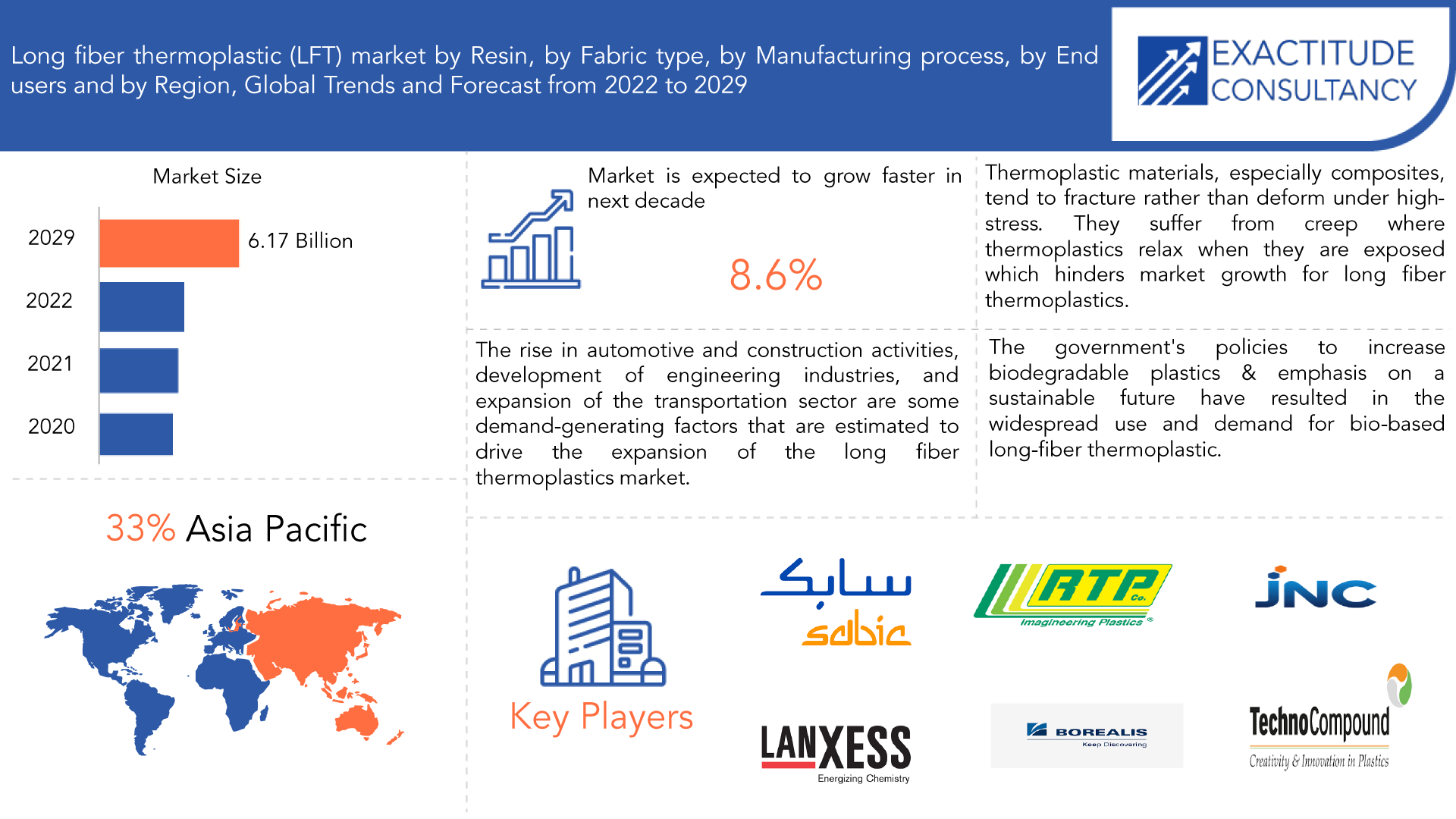
장섬유 열가소성 플라스틱(LFT) 시장은 2022년부터 2029년까지 8.6% CAGR로 성장할 것으로 예상됩니다 . 2020년 30억 2천만 달러에서 2029년까지 61억 7천만 달러 이상으로 성장할 것으로 예상됩니다 .
장섬유 열가소성 플라스틱 산업은 사출 성형에 사용되는 열가소성 플라스틱에 대한 최고 수준의 구조적 성능을 나타냅니다. 이 제품은 높은 수준의 강성, 강도 및 인성과 같은 품질을 하나의 소재로 모두 갖추고 있습니다. 폴리에테르 에테르 케톤 강화재를 녹이는 다른 방법보다 성능이 뛰어납니다. 장 섬유 복합재는 금속, 플라스틱 수지 또는 엔지니어링 폴리머 대체재로 자주 선택되며 성능이 떨어지는 금속을 대체하기도 합니다. 장섬유 열가소성 플라스틱은 전기 및 전자, 항공우주, 자동차, 건물 및 건설, 스포츠 용품 등 다양한 최종 사용자 산업에서 점점 더 수요가 증가하고 있습니다. 주로 자동차 부문의 주요 기술 발전으로 인해 장섬유 열가소성 플라스틱은 열가소성 매트릭스 복합재에서 더 흔해졌습니다. 또한 장섬유 열가소성 플라스틱이 앞서 언급한 사업에서 기존 소재를 대체할 것으로 예상되며 예상 기간 동안 사용이 증가할 것으로 예상됩니다. 장섬유 열가소성 플라스틱 부문에 대한 시장 수요는 이러한 모든 원인에 의해 부분적으로 촉진됩니다.
| 기인하다 | 세부 |
| 학습 기간 | 2020-2029 |
| 기준년도 | 2021 |
| 추정 연도 | 2022 |
| 예상 연도 | 2022-2029 |
| 역사적 기간 | 2018-2020 |
| 단위 | 가치(10억 달러), (킬로톤) |
| 분할 | 수지 유형별, 섬유 유형별, 제조 공정별, 최종 사용자별, 지역별 |
| 수지 종류별 | |
| 섬유 종류별 |
|
| 제조 공정에 따라 |
|
| 최종 사용자에 의해 |
|
| 지역별로 |
|
Innovative structural elements and polymer resins that are reinforced with short or long fibers of organic and inorganic composites are referred to as long-fiber thermoplastics (LFTs). They are lighter and more durable than other metals and low-performance plastics, and they have better toughness, ideal dimensional stability, and stronger mechanical strength to increase product shelf life. In addition, LFTs have stiffness, environmental friendliness, cost effectiveness, fatigue resistance, corrosion and chemical resistance, and thermal conductivity. Due to these qualities, LFTs are widely employed in the preparation of pellets for injection molding and pultrusion across numerous industries. They can currently be purchased as short fiber, continuous fiber, glass mat, and long fiber reinforced thermoplastics on the market.
Long-fiber thermoplastics are expected to be in higher demand in the automotive sector, which would likely drive the market. Moreover, long fiber thermoplastics offer a number of advantages over conventional thermoplastics and metal in the end-use sectors, including high strength, durability, toughness, fatigue endurance, and lightweight. The demand for various types of long fiber thermoplastics is anticipated to increase in the next years due to growing awareness of various fiber-reinforced thermoplastic resin properties such as lightweight, durability, flexibility, toughness, and thermal resistance.
Long fiber thermoplastics market growth is anticipated to be fueled by factors such as rising construction and automotive activity, the growth of the engineering industry, and rising transportation spending. Long fiber thermoplastics have greater strength and are lightweight, both of which contribute to increased fuel efficiency. The demand for lightweight manufacturing materials has increased recently due to the boom in the vehicle industry. This has significantly aided in the expansion of the long fiber thermoplastics market globally. As a result, the market for long fiber thermoplastics is anticipated to experience substantial growth over the course of the forecast period due to the quickly rising demand from the automotive sector globally. Global vehicle production was valued at USD 691 billion, according to the International Organization of Motor Vehicle Manufacturers. As a result, the market for long fiber thermoplastics is growing due to all of these considerations.
In the aerospace industry, light weighting, or mass reduction, is a key focus since it enables improved fuel efficiency and lowers related emissions. Long fiber composites are a greener choice than heavier materials in this situation. In addition to lowering weight, using less of a higher-performing material can also minimize overall material costs, particularly when fiber reinforcement is employed to improve the structural qualities of a lower-cost polymer or as a price diluent in more expensive engineering resins. As a result, the market for long fiber thermoplastics is growing due to all of these considerations.
Composites in particular exhibit a tendency to fracture rather than deform when subjected to high stresses. Creep, which occurs when thermoplastic materials relax or weaken when they are exposed to long-term loading, prevents the market for long fiber thermoplastics from expanding. When exposed for extended periods of time to direct sunshine or ultraviolet light, some types of low-quality thermoplastics melt and some thermoplastics deteriorate. A shortage in the market could result from poor nations' lack of knowledge about the advantages of long fiber thermoplastics. Nonetheless, scientists are attempting to improve the thermal and mechanical characteristics of long fiber thermoplastics. These innovations will improve the performance of long fiber thermoplastics, enabling the market for these materials to grow.
The extensive usage of and demand for bio-based long-fiber thermoplastic is a result of the government's initiatives encouraging the use of biodegradable plastics and putting a focus on a sustainable future. A new bio-based polyamide 11 powders (Rilsan polyamide 11 powders) plant will be built, according to an announcement made by Arkema in November 2021. The major challenges for manufacturers include an underdeveloped production base compared to thermoset composites, high capital costs, and poor material expertise at the end user level because of a lack of material data bases. That indicates that the market for CFTs has significant potential and is thirsty for innovation. Materials providers must concentrate on growth potential through new and enhanced applications, process development expertise, and a customer-focused and innovation-driven growth strategy in order to obtain competitive advantage in this market.
장섬유 열가소성 플라스틱 시장은 COVID-19 전염병으로 인해 심각한 피해를 입었습니다. COVID-19 발병과 관련된 불리한 조건과 더 큰 비용 및 기타 제약으로 인해 시장 확장이 제한되고 있습니다. 장섬유 열가소성 플라스틱은 내열성, 저온 성능 및 크립 저항성을 포함한 특성이 특징입니다. 장섬유 열가소성 플라스틱은 자동차 분야에서 휠 커버, 래치 브래킷, 선루프 부품, 시트 핸들, 시트 백 및 공기 흡입구 구성 요소와 같은 응용 분야에 사용됩니다. Knoema Global의 데이터에 따르면 여행 금지 및 COVID-19 전염병으로 인한 경제 활동의 전반적인 침체로 인해 2020년 자동차 생산이 크게 감소하여 전년 대비 15.4%로 떨어졌습니다. 승용차 생산은 각각 16.9% 및 11.6%로 상용차 생산의 두 배 이상 감소했습니다. 전 세계 자동차 생산량은 3년 연속 마이너스로 성장했습니다. 결과적으로 자동차 부문의 수요 감소는 장섬유 열가소성 플라스틱의 시장 점유율 확대를 방해하고 있는 것으로 생각됩니다.
[캡션 id="attachment_16187" 정렬="정렬센터" 너비="1920"]
Frequently Asked Questions
• What is the worth of long fiber thermoplastic (LFT) market?
The long fiber thermoplastic (LFT) market is expected to grow at 8.6% CAGR from 2022 to 2029. It is expected to reach above USD 6.17 Billion by 2029 from USD 3.02 Billion in 2020.
• What is the size of the Asia Pacific payment security industry?
Asia Pacific held more than 33% of the long fiber thermoplastic (LFT) market revenue share in 2021 and will witness expansion in the forecast period.
• What are some of the market's driving forces?
Long fiber thermoplastics market growth is anticipated to be fueled by factors such as rising construction and automotive activity, the growth of the engineering industry, and rising transportation spending. Long fiber thermoplastics have greater strength and are lightweight, both of which contribute to increased fuel efficiency. The demand for lightweight manufacturing materials has increased recently due to the boom in the vehicle industry. This has significantly aided in the expansion of the long fiber thermoplastics market globally. As a result, the market for long fiber thermoplastics is anticipated to experience substantial growth over the course of the forecast period due to the quickly rising demand from the automotive sector globally. Global vehicle production was valued at USD 691 billion, according to the International Organization of Motor Vehicle Manufacturers. As a result, the market for long fiber thermoplastics is growing due to all of these considerations.
• Which are the top companies to hold the market share in long fiber thermoplastic (LFT) market?
The long fiber thermoplastic (LFT) market key players includes SABIC, RTP Company, Lanxess, JNC Corporation, Borealis AG, TechnoCompound, Sambark LFT Inc., Xiamen long fiber thermoplastics composite plastic Co., Ltd, Avient, Celanese Corporation.
• What is the leading application of long fiber thermoplastic (LFT) market?
The industry for long fiber thermoplastics represents the highest level of structural performance for thermoplastics used in injection molding. They possess qualities like high levels of stiffness, strength, and toughness all in one material. They perform better than any other way of melting polyether ether ketone reinforcement. Long fiber composites are frequently chosen as metal, plastic resin, or engineering polymer alternatives, as well as replacements for underperforming metals. Long-fiber thermoplastics are becoming more and more in demand from a variety of end-user industries, including electrical and electronics, aerospace, automotive, buildings and construction, sporting goods, and others. Due mostly to major technological advancements in the automotive sector, long-fiber thermoplastics have become more common in thermoplastic matrix composites. Additionally, it is anticipated that long-fiber thermoplastics would displace conventional materials in the aforementioned business, and that their use will increase over the course of the projected period. The market demand for the long-fiber thermoplastics sector is fueled in part by all of these causes.
• Which is the largest regional market for long fiber thermoplastic (LFT) market?
With a market share of over 33% in 2021, Asia Pacific (APAC), followed by North America and Europe, dominated the long-fiber thermoplastics market. According to projections, in terms of volume and value, the Asia Pacific (APAC) region would have the largest and fastest-growing market. The indoor module, wheel cover, latch bracket, sunroof components, seat handle, seat back, and air inlet components are just a few of the items whose use is increasing quickly and are responsible for this growth. India and China, two Asian nations, make up more than half of the region's market. The expansion of the automotive sector is responsible for the rise in demand for long-fiber thermoplastics. One of the region's biggest producers and consumers of long-fiber thermoplastics is China. Due to the country's expanding population, rapid urbanisation, and replacement of numerous metals with suitable long-fiber thermoplastics in a variety of applications, China's use of long-fiber thermoplastics has dramatically expanded in recent years. Long fibre thermoplastics will be more in demand as a result of the robust and healthy growth in the equipment industry as well as rising need for electrical sockets, switches, faceplates, and metering devices.
Long fiber thermoplastic (LFT) market Segment Analysis
The long fiber thermoplastic (LFT) market is segmented based on resin type, fiber type, manufacturing process, end user and region.
By resin type, the market is bifurcated into (Polypropylene, Polyamide, Polyether ether ketone, Polyphthalamide). By fiber type into (Carbon, Glass). By manufacturing process into (Injection molding, Pultrusion, D-LFT). By end user into (Automotive, Electronics and electricals) and region.
The sector made up of polypropylene had the highest revenue share of 58.0% in 2021 and is anticipated to continue to lead during the projected period. The automobile, textile, packaging, and construction industries all use polypropylene-based thermoplastics extensively. In comparison to polyamide and polyether ether ketone, long-fiber thermoplastics based on polypropylene are far more affordable. As a result, the automobile and construction industries are seeing an increase in their penetration. Throughout the projection period, the CAGR for the polyamide segment is anticipated to be 10.1%. Automobile makers should consider polyamide-based LFTs since they have qualities like longevity, extreme toughness, and extreme strength. Compared to polyether ether ketone, polyamide-based LFTs are less expensive.
With a 50.3% revenue share in 2021, the glass fiber category led the market and is anticipated to continue to dominate during the forecast period. Because they are commonly available and affordable, glass fibers are frequently used to make long fiber thermoplastics. All thermoplastic polymers have their mechanical characteristics improved by long glass fibers. The cost of glass fibers is almost ten times less than that of carbon fibers. The most popular composite material in Europe is glass-reinforced polymers, according to a 2020 report by the U.S. Commercial Service. Over the projected period of 2022–2030, the carbon fiber segment is anticipated to experience a CAGR of 10.5%. Long carbon-reinforced thermoplastic composites are more convenient for recycling and easier to process.
With a 45.0% revenue share in 2021, the injection molding segment led the market and is anticipated to continue to do so throughout the forecast period. The injection molding method has various advantages over other methods, including great efficiency, compatibility with a variety of materials, use in large quantities to scale up manufacturing, and excellent repeatability and reliability. Throughout the projected period of 2022– 2030, the D–LFT segment is anticipated to have the quickest CAGR of 10.2%. Direct roving, also known as single-end roving or D-LFT, is a particularly successful and economical procedure because it does not need the production of semi-finished goods by the material source. Long-fiber thermoplastics based on polypropylene and polyamide are produced in large quantities using this technique.
In terms of revenue, the automotive segment held the biggest market share of 37.3% in 2021 and is anticipated to keep that position throughout the industry's anticipated growth. This is explained by the growing use of fiber-reinforced thermoplastic composites in the automobile sector. Long fiber thermoplastics have a number of desirable traits, including stiffness, high strength, light weight, toughness, and durability. LFTs are utilized in a variety of automotive components, including bumper moldings, door modules, instrument panel carriers, seat pans, bumper beams, and front-end modules.
[caption id="attachment_16199" align="aligncenter" width="1920"]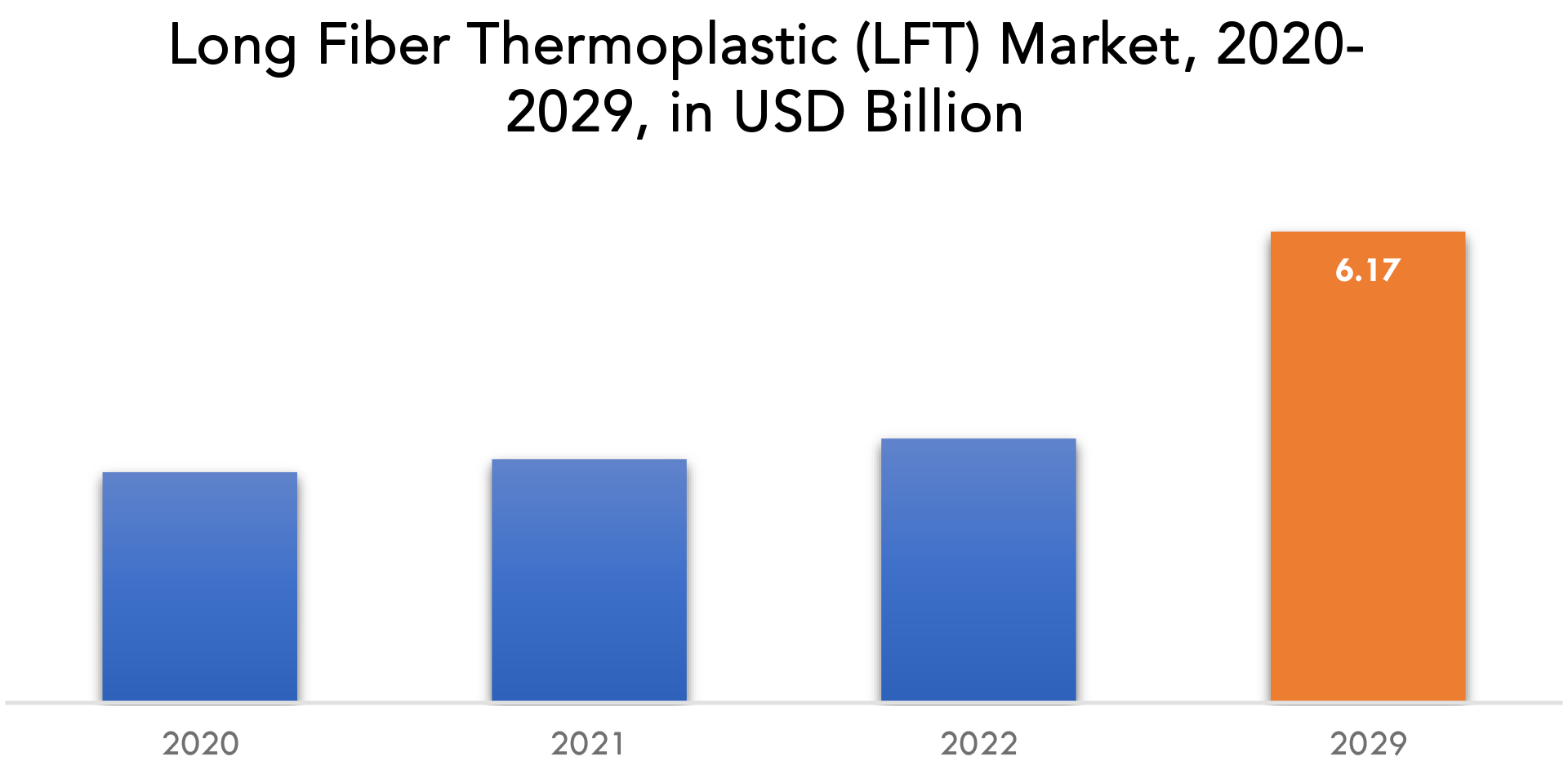
Long fiber thermoplastic (LFT) market Players
The long fiber thermoplastic (LFT) market key players includes SABIC, RTP Company, Lanxess, JNC Corporation, Borealis AG, TechnoCompound, Sambark LFT Inc., Xiamen long fiber thermoplastics composite plastic Co., Ltd, Avient, Celanese Corporation.
Industry Development
21 December 2022: SABIC, a global leader in the diversified chemical industry, has introduced a new high-density polyethylene (HDPE) with mechanically recycled content as part of TRUCIRCLE™, the company’s commitment to help accelerate a circular economy for plastics. The material was custom-developed for blow molding of motor oil and lubricant bottles. It has a content in the range of 30% mechanically recycled post-consumer plastic. 13 December 2022: SABIC, a global leader in the chemical industry, and Cabka – the market leader in sustainable and reusable transport packaging, have collaborated to launch the CabCube 4840 – the next generation in foldable large containers.Who Should Buy? Or Key stakeholders
- Technology providers
- Automotive Industries
- Electronics and Electricals Industries
- Polymer Industries
- Chemical Companies
- Aerospace and defense
- Construction Companies
- Healthcare sector
- Transport authorities
- Research Manufacturing process
- Investors
- Regulatory Authorities
- Others
Long fiber thermoplastic (LFT) market Regional Analysis
The long fiber thermoplastic (LFT) market by region includes North America, Asia-Pacific (APAC), Europe, South America, and Middle East & Africa (MEA).
- North America: includes the US, Canada, Mexico
- Asia Pacific: includes China, Japan, South Korea, India, Australia, ASEAN and Rest of APAC
- Europe: includes UK, Germany, France, Italy, Spain, Russia, and Rest of Europe
- South America: includes Brazil, Argentina and Rest of South America
- Middle East & Africa: includes Turkey, UAE, Saudi Arabia, South Africa, and Rest of MEA
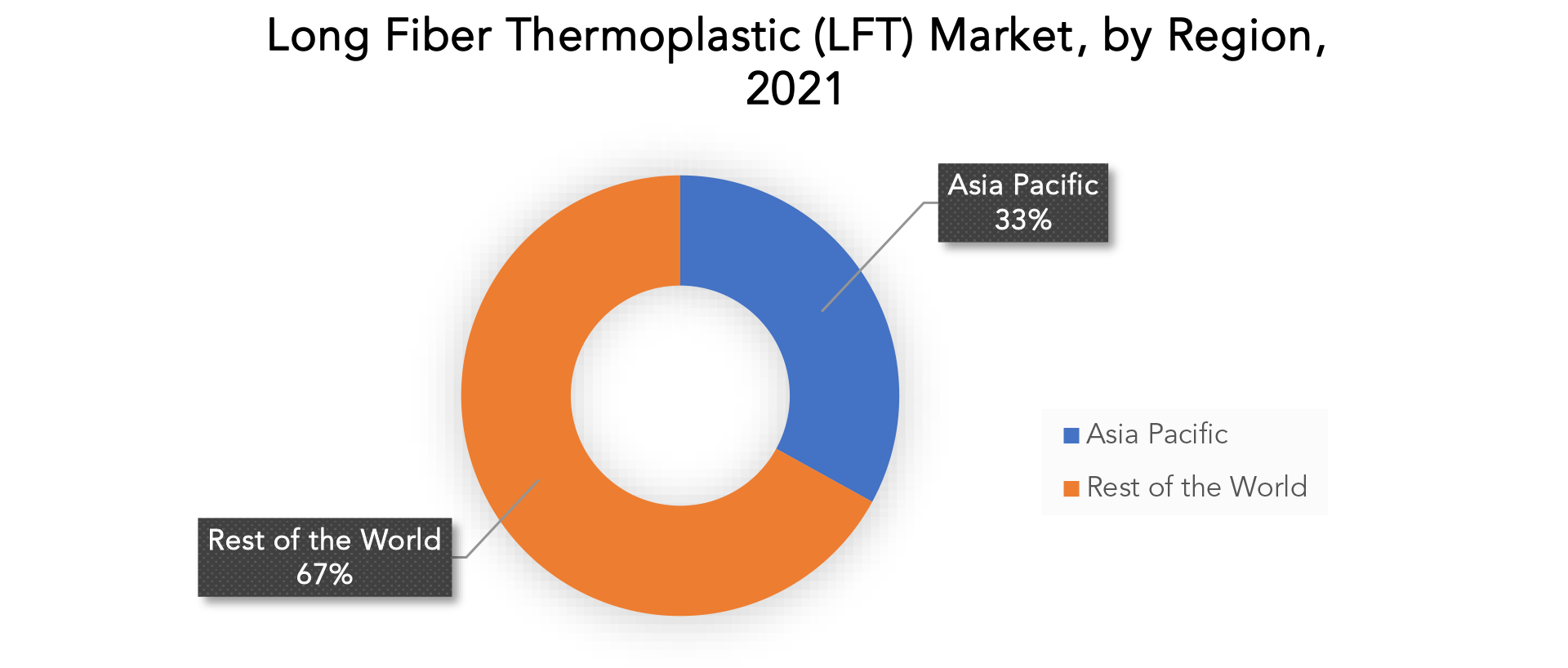
With a market share of over 33% in 2021, Asia Pacific (APAC), followed by North America and Europe, dominated the long-fiber thermoplastics market. According to projections, in terms of volume and value, the Asia Pacific (APAC) region would have the largest and fastest-growing market. The indoor module, wheel cover, latch bracket, sunroof components, seat handle, seat back, and air inlet components are just a few of the items whose use is increasing quickly and are responsible for this growth. India and China, two Asian nations, make up more than half of the region's market. The expansion of the automotive sector is responsible for the rise in demand for long-fiber thermoplastics. One of the region's biggest producers and consumers of long-fiber thermoplastics is China. Due to the country's expanding population, rapid urbanisation, and replacement of numerous metals with suitable long-fiber thermoplastics in a variety of applications, China's use of long-fiber thermoplastics has dramatically expanded in recent years. Long fibre thermoplastics will be more in demand as a result of the robust and healthy growth in the equipment industry as well as rising need for electrical sockets, switches, faceplates, and metering devices.
Throughout the projection period, North America is anticipated to grow at a CAGR of 8.5%. In the automobile, aerospace, and electrical & electronics industries, long fibre thermoplastics are widely used. One of the major drivers of the expansion of long-fiber thermoplastics in the area is the significant presence of these businesses there.
Key Market Segments: long fiber thermoplastic (LFT) market
Long Fiber Thermoplastic (Lft) Market By Resin Type, 2020-2029, (Usd Billion), (Kilotons).- Polypropylene
- Polyamide
- Polyether Ether Ketone
- Polyphthalamide
- Carbon
- Glass
- Injection Molding
- Pultrusion
- D-Lft
- Automotive
- Electronics And Electricals
- North America
- Asia Pacific
- Europe
- South America
- Middle East And Africa
Exactitude Consultancy Services Key Objectives:
- Increasing sales and market share
- Developing new fiber type
- Improving profitability
- Entering new markets
Key Question Answered
- What is the expected growth rate of the long fiber thermoplastic (LFT) market over the next 7 years?
- Who are the major players in the long fiber thermoplastic (LFT) market and what is their market share?
- What are the end-user industries driving demand for market and what is their outlook?
- What are the opportunities for growth in emerging markets such as Asia-Pacific, Middle East, and Africa?
- How is the economic environment affecting the long fiber thermoplastic (LFT) market, including factors such as interest rates, inflation, and exchange rates?
- What is the expected impact of government policies and regulations on the long fiber thermoplastic (LFT) market?
- What is the current and forecasted size and growth rate of the global long fiber thermoplastic (LFT) market?
- What are the key drivers of growth in the long fiber thermoplastic (LFT) market?
- What are the distribution channels and supply chain dynamics in the long fiber thermoplastic (LFT) market?
- What are the technological advancements and innovations in the long fiber thermoplastic (LFT) market and their impact on resin type development and growth?
- What are the regulatory considerations and their impact on the market?
- What are the challenges faced by players in the long fiber thermoplastic (LFT) market and how are they addressing these challenges?
- What are the opportunities for growth and expansion in the long fiber thermoplastic (LFT) market?
- What are the products offerings and specifications of leading players in the market?
- What is the pricing trend of long fiber thermoplastic (LFT) in the market and what is the impact of raw material prices on the price trend?
- 소개
- 시장 정의
- 시장 세분화
- 연구 일정
- 가정 및 제한
- 연구 방법론
- 데이터 마이닝
- 2차 연구
- 1차 연구
- 주제별 전문가의 조언
- 품질 검사
- 최종 검토
- 데이터 삼각 측량
- 바텀업 방식
- 탑다운 접근 방식
- 연구 흐름
- 데이터 소스
- 데이터 마이닝
- 요약
- 시장 개요
- 글로벌 장섬유 열가소성 플라스틱(LFT) 전망
- 시장 동인
- 시장 제약
- 시장 기회
- 장섬유 열가소성 플라스틱(LFT) 시장에 대한 COVID-19의 영향
- 포터의 5가지 힘 모델
- 신규 진입자의 위협
- 대체품으로부터의 위협
- 공급업체의 협상력
- 고객의 협상력
- 경쟁의 정도
- 산업 가치 사슬 분석
- 글로벌 장섬유 열가소성 플라스틱(LFT) 전망
- 수지별 글로벌 장섬유 열가소성 플라스틱(LFT) 시장 (USD 십억) (킬로톤) 2020-2029
- 폴리프로필렌
- 폴리아미드
- 폴리에테르 에테르 케톤
- 폴리프탈아미드
- 섬유 유형별 글로벌 장섬유 열가소성 플라스틱(LFT) 시장 (USD 십억) (킬로톤) 2020-2029
- 탄소
- 유리
- 제조 공정별 글로벌 장섬유 열가소성 플라스틱(LFT) 시장 (USD 십억) (킬로톤) 2020-2029
- 사출성형
- 인발성형
- 디-LFT
- 최종 사용자별 글로벌 장섬유 열가소성 플라스틱(LFT) 시장 (USD 십억) (킬로톤) 2020-2029
- 자동차
- 전자 및 전기
- 지역별 글로벌 장섬유 열가소성 플라스틱(LFT) 시장 (USD 십억) (킬로톤) 2020-2029
- 북아메리카
- 우리를
- 캐나다
- 멕시코
- 남아메리카
- 브라질
- 아르헨티나
- 콜롬비아
- 남미의 나머지 지역
- 유럽
- 독일
- 영국
- 프랑스
- 이탈리아
- 스페인
- 러시아 제국
- 유럽의 나머지 지역
- 아시아 태평양
- 인도
- 중국
- 일본
- 대한민국
- 호주
- 동남아시아
- 아시아 태평양의 나머지 지역
- 중동 및 아프리카
- 아랍에미리트
- 사우디 아라비아
- 남아프리카 공화국
- REST OF MIDDLE EAST AND AFRICA
- 북아메리카
- COMPANY PROFILES*
(BUSINESS OVERVIEW, COMPANY SNAPSHOT, PRODUCTS OFFERED, RECENT DEVELOPMENTS)
- SABIC
- RTP COMPANY
- LANXESS
- JNC CORPORATION
- BOREALIS AG
- TECHNOCOMPOUND
- SAMBARK LFT INC.
- XIAMEN LONG FIBER THERMOPLASTICS COMPOSITE PLASTIC CO., LTD
- AVIENT
- CELANESE CORPORATION.
*THE COMPANY LIST IS INDICATIVE
LIST OF TABLES
TABLE 1 GLOBAL LONG FIBER THERMOPLASTIC (LFT) MARKET BY FIBER TYPE (USD BILLION) 2020-2029
TABLE 2 GLOBAL LONG FIBER THERMOPLASTIC (LFT) MARKET BY FIBER TYPE (KILOTONS) 2020-2029
TABLE 3 GLOBAL LONG FIBER THERMOPLASTIC (LFT) MARKET BY END USER (USD BILLION) 2020-2029
TABLE 4 GLOBAL LONG FIBER THERMOPLASTIC (LFT) MARKET BY END USER (KILOTONS) 2020-2029
TABLE 5 GLOBAL LONG FIBER THERMOPLASTIC (LFT) MARKET BY RESIN (USD BILLION) 2020-2029
TABLE 6 GLOBAL LONG FIBER THERMOPLASTIC (LFT) MARKET BY RESIN (KILOTONS) 2020-2029
TABLE 7 GLOBAL LONG FIBER THERMOPLASTIC (LFT) MARKET BY MANUFACTURING PROCESS (USD BILLION) 2020-2029
TABLE 8 GLOBAL LONG FIBER THERMOPLASTIC (LFT) MARKET BY MANUFACTURING PROCESS (KILOTONS) 2020-2029
TABLE 9 GLOBAL LONG FIBER THERMOPLASTIC (LFT) MARKET BY REGION (USD BILLION) 2020-2029
TABLE 10 GLOBAL LONG FIBER THERMOPLASTIC (LFT) MARKET BY REGION (KILOTONS) 2020-2029
TABLE 11 NORTH AMERICA LONG FIBER THERMOPLASTIC (LFT) MARKET BY COUNTRY (USD BILLION) 2020-2029
TABLE 12 NORTH AMERICA LONG FIBER THERMOPLASTIC (LFT) MARKET BY COUNTRY (KILOTONS) 2020-2029
TABLE 13 NORTH AMERICA LONG FIBER THERMOPLASTIC (LFT) MARKET BY FIBER TYPE (USD BILLION) 2020-2029
TABLE 14 NORTH AMERICA LONG FIBER THERMOPLASTIC (LFT) MARKET BY FIBER TYPE (KILOTONS) 2020-2029
TABLE 15 NORTH AMERICA LONG FIBER THERMOPLASTIC (LFT) MARKET BY END USER (USD BILLION) 2020-2029
TABLE 16 NORTH AMERICA LONG FIBER THERMOPLASTIC (LFT) MARKET BY END USER (KILOTONS) 2020-2029
TABLE 17 NORTH AMERICA LONG FIBER THERMOPLASTIC (LFT) MARKET BY RESIN (USD BILLION) 2020-2029
TABLE 18 NORTH AMERICA LONG FIBER THERMOPLASTIC (LFT) MARKET BY RESIN (KILOTONS) 2020-2029
TABLE 19 NORTH AMERICA LONG FIBER THERMOPLASTIC (LFT) MARKET BY MANUFACTURING PROCESS (USD BILLION) 2020-2029
TABLE 20 NORTH AMERICA LONG FIBER THERMOPLASTIC (LFT) MARKET BY MANUFACTURING PROCESS (KILOTONS) 2020-2029
TABLE 21 US LONG FIBER THERMOPLASTIC (LFT) MARKET BY FIBER TYPE (USD BILLION) 2020-2029
TABLE 22 US LONG FIBER THERMOPLASTIC (LFT) MARKET BY FIBER TYPE (KILOTONS) 2020-2029
TABLE 23 US LONG FIBER THERMOPLASTIC (LFT) MARKET BY END USER (USD BILLION) 2020-2029
TABLE 24 US LONG FIBER THERMOPLASTIC (LFT) MARKET BY END USER (KILOTONS) 2020-2029
TABLE 25 US LONG FIBER THERMOPLASTIC (LFT) MARKET BY RESIN (USD BILLION) 2020-2029
TABLE 26 US LONG FIBER THERMOPLASTIC (LFT) MARKET BY RESIN (KILOTONS) 2020-2029
TABLE 27 US LONG FIBER THERMOPLASTIC (LFT) MARKET BY MANUFACTURING PROCESS (USD BILLION) 2020-2029
TABLE 28 US LONG FIBER THERMOPLASTIC (LFT) MARKET BY MANUFACTURING PROCESS (KILOTONS) 2020-2029
TABLE 29 CANADA LONG FIBER THERMOPLASTIC (LFT) MARKET BY FIBER TYPE (USD BILLION) 2020-2029
TABLE 30 CANADA LONG FIBER THERMOPLASTIC (LFT) MARKET BY FIBER TYPE (KILOTONS) 2020-2029
TABLE 31 CANADA LONG FIBER THERMOPLASTIC (LFT) MARKET BY END USER (USD BILLION) 2020-2029
TABLE 32 CANADA LONG FIBER THERMOPLASTIC (LFT) MARKET BY END USER (KILOTONS) 2020-2029
TABLE 33 CANADA LONG FIBER THERMOPLASTIC (LFT) MARKET BY RESIN (USD BILLION) 2020-2029
TABLE 34 CANADA LONG FIBER THERMOPLASTIC (LFT) MARKET BY RESIN (KILOTONS) 2020-2029
TABLE 35 CANADA LONG FIBER THERMOPLASTIC (LFT) MARKET BY MANUFACTURING PROCESS (USD BILLION) 2020-2029
TABLE 36 CANADA LONG FIBER THERMOPLASTIC (LFT) MARKET BY MANUFACTURING PROCESS (KILOTONS) 2020-2029
TABLE 37 MEXICO LONG FIBER THERMOPLASTIC (LFT) MARKET BY FIBER TYPE (USD BILLION) 2020-2029
TABLE 38 MEXICO LONG FIBER THERMOPLASTIC (LFT) MARKET BY FIBER TYPE (KILOTONS) 2020-2029
TABLE 39 MEXICO LONG FIBER THERMOPLASTIC (LFT) MARKET BY END USER (USD BILLION) 2020-2029
TABLE 40 MEXICO LONG FIBER THERMOPLASTIC (LFT) MARKET BY END USER (KILOTONS) 2020-2029
TABLE 41 MEXICO LONG FIBER THERMOPLASTIC (LFT) MARKET BY RESIN (USD BILLION) 2020-2029
TABLE 42 MEXICO LONG FIBER THERMOPLASTIC (LFT) MARKET BY RESIN (KILOTONS) 2020-2029
TABLE 43 MEXICO LONG FIBER THERMOPLASTIC (LFT) MARKET BY MANUFACTURING PROCESS (USD BILLION) 2020-2029
TABLE 44 MEXICO LONG FIBER THERMOPLASTIC (LFT) MARKET BY MANUFACTURING PROCESS (KILOTONS) 2020-2029
TABLE 45 SOUTH AMERICA LONG FIBER THERMOPLASTIC (LFT) MARKET BY COUNTRY (USD BILLION) 2020-2029
TABLE 46 SOUTH AMERICA LONG FIBER THERMOPLASTIC (LFT) MARKET BY COUNTRY (KILOTONS) 2020-2029
TABLE 47 SOUTH AMERICA LONG FIBER THERMOPLASTIC (LFT) MARKET BY FIBER TYPE (USD BILLION) 2020-2029
TABLE 48 SOUTH AMERICA LONG FIBER THERMOPLASTIC (LFT) MARKET BY FIBER TYPE (KILOTONS) 2020-2029
TABLE 49 SOUTH AMERICA LONG FIBER THERMOPLASTIC (LFT) MARKET BY END USER (USD BILLION) 2020-2029
TABLE 50 SOUTH AMERICA LONG FIBER THERMOPLASTIC (LFT) MARKET BY END USER (KILOTONS) 2020-2029
TABLE 51 SOUTH AMERICA LONG FIBER THERMOPLASTIC (LFT) MARKET BY RESIN (USD BILLION) 2020-2029
TABLE 52 SOUTH AMERICA LONG FIBER THERMOPLASTIC (LFT) MARKET BY RESIN (KILOTONS) 2020-2029
TABLE 53 SOUTH AMERICA LONG FIBER THERMOPLASTIC (LFT) MARKET BY MANUFACTURING PROCESS (USD BILLION) 2020-2029
TABLE 54 SOUTH AMERICA LONG FIBER THERMOPLASTIC (LFT) MARKET BY MANUFACTURING PROCESS (KILOTONS) 2020-2029
TABLE 55 BRAZIL LONG FIBER THERMOPLASTIC (LFT) MARKET BY FIBER TYPE (USD BILLION) 2020-2029
TABLE 56 BRAZIL LONG FIBER THERMOPLASTIC (LFT) MARKET BY FIBER TYPE (KILOTONS) 2020-2029
TABLE 57 BRAZIL LONG FIBER THERMOPLASTIC (LFT) MARKET BY END USER (USD BILLION) 2020-2029
TABLE 58 BRAZIL LONG FIBER THERMOPLASTIC (LFT) MARKET BY END USER (KILOTONS) 2020-2029
TABLE 59 BRAZIL LONG FIBER THERMOPLASTIC (LFT) MARKET BY RESIN (USD BILLION) 2020-2029
TABLE 60 BRAZIL LONG FIBER THERMOPLASTIC (LFT) MARKET BY RESIN (KILOTONS) 2020-2029
TABLE 61 BRAZIL LONG FIBER THERMOPLASTIC (LFT) MARKET BY MANUFACTURING PROCESS (USD BILLION) 2020-2029
TABLE 62 BRAZIL LONG FIBER THERMOPLASTIC (LFT) MARKET BY MANUFACTURING PROCESS (KILOTONS) 2020-2029
TABLE 63 ARGENTINA LONG FIBER THERMOPLASTIC (LFT) MARKET BY FIBER TYPE (USD BILLION) 2020-2029
TABLE 64 ARGENTINA LONG FIBER THERMOPLASTIC (LFT) MARKET BY FIBER TYPE (KILOTONS) 2020-2029
TABLE 65 ARGENTINA LONG FIBER THERMOPLASTIC (LFT) MARKET BY END USER (USD BILLION) 2020-2029
TABLE 66 ARGENTINA LONG FIBER THERMOPLASTIC (LFT) MARKET BY END USER (KILOTONS) 2020-2029
TABLE 67 ARGENTINA LONG FIBER THERMOPLASTIC (LFT) MARKET BY RESIN (USD BILLION) 2020-2029
TABLE 68 ARGENTINA LONG FIBER THERMOPLASTIC (LFT) MARKET BY RESIN (KILOTONS) 2020-2029
TABLE 69 ARGENTINA LONG FIBER THERMOPLASTIC (LFT) MARKET BY MANUFACTURING PROCESS (USD BILLION) 2020-2029
TABLE 70 ARGENTINA LONG FIBER THERMOPLASTIC (LFT) MARKET BY MANUFACTURING PROCESS (KILOTONS) 2020-2029
TABLE 71 COLOMBIA LONG FIBER THERMOPLASTIC (LFT) MARKET BY FIBER TYPE (USD BILLION) 2020-2029
TABLE 72 COLOMBIA LONG FIBER THERMOPLASTIC (LFT) MARKET BY FIBER TYPE (KILOTONS) 2020-2029
TABLE 73 COLOMBIA LONG FIBER THERMOPLASTIC (LFT) MARKET BY END USER (USD BILLION) 2020-2029
TABLE 74 COLOMBIA LONG FIBER THERMOPLASTIC (LFT) MARKET BY END USER (KILOTONS) 2020-2029
TABLE 75 COLOMBIA LONG FIBER THERMOPLASTIC (LFT) MARKET BY RESIN (USD BILLION) 2020-2029
TABLE 76 COLOMBIA LONG FIBER THERMOPLASTIC (LFT) MARKET BY RESIN (KILOTONS) 2020-2029
TABLE 77 COLOMBIA LONG FIBER THERMOPLASTIC (LFT) MARKET BY MANUFACTURING PROCESS (USD BILLION) 2020-2029
TABLE 78 COLOMBIA LONG FIBER THERMOPLASTIC (LFT) MARKET BY MANUFACTURING PROCESS (KILOTONS) 2020-2029
TABLE 79 REST OF SOUTH AMERICA LONG FIBER THERMOPLASTIC (LFT) MARKET BY FIBER TYPE (USD BILLION) 2020-2029
TABLE 80 REST OF SOUTH AMERICA LONG FIBER THERMOPLASTIC (LFT) MARKET BY FIBER TYPE (KILOTONS) 2020-2029
TABLE 81 REST OF SOUTH AMERICA LONG FIBER THERMOPLASTIC (LFT) MARKET BY END USER (USD BILLION) 2020-2029
TABLE 82 REST OF SOUTH AMERICA LONG FIBER THERMOPLASTIC (LFT) MARKET BY END USER (KILOTONS) 2020-2029
TABLE 83 REST OF SOUTH AMERICA LONG FIBER THERMOPLASTIC (LFT) MARKET BY RESIN (USD BILLION) 2020-2029
TABLE 84 REST OF SOUTH AMERICA LONG FIBER THERMOPLASTIC (LFT) MARKET BY RESIN (KILOTONS) 2020-2029
TABLE 85 REST OF SOUTH AMERICA LONG FIBER THERMOPLASTIC (LFT) MARKET BY MANUFACTURING PROCESS (USD BILLION) 2020-2029
TABLE 86 REST OF SOUTH AMERICA LONG FIBER THERMOPLASTIC (LFT) MARKET BY MANUFACTURING PROCESS (KILOTONS) 2020-2029
TABLE 87 ASIA-PACIFIC LONG FIBER THERMOPLASTIC (LFT) MARKET BY COUNTRY (USD BILLION) 2020-2029
TABLE 88 ASIA-PACIFIC LONG FIBER THERMOPLASTIC (LFT) MARKET BY COUNTRY (KILOTONS) 2020-2029
TABLE 89 ASIA-PACIFIC LONG FIBER THERMOPLASTIC (LFT) MARKET BY FIBER TYPE (USD BILLION) 2020-2029
TABLE 90 ASIA-PACIFIC LONG FIBER THERMOPLASTIC (LFT) MARKET BY FIBER TYPE (KILOTONS) 2020-2029
TABLE 91 ASIA-PACIFIC LONG FIBER THERMOPLASTIC (LFT) MARKET BY END USER (USD BILLION) 2020-2029
TABLE 92 ASIA-PACIFIC LONG FIBER THERMOPLASTIC (LFT) MARKET BY END USER (KILOTONS) 2020-2029
TABLE 93 ASIA-PACIFIC LONG FIBER THERMOPLASTIC (LFT) MARKET BY RESIN (USD BILLION) 2020-2029
TABLE 94 ASIA-PACIFIC LONG FIBER THERMOPLASTIC (LFT) MARKET BY RESIN (KILOTONS) 2020-2029
TABLE 95 ASIA-PACIFIC LONG FIBER THERMOPLASTIC (LFT) MARKET BY MANUFACTURING PROCESS (USD BILLION) 2020-2029
TABLE 96 ASIA-PACIFIC LONG FIBER THERMOPLASTIC (LFT) MARKET BY MANUFACTURING PROCESS (KILOTONS) 2020-2029
TABLE 97 INDIA LONG FIBER THERMOPLASTIC (LFT) MARKET BY FIBER TYPE (USD BILLION) 2020-2029
TABLE 98 INDIA LONG FIBER THERMOPLASTIC (LFT) MARKET BY FIBER TYPE (KILOTONS) 2020-2029
TABLE 99 INDIA LONG FIBER THERMOPLASTIC (LFT) MARKET BY END USER (USD BILLION) 2020-2029
TABLE 100 INDIA LONG FIBER THERMOPLASTIC (LFT) MARKET BY END USER (KILOTONS) 2020-2029
TABLE 101 INDIA LONG FIBER THERMOPLASTIC (LFT) MARKET BY RESIN (USD BILLION) 2020-2029
TABLE 102 INDIA LONG FIBER THERMOPLASTIC (LFT) MARKET BY RESIN (KILOTONS) 2020-2029
TABLE 103 INDIA LONG FIBER THERMOPLASTIC (LFT) MARKET BY MANUFACTURING PROCESS (USD BILLION) 2020-2029
TABLE 104 INDIA LONG FIBER THERMOPLASTIC (LFT) MARKET BY MANUFACTURING PROCESS (KILOTONS) 2020-2029
TABLE 105 CHINA LONG FIBER THERMOPLASTIC (LFT) MARKET BY FIBER TYPE (USD BILLION) 2020-2029
TABLE 106 CHINA LONG FIBER THERMOPLASTIC (LFT) MARKET BY FIBER TYPE (KILOTONS) 2020-2029
TABLE 107 CHINA LONG FIBER THERMOPLASTIC (LFT) MARKET BY END USER (USD BILLION) 2020-2029
TABLE 108 CHINA LONG FIBER THERMOPLASTIC (LFT) MARKET BY END USER (KILOTONS) 2020-2029
TABLE 109 CHINA LONG FIBER THERMOPLASTIC (LFT) MARKET BY RESIN (USD BILLION) 2020-2029
TABLE 110 CHINA LONG FIBER THERMOPLASTIC (LFT) MARKET BY RESIN (KILOTONS) 2020-2029
TABLE 111 CHINA LONG FIBER THERMOPLASTIC (LFT) MARKET BY MANUFACTURING PROCESS (USD BILLION) 2020-2029
TABLE 112 CHINA LONG FIBER THERMOPLASTIC (LFT) MARKET BY MANUFACTURING PROCESS (KILOTONS) 2020-2029
TABLE 113 JAPAN LONG FIBER THERMOPLASTIC (LFT) MARKET BY FIBER TYPE (USD BILLION) 2020-2029
TABLE 114 JAPAN LONG FIBER THERMOPLASTIC (LFT) MARKET BY FIBER TYPE (KILOTONS) 2020-2029
TABLE 115 JAPAN LONG FIBER THERMOPLASTIC (LFT) MARKET BY END USER (USD BILLION) 2020-2029
TABLE 116 JAPAN LONG FIBER THERMOPLASTIC (LFT) MARKET BY END USER (KILOTONS) 2020-2029
TABLE 117 JAPAN LONG FIBER THERMOPLASTIC (LFT) MARKET BY RESIN (USD BILLION) 2020-2029
TABLE 118 JAPAN LONG FIBER THERMOPLASTIC (LFT) MARKET BY RESIN (KILOTONS) 2020-2029
TABLE 119 JAPAN LONG FIBER THERMOPLASTIC (LFT) MARKET BY MANUFACTURING PROCESS (USD BILLION) 2020-2029
TABLE 120 JAPAN LONG FIBER THERMOPLASTIC (LFT) MARKET BY MANUFACTURING PROCESS (KILOTONS) 2020-2029
TABLE 121 SOUTH KOREA LONG FIBER THERMOPLASTIC (LFT) MARKET BY FIBER TYPE (USD BILLION) 2020-2029
TABLE 122 SOUTH KOREA LONG FIBER THERMOPLASTIC (LFT) MARKET BY FIBER TYPE (KILOTONS) 2020-2029
TABLE 123 SOUTH KOREA LONG FIBER THERMOPLASTIC (LFT) MARKET BY END USER (USD BILLION) 2020-2029
TABLE 124 SOUTH KOREA LONG FIBER THERMOPLASTIC (LFT) MARKET BY END USER (KILOTONS) 2020-2029
TABLE 125 SOUTH KOREA LONG FIBER THERMOPLASTIC (LFT) MARKET BY RESIN (USD BILLION) 2020-2029
TABLE 126 SOUTH KOREA LONG FIBER THERMOPLASTIC (LFT) MARKET BY RESIN (KILOTONS) 2020-2029
TABLE 127 SOUTH KOREA LONG FIBER THERMOPLASTIC (LFT) MARKET BY MANUFACTURING PROCESS (USD BILLION) 2020-2029
TABLE 128 SOUTH KOREA LONG FIBER THERMOPLASTIC (LFT) MARKET BY MANUFACTURING PROCESS (KILOTONS) 2020-2029
TABLE 129 AUSTRALIA LONG FIBER THERMOPLASTIC (LFT) MARKET BY FIBER TYPE (USD BILLION) 2020-2029
TABLE 130 AUSTRALIA LONG FIBER THERMOPLASTIC (LFT) MARKET BY FIBER TYPE (KILOTONS) 2020-2029
TABLE 131 AUSTRALIA LONG FIBER THERMOPLASTIC (LFT) MARKET BY END USER (USD BILLION) 2020-2029
TABLE 132 AUSTRALIA LONG FIBER THERMOPLASTIC (LFT) MARKET BY END USER (KILOTONS) 2020-2029
TABLE 133 AUSTRALIA LONG FIBER THERMOPLASTIC (LFT) MARKET BY RESIN (USD BILLION) 2020-2029
TABLE 134 AUSTRALIA LONG FIBER THERMOPLASTIC (LFT) MARKET BY RESIN (KILOTONS) 2020-2029
TABLE 135 AUSTRALIA LONG FIBER THERMOPLASTIC (LFT) MARKET BY MANUFACTURING PROCESS (USD BILLION) 2020-2029
TABLE 136 AUSTRALIA LONG FIBER THERMOPLASTIC (LFT) MARKET BY MANUFACTURING PROCESS (KILOTONS) 2020-2029
TABLE 137 SOUTH-EAST ASIA LONG FIBER THERMOPLASTIC (LFT) MARKET BY FIBER TYPE (USD BILLION) 2020-2029
TABLE 138 SOUTH-EAST ASIA LONG FIBER THERMOPLASTIC (LFT) MARKET BY FIBER TYPE (KILOTONS) 2020-2029
TABLE 139 SOUTH-EAST ASIA LONG FIBER THERMOPLASTIC (LFT) MARKET BY END USER (USD BILLION) 2020-2029
TABLE 140 SOUTH-EAST ASIA LONG FIBER THERMOPLASTIC (LFT) MARKET BY END USER (KILOTONS) 2020-2029
TABLE 141 SOUTH-EAST ASIA LONG FIBER THERMOPLASTIC (LFT) MARKET BY RESIN (USD BILLION) 2020-2029
TABLE 142 SOUTH-EAST ASIA LONG FIBER THERMOPLASTIC (LFT) MARKET BY RESIN (KILOTONS) 2020-2029
TABLE 143 SOUTH-EAST ASIA LONG FIBER THERMOPLASTIC (LFT) MARKET BY MANUFACTURING PROCESS (USD BILLION) 2020-2029
TABLE 144 SOUTH-EAST ASIA LONG FIBER THERMOPLASTIC (LFT) MARKET BY MANUFACTURING PROCESS (KILOTONS) 2020-2029
TABLE 145 REST OF ASIA PACIFIC LONG FIBER THERMOPLASTIC (LFT) MARKET BY FIBER TYPE (USD BILLION) 2020-2029
TABLE 146 REST OF ASIA PACIFIC LONG FIBER THERMOPLASTIC (LFT) MARKET BY FIBER TYPE (KILOTONS) 2020-2029
TABLE 147 REST OF ASIA PACIFIC LONG FIBER THERMOPLASTIC (LFT) MARKET BY END USER (USD BILLION) 2020-2029
TABLE 148 REST OF ASIA PACIFIC LONG FIBER THERMOPLASTIC (LFT) MARKET BY END USER (KILOTONS) 2020-2029
TABLE 149 REST OF ASIA PACIFIC LONG FIBER THERMOPLASTIC (LFT) MARKET BY RESIN (USD BILLION) 2020-2029
TABLE 150 REST OF ASIA PACIFIC LONG FIBER THERMOPLASTIC (LFT) MARKET BY RESIN (KILOTONS) 2020-2029
TABLE 151 REST OF ASIA PACIFIC LONG FIBER THERMOPLASTIC (LFT) MARKET BY MANUFACTURING PROCESS (USD BILLION) 2020-2029
TABLE 152 REST OF ASIA PACIFIC LONG FIBER THERMOPLASTIC (LFT) MARKET BY MANUFACTURING PROCESS (KILOTONS) 2020-2029
TABLE 153 EUROPE LONG FIBER THERMOPLASTIC (LFT) MARKET BY COUNTRY (USD BILLION) 2020-2029
TABLE 154 EUROPE LONG FIBER THERMOPLASTIC (LFT) MARKET BY COUNTRY (KILOTONS) 2020-2029
TABLE 155 ASIA-PACIFIC LONG FIBER THERMOPLASTIC (LFT) MARKET BY FIBER TYPE (USD BILLION) 2020-2029
TABLE 156 ASIA-PACIFIC LONG FIBER THERMOPLASTIC (LFT) MARKET BY FIBER TYPE (KILOTONS) 2020-2029
TABLE 157 ASIA-PACIFIC LONG FIBER THERMOPLASTIC (LFT) MARKET BY END USER (USD BILLION) 2020-2029
TABLE 158 ASIA-PACIFIC LONG FIBER THERMOPLASTIC (LFT) MARKET BY END USER (KILOTONS) 2020-2029
TABLE 159 ASIA-PACIFIC LONG FIBER THERMOPLASTIC (LFT) MARKET BY RESIN (USD BILLION) 2020-2029
TABLE 160 ASIA-PACIFIC LONG FIBER THERMOPLASTIC (LFT) MARKET BY RESIN (KILOTONS) 2020-2029
TABLE 161 ASIA-PACIFIC LONG FIBER THERMOPLASTIC (LFT) MARKET BY MANUFACTURING PROCESS (USD BILLION) 2020-2029
TABLE 162 ASIA-PACIFIC LONG FIBER THERMOPLASTIC (LFT) MARKET BY MANUFACTURING PROCESS (KILOTONS) 2020-2029
TABLE 163 GERMANY LONG FIBER THERMOPLASTIC (LFT) MARKET BY FIBER TYPE (USD BILLION) 2020-2029
TABLE 164 GERMANY LONG FIBER THERMOPLASTIC (LFT) MARKET BY FIBER TYPE (KILOTONS) 2020-2029
TABLE 165 GERMANY LONG FIBER THERMOPLASTIC (LFT) MARKET BY END USER (USD BILLION) 2020-2029
TABLE 166 GERMANY LONG FIBER THERMOPLASTIC (LFT) MARKET BY END USER (KILOTONS) 2020-2029
TABLE 167 GERMANY LONG FIBER THERMOPLASTIC (LFT) MARKET BY RESIN (USD BILLION) 2020-2029
TABLE 168 GERMANY LONG FIBER THERMOPLASTIC (LFT) MARKET BY RESIN (KILOTONS) 2020-2029
TABLE 169 GERMANY LONG FIBER THERMOPLASTIC (LFT) MARKET BY MANUFACTURING PROCESS (USD BILLION) 2020-2029
TABLE 170 GERMANY LONG FIBER THERMOPLASTIC (LFT) MARKET BY MANUFACTURING PROCESS (KILOTONS) 2020-2029
TABLE 171 UK LONG FIBER THERMOPLASTIC (LFT) MARKET BY FIBER TYPE (USD BILLION) 2020-2029
TABLE 172 UK LONG FIBER THERMOPLASTIC (LFT) MARKET BY FIBER TYPE (KILOTONS) 2020-2029
TABLE 173 UK LONG FIBER THERMOPLASTIC (LFT) MARKET BY END USER (USD BILLION) 2020-2029
TABLE 174 UK LONG FIBER THERMOPLASTIC (LFT) MARKET BY END USER (KILOTONS) 2020-2029
TABLE 175 UK LONG FIBER THERMOPLASTIC (LFT) MARKET BY RESIN (USD BILLION) 2020-2029
TABLE 176 UK LONG FIBER THERMOPLASTIC (LFT) MARKET BY RESIN (KILOTONS) 2020-2029
TABLE 177 UK LONG FIBER THERMOPLASTIC (LFT) MARKET BY MANUFACTURING PROCESS (USD BILLION) 2020-2029
TABLE 178 UK LONG FIBER THERMOPLASTIC (LFT) MARKET BY MANUFACTURING PROCESS (KILOTONS) 2020-2029
TABLE 179 FRANCE LONG FIBER THERMOPLASTIC (LFT) MARKET BY FIBER TYPE (USD BILLION) 2020-2029
TABLE 180 FRANCE LONG FIBER THERMOPLASTIC (LFT) MARKET BY FIBER TYPE (KILOTONS) 2020-2029
TABLE 181 FRANCE LONG FIBER THERMOPLASTIC (LFT) MARKET BY END USER (USD BILLION) 2020-2029
TABLE 182 FRANCE LONG FIBER THERMOPLASTIC (LFT) MARKET BY END USER (KILOTONS) 2020-2029
TABLE 183 FRANCE LONG FIBER THERMOPLASTIC (LFT) MARKET BY RESIN (USD BILLION) 2020-2029
TABLE 184 FRANCE LONG FIBER THERMOPLASTIC (LFT) MARKET BY RESIN (KILOTONS) 2020-2029
TABLE 185 FRANCE LONG FIBER THERMOPLASTIC (LFT) MARKET BY MANUFACTURING PROCESS (USD BILLION) 2020-2029
TABLE 186 FRANCE LONG FIBER THERMOPLASTIC (LFT) MARKET BY MANUFACTURING PROCESS (KILOTONS) 2020-2029
TABLE 187 ITALY LONG FIBER THERMOPLASTIC (LFT) MARKET BY FIBER TYPE (USD BILLION) 2020-2029
TABLE 188 ITALY LONG FIBER THERMOPLASTIC (LFT) MARKET BY FIBER TYPE (KILOTONS) 2020-2029
TABLE 189 ITALY LONG FIBER THERMOPLASTIC (LFT) MARKET BY END USER (USD BILLION) 2020-2029
TABLE 190 ITALY LONG FIBER THERMOPLASTIC (LFT) MARKET BY END USER (KILOTONS) 2020-2029
TABLE 191 ITALY LONG FIBER THERMOPLASTIC (LFT) MARKET BY RESIN (USD BILLION) 2020-2029
TABLE 192 ITALY LONG FIBER THERMOPLASTIC (LFT) MARKET BY RESIN (KILOTONS) 2020-2029
TABLE 193 ITALY LONG FIBER THERMOPLASTIC (LFT) MARKET BY MANUFACTURING PROCESS (USD BILLION) 2020-2029
TABLE 194 ITALY LONG FIBER THERMOPLASTIC (LFT) MARKET BY MANUFACTURING PROCESS (KILOTONS) 2020-2029
TABLE 195 SPAIN LONG FIBER THERMOPLASTIC (LFT) MARKET BY FIBER TYPE (USD BILLION) 2020-2029
TABLE 196 SPAIN LONG FIBER THERMOPLASTIC (LFT) MARKET BY FIBER TYPE (KILOTONS) 2020-2029
TABLE 197 SPAIN LONG FIBER THERMOPLASTIC (LFT) MARKET BY END USER (USD BILLION) 2020-2029
TABLE 198 SPAIN LONG FIBER THERMOPLASTIC (LFT) MARKET BY END USER (KILOTONS) 2020-2029
TABLE 199 SPAIN LONG FIBER THERMOPLASTIC (LFT) MARKET BY RESIN (USD BILLION) 2020-2029
TABLE 200 SPAIN LONG FIBER THERMOPLASTIC (LFT) MARKET BY RESIN (KILOTONS) 2020-2029
TABLE 201 SPAIN LONG FIBER THERMOPLASTIC (LFT) MARKET BY MANUFACTURING PROCESS (USD BILLION) 2020-2029
TABLE 202 SPAIN LONG FIBER THERMOPLASTIC (LFT) MARKET BY MANUFACTURING PROCESS (KILOTONS) 2020-2029
TABLE 203 RUSSIA LONG FIBER THERMOPLASTIC (LFT) MARKET BY FIBER TYPE (USD BILLION) 2020-2029
TABLE 204 RUSSIA LONG FIBER THERMOPLASTIC (LFT) MARKET BY FIBER TYPE (KILOTONS) 2020-2029
TABLE 205 RUSSIA LONG FIBER THERMOPLASTIC (LFT) MARKET BY END USER (USD BILLION) 2020-2029
TABLE 206 RUSSIA LONG FIBER THERMOPLASTIC (LFT) MARKET BY END USER (KILOTONS) 2020-2029
TABLE 207 RUSSIA LONG FIBER THERMOPLASTIC (LFT) MARKET BY RESIN (USD BILLION) 2020-2029
TABLE 208 RUSSIA LONG FIBER THERMOPLASTIC (LFT) MARKET BY RESIN (KILOTONS) 2020-2029
TABLE 209 RUSSIA LONG FIBER THERMOPLASTIC (LFT) MARKET BY MANUFACTURING PROCESS (USD BILLION) 2020-2029
TABLE 210 RUSSIA LONG FIBER THERMOPLASTIC (LFT) MARKET BY MANUFACTURING PROCESS (KILOTONS) 2020-2029
TABLE 211 REST OF EUROPE LONG FIBER THERMOPLASTIC (LFT) MARKET BY FIBER TYPE (USD BILLION) 2020-2029
TABLE 212 REST OF EUROPE LONG FIBER THERMOPLASTIC (LFT) MARKET BY FIBER TYPE (KILOTONS) 2020-2029
TABLE 213 REST OF EUROPE LONG FIBER THERMOPLASTIC (LFT) MARKET BY END USER (USD BILLION) 2020-2029
TABLE 214 REST OF EUROPE LONG FIBER THERMOPLASTIC (LFT) MARKET BY END USER (KILOTONS) 2020-2029
TABLE 215 REST OF EUROPE LONG FIBER THERMOPLASTIC (LFT) MARKET BY RESIN (USD BILLION) 2020-2029
TABLE 216 REST OF EUROPE LONG FIBER THERMOPLASTIC (LFT) MARKET BY RESIN (KILOTONS) 2020-2029
TABLE 217 REST OF EUROPE LONG FIBER THERMOPLASTIC (LFT) MARKET BY MANUFACTURING PROCESS (USD BILLION) 2020-2029
TABLE 218 REST OF EUROPE LONG FIBER THERMOPLASTIC (LFT) MARKET BY MANUFACTURING PROCESS (KILOTONS) 2020-2029
TABLE 219 MIDDLE EAST AND AFRICA LONG FIBER THERMOPLASTIC (LFT) MARKET BY COUNTRY (USD BILLION) 2020-2029
TABLE 220 MIDDLE EAST AND AFRICA LONG FIBER THERMOPLASTIC (LFT) MARKET BY COUNTRY (KILOTONS) 2020-2029
TABLE 221 MIDDLE EAST AND AFRICA LONG FIBER THERMOPLASTIC (LFT) MARKET BY FIBER TYPE (USD BILLION) 2020-2029
TABLE 222 MIDDLE EAST AND AFRICA LONG FIBER THERMOPLASTIC (LFT) MARKET BY FIBER TYPE (KILOTONS) 2020-2029
TABLE 223 MIDDLE EAST AND AFRICA LONG FIBER THERMOPLASTIC (LFT) MARKET BY END USER (USD BILLION) 2020-2029
TABLE 224 MIDDLE EAST AND AFRICA LONG FIBER THERMOPLASTIC (LFT) MARKET BY END USER (KILOTONS) 2020-2029
TABLE 225 MIDDLE EAST AND AFRICA LONG FIBER THERMOPLASTIC (LFT) MARKET BY RESIN (USD BILLION) 2020-2029
TABLE 226 MIDDLE EAST AND AFRICA LONG FIBER THERMOPLASTIC (LFT) MARKET BY RESIN (KILOTONS) 2020-2029
TABLE 227 MIDDLE EAST AND AFRICA LONG FIBER THERMOPLASTIC (LFT) MARKET BY MANUFACTURING PROCESS (USD BILLION) 2020-2029
TABLE 228 MIDDLE EAST AND AFRICA LONG FIBER THERMOPLASTIC (LFT) MARKET BY MANUFACTURING PROCESS (KILOTONS) 2020-2029
TABLE 229 UAE LONG FIBER THERMOPLASTIC (LFT) MARKET BY FIBER TYPE (USD BILLION) 2020-2029
TABLE 230 UAE LONG FIBER THERMOPLASTIC (LFT) MARKET BY FIBER TYPE (KILOTONS) 2020-2029
TABLE 231 UAE LONG FIBER THERMOPLASTIC (LFT) MARKET BY END USER (USD BILLION) 2020-2029
TABLE 232 UAE LONG FIBER THERMOPLASTIC (LFT) MARKET BY END USER (KILOTONS) 2020-2029
TABLE 233 UAE LONG FIBER THERMOPLASTIC (LFT) MARKET BY RESIN (USD BILLION) 2020-2029
TABLE 234 UAE LONG FIBER THERMOPLASTIC (LFT) MARKET BY RESIN (KILOTONS) 2020-2029
TABLE 235 UAE LONG FIBER THERMOPLASTIC (LFT) MARKET BY MANUFACTURING PROCESS (USD BILLION) 2020-2029
TABLE 236 UAE LONG FIBER THERMOPLASTIC (LFT) MARKET BY MANUFACTURING PROCESS (KILOTONS) 2020-2029
TABLE 237 SAUDI ARABIA LONG FIBER THERMOPLASTIC (LFT) MARKET BY FIBER TYPE (USD BILLION) 2020-2029
TABLE 238 SAUDI ARABIA LONG FIBER THERMOPLASTIC (LFT) MARKET BY FIBER TYPE (KILOTONS) 2020-2029
TABLE 239 SAUDI ARABIA LONG FIBER THERMOPLASTIC (LFT) MARKET BY END USER (USD BILLION) 2020-2029
TABLE 240 SAUDI ARABIA LONG FIBER THERMOPLASTIC (LFT) MARKET BY END USER (KILOTONS) 2020-2029
TABLE 241 SAUDI ARABIA LONG FIBER THERMOPLASTIC (LFT) MARKET BY RESIN (USD BILLION) 2020-2029
TABLE 242 SAUDI ARABIA LONG FIBER THERMOPLASTIC (LFT) MARKET BY RESIN (KILOTONS) 2020-2029
TABLE 243 SAUDI ARABIA LONG FIBER THERMOPLASTIC (LFT) MARKET BY MANUFACTURING PROCESS (USD BILLION) 2020-2029
TABLE 244 SAUDI ARABIA LONG FIBER THERMOPLASTIC (LFT) MARKET BY MANUFACTURING PROCESS (KILOTONS) 2020-2029
TABLE 245 SOUTH AFRICA LONG FIBER THERMOPLASTIC (LFT) MARKET BY FIBER TYPE (USD BILLION) 2020-2029
TABLE 246 SOUTH AFRICA LONG FIBER THERMOPLASTIC (LFT) MARKET BY FIBER TYPE (KILOTONS) 2020-2029
TABLE 247 SOUTH AFRICA LONG FIBER THERMOPLASTIC (LFT) MARKET BY END USER (USD BILLION) 2020-2029
TABLE 248 SOUTH AFRICA LONG FIBER THERMOPLASTIC (LFT) MARKET BY END USER (KILOTONS) 2020-2029
TABLE 249 SOUTH AFRICA LONG FIBER THERMOPLASTIC (LFT) MARKET BY RESIN (USD BILLION) 2020-2029
TABLE 250 SOUTH AFRICA LONG FIBER THERMOPLASTIC (LFT) MARKET BY RESIN (KILOTONS) 2020-2029
TABLE 251 SOUTH AFRICA LONG FIBER THERMOPLASTIC (LFT) MARKET BY MANUFACTURING PROCESS (USD BILLION) 2020-2029
TABLE 252 SOUTH AFRICA LONG FIBER THERMOPLASTIC (LFT) MARKET BY MANUFACTURING PROCESS (KILOTONS) 2020-2029
TABLE 253 REST OF MIDDLE EAST AND AFRICA LONG FIBER THERMOPLASTIC (LFT) MARKET BY FIBER TYPE (USD BILLION) 2020-2029
TABLE 254 REST OF MIDDLE EAST AND AFRICA LONG FIBER THERMOPLASTIC (LFT) MARKET BY FIBER TYPE (KILOTONS) 2020-2029
TABLE 255 REST OF MIDDLE EAST AND AFRICA LONG FIBER THERMOPLASTIC (LFT) MARKET BY END USER (USD BILLION) 2020-2029
TABLE 256 REST OF MIDDLE EAST AND AFRICA LONG FIBER THERMOPLASTIC (LFT) MARKET BY END USER (KILOTONS) 2020-2029
TABLE 257 REST OF MIDDLE EAST AND AFRICA LONG FIBER THERMOPLASTIC (LFT) MARKET BY RESIN (USD BILLION) 2020-2029
TABLE 258 REST OF MIDDLE EAST AND AFRICA LONG FIBER THERMOPLASTIC (LFT) MARKET BY RESIN (KILOTONS) 2020-2029
TABLE 259 REST OF MIDDLE EAST AND AFRICA LONG FIBER THERMOPLASTIC (LFT) MARKET BY MANUFACTURING PROCESS (USD BILLION) 2020-2029
TABLE 260 REST OF MIDDLE EAST AND AFRICA LONG FIBER THERMOPLASTIC (LFT) MARKET BY MANUFACTURING PROCESS (KILOTONS) 2020-2029
LIST OF FIGURES
FIGURE 1 MARKET DYNAMICS
FIGURE 2 MARKET SEGMENTATION
FIGURE 3 REPORT TIMELINES: YEARS CONSIDERED
FIGURE 4 DATA TRIANGULATION
FIGURE 5 BOTTOM-UP APPROACH
FIGURE 6 TOP-DOWN APPROACH
FIGURE 7 RESEARCH FLOW
FIGURE 8 GLOBAL LONG FIBER THERMOPLASTIC (LFT) BY RESIN, USD BILLION, 2020-2029
FIGURE 9 GLOBAL LONG FIBER THERMOPLASTIC (LFT) BY FIBER TYPE, USD BILLION, 2020-2029
FIGURE 10 GLOBAL LONG FIBER THERMOPLASTIC (LFT) BY MANUFACTURING PROCESS, USD BILLION, 2020-2029
FIGURE 11 GLOBAL LONG FIBER THERMOPLASTIC (LFT) BY END-USER, USD BILLION, 2020-2029
FIGURE 12 GLOBAL LONG FIBER THERMOPLASTIC (LFT) BY REGION, USD BILLION, 2020-2029
FIGURE 13 GLOBAL LONG FIBER THERMOPLASTIC (LFT) BY RESIN, USD BILLION, 2021
FIGURE 14 GLOBAL LONG FIBER THERMOPLASTIC (LFT) BY FIBER TYPE, USD BILLION, 2021
FIGURE 15 GLOBAL LONG FIBER THERMOPLASTIC (LFT) BY MANUFACTURING PROCESS, USD BILLION, 2021
FIGURE 16 GLOBAL LONG FIBER THERMOPLASTIC (LFT) BY END-USER, USD BILLION, 2021
FIGURE 17 GLOBAL LONG FIBER THERMOPLASTIC (LFT) BY REGION, USD BILLION, 2021
FIGURE 18 PORTER’S FIVE FORCES MODEL
FIGURE 19 MARKET SHARE ANALYSIS
FIGURE 20 SABIC: COMPANY SNAPSHOT
FIGURE 21 RTP COMPANY: COMPANY SNAPSHOT
FIGURE 22 LANXESS: COMPANY SNAPSHOT
FIGURE 23 JNC CORPORATION: COMPANY SNAPSHOT
FIGURE 24 BOREALIS AG: COMPANY SNAPSHOT
FIGURE 25 TECHNOCOMPOUND: COMPANY SNAPSHOT
FIGURE 26 SAMBARK LFT INC.: COMPANY SNAPSHOT
FIGURE 27 XIAMEN LONG FIBER THERMOPLASTICS COMPOSITE PLASTIC CO., LTD: COMPANY SNAPSHOT
FIGURE 28 AVIENT: COMPANY SNAPSHOT
FIGURE 29 CELANESE CORPORATION: COMPANY SNAPSHOT
DOWNLOAD FREE SAMPLE REPORT
License Type
SPEAK WITH OUR ANALYST
Want to know more about the report or any specific requirement?
WANT TO CUSTOMIZE THE REPORT?
Our Clients Speak
We asked them to research ‘ Equipment market’ all over the world, and their whole arrangement was helpful to us. thehealthanalytics.com insightful analysis and reports contributed to our current analysis and in creating a future strategy. Besides, the te
Yosuke Mitsui
Senior Associate Construction Equipment Sales & Marketing
We asked them to research ‘Equipment market’ all over the world, and their whole arrangement was helpful to us. thehealthanalytics.com insightful analysis and reports contributed to our current analysis and in creating a future strategy. Besides, the te